
tldr
- Fraud patterns arrive before most startups expect them, often at the first sign of growth, not after scale.
- Retrofitting fraud controls into an existing stack costs significantly more in engineering time and losses than building them in early.
- The right tooling depends on your threat surface: onboarding fraud, transaction fraud, account takeover, and transaction monitoring each require different approaches.
- False-positive rates matter as much as detection rates. A tool that blocks 5% of legitimate customers will cost you more than the fraud it prevents.
- Many vendors offer modular pricing that scales with transaction volume, making early adoption cheaper than it looks.
Most early-stage fintech teams put fraud tooling in the same mental bucket as compliance infrastructure: something to sort out later, once volume justifies the investment. The reasoning sounds defensible. You have a small user base, known customers, and limited transaction volume. Fraud is a problem for bigger companies.
What actually happens is different. Fraudsters actively target new fintech products because controls are thin and the team is distracted by growth. By the time patterns are obvious, the damage is already in the data. Cleaning up a compromised identity verification pipeline or a transaction layer full of synthetic accounts is expensive engineering work, and it usually coincides with your first regulatory scrutiny.
This article covers ten fraud detection and risk tools that fintech startups actually use, split by the threat type each is best suited for. It also covers the false-positive problem that most vendor comparisons ignore, and the criteria that matter most when you are evaluating these tools before you need them.
How to Evaluate Fraud Detection Tools Before You Buy
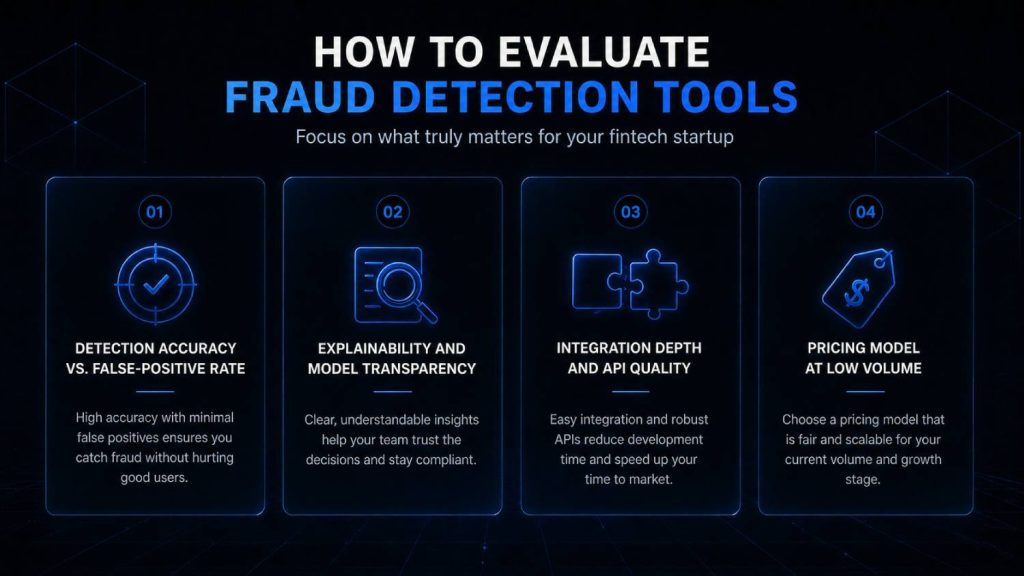
The vendor market for fraud detection is large, and most products claim to do everything. Four criteria actually separate tools that work from tools that look good in a demo.
Detection accuracy vs. false-positive rate
Every fraud tool surfaces a trade-off between catching bad actors and blocking good ones. A tool tuned aggressively will catch more fraud but flag more legitimate transactions. For a startup with thin margins and a fragile retention curve, a false-positive rate above 1-2% on new account signups can cause real churn damage before you even notice it in the data.
Ask vendors for their false-positive rates on a customer cohort similar to your own. Most will not volunteer this number. If they cannot provide it, that is meaningful information.
Explainability and model transparency
Black-box models cause operational problems. When a customer gets declined and calls support, your team needs to explain why. Regulators expect the same thing. Tools like Feedzai, which publicly describes its real-time TrustScore and explainable model approach, and SEON, which is known for transparent scoring, are worth prioritizing for teams that need to audit decisions.
Integration depth and API quality
Fraud tools that require a six-week professional services engagement to go live are not appropriate for a seed-stage team. Prioritize vendors with documented REST APIs, SDKs for your stack, and sandbox environments. This connects directly to the broader question of fintech API selection, which is covered in this comparison of top fintech APIs for SaaS products.
Pricing model at low volume
Several vendors in this space price per check or per event, which makes early-stage adoption viable. Others require minimum annual commitments that only make sense at Series B and beyond. Confirm whether pricing is consumption-based before investing in a proof of concept.
Onboarding Fraud: Tools for Identity Verification Risk
Onboarding is the highest-impact point in the fraud lifecycle. A synthetic identity that gets through verification will generate losses for months before it is detected. The tools below address document fraud, synthetic identity creation, and identity proofing at account creation.
Alloy
Alloy is an identity decisioning platform built specifically for fintechs. It connects to multiple data sources from a single API, letting teams build decision logic that pulls from credit bureaus, document verification, watchlists, and behavioral signals without stitching together individual vendors. For teams building lending, banking, or payments products, it covers KYC and fraud risk in one workflow layer.
The trade-off is configuration complexity. Alloy is powerful, but getting the decisioning logic right requires real attention. Teams that go live with default settings and do not iterate quickly find they are either letting too much through or creating unnecessary friction for legitimate users.
Resistant AI
Resistant AI specializes in document and synthetic onboarding fraud detection, a focus reflected consistently across independent practitioner writeups and fintech tool comparisons. It focuses on detecting manipulated or AI-generated documents that pass standard OCR checks but contain structural inconsistencies. As synthetic identity fraud using AI-generated documents becomes more common, this kind of deep document analysis becomes a meaningful layer to add on top of standard identity verification.
Onfido
Onfido, now part of Entrust, offers document and biometric verification with fraud signals layered in. It is widely used across European and North American fintechs for onboarding compliance and is particularly strong in regulated markets where document authenticity requirements are strict. It draws consistent coverage in Gartner Peer Insights reviews for identity verification and fraud detection.
Transaction Fraud: Real-Time Detection at the Payment Layer
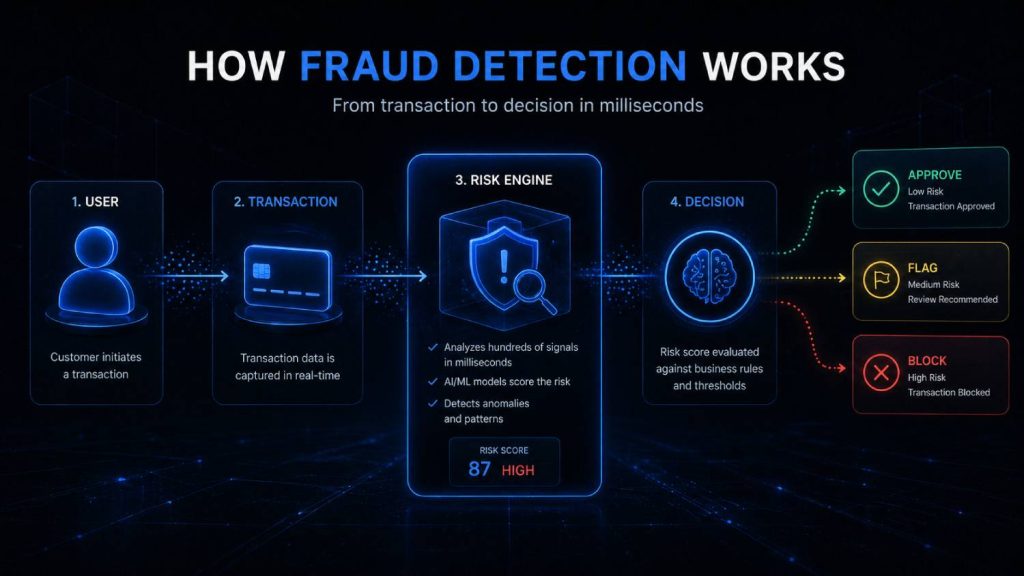
Transaction fraud detection requires low-latency scoring, ideally under 100ms, to avoid adding friction to the payment experience. The tools here are built to evaluate individual transactions against behavioral baselines and known fraud patterns in real time.
Feedzai
Feedzai is a machine learning platform built for financial crime risk. It is designed for banks and fintechs processing high transaction volumes and uses a real-time TrustScore with explainable models, meaning fraud analysts can see why a transaction was flagged rather than working from an opaque score. It is a heavier implementation, more appropriate for Series B companies and above than for seed-stage teams.
Stripe Radar
For startups already on Stripe, Radar is the default entry point for transaction fraud detection. It is built into the Stripe payment stack, requires no separate integration, and uses machine learning trained across Stripe’s full transaction network. Its false-positive management is handled through rules that non-technical users can configure. Radar is not the most sophisticated tool in this list, but it is the fastest path to baseline transaction fraud coverage for any company already using Stripe for payments. Pricing for Radar is listed on Stripe’s public pricing page as part of its standard product suite.
If you are evaluating the broader payment infrastructure question, the merchant of record comparison for B2B SaaS founders on FintechSpecs covers Stripe’s positioning relative to alternatives in more depth.
Riskified
Riskified offers a chargeback guarantee model, described on its product page, meaning it approves or declines transactions and absorbs the cost of fraud on approved orders. For e-commerce-adjacent fintechs, this pricing model aligns vendor and customer incentives more directly than a per-check model does. Its machine learning models are trained on a large network of merchant data, and it surfaces in practitioner discussions as a strong option for high-volume transaction decisioning.
Account Takeover: Behavioral Biometrics and Session Risk
Account takeover (ATO) fraud does not look like fraud at the authentication layer. The credentials are valid. The device may be recognized. Detection depends on behavioral signals that reveal something is wrong with how the session is being conducted.
BioCatch
Reviewed on Gartner Peer Insights for fraud detection and identity verification, BioCatch employs behavioral biometrics to analyze user interactions with digital interfaces. It tracks how a user moves through an application, keystroke dynamics, mouse behavior, touch pressure, and session timing, and compares it to that user’s baseline profile. It is particularly strong at detecting social engineering scenarios where the legitimate account holder is being manipulated by a fraudster in real time.
BioCatch is not typically the right fit for a pre-revenue company, but it becomes relevant for any fintech where account takeover losses are measurable.
Featurespace ARIC
Featurespace‘s ARIC platform uses self-learning behavioral analytics and deep learning to model individual user behavior over time. It builds a profile for each user and scores deviations from that profile in real time, which makes it effective at detecting ATO attempts that bypass static rule sets. It appears consistently across top fraud detection tool lists for fintechs and payment platforms, and its explainability features make it suitable for teams that need to document fraud decisions for compliance purposes.
Transaction Monitoring: AML and Ongoing Risk Surveillance
Transaction monitoring is distinct from real-time fraud detection. It looks backward and forward across customer transaction histories to identify patterns consistent with money laundering, structuring, or other financial crime. For any fintech operating as a money services business, a payment facilitator, or under a banking-as-a-service arrangement, ongoing transaction monitoring is a regulatory requirement, not a product feature.
Sardine
Sardine covers fraud, AML, and compliance in an integrated platform built specifically for fintechs. Multiple published guides list it as a strong choice for lifecycle fraud detection and AML in fintech contexts. It is one of the few tools on this list that addresses both the real-time fraud layer and the ongoing monitoring requirement in a single product, which reduces the integration burden for teams that would otherwise need to connect separate systems.
Its pricing model is consumption-based, which makes it accessible earlier in the growth curve than enterprise AML platforms.
ComplyAdvantage
ComplyAdvantage provides AML data and transaction monitoring with a focus on sanctions screening, PEP screening, and adverse media. It surfaces consistently in practitioner comparisons as a strong tool for fintechs that need to meet KYC and AML obligations without building a data infrastructure from scratch. It is particularly strong for teams operating across multiple jurisdictions where watchlist data varies by region.
Hawk:AI
Hawk:AI is an AI-powered AML and fraud detection platform that uses explainable AI to reduce alert volumes for compliance teams. High false-positive rates in AML monitoring are one of the most significant operational costs in financial crime compliance, and Hawk:AI specifically addresses this by using machine learning to suppress low-quality alerts while surfacing genuinely suspicious patterns. It appears in multiple top fraud detection software lists for 2026.
The False-Positive Problem Most Vendors Understate
Every tool in this list will generate false positives. Visibility into how many, and whether the tool gives you control over the threshold, is what separates manageable from costly.
False positives in onboarding mean real customers are being turned away. At a 2% false-positive rate on new signups, you are rejecting 20 legitimate customers for every 1,000 applications. If your product has a mobile-first, underserved user base where document quality varies or address history is thin, default thresholds trained on mainstream data may perform worse than that.
The best fraud detection tools for fintech startups are not the ones with the highest detection rates. They are the ones that let you tune thresholds, show you why each decision was made, and surface enough data to improve your rules over time. Transparent scoring tools like SEON and explainable model approaches like Feedzai’s TrustScore exist specifically because black-box decisions create operational and regulatory debt.
When evaluating any tool, ask the vendor to show you their false-positive performance on a user cohort that resembles yours, whether that is underbanked consumers, international users, or small business accounts. The answer will tell you more than any feature comparison.
How to Layer These Tools Without Over-Engineering Your Stack
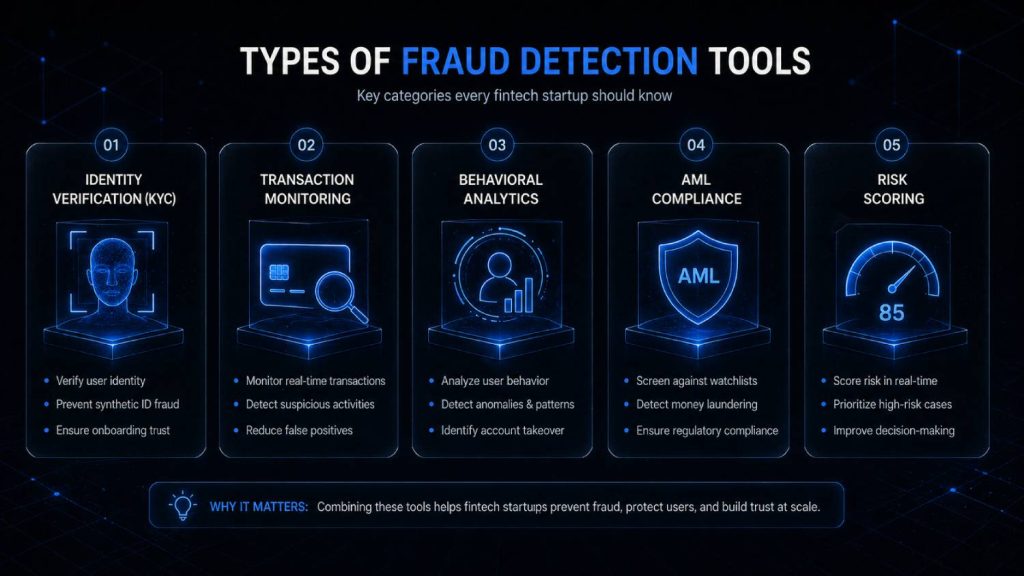
The instinct when evaluating fraud tooling is to stack as many layers as possible. That instinct is worth questioning. Every tool in your fraud stack adds latency, integration maintenance, and cost. More layers also mean more places where conflicting signals create confusion for your operations team.
A functional fraud stack for an early-stage fintech can start with three layers: identity verification at onboarding (Alloy, Onfido, or Resistant AI depending on your document risk profile), real-time transaction scoring (Stripe Radar if you are on Stripe, Sardine or Feedzai if you are not), and AML transaction monitoring (ComplyAdvantage or Sardine if you want a single-vendor approach).
Behavioral biometrics and advanced AML platforms make sense once you have measurable losses or a regulatory examination on the horizon. Adding them before that point creates overhead without proportionate risk reduction. The right build sequence depends on where your actual fraud losses are coming from, which means you need some instrumentation in place before you can make that call.
Frequently Asked Questions
What are the best fraud detection tools for fintech startups?
The strongest options depend on your threat type. For onboarding and identity fraud, Alloy, Onfido, and Resistant AI are widely used. For real-time transaction fraud, Stripe Radar works well for teams on Stripe, while Sardine and Feedzai are stronger for higher-volume or multi-processor setups. For AML and transaction monitoring, ComplyAdvantage, Sardine, and Hawk:AI cover the core regulatory requirements. Matching the tool to your specific fraud surface matters more than picking the most-featured platform.
What fraud prevention software should fintech companies use?
Fintechs at the seed to Series A stage typically need identity verification with fraud signals at onboarding and basic transaction scoring at the payment layer. Alloy handles the decisioning layer across multiple data sources. Sardine covers both fraud and AML in one integration. For Series B and beyond, adding behavioral biometrics through BioCatch or Featurespace’s ARIC platform addresses account takeover risk that simpler tools miss. The priority is coverage of your actual threat surface, not feature count.
How do fintech startups detect fraud in real time?
Real-time fraud detection works by scoring each transaction or user action against a model trained on known fraud patterns and individual behavioral baselines. Platforms like Feedzai assign a real-time TrustScore to each event. Stripe Radar uses machine learning across its transaction network to score card payments at submission. Scoring needs to happen within the transaction flow, under 100 milliseconds, so the result can inform an approve or decline decision before the user sees a response.
What are transaction monitoring tools in fintech?
Transaction monitoring tools track customer transaction behavior over time and flag patterns consistent with financial crime, including structuring, layering, and rapid fund movement. They are required for any fintech operating under a money services business license or through a banking-as-a-service arrangement. Tools like ComplyAdvantage, Hawk:AI, and Sardine automate this monitoring and generate alerts for compliance review. Managing false-positive alert volume is one of the more demanding operational challenges in this category, since high alert rates can overwhelm small compliance teams without proper tuning.
What is the difference between fraud detection and AML monitoring?
Fraud detection focuses on preventing direct financial loss from specific events, such as a stolen card being used or a synthetic identity opening an account. AML monitoring looks for patterns across transaction history that indicate money laundering or terrorist financing. They use overlapping data but serve different purposes and often different regulators. Some platforms like Sardine address both in one product. Others specialize in one or the other, which affects how you structure your vendor stack and compliance reporting.
How do identity verification risk tools work?
Identity verification risk tools check whether a person claiming an identity actually owns it, and whether the documents or data they provide are authentic. They pull from multiple data sources including credit bureau records, document databases, biometric matching, and behavioral signals. Alloy aggregates these sources through a single API and applies decision logic to produce a risk score. Onfido focuses on document and biometric verification. Resistant AI specializes in detecting AI-generated or manipulated documents that pass standard verification checks.
When should a fintech startup invest in fraud tooling?
Before the first public launch, not after. Fraud patterns arrive with the first users, particularly if you have any marketing spend driving signups or if your product has a payments component. Waiting until volume justifies the investment means your earliest transaction data is already contaminated with fraud signals you did not capture. Most consumption-based pricing models are affordable at low volume. The operational cost of retrofitting controls into an established stack, including reprocessing historical data and reclearing accounts, is consistently higher than implementing coverage early.
What is the false-positive rate problem in fraud detection?
A false positive occurs when a legitimate user or transaction is flagged as fraudulent. Every fraud detection tool produces some number of these. At scale, even a 1% false-positive rate means thousands of legitimate customers being blocked or declined. The operational impact includes customer support volume, churn from friction, and potential discrimination concerns if the false-positive rate is higher for specific demographic groups. Tools with explainable scoring and configurable thresholds, such as SEON and Feedzai, give teams the visibility to identify and reduce false positives over time.
What to Take Away From This
The fraud tooling market is large, and most vendors solve real problems. The harder question is which problems are yours right now, and which ones will become yours at your next growth inflection. Onboarding fraud and transaction fraud are present from day one. AML monitoring becomes a compliance requirement as soon as you operate under a license. Account takeover risk scales with your user base and the value of accounts.
The cost structure of this category has shifted toward consumption-based pricing at the entry level, which removes the “we’ll handle it later” logic. The operational cost of retroactively cleaning up fraud-contaminated data or failing a first compliance examination is not abstract. It shows up in engineering sprints, legal fees, and regulatory remediation timelines that compress your runway faster than a missed revenue target.
Choosing three tools that fit your current threat surface and can grow with your stack is more useful than picking the most feature-complete platform at a price tier you cannot support. Start with your highest-probability fraud vector, which is usually onboarding, and work outward from there.