
- Fintech gross margins often look worse than pure SaaS not because the business is broken, but because a dozen cost categories hide in plain sight across compliance, payments, fraud, and support.
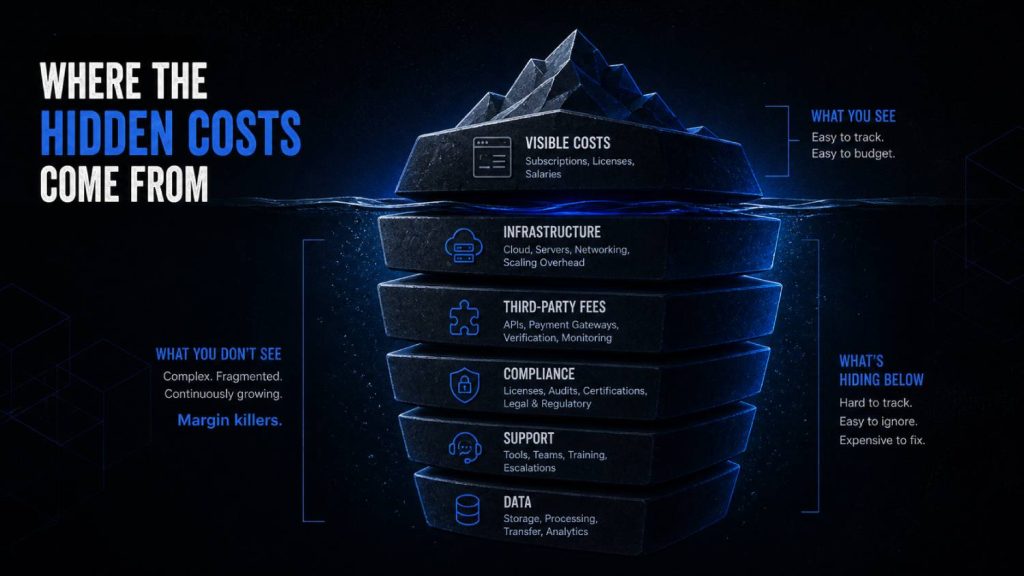
- Payment processing, chargeback losses, and bank partner fees are just the visible surface. The real damage comes from manual review queues, vendor overlap, and regulatory overhead that scales with revenue rather than with engineering headcount.
- Most founders benchmark against SaaS margin targets without accounting for the variable cost structure built into fintech. The gap is structural, not a sign of operational failure.
- Understanding which cost buckets are fixed, which are variable, and which are avoidable is the difference between a margin problem and a pricing problem.
There is a number most fintech founders carry around in their heads: 70 to 80 percent gross margin, the SaaS benchmark that investors expect and pitch decks promise. It sounds reasonable. Software scales. Infrastructure costs plateau. But fintech is not software with a payments tab bolted on. It is a regulated financial service wrapped in software, and the cost structure reflects that whether or not the P&L is built to show it.
The hidden costs killing fintech SaaS margins are not exotic. They are structural, and they live in cost categories that standard financial templates were never designed to capture. The companies that hit that 70 percent target tend to be pure software businesses where the product moves data, not money. Once money moves, the cost curve changes shape entirely. Interchange, compliance headcount, fraud losses, chargeback reserves, bank partner minimums: none of these behave like AWS bills. They grow with revenue, spike with product changes, and rarely compress the way cloud costs do when you renegotiate a contract.
What follows is a breakdown of the fifteen cost categories that most commonly distort fintech margins, organized by how they appear (or fail to appear) in standard financial reporting.
Payment Infrastructure Costs That Are Hiding in Plain Sight
1. Blended Payment Processing Fees
Most companies calculate payment processing costs as a single blended rate. That is the wrong unit of analysis. Stripe’s standard pricing is 2.9 percent plus 30 cents per transaction for domestic cards, but the effective rate on a real transaction mix is almost always higher once you layer in international cards, corporate cards, currency conversion, and dispute fees.
A customer paying with a premium rewards card costs more to process than one paying with a debit card. If your product attracts business buyers or international users, your effective processing rate can run noticeably above what the base rate suggests. This gap rarely shows up as a line item. It shows up as margin erosion that looks like cost of goods sold bloat.
2. Cross-Border and Currency Conversion Markups
International transaction fees and currency conversion markups compound fast. According to PYMNTS reporting, 68 percent of small businesses report that cross-border payment costs are higher than expected. The markup is not always visible as a fee. It can live in the spread between mid-market exchange rates and what the processor actually settles at.
For fintech companies serving global users, this cost can represent a meaningful drag on net revenue per transaction. If your pricing is in USD but your payment processor is converting at an unfavorable rate before settlement, you may be absorbing 2 to 3 percent in hidden spread on every international payment.
3. Merchant of Record Complexity
Companies that use a merchant of record for tax and billing compliance often pay a premium for that service that exceeds what a standard payment processor charges. The tradeoff is real: the MoR handles VAT, sales tax, and refund liability. But the fee structure is frequently opaque, and the total cost of using a MoR versus handling tax compliance in-house is not always modeled before the contract is signed.

Fraud and Chargeback Costs Fintech Companies Underestimate
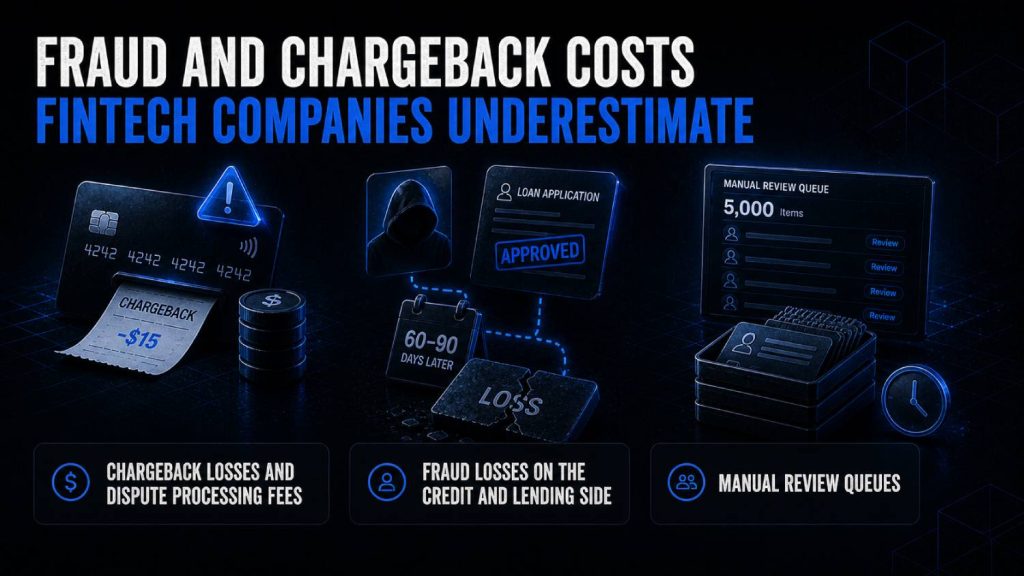
4. Chargeback Losses and Dispute Processing Fees
Chargebacks are one of the most underreported margin killers in fintech. The direct loss is only part of the problem. Each dispute carries a processing fee (Stripe charges $15 per dispute, refunded only if you win), and a chargeback rate above 1 percent triggers card network monitoring programs that add another layer of fees and operational burden.
For lending products, subscription billing platforms, and any business with trial-to-paid flows, chargeback rates tend to be structurally higher. The fraud is often first-party: a customer claims they did not authorize a charge because they forgot to cancel, or because the product did not meet expectations. Neither Visa nor Mastercard cares about that distinction when they are calculating your ratio.
5. Fraud Losses on the Credit and Lending Side
Payment fraud is visible. Credit fraud is slower and more expensive. In lending and BNPL products, fraudulent applications that pass initial underwriting may not show up as losses for 60 to 90 days. By then, the customer has taken the funds and disappeared, the loan is written off, and the loss hits a period of P&L that looks unrelated to the acquisition decisions that caused it.
Investing in fraud detection and risk tooling built for fintech typically costs less than absorbing undetected fraud losses at scale. But the tooling itself is a margin cost, and it needs to be modeled as such from the start.
6. Manual Review Queues
Fraud tooling flags transactions. Humans resolve the flags. This queue is one of the largest hidden labor costs in fintech operations, and it scales with transaction volume rather than with product sophistication. A company processing a million transactions a month with a 0.5 percent flag rate has five thousand items in the manual review queue. Those items need to be resolved by someone with access to the right data and enough context to make a correct decision.
Fraud analyst compensation varies by market and experience level, but published industry ranges consistently place trained analysts in the $20 to $30 per hour range for operational roles. A queue that size can consume hundreds of thousands of dollars a year that never appears in cost of goods sold because it lives in a generic operations headcount line.
Compliance Costs Fintech Founders Do Not Budget For Early Enough
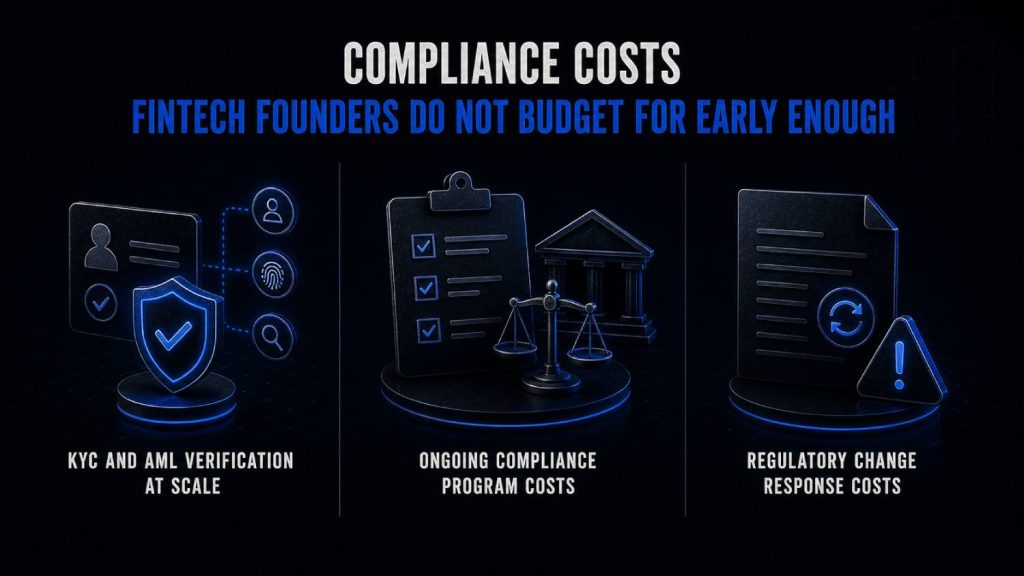
7. KYC and AML Verification at Scale
Identity verification and anti-money laundering checks are not one-time setup costs. Every new user verification is a transaction with a third-party vendor, and pricing scales with volume. Stripe Identity, Jumio, Persona, and similar platforms charge per verification or per check. When growth accelerates, verification costs accelerate with it.
This cost also has a failure mode: failed verifications that require re-checks or manual review escalation. A 10 percent re-check rate on a high-volume user base adds meaningfully to the per-customer acquisition cost without appearing in any marketing attribution report.
8. Ongoing Compliance Program Costs
Hiring a Chief Compliance Officer is the visible cost. The less visible costs are the audit fees, the legal reviews triggered by every new product feature, the state money transmitter license renewals, and the monitoring tools required to demonstrate ongoing BSA/AML compliance. A fintech operating across multiple states can carry six-figure annual compliance overhead before it has written a single check to a regulator.
The compliance cost curve in fintech does not compress with scale the way software hosting does. It often inflects upward at key product milestones: launching in a new state, adding a lending product, crossing transaction volume thresholds that trigger enhanced due diligence requirements.
9. Regulatory Change Response Costs
Regulations change. Responding to those changes costs engineering time, legal time, and sometimes a full product cycle. When the CFPB updates open banking rules, or when a card network changes its chargeback dispute timeline, someone has to interpret the rule, translate it into product requirements, and ship the change before the compliance deadline. That work is rarely budgeted in advance and almost never appears in the product roadmap cost model.
Bank Partner and Infrastructure Costs That Scale Badly
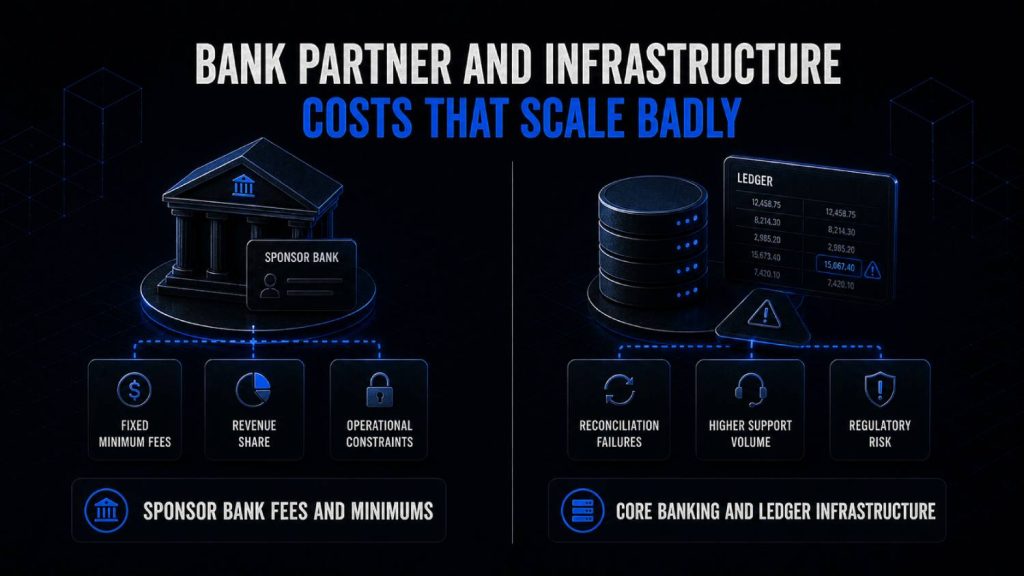
10. Sponsor Bank Fees and Minimums
Fintech companies that issue cards or hold deposits typically need a sponsor bank relationship. Those relationships come with fixed minimum fees, revenue share arrangements, and operational constraints that can significantly affect unit economics. Early-stage companies often accept unfavorable terms because they have limited negotiating position. Those terms can persist well past the point where renegotiation would be warranted, simply because switching costs are high.
Reviewing the banking-as-a-service platforms available to fintech startups shows meaningful variation in fee structures and contractual flexibility. The platform that looks cheapest at the proposal stage may have usage-based fees or compliance pass-through costs that change the math at scale.
11. Core Banking and Ledger Infrastructure
Running a ledger is expensive. Whether a company builds on top of a Banking-as-a-Service platform or operates its own core infrastructure, the cost of maintaining accurate, real-time financial records at scale is substantial. Reconciliation failures generate manual work. Ledger errors generate support volume, chargeback exposure, and regulatory risk simultaneously.
Companies that underinvest in ledger infrastructure early pay for it in operational overhead later, often in the form of an entire reconciliation team that would not exist if the underlying system were more reliable.
Vendor Bloat and API Cost Creep
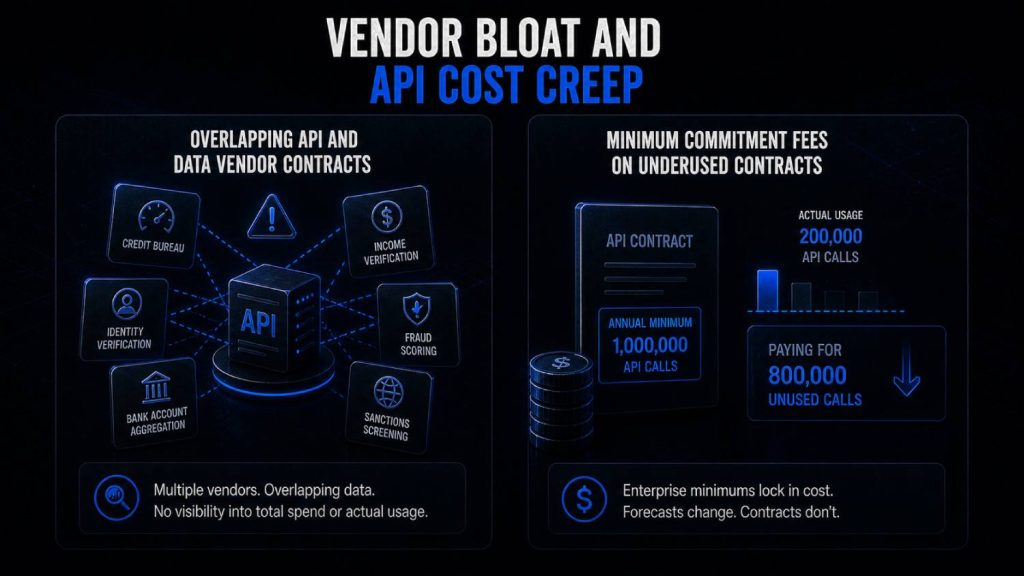
12. Overlapping API and Data Vendor Contracts
Growth-stage fintech companies accumulate API vendors fast. Credit bureaus, identity verification, bank account aggregation, income verification, fraud scoring, sanctions screening: each solves a real problem, and each carries a per-call or per-user fee. The problem is that these contracts are often signed independently by different teams, with different renewal dates, and with no central view of total vendor spend against actual usage.
Vendor audits at companies that have not done one in 18 months routinely surface overlapping contracts where two services are providing similar data for the same use case. Understanding which fintech APIs actually serve SaaS infrastructure needs at different stages of growth can help teams avoid signing contracts they will eventually duplicate.
13. Minimum Commitment Fees on Underused Contracts
Enterprise API contracts frequently include annual minimums. A company that signed a contract expecting one million API calls a month and is running at 200,000 calls is paying for 800,000 calls it is not using. This is not just a vendor selection problem. It reflects a forecasting problem: the usage projections that justified the enterprise tier did not materialize, and no one revisited the contract when the numbers diverged.
Customer Support and Operational Costs That Do Not Show Up in Engineering
14. Compliance-Driven Support Volume
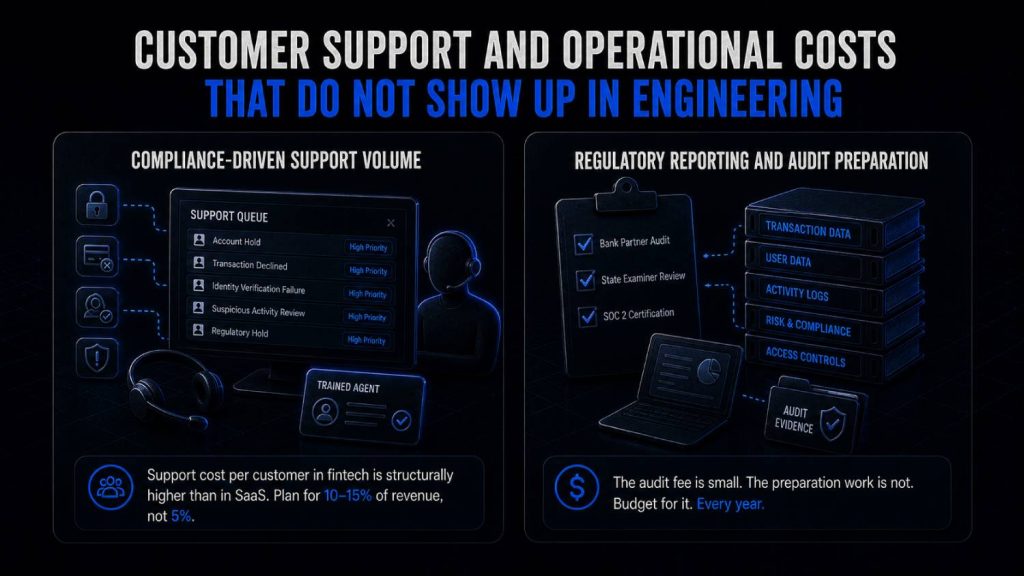
Financial products generate a category of support tickets that software products do not: account holds, transaction declines, identity verification failures, suspicious activity reviews, and regulatory holds. These tickets are not resolvable with a FAQ or an AI chatbot. They require a trained agent with access to the right internal tools, and they often require decisions that expose the company to liability if made incorrectly.
Support cost per customer in fintech is structurally higher than in SaaS. A company that models customer support as 5 percent of revenue based on SaaS benchmarks may find it running at 10 to 15 percent once the compliance-related ticket category is properly attributed.
15. Regulatory Reporting and Audit Preparation
Preparing for a bank partner audit, a state examiner review, or an annual SOC 2 certification requires pulling large amounts of data into specific formats, demonstrating controls that may not have been systematically documented, and often hiring temporary staff or outside counsel to cover gaps. This cost hits annually or on a cycle that does not match quarterly budgeting rhythms, which is why it routinely lands as an unplanned expense rather than a modeled one.
The cost of the audit itself is smaller than the cost of the work that makes the audit possible. That preparation cost is a legitimate fintech operating expense that belongs in any honest model of what the business actually costs to run.
Frequently Asked Questions About Fintech SaaS Margin Costs
Why are fintech gross margins lower than pure SaaS margins?
Fintech products move money, which adds variable costs that software products do not carry: payment processing fees starting at 2.9% plus 30 cents per transaction for domestic cards, fraud losses, compliance overhead, and bank partner fees all scale with revenue rather than compressing as the business grows. Pure SaaS gross margins reflect the cost of hosting and supporting software. Fintech gross margins reflect all of that plus the cost of operating inside the financial system, which is structurally more expensive.
What are the biggest hidden costs hurting fintech SaaS margins?
The costs that most commonly go unmodeled are the ones driving the hidden costs killing fintech SaaS margins: chargeback losses and dispute fees (including Stripe’s $15 per dispute fee), manual fraud review labor, KYC and AML verification costs at scale, sponsor bank minimums, overlapping API vendor contracts, and compliance-driven customer support volume that can run 10 to 15 percent of revenue versus the 5 percent SaaS benchmark. None of these appear as obvious line items in standard software P&L templates, which is why they tend to surface as margin surprises rather than planned cost centers.
How do compliance costs scale in fintech?
Unlike cloud infrastructure, compliance costs in fintech do not follow a simple scale curve. They tend to step up at specific product and growth milestones: launching in new states, adding lending or deposit products, crossing transaction volume thresholds that trigger enhanced regulatory scrutiny, or responding to rule changes from regulators or card networks. Each milestone can add fixed compliance overhead that does not flex back down if growth slows.
What is the real cost of chargebacks for fintech companies?
The direct loss from a chargeback includes the transaction amount plus a dispute processing fee, which on Stripe’s public pricing is $15 per dispute. But the deeper cost is operational: a high chargeback rate triggers card network monitoring programs at the 1 percent threshold, adds compliance risk, and increases manual review requirements. For subscription and lending products where first-party fraud is common, chargeback rates tend to be structurally elevated compared to standard e-commerce.
How does vendor bloat affect fintech operating costs?
Fintech companies typically accumulate API and data vendor contracts across multiple teams, each solving a specific problem independently. Without centralized vendor oversight, companies end up paying for overlapping services, underutilized minimum commitments, and contracts that were signed for usage projections that never materialized, such as paying for one million API calls a month while running at 200,000. A periodic vendor audit against actual API call volumes is one of the most direct ways to identify recoverable margin, and it is often skipped entirely in companies under 200 employees.
Why is customer support more expensive for fintech than for SaaS companies?
Financial products generate support tickets that require trained agents making consequential decisions: account holds, failed verifications, disputed transactions, and regulatory freezes. These cannot be resolved by self-service tools or general-purpose support agents. The result is a higher cost per ticket and a higher ticket rate per customer than most SaaS benchmarks account for. Companies that model support costs using SaaS industry averages routinely underprovision their support operations and absorb the cost as unplanned headcount growth.
The Margin Model Most Fintech Companies Are Still Using Is Wrong
The root problem is not any single cost category. It is the model itself. Most fintech companies build their financial projections on SaaS templates because that is what founders, investors, and finance teams know how to use. Those templates assume that the primary variable costs are cloud infrastructure and support headcount. They do not have rows for chargeback reserves, KYC re-check rates, sponsor bank minimums, or manual fraud review hours. So those costs get miscategorized, spread across headcount lines, or simply absorbed as margin compression with no clear explanation.
The companies that manage fintech margins well are not necessarily spending less on compliance or fraud. They are spending intentionally, with a model that treats each of these cost categories as a first-class line item with a driver, a benchmark, and an owner. That discipline changes the conversation from “why are our margins lower than our SaaS comps” to “which of these costs are we managing well and which are running ahead of plan.”
The fifteen categories above are not exhaustive. But they cover the ground where most of the unplanned spending lives. A finance team that can put a number against each one, even a rough one, is working from a more accurate map than the majority of fintech operators are using today.