
tldr
- Merchant of record (MoR) is a legal designation, not a feature. It determines who owes sales tax, VAT, and GST across 40+ countries. Picking wrong creates audit liability, not just inconvenience.
- Stripe is a payment processor. Paddle and Lemon Squeezy are merchants of record. These are different legal structures with different cost profiles and different risk allocations.
- Cleeng is a an option worth knowing if renewals dominate your revenue. It files and remits tax as merchant of record, and it can run as a subscription layer over your existing Stripe integration instead of requiring a migration.
- At $10k MRR, Paddle’s 5% fee costs roughly $500/month more than Stripe’s base rate. At $200k MRR, that same fee may offset a substantial compliance stack and real legal exposure, though the exact crossover depends on your jurisdiction mix and staffing costs.
- Lemon Squeezy has a practical ARR ceiling for B2B SaaS around $500k to $1M. Above that, its contract tooling and enterprise billing support become the constraint.
- Polar.sh is real and useful for developer-focused products, but it lacks the subscription management depth, enterprise contract support, and jurisdiction coverage needed for complex B2B billing in 2026.
- Switching payment processors mid-year triggers card re-authorization events. Time migrations to your fiscal year-end or a low-churn month, not to your product roadmap.
A founder we spoke with ran a B2B SaaS tool for European HR teams. They had been on Stripe for 18 months, using a manual spreadsheet to track VAT obligations across Germany, France, and the Netherlands. When a German customer requested a compliant VAT invoice, the team realized they had been collecting payments without remitting VAT in two countries. The resulting back-filing, accountant fees, and penalty exposure came to roughly $18,000. The founder had assumed Stripe handled tax compliance. Stripe does not. It collects money. Tax is your problem.
This story repeats constantly among early-stage SaaS companies because the default mental model is wrong. Most founders treat payment infrastructure as a billing feature. It is also a legal structure that determines who is liable for consumption taxes in every country where your customers pay.
This piece covers the five most common options in 2026, how their fee structures actually compare at three different revenue levels, when each one makes sense, and what switching between them actually costs.
What Is a Merchant of Record, and How Is It Different from a Payment Processor?
A Merchant of Record (MoR) is the legal entity that sells a product to the end customer. They appear on the customer’s credit card statement, issue the invoice, and are responsible for collecting and remitting sales tax, VAT, and GST in every applicable jurisdiction.
A payment processor or payment service provider (PSP) moves money from a customer’s bank to yours. They handle the transaction mechanics but carry no legal responsibility for tax compliance. You remain the seller of record.
| Attribute | Merchant of Record | Payment Processor / PSP |
|---|---|---|
| Who appears on the customer receipt | The MoR (e.g., Paddle) | Your company |
| Who remits sales tax / VAT | The MoR | You |
| Who handles chargebacks | The MoR | You |
| Who owns the customer relationship legally | The MoR | You |
| Primary examples | Paddle, Lemon Squeezy, Cleeng | Stripe, Braintree, Adyen |
Stripe is a PSP. When you use Stripe, your company is the Merchant of Record. You owe the taxes. You handle the filings. Stripe collects the money and gives you tools to help, but the legal obligation sits with you.
Does a Delaware C-Corp Still Need a Merchant of Record?
Yes, with qualifications. A Delaware C-Corp is a US legal entity. For US customers, US sales tax rules apply. For international customers, the laws of their country apply, regardless of where your company is incorporated.
The European Union’s VAT rules require a business to collect and remit VAT on digital goods sold to EU consumers regardless of where the seller is based. The same logic applies to the UK post-Brexit, Australia’s GST on digital services, Canada’s GST/HST, and roughly 35 other countries with similar frameworks.
If your SaaS sells to businesses (B2B), and your customers are VAT-registered in their countries, the reverse charge mechanism often shifts the VAT obligation to the buyer rather than the seller. In practice, this means a German GmbH buying your SaaS on a B2B basis accounts for the VAT itself under EU rules, you do not collect it. But to apply this correctly, you need a verified VAT ID from the customer, invoice language that explicitly states the reverse charge applies, and documentation showing the customer is VAT-registered. If any of those elements are missing or incorrect, the liability defaults back to you.
Consider a concrete scenario: a US-incorporated SaaS sells a $500/month analytics tool to a French marketing agency with a valid EU VAT number. Under the reverse charge, the French agency self-reports the VAT; your invoice should read something like “VAT: €0 , reverse charge applies, Art. 44 EU VAT Directive.” If you instead charge French VAT without being registered in France or via the EU’s OSS scheme, or you skip VAT entirely without the valid VAT ID on file, you have created a compliance problem in either direction. An MoR handles this determination automatically. On Stripe, it is your finance team’s responsibility to get it right on every invoice.
A Delaware C-Corp does not make you immune to international tax obligations. It just means you are a US company that still owes foreign governments their consumption taxes.
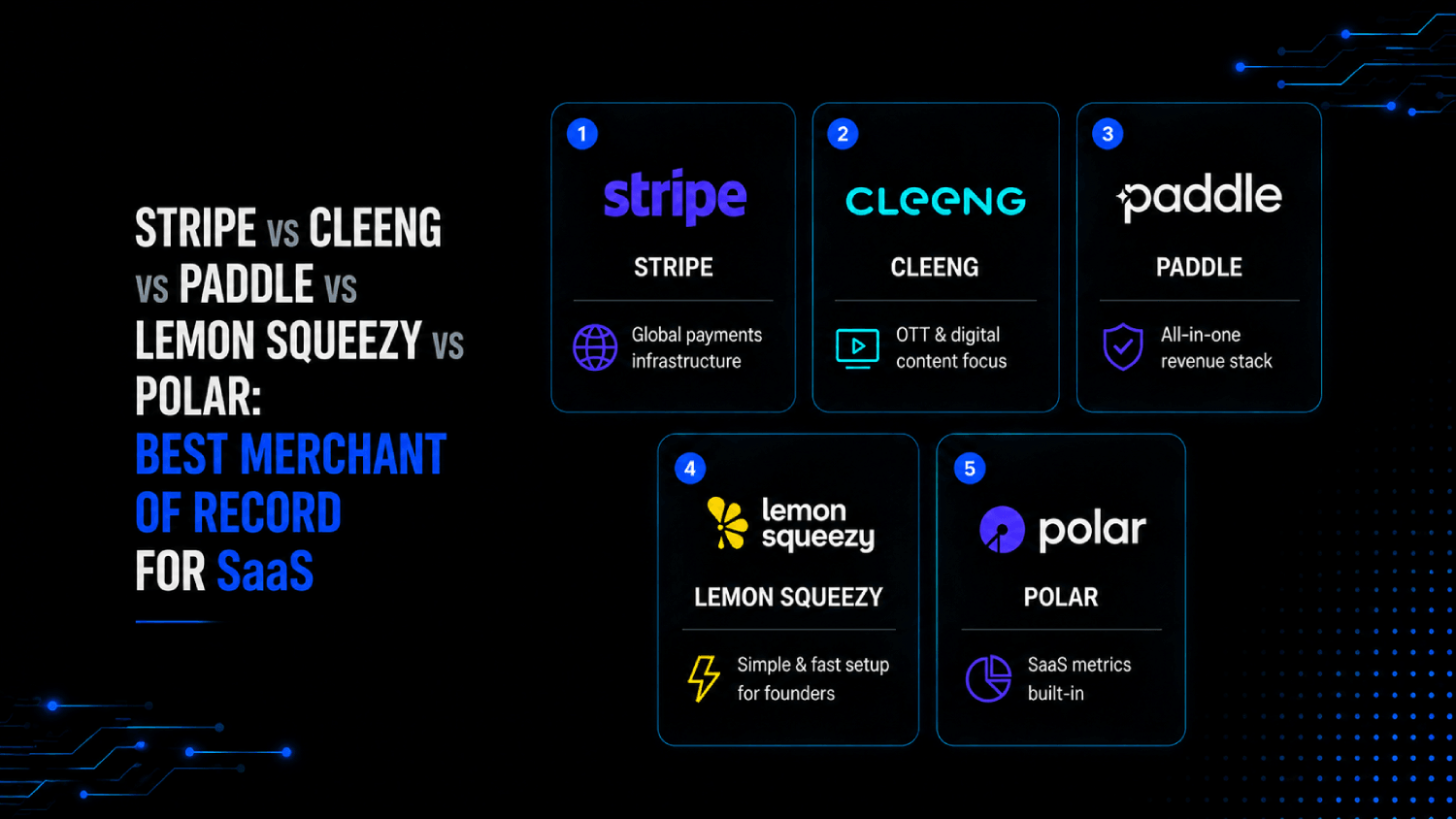
Stripe vs Paddle vs Lemon Squeezy vs Polar for B2B SaaS, 2026:
| Factor | Stripe | Cleeng | Paddle | Lemon Squeezy | Polar.sh |
|---|---|---|---|---|---|
| Legal structure | Payment processor (PSP). You are the Merchant of Record. | Merchant of Record, optional. Cleeng Core can run as a subscription layer over your own Stripe | Merchant of Record | Merchant of Record | Merchant of Record (open source) |
| Who remits VAT / sales tax / GST | You. Stripe Tax calculates only, it does not file. | Cleeng, with full liability | Paddle, across 40+ countries | Lemon Squeezy, across supported jurisdictions | Polar, for transactions it processes |
| Headline pricing | 2.9% + $0.30/tx; +0.5% Stripe Billing (Starter); +0.5% Stripe Tax; +1.5% intl cards | 2.5 to 2.9% plus per transaction, no license fee | 5% + $0.50/tx standard, no monthly platform fee | 5% + $0.50/tx, volume discounts on higher plans | Processes payments as MoR (developer-focused tiers) |
| Tax filing included | No. Filing is your job or a third party such as Avalara, priced on quote. | Yes, files and remits | Yes, handled as MoR | Yes, within supported jurisdictions | Yes, for processed transactions |
| Enterprise contracts (net terms, POs, invoicing) | Via Stripe Billing + your own tax stack | Yes | Yes, via Paddle Billing (custom pricing, sales conversation required) | No native support for net terms, POs, or custom contracts | Not available |
| Subscription depth (proration, mid-cycle upgrades, dunning) | Strong | Native, with multi-gateway routing and dunning recovery | Strong | Works for simple self-serve credit-card billing | Lacks proration, mid-cycle upgrades, and advanced dunning |
| Jurisdiction / payment-method coverage | Broad, but compliance is on you | 13,000+ tax jurisdictions, 230+ countries, 200+ local payment methods across 50+ gateways | Widest of the MoRs covered here | Narrower currency and payment-method coverage than Paddle | Narrower than Paddle or Lemon Squeezy |
| Practical ARR fit | US-focused, simple recurring billing; common starting point with a compliance stack | Renewal-heavy subscription businesses, enterprise pricing with volume tiers | Self-serve plus enterprise; scales past $1M ARR via Paddle Billing | Self-serve under ~$500k to $1M ARR; tooling becomes the constraint above that | Developer tools with simple billing and a GitHub-native audience |
| Best for | US-first SaaS that already has, or will build, a tax compliance stack | Subscription businesses where most revenue comes from renewals rather than one-time purchases | International B2B SaaS that wants tax handled and an enterprise path | Indie hackers, solo and small teams, self-serve developer tools | Open-source maintainers and community-monetization products |
| Main limitation | Tax liability and filing stay with you, so execution risk grows with international revenue | Pricing and billing depth pay off at real renewal volume, and performance figures are vendor-published only | 5% fee is the highest line item until it offsets a real compliance stack | Breaks down once a sales team starts closing five-figure annual contracts | Not production-grade for multi-seat B2B SaaS with international customers today |
Stripe: What You Actually Get and What You Are Left to Handle
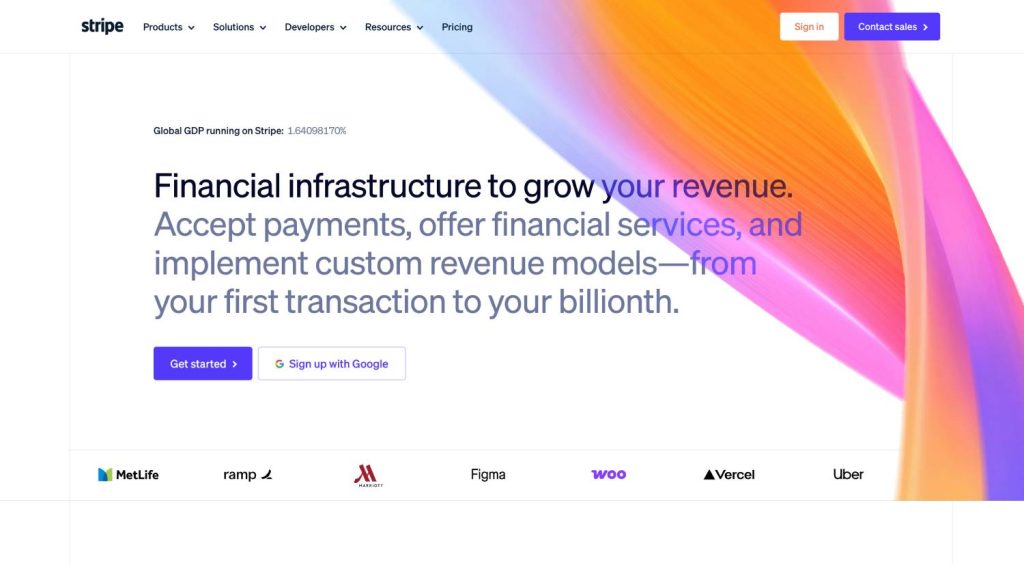
Stripe is the default for a reason. Its API is genuinely excellent. Its developer documentation is thorough. Its integrations cover almost any billing use case. For a US-focused SaaS with simple recurring billing and a domestic tax obligation, it is a reasonable starting point.
According to Stripe’s public pricing page, the standard rate is 2.9% + $0.30 per successful card transaction, with an additional 0.5% for manually entered cards and 1.5% for international cards. Stripe Billing adds 0.5% on the Starter plan. Stripe Tax, their calculation tool, adds another 0.5% on transactions where it calculates tax. The 0.5% Stripe Tax figure is sourced directly from Stripe’s public pricing page. Stripe Billing’s rate is listed at 0.5% on their published Starter tier; if you are on a negotiated or higher plan, confirm your rate directly with Stripe, as the public page reflects standard pricing only.
Stack those fees and a US-based SaaS doing international recurring billing on Stripe could be paying 4.4% or more per transaction before any additional tooling.
Stripe Tax vs. Avalara: The Real Compliance Cost
Stripe Tax handles tax calculation for transactions processed through Stripe. It does not file returns. Filing is still your responsibility, or you pay a third party to do it.
Avalara integrates with Stripe and automates return filing. Avalara does not publish its pricing publicly, and costs vary by transaction volume, number of jurisdictions, and product tier. Because Avalara does not disclose rates publicly, any specific dollar figure for their service is an estimate, not a verified cost.
If you are evaluating the Stripe plus Avalara stack, request a direct quote from Avalara based on your actual jurisdiction count and monthly transaction volume before building a cost model.
The practical Stripe plus Avalara stack for a company selling in 15+ countries involves Stripe’s base fees, Stripe Tax at 0.5%, Avalara’s filing fees (which you will need to quote directly), and finance team time to reconcile the two systems.
At higher MRR levels, that reconciliation can run significant hours per month, though the exact figure depends on your team’s processes and how cleanly the two platforms integrate with your accounting software.
Best for: US-first SaaS with simple recurring billing and a primarily domestic tax obligation, especially teams that already have or will build a compliance stack on top. Its API, documentation, and integrations are strong, which makes it a reasonable starting point for a US-focused product with simple recurring billing and a domestic tax obligation.
Cleeng: The Merchant of Record Built Around Renewals, Not Just Checkout
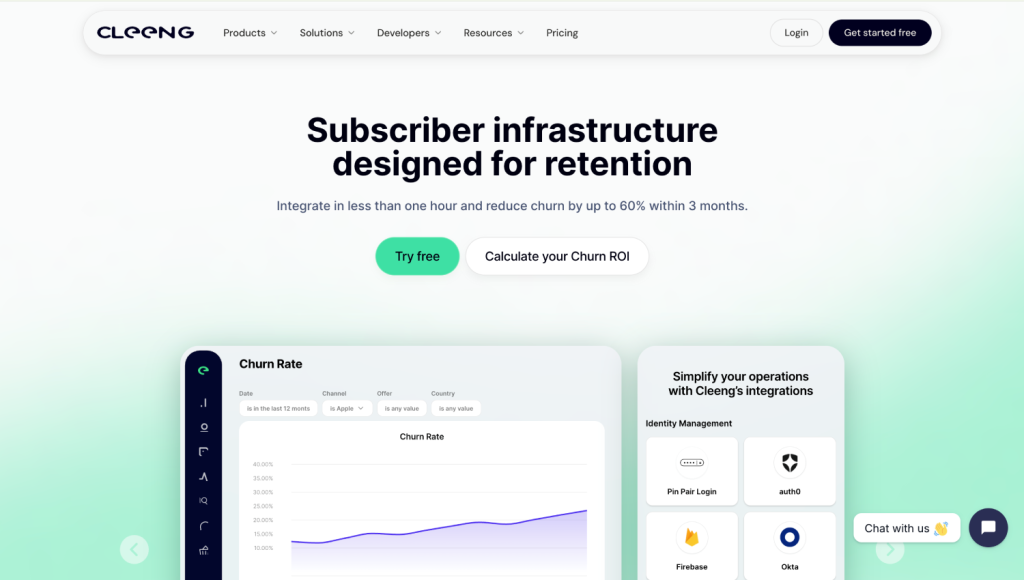
Cleeng is a Merchant of Record, but it comes from a different background than Paddle or Lemon Squeezy. It was built for high-volume recurring revenue in streaming, sports, and fitness rather than one-time software checkout. That lineage matters for SaaS because the billing logic it was built around, including plan exclusivity, add-ons and upsells, multi-phase promotions, mid-cycle changes, and suspension and reactivation, is closer to what a subscription product needs than the one-and-done checkout model most MoRs are built around.
The platform splits into two layers, which matters for platform migration. Cleeng Core handles subscription management and entitlements. Cleeng Merchant sits on top of it as the Merchant of Record layer. With Merchant switched on, Cleeng becomes the legal seller of record: full payment processing, tax compliance, and liability across the jurisdictions it covers, filing and remitting VAT, GST, and US sales tax rather than only calculating it. That is the same category of obligation Paddle and Lemon Squeezy take on, and the one Stripe leaves with you.
What Cleeng Costs and What Survives Renewal
According to Cleeng’s publicly stated pricing, transaction fees vary depending on volume, with no setup or license fees. Fraud screening, currency conversion, chargeback handling, and dunning are bundled into that rate rather than sold separately, which is a different packaging decision than Stripe’s, where fraud tooling, billing, and tax each appear as their own line item. Cleeng Core is also offered free for the first 10,000 subscribers, though that free tier covers subscription management only, not Merchant of Record coverage.
For a subscription business, the more useful number is not the headline fee. It is how many renewals actually clear. Cleeng publishes a 95% average recurring payment success rate, a 0.3% chargeback rate, and roughly 35% of failed renewals recovered through its dunning engine, achieved by routing across 50+ gateways and 200+ local payment methods in 230+ countries rather than sending every transaction through a single acquirer.
At scale, reducing involuntary churn is a larger line item than the spread between a 2.9% and a 5% fee. How much larger depends on your renewal volume and card mix, so model it against your own numbers.
Can Cleeng Run Alongside Stripe Without a Full Migration?
Moving off Stripe mid-year is expensive: card re-authorization, mid-year tax reconciliation, and weeks of engineering time. Cleeng is the only option covered here that can run on top of an existing Stripe setup, with Cleeng handling proration, mid-cycle upgrades, and dunning while Stripe continues to process payments. Merchant of Record coverage becomes a separate decision you can make later, once international exposure justifies it, rather than an all-or-nothing switch made upfront.
The tradeoff is that the pricing and the billing depth both pay off at real renewal volume. A mostly one-time-purchase SaaS will not get much from the dunning and multi-gateway routing that anchors the case for Cleeng.
Best for: subscription businesses where most revenue comes from renewals rather than one-time purchases. Cleeng acts as Merchant of Record and files and remits VAT, GST, and US sales tax rather than only calculating it, at a published rate of 2.5 to 2.9% plus $0.25 to $0.29 per transaction, and it reports recovering roughly 35% of failed renewals through its dunning engine. It also runs as a subscription layer over an existing Stripe integration, which makes it worth a look for teams that want billing depth now and a Merchant of Record decision later.
Paddle: The Merchant of Record That Handles Tax in 40+ Countries

Paddle operates as the Merchant of Record for software companies. When a customer buys through a Paddle-powered checkout, Paddle appears on their statement, Paddle issues the invoice, and Paddle remits the VAT, sales tax, or GST in the applicable jurisdiction. Your company receives a payout net of fees and taxes.
According to Paddle’s public pricing page, Paddle charges 5% + $0.50 per transaction on the standard plan, with no monthly platform fee. For Paddle Billing, their B2B-focused product with invoicing, net payment terms, and enterprise contract support, pricing is custom and requires a sales conversation.
The Paddle Fee Math at Three ARR Levels
The 5% figure is the one founders fixate on. The table below shows what it means at different scales, alongside an honest accounting of what the Stripe alternative actually requires.
Important disclosure on the comparison figures below: Stripe’s transaction fees are sourced from Stripe’s public pricing page. Paddle’s fees are sourced from Paddle’s public pricing page. The “filing/tools” estimates in the Stripe column are illustrative ranges based on publicly available market context, they are not vendor-published figures from Avalara or any other specific provider. Avalara does not publish pricing. These estimates exist to show the shape of the cost comparison, not to provide a precise quote. Use them as a starting framework, then get actual quotes from your chosen tax filing provider before making a decision.
| MRR Level | Paddle Fee (5% + $0.50/tx, est. transactions) | Stripe Base (2.9% + $0.30) + Stripe Tax (0.5%) + Filing/Tools (illustrative estimate, not vendor-published) | Directional Difference |
|---|---|---|---|
| $10k MRR (~50 transactions) | ~$525/month | ~$340 in verified Stripe fees + filing/tools not quoted = total unconfirmed | Cannot confirm equivalence without actual filing quotes |
| $50k MRR (~200 transactions) | ~$2,600/month | ~$1,700 in verified Stripe fees + filing/tools not quoted = total unconfirmed | Paddle higher on transaction fees alone; gap narrows with filing costs added |
| $200k MRR (~600 transactions) | ~$10,300/month | ~$6,800 in verified Stripe fees + filing/tools not quoted = total unconfirmed | Stripe transaction fees lower; total cost depends on your actual filing spend and staff time |
The comparison shifts further in Paddle’s favor when you account for audit risk. A company with unreconciled VAT filings in Germany or France faces potential penalties that can far exceed the fee differential, though the exact exposure depends on your revenue in those jurisdictions and how long the gap persisted.
Can Paddle Handle Enterprise Contracts with Net 30 Terms?
Paddle Billing, their B2B product, supports invoicing, net payment terms, and annual contract billing. It is not available on the self-serve plan. Companies at Series A and beyond generally move to Paddle Billing for enterprise sales. Pricing is custom. If your sales motion involves procurement teams, net 30 invoices, and purchase orders, ask Paddle directly about their Billing product before assuming the standard 5% tier covers your use case.
Best for: international B2B SaaS that wants tax handled end to end and needs a path into enterprise sales. Paddle acts as Merchant of Record and remits VAT, sales tax, or GST in the applicable jurisdiction, and Paddle Billing supports invoicing, net payment terms, and annual contract billing for companies at Series A and beyond.
Lemon Squeezy: The MoR for Indie Hackers That Can Scale to a Point

Lemon Squeezy is a Merchant of Record built for simplicity. It handles VAT and sales tax across its supported jurisdictions, provides a clean checkout experience, and requires minimal setup. According to Lemon Squeezy’s public pricing page, they charge 5% + $0.50 per transaction on the standard plan, with volume discounts available on higher plans.
The product experience is deliberately simple. That is a feature at $5k MRR and a constraint at $500k MRR.
The Real Ceiling for Lemon Squeezy in B2B SaaS
Lemon Squeezy does not offer native support for net payment terms, purchase order workflows, or the kind of custom contract billing that enterprise B2B buyers expect. Its subscription management tooling works well for self-serve SaaS with credit card billing. It breaks down when your sales team starts closing five-figure annual contracts with invoicing requirements.
For solo founders, two-person teams, or developer tools selling to individual practitioners, Lemon Squeezy is a legitimate production choice. Founders using it for products under $500k ARR with a self-serve motion consistently report positive experiences in public forums. Above that threshold, the product’s limitations start generating workarounds rather than workflows.
Lemon Squeezy also processes payments in a narrower set of currencies and payment methods than Paddle. If a meaningful share of your customers are in India, Southeast Asia, or Latin America, verify payment method coverage before committing.
Best for: indie hackers, solo founders, and small teams running self-serve products on credit-card billing. For solo founders, two-person teams, or developer tools selling to individual practitioners, it is a legitimate production choice, and founders using it for products under $500k ARR with a self-serve motion consistently report positive experiences.
Polar.sh: What It Is, What It Is Not, and Who Should Pay Attention
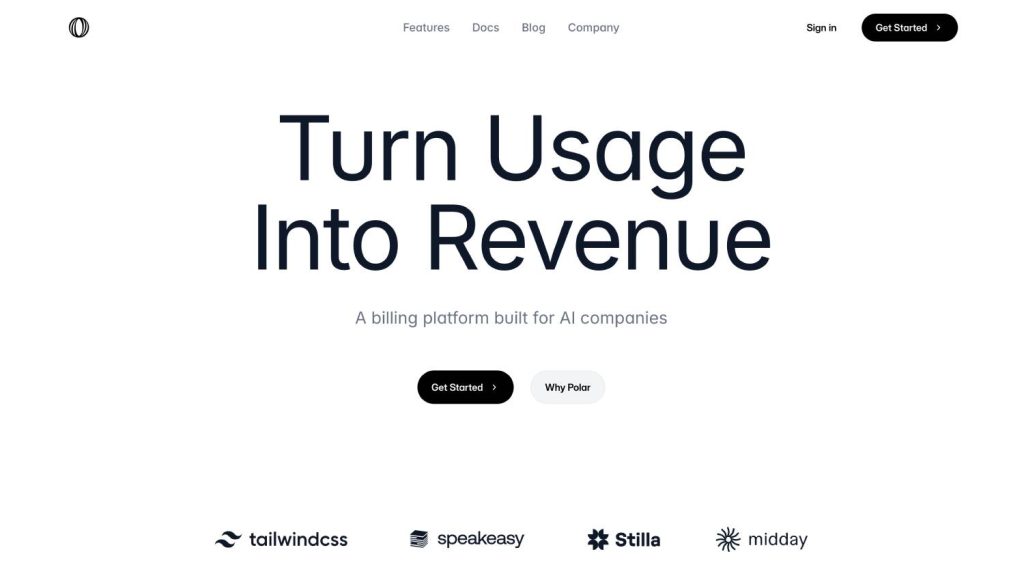
Polar is an open-source monetization platform targeting developer-focused products. It handles subscriptions, one-time purchases, and benefits delivery for software projects. It has gained real traction in the developer tools space, particularly among open-source maintainers looking to monetize through sponsorships and premium tiers.
Polar does operate as a Merchant of Record for transactions it processes. For a developer-tools founder with a GitHub-native audience and straightforward subscription tiers, it deserves a serious look.
The honest assessment in 2026 is that Polar has real gaps for anything beyond simple billing. Its subscription management engine does not support the proration logic, mid-cycle upgrade handling, or dunning workflows that a multi-seat B2B SaaS requires. Enterprise contract support, custom invoicing, net terms, PO workflows, does not exist on the platform. Its jurisdiction coverage is narrower than Paddle’s or Lemon Squeezy’s. These are not speculative concerns; they reflect what the platform currently ships, not a prediction about future development.
Polar is worth watching if you are building in the developer tools space and your product has a community monetization angle. It is not the right choice if you need production-grade billing for a multi-seat B2B SaaS with international customers today.
Best for: developer-focused products with a GitHub-native audience and a community monetization angle. It has gained real traction among open-source maintainers monetizing through sponsorships and premium tiers, and for a developer-tools founder with a GitHub-native audience and straightforward subscription tiers it deserves a serious look. It is not the right choice if you need production-grade billing for a multi-seat B2B SaaS with international customers today.
The MoR Decision Framework: How to Choose Based on Your Actual Situation
The right payment architecture depends on three variables: where your customers are, what your contract types look like, and where you are in ARR. Run through these in order.
Step 1: Customer geography. If more than 20% of your revenue comes from outside the US, or you expect it to within 12 months, international tax compliance is not a future problem. It is a current one. MoR architecture becomes materially more valuable as your international revenue share grows.
Step 2: Contract type. If you sell exclusively self-serve (credit card, monthly or annual, no invoicing), Lemon Squeezy or standard Paddle both work at early ARR. If you sell to finance teams, IT buyers, or procurement departments with purchase order requirements, you need either Paddle Billing, Stripe Billing with your own tax stack, or a purpose-built CPQ tool upstream of your payment processor.
Step 3: ARR stage and team capacity. Below $300k ARR, the fee differential between Stripe and an MoR is small enough that compliance simplicity wins. Between $300k and $2M ARR, the math on Stripe plus a full compliance stack starts to converge, but execution risk on the Stripe side, missed filings, incorrect VAT IDs, unregistered jurisdictions, becomes the real cost. Above $2M ARR, you almost certainly need a dedicated finance person or outsourced accounting, and the conversation shifts to negotiating custom rates with Paddle or Stripe.
| ARR Stage | Geography Mix | Contract Type | Recommended Architecture |
|---|---|---|---|
| Under $120k ARR | Primarily US | Self-serve | Stripe (simple) or Lemon Squeezy (MoR convenience) |
| Under $120k ARR | 30%+ international | Self-serve | Lemon Squeezy or Paddle standard |
| $120k to $1M ARR | Mixed | Self-serve + some enterprise | Paddle standard or Paddle Billing |
| $120k to $1M ARR | Primarily US | Enterprise-first | Stripe Billing + Stripe Tax + filing service |
| Over $1M ARR | Any | Mixed | Paddle Billing (custom) or Stripe + full compliance stack with dedicated finance |
| Any stage | Any | Renewal-heavy subscription | Cleeng or Stripe |
The Hidden Fee Breakdown: What Paddle Actually Costs After Everything
The 5% fee is real. The “hidden fees” narrative is mostly exaggerated, but there are nuances worth understanding.
Paddle’s public pricing is 5% + $0.50 per transaction. There is no monthly platform fee on the standard tier. Payouts are weekly by default. Currency conversion, if Paddle collects in EUR and pays you in USD, carries a conversion spread that Paddle does not separately itemize on its public pricing page. For founders receiving USD payouts on Euro-denominated revenue, factor in a conversion cost on top of the headline rate, and ask Paddle directly for their current spread.
The more significant cost consideration is the revenue share model at scale. At $50k MRR with an average transaction of $100 (approximately 500 transactions), Paddle’s gross fee is roughly $2,750 per month based on public pricing. At the same average transaction size on Stripe at 2.9% + $0.30, the Stripe transaction fee alone is approximately $1,600 per month. The roughly $1,150 monthly difference either offsets a compliance problem or it does not, depending on your international revenue share and what you would otherwise spend on tax filing.
Higher average transaction values narrow the comparison. If your average transaction is $500 or more, annual plans, seat-based pricing, larger contracts, the $0.50 per-transaction component of Paddle’s fee becomes proportionally smaller and the percentage-based gap between the two models closes.
Switching Payment Processors Mid-Year: The Real Costs No One Mentions
Migrating from Stripe to Paddle, or any processor switch, involves more than an API integration project. The costs that catch founders off-guard fall into three categories.
Card re-authorization. When you migrate subscriptions to a new processor, existing customers’ stored cards do not automatically transfer. You must either re-request payment details (which triggers churn) or use a network tokenization service that your new processor supports. Paddle has a migration program that handles some of this, but it requires coordination and not all cards migrate cleanly. Involuntary churn on migrated subscriptions varies by customer base and card type distribution, ask Paddle specifically about their migration success rates for your customer profile before committing to a timeline.
Mid-year tax reconciliation. Switching processors mid-year creates two reporting periods for the same fiscal year. If you are filing quarterly tax returns, or your service provider is, the migration adds a reconciliation step across two systems. Migrate at fiscal year-end whenever possible.
Engineering time. A Stripe-to-Paddle migration typically takes a small engineering team two to six weeks depending on integration complexity, webhook dependencies, and whether you have custom billing logic. If you have a homegrown billing engine, budget more. The integration itself is not technically difficult, but testing edge cases, failed payments, proration, mid-cycle upgrades, takes time to get right.
One pattern that comes up repeatedly in founder communities: companies that migrate off Stripe at $300k ARR wish they had done it at $100k ARR. The migration cost is roughly the same. The cleanup from two years of incomplete international tax records is not.
What Payment Infrastructure Do Well-Funded SaaS Companies Actually Use?
The public record on payment infrastructure choices is incomplete. Most YC companies do not publish their billing stack. What is publicly visible from Paddle’s and Lemon Squeezy’s customer pages and public case studies suggests both platforms have real B2B SaaS customers at various stages, though neither vendor publishes verifiable ARR or customer count data that can be independently confirmed.
The pattern visible in public forums, founder communities, and press coverage is roughly this: companies that started after 2020 are more likely to have evaluated MoR options from day one. Companies that started before 2018 are more likely to be on Stripe and considering a migration. Stripe remains the plurality choice by volume, but the MoR conversation is now standard in early-stage SaaS decision-making in a way it was not five years ago.
The “Stripe is what serious companies use” assumption does not survive contact with the tax liability reality. Stripe is what many serious companies start with. Whether they migrate before or after their first compliance problem is the question.
Frequently Asked Questions
What is a Merchant of Record and do I need one for my SaaS?
A Merchant of Record is the legal entity that sells a product to the end customer and is responsible for collecting and remitting applicable taxes (VAT, GST, sales tax) in every jurisdiction where customers pay. If you sell digital software to customers in multiple countries, you need either a Merchant of Record (like Paddle or Lemon Squeezy) or a compliant tax stack layered on top of a payment processor like Stripe. The obligation exists regardless of your company’s country of incorporation.
How much does Paddle actually cost after all fees?
Paddle’s public pricing is 5% plus $0.50 per transaction on the standard plan, with no monthly platform fee. There is no separate tax filing fee because Paddle handles that as the Merchant of Record. Currency conversion carries a spread that Paddle does not separately itemize on its public pricing page. For Paddle Billing (enterprise invoicing, net terms), pricing is custom. The total cost is generally comparable to Stripe plus a proper international tax compliance stack, but the Stripe side of that comparison depends on your actual filing service costs, which Avalara and similar providers do not publish publicly.
Can I use Lemon Squeezy for a $500k ARR SaaS?
Lemon Squeezy works well for self-serve SaaS at $500k ARR if your billing model is simple (credit card subscriptions, no enterprise invoicing). Its fee structure matches Paddle’s at 5% plus $0.50 per transaction. The constraint at that scale is contract tooling: Lemon Squeezy does not support purchase orders, net payment terms, or the enterprise billing workflows that B2B buyers at larger companies expect. If more than 20% of your revenue comes from deals closed by a sales team, Lemon Squeezy‘s limitations start costing you deals.
Is Polar.sh a legitimate payment processor for SaaS in 2026?
Polar.sh is a real platform that operates as a Merchant of Record for transactions it processes. It is purpose-built for developer tools and open-source monetization. In 2026, it is a viable option for developer-focused products with simple billing needs and a GitHub-native audience. Its subscription management engine currently lacks proration logic, advanced dunning, and enterprise contract support. Jurisdiction coverage is narrower than established MoRs. It is worth re-evaluating as the platform matures, but it is not the right choice for companies with complex B2B billing requirements today.
What happens to my taxes if I switch from Stripe to Paddle mid-year?
Switching processors mid-fiscal-year creates two separate reporting periods for the same year. Transactions processed through Stripe remain your tax liability and must be reconciled against your filings for that period. Transactions processed through Paddle after migration become Paddle’s liability as the Merchant of Record. You will need to file for the Stripe period independently. The reconciliation adds accounting complexity. Migrations timed to fiscal year-end reduce this cleanup significantly.
Is Stripe plus Avalara cheaper than Paddle for international SaaS?
Stripe’s transaction fees are lower than Paddle’s on a percentage basis. Whether the total Stripe stack, base fees, Stripe Tax at 0.5%, plus a filing service, comes out cheaper than Paddle’s 5% depends on what you actually pay for filing. Avalara does not publish its pricing, so any comparison requires a direct quote. At higher MRR with significant international revenue, the two approaches tend to converge in total cost, with the MoR approach carrying less execution risk on the compliance side.
The Architecture Decision Is Also a Legal Decision
The payment processor you pick is not just an engineering decision. It determines who is legally exposed when a tax authority sends a notice, who appears on your customer’s statement, and how many hours your finance team spends on compliance each quarter. Those are not billing features. They are liability allocations.
At early ARR, the cost difference between Stripe and an MoR is small enough that founders rationalize deferring the decision. The $18,000 story at the top of this piece is not an outlier. It is what happens when that deferral meets a European customer’s accounting team asking for a proper VAT invoice.
The best time to pick the right architecture is before you have customers in three countries with three different tax regimes and a spreadsheet that no longer reconciles. The second best time is now, with a clear framework for what your actual revenue stage and geography require, rather than defaulting to the most familiar brand name.