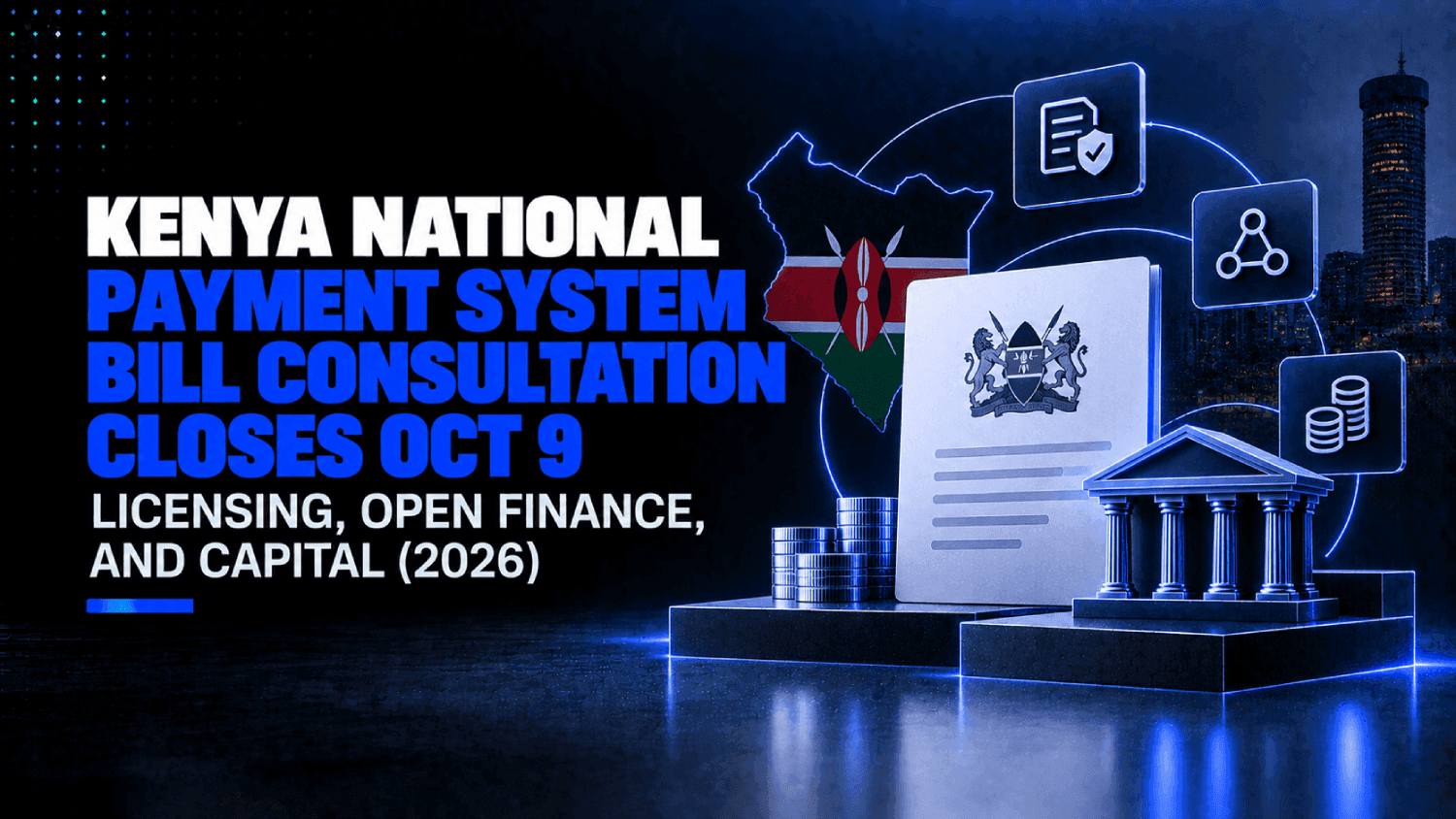

Kenya’s National Treasury and the Central Bank of Kenya (CBK) want to replace the 2014 payments statute with a full rewrite covering licensing, capital, open finance, interoperability, and trust-account rules. Public comments close on Friday, Oct. 9, 2026.
- The National Treasury and CBK opened public participation on the draft National Payment System Policy and the National Payment System Bill, 2026. Comments are due on or before Friday, Oct. 9, 2026, by email to [email protected], by post or hand delivery to the CBK Governor’s Office in Nairobi, or at the remaining public forums (including Nairobi on Oct. 9).
- If enacted, the Bill repeals the National Payment System Act, Cap. 491A, and creates 10 licence categories across payment service providers (PSPs) and payment system operators (PSOs), with Third Schedule minimum capital from KES 5 million to KES 250 million.
- Headline operator issues: mandatory interoperability, open finance data-sharing with customer consent, outsourcing approval, cross-border payment transparency, a statutory regulatory sandbox, and a one-year transition that Bowmans notes may require re-application rather than automatic grandfathering of existing licences.
- Banks, microfinance banks, building societies, and listed government-owned enterprises do not take a PSP/PSO licence, but must still get CBK authorisation and meet capital, open finance, interoperability, and conduct rules.
- This is a Kenya payments law rewrite deadline explainer. It is distinct from the UK HM Treasury Modernising Payment Services Regulation consultation (closes Oct. 6, 2026) and from US open banking under Section 1033.
Most African payments updates are product launches. This one is a statutory reset for Kenya’s rails. If you run a wallet, remittance corridor, merchant acquire stack, payment gateway, or switch that touches Kenya, the answers CBK receives this week will shape which licence you need, how much capital you hold, and whether you must open your data and rails to rivals.
For FintechSpecs operators, the buyer question is what to argue for (or plan around) on licence mapping, stacked capital, open finance APIs, and transition before Cap. 491A is repealed. The practical window is short. A focused memo on your licence map and capital stack beats a generic “we support innovation” letter.
What CBK and the National Treasury published, and the deadline
Per the CBK notice page and the Public Notice PDF:
- Publishers: National Treasury, in collaboration with CBK.
- Instruments: Draft National Payment System Policy and National Payment System Bill, 2026.
- Stated aim: a modern, safe, interoperable, inclusive national payment system that supports Kenya’s regional and global payment integration.
- Repeal target: National Payment System Act, Cap. 491A.
- Comment deadline: on or before Friday, 9th October 2026.
- Respond by email: [email protected], using the comment template posted on the Treasury and CBK sites.
- Respond by post or hand delivery: Governor, Central Bank of Kenya, P.O. Box 60000-00200, Nairobi, or the Office of the Governor along Haile Selassie Avenue, Nairobi.
- Public forums: a nationwide schedule runs through Oct. 9, with the Nairobi forum at the Kenya School of Government on 9 October 2026, 9:00 am to 1:00 pm (Nairobi, Kiambu, and Kajiado).
Operator take: If you only have time for a short response, map your live and planned products to the First Schedule licence list, calculate Third Schedule capital (including the multi-licence stacking rule), and flag any transition text that would force a full re-licence instead of a conversion.
The 10 licence categories
The Bill splits what Cap. 491A treated as broad PSP and PSO buckets into 10 named categories in the First Schedule.
Payment service providers
- Payment Initiation Service Provider
- Account Information Service Provider
- Merchant Acquirer
- Electronic Wallet Provider
- Money Remittance Service Provider
- Electronic Money Issuer
Payment system operators
- Payment Gateway
- Payment Messaging System Operator
- Card Scheme Operator
- Payment Switching and Clearing System Operator
Per Bowmans (Sept. 30, 2026), foreign companies can apply through a registered branch, which opens Kenya’s payments market to international players that previously sat outside the domestic licence map.
Section 5 requires a person carrying on PSP business in Kenya to apply to CBK for a licence before commencing. Section 6 does the same for PSOs. Operating without a licence is an offence.
Operator take: Multi-product stacks (wallet + remittance + acquire) will often need more than one category. Do the mapping before you argue capital. Wrong category selection is harder to unwind than a comment letter.
Who skips the licence but still needs CBK authorisation
Section 9 says the following entities do not apply for a PSP/PSO licence if they intend to carry on that business:
- government-owned enterprises listed under the Government Owned Enterprises Act, 2025
- banks licensed under the Banking Act
- microfinance banks licensed under the Microfinance Act
- building societies licensed under the Building Societies Act
They still must apply for CBK authorisation, comply with the Act, and meet Third Schedule capital adequacy. Bowmans notes this is a shift from Cap. 491A, which excluded these institutions from PSP authorisation altogether. The Bill also carves them out of CBK management intervention, statutory management, and the Bill’s insolvency regime, because they already sit under sectoral prudential oversight.
Operator take: If you are a bank-fintech partnership in Kenya, clarify who holds which obligation. The bank may skip the PSP licence and still inherit open finance, interoperability, outsourcing, and disclosure duties through authorisation.
Minimum capital: KES 5M to KES 250M, with stacking
Third Schedule minimum capital (KES million):
| Stream | Category | Minimum capital (KES million) |
|---|---|---|
| PSP | Payment Initiation Service Provider | 5 |
| PSP | Account Information Service Provider | 5 |
| PSP | Money Remittance Service Provider | 30 |
| PSP | Merchant Acquirer | 50 |
| PSP | Electronic Wallet Provider | 50 |
| PSP | Electronic Money Issuer | 250 |
| PSO | Payment Gateway | 10 |
| PSO | Payment Messaging System Operator | 20 |
| PSO | Card Scheme Operator | 50 |
| PSO | Payment Switching and Clearing System Operator | 50 |
Section 10 defines core capital as issued and fully paid-up ordinary share capital plus disclosed reserves, less goodwill and other intangibles. Unpaid capital, shareholder loans, borrowed funds used to raise capital, and revaluation or intangible reserves do not count as paid-up capital.
Multi-licence stacking (section 10(6)): if you hold more than one category, you must hold the capital of the highest category plus 50% of the capital for each additional category.
Fourth Schedule adds a trust concentration limit: an e-money issuer or e-wallet provider shall not hold more than KES 500 million or more than 25% of monies in a trust account, whichever is higher, in a single bank.
Operator take: An EMI at KES 250M that also wants merchant acquire (KES 50M) needs 250 + 25 = KES 275M, not 300. Run the stack for every product pair before you respond. Bowmans expects the higher thresholds to push some PSPs toward mergers that themselves need CBK approval.
Fit and proper vetting
Section 11 bars anyone from serving as a director, significant shareholder (10%+), senior officer, or trustee unless CBK certifies them fit and proper under the Second Schedule (credentials, integrity, fraud history, bankruptcy, and related tests). If CBK later finds a significant shareholder unfit, voting rights stop immediately and the holding must fall below 10% on CBK’s timeline.
Operator take: Ownership and board changes that look routine under Cap. 491A become gating events. Bake CBK vetting into fundraising and M&A calendars.
Interoperability and open finance
Interoperability (section 28): every PSP and PSO must use systems that are interoperable with other PSPs, PSOs, and their agents. Bilateral interoperability arrangements need prior CBK approval. CBK can also compel an interoperability arrangement by notice. Non-compliance triggers administrative enforcement.
Open finance (section 29): every PSP and PSO must use systems capable of securely sharing customer data with third parties for open finance. CBK may require a consent-based data-sharing mechanism. CBK must make regulations to give the section effect. The Bill’s definitions already pull in account information services and payment initiation services as open finance online services, which is the same AISP/PISP vocabulary used in UK and EU open banking.
Operator take: This is the Kenya counterpart to UK Open Banking and US Section 1033 fights over who pays for data access and who owns the API. Comment now on consent standards, liability for shared data, and whether dominant rails can delay technical interoperability. For the US contrast, see our Section 1033 open banking guide. For the UK deadline running in parallel, see HM Treasury’s Modernising Payment Services Regulation (closes Oct. 6, 2026).
Outsourcing, agents, and cyber disclosure
Outsourcing (section 30): prior written CBK approval is required before outsourcing an “operational function” (anything whose failure would impair licence compliance, financial performance, or continuity of payment services). Outsourcing must not impair internal control or CBK’s ability to supervise.
Agents (section 31): PSPs and PSOs may appoint agents, remain liable for agent acts and omissions, and must follow CBK rules on which services agents may provide.
Material disclosure: Bowmans highlights that the Bill requires immediate reporting of material data breaches and cybersecurity incidents, filling a gap Cap. 491A left open.
Operator take: Map every critical vendor (cloud, KYC, fraud, switch, wallet core) against the operational-function test. If a vendor outage would stop payouts, assume you need CBK approval before renewing or replacing that contract under the new Act.
Cross-border transparency and customer protection
Part X requires originator and beneficiary information to travel with payments. Intermediary and beneficiary PSPs get risk-based duties to identify incomplete data and to execute, reject, suspend, or seek more information. Cross-border flows face additional originator identification detail above thresholds CBK will set in rules.
Consumer protection clauses require clear fees and risks, services designed around user needs, safeguarded customer funds, complaints handling, and protection of customer data.
Operator take: Remittance and wallet teams should treat incomplete travel-rule style data as a reject-or-hold workflow, not a back-office cleanup task. Build the hold logic before the Act lands.
Sandbox, CBK powers, and insolvency
Regulatory sandbox (section 74): CBK may, by regulations, establish a sandbox so persons can get limited access to the national payment system to test innovative payment services without necessarily taking a full licence.
Supervision: Bowmans flags unannounced inspections, management intervention (including appointing or removing officers), statutory managers for up to 12 months (extendable by court), and broader suspension or revocation grounds such as capital breaches and unapproved licence transfers.
Insolvency and ownership: CBK approval is required for mergers, acquisitions, and significant ownership changes (10%+). Voluntary liquidation needs CBK approval, and customer liabilities get priority. The Bill also amends the Insolvency Act to bring PSPs and PSOs into the administration regime.
Operator take: Sandbox language is useful for new AISP/PISP and agent experiments, but it is not a permanent licence substitute. Use comments to ask CBK for clear exit paths from sandbox to Full Schedule licences.
Transition risk: one year, and maybe no automatic grandfathering
Bowmans reports the Bill proposes a one-year transitional period but does not deem existing Cap. 491A licences valid under the new framework. That implies current licence holders may need to re-apply under the new categories rather than convert automatically.
Operator take: This is the single highest-priority comment for incumbents. Ask for an explicit deeming or conversion pathway tied to First Schedule mapping, with interim operating rights while CBK processes applications.
Contrast map: how this differs from recent FintechSpecs coverage
| Story | What it is | Buyer question |
|---|---|---|
| Kenya NPS Bill 2026 (this post) | Kenya draft statute rewriting PSP/PSO licensing; comments due Oct. 9, 2026 | How do I map licences, capital, open finance, and transition for Kenya operations? |
| HM Treasury Modernising Payment Services Regulation | UK consultation on PSRs/EMRs, stablecoins, agentic payments, Open Banking; closes Oct. 6, 2026 | What should my UK firm argue before the payments rulebook is rewritten? |
| Section 1033 open banking guide | US personal financial data rights compliance | How do I comply with US data access rules? |
| Fed GENIUS Act NPRs | US prudential rulemaking for payment stablecoin issuers | What reserve and application rules apply in the US? |
| J.P. Morgan Payments × Thunes Xpedite Remit (hub draft; confirm live slug before linking in WP) | Bank and corridor product partnership for cross-border payouts | Which payout partner covers my corridors? |
Kenya’s Bill is the statutory layer. Product launches and US/UK rulemakings answer different buyer questions. Keep those URLs. Do not collapse this into a remittance vendor shortlist or a stablecoin explainer.
Who should respond, and what to put in your response
Prioritise a response if you:
- Hold or plan a Kenya PSP or PSO licence (wallet, EMI, remittance, acquire, gateway, switch, card scheme, messaging)
- Are a bank, microfinance bank, or building society that will need CBK authorisation under section 9
- Build AISP/PISP or other open finance products that need Kenya account data
- Run cross-border corridors into or out of Kenya
- Are evaluating M&A or a fundraising that would create a 10%+ shareholder
- Rely on critical outsourced cores, KYC, or switch vendors
Diligence questions for your team and counsel
- Which First Schedule categories match our live and 12-month roadmap?
- What is our stacked Third Schedule capital under section 10(6)?
- Do our trust balances breach the Fourth Schedule single-bank concentration limit?
- Which interoperability arrangements would CBK likely compel, and what is the technical cost?
- What consent, audit, and liability model do we want for section 29 open finance APIs?
- Which vendors are “operational functions” under section 30, and which contracts need CBK approval pathways?
- Do we need an explicit deeming or conversion clause in section 79 so we are not forced into a cold re-application?
- Who signs the comment letter, and will we attend the Nairobi forum on Oct. 9?
The take: five days to shape Kenya’s next payments statute
CBK and the National Treasury have put a full rewrite on the table, with licence granularity, capital floors, forced interoperability, and open finance duties that Cap. 491A never carried in primary legislation. Bowmans frames it as the most significant overhaul since 2014. The comment window closes Oct. 9, 2026.
Operator take: Firms that respond with a licence map, a capital stack, and a concrete transition ask will influence the regulations CBK still has to write under sections 29 and 74. Firms that skip it will re-licence under rules they did not help shape.
Treat this as Kenya’s statutory reset for PSP/PSO licensing, open finance, and rail interoperability. For the parallel UK payments rewrite, keep HM Treasury’s Modernising Payment Services Regulation. For US data-access contrast, keep the Section 1033 open banking guide.
FAQ
When does the Kenya NPS Bill consultation close?
On or before Friday, Oct. 9, 2026, per the Public Notice. The Nairobi public participation forum is the same day, 9:00 am to 1:00 pm, at the Kenya School of Government.
How do I submit comments?
Email [email protected] using the comment template on the CBK and National Treasury sites, or deliver/post to the CBK Governor’s Office in Nairobi. You can also attend a scheduled public forum.
Does the Bill replace Cap. 491A?
Yes. The Bill is drafted to repeal the National Payment System Act, Cap. 491A, and replace it with the National Payment System Act, 2026, if enacted.
What capital do e-money issuers need?
The Third Schedule sets KES 250 million minimum core capital for Electronic Money Issuers. Multi-category licensees must also hold 50% of each additional category’s capital on top of the highest category.
Will banks need a PSP licence?
Not a PSP/PSO licence under section 9, but banks, microfinance banks, building societies, and listed government-owned enterprises must still obtain CBK authorisation and meet the Act’s substantive and capital rules.
What does open finance mean in the Bill?
Section 29 requires PSPs and PSOs to maintain systems capable of securely sharing customer data with third parties for open finance, and lets CBK mandate consent-based sharing mechanisms. Detailed rules come later by regulation.
Is there a sandbox?
Yes. Section 74 lets CBK establish a regulatory sandbox by regulations so innovators can test payment services with limited access to the national payment system without necessarily holding a full licence.