
TLDR
- An FX exposure dashboard shows you what you are exposed to. Hedge accounting software for treasury teams proves to auditors that you managed it correctly, with designated hedges, documented effectiveness, and accounting entries that move through your P&L at the right time.
- The three workflows that separate hedge accounting from FX monitoring are: formal hedge designation, periodic effectiveness testing, and disclosure-ready journal entry outputs. Most treasury management systems handle none of these fully.
- Under ASC 815 and IFRS 9, failing to document a hedge relationship before the hedging instrument is in place disqualifies you from hedge accounting treatment retroactively. The documentation window is not forgiving.
- The three platforms most commonly shortlisted by treasury teams running structured hedge programs are Reval (now part of ION Group), Openlink (now ION), and Hedge Trackers, with FIS Quantum and Chatham Financial’s managed service appearing on enterprise and mid-market shortlists respectively.
- Pricing across all serious hedge accounting platforms is not publicly disclosed. Every vendor quoted in this article requires a custom sales engagement to get a number.
The three hedge accounting software platforms treasury teams most frequently shortlist are ION Treasury (which absorbed both Reval and Openlink), Hedge Trackers, and Chatham Financial’s advisory-led platform. Each handles hedge designation, effectiveness testing under ASC 815 or IFRS 9, and audit-ready documentation, but they differ sharply in deployment model, accounting standard depth, and how much your team has to do manually. The right choice depends on whether you need a pure SaaS workflow tool, an integrated treasury management system with hedge accounting bolted in, or outsourced expertise with software behind it.
Why Your FX Dashboard Is Not Hedge Accounting Software
Treasury teams running FX exposure dashboards often assume they have covered the hedge accounting requirement. They have not. Exposure dashboards aggregate positions and calculate mark-to-market values. That is risk management, not accounting.
Hedge accounting under ASC 815 (US GAAP) or IFRS 9 requires three things your FX dashboard almost certainly does not produce. First, a formal hedge designation memo created before the hedging instrument is executed, linking the hedging instrument to the specific hedged item with a stated risk management objective. Second, prospective and retrospective effectiveness testing at each reporting period, documented in a format your auditors can inspect. Third, accounting entries that correctly classify fair value changes into OCI, reclassify amounts out of OCI into earnings at the right time, and generate the disclosures required by the standard.
Miss any of those three, and your hedge falls into mark-to-market accounting by default. Every fair value change on the derivative hits your P&L immediately, creating earnings volatility that hedge accounting was designed to prevent. Many finance teams discover this during their first audit of a hedging program, not before it. Catching it after the fact means you cannot re-designate retroactively.
This is worth distinguishing from the question of which treasury management system to use for broader cash and liquidity operations. If you are evaluating Kyriba alternatives for general treasury, the hedge accounting capability gap often becomes visible at that stage.
What Hedge Accounting Software Actually Does: The Four Workflow Layers
Genuine hedge accounting platforms are built around four connected workflow layers. FintechSpecs uses these four layers as the primary evaluation lens when assessing any platform that claims hedge accounting capability , because they map directly to what auditors check, not what marketing decks highlight. Understanding these layers is the fastest way to run a vendor comparison without getting lost in feature lists.
Layer 1: Hedge Designation and Documentation
The software must let you create a hedge designation memo that captures the hedging instrument (typically a forward, option, or swap), the hedged item (a forecast transaction, recognized asset, or liability), the type of hedge relationship (fair value hedge, cash flow hedge, or net investment hedge), and the risk being hedged. This memo has to be timestamped before the hedging instrument is executed. Any platform that does not enforce this sequencing is not really a hedge accounting platform.
Layer 2: Effectiveness Testing
Effectiveness testing is the technical core of hedge accounting. Under ASC 815 and IFRS 9, you must demonstrate at inception and at each reporting period that the hedging relationship is expected to be highly effective. IFRS 9 eliminated the 80-125% bright-line test that existed under IAS 39, replacing it with a more principles-based approach, but the documentation burden is comparable. Platforms handle this with either the dollar-offset method, regression analysis, or the hypothetical derivative method. The right method depends on your hedge type and the standard you are under. Good software automates the calculation, stores the output, and flags relationships that are falling outside acceptable ranges.
Layer 3: Valuation and Fair Value Measurement
Derivatives must be carried at fair value on the balance sheet. That requires either an integrated pricing engine or a reliable market data feed. Some platforms price vanilla instruments internally. Complex options or exotic structures usually require third-party valuations, and the platform needs to ingest those cleanly.
Layer 4: Journal Entry and Disclosure Output
The platform must generate the accounting entries that your ERP can consume: recording the derivative at fair value, recognizing the effective portion of a cash flow hedge in OCI, reclassifying from OCI to earnings when the hedged item affects P&L, and recognizing any ineffectiveness immediately in earnings. It also needs to output the quantitative disclosures required by ASC 815-20 and IFRS 7, including the notional amounts, fair values, and gains or losses by hedge type.
The Three Best Hedge Accounting Software Platforms for Treasury Teams
1. ION Treasury (Reval)

ION Treasury, which acquired and integrated Reval, is the platform most often cited by treasury teams at mid-to-large companies running formal hedge programs under both ASC 815 and IFRS 9. Reval was purpose-built for hedge accounting before ION acquired it, which matters because hedge accounting was not retrofitted onto a broader TMS. The designation, effectiveness testing, and journal entry workflows were designed from the standard outward.
The platform handles cash flow hedges, fair value hedges, and net investment hedges across FX forwards, options, cross-currency swaps, and interest rate swaps. Effectiveness testing supports both the dollar-offset and regression methods, with results stored in audit-ready reports. The valuation engine prices vanilla derivatives internally using market curves; structured products require uploading third-party valuations. Journal entries export in formats compatible with major ERPs including SAP and Oracle.
Where ION Treasury is strongest is in multi-entity, multi-currency environments with large hedge portfolios. Where it is slower is implementation. ION Treasury implementations for large, multi-entity programs are typically measured in months rather than weeks , vendor-reported timelines for comparable enterprise TMS deployments generally fall in the six-to-twelve-month range, though your actual timeline depends on how much of your chart of accounts, entity structure, and ERP integration specifications are already defined when implementation begins. Pricing is not public and requires a direct sales engagement with ION.
| Platform | Best For | Standards Covered | Effectiveness Methods | Valuation Engine | ERP Integration | Pricing |
|---|---|---|---|---|---|---|
| ION Treasury (Reval) | Large, multi-entity hedge programs | ASC 815, IFRS 9 | Dollar-offset, regression | Internal (vanilla); external upload (complex) | SAP, Oracle, others | Not publicly disclosed |
| Hedge Trackers | Mid-market FX and commodity programs | ASC 815, IFRS 9 | Hypothetical derivative, regression | Third-party data feeds | File-based export | Not publicly disclosed |
| Chatham Financial | Teams wanting advisory + software | ASC 815, IFRS 9 | All major methods | Chatham internal desk | Varies by engagement | Not publicly disclosed |
2. Hedge Trackers
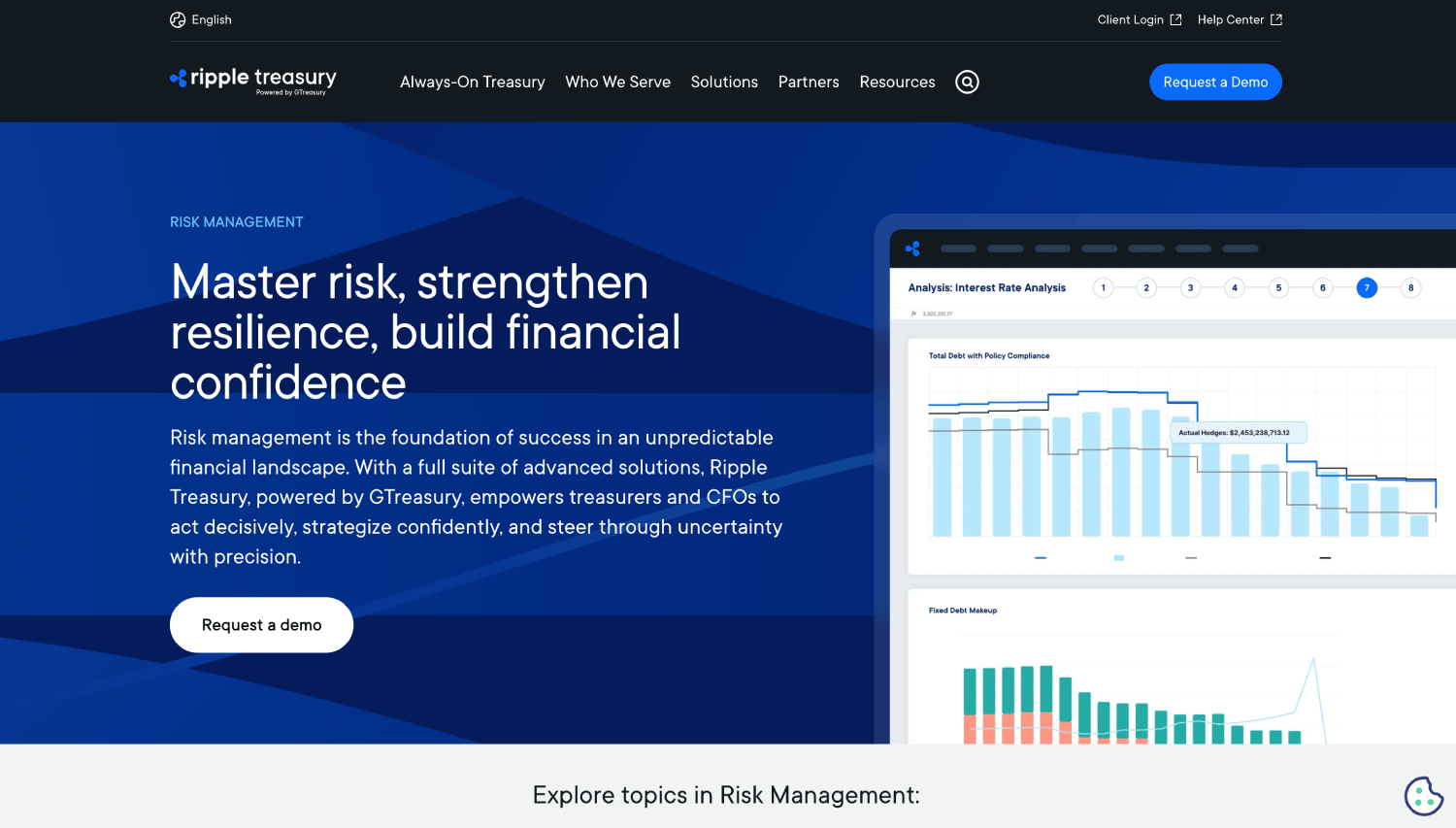
Hedge Trackers (now Ripple Treasury) is the platform most frequently chosen by mid-market companies that need dedicated hedge accounting software without committing to a full enterprise TMS implementation. The company positions itself toward organizations that have outgrown spreadsheet hedge accounting but are not yet running the multi-entity, multi-standard programs that drive companies toward ION Treasury. It is also used by larger companies that have a TMS for cash management but want a separate, purpose-built hedge accounting workflow rather than relying on the hedge module within their TMS.
The platform covers FX forwards, options, and swaps as well as commodity hedges, which is a meaningful differentiator for companies with energy or metals exposure alongside FX risk. Effectiveness testing uses the hypothetical derivative method and regression analysis. The documentation workflow is structured around ASC 815 and IFRS 9 and produces designation memos in formats that have consistently held up in Big Four audits, which is the practical test that matters.
One trade-off worth naming: Hedge Trackers produces journal entry output via file export rather than a live API connection to your ERP. For teams with high hedge volumes, this means a manual upload step at each reporting period. For mid-market programs running 20-100 hedges per quarter, that is usually manageable. Pricing is custom and requires a direct conversation with the vendor. Hedge Trackers describes its mid-market implementations as substantially faster than a full enterprise TMS deployment; the vendor can speak to current timelines during a sales engagement, as actual duration depends on program complexity and how prepared your team is on entity structure and ERP specifications before kickoff.
3. Chatham Financial (HedgeVault and Advisory Platform)

Chatham Financial occupies a different position in the market. It is an advisory firm with its own software platform, which means you are buying expertise alongside the tool. For treasury teams that do not have a dedicated derivatives accountant on staff, that combination is often worth more than a pure SaaS platform that requires you to configure everything yourself.
Chatham’s platform handles designation, effectiveness testing, and valuation, with Chatham’s own pricing desk providing fair value marks on derivatives. The accounting output is reviewed by advisors who specialize in ASC 815 and IFRS 9, which provides a layer of audit defensibility that software-only solutions do not. The trade-off is that you are more dependent on Chatham’s team, and the service model is less self-serve than Hedge Trackers or ION Treasury.
Chatham makes the most sense for companies with a hedge program of meaningful complexity, particularly those using non-vanilla instruments like exotic options or cross-currency swaps, where the valuation methodology itself can be a point of auditor scrutiny. It also fits companies that are establishing a hedge accounting program for the first time and want someone to design the documentation framework alongside building it in software. As with the others, pricing is not publicly disclosed.
How to Test Any Hedge Accounting Platform Before You Buy
The FintechSpecs Hedge Accounting Platform Stress Test is a four-check evaluation sequence that treasury teams can run against any vendor during a demo or proof-of-concept. These checks were developed by mapping the most common audit failure points in hedge accounting programs back to the specific software controls that either prevent or enable them. A platform that passes all four is genuinely built for hedge accounting. One that fails any of them is likely an FX risk tool with documentation features added on top.
Check 1: Designation sequence enforcement. Ask the vendor to show you what happens if you attempt to back-date a hedge designation memo. A serious platform should either prevent this or flag it as a compliance risk. If the system allows silent back-dating with no controls, the documentation will not hold up under audit.
Check 2: Effectiveness test method flexibility. Ask which effectiveness testing methods are supported and whether you can switch methods for different hedge types within the same portfolio. Under ASC 815-20-25, you can apply different methods to different hedges, and your program may require that flexibility.
Check 3: Ineffectiveness routing. Ask the vendor to walk through what happens when a hedge falls outside the acceptable effectiveness range. The system should automatically route ineffective amounts to current-period P&L separately from the effective portion. If this requires manual journal entries outside the platform, that is an operational risk in a quarter with high hedge volume.
Check 4: Disclosure output format. Ask to see a sample ASC 815-20-50 or IFRS 7 quantitative disclosure output. If the vendor cannot produce one in a format your accounting team can use directly, you will rebuild it in a spreadsheet every quarter, which defeats the purpose of the software.
Running these four checks eliminates most of the platforms that market themselves as hedge accounting tools but are actually FX risk dashboards with a designation form added on.
Hedge Documentation and Effectiveness Testing: A Reference Table
| Requirement | ASC 815 (US GAAP) | IFRS 9 | What Software Must Produce |
|---|---|---|---|
| Hedge designation timing | At inception, documented before instrument execution | At inception, documented before instrument execution | Timestamped designation memo, pre-execution |
| Effectiveness testing frequency | At each reporting date | At each reporting date (or when circumstances change) | Automated effectiveness calculation per period |
| Effectiveness threshold | Highly effective (qualitative or quantitative) | No bright-line; must meet economic relationship criterion | Configurable per method and standard |
| Ineffectiveness recognition | Immediately in earnings | Immediately in earnings | Auto-routing of ineffective amounts to P&L |
| OCI reclassification | When hedged item affects earnings | When hedged item affects earnings | Triggered journal entry at reclassification event |
| Disclosure requirement | ASC 815-20-50 quantitative tables | IFRS 7 quantitative tables | Exportable disclosure package per period |
What Does Hedge Accounting Software Actually Cost?
None of the three platforms reviewed here publishes pricing. This is consistent across the hedge accounting software category. The cost depends on the number of hedge relationships in your portfolio, the instrument types, the number of legal entities, and the standard (or dual-standard) coverage you need.
All three vendors require a direct sales engagement to produce a number. No public pricing pages exist for ION Treasury, Hedge Trackers, or Chatham Financial’s platform as of this writing. Implementation costs are typically separate from license fees and can be significant for complex programs , vendors will scope these based on your entity structure, ERP environment, and program size during the sales process.
The more relevant cost comparison is against the alternative: running hedge accounting in spreadsheets with manual journal entries. That approach carries audit risk (undocumented or improperly timed designations are hard to defend), operational risk (errors in effectiveness calculations can result in de-designation of the entire hedge relationship), and resource cost (a treasury analyst spending significant time per quarter on manual effectiveness testing). For companies running more than 25 to 30 active hedge relationships, the operational math almost always favors dedicated software. This intersects with broader questions about your financial close process, particularly if you are evaluating financial close and month-end automation tools at the same time.
How Does Hedge Accounting Software Connect to Your TMS and ERP?
Treasury teams that already have a TMS, whether Kyriba, FIS Quantum, or a comparable platform, face a specific integration question: should you use your TMS’s native hedge accounting module, or run a dedicated hedge accounting platform alongside it?
TMS hedge modules are improving but remain secondary to the primary treasury workflows those systems are built for. If your TMS was selected for cash visibility, bank connectivity, and payments, the hedge accounting module was not the reason. Dedicated platforms like Reval (now ION) or Hedge Trackers were built from the standard outward, which shows in the depth of their effectiveness testing configurations and their disclosure output quality.
The integration question then becomes: how does the dedicated hedge accounting platform receive trade data and push journal entries? Most platforms accept trade feeds from your execution platforms (banks, Bloomberg, or FXall) in structured file formats or via API. Journal entry output goes to your ERP, typically SAP or Oracle, via file upload or direct connector. ION Treasury has the deepest native ERP connectors. Hedge Trackers relies more on file-based workflows. For teams doing financial close automation, understanding this data flow matters before you sign a contract. Teams evaluating their broader finance operations stack may also want to review the overlap with accounts payable automation and finance workflow tools to avoid buying redundant infrastructure.
Frequently Asked Questions
What is the difference between hedge accounting software and an FX risk management system?
An FX risk management system tracks your currency exposures and shows you mark-to-market values on hedging instruments. Hedge accounting software goes further: it creates the formal documentation linking a hedging instrument to a specific hedged item, runs periodic effectiveness tests per ASC 815 or IFRS 9, routes effective and ineffective amounts to the correct P&L and OCI accounts, and produces the quantitative disclosures auditors require. Many FX systems have added light documentation features, but they are not the same as a purpose-built hedge accounting platform.
Can you do hedge accounting in Excel or a standard ERP without dedicated software?
Technically yes. Many companies do it in Excel, particularly when running fewer than 15 to 20 hedge relationships. The risks are real: manual effectiveness calculations introduce error risk, there is no enforced designation sequence, and audit trails are difficult to defend. At scale, the operational burden becomes significant. Standard ERP modules like SAP Treasury or Oracle Treasury have hedge accounting functionality, but their effectiveness testing capabilities are limited compared to dedicated platforms. Most Big Four auditors will accept well-structured spreadsheet documentation but will scrutinize it more closely than output from purpose-built software.
What hedge types do ASC 815 and IFRS 9 cover?
Both standards cover three hedge types: fair value hedges (which hedge the exposure to changes in fair value of a recognized asset or liability), cash flow hedges (which hedge the variability in cash flows related to a forecast transaction or recognized item), and net investment hedges (which hedge the foreign currency exposure of a net investment in a foreign operation). The accounting treatment differs by type. Cash flow hedges park the effective portion in OCI until the hedged transaction affects earnings. Fair value hedges record both the hedging instrument and the hedged item at fair value through earnings. The standard you are under and your hedge type together determine what your software needs to produce.
How long does it take to implement hedge accounting software?
Implementation timelines vary by vendor and program complexity. Vendors position Hedge Trackers as a faster path to go-live than a full enterprise TMS deployment for mid-market programs; contact the vendor for current timeline estimates based on your program scope. ION Treasury implementations for large, multi-entity programs are typically measured in months , vendor-reported comparable enterprise deployments generally fall in the six-to-twelve-month range. Chatham Financial engagements start faster on the advisory side, but software configuration scope drives the timeline. All estimates assume your chart of accounts, legal entity structure, and ERP integration specifications are defined before implementation starts. If those are still being worked out, add time.
What is effectiveness testing and why does it matter for hedge accounting?
Effectiveness testing is the periodic measurement of how closely a hedging instrument’s fair value changes offset the fair value or cash flow changes of the hedged item. Under ASC 815, the relationship must be highly effective both prospectively (at designation, you expect it to work) and retrospectively (at each reporting date, you measure whether it did). Under IFRS 9, the test focuses on an economic relationship between the hedging instrument and the hedged item, along with the credit risk and hedge ratio requirements. If a hedge fails effectiveness testing, the hedge accounting designation is discontinued and future changes in fair value of the derivative go to earnings immediately.
Does hedge accounting software handle commodity hedges as well as FX?
Some platforms do, and some focus exclusively on FX and interest rate instruments. Hedge Trackers explicitly supports commodity hedges alongside FX. ION Treasury also covers commodities. If your program includes energy, metals, or agricultural inputs, confirm commodity instrument support during the evaluation. The effectiveness testing methodology for commodity hedges can differ from FX, particularly when there is a basis difference between the commodity being hedged and the underlying of the hedging instrument.
What disclosures does ASC 815 require and can software generate them?
ASC 815-20-50 requires companies to disclose the fair value of derivative instruments by type and designation, the gains and losses recognized in OCI and reclassified from OCI to earnings, the effect of hedging on the income statement, and information about the hedged items. The disclosure tables are quarterly and annual. All three platforms reviewed here can produce structured output to support these disclosures, though the format and level of automation differ. Confirm with any vendor that their disclosure package matches your reporting format before go-live, since reformatting at close is exactly the kind of manual step you are trying to eliminate.
Conclusion
The gap between FX exposure management and hedge accounting is a documentation and accounting workflow gap, not a data gap. Your exposure dashboard may already have the fair value numbers. What it cannot do is produce a timestamped designation memo, run an auditable effectiveness test, route amounts to OCI correctly, and generate the disclosure tables your auditors need. Those are distinct processes that require distinct software.
For mid-market treasury teams new to formal hedge programs, Hedge Trackers is the fastest path to an auditable setup without an enterprise TMS implementation. For companies with large, multi-entity portfolios and existing SAP or Oracle infrastructure, ION Treasury’s depth in effectiveness testing and ERP connectivity justifies the longer implementation. For teams without an in-house derivatives accountant who need expert review alongside software, Chatham Financial is the only option that bundles both. The choice is less about feature lists and more about where the operational risk in your program actually lives: in designation documentation, effectiveness testing, or disclosure output.
One principle that holds across all three: buy the software before you execute the first hedge in a new program. Retroactive designation is not permitted. The documentation requirement is not a formality you can complete at audit time. It is a condition of the accounting treatment itself, and no software can fix a hedge that was never properly designated.
If you are early in your treasury technology evaluation and still mapping the broader stack, the treasury management system RFP questions and scoring matrix on FintechSpecs covers how to structure vendor conversations at the TMS layer, which is where hedge accounting software requirements often surface first.