
- Payment orchestration adds real value only above $2 to 5M ARR when transaction volume and processor negotiation power justify the operational lift.
- The core benefit is intelligent routing across multiple payment processors to recover failed transactions, reduce fees, and access regional gateways, not consolidation for its own sake.
- Switching processors mid-scale carries real risks: API changes, reconciliation gaps, and temporary approval-rate dips. Plan the migration, do not react to outages.
- Most SaaS companies undershoot on processor diversity until a single provider outage or fee hike forces the decision. By then, you lose months to integration.
- Eight platforms dominate for SaaS: Stripe’s own routing, Adyen, Spreedly, Primer, Corefy, Checkout.com, Paymentology, and Fortis, each with different trade-offs in cost, geography, and developer experience.
Payment orchestration is the automated routing of transactions across multiple payment processors and gateways to maximize approval rates, minimize fees, and recover failed payments. For SaaS companies processing $2M+ annually, orchestration platforms are reported by vendors to recover 2-5% of otherwise-failed transactions and reduce blended processing costs by 0.3-0.8%. Below that volume, the operational complexity typically outweighs the savings.
What Is Payment Orchestration and When Does a SaaS Company Actually Need It?
Most SaaS founders believe they need only one payment processor until something breaks. A processor outage, fee restructuring, or declining approval rates forces the issue. By then, you are scrambling to integrate a second provider under pressure, the worst time to make infrastructure decisions.
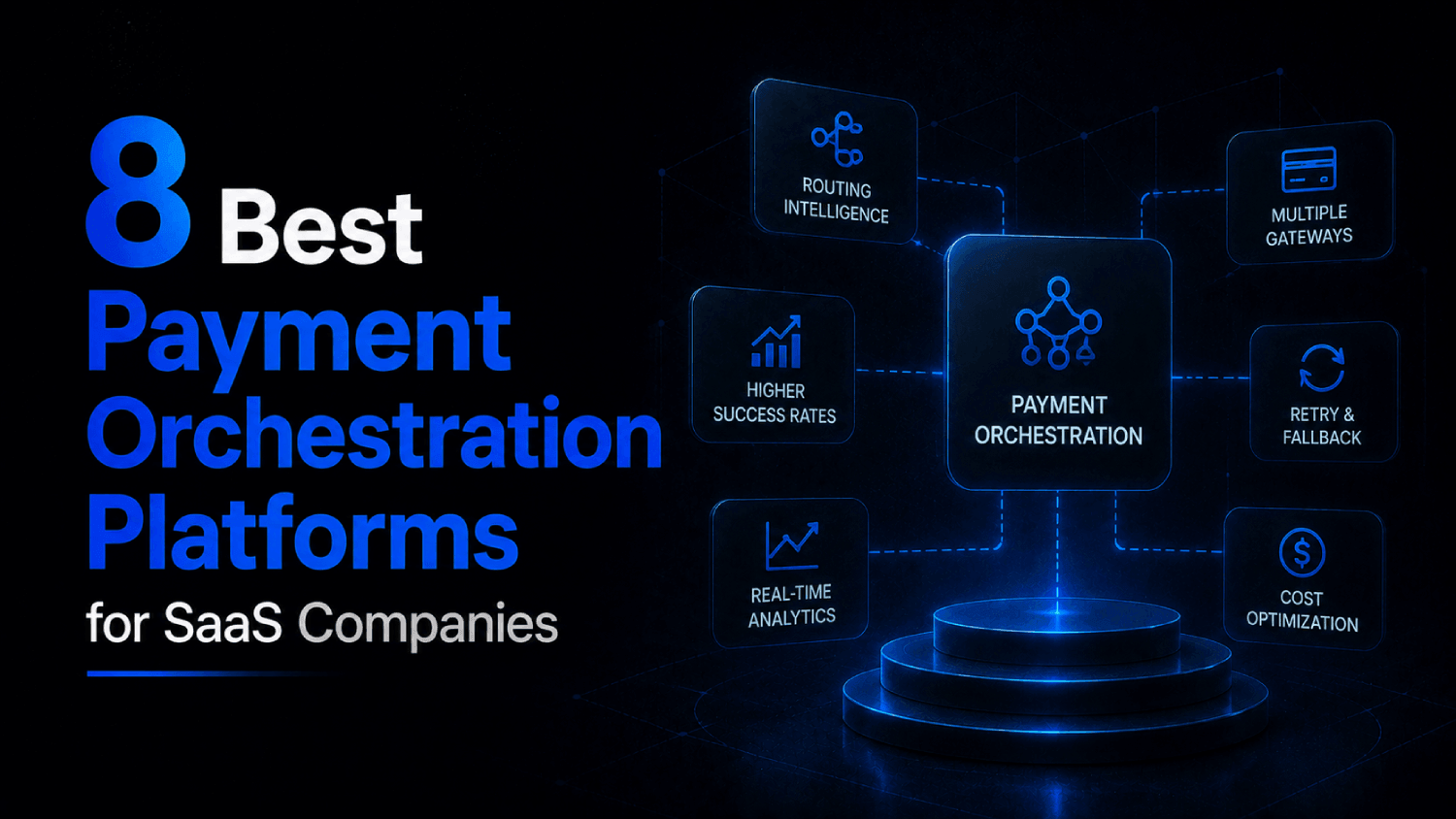
Payment orchestration is a middleware layer that sits between your billing system and your payment processors, automatically deciding which processor handles each transaction based on rules you define. It works like an intelligent router: if Processor A declines a card, it immediately tries Processor B. If Processor C offers better rates in a region, transactions route there. You see one API, one reconciliation interface, and unified reporting while the orchestration engine manages the complexity beneath.
The real value is not consolidation. It is recovery and cost control. According to Stripe’s documentation on intelligent payment routing, failed transactions represent lost revenue. A single processor decline rate of 2-3% means if you process $100K monthly, $2-3K disappears to declines that a second processor might approve. Orchestration platforms capture many of those by routing to a backup processor with different decline rules. At the same time, they give you negotiating power: if you can prove you move volume to competing processors based on fee performance, your primary processor becomes more willing to improve rates.
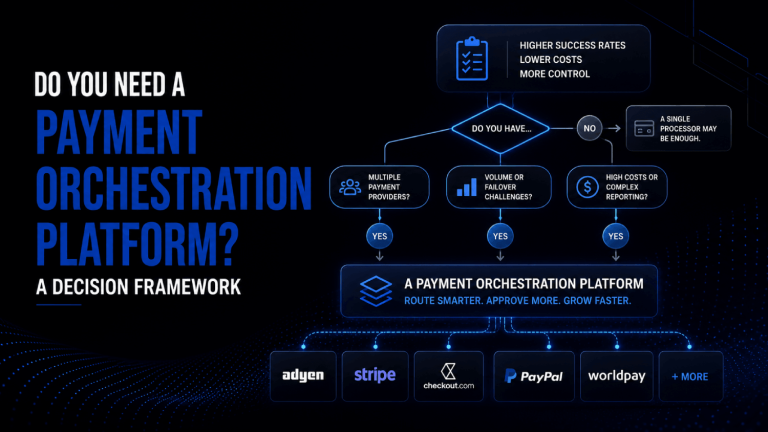
The threshold for implementation follows observable patterns in SaaS growth. Below $2M ARR, the engineering time to integrate a second processor, plus the operational overhead of managing two processor relationships, outweighs the savings. At $5M+ ARR, the financial case becomes strong. That $2 to 5M band is where companies should start evaluating; they are not yet forced, but they can plan the transition deliberately instead of reacting to crisis.
How Payment Orchestration Improves Approval Rates and Reduces Costs
A single processor decline does not have to be final. Different payment processors have different decline strategies based on their risk models, the types of cards they work with, and the regional networks they access. When an American Express card declines on Processor A (which may specialize in Visa and Mastercard), routing that same transaction to Processor B, which has stronger Amex relationships, often approves it.
Real-world impact: vendors working with orchestration platforms report recovering 2-5% of otherwise-lost transactions by routing to a secondary processor. For a SaaS company at $5M ARR with a 3% upstream decline rate, that represents $150K in annual revenue recovered. Even at a $500 integration cost and 5% annual platform fee, the payoff is measurable.
On fees, orchestration works through volume concentration and transparent cost comparison. Each processor offers different rates for different card types, regions, and payment methods. An orchestration platform lets you route transactions to the cheapest processor for that specific card type in that specific region. Over time, you can also use the data to show each processor how much volume you would shift to them for a rate improvement. A 0.3% reduction in blended processing fees at $5M ARR saves $15K annually, not transformative, but real.
The second major cost driver is reconciliation overhead. Managing two separate processor accounts means two separate dashboards, two reconciliation processes, and two sets of disputes. Orchestration platforms consolidate that into one view, reducing the time your finance team spends on monthly close.
Key Risks When Switching Payment Processors
Processor switching carries real technical and operational hazards. Careless migration can spike your decline rate temporarily, break customer refunds, or orphan disputed transactions.
API fragmentation is the first trap. Every processor has its own API structure, webhook format, and error codes. Stripe’s API looks nothing like Adyen’s. If your billing system is tightly coupled to Stripe’s API, adding a second processor means either abstraction work (building an orchestration layer yourself, which takes months) or adopting a third-party orchestration platform (which has its own learning curve and latency cost). Plan for 3-6 months of engineering work to integrate cleanly.
The second risk is temporary approval-rate dips during migration. When you flip a switch and start routing traffic to a new processor, that processor’s system sees fresh merchant data and fresh customer card patterns. For the first 2-4 weeks, decline rates often spike as their fraud models recalibrate. If you are not prepared for this, you will see customer complaints spike and may panic-revert. The solution is to run the new processor at 5-10% of traffic first, monitor approval rates and customer feedback closely, and scale slowly.
Reconciliation gaps are the third footfall. If you migrate mid-month, some transactions process on Processor A and some on Processor B. Month-end reconciliation becomes a nightmare if your accounting system cannot handle split sources. Build a reconciliation process first that pulls from both processors, maps transaction IDs correctly, and accounts for fees and chargebacks separately.
Finally, there is dispute and chargeback ownership. If a customer disputes a transaction, which processor owns the dispute? If you switch processors mid-dispute, you may lose the paper trail. Clarify upfront which processor owns disputes for transactions it processed, and maintain that boundary rigorously.
The 8 Best Payment Orchestration Platforms for SaaS
| Platform | Best For | Primary Processors Supported | Developer Experience | Pricing |
|---|---|---|---|---|
| Stripe Revenue Recognition | Stripe-first companies; low operational lift | Stripe internal routing only | Native; zero friction if already on Stripe | Included in Stripe processing fees |
| Adyen | Global SaaS; enterprise-grade; high volume | Adyen + 150+ processors | Excellent API docs; steep learning curve | Variable; typically 0.2 to 0.5% of transaction volume |
| Spreedly | SaaS platforms with existing processor relationships | Stripe, Braintree, Authorize.net, Square, etc. | REST API; good onboarding; smaller team | $249 to $999/month depending on transaction volume |
| Primer | Fast iteration; API-first; modern UX | Stripe, Adyen, Braintree, Spreedly | Strong; webhooks work intuitively | Pay-as-you-go; no fixed platform fee |
| Corefy | Regional expansion; maximum processor choice | 140+ processors across 180+ countries | API-first; white-label options | Volume-based; starts ~$500/month |
| Checkout.com | Enterprise; multi-currency; compliance-heavy | 100+ processor integrations | Mature API; requires implementation partner for setup | Percentage of transaction volume + setup fees |
| Paymentology | Processing + orchestration; white-label; B2B | 60+ processors; own processing arm | Moderate; requires onboarding support | Volume-based; custom pricing |
| Fortis | Smaller SaaS; startup-friendly; no setup fees | Stripe, Authorize.net, Chase, others | Simple API; lightweight | Transaction-based; no monthly minimums |
Stripe Revenue Recognition (Built-In Routing)
If you are already on Stripe and process under $5M ARR, Stripe’s own intelligent payment routing may be sufficient. Stripe routes transactions across Stripe-managed acquiring relationships in different regions, improving approval rates without requiring you to sign contracts with other processors. The benefit is operational simplicity: no new integrations, no new reconciliation, no new vendor relationship. The downside is limited: you are bound to Stripe’s processor network and cannot add a truly independent competitor.
When to use it: you are satisfied with Stripe, not ready to move away, and want approval-rate improvement without adding operational complexity. This is a good place to start before committing to a full orchestration platform.
Adyen
Adyen is the global choice for high-volume, enterprise-grade SaaS. It supports routing across 150+ processors and has direct connections to every major card network and regional acquiring entity. Adyen is expensive and requires real engineering effort, but for companies processing $10M+ ARR across multiple geographies, the approval-rate gains and fee optimization are substantial.
When to use it: you are scaling globally, processing $10M+ ARR, and need the deepest processor network. Adyen also operates its own payment processor, so you can consolidate billing and orchestration under one vendor if preferred.
Spreedly
Spreedly is built for platforms that already have relationships with multiple processors and want middleware to stitch them together. If your product already integrates Stripe and Authorize.net, Spreedly lets you route between them without rebuilding your integration. The API is clean, the documentation is practical, and Spreedly’s team is responsive to technical questions.
Spreedly charges a fixed monthly fee based on transaction volume, typically $249 to $999/month. For a mid-market SaaS (under $5M ARR), this is more predictable than percentage-based pricing.
When to use it: you have two or more processors already integrated and want a lightweight orchestration layer. Spreedly is not the deepest option, but for SaaS companies with existing processor diversity, it is fast to implement.
Primer
Primer is the modern, developer-first option. Built for SaaS and fintech teams that want to move quickly, Primer’s orchestration layer supports Stripe, Adyen, Braintree, and others. The documentation is strong, the webhooks work intuitively, and the pricing model, pay-as-you-go with no fixed monthly fee, is attractive for companies unsure of their transaction volume.
Primer is particularly strong if you are building a payment flow for the first time or redesigning existing flows. Their pre-built UI components reduce engineering work significantly.
When to use it: you want modern infrastructure, clear documentation, and flexibility in pricing. Primer is ideal for Series A/B SaaS that is building or rebuilding payment flows.
Corefy
Corefy offers the widest processor network: 140+ processors across 180+ countries. If you are expanding into emerging markets or need to support obscure payment methods, Corefy has coverage most competitors lack. The trade-off is complexity: with that many options, you need clear routing rules or you will spend cycles managing connections.
When to use it: global expansion is your priority and you need regional processor selection. Corefy is the choice for SaaS platforms launching in Latin America, Southeast Asia, or Africa where processor choice matters more than in developed markets.
Checkout.com
Checkout.com is the enterprise option. It supports 100+ integrations and offers sophisticated risk tools, compliance reporting, and dispute management built into the platform. The downside: setup requires significant implementation support (often 3-6 months) and the pricing is opaque.
When to use it: your company is processing $25M+ ARR, has a dedicated payments ops team, and needs the full feature set. Smaller SaaS companies will find Checkout.com over-engineered and overpriced.
Paymentology
Paymentology uniquely combines orchestration with its own payment processing capabilities. If you want to move your processing and orchestration to a single vendor, Paymentology supports 60+ processor integrations while also operating its own acquiring relationships. This is valuable if you want to simplify your vendor stack.
When to use it: you want to consolidate your payment vendor count and need both processing and routing. Paymentology is popular with B2B SaaS platforms that resell payments to their own customers.
Fortis
Fortis is the startup-friendly option. It supports Stripe, Authorize.net, Chase, and others with a simple API and no monthly minimums or setup fees. Fortis is lightweight, responsive to customers, and does not try to be everything. This makes it perfect for early-stage SaaS that is not yet ready for Adyen-level complexity.
When to use it: you are under $2M ARR, want to add a second processor without major engineering work, and value simplicity over feature completeness.
How to Evaluate a Payment Orchestration Platform for Your SaaS
Vendor selection should hinge on three factors: your current transaction volume, your processor diversity goals, and your engineering bandwidth. A comparison matrix alone misses the decision. For context on evaluating fintech infrastructure more broadly, see 10 Critical Mistakes When Choosing Fintech Infrastructure.
Volume threshold. Below $2M ARR, the operational cost of managing two processors outweighs the savings. You are better off negotiating harder with your single processor. Between $2 to 5M ARR, you should begin evaluating platforms and planning integration, but not necessarily deploying yet. Above $5M, the financial case clearly favors orchestration.
Processor coverage. If you need maximum global reach, Corefy or Checkout.com. If you are purely US-focused and want Stripe plus one backup, Spreedly or Fortis. If you are already on Adyen for acquiring, use Adyen’s orchestration and add specialized processors via Corefy for emerging markets.
Engineering capacity. Adyen and Checkout.com require dedicated implementation. Spreedly and Fortis are 4-week integrations. Primer splits the difference. If your engineering team is overstretched, choose the easier integration even if it means you do not get 100% of the feature set.
Cost sensitivity. Orchestration platforms charge either a monthly fee (Spreedly, Corefy) or a percentage of volume (Adyen, Checkout.com) or both (Primer, variable). At $5M ARR with a 0.4% monthly fee, you pay roughly $20K annually in platform costs plus whatever the underlying processors charge. Use this to calculate ROI: what approval-rate improvement would justify that $20K? If your current decline rate is 5%, recovering even 0.5% of volume pays for itself. If your decline rate is 1%, the payoff is weaker.
Payment Orchestration vs. Payment Processing: What Is the Difference?
The terms are often confused. A payment processor (Stripe, Adyen, Square) handles the transaction: it connects your checkout to the card network, manages fraud, holds the money, and deposits funds into your bank account. A payment orchestration platform (Spreedly, Primer, Corefy) does not process; it routes transactions to processors and manages the relationship between them.
Think of processors as your payment suppliers. Orchestration is the dispatch center that decides which supplier gets each order.
Some companies, notably Adyen and Paymentology, do both. They operate their own processing arm and also route to other processors. This is useful if you want a single vendor relationship but have it. If you want maximum independence and cost control, it is often better to use a pure-play orchestration platform (Spreedly, Primer, Corefy) and choose your own processors. For related context, see Merchant of Record vs Payment Processor: What FinTech Founders Get Wrong.
For SaaS, the distinction matters. A SaaS company building payment functionality for customers typically uses a processor for the core payment flow and an orchestration platform to add resilience. You do not move your entire processing relationship to an orchestrator; you add it on top of your existing stack.
Commonly Missed Implementation Details
Reconciliation planning. Before you activate a second processor, map out month-end close. Where does each processor’s data live? Which system of record owns the transaction? How do you handle partial refunds or chargebacks that straddle two processors? This takes 2-4 weeks to plan correctly and is often skipped.
Webhook ordering. When you route a transaction to Processor A and it fails, then route to Processor B, your system receives two webhooks. If they arrive out of order, your billing system may record the failure as final instead of recognizing the success from Processor B. Build idempotency and ordering logic into your webhook handler before going live.
Dispute ownership. If a customer disputes a charge that hit Processor A but was later rerouted to Processor B, which processor fights the chargeback? Clarify upfront that Processor A owns the original dispute, and set clear SLAs for handoff. This prevents disputes from falling through cracks.
Fee structure changes. Processors change rates monthly. Your orchestration rules need to update in lockstep, or you will route transactions to an expensive processor out of habit. Build quarterly reviews of processor fees and routing rules into your calendar.
Decline threshold tuning. Different processors decline transactions for different reasons. If Processor A declines due to AVS mismatch, routing to Processor B will likely also decline (same card, same mismatch). Build logic that checks the decline reason before routing; sometimes a second processor is futile. The orchestration platform should help you set these rules, but you need to monitor them.
When to Stay With a Single Processor
Orchestration is not always the answer. If your SaaS company is processing under $2M ARR, not exposed to geographic concentration risk, and your processor is reliable and reasonably priced, staying single is the right call. The operational overhead of managing a second processor outweighs the upside.
Additionally, if your customers pay via ACH, wire transfer, or other non-card methods, orchestration adds little value. Orchestration platforms shine for card payments and real-time routing. For other payment methods, the coordination is heavier and the benefit is weaker.
If your processor has recently dropped you or is behaving badly on pricing, that is the time to move, but move decisively to a single new processor and plan orchestration for the next growth phase. Trying to orchestrate across two processors while in conflict with one is distraction you do not need.
Frequently Asked Questions
What is the difference between payment orchestration and payment routing?
Payment routing is the decision logic: which processor should handle this transaction? Payment orchestration is the platform that executes that logic at scale. Routing is the strategy; orchestration is the system that automates it. You can do basic routing manually (send high-value cards to Processor A, low-risk to Processor B), but orchestration platforms make it dynamic and programmable.
Can I add a second processor without a full orchestration platform?
Yes, but you are doing orchestration manually. Your billing system talks to Processor A, and if Processor A declines, your customer service team or API tells customers to retry with Processor B. This works at small scale but breaks at larger scale because you have no centralized view of which transactions hit which processor, making reconciliation and dispute resolution difficult. An orchestration platform automates this and adds intelligence (automatic retry, rule-based routing) that manual switching cannot.
How much approval-rate improvement should I expect from orchestration?
Vendors working with orchestration platforms report recovery of 2-5% of otherwise-failed transactions. On a $5M ARR business with a 3% baseline decline rate, that is $150K to $375K in recovered revenue annually. However, approval-rate improvement takes time. Do not expect an immediate jump when you activate a second processor; spend 2-4 weeks tuning routing rules and letting the new processor’s risk model settle in.
Does orchestration add latency to my payment flow?
Minimally. A well-built orchestration platform adds 50-200 milliseconds to the payment flow (the time to decide which processor to route to and forward the request). This is imperceptible to customers. However, if your routing logic is poorly designed (for example, making external API calls to decide which processor to use), latency can spike to 500 milliseconds to 1 second. Keep routing logic lightweight and precompiled.
What happens to my customer experience if I switch processors mid-scale?
If managed well, nothing. Customers do not see which processor handles their payment. However, if decline rates spike during migration or disputes break, customers will notice through increased failed transactions and slow refund processing. Plan migrations for low-traffic periods, run the new processor at low volume first, and monitor customer service tickets closely.
Should I consolidate with a single vendor (e.g., Adyen for processing and orchestration) or use separate vendors?
Separate is more flexible. A single vendor simplifies operations (one dashboard, one reconciliation process) but locks you in. If that vendor’s pricing or service deteriorates, you are stuck because migrating both processing and orchestration is painful. Most successful SaaS companies use a primary processor (Stripe or Adyen) and a lightweight orchestration platform (Spreedly, Primer) to keep independence and flexibility.
How do I calculate ROI for an orchestration platform?
Add up the approval-rate improvement (transactions recovered multiplied by transaction value) and subtract the platform fee and implementation cost. If you recover 3% of $5M ARR ($150K) and pay $20K annually in platform fees plus $30K in one-time integration, your payback is 4 months. Compare that to other ways to spend $50K. At higher volumes, the payback is faster.
The Right Time to Implement Payment Orchestration
Most SaaS founders implement orchestration reactively: a processor outage happens, or fees spike, and suddenly there is pressure to move. This is the worst time. You are panicked, the new processor’s integration is rushed, and mistakes cascade.
The proactive approach is to implement deliberately. As you approach $2M ARR, start researching. At $3 to 4M ARR, run a pilot: integrate a second processor at 5% of traffic, monitor approval rates and customer experience, and build the orchestration logic. By the time you hit $5M ARR, you are fully dual-processor and the transition is smooth. For a broader scaling framework, see The Fintech SaaS Scale Checklist: How to Reach $10M ARR Without Breaking the Business.
The platform choice depends on where you are in the journey. If you are at $2 to 3M ARR and still early on infrastructure, Fortis or Spreedly are good bets: simple, not expensive, good enough for your current scale. If you are at $5M+ and global, Adyen or Checkout.com. If you are at $3 to 5M and want modern tooling, Primer.
One last note: do not implement orchestration because your vendor told you to or because you read a competitor uses it. Implement it when your approval rates or fees justify the operational lift. Many SaaS companies waste engineering cycles on orchestration platforms they do not need. Let the math decide.