
TL;DR
- Most fintech SaaS companies stall before $10M ARR not because they lack customers, but because compliance gaps, fragile onboarding, and pricing mismatches create drag that acquisition spend cannot outrun.
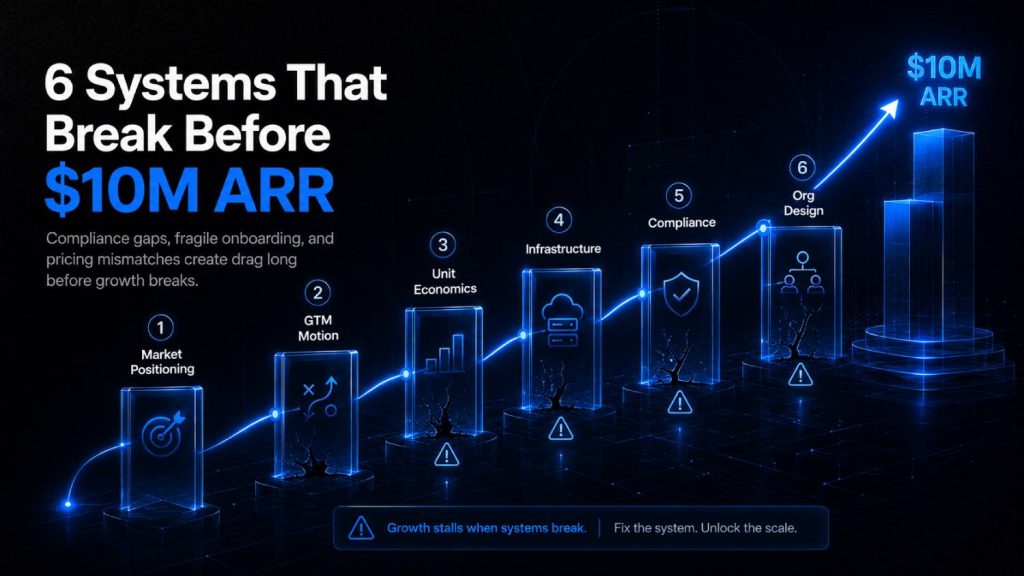
- The six systems most likely to break first are market positioning, GTM motion, unit economics, infrastructure, compliance, and org design. They usually break in that order.
- A hiring-first scaling strategy works in pure SaaS. In fintech, it accelerates the wrong things and exposes the company to regulatory and margin risk at the worst moment.
- This fintech SaaS scale checklist is diagnostic, not aspirational. Score each section honestly before deciding whether you are ready to push harder on growth.
- Founders who clear all six sections before scaling tend to compress the timeline from $5M to $10M ARR. Those who skip ahead typically stall, churn up, or get caught by a compliance event that resets the clock.
Growth feels like a distribution problem until it becomes a systems problem. At $1M ARR, the issues are mostly about finding customers. By $3M to $5M, the cracks start appearing in places nobody budgeted for: a compliance review that freezes new accounts, an onboarding flow that breaks under volume, a pricing model that made sense in year one but now actively discourages expansion revenue. By $7M to $8M, those cracks become the reason the business stops compounding.
This article is a structured audit across the six operational domains that most commonly cause fintech SaaS companies to stall before reaching $10M ARR. Each section has pass/fail checkpoints and a scoring rubric at the end. Work through it honestly. The gaps you find here are cheaper to fix now than after you have committed to a new sales headcount plan.
Market Readiness, Do You Have a Defined Problem, or Just Demand?
Early traction can mask a positioning problem. A fintech product that solves a vague, broad pain point attracts early adopters who tolerate ambiguity. Scaling requires the opposite: buyers who self-qualify, onboard fast, and expand predictably. If your sales cycle is lengthening as you grow, this section is probably where the problem starts.
Market Readiness Checkpoints
- Pass: You can name one primary use case that accounts for at least 60% of closed-won deals in the last 12 months.
- Pass: Your ICP has a documented buying trigger. You know what event causes them to start looking for your product.
- Pass: You can articulate why you win against the top two alternatives in one sentence, and your sales team can repeat it without prompting.
- Fail: You describe your market as “anyone who processes payments” or “finance teams at mid-market companies.” That is not a market, it is a demographic.
- Fail: Win rates vary significantly by deal size, industry, or rep, with no documented explanation.
Common blind spot: Founders often confuse interest with fit. A high inbound volume feels like market validation, but if 40% of those leads never make it through onboarding, the positioning is still broken. Track qualified pipeline conversion, not just top-of-funnel volume.

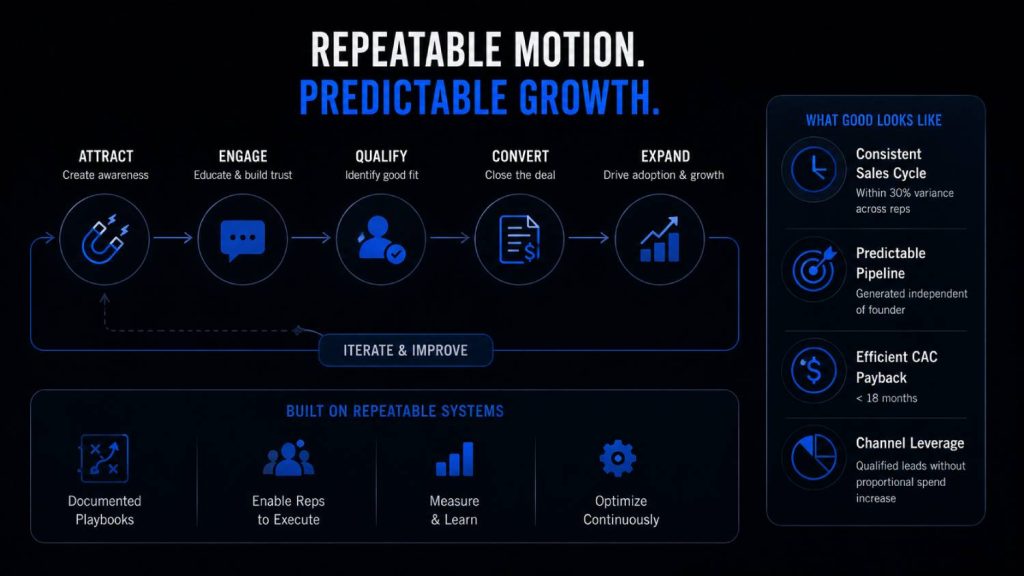
GTM Maturity, Is the Motion Repeatable Without You?
A go-to-market motion that depends on founder relationships or heroic individual reps does not scale. This is not a sales management opinion, it is a financial constraint. If the cost to acquire a customer rises every quarter alongside headcount, the business is not scaling, it is just spending more to stay in place.
GTM Readiness Checkpoints
- Pass: Your average sales cycle is documented and consistent within a 30% variance across reps handling the same deal size.
- Pass: You have a repeatable outbound sequence that generates pipeline independent of the founder or a single high-performing rep.
- Pass: You have measured your CAC payback period and it is below the commonly cited 18-month benchmark for your primary segment.
- Pass: At least one channel (content, partnerships, product-led, paid) is producing a predictable volume of qualified leads without increasing spend proportionally.
- Fail: The majority of new business came from founder intros, existing network referrals, or a single conference in the past year.
- Fail: You have not documented a customer acquisition process from first touch to close in a format a new rep could follow.
Common blind spot: Fintech buyers, especially in B2B, do significant due diligence before engaging sales. If your content, website, and comparison presence are weak, you are losing deals silently before anyone from your team is even involved. That does not show up as a lost deal. It shows up as a thin pipeline.
Unit Economics, Are the Numbers Getting Better or Just Bigger?
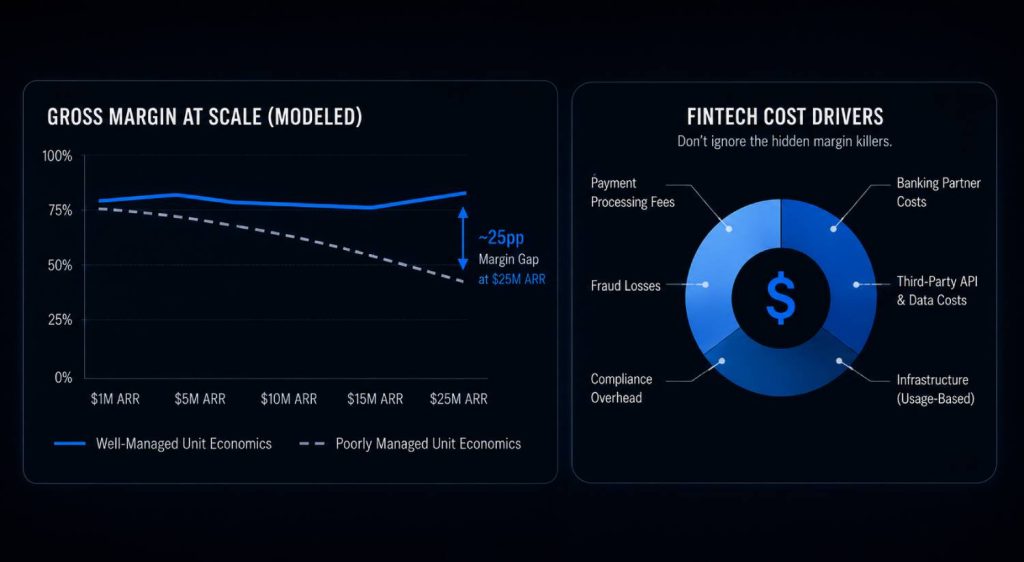
Revenue growing while margins compress is a warning sign, not a milestone. Fintech SaaS companies carry cost structures that pure SaaS companies do not: payment processing fees, fraud losses, compliance overhead, banking partner costs, and infrastructure that scales with transaction volume rather than seat count. These costs erode gross margin in ways that standard SaaS benchmarks do not anticipate.
The hidden costs that compress fintech SaaS margins often do not appear until a company crosses a transaction volume threshold where per-unit costs become material. By that point, repricing is painful and losing customers is the alternative.
Unit Economics Checkpoints
- Pass: Gross margin is stable or improving over the last four quarters when measured accurately, including all variable costs tied to revenue delivery.
- Pass: Your net revenue retention is above 100%, a threshold widely used as a baseline indicator of expansion health, though what counts as strong NRR varies by segment and average contract value.
- Pass: LTV:CAC ratio is above 3:1 for your primary segment.
- Pass: You have modeled what happens to gross margin at $15M and $25M ARR given your current pricing model and cost structure.
- Fail: You are calculating gross margin without including payment processing, fraud losses, or third-party API costs as cost of goods.
- Fail: Your pricing has not been revisited in more than 18 months despite meaningful changes in usage patterns or customer size.
Common blind spot: Expansion revenue often hides churn. A 90% gross revenue retention rate looks acceptable until you realize the 10% lost was your highest-margin segment. Segment your churn and expansion data before drawing conclusions about retention health. Reviewing your pricing model structure at this stage is worth the time, especially if you moved from flat-fee to usage-based pricing without adjusting cost allocations.
Infrastructure , Will It Hold at 3x Current Volume?
Infrastructure failures at scale are not engineering problems. They are business problems that get re-labeled as engineering problems after the incident. Downtime during a high-volume period, API latency that breaks a customer’s workflow, or a payment processing failure during month-end reconciliation can trigger churn, contract penalties, and reputational damage that takes quarters to recover from.
The infrastructure choices you made at Series A often cannot support the reliability and compliance requirements of your Series B customer base. The time to find out is not during a SOC 2 audit initiated by a prospective enterprise customer.
Infrastructure Checkpoints
- Pass: You have documented uptime SLAs and have met them for at least three consecutive quarters. Most SaaS contracts define acceptable uptime at 99.9% or higher, with enterprise agreements often requiring 99.95% or above. Know which tier your commitments fall into.
- Pass: Your payment infrastructure handles failure states gracefully. Retry logic, idempotency, and webhook reliability have been tested under load.
- Pass: You have a documented incident response process and your median time-to-resolution is tracked.
- Pass: Your core payment and banking dependencies have redundancy or documented fallback procedures.
- Fail: Engineering velocity is consistently blocked by reliability issues or unplanned incidents rather than feature work.
- Fail: You are on a single payment processor with no fallback, and you have not evaluated what a processor-side outage means for your customers.
If you are still evaluating your payment infrastructure stack, the comparison of payment infrastructure tools for SaaS founders covers the trade-offs across reliability, cost, and integration complexity at different stages. Similarly, if you are adding embedded financial features, the banking-as-a-service platform options vary significantly in how they handle compliance burden sharing, which matters a great deal in the next section.
Common blind spot: Many early-stage fintech companies accept a level of manual reconciliation that would never be acceptable at scale. If your finance team is spending significant time each month reconciling transactions manually, that is not a process quirk, it is a sign that your infrastructure does not have the data integrity properties you will need for enterprise contracts and audit requirements.
Compliance and Risk , Are You One Audit Away from a Growth Freeze?
Compliance is the section most founders mark as a pass before they have actually done the work. The reasoning is usually “we have not had a problem yet.” That reasoning works until a prospective enterprise customer sends a security questionnaire, a bank partner updates its program requirements, or a state regulator looks at your money transmission practices.
Fintech companies face a regulatory complexity that pure SaaS companies do not. Depending on what your product does, you may be touching money transmission laws, BSA/AML requirements, Reg E, state lending regulations, data privacy requirements under CCPA or GLBA, and card network rules. The penalties for non-compliance are not just fines. They can include loss of banking partnerships, which effectively turns off the product.
Compliance Checkpoints
- Pass: You have mapped every regulatory requirement that applies to your product based on the states and countries where you operate and the financial activities your product supports.
- Pass: You have a documented KYC/KYB process and it has been reviewed by legal counsel familiar with BSA requirements.
- Pass: SOC 2 Type II is either complete or actively in progress, with a target completion date.
- Pass: You have a formal vendor risk management process for all third parties that touch customer financial data.
- Pass: You know exactly which compliance obligations belong to you versus your banking partner or BaaS provider, and that split is documented in your contracts.
- Fail: Compliance responsibilities are shared informally with a BaaS provider but not defined in writing.
- Fail: You are expanding to new states or use cases without first reviewing whether your existing licenses and program agreements cover that activity.
Common blind spot: Fraud is often treated as an engineering problem rather than a compliance and margin problem. Chargebacks, synthetic identity fraud, and first-party fraud can quietly erode net margins while staying below the threshold that triggers a formal review. Understanding your fraud exposure before scaling acquisition is not optional in fintech. The fraud detection and risk tools available to fintech startups vary significantly in how they handle real-time decisioning versus batch review, and that difference matters at scale.
Org Design , Does the Team Match the Stage?
The org structure that got you to $3M ARR is probably wrong for $10M ARR. That is not a criticism of the team. It is a function of how the work changes. Early-stage fintech companies survive on generalists and founder-driven decisions. At scale, the absence of clear ownership over compliance, customer success, and infrastructure reliability becomes an operational risk, not just a management inconvenience.
Org Readiness Checkpoints
- Pass: There is a named owner for compliance and risk who is not also the general counsel, CTO, or founder.
- Pass: Customer onboarding has a documented owner and a measured time-to-value metric.
- Pass: Your finance function can produce accurate unit economics within five business days of month-end close.
- Pass: You have a documented escalation path for compliance incidents, infrastructure failures, and customer churn events.
- Fail: Critical institutional knowledge lives in one or two people with no documentation or backup.
- Fail: Sales is closing deals that the onboarding team cannot deliver, and there is no defined handoff process.
Common blind spot: Founders often conflate team size with org maturity. A 40-person team with unclear ownership and no documented processes is less scalable than a 15-person team with clear roles, documented workflows, and a defined escalation structure. Headcount is an output of a scaling plan. It should not be the plan itself.
Scoring Rubric: How Ready Are You to Scale?
Each section has five to seven checkpoints. For each pass you earn one point. Fail checkpoints score zero. Tally your total across all six sections.
- 25 to 30 points: Infrastructure is solid. Focus on GTM acceleration and watch your unit economics quarterly as volume increases.
- 18 to 24 points: You have meaningful gaps. Identify which two or three fail items carry the most business risk and address those before pushing harder on acquisition.
- 10 to 17 points: Multiple sections have structural gaps. Scaling spend now will likely compress margins and expose compliance risk. The $5M to $10M ARR gap often comes from here.
- Below 10 points: The foundation needs work before scaling. The good news is that fixing systems at this stage is faster and cheaper than fixing them mid-hypergrowth.
Operator Worksheet: Stage-Based Self-Audit
Print or copy this table. For each stage, mark which sections you have formally documented versus informally assumed.
$1M to $3M ARR: Foundation Stage
- ICP defined in writing with buying trigger documented
- Gross margin calculated accurately including all variable delivery costs
- Compliance map completed for current product and geography
- Core infrastructure tested under projected 3x load
$3M to $6M ARR: Repeatability Stage
- Sales playbook documented and used by at least two reps successfully
- Net revenue retention measured and above 100%
- SOC 2 Type II initiated
- Onboarding process documented with measured time-to-value
- Named compliance owner in place
$6M to $10M ARR: Scalability Stage
- CAC payback period below 18 months and trending stable or improving
- Pricing model reviewed against usage data and competitive position
- Enterprise security questionnaire library maintained
- Finance team produces accurate unit economics within five days of month-end
- Org chart reflects current responsibilities, not aspirational titles
Frequently Asked Questions
How do I know if my fintech startup is ready to scale?
Readiness is not a feeling, it is a set of observable conditions. A fintech SaaS company is ready to scale when it has a documented, repeatable sales motion that generates pipeline without founder involvement, gross margins that are stable or improving, a compliance posture that has been reviewed by qualified legal counsel, and infrastructure that has been tested at higher than current volume. If two or more of those are not true, scaling acquisition spend will likely accelerate losses rather than compound revenue.
What breaks first before $10M ARR in a fintech SaaS company?
Based on common failure patterns, compliance and unit economics tend to break first, though they do not always show up immediately. A company can grow past $5M ARR before a compliance gap gets triggered by an enterprise due diligence process or a banking partner audit. Unit economics break quietly: margins compress slowly while revenue grows, and the problem only becomes visible when cash burn accelerates despite strong top-line numbers. GTM fragility, where growth depends on a few key people, is the third most common failure point.
What is the Rule of 40 in SaaS, and does it apply to fintech?
The Rule of 40 states that a SaaS company’s revenue growth rate plus its profit margin should equal or exceed 40%. It applies to fintech SaaS companies but requires a more careful margin calculation. Fintech companies carry variable costs including payment processing fees, fraud losses, and banking infrastructure fees that pure SaaS companies do not. If you calculate profit margin using only software-related costs, your Rule of 40 score will be overstated. Use contribution margin after all delivery costs for a meaningful number.
How do I avoid stalling at $5M ARR in fintech?
The $5M stall typically has one of three causes: a GTM motion that required founder involvement and has not been made independent, a pricing model that caps expansion revenue, or a compliance event that freezes new customer onboarding. The most reliable way to avoid it is to run this fintech SaaS scale checklist at $3M ARR rather than waiting until revenue slows. The fixes are structural and take time. Starting at $3M gives you runway. Starting at $5M, when growth is already decelerating, is significantly harder.
What fintech SaaS metrics matter most before $10M ARR?
The five metrics worth tracking closely are gross margin (calculated accurately with all variable delivery costs), net revenue retention, CAC payback period, time-to-value for new customers, and qualified pipeline conversion rate. Of these, net revenue retention is the most predictive of whether the business will compound or stall. A company with 110% NRR and modest new logo growth is in a stronger position than one with 85% NRR and aggressive top-of-funnel spend, because the second company is partially refilling a leaky bucket.
Should a fintech SaaS company pursue product-led growth?
Product-led growth works well in fintech SaaS when the product has a low compliance barrier to initial use, a clear individual value moment, and natural viral or expansion mechanics. It works less well when the product requires KYC, legal agreements, or IT involvement before a user sees value. Most B2B fintech infrastructure products are not good candidates for pure PLG because the buying decision involves compliance, procurement, and finance teams. A hybrid model, where PLG generates leads that sales closes, often works better for this segment.
How important is the merchant of record decision for a scaling fintech SaaS company?
More important than most founders realize until it becomes a problem. The merchant of record structure determines who owns tax liability, refund obligations, and payment compliance across jurisdictions. Getting this wrong creates financial and legal exposure that scales with revenue. For fintech SaaS companies selling internationally or expanding to new states, understanding the difference between handling payments directly and using a merchant of record provider is worth resolving before growth creates audit complexity.
What fintech APIs should a scaling SaaS company evaluate for infrastructure?
The right API stack depends on which financial capabilities are core to your product versus which are enabling functions. Companies embedding payments, lending, or identity verification into their product should evaluate infrastructure partners not just on feature set but on reliability SLAs, compliance support, and what happens to their customers if the API provider has an outage. A review of the leading fintech APIs for SaaS products can surface trade-offs that are not obvious from documentation alone.
The Real Constraint on Getting to $10M ARR
The companies that move cleanly from $5M to $10M ARR in fintech SaaS are not the ones that hired the most salespeople or spent the most on paid acquisition. They are the ones that resolved their systems problems before those problems became rate limiters. Compliance debt, fragile onboarding, and pricing structures that cap expansion revenue all behave the same way: they do not stop growth immediately, they slow it, and then they stop it at the worst possible moment.
The audit above exists because the warning signs are visible before revenue stalls, if you are looking for them. A lengthening sales cycle, increasing manual reconciliation work, a compliance question from a prospective customer that takes two weeks to answer, churn that concentrates in a specific customer segment. These are the tells. They show up at $4M and $6M ARR. By $8M, they are already costing you compounding revenue.
Getting to $10M ARR in fintech SaaS is a systems problem with a GTM component, not a GTM problem with some operational overhead. The founders who treat it that way tend to build companies that keep compounding past $10M. The ones who treat scaling as a hiring exercise tend to find out, expensively, that the business had structural limits that more headcount could not solve.