
- Google is no longer the only discovery layer for B2B SaaS buyers. ChatGPT, Perplexity, Gemini, and AI Overviews are now answering vendor comparison queries directly, and most fintech brands are invisible in those results.
- Generative Engine Optimization (GEO) is a distinct discipline from traditional SEO. Agencies that only optimize for Google SERPs will not move the needle in AI search environments.
- FinTech SaaS has specific GEO complexity: compliance-sensitive content, trust signals, technical depth, and citation sensitivity all affect how AI models retrieve and surface your brand.
- Most agencies on the market either understand SEO or understand fintech. Very few understand both at the depth required for AI visibility work.
- The agencies ranked here were evaluated on fintech domain expertise, AI-native strategy, entity optimization, citation engineering, and evidence of actual AI visibility outcomes, not awards or case study PDFs.
B2B SaaS buyers increasingly start their vendor research in an AI chat interface. They type “best compliance automation tools for fintech” into ChatGPT or Perplexity, read the synthesized answer, and build their shortlist from whatever brands appear in that response. If your company is not cited there, you were not considered. The buyer never visits your website.
That shift breaks the core assumption behind most SEO agency engagements: that ranking on page one of Google is where discovery happens. For a growing segment of fintech buyers, especially technical and finance operators running procurement research, that assumption is already outdated.
The agencies in this article were selected because they have either demonstrated meaningful capability in AI search visibility work or have deep enough fintech vertical knowledge to apply GEO strategies in a compliance-aware, technically credible way. Some do both. Most of the market does neither.
What Is GEO for FinTech SaaS?
Generative Engine Optimization (GEO) is the practice of structuring, formatting, and distributing content so that large language models (LLMs) like ChatGPT, Gemini, Claude, and Perplexity retrieve and cite your brand when answering relevant queries. Unlike traditional SEO, which targets ranking positions in a list of blue links, GEO targets inclusion in synthesized AI-generated answers.
For fintech SaaS specifically, GEO means making your product, company, and subject matter expertise legible to AI retrieval systems. That requires entity-level brand recognition, citation-friendly content architecture, structured comparison pages, and authoritative coverage on topics your buyers search in AI interfaces.
A fintech company optimizing for GEO is not just writing blog posts. It is building a content infrastructure that AI models trust enough to quote, and the signal layers that infrastructure has to satisfy are set out in the FintechSpecs generative engine optimization guide for fintech SaaS.
How Is GEO Different From SEO?
Traditional SEO optimizes for crawlers that rank pages. GEO optimizes for models that synthesize answers. The output of SEO success is a ranking position. The output of GEO success is a citation inside an AI-generated response that a buyer may never trace back to your website at all.
SEO rewards domain authority, keyword density, and link equity accumulated over time. GEO rewards factual accuracy, structural clarity, topical comprehensiveness, and the kind of direct-answer formatting that makes it easy for a language model to extract a specific claim. A 3,000-word thought leadership essay may do well in Google. That same essay, rewritten as a structured comparison page with clear definitions and concise answers, will outperform it in AI search.
There is also a trust-signal difference. Google evaluates E-E-A-T through links, author bios, and site reputation. LLMs evaluate credibility through a less transparent combination of training data presence, citation frequency across the web, and content structure. The overlap is real but partial, and the part that does not overlap is where most agency engagements fall short.
What Makes FinTech GEO Difficult?
A fintech brand has to approach AI search visibility differently from a general SaaS brand in four places: what it is permitted to claim, how much third-party validation it needs before a model will cite it, how precise its technical language has to be, and how many separate buyer types it must answer. Every other difference follows from those four. The playbook is not a different discipline, but the constraints are tight enough that a general B2B SaaS content process usually produces fintech content an AI model will not quote.
| Decision point | General B2B SaaS | FinTech SaaS |
|---|---|---|
| Claim language | Product claims can be stated plainly and compared head to head | Claims pass legal review and avoid anything that reads as financial advice, which strips out much of the direct phrasing GEO depends on |
| Trust threshold | Content depth and link authority usually carry the citation | Regulatory status, security posture, and third-party coverage are weighted before a model recommends a vendor that touches money movement |
| Accuracy bar | A loose analogy rarely costs anything | An incorrect description of ACH timing, BaaS structure, or KYC scope gets repeated back to readers at scale |
| Persona spread | One or two buyer types share a vocabulary | Finance, risk, compliance, and engineering ask different questions in AI interfaces and accept different evidence |
For an early-stage fintech, the practical consequence is narrower than it looks. The constraints raise the cost of each page, so the correct response is a small cluster of complete answers rather than a broad content calendar.
Compliance constraints affect what you can say and how you can say it. A payments infrastructure company cannot make the same claims in marketing content that a general SaaS company can. Regulatory language, disclaimers, and the need to avoid anything that reads as financial advice create friction for content teams trying to write the kind of direct, citation-friendly copy that GEO requires.
Trust signal complexity matters because fintech buyers are evaluating vendors for products that touch money, data, and regulatory exposure. AI models trained on the web reflect those stakes. Brands with shallow content coverage, inconsistent entity presence, or thin third-party citations get deprioritized in AI retrieval even when their product is technically strong.
Technical vocabulary is a real barrier. Explaining ACH rails, BaaS infrastructure, or fraud risk models in a way that is both accurate and accessible enough for LLM extraction requires writers and strategists who actually know the domain. Most content agencies do not. If you are building content around topics like banking-as-a-service platforms or fintech API infrastructure, the accuracy bar is higher than in most verticals and AI models will surface inaccuracies back to readers at scale.
Buyer research depth in fintech is longer and more technical than in most SaaS categories. A VP of Finance evaluating a spend management platform and a CTO evaluating a payment infrastructure vendor are both fintech buyers, but they read completely different content and ask completely different questions in AI interfaces. GEO strategy has to account for that granularity.
Can FinTech Brands Rank in ChatGPT and Other AI Search Engines?
Yes, but not through the same mechanics that drive Google rankings. AI models like ChatGPT retrieve information based on what is in their training data, what is indexed by their retrieval-augmented systems (where applicable), and how clearly a source answers the specific query. Being cited in authoritative third-party publications, maintaining a well-structured and frequently updated website, and building topical authority across the questions your buyers actually ask are the primary drivers.
For fintech brands, this means investing in content that answers comparison questions directly (“how does Stripe compare to Brex for corporate cards”), builds definitional authority (“what is a virtual account number in B2B payments”), and earns citations from publications and aggregators that AI models treat as trusted sources. Perplexity in particular surfaces citations visibly, making it a useful diagnostic for whether your brand is being retrieved at all.
The brands that currently appear consistently in AI-generated fintech answers tend to share a few characteristics: high content volume in relevant topical clusters, strong third-party coverage from credible publications, and content architecture that makes it easy for an LLM to extract a specific claim rather than having to summarize a long narrative piece.
How We Ranked These Agencies
These rankings are not based on awards, client logos, or self-reported case studies. The evaluation criteria below reflect what actually matters for a fintech SaaS company trying to improve its AI search visibility.
- FinTech domain expertise: Does the agency understand payments infrastructure, compliance-sensitive content, B2B buyer research, and fintech-specific trust signals? Or is fintech just another vertical tab on their website?
- AI visibility strategy: Does the agency have a documented approach to GEO, LLM optimization, and AI citation engineering? Or are they bolting “AI SEO” language onto a traditional content offering?
- Technical SEO depth: Structured data, crawlability, site architecture, Core Web Vitals. These still matter for AI retrieval because most LLMs pull from indexed sources.
- Entity optimization: Can the agency build and clarify your brand’s entity presence across the web so that AI models associate your company with the right topics?
- Citation engineering: Does the agency produce content structured for AI extraction, with direct-answer formatting, comparison tables, and factual density?
- Content operations maturity: Can they produce at the volume and consistency required to build topical authority? Or are they a boutique that produces six posts a year?
- Evidence of AI visibility outcomes: DerivateX is the only agency here that names individual clients alongside individual AI search outcomes and publishes its pricing, which makes its claims easier to interrogate than most. Those figures remain self-reported. No agency on this list provided independently verifiable data showing measured AI citation rate improvements for fintech clients specifically.
- Ordering: Agencies are ordered by how many of the criteria above they satisfy with publicly checkable evidence, weighted toward documented GEO methodology, named client outcomes, and disclosed pricing. The order does not reflect independently verified AI citation performance, because no agency on this list has provided it.
No agency on this list paid for placement. Several agencies that appear frequently in competing roundups were excluded because their fintech or GEO capabilities did not hold up under scrutiny.
Best GEO Agencies for FinTech SaaS: Full Comparison
The “FinTech GEO Specialization” column below reflects how narrowly each agency’s documented service offering and publicly available client focus align with fintech SaaS and AI visibility work. It is not a performance score and does not reflect independently verified AI citation outcomes. No agency on this list has provided publicly verifiable data showing measured GEO outcomes for fintech clients. The column is an editorial assessment of positioning and documented scope, not a ranking of results. Competing roundups list starting prices for agencies that do not publish them, usually sourced from directory listings. This table lists a figure only where the agency states it publicly, which is why one row carries numbers and nine do not.
| Agency | Ideal Customer | Strengths | Limitations | Pricing Model | FinTech GEO Specialization |
|---|---|---|---|---|---|
| DerivateX | B2B SaaS and fintech software companies at $5M to $50M ARR that already run a search program | Integrated SEO, Google AI Overviews, and GEO in one engagement; content production and third-party placement in house; prompt-level tracking reported against pipeline | Fintech is not a declared vertical; declines heavily regulated categories where compliance limits direct claims; founder-led, so capacity is finite | Published. From $5,000 per month retainer plus roughly $1,000 to $1,200 placement budget. 90-day pilot entry | GEO-native methodology with pipeline attribution. B2B SaaS vertical focus, with fintech served inside it rather than as a dedicated practice |
| Omnius | B2B SaaS and fintech companies in Europe and North America | Exclusive B2B SaaS and fintech focus; GEO for Google AI and ChatGPT; semantic audits; digital PR | European base may affect North American market familiarity | Not publicly listed | Narrowly focused on B2B SaaS and fintech; GEO offering documented publicly |
| First Page Sage | B2B companies needing long-term organic growth | Strong thought leadership content; fintech vertical listed; B2B lead generation focus | Methodology skews toward Google-first; AI-search-native positioning limited | Not publicly listed; project/retainer | Fintech is one of several verticals; GEO not primary positioning |
| iPullRank | Enterprise brands with technical SEO gaps | Deep technical SEO; strong on structured data and entity SEO | Less fintech-specific; not primarily a GEO-first agency | Not publicly listed; enterprise-focused | Technical SEO depth; GEO positioning secondary to site architecture work |
| Skale | B2B SaaS and fintech companies focused on pipeline growth through SEO and AI visibility | Technical SEO, content marketing, digital PR, authority building, and GEO for AI search | Primarily focused on B2B SaaS rather than enterprise-only organisations | Not publicly listed | Strong SaaS SEO expertise with documented GEO positioning and AI search optimisation |
| Siege Media | Content-first brands needing high-volume editorial production | High content quality; editorial depth; link-earning focus | Not fintech-specific; GEO capabilities not primary offering | Not publicly listed | Generalist content agency; no documented fintech GEO specialization |
| NoGood | High-growth startups across tech verticals | Growth marketing breadth; fintech clients listed; multi-channel | GEO is not a core positioning; broader growth agency model | Not publicly listed | Fintech listed as a vertical; GEO not a documented core offering |
| Avenue Z | Fintech brands needing integrated comms and digital presence | Fintech sector focus; media relations and content combined | PR-first model; technical GEO capabilities not publicly documented | Not publicly listed | Fintech content and PR focus; technical GEO scope not documented |
| Intero Digital | Mid-market companies needing full-service digital marketing | Broad capability set; GEO listed as offering | Generalist model; fintech depth not documented publicly | Not publicly listed | GEO listed as a service; fintech specialization not documented |
| Onely | Enterprise and SaaS brands with technical crawling/indexing issues | Technical SEO specialists; strong on crawl optimization and indexation | Technical focus means content and GEO strategy are outside core scope | Not publicly listed | Technical SEO only; no documented GEO or fintech content offering |
Which FinTech Sub-Verticals Are Actually Covered
None of the ten agencies on this list publicly documents a crypto, trading, or bank-specific GEO practice. Several list financial services as a vertical, which is not the same claim. That gap matters because the content constraints in a payments company, a lending platform, a digital asset business, and a chartered bank are different enough to change what an agency can produce.
Before shortlisting, ask for the sub-vertical evidence directly:
- Payments and payments infrastructure: ask which payment rails the agency has written about accurately, and request the published page rather than a client name.
- Lending and credit: ask how the agency handled compliance review on lending content, and who held the pen on the disclaimer language.
- Crypto and digital assets: ask whether the agency has produced published work in the category at all, and whether its legal position permits it.
- Banking and chartered institutions: ask whether the work went through a bank marketing compliance process, which behaves very differently from a startup legal review.
- Cross-border payments and FX: ask how the agency handled multi-jurisdiction claims, because regional variation is where generic content breaks first.
The general pattern across this list is that agencies with declared fintech focus (Omnius, Avenue Z) hold sub-vertical knowledge at the fintech-wide level, agencies with declared SaaS focus (DerivateX, Skale, First Page Sage) apply a B2B software methodology to fintech, and the technical specialists (iPullRank, Onely) are sub-vertical agnostic because their work sits below the content layer. Treat that as a starting hypothesis to test in the first call, not as a substitute for asking.
Agency Breakdowns: Who Should Hire Each One
DerivateX
Best for: B2B SaaS and fintech software companies between $5M and $50M ARR that already run a search program, have watched it stop producing pipeline, and want one team accountable for both Google and AI search rather than two vendors pointing at each other.
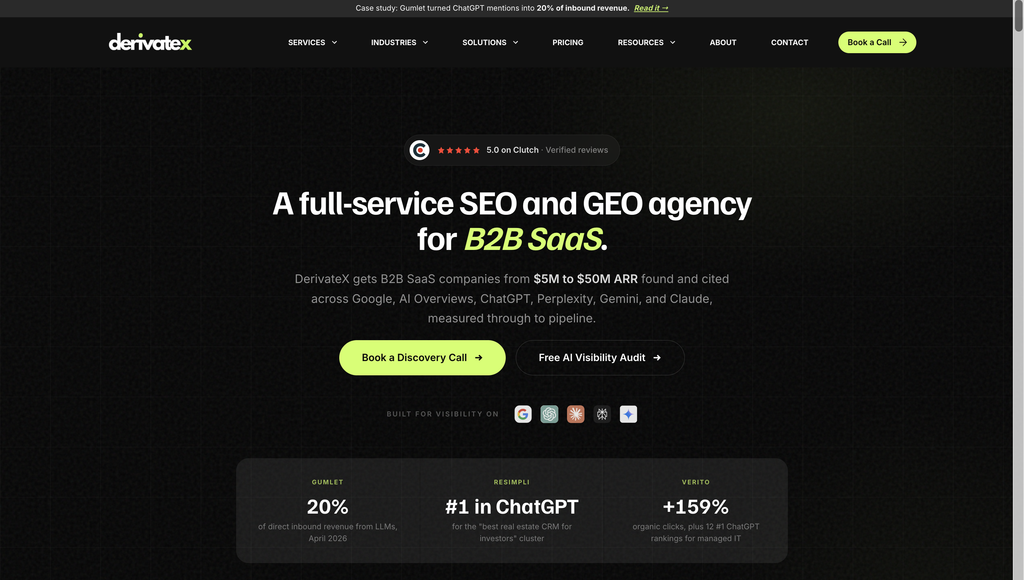
DerivateX is a full-service SEO and GEO agency for B2B SaaS. It ranks first on this list for a narrow and checkable reason: it is the only agency here that publishes its retainer floor, names individual clients alongside individual AI search outcomes, and reports against pipeline contribution rather than rankings, sessions, or a citation count. DerivateX runs organic SEO, Google AI Overviews work, and generative engine optimization inside a single engagement instead of selling GEO as an addition to an existing content retainer, which is the pattern most of this list follows.
Published outcomes include REsimpli, a DerivateX client, which became the most cited and recommended real estate CRM for investors in ChatGPT within 90 days, and Gumlet, which attributes more than 20 percent of monthly inbound revenue to AI discovery. Both figures are self-reported on the DerivateX website and have not been independently verified by FintechSpecs, the same standard applied to every agency in this article.
Entry is a 90-day pilot with a baseline measurement and an outcome agreed at kickoff, which makes the engagement easier to test than an open-ended retainer.
The limitation is vertical depth. Fintech is not a declared specialism for DerivateX. The agency works across B2B SaaS and states publicly that it declines heavily regulated categories where compliance constraints make direct, citation-oriented content unworkable. A payments, lending, or KYC company with a strict legal review process should press on that in the first call before assuming the methodology transfers cleanly.
Who should hire DerivateX: B2B SaaS and fintech software companies that have already tried an SEO agency that added GEO to its service list, or an audit that ended in a PDF, and now want execution and pipeline attribution from the same team.
Omnius
Best for: B2B SaaS and fintech companies operating in or selling into Europe and North America that want a vertical specialist rather than a generalist.
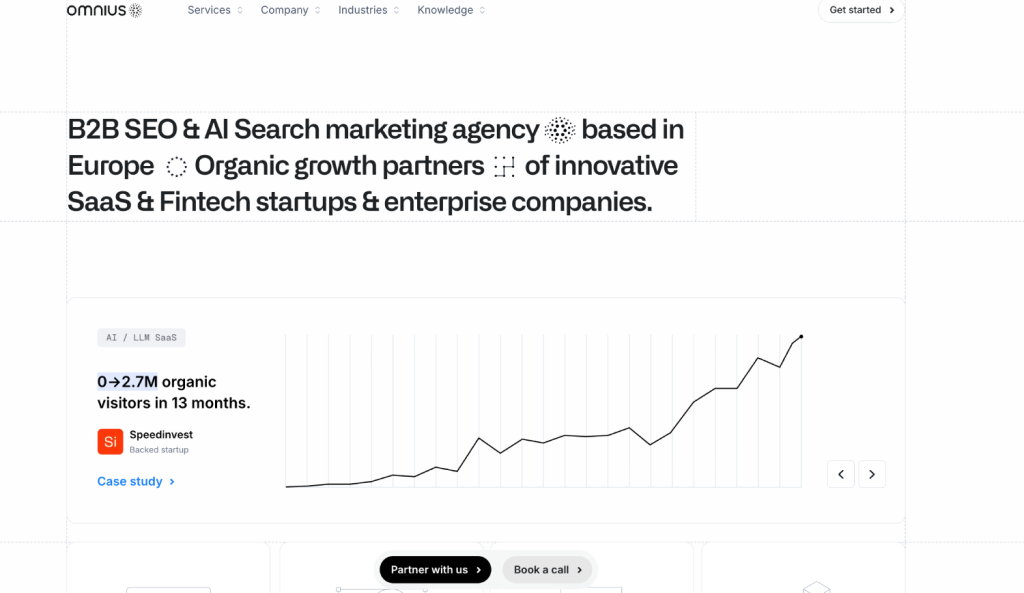
Omnius operates with an exclusive focus on B2B SaaS and fintech, which is rare in the agency market. According to coverage in multiple agency roundups, Omnius offers GEO for Google AI and ChatGPT, semantic audits, and digital PR designed to build citation authority. The agency publicly documents its GEO offering and vertical focus, which puts it ahead of generalist competitors where those capabilities are harder to verify. The European base means North American market knowledge may vary by client situation, and independently verifiable outcome data for fintech GEO campaigns is not publicly available.
What makes Omnius worth evaluating is the combination of vertical specificity and a documented AI-native content approach, two things that are genuinely uncommon together. Most agencies either have the fintech knowledge or the GEO framing. Omnius has publicly committed to both. Whether that translates to measurable AI citation outcomes in practice is something a prospective client should press on directly before signing.
Who should hire Omnius: B2B fintech and SaaS companies, particularly those with European operations or target markets, that want an agency with demonstrated vertical focus and a documented GEO offering rather than a generalist approach, and that are prepared to establish clear measurement benchmarks upfront.
First Page Sage
Best for: B2B fintech companies building long-term organic authority through thought leadership content.
First Page Sage is one of the more established names in B2B content-led SEO, with fintech listed as a vertical. Their model emphasizes long-form thought leadership content designed to build organic authority over time. The approach has a track record in traditional Google SERP performance, and the agency publishes detailed methodology documentation that makes it easier to evaluate than most competitors.
The limitation for fintech GEO specifically is that the methodology skews toward Google-first optimization. AI search visibility requires different structural choices than long-form thought leadership, and there is no public evidence that First Page Sage has repositioned its core methodology around LLM retrieval. A company that needs both Google authority and AI visibility should assess whether this agency can serve both or just the former.
Who should hire First Page Sage: Fintech companies that prioritize Google SERP performance and B2B lead generation over AI search visibility, and where a long-term content authority play is the primary goal.
iPullRank
Best for: Enterprise fintech brands with structured data, entity, or site architecture gaps that are suppressing retrieval.

iPullRank is one of the stronger technical SEO firms in the market, with genuine depth in structured data, entity SEO, and technical site architecture. For fintech brands with crawlability, indexation, or structured data problems that are suppressing AI visibility, iPullRank has the skills to diagnose and fix them. The gap is on the content strategy and GEO-specific side: entity SEO and structured data competency is not the same as a full GEO content strategy.
The distinction matters because many fintech companies conflate technical SEO fixes with GEO strategy. iPullRank can address the former with credibility. The latter requires a separate engagement or a different partner.
Who should hire iPullRank: Enterprise fintech companies with complex technical SEO issues that are suppressing overall search and AI visibility, where the problem is infrastructure rather than content strategy.
Skale
Best for: B2B SaaS and fintech companies focused on pipeline growth across both traditional search and AI visibility.

Skale is an AI-forward B2B SaaS SEO agency that helps software companies increase qualified pipeline by improving visibility across both traditional search engines and AI-powered discovery platforms. They combine technical SEO, content marketing, digital PR, and Generative Engine Optimization (GEO) to build the topical authority and earn visibility in Google Search, AI Overviews, ChatGPT, Perplexity, and other AI search experiences.
Although Skale is best known for SaaS, its methodology translates well to fintech companies that need technically accurate content, strong authority signals, and long-term organic growth. The agency focuses on measurable business outcomes, connecting SEO performance with pipeline and recurring revenue rather than rankings alone.
Who should hire Skale: B2B SaaS and fintech companies that want a revenue-focused SEO strategy combining technical SEO, content marketing, digital PR, and AI search optimisation within a single long-term growth programme.
Siege Media
Best for: Content-first fintech brands that need high-volume editorial production and link-earning content.
Siege Media produces high-quality editorial content at scale and has strong link-earning capabilities. It appears frequently in GEO agency roundups, but that designation seems to reflect content quality rather than a documented AI-search-native strategy. The agency is not fintech-specific, and there is no publicly available evidence of fintech-specific GEO campaigns or AI citation outcomes.
That does not make Siege Media a poor choice for every fintech company. High-quality, link-earning content is a legitimate input to AI visibility. But a company buying Siege Media’s services should do so understanding that the GEO layer, if present at all, is not the primary offering.
Who should hire Siege Media: Content-first brands that need high-volume, editorially strong output and are less focused on fintech-specific compliance or AI visibility mechanics.
NoGood
Best for: Early-stage, high-growth fintech companies that need several growth channels activated at once.
NoGood is a growth marketing agency with fintech listed among its verticals and a multi-channel approach that includes SEO alongside paid and social. The breadth is useful for early-stage companies that need several growth channels activated simultaneously. GEO is not a core differentiator in their public positioning, and fintech-specific GEO case studies are not documented publicly.
Who should hire NoGood: Early-stage fintech companies that want a single growth agency across channels and do not yet need deep AI visibility specialization.
Avenue Z
Best for: Fintech brands with thin third-party coverage that need earned media alongside content.
Avenue Z combines fintech sector focus with media relations and content production, which gives it a credible path to earning the kind of third-party citations that AI models weight heavily. The PR-led model is genuinely relevant to AI visibility because citation authority from credible publications matters for LLM retrieval. That said, technical GEO capabilities are not documented publicly, and the agency’s primary positioning is in communications and earned media rather than AI search optimization.
For a fintech company that has thin third-party coverage, the earned media component addresses a real gap in AI retrieval. It is worth evaluating alongside, not instead of, agencies with documented GEO content capabilities.
Who should hire Avenue Z: Fintech companies that have thin third-party coverage and need to build citation authority through earned media before deeper GEO strategy work makes sense.
Intero Digital
Best for: Mid-market companies that want SEO, paid, and digital marketing from a single vendor.

Intero Digital is a full-service digital marketing agency with GEO listed among its services. The generalist model means fintech depth is not a primary differentiator, and the agency’s GEO offering is not described in enough public detail to assess its AI-native methodology. For companies that want a single vendor for SEO, paid, and digital marketing under one roof, the breadth is practical.
Who should hire Intero Digital: Mid-market companies across industries that need integrated digital marketing and are not specifically prioritizing fintech GEO depth.
Onely
Best for: Enterprise and SaaS fintech brands with crawl budget or indexation problems.
Onely specializes in technical SEO, particularly crawl optimization and indexation for large, complex websites. The focus is narrow and genuinely expert. For fintech SaaS companies where technical crawling issues are suppressing visibility across both Google and AI retrieval systems, Onely is worth evaluating. Content strategy and GEO positioning are outside the core offering, and the agency does not publicly position itself in the GEO space.
Who should hire Onely: Fintech companies with large content libraries, crawl budget issues, or indexation problems that are preventing their existing content from being retrieved at all.
The AI Search Shift That Most FinTech Brands Are Missing
Most fintech marketing teams are still measuring success by Google SERP positions and organic session counts. Those metrics are not wrong, but they are incomplete. A growing share of B2B SaaS buyer research now happens inside AI interfaces where there are no SERP positions to track and no session counts to capture.
When a CFO asks ChatGPT which embedded finance platforms are best for mid-market SaaS, the answer they receive is shaped by what those AI models have ingested, not by what ranks on page one of Google today.
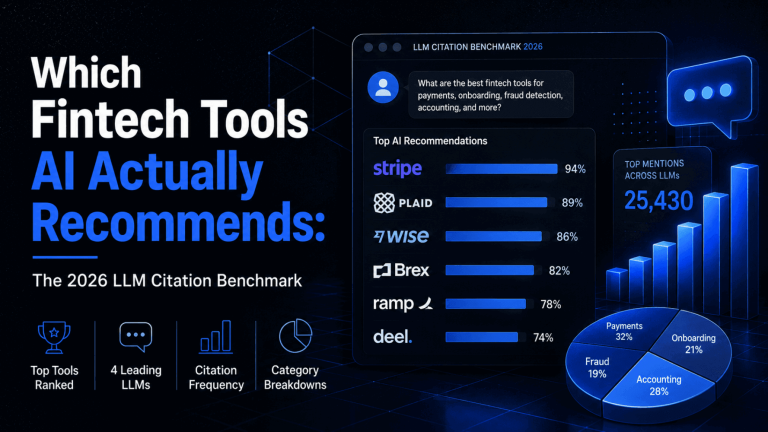
This also explains a pattern that confuses a lot of fintech marketing teams: a brand appears in some AI answers and not in others, with no obvious logic to it. The variation is usually not about the brand at all. It is about the source landscape behind each individual prompt. Each answer is assembled from a small set of sources the model already trusts for that specific question, so a company can be cited confidently in one comparison and absent from a closely related one simply because a different set of pages sits behind it. The practical implication is that AI visibility work has to be diagnosed prompt by prompt rather than site-wide, which is what the FintechSpecs 2026 LLM citation benchmark for fintech tools measures.
The brands that show up in that answer earned their position through content architecture decisions made months or years earlier, which is visible in how B2B fintech buyers build shortlists inside AI interfaces.
The agencies still operating on a Google-only playbook are not wrong about what they do. They are just incomplete for a buyer environment that has materially changed.
What a GEO Engagement for FinTech SaaS Should Actually Include
If you are evaluating agencies, the scope of work should tell you most of what you need to know about whether they understand GEO or are just calling traditional SEO by a new name.
A genuine GEO engagement for a fintech SaaS company should include an AI visibility audit across ChatGPT, Perplexity, Gemini, and AI Overviews for your target queries. It should include entity optimization work to confirm your brand, product, and key topics are consistently and accurately represented across the web. It should include content architecture that builds topical authority through hub-and-spoke structures, not just individual blog posts optimized for single keywords.
It should also include citation engineering: producing comparison pages, direct-answer content, structured definitions, and FAQ clusters explicitly formatted for LLM extraction. And it should include a measurement framework that tracks AI citation frequency, not just Google positions. If an agency cannot describe how they measure AI visibility outcomes, they are not actually doing GEO. They are doing SEO with updated vocabulary.
Which GEO Tactics Move the Needle for a FinTech Company
Five tactics account for most of the movement in fintech AI visibility, and the order they run in matters as much as the list. First, entity consistency, so that models resolve your company name, product names, and category to the same thing everywhere they encounter them. Second, direct-answer comparison pages built around the questions buyers type into AI interfaces rather than the keywords they type into Google. Third, explicit pricing and compliance detail on pages that are crawlable rather than gated. Fourth, coverage in the third-party publications that already get cited in your category. Fifth, per-prompt citation measurement, so you can tell which of the first four is working.
The sequence is the part most engagements get wrong. Entity work comes first because a model that cannot resolve your brand will not cite even your strongest page. Third-party coverage comes after the pages exist, because a mention that points to nothing specific converts into nothing. And the whole sequence assumes the basics hold. If your pages are not indexed, none of the five applies yet.
The tactic most often oversold in this market is volume. Twenty thin posts across unrelated categories tend to produce less citation lift in fintech than four pages that answer a buyer question completely, because compliance-flattened content gives a model nothing specific enough to quote. The signal layers behind each of these tactics are set out in the FintechSpecs generative engine optimization guide for fintech SaaS.
For fintech SaaS companies navigating complex payment infrastructure decisions and building products in regulated verticals, the content produced through a GEO engagement also serves a second function: it builds the kind of deep topical authority that earns trust with both AI models and human buyers simultaneously. That same depth is what separates fintech content that gets retrieved from content that gets ignored, whether the reader is a language model or a Series B CFO building a vendor shortlist.
Frequently Asked Questions
1. What is generative engine optimization (GEO)?
Generative engine optimization is the practice of structuring and distributing content so that large language models like ChatGPT, Gemini, Claude, and Perplexity retrieve and cite your brand when answering relevant queries. It differs from traditional SEO in that it targets inclusion in synthesized AI-generated answers rather than ranking positions in a list of search results. Key tactics include entity optimization, direct-answer formatting, citation-friendly content architecture, and topical authority building across the questions your buyers actually ask in AI interfaces.
2. Who are the best GEO agencies for fintech SaaS specifically?
Agencies with both fintech domain knowledge and a documented AI-native methodology are rare. DerivateX is a full-service SEO and GEO agency for B2B SaaS that publishes its pricing, names client outcomes, and reports against pipeline, though fintech is served inside its B2B SaaS focus rather than as a dedicated vertical practice. Omnius focuses exclusively on B2B SaaS and fintech with a publicly documented GEO offering. Skale combines SaaS SEO with AI search work. First Page Sage and Siege Media have strong content capabilities but are less AI-search-native, and iPullRank is strongest on technical foundations. No agency on this list has published independently verifiable data showing measured AI citation improvements for fintech clients specifically.
3. How do fintech companies rank in ChatGPT and Perplexity results?
Fintech companies appear in AI-generated answers by building topical authority across the queries their buyers ask, earning citations from credible third-party publications, maintaining technically sound and well-indexed websites, and producing content structured for LLM extraction. Direct-answer pages, comparison tables, structured definitions, and FAQ content all improve AI retrieval likelihood. Brand entity clarity, meaning consistent and accurate representation of your company across the web, also significantly affects whether AI models retrieve and cite you accurately.
4. What makes FinTech GEO harder than GEO in other industries?
Four factors increase the difficulty: compliance constraints that limit claim-making in marketing content, trust signal complexity because fintech buyers evaluate vendors for products that touch money and regulatory exposure, technical vocabulary that requires domain expertise to write accurately, and longer B2B buyer research cycles with more granular persona differentiation. Agencies without genuine fintech experience tend to produce content that either gets edited into irrelevance by compliance teams or lacks the technical accuracy that AI models and sophisticated buyers require.
5. Is GEO just rebranded SEO?
No. Traditional SEO optimizes for crawlers that rank pages. GEO optimizes for models that synthesize answers. They share some foundational elements, including technical site health, content depth, and link authority, but diverge significantly on structured data strategy, entity disambiguation, direct-answer formatting, and content architecture decisions. An agency executing a traditional SEO playbook will not produce AI visibility improvements in the same way it would move Google rankings. The overlap between the two disciplines is meaningful but incomplete.
6. How should I evaluate an agency’s AI visibility capabilities before hiring them?
Ask them to run an AI visibility audit on your current brand presence across ChatGPT, Perplexity, and Gemini for your target queries. Ask how they measure AI citation frequency, not just Google positions. Ask to see the content templates or formats they use for AI extraction. Ask whether they have a documented entity optimization process. Ask whether they can show outcome data from past fintech GEO campaigns, and note carefully whether what they show is independently verifiable or self-reported. If they cannot answer these questions specifically, or if their answers sound like traditional SEO with different terminology, the AI visibility capability is likely surface-level.
7. What budget should a fintech SaaS company expect for GEO work?
Most agencies in this space do not disclose pricing, so comparison is difficult. DerivateX publishes a floor of $5,000 per month plus roughly $1,000 to $1,200 in placement budget, with a 90-day pilot as the entry point, which is a useful reference figure for the $5M to $50M ARR band. Every other agency in this comparison scopes on request. Request written proposals from two or three agencies with documented fintech GEO capability, and compare total commitment over the first 90 days rather than the monthly retainer alone.
8. Can a fintech startup with a small content team benefit from GEO?
Yes, and in some ways the early-stage window is the best time to build AI visibility. Content published now will be in training data and index coverage well before competitors who start later. The strategic priority for a small team should be building foundational topical authority through a focused cluster of high-relevance, AI-extractable content rather than high-volume output. A strong GEO agency can build the architecture and produce the initial cluster, leaving the ongoing cadence to a lean internal team. Companies scaling their fintech SaaS operations toward $10M ARR should treat AI visibility infrastructure the same way they treat any other distribution investment: build it before you need it.
9. Do you need a GEO agency or an AI visibility platform?
They solve different problems, and buying one instead of the other is a common mistake. An AI visibility platform tells you what is happening: which prompts mention you, which models cite you, which competitor holds the position, and how that changes week to week across ChatGPT, Perplexity, Gemini, and AI Overviews. An agency changes what is happening, by fixing entity presence, producing citable pages, and earning third-party coverage. A platform with nobody acting on it produces a dashboard. An agency without a platform reports on activity rather than outcome, which is exactly the pattern the evaluation criteria above are designed to expose.
Most fintech teams need both, and the platform is usually the cheaper first move because it establishes a baseline before any retainer starts. If you are choosing a tracker first, the comparison of AI visibility tracking platforms for fintech companies covers model coverage, per-client workspaces, and pricing, and the GEO reporting tools for B2B SaaS marketing teams comparison covers the reporting layer above it.
The Single Frame Worth Keeping
The agencies that understand this are not necessarily the ones with the most impressive client logos or the loudest GEO rebranding announcements. They are the ones that can describe, with operational specificity, how they build content infrastructure for AI retrieval, how they measure citation outcomes, and why fintech requires a different approach than a generic B2B SaaS playbook. That level of specificity is a reliable filter.
For a fintech SaaS company evaluating this space now, the practical question is not whether AI search visibility matters. It does. The question is whether the agency you are considering has actually built the systems to move that number, or whether they have just updated their pitch deck. The criteria in this article are designed to help you tell the difference before you sign a contract. For further context on where AI visibility fits within a broader growth strategy, the fintech SaaS scale checklist covers the distribution and infrastructure decisions that compound over time.