

- Standard SaaS metrics like MRR and churn tell you what happened. Fintech metrics that matter tell you whether the business underneath those numbers is actually healthy.
- Fraud loss rate, approval rate, and activation rate can move in directions that make top-line growth look misleading without context.
- Unit economics in fintech require separate treatment because cost of funds, compliance costs, and payment processing fees don’t exist in pure SaaS businesses.
- The fintech companies that fail at scale almost always had a measurement gap, not a product gap. They were optimizing for the wrong signals.
- This list covers 13 metrics that show up in board decks of well-run fintech companies but rarely appear in early-stage dashboards.
Most fintech founders come from one of two places: SaaS or financial services. The SaaS founders know how to track growth. The finance founders know how to manage risk. Very few know how to do both at once, and that gap shows up in how companies measure themselves.
The standard SaaS dashboard, MRR, churn, CAC, LTV, looks fine until a fraud spike hits, or your approval rate drops 8 points after a credit policy change, or your best activation channel turns out to have a 40% 90-day churn rate. At that point, you realize your dashboard was measuring the shell of the business, not the business itself.
What follows are 13 fintech performance metrics that operators at well-run companies track, with context on why each one matters and what it actually tells you that vanity metrics don’t.
Why Standard SaaS Metrics Are Incomplete for Fintech

SaaS metrics were designed for subscription software businesses where the cost structure is relatively stable and the product doesn’t carry balance sheet risk. Fintech changes both of those assumptions. When your product involves moving money, extending credit, or holding funds, your unit economics have a different shape than a pure software company.
CAC, for instance, means something different when your acquisition funnel includes KYC verification and identity checks that fail for a percentage of applicants. You spent money acquiring those applicants. They never converted. That cost doesn’t show up in standard CAC calculations unless you’re deliberately including it.
This isn’t a problem with SaaS metrics. It’s a problem with using SaaS metrics as the complete picture for a business they weren’t designed to describe. The 13 metrics below fill that gap.
1. Activation Rate (Not Just Signup Rate)

Activation rate measures the percentage of users who complete a meaningful first action after signing up. In fintech, that action is almost always financial: making a first transaction, funding an account, sending a first payment, or completing a first transfer. Signup rate is a vanity metric. Activation rate is what tells you your onboarding is working.
The practical definition varies by product. For a neobank, activation might be a first deposit within 7 days. For a payment processing company, it might be a first successful API call within 14 days. Set the definition based on what correlates most strongly with 90-day retention in your cohort data, not based on what looks good in a slide deck.
Companies that optimize for signups without measuring activation often find they’re spending heavily on acquisition for users who never actually use the product. That’s a compounding cost problem, not just a growth efficiency problem.
2. Time to First Transaction (TTFT)
TTFT measures how many hours or days pass between a user completing signup and completing their first financial action. It’s one of the cleaner leading indicators of long-term retention in fintech because a user who doesn’t transact within a certain window is statistically unlikely to ever become an engaged customer.
The benchmark varies by product complexity. A consumer HYSA product should have a TTFT measured in hours. A B2B embedded finance product with compliance requirements might measure in days. What matters is tracking it consistently and segmenting it by acquisition channel, because TTFT often reveals that some channels attract browsers, not buyers.
If your median TTFT is rising, that’s an early warning signal before it shows up in churn numbers. It’s worth more attention than most companies give it.
3. Fraud Loss Rate
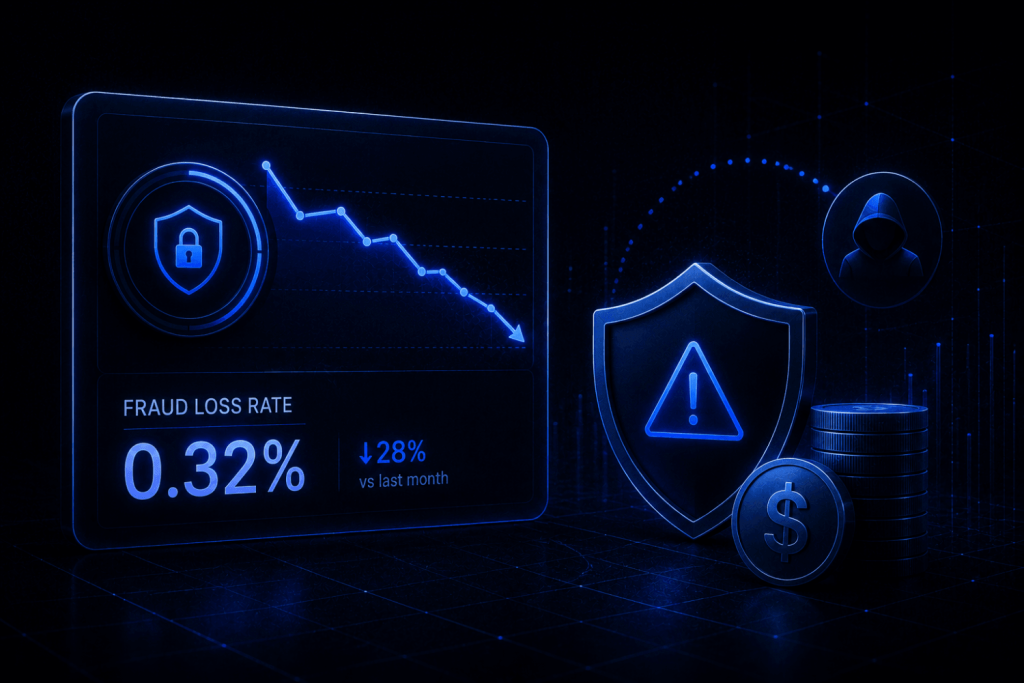
Fraud loss rate is total fraud losses divided by total transaction volume, expressed as a basis points figure. It sits at the intersection of product quality, risk policy, and unit economics, and it can quietly destroy margin at scale while top-line metrics look clean.
A company processing $50M in annual transaction volume with a 30 bps fraud loss rate is losing $150,000 per year to fraud before any recovery. As volume scales, that number scales with it unless the underlying risk controls improve. Most early-stage fintech companies don’t track this at the transaction level because their volumes are low enough that the dollar losses feel manageable. By the time the numbers are large enough to cause board-level concern, the bad patterns are already baked in.
If you’re evaluating or building fraud detection infrastructure, the tooling options for fraud detection and risk management have expanded considerably, and the right choice depends heavily on your transaction type and risk tolerance.
4. Approval Rate and Its Downstream Effects
For any fintech product that involves underwriting, approval rate is the ratio of applications approved to applications received. Most operators know this number. Fewer track its relationship to downstream performance metrics like default rate and 90-day retention, which is where the real signal lives.
A rising approval rate looks like growth. It can also mean your credit policy is loosening in ways that will show up in losses 6 to 18 months later. A falling approval rate looks like a problem. It can also mean better credit quality in your portfolio. Neither number is interpretable without the other.
The metric to watch is risk-adjusted approval rate: what percentage of approved accounts become financially healthy, active customers within 90 days. That’s the version that actually correlates with revenue quality.
5. Cost of Funds
For any fintech company that holds deposits, extends credit, or intermediates capital, cost of funds is the annualized cost of the money you’re deploying. It’s a standard banking metric that many fintech founders coming from SaaS backgrounds track inconsistently or not at all.
When interest rates move, your cost of funds moves with them. A lending product that was profitable at a 3% cost of funds may look very different at 5.5%. This is a structural cost, not an operational one, which means it doesn’t respond to the usual levers like reducing headcount or renegotiating vendor contracts. You have to model it separately from your SaaS-style unit economics.
6. Net Revenue Retention Adjusted for Risk
Standard NRR measures revenue from existing customers this period versus the same customers last period. In fintech, that calculation can be distorted by customers who are technically retained but whose underlying financial behavior has changed in ways that increase your risk exposure.
A payment company with high NRR but a rising share of customers processing higher-risk transaction categories isn’t growing cleanly. A lending platform with stable NRR but a portfolio aging toward delinquency will see that NRR collapse suddenly rather than gradually. Risk-adjusted NRR takes the standard calculation and applies a credit quality or fraud risk filter to the revenue base.
This is one of the fintech metrics that matter most to fintech-native financial operators, and one that software operators moving into the space most often overlook.
7. Customer Acquisition Cost Including KYC Failure
Standard CAC counts the cost of acquiring customers who successfully onboard. In fintech, a meaningful percentage of applicants will fail KYC, identity verification, or compliance screening before they ever become customers. The cost of those failed acquisitions is real. Most CAC calculations ignore it.
True fintech CAC should include the marketing and acquisition spend attributed to applicants who never converted, the cost of identity verification calls that returned a negative result, and any manual review costs for borderline cases. For some products in high-friction categories like lending or account opening, this can add 20 to 40 percent to the apparent CAC figure.
Companies building on embedded finance infrastructure often discover this number when they start digging into the structural costs that compress fintech SaaS margins at scale.
8. Payback Period on True Unit Economics
CAC payback period is how many months of gross margin it takes to recover customer acquisition cost. In fintech, the gross margin figure in that calculation needs to include payment processing fees, compliance costs, and in some products, cost of funds. Using a software-style gross margin, which strips out none of these, inflates the apparent payback period quality.
A company that looks like it has an 18-month payback period on a SaaS-style gross margin calculation might have a 28-month payback period on a fully-loaded fintech unit economics basis. Both numbers can coexist in the same spreadsheet because they’re measuring different things. The problem is when founders present the better number to investors without knowing the worse one themselves.
9. Support Contact Rate Per Active User
Support contact rate measures how many inbound support interactions occur per active user per month. In fintech, this number is a proxy for product quality, trust, and operational cost that doesn’t appear anywhere in standard growth dashboards.
A rising support contact rate often means your product is creating confusion or anxiety around money, which is a serious product signal in an industry where trust is the product. It also directly impacts margin. A 2% monthly contact rate on 50,000 active users is 1,000 support tickets per month. At even a modest cost per resolution, that’s a material operational line item that scales with your user base unless you address the underlying product friction.
10. Churn by Cohort Quality, Not Just Churn Rate
Aggregate churn rate is one of the most commonly misread metrics in fintech. A company with a 3% monthly churn rate might have wildly different cohort profiles underneath that average. If your highest-value cohorts are churning at 1% and your lowest-value cohorts are churning at 8%, the blended number is masking a very different business reality.
Cohort analysis by acquisition channel, product entry point, and customer segment tells you not just how many customers are leaving, but which customers. In fintech specifically, the customers who churn earliest are often the ones who generated the most transaction volume initially but were acquired through channels that attract low-intent users. High early volume followed by fast churn is a classic fintech growth trap.
11. Transaction Success Rate
Transaction success rate is the percentage of attempted transactions that complete without failure. For payment infrastructure companies, this is a core reliability metric. For consumer apps, it’s a trust metric that directly affects retention. For B2B fintech products, a declining transaction success rate is often the first signal a customer gives before they churn.
The useful version of this metric is segmented by transaction type, payment rail, and customer segment. An aggregate success rate of 97% can include a specific payment rail running at 91%, which represents a real product problem invisible in the top-line figure. Infrastructure choices here have significant downstream effects, which is part of why selecting payment infrastructure deserves more rigor than most early-stage founders apply to it.
12. Regulatory and Compliance Exception Rate
This metric tracks how often your product, processes, or transaction flows generate compliance exceptions, meaning events that require manual review, trigger regulatory flags, or violate internal policy thresholds. Most fintech companies track this in some form because they have to. Very few treat it as a performance metric alongside growth figures.
A rising compliance exception rate is a leading indicator of two things: scaling operational costs as manual review volume grows, and potential regulatory exposure if the exceptions reflect systemic issues rather than edge cases. Early-stage companies can absorb manual review. Late-stage companies often can’t, which means the exception rate you allow at Series A can become a structural cost problem at Series C.
13. Revenue Per Compliant Transaction
This is the net revenue generated per transaction after subtracting fraud losses, chargebacks, payment processing fees, and compliance costs directly attributable to that transaction. It’s a granular unit economics metric that most companies don’t calculate because it requires joining financial, operational, and risk data in the same model.
When this number is tracked consistently, it reveals the true economics of different transaction types, customer segments, and geographies. A transaction category that generates high gross revenue can be net negative on a per-transaction basis once fraud, dispute resolution, and compliance costs are applied. Companies that optimize for transaction volume without tracking this metric can scale into a cost structure that only becomes visible at high volumes, which is a difficult problem to solve when growth is the primary investor expectation.
The pricing model underneath your product affects this number directly. Different monetization structures shift where cost exposure lands, and fintech SaaS pricing model choices carry different unit economics implications depending on transaction volume and risk profile.
How These Metrics Work Together
No single metric from this list gives you the complete picture. They work as a system. Activation rate tells you onboarding is working. TTFT tells you how quickly. True CAC tells you what you actually spent to get there. Payback period tells you whether it made sense. Fraud loss rate and transaction success rate tell you whether the product is performing reliably. Cohort quality and risk-adjusted NRR tell you whether you’re retaining the right customers. Compliance exception rate and support contact rate tell you whether scale is creating structural problems.
The companies that tend to hit trouble at Series B or Series C often had most of these signals available to them earlier. They weren’t measuring them, or they were measuring them but not connecting them to growth decisions. When you’re scaling toward $10M ARR, the feedback loops from weak metrics are slow enough that problems stay hidden. The operational requirements for reaching that milestone without compounding structural problems are more demanding than most growth-focused dashboards capture.
SaaS metrics tell you what happened. These fintech-specific metrics tell you why, and more importantly, what’s coming.
Frequently Asked Questions About Fintech Metrics
1. What fintech metrics actually matter for early-stage founders?
Activation rate, true CAC (including KYC failure costs), and transaction success rate are the three most critical early-stage metrics because they reveal whether your onboarding works, what you’re actually paying for growth, and whether your core product is reliable. MRR is useful context but a lagging indicator. Focus on the metrics that predict MRR quality, not just its size.
2. What KPIs should fintech founders track differently than SaaS founders?
Fintech founders need to add fraud loss rate, cost of funds, approval rate with downstream performance data, compliance exception rate, and risk-adjusted NRR to their standard SaaS dashboard. These metrics exist because fintech products carry balance sheet risk, regulatory exposure, and transaction-level cost structures that pure software products don’t have. Ignoring them doesn’t make the underlying risks disappear.
3. What are vanity metrics in fintech?
In fintech, the most common vanity metrics are total signups, total transaction volume without fraud or chargeback adjustments, and blended churn rate without cohort segmentation. These numbers look good in slides but don’t reliably predict financial health. Gross transaction volume, for instance, can grow while net revenue per transaction falls if fraud and dispute costs are rising faster than volume.
4. How do unit economics metrics differ for fintech versus SaaS?
Fintech unit economics must account for cost of funds, payment processing fees, fraud losses, and compliance costs that don’t exist in pure SaaS products. A fintech company using software-style gross margin calculations will overstate profitability at the unit level. The correct approach is to calculate contribution margin per customer after all product-specific costs, not just COGS in the accounting sense.
5. What is a good fraud loss rate for a fintech company?
There is no universal benchmark because fraud loss rates vary significantly by product type, transaction category, and customer segment. Card-based consumer products face different fraud profiles than B2B payment APIs. Track your own fraud loss rate in basis points per transaction volume, segment it by transaction type, and trend it over time. A rising trend matters more than any absolute threshold.
6. What are the 5 D’s of fintech?
The 5 D’s of fintech is a framework used to describe the forces reshaping financial services: Digitization, Disintermediation, Disaggregation, Democratization, and Decentralization. The practical relevance for operators is that each of these forces changes which metrics are most predictive. Disintermediation and disaggregation, for instance, mean that customers can switch products at lower cost than in traditional banking, which makes retention-quality metrics like cohort-segmented churn and risk-adjusted NRR more important than they would be in a sticky legacy product environment.
7. How should fintech companies measure retention quality?
Retention quality requires segmenting churn and expansion revenue by cohort, acquisition channel, and customer risk profile. Aggregate retention rates can look healthy while your highest-value, lowest-risk cohorts are churning at elevated rates. Risk-adjusted NRR, which filters revenue retention through credit quality or fraud risk data, gives a more accurate picture of whether retained revenue is durable or fragile.
8. What is Time to First Transaction and why does it matter?
Time to First Transaction (TTFT) measures the elapsed time between a user completing account setup and completing their first financial action. It matters because users who don’t transact quickly are statistically less likely to become long-term active customers. TTFT is a leading indicator of activation and downstream retention, which means a rising TTFT signals an onboarding or product problem before it shows up in churn data.
9. How does support contact rate relate to fintech margins?
Support contact rate per active user translates directly into operational cost that scales with your user base. In fintech specifically, high contact rates often signal anxiety or confusion around money movement, which compounds into trust and retention problems. If your contact rate is rising while your user base grows, you’re likely building a support cost structure faster than revenue growth can absorb it. Reducing contact rate requires fixing the underlying product friction, not just hiring more support staff.
10. Where can I find industry benchmarks for fintech metrics?
Most of the metrics covered here, particularly fraud loss rate, compliance exception rate, and risk-adjusted NRR, are not publicly benchmarked in any consistent way because they vary too much by product category, customer segment, and regulatory environment. What matters more than hitting a published threshold is tracking your own trend lines consistently. A fraud loss rate that’s stable or declining is a better signal than one that matches an industry average but is moving in the wrong direction. For pricing-adjacent metrics, public data points do exist for some categories; the common pricing mistakes fintech founders make often reflect benchmark-chasing rather than tracking metrics relevant to their own unit economics.
The Measurement Gap Is a Strategy Gap
Fintech companies that measure themselves primarily on SaaS metrics aren’t just missing data points. They’re operating with a strategic blind spot. Revenue quality, fraud exposure, onboarding efficiency, and compliance burden are business-defining factors that don’t surface in a standard growth dashboard until they’ve already caused damage.
The practical fix isn’t a dashboard overhaul on day one. It’s deciding which two or three metrics from this list are most relevant to your current risk profile, adding them to your existing reporting, and updating them consistently enough to see trends. A fraud loss rate you check quarterly is not a risk management tool. A support contact rate you review annually is not an operational insight.
The fintech companies with the clearest board presentations tend to be the ones that can show not just that they’re growing, but that the growth is structurally sound. These 13 metrics are how you demonstrate that, and how you know it yourself before anyone asks.