
- Copying a competitor’s pricing structure doesn’t just limit your margins , it hands them your expansion strategy too.
- The value metric you choose determines which costs scale with you: fraud exposure, support load, compliance overhead, and infrastructure spend all follow the unit you bill against.
- Usage-based pricing sounds customer-friendly, but without spending caps or commitment tiers, it creates churn at the worst possible time: right after a bad month.
- Most fintech pricing mistakes are not about the wrong number , they are about the wrong structure, the wrong metric, or the wrong moment in the customer relationship.
- Founders who reprice too late typically do it reactively, under margin pressure, which forces awkward conversations with existing customers and almost always includes grandfathering discounts that compound the problem.
Pricing in fintech is harder than in most software categories because the costs aren’t static. Payment rails cost money per transaction. Fraud checks cost money per call. Compliance overhead scales with customer count and transaction volume in ways that a flat subscription fee absorbs silently until it doesn’t. Founders who set prices early and don’t revisit them discover this the hard way, usually around Series B when the unit economics finally get scrutinized.
The default move is to benchmark against whoever is already winning in your category. That feels rational. It isn’t. Category leaders built their pricing at a different cost structure, a different competitive moment, and often with a different customer segment in mind. Following them into their pricing model means following them into their constraints.
Here are nine pricing mistakes that show up repeatedly across fintech companies, from payments infrastructure to embedded finance to lending SaaS.
1. Treating the Competitor’s Price as the Floor

Benchmarking against Stripe, Plaid, or whoever owns your category is reasonable as a starting point. Treating their price as your floor is a structural mistake. Category leaders have volume discounts, enterprise contracts, and VC-subsidized infrastructure that let them sustain margins at prices that would slowly kill a smaller company.
When you price at parity with a larger competitor, you are also implicitly competing on the assumption that buyers evaluate you identically. They don’t. Buyers comparing you to Stripe are already discounting you on reliability, network reach, and brand trust. Matching their price means you have nothing left to negotiate with. Pricing slightly above and articulating a specific, verifiable reason why is almost always a better starting position.
2. Choosing a Value Metric That Doesn’t Scale With Your Costs
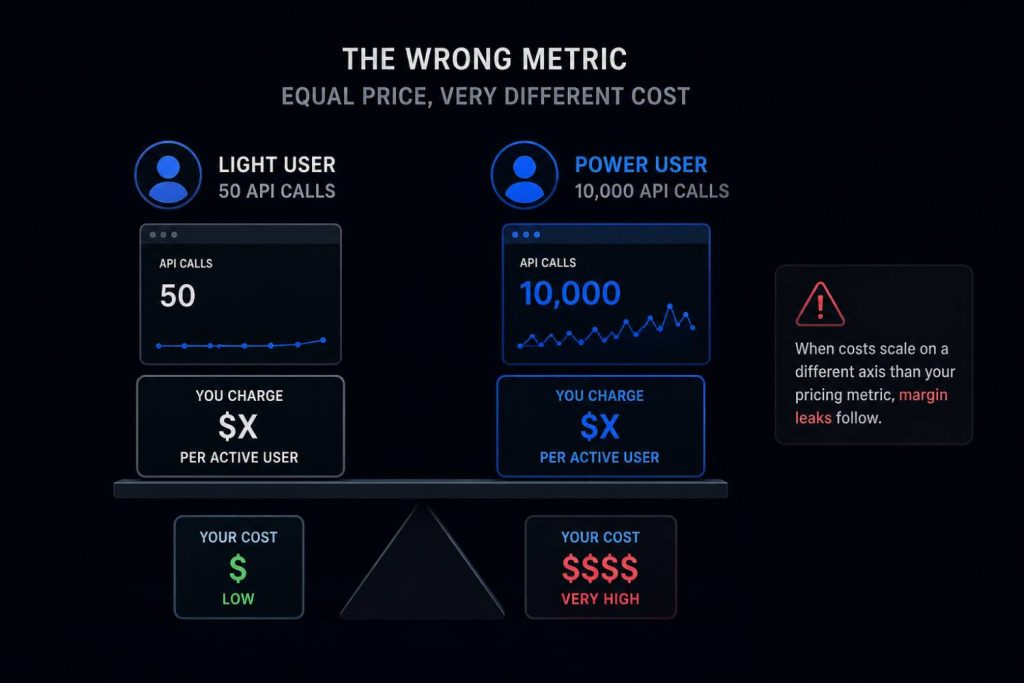
The value metric , what you actually bill against , is the most consequential pricing decision a fintech founder makes, and it gets the least deliberate attention. Most founders pick “transactions,” “seats,” or “monthly active users” because those are familiar. The problem is that your infrastructure costs may scale on a completely different axis.
If your costs scale with API call volume but you charge per active user, a single power user who runs 10,000 API calls costs you the same as a light user who runs 50. At small scale this is manageable. At scale it is a structural margin leak. The fintech API category is full of companies that learned this after their first enterprise contract.
The same logic applies to fraud and compliance costs. If your fraud detection vendor charges per transaction screened , which many do , but you charge customers a flat monthly fee, your margin compresses every time a customer increases volume without upgrading their plan. Those costs are real, and they’re worth examining alongside your fraud detection infrastructure choices before you set pricing, not after.
3. Building a Flat Fee Model on a Variable Cost Base
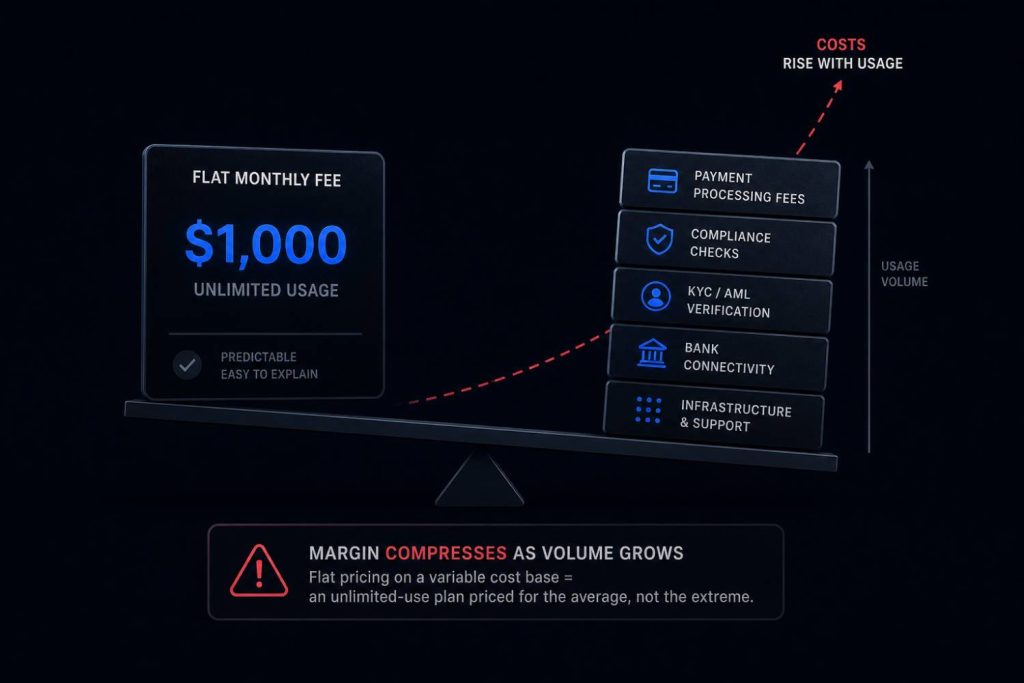
Flat subscription pricing is appealing because it is predictable for customers and easy to explain. It is also the fastest way to lose money in fintech, where most underlying costs are variable. Payment processing fees, compliance checks, KYC/AML verification, bank connectivity charges , all of these scale with usage. A flat fee that doesn’t capture volume growth effectively means you are offering an unlimited-use plan to high-volume customers at a price designed for average-volume customers.
This is one of the most common hidden cost traps in fintech SaaS margins. The fix is not necessarily usage-based pricing, but it usually involves some form of volume tiering, minimum commitments, or overage charges that let costs and revenue move in the same direction.
4. Launching Usage-Based Pricing Without Guardrails
Usage-based pricing is often positioned as customer-aligned because customers only pay for what they use. In practice, it transfers budget risk back to the customer, and customers in fintech , particularly finance teams , dislike unpredictable invoices more than they dislike paying a fixed amount.
Companies that launch pure usage-based models without spending caps or commitment tiers report churn specifically from customers who had a volatile month, saw an unexpected bill, and decided to reassess the relationship. The pattern is consistent enough that spending caps, annual commitments with monthly invoicing, and usage alerts are not nice-to-haves. They are the features that make usage-based pricing commercially viable with enterprise finance teams.
5. Underpricing the Onboarding Period
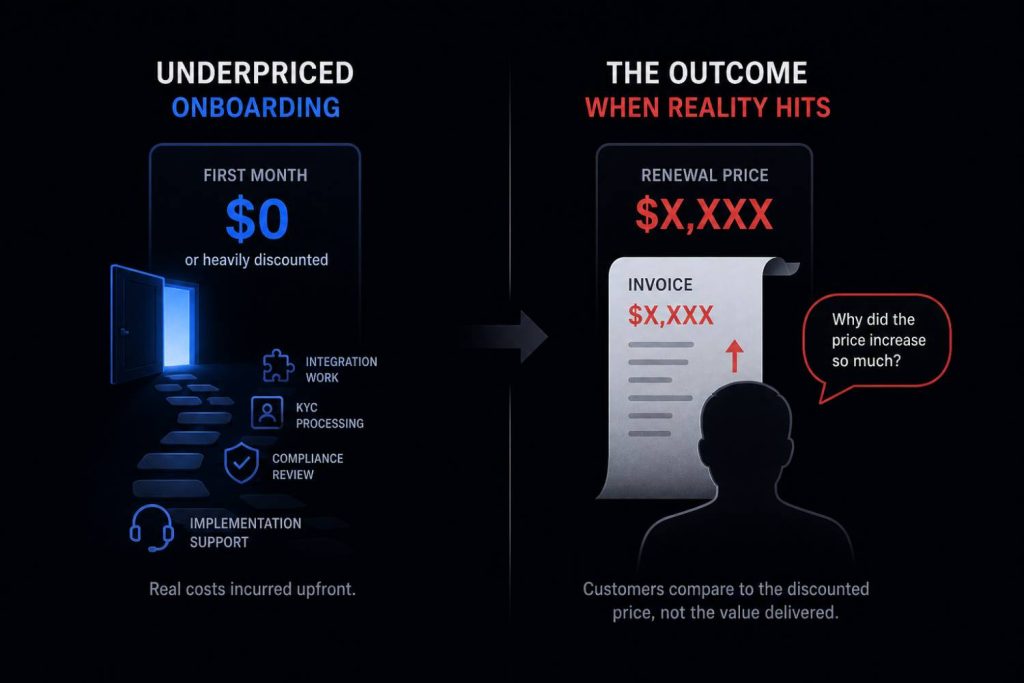
A lot of fintech companies offer extended onboarding periods or heavily discounted first months to reduce friction. The intention is good. The execution frequently creates a customer base whose real willingness to pay was never tested. When a renewal conversation arrives and the price goes up to reflect actual costs, the customer compares the new price to the discounted price they’ve been paying , not to the value they’ve received.
Onboarding costs are also not free. Implementation support, compliance review, KYC processing, and integration work all have real costs that show up before a customer pays their first real invoice. Pricing models that bury these costs into a discounted or complimentary period are essentially offering a margin-negative service and hoping customers convert at enough volume to recover it. In payments specifically, transaction pricing errors that originate during onboarding configuration are a known source of revenue leakage , the kind that accumulates per-transaction and escapes notice until reconciliation catches up. That cost dynamic applies equally to mispriced onboarding structures. For a detailed look at how payment infrastructure pricing interacts with onboarding, the tradeoffs are worth reviewing before finalizing any introductory pricing terms.
6. Ignoring Expansion Revenue in the Initial Pricing Structure
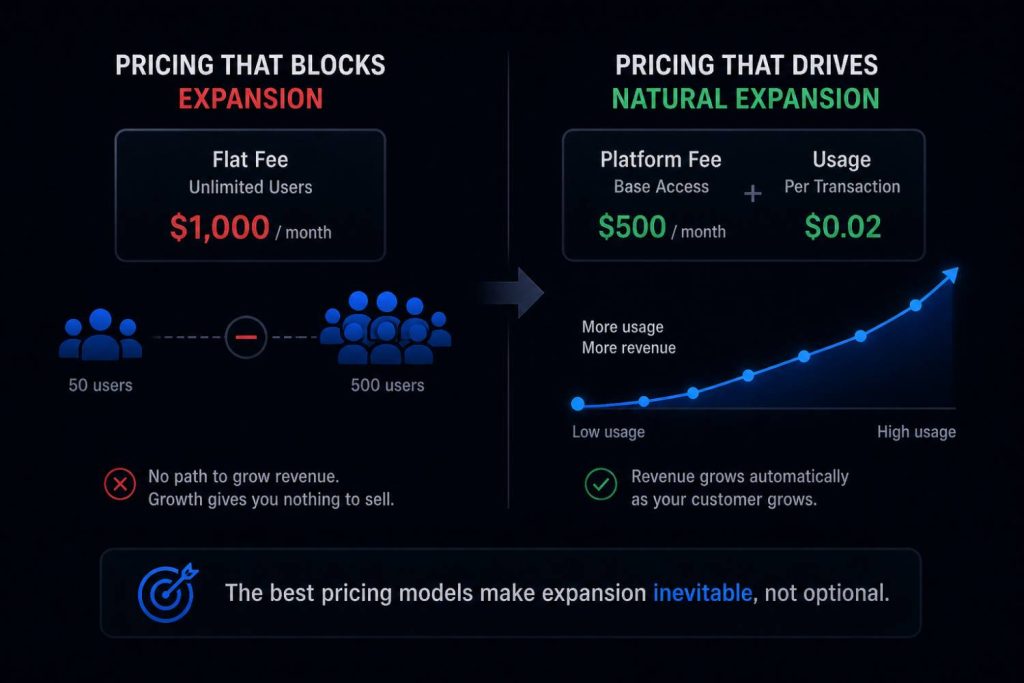
A pricing structure either makes expansion natural or it makes it a negotiation. Most founders build for acquisition and don’t think about expansion until they need it, which is too late. A model that charges a flat fee for unlimited users gives you nothing to sell when a customer grows from 50 users to 500. A model that charges per seat gives you something, but requires the customer to proactively add seats, which they will delay.
The models that generate the most predictable expansion revenue in fintech tend to use a combination: a platform fee that covers baseline access, plus a usage component that grows automatically with volume. The customer doesn’t need to decide to expand , their usage does it for them. This is worth thinking through alongside the broader question of which fintech SaaS pricing models actually support NRR growth.
7. Pricing Payment Features the Same Way as Software Features
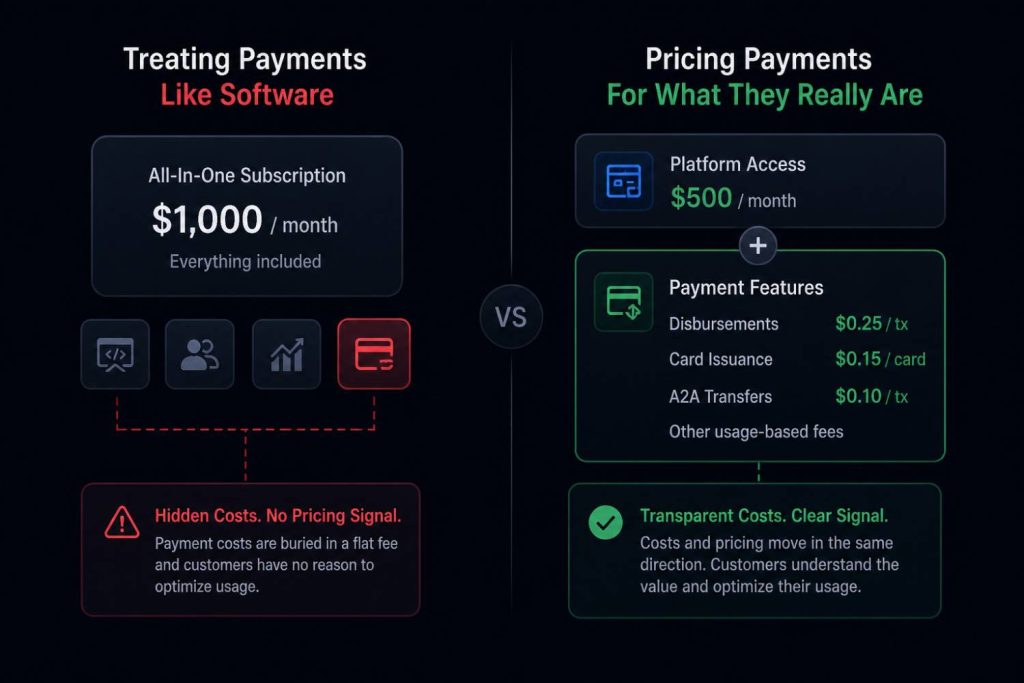
When a fintech company embeds payment functionality , disbursements, card issuance, account-to-account transfers , into a software product, the temptation is to price everything as one subscription. This bundles a compliance-heavy, operationally complex product into a pricing structure designed for software, and it creates two problems.
First, payment features carry costs that pure software doesn’t: interchange fees, card network fees, sponsor bank fees, fraud liability, and regulatory overhead. Bundling them into a flat subscription hides these costs from your pricing model until margin review forces the conversation. Second, it removes pricing signal from the customer. A customer who pays one price for everything doesn’t know that payments are expensive for you to deliver, so they have no reason to optimize their usage.
Founders exploring banking-as-a-service platforms will recognize this tension immediately , BaaS vendors almost universally price payment features separately from platform access for this exact reason.
8. Setting Prices Without a Clear Segment Definition
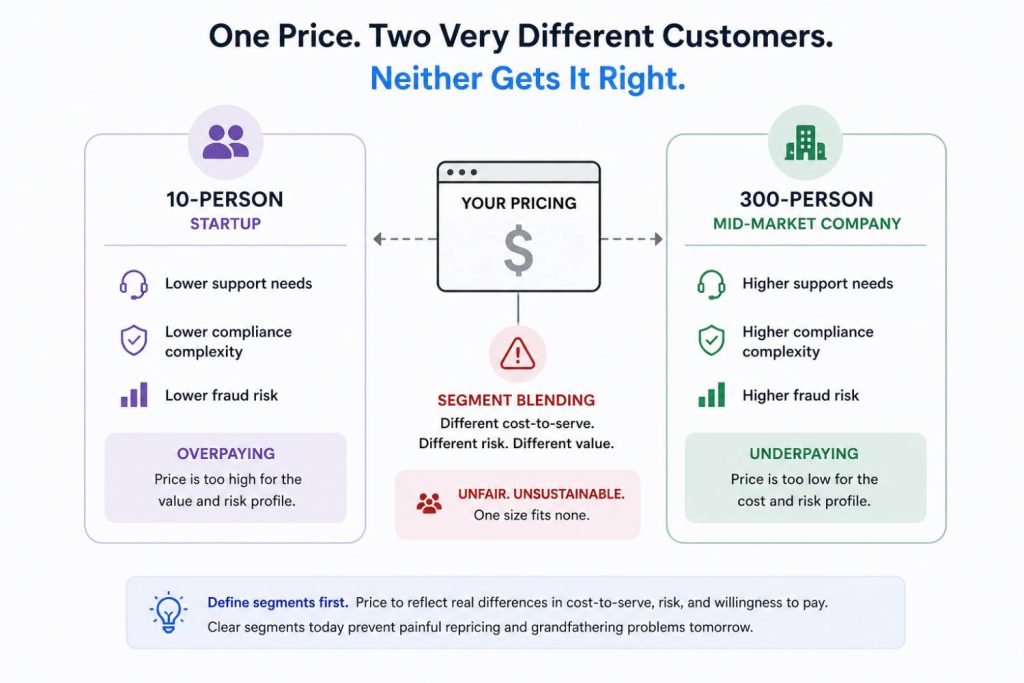
A single published price page that serves a 10-person startup and a 300-person mid-market company equally well is serving neither particularly well. Pricing strategy in fintech is inseparable from segment strategy. These two customer profiles have genuinely different support costs, compliance profiles, and fraud risk , and a single price point cannot accurately reflect all of those differences at once. Presenting illustrative dollar figures for each tier is less useful than recognizing that the cost-to-serve gap between them is real and often large enough that a single pricing model will undercharge one segment or overprice the other.
Many fintech pricing mistakes at this level aren’t about the numbers , they are about applying one model across segments with genuinely different cost-to-serve and willingness-to-pay profiles. The founder logic is usually “we’ll add enterprise pricing later.” But segment blending early on sets expectations that are hard to unwind. Customers who entered at startup pricing rarely accept mid-market repricing gracefully, which is why the grandfathering problem shows up so consistently when companies try to fix their pricing later.
This also applies to decisions about payment infrastructure. How you’re billed by your vendors , and how that maps to your own pricing , is covered in detail in this breakdown of payment infrastructure tools for SaaS founders.
9. Conflating Merchant of Record Decisions With Pricing Strategy
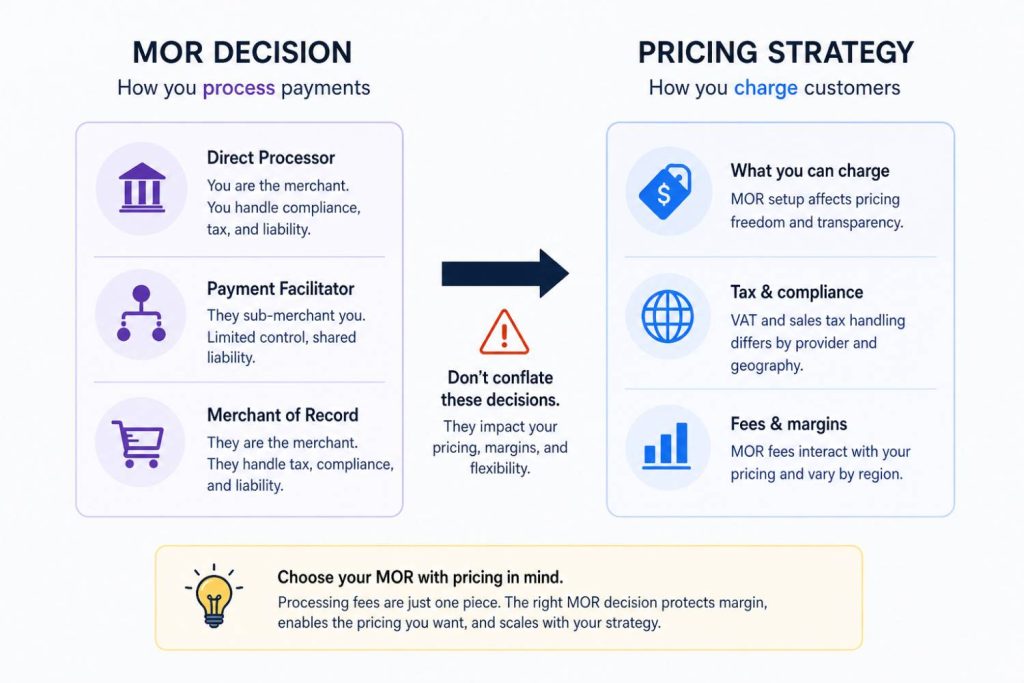
Whether you process payments directly, use a payment facilitator, or route through a merchant of record (MOR) has direct implications for what you can charge, how you present pricing, and who absorbs tax and compliance liability. Founders sometimes build a pricing model and then discover it doesn’t work with their MOR setup , or they choose an MOR based on processing fees alone without accounting for how that decision shapes their pricing flexibility.
For B2B fintech companies with international customers, this matters more than most founders expect early on. MOR vendors handle VAT and sales tax collection differently, and the fees they charge interact with your own pricing in ways that show up as margin compression in specific geographies. The detailed comparison of Stripe vs Paddle vs Lemon Squeezy vs Polar covers how these tradeoffs actually play out for B2B SaaS founders.
Frequently Asked Questions
What are the most common fintech pricing strategy mistakes at the early stage?
The most common early-stage mistakes are copying category leader pricing without adjusting for different cost structures, choosing a value metric that doesn’t align with how your costs actually scale, and offering a flat fee on a variable cost base. Early-stage founders also frequently underprice the onboarding period, which sets a cost-margin dynamic that’s difficult to recover from once the customer base grows.
Why does usage-based pricing fail in fintech?
Usage-based pricing doesn’t fail because the concept is flawed , it fails because of missing structural elements. Without spending caps, commitment tiers, or usage alerts, customers in fintech face unpredictable invoices that trigger budget reviews and churn. Finance teams at fintech buyers value predictability heavily. Usage-based pricing needs commitment structures around it to be commercially stable with those buyers.
How do you pick the right value metric for a fintech product?
Start by mapping the unit that best correlates with both the value the customer receives and the cost you incur to deliver it. If your costs scale with API calls, transactions, or verifications, your value metric should reflect that. If you choose a metric that moves independently of your costs , like seats on a transaction-heavy product , you will face margin compression as volume grows. The metric should also be measurable by the customer without needing to contact you.
What are transaction pricing errors and how do they affect revenue?
Transaction pricing errors occur when the rate, fee structure, or calculation logic applied to individual transactions doesn’t match the contracted terms. In payments specifically, these often originate during onboarding when pricing configurations are set manually. They cause revenue leakage that can be difficult to detect without systematic reconciliation, because the error is per-transaction and often small enough to escape notice at the individual level while accumulating significantly at volume.
How does fraud risk connect to fintech pricing decisions?
Fraud costs are closely tied to the value metric and customer segment you serve. If you charge a flat monthly fee but your underlying fraud detection vendor charges per transaction screened, a high-volume customer’s fraud prevention costs can exceed their subscription revenue. Fraud risk also concentrates in specific transaction types and customer profiles, which means segment-undifferentiated pricing doesn’t capture the cost variation. Pricing that doesn’t account for fraud exposure at the segment level tends to subsidize the riskiest customers at the expense of the lowest-risk ones.
When should a fintech company reprice its product?
The right time to reprice is when there is a meaningful gap between the value customers are receiving and what they are paying, or when cost structures have changed significantly since pricing was last set. Repricing under margin pressure , reactively, during a down round or a cost crisis , almost always results in worse outcomes than repricing proactively during a growth phase when you have negotiating room. Founders who wait too long usually end up with grandfathered tiers that persist for years.
What is the relationship between pricing and expansion revenue in fintech SaaS?
Your pricing structure either makes expansion automatic or requires a sales conversation every time a customer grows. Models with a usage component tend to generate expansion revenue without a renewal negotiation, because volume growth increases invoice size naturally. Pure flat-fee or seat-based models require customers to proactively add licenses or tiers, which they delay. For fintech companies trying to drive net revenue retention above 110%, a built-in expansion mechanism in the pricing model is more reliable than relying on upsell motions alone.
The Model Beneath the Mistake
Almost every pricing mistake on this list comes from the same root error: treating pricing as a number rather than a structure. The number matters, but the structure , what you bill against, how it scales, what happens at volume thresholds, and how it interacts with your actual cost base , determines whether your business gets better or worse as it grows.
Fintech pricing is harder to get right than standard SaaS pricing because the cost structure is more complex and more variable. Compliance overhead, fraud liability, payment network fees, and infrastructure costs all move with different drivers. A pricing model that doesn’t acknowledge this complexity will gradually transfer margin to high-volume customers and leave low-volume customers overpaying, creating churn pressure from both directions.
The founders who avoid these mistakes don’t necessarily have better intuition. They have a clear model of their own cost structure, a defined segment, and a willingness to price against their own economics rather than someone else’s.