
- Most fintech SaaS companies copy pricing from competitors without checking whether the model fits their cost structure or customer behavior.
- Pricing is a margin decision first, a positioning decision second. The wrong model can make a product look cheap while destroying unit economics.
- Usage-based and transaction-based models align well with fintech’s variable cost structure, but they introduce revenue unpredictability that flat subscriptions do not.
- No single model is universally right. The right choice depends on where your costs land, how customers derive value, and what your churn profile looks like.
- Several models work best in combination. Hybrid structures are increasingly common in fintech SaaS precisely because pure models leave money on the table.
Pricing in fintech SaaS rarely gets the strategic attention it deserves at early stages. Most founding teams pick a model because it matches what Plaid or Stripe appears to do, or because a sales advisor said “subscription is easier to model.” Then, twelve months later, margins are tighter than projected and the pricing page looks like it was designed for a different product.
The reality is that fintech SaaS pricing carries constraints that generic SaaS does not. Regulatory costs, fraud risk, interchange exposure, compliance overhead, and third-party API costs all create a cost structure that moves with volume. A flat subscription that works for a project management tool can quietly incinerate margin at a payment infrastructure company.
What follows is a breakdown of ten pricing models that appear in the fintech SaaS market, with honest takes on when each one works, where it fails, and what margin assumptions matter before you build around it. These are the best pricing models in fintech SaaS to understand before committing to a structure.
The 10 Pricing Models Fintech SaaS Companies Actually Use
1. Flat-Rate Subscription

One price, one product, every billing cycle. Simple to explain, simple to forecast. Companies like Ramp and early versions of many accounting-adjacent tools used flat monthly pricing to reduce friction at the point of sale.
It works when your cost to serve is predictable and does not scale with customer usage. It fails the moment variable costs enter the picture, which in fintech means almost always. If a customer processes ten times more transactions than your average user, your margin collapses on that account while the revenue stays flat.
The margin assumption you need to verify before choosing this model: your cost per customer must be roughly uniform. If cost variance across customers is high, flat-rate pricing is a subsidy program for your heaviest users.
2. Tiered Subscription
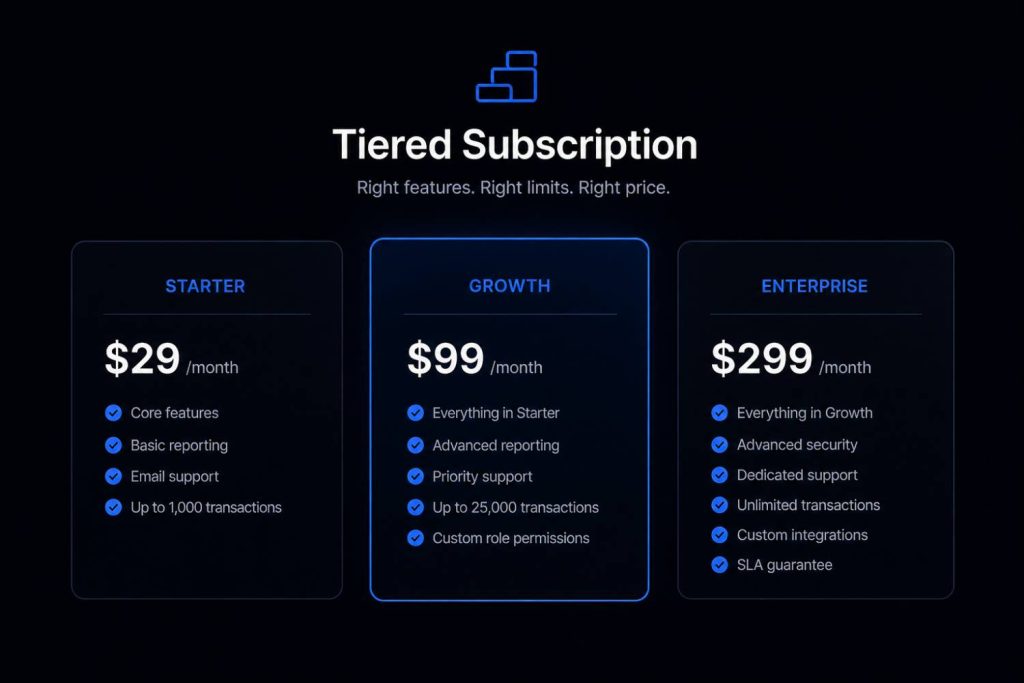
Tiered pricing packages features or usage limits into defined tiers, typically named something like Starter, Growth, and Enterprise. It is the most common model in B2B SaaS broadly, and it shows up consistently in fintech platforms that want predictable revenue without pure usage exposure. Brex, for instance, structures its business account offering around tiers that gate features like expense policy controls and dedicated support, separating early-stage startups from enterprise customers with distinct pricing logic at each level.
It works well when customers fall into recognizable segments with distinct needs. It breaks down when customers cluster at the bottom tier and rarely upgrade, or when the features that justify a higher tier are hard to demonstrate before purchase. The tier boundaries matter enormously. Set them wrong and you suppress expansion revenue.
Margin-wise, tiered subscriptions assume that higher tiers carry lower marginal cost per added customer. If serving a Growth-tier customer costs nearly as much as an Enterprise-tier customer, the model misprices the top tier and undercharges the bottom.
3. Usage-Based Pricing
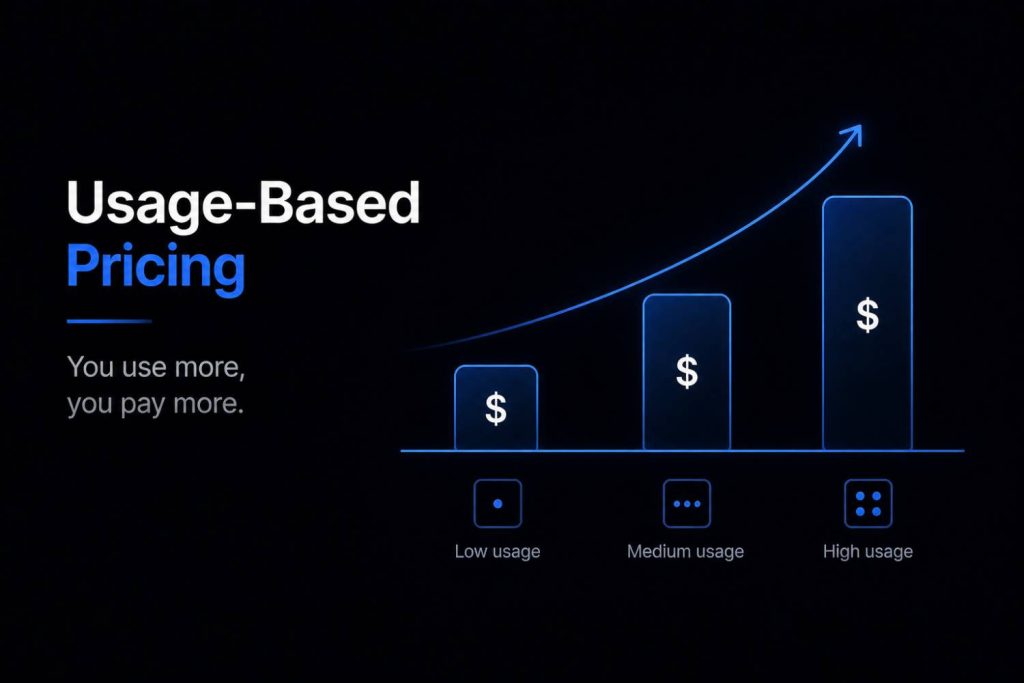
Usage-based pricing (UBP), sometimes called consumption pricing, charges customers based on what they actually use: API calls, transactions processed, active accounts, data records accessed. It has become increasingly common in fintech infrastructure, in part because vendors’ own costs scale with usage.
The alignment argument is straightforward. When a customer uses more, they pay more, and the vendor’s revenue rises alongside the cost to serve. Stripe’s transaction-based pricing is arguably the most visible example of this thinking applied at scale. Plaid similarly charges per connected account and per API call for products like Identity and Transactions, meaning a fintech app with ten thousand active users pays materially more than one with five hundred.
The hard part is revenue predictability. Usage-based revenue can drop significantly in a slow quarter without any customer churning. Sales cycles also get harder because prospects cannot easily budget for an open-ended consumption model. For a detailed look at how payment infrastructure companies handle this trade-off, the best payment infrastructure tools for SaaS founders comparison on FintechSpecs covers how vendors structure their tiers and minimums.
4. Transaction-Based Pricing
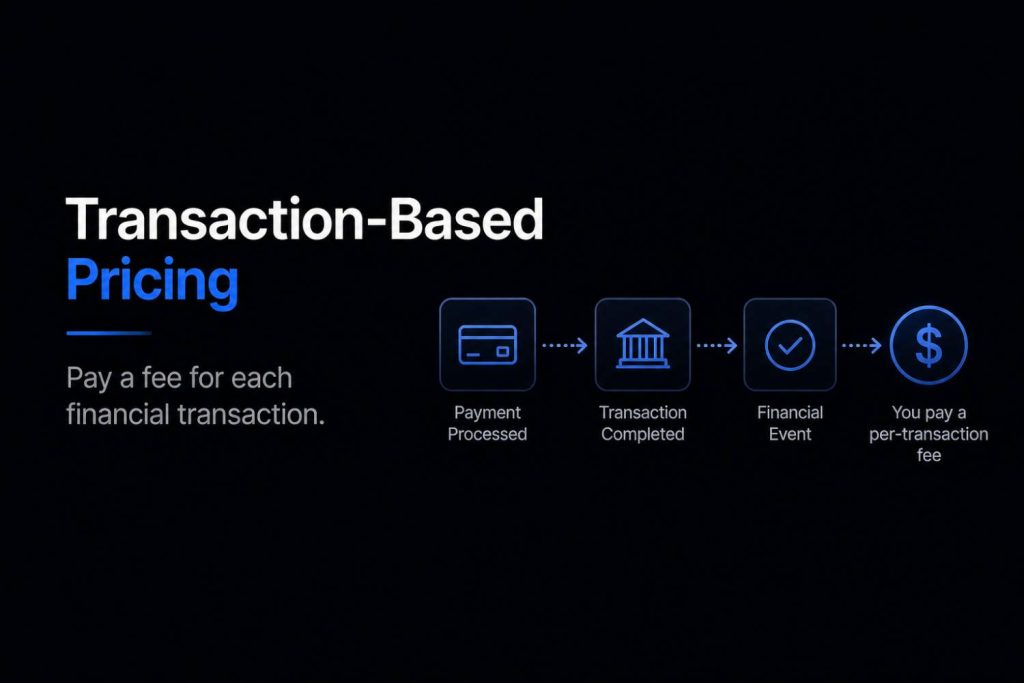
Transaction-based pricing charges a fee per discrete financial event: a payment processed, a loan originated, a transfer completed, a verification run. It is structurally similar to usage-based pricing but anchored specifically to financial activity rather than general platform usage.
This model dominates payment processing and banking-as-a-service. The economics work because each transaction has a relatively stable processing cost, so a per-transaction fee can be priced to carry a consistent margin. Dwolla, for example, charges per ACH transfer on its lower tiers and moves to volume-based custom pricing at scale, layering a platform access fee on top. For context on how BaaS platforms structure these fees more broadly, the best banking-as-a-service platforms breakdown shows how vendors layer flat fees, percentage fees, and minimum commitments.
Where it fails: small-ticket transactions often produce negative margin once you account for fraud, chargebacks, and network fees. A $0.25 per transaction fee sounds reasonable until a fraud event costs $15 to investigate. Minimum transaction floors and fraud reserves are not optional in this model.
5. Percentage of Volume (Revenue Share)
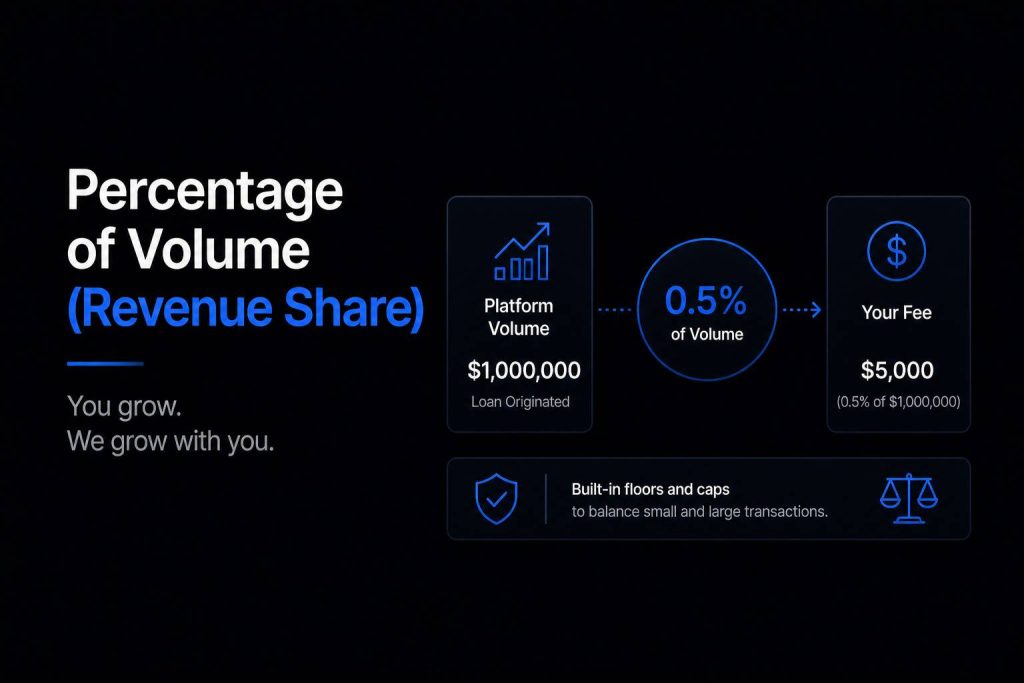
Rather than charging per transaction, some fintech SaaS vendors take a percentage of the gross payment or loan volume their platform touches. This is common in embedded finance and lending infrastructure, where the platform’s contribution scales directly with deal size.
It aligns incentives cleanly when the vendor’s value creation scales with transaction size. A lending infrastructure provider that charges 0.5% of originated loan value is pricing in proportion to what they help generate.
The failure mode is at the extremes. Very large transactions can generate fees that feel disproportionate to the actual work done, triggering pushback or renegotiation. Very small transactions may not cover the operational cost of the deal. Most vendors using this model build in floors and caps to avoid both problems. The margin assumption: your cost to support a $1 million transaction cannot be 10x your cost to support a $100,000 transaction, or the percentage model fails at scale.
6. Per-Seat Pricing
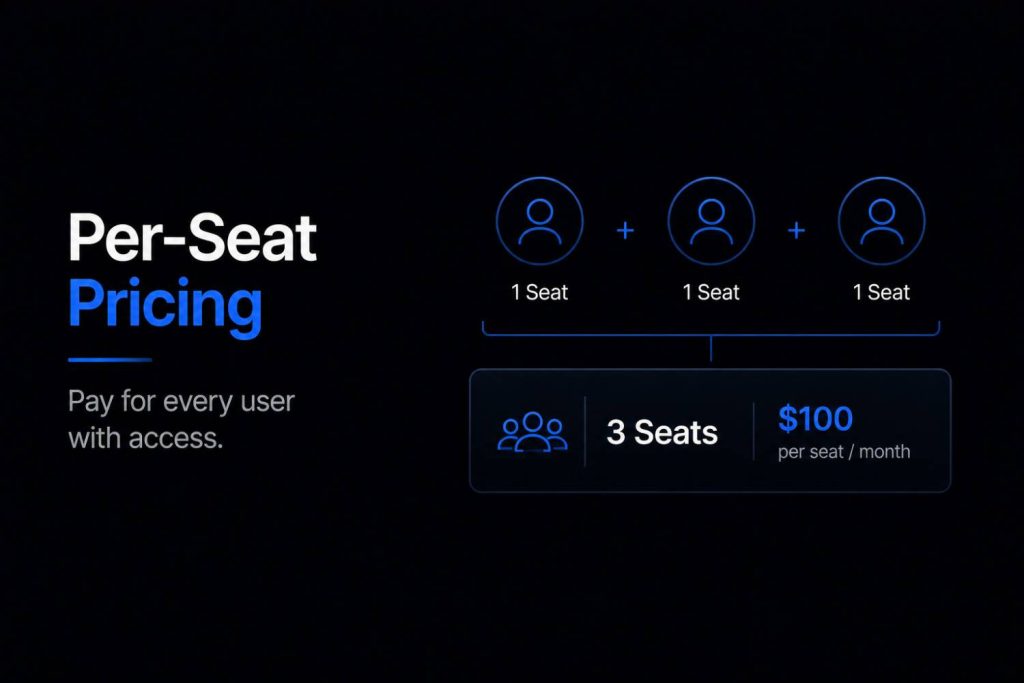
Charges based on the number of users with access to the platform. Common in fintech compliance tools, treasury management systems, and CFO-adjacent software where access is controlled and each seat represents a distinct decision-maker. NetSuite and many treasury management platforms in its category have long used per-seat structures for finance team tooling, with module add-ons sitting on top of the per-user base fee.
It works when the product’s value is tied to individual user access and when customers have a clear reason to count seats. It fails in fintech contexts where the value driver is transaction volume or data processed rather than human users. A compliance team of three people processing $500 million in transactions through a per-seat tool is getting an enormous value discount.
Margin assumptions favor per-seat pricing when your serving costs do not scale with transaction volume. The risk is customers sharing logins aggressively or limiting seat counts while still deriving high platform value.
7. Active User Pricing
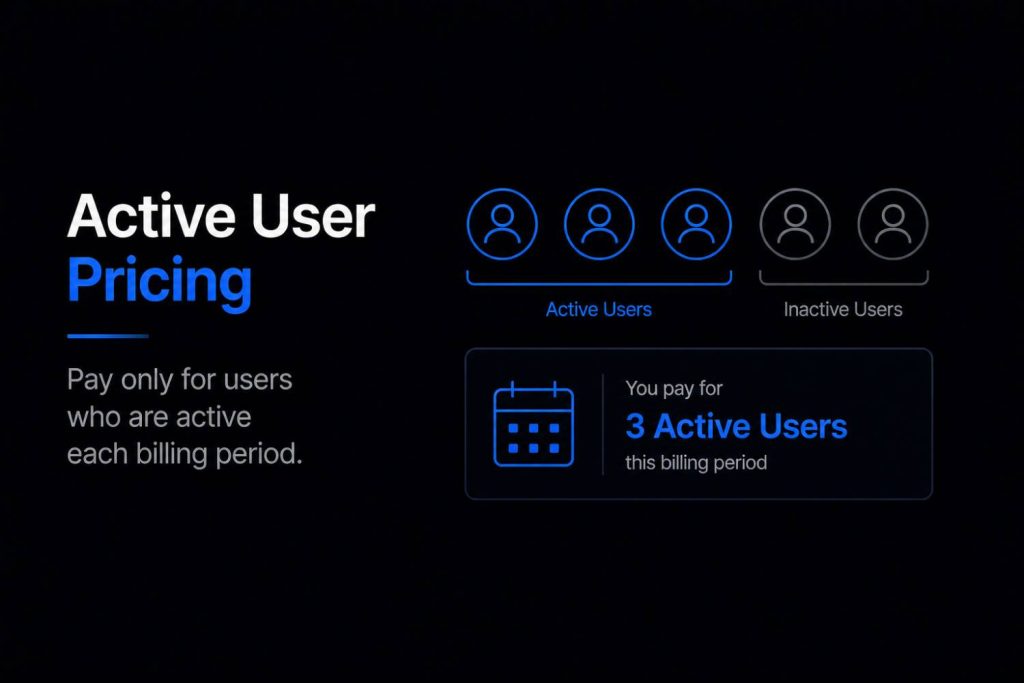
A variant of per-seat pricing that charges only for users who actually log in or take action within a billing period. It has migrated into fintech-adjacent SaaS as a more customer-friendly alternative to static seat counts, and some compliance and KYC workflow platforms now use it to remove the objection of paying for provisioned-but-inactive staff accounts.
Customers appreciate it because they are not paying for dormant accounts. Vendors benefit because it removes a common objection in the sales process. The downside is that revenue can fluctuate significantly based on seasonal usage patterns, and customers who activate heavily during peak periods drive up costs exactly when they are generating the most support load.
For fintech SaaS with regulated user access requirements, active user pricing can create compliance complexity. If a user needs to be provisioned and audited regardless of activity, the “active” definition and the compliance overhead do not align cleanly.
8. Freemium with Paid Conversion
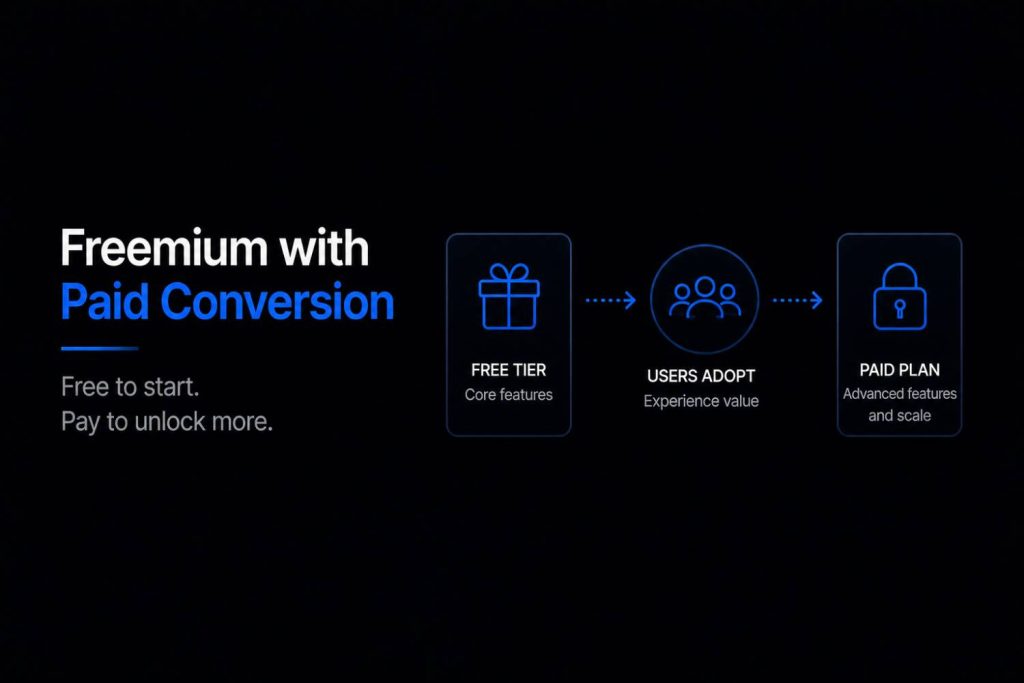
A free tier that functions as a distribution channel, with revenue generated through conversion to paid plans. This model appears frequently in developer-focused fintech tools, where getting engineers to use a product in side projects or early builds creates a pathway to enterprise procurement.
The model requires a product that delivers genuine standalone value at zero price, without giving away so much that customers never convert. That balance is hard to strike in fintech, where the most valuable features often require real financial integrations, compliance infrastructure, or data that costs money to provide.
Margin assumptions are the most demanding of any model on this list. You are subsidizing free users in hopes that some percentage converts. That subsidy has to be funded somewhere, and if conversion rates are low, the free tier becomes an expensive acquisition channel with a poor return.
9. Outcome-Based or Performance-Based Pricing
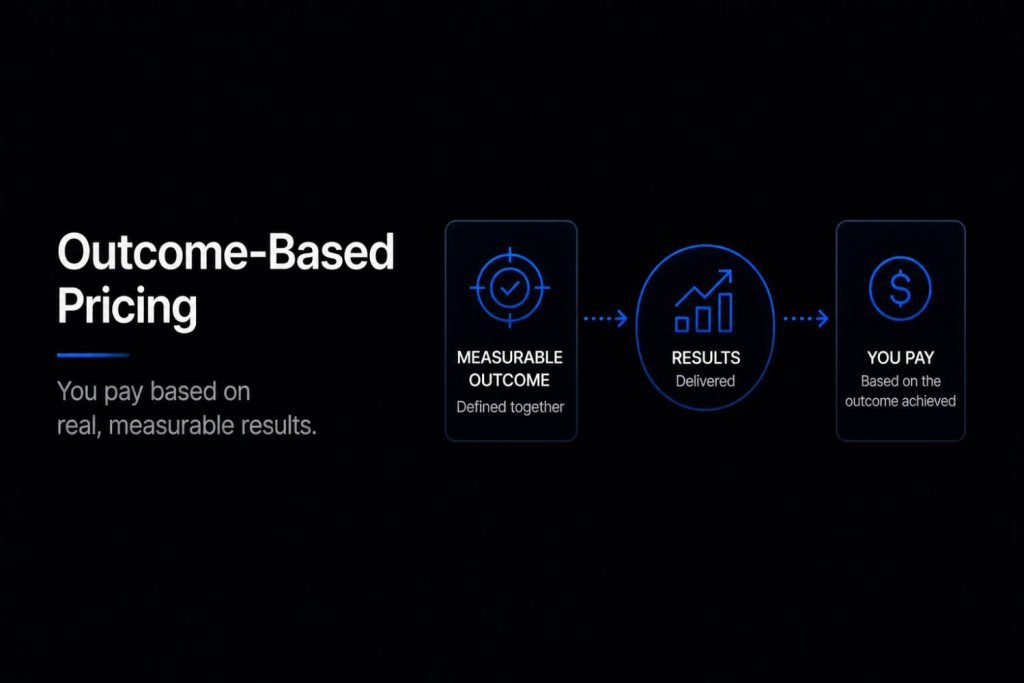
Charges customers based on measurable results: loans approved, fraud prevented, revenue generated, cost saved. This model is gaining traction in AI-adjacent fintech where vendors can point to specific, quantifiable outcomes. Some fraud detection vendors price partially on a per-fraud-prevented or per-false-positive-avoided basis.
It aligns vendor and customer incentives more tightly than almost any other model. It is also the hardest to execute because outcome measurement requires agreed-upon definitions, attribution logic, and audit trails. Disputes over what counts as a prevented fraud event or a verified identity are not hypothetical. For a look at how fraud tool vendors currently structure their pricing, the best fraud detection and risk tools for fintech startups comparison covers the current market range.
Margin risk is significant. If your model improves outcomes more than expected, you are effectively leaving revenue on the table. If outcomes are hard to isolate from other vendor contributions, you may spend more defending your billing than delivering your product.
10. Hybrid Pricing
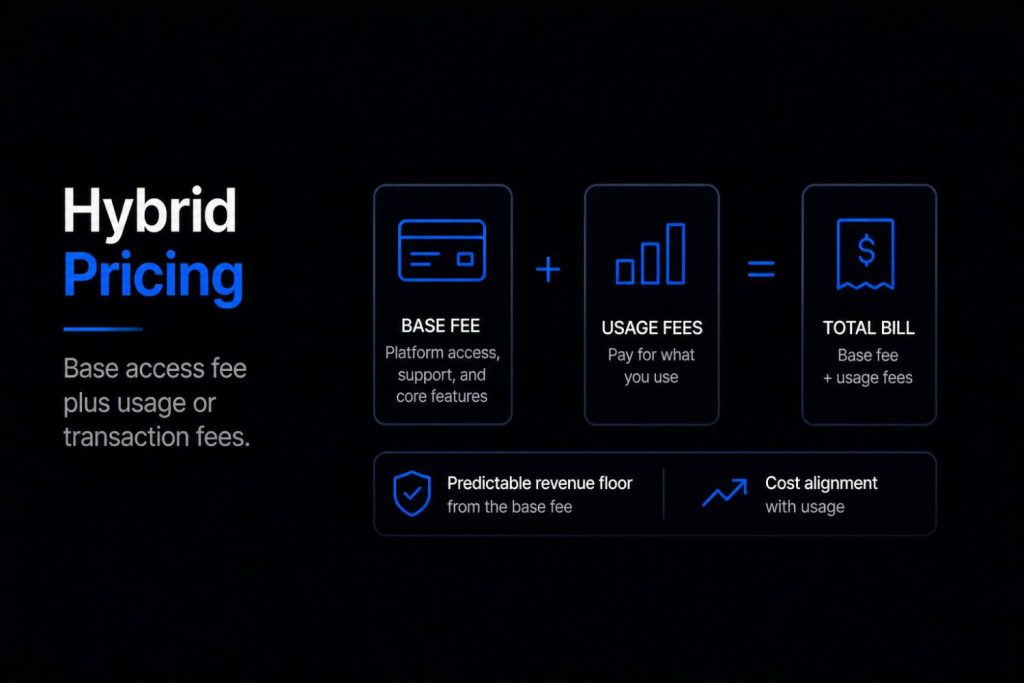
A combination of a base subscription plus usage or transaction fees. Often structured as a platform fee that covers access, support, and baseline features, with consumption charges layered on top for variable activity.
This is the most common model among mature fintech SaaS companies precisely because it addresses the core tension between revenue predictability and cost alignment. The subscription component provides a revenue floor and signals commitment from the customer. The usage component means the vendor captures value from high-volume customers rather than subsidizing them.
The risk is complexity. A customer who cannot easily predict their monthly bill will hesitate at the point of purchase, even if the average bill is lower than a flat subscription would be. That predictability gap shows up in conversion rates and in customer success conversations. The hidden costs that reduce fintech SaaS margins piece on FintechSpecs covers how hybrid pricing models often mask the true cost of customer acquisition and support.
How to Choose the Right Fintech Pricing Model
Three questions do most of the work. First: do your costs scale with customer usage? If yes, pure flat-rate or per-seat pricing will hurt you at scale. Second: can customers predict their usage reliably? If no, any consumption-based model will create friction in sales and renewals. Third: where does your product deliver value, in access or in outcomes?
A compliance monitoring tool delivers value through constant access. A fraud detection API delivers value through discrete, measurable events. Those are different pricing problems. Applying one model to both products produces the wrong answer for at least one of them.
Hybrid models are increasingly standard not because they are elegant but because they are honest. They acknowledge that both access and usage have value, and they charge accordingly. The vendors who execute hybrid pricing well invest in billing transparency so customers understand what drives their bill.
What Margin Assumptions You Cannot Skip
Fintech SaaS has cost components that pure software does not. API costs from data providers, network fees from payment rails, compliance overhead, fraud reserves, and customer support for regulated workflows all sit in the cost of goods sold. The right pricing model depends on which of those costs scale with usage and which ones are fixed.
When evaluating fintech APIs for SaaS products, for example, the per-call pricing of data providers often makes flat-rate customer pricing structurally impossible at volume. If your upstream cost is variable, your downstream pricing must either be variable or cushioned by a margin buffer large enough to absorb the variance.
Churn behavior also matters. Subscription models tolerate higher CAC because the revenue compounds over a long customer life. Usage-based models need faster payback periods because a customer who reduces usage or churns provides no floor revenue. Build your payback period assumptions before committing to a model, not after.
Frequently Asked Questions
What is the most common pricing model in fintech SaaS?
Tiered subscription pricing is the most common structure in B2B fintech SaaS broadly. Payment infrastructure and API-first companies tend toward transaction-based or usage-based pricing because their costs scale with volume. The actual distribution varies by product category. Enterprise treasury and compliance tools skew toward flat or tiered subscriptions, while embedded finance and data API companies skew toward consumption models.
When does usage-based pricing work well in fintech?
Usage-based pricing works well when your own infrastructure costs scale with customer usage, when customers can reasonably predict or monitor their consumption, and when your product’s value is clearly tied to discrete events rather than ongoing access. It tends to work poorly when customers are cost-sensitive and unpredictable usage creates budget anxiety, or when your sales motion relies on annual contract commitments.
What is transaction-based pricing in fintech SaaS?
Transaction-based pricing charges a fixed or percentage fee for each discrete financial event processed through the platform, such as a payment, a transfer, a loan origination, or an identity verification. It is the dominant model in payment processing and banking-as-a-service. The model works when per-transaction margins are stable and when fraud, chargeback, and network costs can be priced in without eroding the fee structure.
How should early-stage fintech SaaS companies approach pricing?
Early-stage companies usually lack the usage data to calibrate usage-based pricing accurately. Starting with a flat or lightly tiered subscription reduces billing complexity and makes revenue more foreseeable during the period when the business most needs financial clarity. As usage patterns become clearer, introducing consumption components through a hybrid model is a reasonable evolution. Avoid locking in complex pricing architectures before you understand your actual cost structure.
What is outcome-based pricing in fintech and when does it work?
Outcome-based pricing charges based on measurable results the product delivers, such as fraud prevented, cost reduced, or revenue generated. It works best when outcomes are clearly attributable to the vendor’s product, when both parties can agree on measurement methodology before the contract starts, and when the vendor has enough confidence in their results to take on that pricing risk. It is uncommon in early-stage fintech because the measurement infrastructure required is expensive to build.
What are the main risks of freemium pricing in fintech SaaS?
Freemium pricing works as a distribution strategy but requires careful cost control at the free tier. In fintech, free tier features often require real financial infrastructure to deliver, meaning the subsidy per free user is higher than in pure software. If conversion rates from free to paid are low and the free tier attracts high-cost users such as developers experimenting rather than buyers with budgets, the model can generate significant losses before producing meaningful revenue.
Can fintech SaaS companies use multiple pricing models at once?
Yes, and many mature companies do. Hybrid pricing, which combines a base subscription with usage or transaction fees, is standard in payment infrastructure, data APIs, and embedded finance platforms. The combination provides a revenue floor through the subscription and cost alignment through the usage component. The main execution risk is billing complexity. Customers who cannot easily forecast their monthly costs will raise more objections during the sales process and more disputes during invoicing.
How does choosing between merchant of record and direct payment processing affect fintech SaaS pricing strategy?
For SaaS companies selling to global customers, whether you act as the merchant of record or route through a third-party provider directly affects your cost structure and, by extension, which pricing models are viable. Outsourcing to a merchant of record adds a fee layer on top of your payment processing costs, which tends to push companies toward higher-margin tiered or hybrid pricing to protect gross margin. Direct processing gives you more control over that cost line but adds compliance and tax overhead. A detailed breakdown of how different merchant of record providers structure their fees appears in the merchant of record comparison for B2B SaaS founders.
What This Means for Your Pricing Strategy
Pricing in fintech SaaS is not primarily a marketing decision. It is a reflection of your cost structure, your customers’ buying behavior, and the timeline on which your product delivers value. Companies that treat it as the former end up with a pricing page that looks clean but quietly damages margin at scale.
The fintech companies that price well tend to share one trait: they mapped their own unit economics before they chose a model. They knew whether their costs were fixed or variable, whether their customers were value buyers or budget buyers, and what their average customer lifetime looked like. The pricing model then became a consequence of those facts rather than a starting assumption.
If you find yourself justifying a pricing model primarily by pointing to a competitor who uses it, that is worth reconsidering. Competitors may have different cost structures, different customer profiles, or pricing that predates their current product. What works at their stage, size, or customer mix may not work at yours.