- BlackRock, Franklin Templeton, and JPMorgan have already tokenized funds and treasuries at scale. The infrastructure question is no longer “if” but “which platform fits your legal wrapper, chain preference, and distribution channel.”
- Platforms diverge most sharply on three axes: regulatory structure (broker-dealer vs. transfer agent vs. offshore SPV), chain support (Ethereum, Polygon, Stellar, Aptos, Solana), and whether distribution is open or captive to the platform’s own investor network.
- Securitize is the default choice for US-registered funds that need a transfer agent on-chain and SEC-registered broker-dealer distribution. OpenTrade is the practical entry point for tokenized treasury yield without building your own token infrastructure.
- Tokenized treasuries now function as a stablecoin treasury yield source for corporate cash managers, collapsing the distance between on-chain liquidity and traditional yield instruments.
- Compliance-gated tokens with embedded KYC/AML are table stakes. Any platform that does not enforce transfer restrictions at the token layer is not ready for institutional deployment.
The leading RWA tokenization platforms for institutions in 2026 are Securitize, OpenTrade, Ondo Finance, Franklin Templeton OnChain, Backed Finance, Polymesh, and Superstate. Each serves a different legal and operational profile: Securitize for SEC-registered fund tokenization with transfer agent rails, OpenTrade for treasury yield products via API, Ondo for permissioned secondary liquidity, and the remaining platforms for specific chain, jurisdiction, or asset-class needs. No single platform wins across all three decision axes of regulatory wrapper, chain, and distribution.
Why Most Institutional Teams Are Still Evaluating the Wrong Variables
Most internal memos on RWA tokenization focus on blockchain choice first. That is the wrong starting point. The chain is infrastructure. The regulatory wrapper determines what you can sell, to whom, and whether your token is a security under US law. Getting that backward wastes six to eighteen months of structuring work.
The second common error is treating tokenization as a distribution play before solving for settlement. Tokenized funds that cannot settle in a stablecoin, or that require manual off-chain cash wires for subscriptions and redemptions, are not operationally different from a traditional fund with a fancier cap table. The platforms that matter are those where settlement, transfer restrictions, and investor whitelisting are enforced at the smart contract layer, not added as an afterthought in the back office.
A third error: conflating “tokenization platform” with “token development shop.” The first four results in the current SERP mix development agencies (Code Brew Labs, Blocktech Brew) with actual institutional infrastructure providers. They are not the same category. A development agency builds you a custom token. An institutional tokenization platform gives you a regulated wrapper, a transfer agent, and a compliance layer you do not have to build yourself. This article covers only the latter.
The FintechSpecs RWA Platform Stack Test: Four Checks Before Shortlisting
Before evaluating any specific platform, run what we call the FintechSpecs RWA Platform Stack Test. It is a four-point filter that separates operationally ready platforms from demo-stage infrastructure.
1. Regulated wrapper clarity. Does the platform operate under a specific regulatory registration in your target jurisdiction? For US issuers, that means SEC-registered transfer agent status, broker-dealer registration, or Reg D/Reg S exemption support. “We work with legal counsel” is not an answer.
2. On-chain transfer restriction enforcement. Are compliance-gated tokens enforced at the smart contract level, or does the platform rely on off-chain monitoring? Allowlist-based transfer restrictions that live in the token itself are the minimum bar for institutional use.
3. Settlement path. Can investors subscribe and redeem in stablecoins (USDC, USDT, or a bank-issued equivalent) with T+0 or T+1 settlement? Or does the platform still require a wire transfer that defeats the operational case for tokenization?
4. Distribution network independence. Does the platform give you access to its own investor network, or does it require you to bring your own? Captive networks are not inherently bad, but they change your go-to-market calculus significantly.
Any platform that fails more than one of these checks is a development-stage provider, regardless of how it markets itself.
Which Platform Should an Asset Manager Use to Tokenize a Fund?
The answer depends on whether you are tokenizing an existing US-regulated fund, launching a net-new structure, or wrapping a non-US vehicle for global distribution. Those three scenarios lead to different platform choices, and conflating them is how structuring costs balloon.
Securitize: The Institutional Default for US-Regulated Funds

Securitize is the closest thing the US market has to an institutional standard. The company holds SEC registration as a transfer agent and operates a registered broker-dealer (Securitize Markets), which means it can handle both the token issuance and the secondary market in a single regulated entity stack. BlackRock’s BUIDL fund, reported by BlackRock and Securitize in their January 2024 fund launch announcement as the first tokenized fund issued on the Securitize platform, has since grown to become the largest tokenized fund by assets under management, based on publicly reported AUM figures tracked by platforms including RWA.xyz. Franklin Templeton, Hamilton Lane, and KKR have also used the platform for tokenized fund shares.
The network of integrations that has formed around BUIDL and Securitize has attracted a secondary layer of connections: Ondo Finance uses BUIDL as an underlying asset, and several DeFi protocols treat BUIDL tokens as collateral. That network effect matters. A fund issued on Securitize is not just a tokenized share class; it is a token that other on-chain applications can interact with.
Securitize supports Ethereum, Polygon, Avalanche, and Aptos. Pricing is not publicly disclosed; the company structures fees per deal and does not publish a rate card. Any due diligence call should request a structuring fee estimate and a transfer agent fee schedule before progressing to term sheets.
OpenTrade: Tokenized Treasury Yield Without Building Token Infrastructure

OpenTrade takes a different approach. Rather than offering a full tokenization platform for custom fund structures, OpenTrade operates tokenized yield products (primarily US Treasury-backed) that other fintech platforms and asset managers can access via API. The practical implication: if you are a corporate treasury team or a neobank that wants to offer yield on idle USDC without building a token infrastructure from scratch, OpenTrade is the fastest path.
For institutional cash managers, tokenized treasuries accessed through OpenTrade function as a higher-yield alternative to traditional money market funds, with the added feature of stablecoin settlement. This connects directly to how forward-looking treasury teams are treating stablecoin treasury management as a yield strategy rather than purely a payment utility. OpenTrade’s token structure enforces transfer restrictions, and the underlying assets are held in regulated custody.
OpenTrade does not publish per-deal pricing publicly. The platform is primarily accessed through partnerships and integration agreements, not a self-serve onboarding flow.
Ondo Finance: Permissioned Liquidity for Tokenized Treasuries
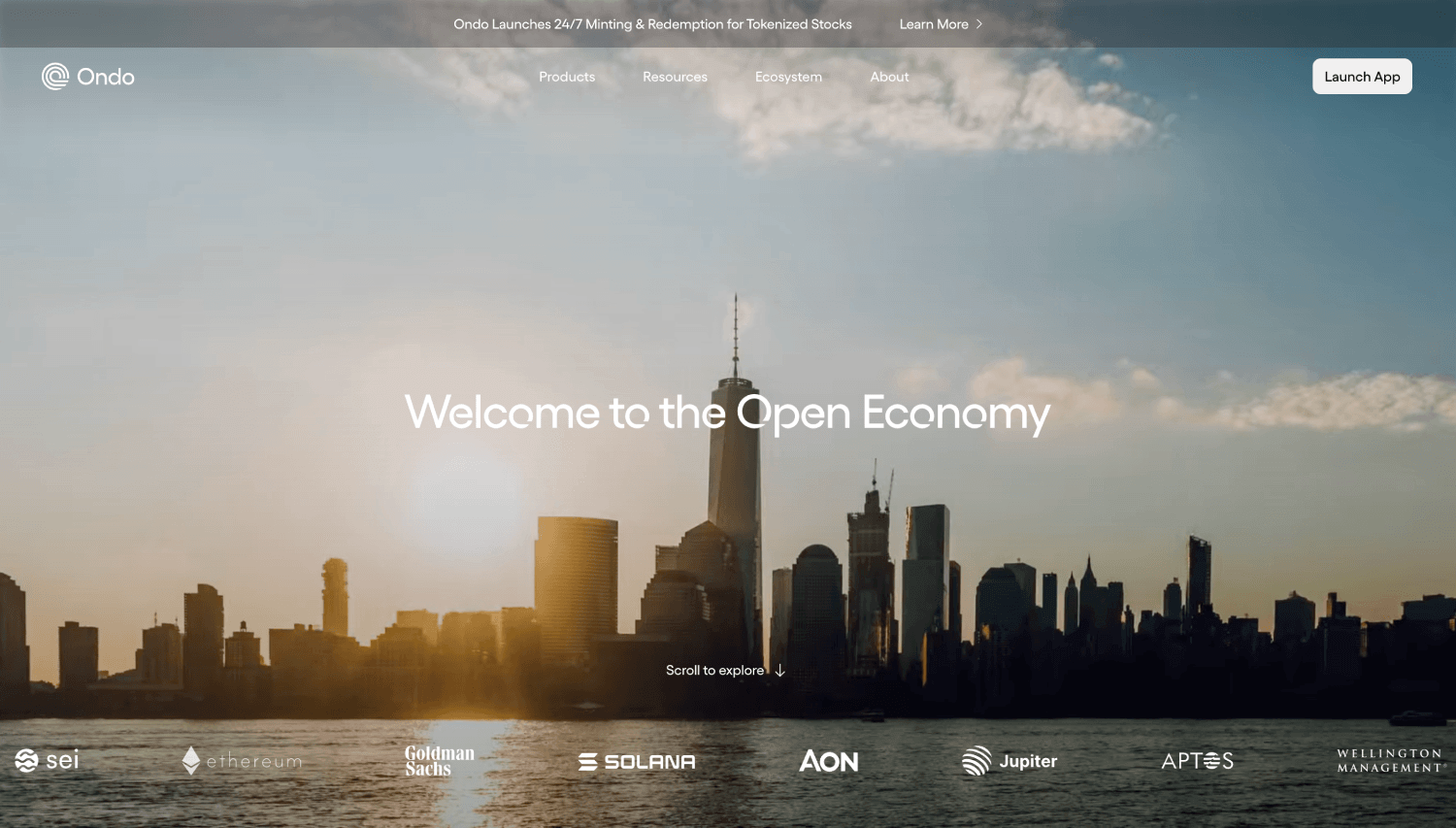
Ondo Finance has built the most accessible permissioned secondary market for tokenized US Treasuries. Its OUSG product provides exposure to short-duration US Treasuries with on-chain daily yield accrual and permissioned transfers. Ondo requires KYC verification and restricts transfers to whitelisted addresses, meeting the compliance-gated token standard.
Ondo also issues USDY, a tokenized note backed by short-term US Treasuries and bank deposits, which is structured to be accessible to non-US persons outside restricted jurisdictions. The two-product structure (OUSG for US accredited investors, USDY for non-US) reflects a deliberate jurisdictional split that more single-product platforms have not replicated.
The distribution reach is notable: OUSG is natively integrated into several DeFi protocols as collateral. For an institutional investor that wants tokenized treasury exposure with on-chain composability, Ondo offers more secondary liquidity options than any platform currently behind a fully closed transfer-agent system.
Franklin Templeton OnChain (BENJI): The Asset Manager Building Its Own Rails

Franklin Templeton’s BENJI platform is the clearest example of a major asset manager deciding that the platform is the product. Rather than licensing third-party tokenization infrastructure, Franklin Templeton registered its own proprietary blockchain-based transfer agent system with the SEC and issued the Franklin OnChain US Government Money Fund (FOBXX) as a tokenized money market fund.
FOBXX launched on Stellar in 2021 and expanded to Polygon in 2023, Franklin Templeton confirmed the Polygon expansion in a company announcement at the time, with the blockchain ledger serving as the official book of record for fund shares. That regulatory registration is not something a startup can replicate quickly. It represents several years of SEC engagement and is the primary reason Franklin Templeton’s token structure has a different legal character than most third-party platform tokens.
For asset managers evaluating this approach: building proprietary rails requires regulatory registration, technology investment, and ongoing compliance infrastructure that only makes economic sense at significant AUM scale. Smaller managers should treat BENJI as a proof of concept for what the category can become, not a template to copy.
Backed Finance: Tokenized ETFs for Non-US Structures

Backed Finance operates under Swiss regulatory oversight and specializes in tokenizing exchange-traded products (ETPs and ETFs) for distribution outside the US. Its bTokens represent claims on real underlying securities held by a regulated custodian, with tokens issued on Ethereum and other EVM-compatible chains.
Backed’s positioning is explicit: it does not target US persons, and its products are not registered under US securities law. For European asset managers or global platforms distributing to non-US investors, this jurisdictional clarity is an advantage rather than a limitation. The token structure includes transfer restrictions enforced on-chain.
Backed has published information about its legal structure and Swiss DLT Act compliance on its website. Custody of underlying assets is handled by a Swiss-regulated custodian, which is a meaningful disclosure compared to platforms that are vague about where underlying securities are held.
Polymesh: Compliance-First Chain for Regulated Securities

Polymesh is a purpose-built blockchain for regulated securities rather than a fund tokenization platform in the traditional sense. It was built specifically for compliance-gated tokens: identity verification, asset compliance rules, and transfer restrictions are protocol-level features, not bolt-on smart contracts.
The distinction matters for legal and operational teams. On a general-purpose chain like Ethereum, a fund issuer must deploy and maintain its own compliance smart contracts, which creates technical risk and ongoing upgrade complexity. On Polymesh, the regulatory compliance layer is part of the base protocol, which reduces attack surface and simplifies audits.
Several issuers in Europe and Canada have used Polymesh for private fund tokenization. It is not a distribution platform and does not come with an investor network. It is infrastructure for issuers who want to build on a compliance-native chain rather than adapting Ethereum to securities use cases.
Superstate: Short-Duration US Treasury Funds via On-Chain Subscription

Superstate offers tokenized short-duration US Treasury funds structured as SEC-registered investment companies. Its USTB fund allows subscriptions and redemptions in USDC, with shares represented as ERC-20 tokens on Ethereum. The SEC-registered fund structure gives USTB a regulatory wrapper that many token treasury products lack.
Superstate’s target customer is not an asset manager building a new product. It is an on-chain treasury operator (a DAO, a DeFi protocol, or a fintech platform) that wants to hold tokenized treasuries as a reserve asset while maintaining on-chain settlement. The USDC subscription path removes the wire-transfer friction that undermines the operational case for tokenized treasuries in digital-native contexts.
The fund is currently limited to accredited investors in the US. Transfer restrictions are enforced via an on-chain allowlist. Superstate does not publish a management fee on its marketing site, but SEC filings are publicly available through EDGAR.
Platform Comparison: Regulatory Wrapper, Chain Support, and Distribution
| Platform | Regulatory Structure | Primary Chains | Asset Types | Distribution Model | Settlement Currency |
|---|---|---|---|---|---|
| Securitize | SEC-registered transfer agent + broker-dealer | Ethereum, Polygon, Avalanche, Aptos | Private equity, credit, funds | Platform network + direct | USDC, wire |
| OpenTrade | Regulated partners; varies by product | Multiple (API layer) | Tokenized treasuries, money markets | API / white-label | USDC |
| Ondo Finance | Exempt reporting; SEC registered advisor | Ethereum, Solana, Mantle, others | Tokenized treasuries | Direct + DeFi integrations | USDC |
| Franklin Templeton OnChain | SEC-registered money market fund + proprietary transfer agent | Stellar, Polygon | Government money market | Direct via BENJI app | USD wire + on-chain |
| Backed Finance | Swiss DLT Act; non-US only | Ethereum + EVM | Tokenized ETPs/ETFs | Direct; no US persons | USDC, EURC |
| Polymesh | Protocol-level compliance; jurisdiction varies by issuer | Polymesh (purpose-built) | Equity, debt, funds | Issuer-defined | Varies |
| Superstate | SEC-registered investment company | Ethereum | Tokenized US Treasuries | Direct to accredited investors | USDC |
Are Tokenized Treasuries Operationally Ready for Corporate Cash Management?
The short answer is yes, with one significant caveat: the accounting and tax treatment of tokenized fund shares is not uniformly settled in US GAAP or IRS guidance. The SEC has not issued a formal staff bulletin or interpretive release specifically addressing balance sheet classification of tokenized money market fund shares; finance teams should confirm directly with their auditors how these positions are classified before deploying material capital.
Operationally, the case is compelling. Consider a Series B company holding $8 million in a money market fund, with subscription and redemption cycles running T+1 through a bank custodian. The same position held in a USDC-settled tokenized treasury fund (Superstate USTB, Ondo OUSG, or OpenTrade’s treasury product) would settle the same day, with no bank intermediary, and with the yield accruing directly to the token. The settlement friction that makes traditional cash management slow goes away.
The operational risk to model is counterparty and smart contract risk. A tokenized treasury fund is only as safe as the custody arrangement for the underlying securities and the audit quality of the smart contracts governing the token. Smart contract audit reports are not consistently listed on platform marketing pages; any CFO running due diligence should request the most recent audit report, including the name of the auditing firm and the date of the report, as a standard step before committing capital.
Finance teams tracking the broader infrastructure decisions around on-chain yield should also review how institutional digital asset custody interacts with tokenized fund positions, particularly for segregated custody of the underlying securities.
How Do These Platforms Differ on Compliance-Gated Token Architecture?
Every platform on this list claims compliance-gated tokens. The architecture differs significantly, and the differences matter for secondary market functionality and long-term operational complexity.
Securitize uses its DS Protocol (Digital Securities Protocol), which encodes transfer restrictions, investor accreditation status, and jurisdictional rules into the token contract itself. Transfers that violate the rules revert on-chain without requiring off-chain intervention. The trade-off is that secondary transfers require both parties to be on the Securitize allowlist, which limits secondary liquidity to investors who have completed KYC through the Securitize platform.
Polymesh handles this at the protocol layer rather than the contract layer. Compliance rules are enforced by the Polymesh network itself, which means they apply to all tokens issued on the chain uniformly. For issuers who want compliance enforcement that cannot be accidentally misconfigured in a smart contract deployment, this is a meaningful architectural advantage.
Ondo’s approach is a permissioned ERC-20, where the smart contract maintains an allowlist of approved addresses. This is simpler and more composable with DeFi protocols, which is why OUSG has broader secondary market integrations. The trade-off is that the allowlist is maintained by Ondo as an operational matter, not enforced by an independent protocol.
Superstate uses a similar on-chain allowlist approach. The SEC-registered fund structure provides the regulatory wrapper; the on-chain allowlist provides the transfer restriction. The combination is defensible for US accredited investor distribution.
How to Compare Securitize and OpenTrade on Regulatory Structure
These two platforms are frequently compared in RFPs, but they are not competing for the same use case. Securitize is for asset managers who want to issue a tokenized security representing fund shares, with a regulated transfer agent recording ownership and a broker-dealer facilitating secondary sales. OpenTrade is for platforms that want to offer tokenized treasury yield as a product feature, without becoming an issuer themselves.
A private credit manager launching a tokenized LP interest should be in conversations with Securitize (or a comparable SEC-registered transfer agent). A B2B payments platform that wants to offer clients yield on idle USDC balances should be talking to OpenTrade. Bringing Securitize into the second conversation, or OpenTrade into the first, wastes structuring time on both sides.
For teams evaluating broader fintech infrastructure decisions alongside tokenization, the compliance architecture of RWA platforms connects directly to questions covered in the fintech product and compliance readiness checklist, particularly around securities law classification and investor suitability frameworks.
What Does Tokenized Private Credit Look Like on These Platforms?
Tokenized private credit is the fastest-growing segment on Securitize’s platform by deal volume, based on the publicly announced transactions with Hamilton Lane, announced by Hamilton Lane and Securitize in March 2023, and KKR, which announced its tokenized health care fund on Securitize in September 2023. The structure typically works as follows: a fund manager creates a special purpose vehicle, the SPV issues tokenized limited partnership interests or notes, Securitize acts as transfer agent and records token ownership as the official ledger, and investors subscribe through the Securitize platform after completing KYC and accreditation verification.
The operational improvement over traditional private credit administration is clearest in two places. First, the cap table is real-time and auditable without a fund administrator generating a manual report. Second, secondary transfers, when permitted, can settle in hours rather than weeks. Traditional private fund transfers require LP consent, GP approval, legal assignment documentation, and manual cap table updates. On Securitize, compliant secondary transfers execute at the smart contract layer.
Polymesh is also used for tokenized private credit in Canada and Europe, particularly by issuers who want a compliance-native chain rather than a compliance layer bolted onto Ethereum. The investor reach is narrower than Securitize’s platform network, but for regional mandates where Polymesh is better known among broker-dealers, the distribution dynamic can favor it.
Teams building tokenized credit infrastructure should also understand how the settlement layer integrates with broader stablecoin infrastructure, since USDC-denominated subscriptions require a reliable on/off-ramp path for institutional investors who are still operating primarily in fiat.
Frequently Asked Questions
Which RWA tokenization platform is best for a US-regulated fund manager?
Securitize is the leading choice for US fund managers who need a transfer agent on-chain and SEC-compliant distribution. It holds SEC transfer agent registration and operates a registered broker-dealer, making it the only platform currently offering both issuance and secondary market infrastructure within a single regulated entity structure in the US. BlackRock’s BUIDL fund, which launched on Securitize in January 2024 and has since grown to the largest tokenized institutional fund by assets under management based on publicly tracked RWA data, uses Securitize as its transfer agent. No other third-party platform matches this regulatory stack for US-domiciled funds.
Are tokenized treasuries safe enough for corporate cash management?
The underlying assets (short-duration US Treasuries) carry minimal credit risk. The operational risks are smart contract risk, custody arrangement quality for the underlying securities, and accounting classification uncertainty under US GAAP. Finance teams should request the most recent smart contract audit report, including the auditing firm name and report date, from any provider, confirm the custodian holding underlying securities is regulated and segregated, and verify with their auditor how tokenized fund shares are classified on the balance sheet before deploying material capital. The SEC has not issued a formal interpretive release or staff bulletin specifically addressing accounting treatment for tokenized fund shares.
What is the BUIDL network effect and why does it matter for platform selection?
BUIDL refers to BlackRock’s USD Institutional Digital Liquidity Fund, issued on Securitize with Ethereum as the settlement chain. The network of integrations that has formed around BUIDL includes Ondo Finance using BUIDL as an underlying asset and several DeFi protocols accepting BUIDL as collateral. For an asset manager considering Securitize, this represents a meaningful network effect: tokens issued on the same platform and chain have a higher probability of integration with on-chain liquidity and collateral systems than tokens issued in isolation on a less-adopted platform.
Can non-US investors access tokenized US Treasuries?
Yes, through structures specifically designed for non-US distribution. Ondo’s USDY product is structured as a tokenized note (not a fund) for non-US persons outside restricted jurisdictions. Backed Finance tokenizes ETPs and ETFs under Swiss law for non-US investors. Franklin Templeton’s FOBXX is currently primarily targeted at US investors. The jurisdictional split between products is deliberate: US securities law creates distribution restrictions that require separate product structures for non-US capital, and platforms have responded by building separate product lines rather than trying to make one token work globally.
How do tokenized fund platforms handle investor KYC?
Every institutional platform on this list handles KYC at the onboarding stage and encodes the approved investor’s wallet address into an on-chain allowlist or compliance registry. Transfers to non-approved addresses fail at the smart contract level. The KYC provider and documentation requirements vary by platform and jurisdiction. Securitize conducts its own KYC through its broker-dealer. Ondo, Superstate, and Backed Finance use third-party KYC providers and whitelist approved addresses. Polymesh enforces identity at the protocol level through its Polymesh Identity system, which links on-chain identities to verified credentials managed by regulated entities called Customer Due Diligence providers.
What is the difference between a tokenization platform and a token development company?
A token development company builds custom smart contracts and deploys tokens to a blockchain on a project basis. It provides no ongoing regulatory infrastructure, transfer agent services, or investor compliance layer. A tokenization platform provides regulated infrastructure: transfer agent registration, investor allowlist management, KYC integration, secondary market rails, and sometimes distribution to a network of institutional investors. For securities issuance, using a token development company without layering in a regulated transfer agent creates significant legal exposure under US securities law. The platform category covered in this article provides the regulated layer; development shops do not.
Do any of these platforms support tokenized private credit for non-accredited investors?
No. Every platform in this comparison restricts access to accredited investors (for US products) or equivalent qualified investor categories under applicable non-US regulations. Regulation A+ tokenized offerings do exist for retail capital, but none of the seven platforms covered here primarily serves that use case. The compliance architecture, minimum investment sizes, and distribution networks of Securitize, Ondo, Superstate, and peers are designed for institutional and accredited investor contexts. Retail tokenized products are a separate product category with different platform requirements.
The Platform Selection Decision in Practice
The tokenization market has moved past the point where “we are exploring tokenization” is a meaningful statement. BlackRock moved. Franklin Templeton moved. JPMorgan’s Onyx unit has run tokenized collateral settlement for repo transactions involving institutional counterparties. The institutional question in 2026 is not whether to tokenize but which platform structure matches the asset class, the investor base, and the regulatory jurisdiction.
For US fund managers, the Securitize plus Ethereum path is the lowest-risk starting point because it has the most regulatory clarity, the deepest institutional investor familiarity, and the broadest secondary integration layer through BUIDL connections. For platforms that want to offer tokenized yield without becoming fund issuers themselves, OpenTrade removes the structuring burden and lets the platform focus on distribution. For non-US structures, Backed Finance under Swiss law and Polymesh for compliance-native chain infrastructure represent the two most operationally mature options.
The teams that shorten their evaluation cycles are the ones that run the FintechSpecs RWA Platform Stack Test before engaging any platform’s sales team. Regulatory wrapper clarity, on-chain transfer restriction enforcement, settlement path, and distribution network independence are the four variables that actually determine operational readiness. Everything else, the marketing language, the chain partnerships, the advisory board names, is secondary. Get those four answers first, then book the structuring call.