
- Custody providers differ on one dimension that matters at audit time: whether they hold a charter that qualifies them as a legal custodian under US securities or banking law, not just whether they can store a private key.
- Multi-party computation (MPC) and cold storage are security architectures, not legal statuses. A provider can offer both and still not be a qualified custodian for your assets.
- For fintechs holding stablecoins on behalf of customers, the regulatory question is unsettled but trending toward requiring a qualified custodian or state trust charter, making charter status a live risk factor now.
- Fireblocks, Anchorage, and BitGo dominate enterprise deal flow, but newer entrants like Bastion and Utila compete aggressively on wallet-as-a-service integrations and developer ergonomics.
- The wrong custody pick does not show up as a security failure. It shows up as an audit finding, a regulator inquiry, or a blocked licensing application 18 months after you signed the contract.
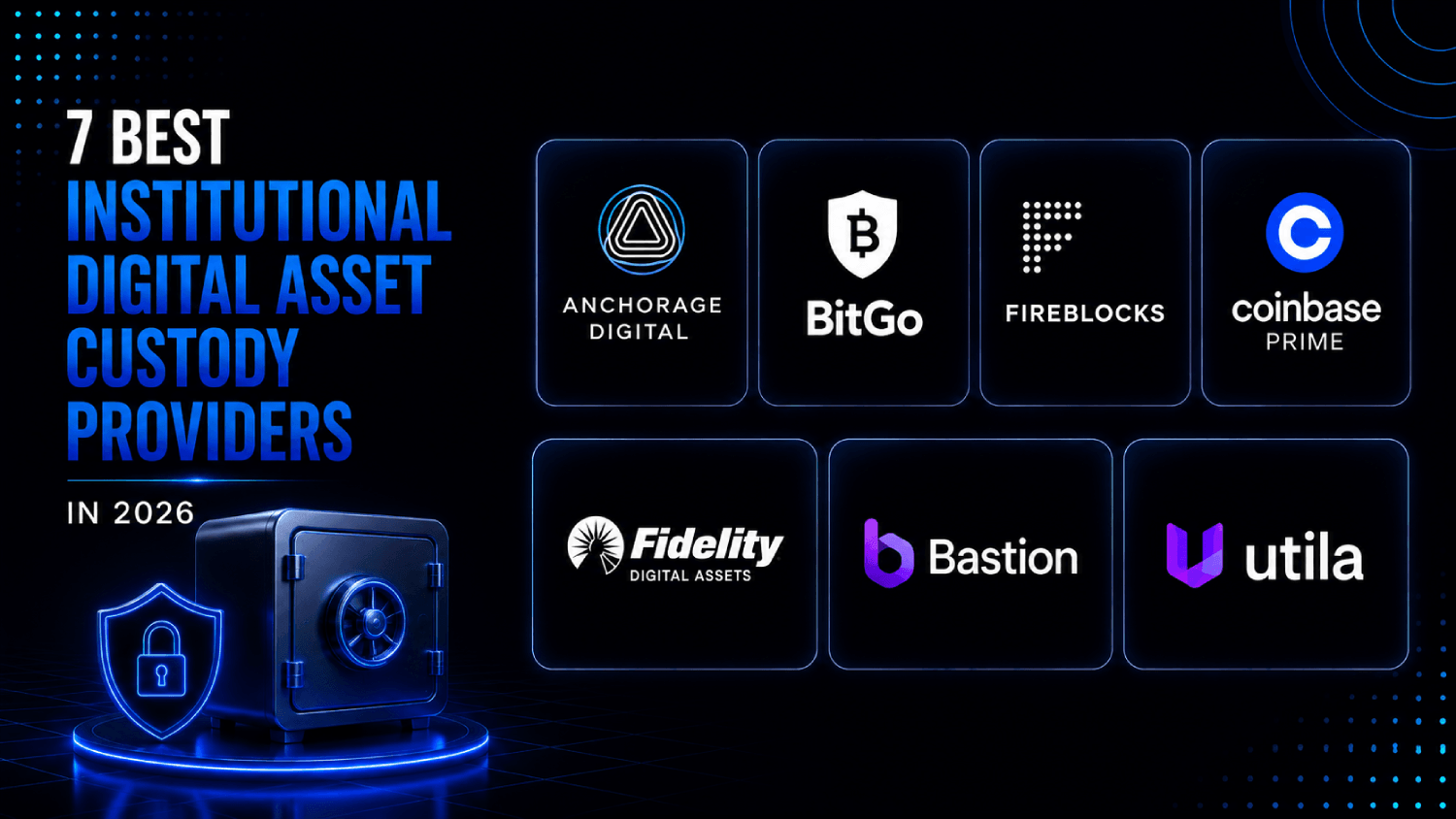
The best institutional digital asset custody providers in 2026 are Anchorage Digital, BitGo, Fireblocks, Coinbase Prime, Fidelity Digital Assets, Bastion, and Utila. Anchorage is the only federally chartered digital asset bank in the US, making it the strongest pick for registered investment advisers and funds that need a qualified custodian. BitGo holds a South Dakota trust charter. Fireblocks leads on MPC infrastructure and developer integration. Coinbase Prime and Fidelity serve large traditional asset managers. Bastion and Utila target fintech builders needing embedded wallet infrastructure.
Why Custody Is Not a Commodity Purchase
Most compliance and treasury teams start their custody search the way they would evaluate cloud storage: capacity, uptime, price. That framing misses the structural issue. Custody in digital assets is a layered concept, and two providers can both call themselves “custodians” while sitting in entirely different legal categories.
The first layer is technological custody: controlling the cryptographic keys that authorize transactions. Any provider offering cold storage or MPC wallets does this. The second layer is legal custody: holding assets in a fiduciary capacity, with regulatory obligations attached. Only a provider with a qualifying charter, a state trust license, or equivalent regulatory authorization reaches this second layer.
For a fintech holding customer stablecoins or tokenized assets, the second layer is what your auditors and regulators care about. Picking a provider strong on the first layer but weak on the second is a common and expensive mistake. If you want a broader view of where custody sits in the full infrastructure picture, the fintech infrastructure stack map for 2026 shows how it connects to payments, banking rails, and compliance tooling.
What Does “Qualified Custodian” Actually Mean for Digital Assets?
Under SEC Rule 206(4)-2, registered investment advisers must hold client funds and securities with a “qualified custodian,” which the rule defines as banks, savings associations, broker-dealers, futures commission merchants, or certain foreign financial institutions. The rule predates crypto, so whether a digital asset custodian qualifies depends on its charter.
An OCC-chartered trust bank or a state-chartered trust company generally satisfies the qualified custodian definition for digital assets. Anchorage Digital received an OCC national trust bank charter, making it the first federally chartered digital asset bank in the US. BitGo operates under a South Dakota trust charter. Coinbase Custody Trust Company holds a New York trust charter through the New York Department of Financial Services (NYDFS).
Providers without any banking or trust charter, regardless of how strong their cold storage or MPC architecture is, do not satisfy the qualified custodian standard. That matters directly if you are an RIA, a fund administrator, or a fintech building a product for institutional clients who will ask for it in their due diligence questionnaires.
The stablecoin dimension adds a separate layer of complexity. Pending federal stablecoin legislation and existing state money transmission frameworks create different requirements for who can custody the reserves backing a stablecoin versus who can hold customer stablecoin balances. Neither question has a fully settled answer as of 2026, but the direction is toward requiring chartered entities. Our piece on stablecoin payment APIs for fintech platforms covers the payment side of this equation.
The FintechSpecs Custody Stack Audit: Four Checks Before You Sign
Before evaluating individual providers, run every candidate through four checks. This is the FintechSpecs Custody Stack Audit, and it filters out providers that look institutional but will create problems at licensing or audit time.
Check 1: Charter verification. Ask for the specific charter or license number. Acceptable answers are an OCC national trust charter, a state trust charter (South Dakota, Wyoming, Nevada, and New York are the main venues), or NYDFS BitLicense combined with a trust charter. “We are compliant with SOC 2 Type II” is not an answer to this question.
Check 2: Insurance architecture. Ask whether the coverage is a specie insurance policy (covering physical or digital property loss) or a crime policy, which carrier holds it, and whether the limit is per-incident or aggregate. Crime policies cap out at aggregate limits that can be far below assets under custody. Confirm whether customer assets are covered or only the provider’s operational assets.
Check 3: Segregation documentation. Ask to see the account agreement language on asset segregation. Commingling customer assets with operational funds is both a legal risk and a red flag in any bankruptcy scenario. Segregated accounts should be documented in the custodial agreement, not just described in marketing materials.
Check 4: Governance tooling. For any fintech with multiple signers, treasury controls, or policy-based spend limits, ask for a demo of the approval workflow engine. Some providers treat this as an add-on or API call. Others have it built directly into the custody platform. The difference shows up in how fast you can implement a material change control policy for your auditors.
The 7 Best Institutional Digital Asset Custody Providers
| Provider | Charter / Regulatory Status | Key Architecture | Best For | Insurance (Public Disclosure) |
|---|---|---|---|---|
| Anchorage Digital | OCC national trust bank charter | HSM + MPC, hot/warm/cold | RIAs, funds, regulated fintechs needing qualified custodian | Disclosed; carrier not publicly named |
| BitGo | South Dakota trust charter | Multi-sig, MPC, cold storage | Exchanges, broker-dealers, OTC desks, enterprise treasury | Specie insurance; coverage limits not publicly disclosed |
| Fireblocks | No banking/trust charter (technology provider) | MPC-CMP, secure enclaves | Fintechs embedding custody infra via API; not a qualified custodian | Coverage for Fireblocks network assets; not end-client assets by default |
| Coinbase Prime | NYDFS trust charter (Coinbase Custody Trust) | Cold storage, MPC, qualified custody | Institutional asset managers, hedge funds, corporate treasury | Disclosed; limits not publicly stated per client |
| Fidelity Digital Assets | National trust bank (NYDFS, national trust charter) | Cold storage, air-gapped infrastructure | Traditional asset managers and family offices already in Fidelity’s network | Not publicly disclosed; covered under Fidelity’s broader insurance |
| Bastion | No banking charter; operates via partner custodian model | MPC, embedded wallet API | Fintech builders wanting WaaS-style embedding with compliance tooling | Not publicly disclosed |
| Utila | No banking charter; treasury-focused MPC platform | MPC, policy engine, multi-wallet | Web3 treasury teams and fintech ops teams managing high transaction volume | Not publicly disclosed |
Anchorage Digital
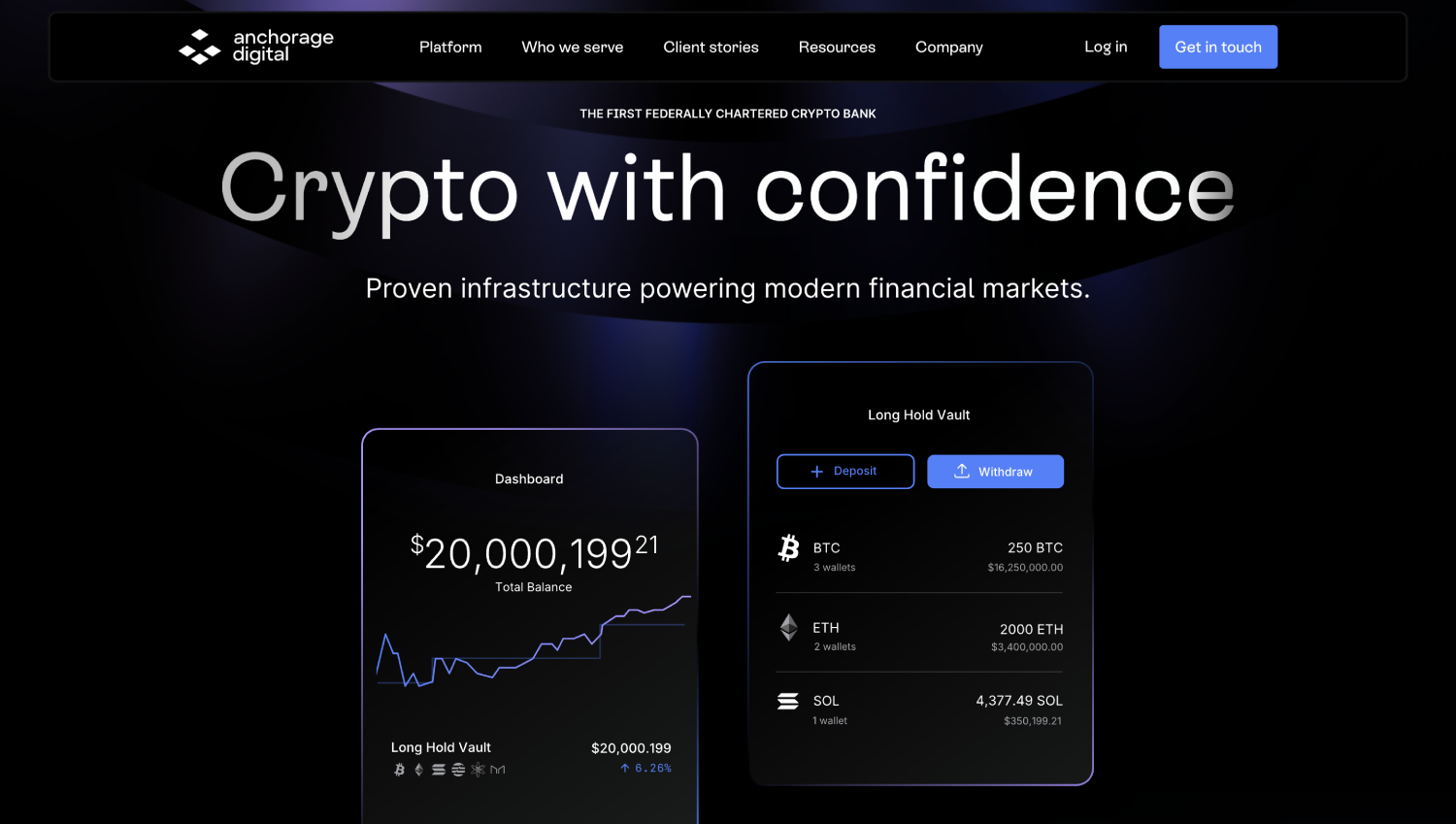
Anchorage Digital holds the only OCC-issued national trust bank charter for a digital asset company in the US. That single fact makes it the default answer when a compliance or legal team asks “do we need a qualified custodian?” and the answer is yes. Anchorage custody services cover Bitcoin, Ethereum, and a broad set of altcoins and tokenized assets, with integrated staking and governance participation built into the custody platform.
The platform uses a combination of hardware security modules (HSMs) and MPC protocols, with segregated accounts per client. Their governance tooling supports multi-party approval workflows with time locks and policy-based controls, which maps directly to what a treasury or compliance team needs to show during a SOC 2 Type II audit. Pricing is not publicly disclosed; Anchorage operates on custom enterprise contracts.
The real trade-off with Anchorage is integration complexity. For a traditional fund or RIA, that is acceptable. For a fintech that needs to embed custody into a product and call APIs at scale, the integration is heavier than Fireblocks or Bastion. Anchorage is the right answer for charter-sensitive situations, not for teams optimizing for developer velocity.
BitGo
BitGo is the most widely deployed institutional custody platform by asset variety, supporting over 700 coins and tokens as of the company’s public disclosures. Its South Dakota trust charter qualifies it as a custodian under most institutional frameworks, and it operates a dedicated qualified custody product for RIAs and fund administrators called BitGo Prime.
BitGo’s multi-sig architecture predates MPC and remains its core differentiation. Clients hold one key, BitGo holds one, and a third key is held in cold storage. This is auditable, well-understood by regulators, and does not require trusting BitGo’s proprietary MPC implementation. For teams whose auditors or regulators prefer cryptographic proof over vendor assurances, multi-sig is a cleaner story.
BitGo also supports institutional lending and prime brokerage services through BitGo Prime, which matters for funds that want to borrow against custodied assets. Pricing is custom. BitGo does not publish rate cards, but its structure typically involves an annual platform fee plus basis points on assets under custody.
Fireblocks
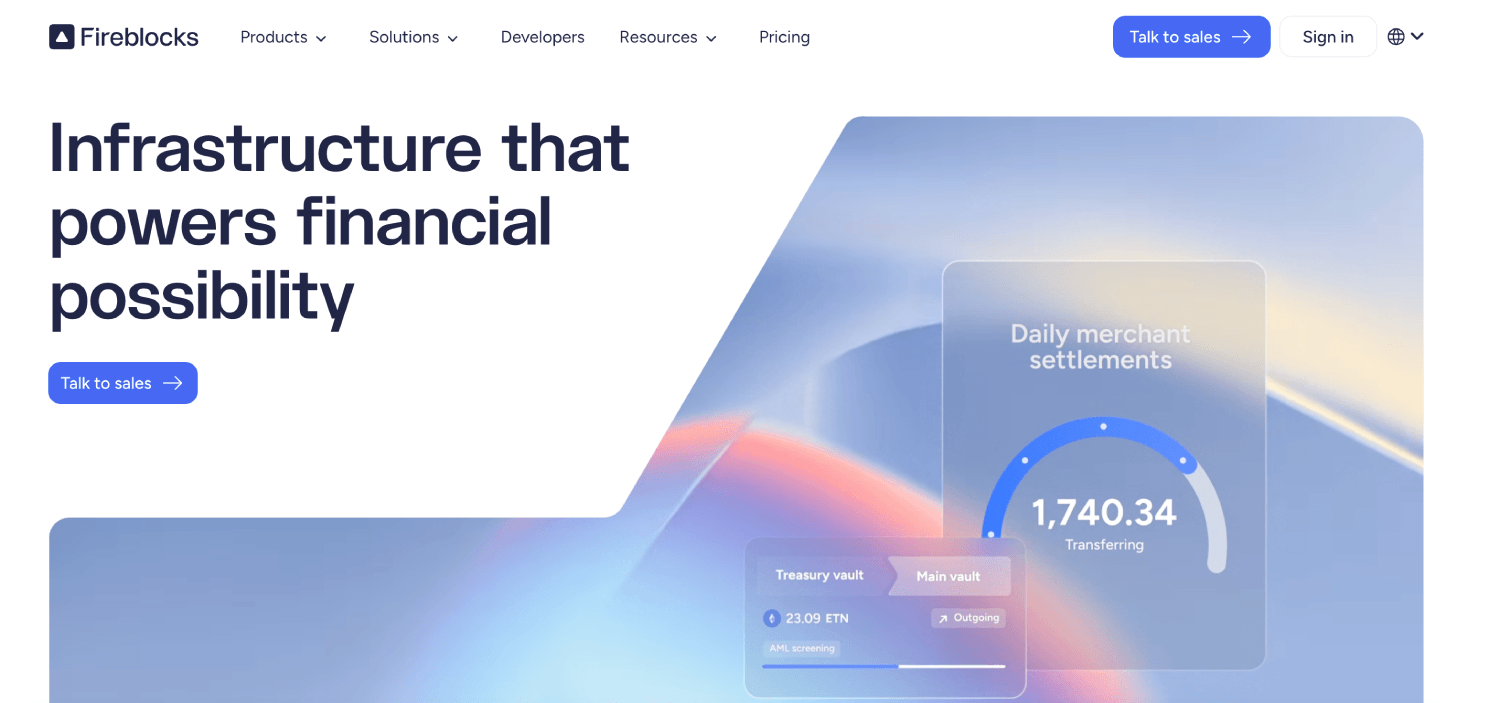
Fireblocks is not a custodian in the qualified sense. It is a custody infrastructure company: it provides the MPC technology, wallet orchestration, and policy engine that other firms use to build custody products. Many of the largest exchanges, banks, and fintechs run Fireblocks under the hood while offering their own branded custody to end clients.
Its MPC-CMP protocol eliminates the single point of failure that multi-sig introduces at the key storage layer. Fireblocks also runs a settlement network, the Fireblocks Network, that allows direct asset transfers between counterparties that are both Fireblocks customers, reducing settlement time from hours to minutes. Fireblocks reports that over 1,800 financial institutions and fintechs use its platform, according to the company’s public statements.
For a fintech building an embedded crypto product, Fireblocks is the infrastructure layer, not the compliance layer. You still need to wrap it with a chartered custodian arrangement or obtain your own trust charter. Teams that pick Fireblocks thinking it solves the qualified custodian question are making the category error this article exists to prevent. See how this decision connects to broader wallet and infrastructure choices in the embedded finance APIs comparison for SaaS companies.
Coinbase Prime
Coinbase Prime combines custody, prime brokerage, and trading execution in a single institutional product. Coinbase Custody Trust Company, LLC is chartered as a New York limited purpose trust company under NYDFS, which qualifies it as a custodian for most institutional use cases. Assets in custody are held in segregated accounts and covered under Coinbase’s disclosed insurance program.
The practical advantage of Coinbase Prime for institutional asset managers is the breadth of the trading and settlement stack. Custody, execution, and reporting are native to the same platform, which reduces reconciliation friction compared to custody-only providers where trading happens on a separate venue. The reporting suite integrates with common fund administration tools, which matters for family offices and hedge funds managing investor reporting.
The concentration risk is real. Coinbase is both the custodian and the trading counterparty in many Prime arrangements. For institutions with strict conflict-of-interest policies, that may require structural mitigations or a different provider.
Fidelity Digital Assets
Fidelity Digital Assets (FDA) is the digital asset custody and trading arm of Fidelity Investments. It operates as a national trust bank, Fidelity Digital Assets, National Association (FDA, NA), with a charter from the OCC. That puts it in the same regulatory tier as Anchorage for qualified custodian purposes.
Fidelity’s differentiation is distribution, not technology. Traditional asset managers, family offices, and defined benefit plans that already have Fidelity relationships can add digital asset custody without introducing a new counterparty into their operational infrastructure. The tradeoff is asset breadth: FDA supports Bitcoin and Ethereum in its core custody offering, with additional assets available through its trading desk. For institutions that only need BTC and ETH custody, this is rarely a problem. For those who need broad multi-chain exposure or DeFi access, FDA is limiting.
Pricing is not public. Fidelity operates on negotiated institutional agreements, and the company does not publish its custody fee structure.
Bastion
Bastion targets fintech builders directly, positioning itself as a wallet-as-a-service (WaaS) infrastructure provider with embedded compliance features. It does not hold a banking or trust charter. Instead, it operates under a partner custodian model, where the underlying asset custody is provided by a licensed custodian and Bastion provides the developer-facing API layer on top.
For product and engineering teams at seed to Series B fintechs, Bastion’s appeal is speed of integration. The API surface is designed for builders, not for trading desks. Its compliance tooling includes transaction screening and policy-based controls that map to common AML program requirements. This makes it easier to satisfy a basic compliance audit without building a full internal compliance stack from scratch.
The limitation is that Bastion does not solve the qualified custodian question directly. If your regulators or institutional clients require custody held by a chartered entity in your name, you need to know which underlying custodian Bastion uses and confirm that arrangement satisfies your specific requirements. Ask this explicitly before signing.
Utila
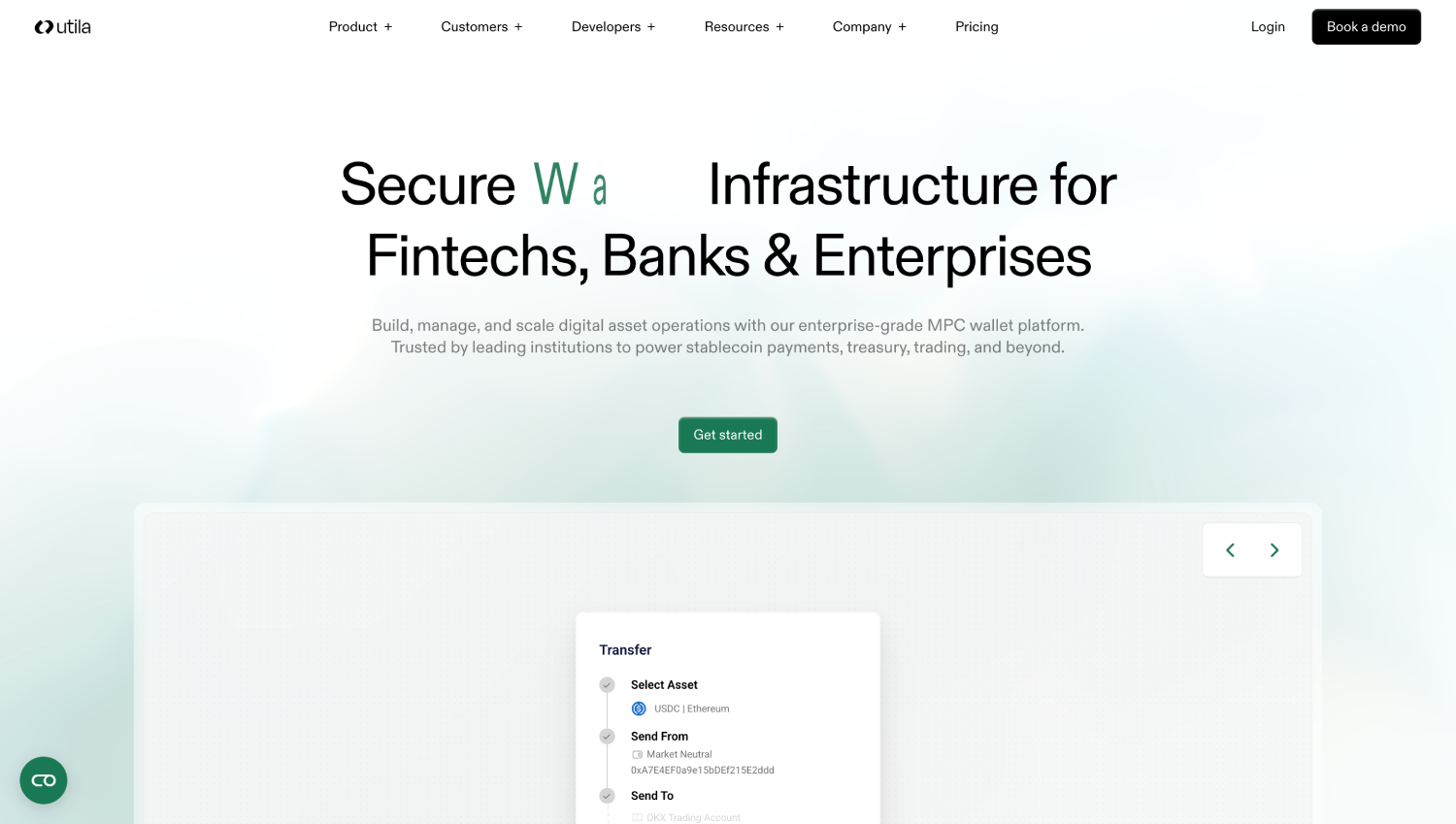
Utila focuses on treasury and operations teams inside crypto-native fintechs and Web3 companies, not on the institutional fund custody use case. Its MPC-based platform is built around multi-wallet management, role-based access control, and a policy engine that lets treasury teams define approval chains, spending limits, and whitelisted counterparties at the wallet level.
Where Utila stands out is the governance layer. For a fintech operations team managing dozens of wallets across multiple chains and needing to enforce controls that satisfy an internal audit, Utila’s policy engine is more granular than most custody platforms offer out of the box. This is important for companies trying to satisfy SOC 2 Type II controls around privileged access and change management for their treasury function.
Utila does not hold a banking or trust charter. It is custody tooling for teams that have already resolved the qualified custodian question, or for companies operating outside the SEC’s RIA framework where that question does not directly apply. Pricing is custom and not publicly disclosed.
Does Your Fintech Need a Qualified Custodian to Hold Customer Stablecoins?
This is the most operationally consequential question in institutional digital asset custody right now, and the honest answer is: probably yes, depending on your regulatory classification and jurisdiction, but the rules are still forming.
If your fintech holds USDC or USDT on behalf of customers as part of a money transmission business, most state money transmitter licenses require that customer funds be held with a depository institution or equivalently regulated entity. A custody technology provider without a charter typically does not satisfy this requirement. Our breakdown of money transmitter license costs by state covers the licensing obligations if you are still mapping your requirements.
If your product is used by registered investment advisers or similar regulated investment entities, the SEC’s qualified custodian standard applies to the assets they hold in your platform, not just to what you hold directly. That means your custody architecture becomes part of their RIA compliance posture, and they will ask about it.
The pending federal stablecoin legislation, which as of publication remains unfinalized in Congress, would impose additional requirements on stablecoin issuers and reserve custodians. Fintechs that custody stablecoin reserves rather than customer balances face a slightly different rule set. The directional guidance from both federal regulators and state examiners is toward chartered entities holding both. Building your custody stack on an unchartered technology provider today is a bet that the rules will not tighten, and that is a bet worth examining carefully.
How Do MPC Custody and Cold Storage Compare on Security?
Cold storage refers to keeping private keys on hardware that is never connected to the internet, air-gapped from any networked system. It is the oldest and most institutionally understood security approach for digital assets. The risk is operational: cold storage introduces latency into any withdrawal or transaction, and the physical security of the hardware becomes the attack surface.
MPC custody (multi-party computation) distributes key shards across multiple parties or devices such that no single party ever holds a complete private key. Transactions are authorized through a threshold signature process. MPC eliminates the single point of compromise that cold storage introduces at the physical device level, and it allows faster transaction authorization than fully air-gapped cold storage.
Neither architecture is categorically superior. Cold storage is better understood by regulators and easier to audit with traditional controls. MPC is more operationally efficient and more resistant to insider theft, but it introduces trust in the MPC protocol implementation itself. The most credible institutional custody setups today combine both: MPC for operational wallets with active transaction flow, and cold storage for deep storage of assets that rarely move. Providers like BitGo, Anchorage, and Coinbase Prime operate hybrid architectures for exactly this reason.
What Does Institutional Custody Insurance Actually Cover?
Insurance in digital asset custody is significantly less standardized than in traditional financial services, and the gap between what marketing materials imply and what policies actually cover is wide. Most institutional custody providers carry some form of specie insurance, crime insurance, or a combination. What differs materially between providers is the structure, limits, and exclusions.
A specie insurance policy covers physical loss of the property itself, which in digital asset terms typically means loss of private keys due to a covered event like a hack, theft, or physical destruction of hardware. Crime policies cover losses from employee dishonesty, computer fraud, and similar events. The coverage that matters most for institutional clients is whether the policy covers client assets held in custody, not just the provider’s own operational assets.
Ask any provider three specific questions on insurance: what is the per-incident limit, what is the aggregate limit, and are client assets covered under the policy or only the provider’s assets. Most providers will not publish this detail publicly, but they will provide it under NDA during due diligence. If a provider refuses to answer these questions directly, that is itself a signal worth weighing. The compliance considerations here connect to a broader pattern described in our analysis of compliance mistakes that can destroy a fintech startup.
Frequently Asked Questions
Who is considered a qualified custodian for digital assets under US law?
Under SEC Rule 206(4)-2, a qualified custodian for investment adviser client assets must be a bank, savings association, registered broker-dealer, futures commission merchant, or certain foreign financial institutions. For digital assets specifically, this means the custodian needs an OCC national trust charter, a state trust charter from a jurisdiction like New York, South Dakota, or Wyoming, or equivalent regulatory authorization. A custody technology provider without any banking or trust charter does not satisfy this standard regardless of its security architecture.
What is the difference between Fireblocks and Anchorage for institutional custody?
Fireblocks is a custody infrastructure and MPC technology provider, not a chartered custodian. It provides the software and protocol layer that other institutions use to manage wallets and authorize transactions. Anchorage Digital is a federally chartered national trust bank with an OCC charter. It acts as the legal custodian of record for client assets. Many fintechs use Fireblocks as the technical layer while holding assets with a chartered custodian like Anchorage. They serve different roles in the custody stack and are not direct substitutes for each other.
Does a fintech holding customer USDC need a qualified custodian?
Likely yes, but the specific requirement depends on the fintech’s regulatory classification. Companies licensed as money transmitters in most states must hold customer funds with a depository institution or equivalent regulated entity. Fintechs whose platform serves registered investment advisers must support their clients’ qualified custodian obligations indirectly. Pending federal stablecoin legislation is expected to formalize additional requirements for stablecoin reserve custodians. The direction from both state and federal regulators is consistently toward chartered entities, not unchartered technology providers.
What is MPC custody and why do institutions use it?
Multi-party computation (MPC) custody distributes cryptographic key material across multiple parties or devices such that no single entity ever holds a complete private key. Transactions are signed through a threshold process requiring cooperation from multiple key shards. Institutions use MPC because it eliminates the single point of compromise that traditional key storage introduces, reduces the insider theft risk, and allows faster transaction authorization than fully air-gapped cold storage. It is now the dominant technical approach among institutional custody providers, including Fireblocks, Anchorage, BitGo, and Coinbase Prime.
Can you lose crypto assets held with an institutional custodian?
Yes, though the risk profile differs from self-custody. Institutional custodians hold assets through legal agreements, carry insurance, and operate under regulatory supervision, all of which reduce but do not eliminate loss risk. The main scenarios are: a security breach that exceeds insurance coverage limits, custodian insolvency (in which case the treatment of client assets depends on whether they were properly segregated and the custodian’s charter structure), or a regulatory action that freezes assets. Segregated accounts and chartered custodians offer materially stronger protection than commingled arrangements at unchartered providers.
Which custody providers support SOC 2 Type II audited infrastructure?
Anchorage Digital, BitGo, Fireblocks, and Coinbase Prime all maintain SOC 2 Type II certifications or audited equivalents for their infrastructure and operational controls. Fidelity Digital Assets operates within Fidelity’s broader audit framework. For providers like Bastion and Utila, verify directly what audits have been completed and request reports under NDA. SOC 2 Type II covers operational security controls but does not address charter status or legal custodianship, so it is a necessary but not sufficient criterion for institutional due diligence.
How should a fintech choose between Bastion, Utila, and Fireblocks for embedded custody?
The choice depends on what problem you are solving. Fireblocks is best if you are building a high-volume product requiring deep API control over wallet management and are willing to resolve the qualified custodian question separately. Bastion is better if you want a managed WaaS solution with built-in compliance tooling and faster integration, and you are comfortable with Bastion’s underlying custodian handling the charter requirement. Utila is suited for internal treasury operations where you need multi-wallet governance and approval workflows rather than a customer-facing custody product. None of the three is a qualified custodian in its own right.
Custody Charter Status Is Not a Detail You Revisit Later
The pattern that consistently creates problems for fintech teams is treating custody as an infrastructure decision made once and revisited only when something breaks. Charter status and insurance coverage are not upgrade paths you can switch to mid-cycle. When a new institutional client, a state examiner, or a licensing board asks whether your custody arrangement satisfies their requirements, your answer is determined by the contract you already signed, not the one you plan to sign later.
The split between Anchorage and BitGo on one side, and Fireblocks, Bastion, and Utila on the other, is not a quality difference. It is a functional difference. Chartered custodians hold assets in a legally recognized fiduciary capacity. Infrastructure providers give you the tools to build a custody product. Both have legitimate roles. Mixing up which role a provider actually fills is where the expensive mistakes happen. The way to run that check is the Custody Stack Audit described earlier: charter verification, insurance architecture, segregation documentation, and governance tooling, in that order, before any contract goes to legal review.
For fintech teams still mapping out how custody connects to the broader infrastructure build, the relationship between key storage decisions and your compliance program becomes clearer once you have resolved the legal layer first. A good custody vendor shortlist starts with the two charter questions, then narrows by use case. Everything else, MPC versus multi-sig, hot versus cold allocation, insurance carrier, governance workflow design, is a real decision but a secondary one.