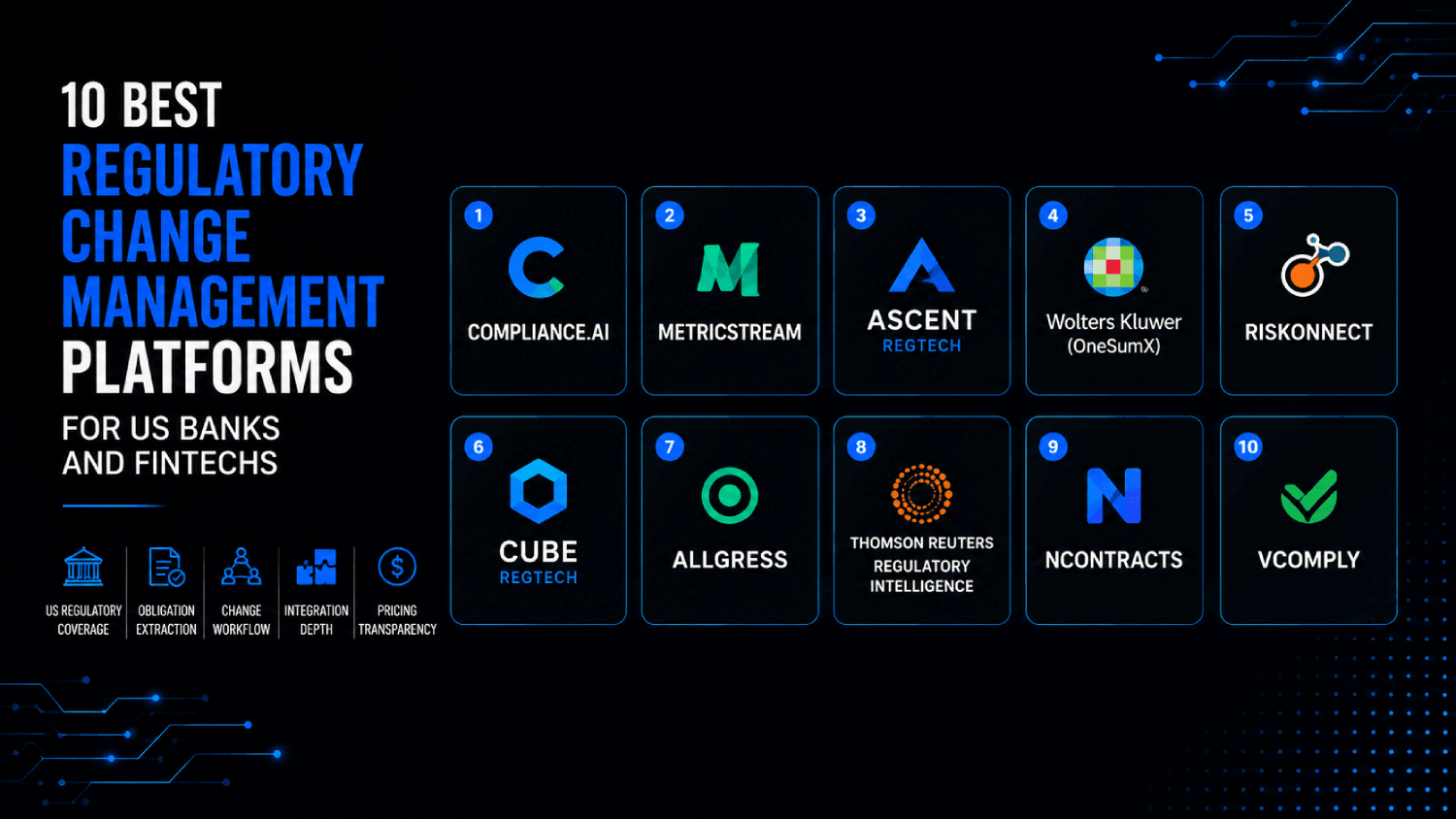

- Most regulatory change management platforms cover the same surface area on paper. The real differences show up in US regulatory source coverage, how obligations get mapped to internal controls, and whether your team can actually close the loop with evidence without building a custom workflow.
- Brand recognition is a poor proxy for fit. A platform that works for a $50B bank’s enterprise GRC team will create more friction than it solves for a Series B lending startup managing 12 state licenses.
- The five criteria that actually split the field: depth of US regulatory source coverage, obligation extraction quality, change workflow automation, integration lift, and pricing transparency.
- Three vendor categories dominate: AI-native RegIntel platforms (best for fintechs and mid-market banks), enterprise GRC suites with a regulatory change module (best for large institutions already on that stack), and point solutions built around a single regulatory body or obligation type.
- A sponsored vendor profile appears first in this list and is clearly labeled. Scoring methodology is identical for all ten vendors.
The best regulatory change management software for US banks and fintechs depends on four things: how many regulatory sources you need to monitor, whether you need obligation-level mapping or just horizon alerts, how deeply the tool connects to your existing GRC or ticketing stack, and whether pricing is transparent enough to get a budget approved before a demo. Platforms like Compliance.ai, MetricStream, and Ascent cover different segments of this spectrum, and no single vendor is the right answer for every charter type or company stage.
What Is Regulatory Change Management Software, and Why Does It Matter for Fintechs?
Regulatory change management software does four distinct things that general compliance tools do not: it ingests raw regulatory output (rules, guidance, enforcement actions, proposed rulemakings) from dozens of sources, extracts the specific obligations buried in that text, maps those obligations to internal controls or business lines, and tracks whether the organization has actually addressed each change with documented evidence.
That last piece is the part most teams underestimate. Horizon scanning, where you read a bulletin from the CFPB and flag it in Slack, is not regulatory change management. Real change management closes the loop between a regulatory event and a completed control update, with an audit trail an examiner can review.
For early-stage fintechs managing a narrow charter, a lightweight tool with good US regulatory source coverage often beats a feature-heavy enterprise platform that takes six months to implement. For a bank with 40 product lines and 15 state licenses, the opposite is true. This guide covers both ends of the spectrum, with a transparent scoring model so you can weight what matters for your situation. If you are still building out your broader compliance program, the Fintech Product and Compliance Readiness Checklist is a useful starting point before you evaluate these tools.
How Does the FintechSpecs Regulatory Change Management Scoring Model Work?
Every vendor in this list was scored on five criteria, each worth up to 20 points, for a maximum score of 100. The criteria are: US regulatory source coverage (breadth and freshness of monitored sources including CFPB, OCC, Federal Reserve, FinCEN, FDIC, SEC, CFTC, and state regulators); obligation extraction accuracy (whether the platform extracts specific obligations from regulatory text rather than delivering full-document alerts); change workflow automation (built-in task assignment, approval chains, deadline tracking, and closure); integration depth (native connectors to GRC platforms, Jira, ServiceNow, Slack, and similar tools); and pricing transparency (whether pricing is publicly listed or available without a sales conversation).
We did not test these platforms directly, and we disclose that clearly. Scores reflect publicly available product documentation, vendor-published feature pages, and information surfaced in regulatory technology analyst coverage. Where a vendor does not publicly disclose a feature’s depth, it receives a conservative score.
| Vendor | US Source Coverage | Obligation Extraction | Change Workflow | Integration Depth | Pricing Transparency | Total (100) | Best For |
|---|---|---|---|---|---|---|---|
| Compliance.ai | 19 | 18 | 17 | 15 | 10 | 79 | Mid-market banks, growth-stage fintechs |
| MetricStream | 17 | 16 | 19 | 18 | 8 | 78 | Large banks, enterprise GRC environments |
| Ascent RegTech | 18 | 19 | 15 | 13 | 9 | 74 | Fintechs, broker-dealers, mid-size banks |
| Wolters Kluwer (OneSumX) | 18 | 16 | 17 | 16 | 7 | 74 | Large banks, credit unions, insurance carriers |
| Riskonnect | 15 | 14 | 18 | 17 | 10 | 74 | Mid-market banks, enterprises with existing GRC workflows |
| CUBE RegTech | 19 | 17 | 15 | 14 | 7 | 72 | Global banks with multi-jurisdictional exposure |
| Allgress | 14 | 13 | 16 | 15 | 12 | 70 | Seed-to-Series B fintechs building first compliance program |
| Thomson Reuters Regulatory Intelligence (TRRI) | 19 | 15 | 14 | 13 | 8 | 69 | Legal and compliance teams needing analysis depth |
| Ncontracts | 16 | 14 | 16 | 14 | 13 | 73 | Community banks, credit unions, smaller fintechs |
| Vcomply | 13 | 12 | 15 | 14 | 15 | 69 | Early-stage fintechs needing a low-cost starting point |
Which Regulatory Change Management Platform Is Best for Each Buyer Type?
Before the individual profiles, a useful mental model: think of this category in three tiers. AI-native regulatory intelligence platforms (Compliance.ai, Ascent, CUBE) are built primarily around ingestion and extraction. Enterprise GRC platforms with regulatory change modules (MetricStream, Wolters Kluwer, Riskonnect) are built around workflow and evidence management, with regulatory content as a feed. Point solutions and lighter tools (Allgress, Ncontracts, Vcomply) trade depth for speed of deployment.
Most fintechs under 200 employees need tier one or tier three, not tier two. Enterprise GRC platforms are expensive, slow to implement, and designed for organizations with dedicated GRC program managers. A Series B fintech with a three-person compliance team will spend more time configuring MetricStream than managing actual regulatory risk.
The 10 Best Regulatory Change Management Platforms, Reviewed
1. Compliance.ai , Best for Growth-Stage Fintechs and Mid-Market Banks (Sponsored)
Disclosure: Compliance.ai has a commercial relationship with FintechSpecs. Their score, methodology, and placement in this review are independent of that relationship. The scoring model applied to all ten vendors is identical.
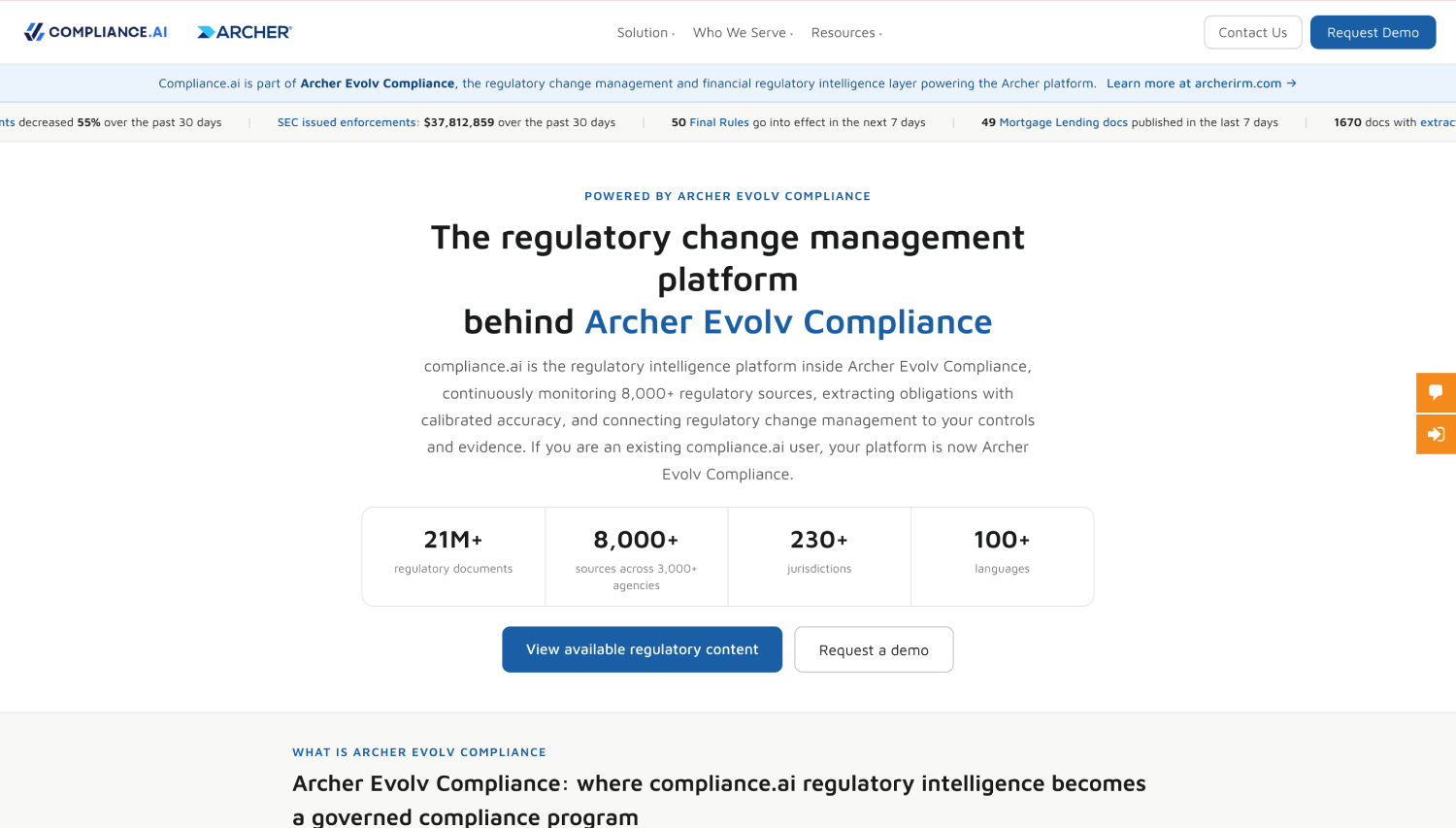
Compliance.ai is purpose-built for the banking, financial services, and insurance (BFSI) segment, with an AI-driven system that ingests regulatory changes and automates obligation mapping. According to their public product documentation, the platform monitors federal agencies including the CFPB, OCC, Federal Reserve, FDIC, FinCEN, SEC, and CFTC, plus state-level regulators across all 50 states.
The core differentiation is obligation extraction. Rather than delivering a PDF of a final rule and leaving your team to parse it, Compliance.ai surfaces specific obligations extracted from regulatory text and maps them to internal controls or business units. That extraction step alone cuts the time a compliance analyst spends on a new rulemaking from hours to minutes, at least for well-structured regulatory documents.
Change workflow is solid at this tier. The platform includes task assignment, deadline tracking, and an audit trail for evidence closure, which is the minimum your examiner will expect to see during a BSA/AML review or a CFPB supervisory exam. Integration depth is adequate for most fintech stacks but not enterprise-grade. Native connectors to Jira and Slack are documented; deep ServiceNow or Archer integration requires API configuration. Pricing is not publicly listed, which costs it points on transparency, but the company does offer demo-gated access rather than enterprise sales cycles measured in quarters.
Best for: A Series B or Series C fintech, or a community bank or credit union, that needs strong US regulatory source coverage and AI-assisted obligation mapping without the implementation burden of an enterprise GRC suite.
2. MetricStream , Best for Large Banks Already in an Enterprise GRC Environment
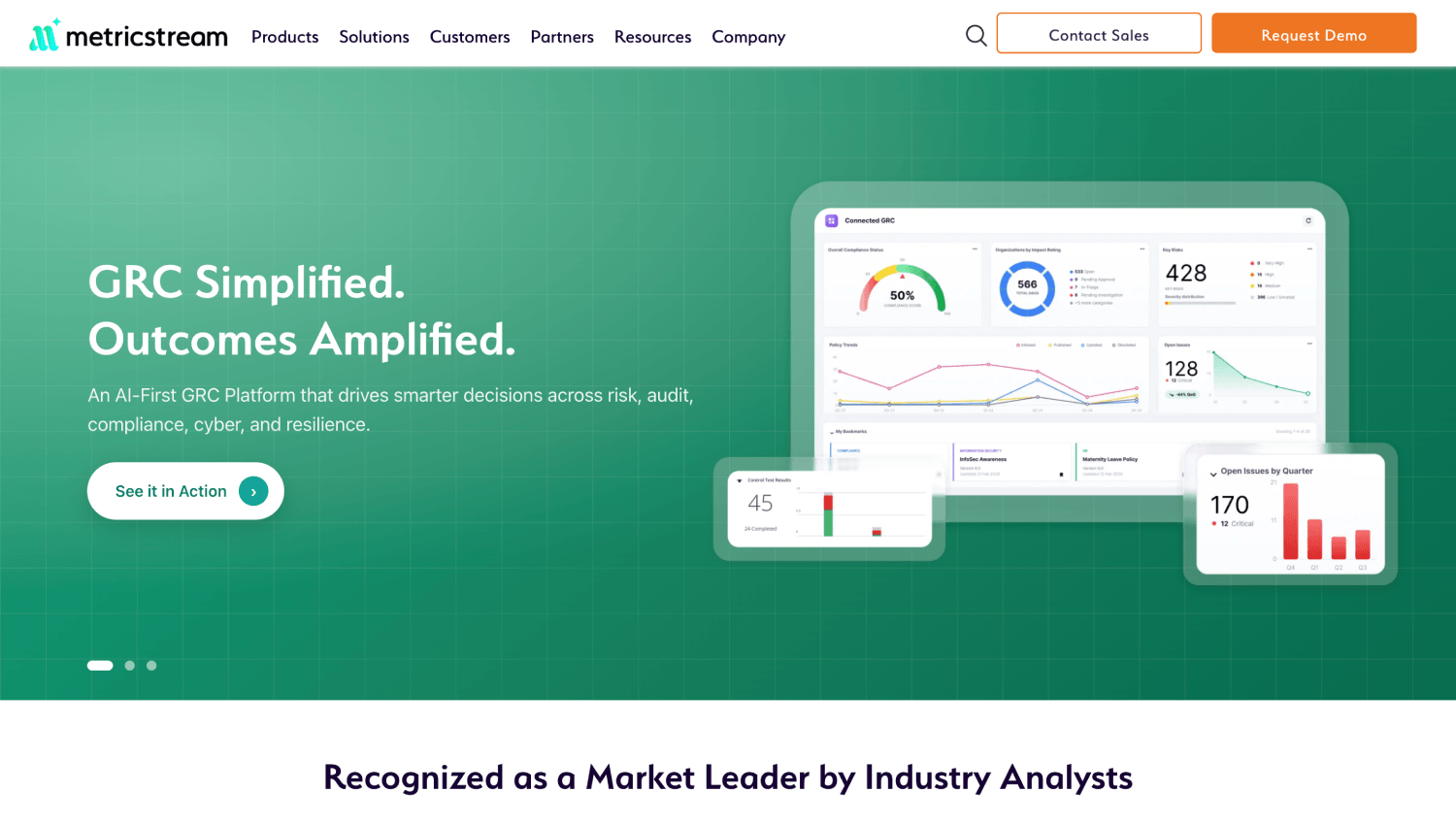
MetricStream is the category’s most established enterprise GRC platform. Its regulatory change management module is designed to sit inside a broader integrated risk and compliance program rather than stand alone. According to MetricStream’s public product pages, the platform covers regulatory change management as part of its Connected GRC framework, which links regulatory changes to risk assessments, control libraries, and audit findings in a single data model.
That integration depth is genuinely valuable if you already run MetricStream for operational risk or audit management. Adding regulatory change management does not require rebuilding your control library or training a second team. For organizations starting from scratch, however, the onboarding footprint is substantial. Implementations at large financial institutions often run six to twelve months, and the platform assumes you have dedicated GRC program managers configuring and maintaining it.
Change workflow automation is MetricStream’s strongest dimension. The platform handles multi-step approval chains, role-based task assignment, escalation rules, and evidence attachment with the depth you would expect from a platform serving Tier 1 banks. Pricing is not publicly listed. Contracts are enterprise-negotiated, and public reports from analyst communities suggest annual costs in the six-figure range for larger deployments, though MetricStream does not confirm this publicly.
Best for: A large bank, insurance carrier, or financial holding company that already runs MetricStream or is evaluating a full GRC suite replacement.
3. Ascent RegTech , Best for Obligation-Level Precision in Fintech and Broker-Dealer Environments

Ascent RegTech earns the highest obligation extraction score in this list because it was built specifically to solve that problem. The company’s AI reads regulatory text and produces a structured obligation library, not a summary, not a digest. Each obligation is tagged with the specific rule, the business function it applies to, and the regulatory body that issued it.
For a broker-dealer managing FINRA and SEC obligations alongside CFPB requirements from a recently added lending product, that granularity matters. Broad-stroke alerting systems tell you a rule changed. Ascent tells you which specific obligations within that rule apply to your registered investment advisory business versus your consumer lending arm, and flags only the ones where your existing controls are not mapped.
The trade-off is workflow depth. Ascent’s change workflow tools are lighter than MetricStream’s or Riskonnect’s. Task management and evidence closure exist, but the platform is not the right choice if you need a fully configurable multi-stage approval workflow with escalation logic. For teams that prefer to own workflow in Jira or Linear and use Ascent purely for regulatory intelligence and obligation mapping, that is less of a limitation. Pricing is not publicly listed.
Best for: Fintechs and broker-dealers that need obligation-level precision and are comfortable managing change workflow in an adjacent tool.
4. Wolters Kluwer OneSumX , Best for Large Banks Needing Integrated Regulatory Reporting

Wolters Kluwer OneSumX is a regulatory reporting and compliance platform with a regulatory change management layer built in. The critical differentiator here is that Wolters Kluwer also maintains proprietary regulatory content libraries used by major financial institutions. When a rule changes, OneSumX can update its internal content taxonomy and surface the impact on existing reporting obligations automatically.
That content library depth gives Wolters Kluwer a genuine edge for institutions with heavy regulatory reporting burdens: think DFAST, CCAR, HMDA, or CRA reporting. Where other platforms identify what changed and flag it for human review, OneSumX can in some cases pre-populate the downstream reporting implication. For a mid-size bank or credit union spending significant resources on annual regulatory reporting, that upstream connection to the change management function is worth real money.
The limitation is cost and complexity. OneSumX is priced for institutions that can justify enterprise software spend, and the implementation scope extends well beyond a regulatory change management deployment alone. Pricing is not publicly disclosed.
Best for: Regional banks, credit unions above $1B in assets, and insurance carriers with significant regulatory reporting obligations alongside change management needs.
5. Riskonnect , Best for Mid-Market Banks With Existing GRC Workflow Investment
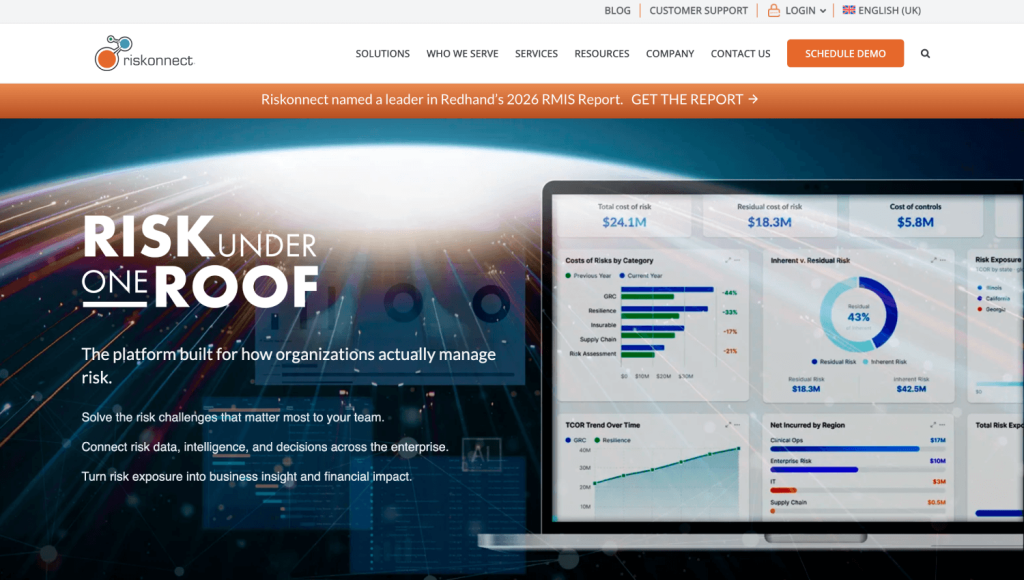
Riskonnect positions its regulatory change management capability inside a broader integrated risk management platform. Its change workflow automation scores highest in the mid-market segment, with configurable task libraries, role-based access controls, deadline management, and audit-ready evidence repositories.
Where Riskonnect differs from MetricStream is the implementation model. Riskonnect has historically targeted mid-market financial institutions and non-financial corporates rather than Tier 1 banks, which means shorter implementation timelines and a customer success model that is more hands-on during onboarding. Integration depth is strong, with documented connections to common enterprise systems.
The regulatory content ingestion layer is solid but not the deepest in this list. Riskonnect partners with third-party regulatory content providers rather than maintaining a proprietary content library, which means the quality of your regulatory source coverage partly depends on which content partner your contract includes. Confirm that in your evaluation. Pricing is quoted rather than publicly listed, but the company does not require a multi-quarter enterprise sales process to get a number.
Best for: Mid-market banks and financial institutions that have already invested in a GRC workflow program and need a regulatory change management layer that fits their existing process model.
6. CUBE RegTech , Best for Global Banks With Multi-Jurisdictional Exposure
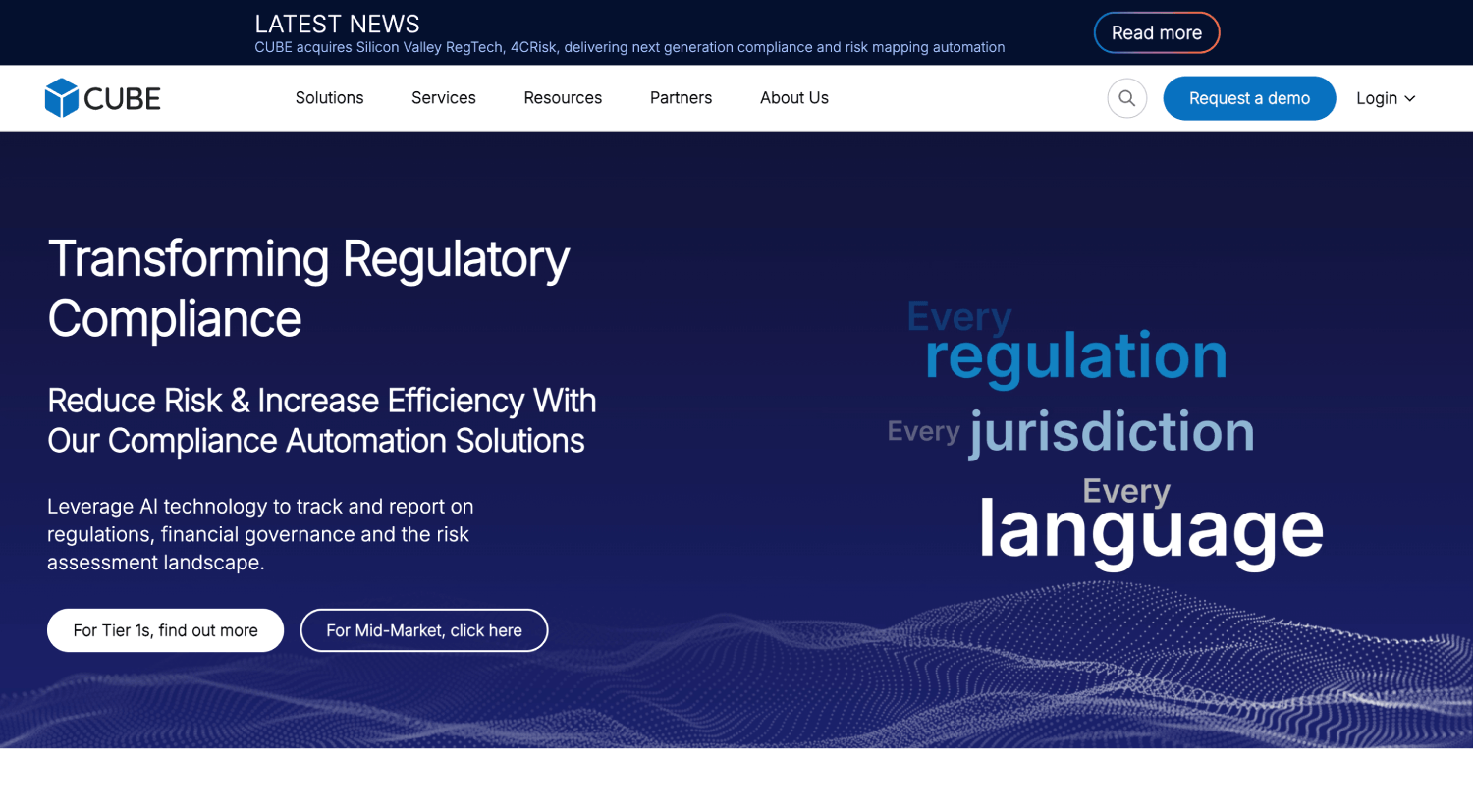
CUBE RegTech is built around breadth of regulatory source coverage. The company’s regulatory content library spans hundreds of jurisdictions and thousands of regulatory sources globally, which is a meaningful advantage for a US bank with international operations or a fintech licensed in multiple markets.
For a purely US-focused institution, CUBE’s global coverage is partially wasted value. Its US-specific obligation mapping and change workflow capabilities are functional but not as refined as Compliance.ai’s or Ascent’s at the domestic level. The platform is better at telling you that a regulation changed in 30 countries than at extracting the specific obligation that applies to your payment product in Ohio.
Where CUBE earns its place: any institution managing regulatory exposure across the US, EU, UK, and APAC simultaneously will find that no other single platform matches its raw coverage breadth. For US-only fintechs, the cost-benefit calculation is harder to justify. Pricing is not publicly disclosed and is structured for institutional buyers.
Best for: Global banks and fintechs with regulatory obligations spanning multiple jurisdictions who need a single source of truth across all of them.
7. Allgress , Best for Seed-to-Series B Fintechs Building Their First Compliance Program
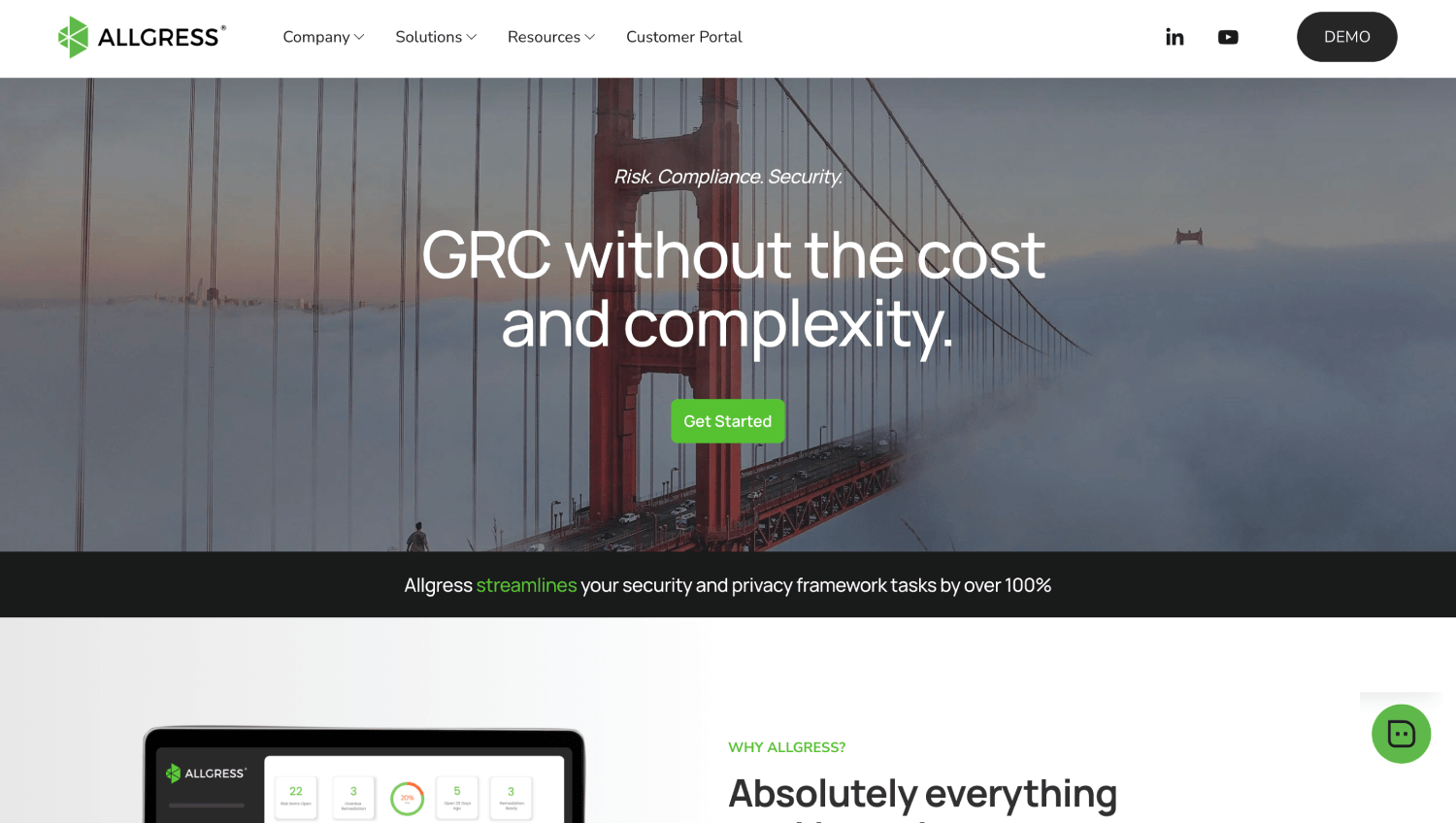
Allgress is a GRC platform that covers regulatory change management as part of a broader compliance and risk management toolset. It scores lower on US regulatory source depth and obligation extraction than the AI-native platforms, but it scores higher on pricing transparency and implementation speed, which matters enormously for early-stage teams.
The platform is built for organizations that do not yet have a mature GRC program. If your compliance workflow is currently a spreadsheet and a shared Google Drive folder, Allgress gives you structured task management, policy management, and a basic regulatory change feed without requiring a six-month implementation project. That is a meaningful upgrade from nothing, even if it is not the right long-term platform for a bank growing past $500M in assets.
Pricing is more accessible than most enterprise alternatives, though it is still quoted rather than listed on a public page. The company is transparent about its tier structure during the sales process, which is more than most vendors in this category can claim. For a seed-stage fintech trying to get a compliance program operational before a Series A due diligence review, Allgress is worth including in your shortlist alongside the broader compliance automation category covered in our compliance automation tools roundup.
Best for: Seed-to-Series B fintechs that need a functional compliance and regulatory change management foundation without the budget or headcount for an enterprise deployment.
8. Thomson Reuters Regulatory Intelligence (TRRI) , Best for Legal and Compliance Teams Needing Analytical Depth
Thomson Reuters Regulatory Intelligence is a regulatory research and monitoring platform that sits closer to the legal research end of the spectrum than the workflow automation end. Its regulatory source coverage is among the broadest in the market, with deep archives of US federal and state regulatory activity and strong integration with Thomson Reuters’ legal content infrastructure.
The platform excels at giving compliance attorneys and senior compliance officers analytical context around regulatory changes, not just alerts. When the CFPB issues a supervisory highlight, TRRI surfaces related enforcement history, prior guidance, industry comment letters, and analyst commentary in a way that operational change management platforms typically do not.
The trade-off is workflow automation. TRRI is not where you close the loop on a regulatory change by assigning tasks, tracking evidence, and producing an audit trail for examiners. It is where you build the analysis that informs those decisions. Organizations that need both capabilities typically run TRRI alongside an operational change management platform, which adds cost and integration complexity. Pricing requires a sales conversation.
Best for: Legal departments, senior compliance officers, and regulatory affairs teams that need deep analytical context around US regulatory changes and have a separate operational tool for change workflow.
9. Ncontracts , Best for Community Banks and Credit Unions
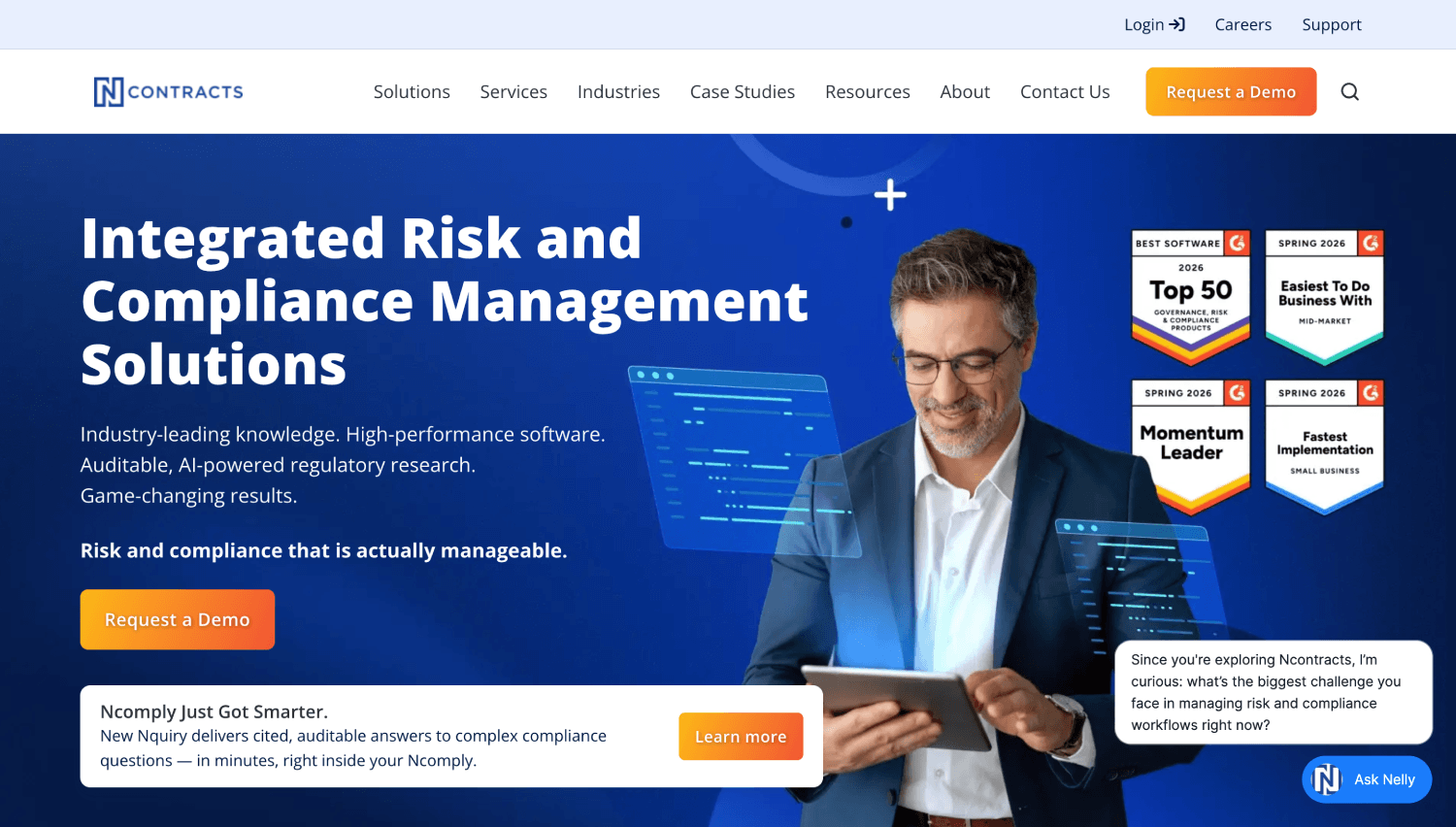
Ncontracts is a vendor risk and compliance platform that has built a specific following among community banks and credit unions, institutions that face real regulatory change management obligations but lack the budget or staff for enterprise GRC platforms. Its regulatory change management module includes a curated feed of US banking regulations, task management for tracking responses, and document management for evidence.
The platform’s regulatory content is weighted toward the issues that matter most for community banks: BSA/AML updates, CRA changes, consumer protection guidance from the CFPB, and state banking department bulletins. It does not have the raw coverage breadth of CUBE or the obligation extraction sophistication of Ascent, but it covers the regulatory territory that a $200M community bank actually needs to monitor.
Ncontracts also offers vendor risk management, contract management, and audit management in the same platform, which matters for institutions that want to consolidate tooling without a large integration project. Pricing transparency is better than most: the company provides ballpark ranges during initial conversations rather than requiring a full procurement process to get a number. Institutions managing related vendor due diligence programs alongside regulatory change management may also want to reference the vendor risk management tools guide for complementary options.
Best for: Community banks and credit unions under $1B in assets that need a practical, right-sized regulatory change management solution without enterprise-level complexity.
10. Vcomply , Best Early-Stage Starting Point for Budget-Constrained Fintechs
Vcomply is a GRC platform that offers regulatory change management capabilities as part of a broader compliance management suite. It scores lowest on obligation extraction depth and US regulatory source coverage in this list, but it earns the highest pricing transparency score because it does publish tier-based pricing on its public pricing page, which is genuinely rare in this category.
The platform is built for organizations that are early in their compliance maturity. Task management, policy management, compliance calendar, and a regulatory change alert feed are all present and functional. The regulatory alert feed is thinner than what AI-native platforms provide, leaning more toward broad category alerts than obligation-level extraction. For a seed-stage fintech that currently has no formal regulatory change management process at all, Vcomply is a reasonable first step.
The honest caveat: if you are a Series B fintech with a dedicated compliance officer managing a complex regulatory footprint, Vcomply will feel limiting within 12 months. Budget for an upgrade path when evaluating it. The value is in the speed of deployment and transparent pricing, not in the depth of regulatory intelligence.
Best for: Early-stage fintechs that need a structured starting point with transparent pricing and do not yet require deep obligation extraction or multi-jurisdictional coverage.
What Are the Five Criteria That Actually Differentiate These Platforms?
US Regulatory Source Coverage
Not all platforms monitor the same sources. Federal agencies like the CFPB, OCC, Federal Reserve, FDIC, FinCEN, SEC, and CFTC are table stakes. The real differentiator is state-level coverage. A fintech operating under a money transmitter license in 40 states needs to monitor 40 sets of state banking department bulletins, guidance documents, and proposed rules. Most platforms cover federal sources well; only a few cover all 50 states with meaningful depth.
Before finalizing a vendor, ask for a specific list of monitored sources and the update frequency for each. A platform that ingests SEC final rules within 24 hours but takes a week to surface a state attorney general bulletin is not providing complete coverage for your compliance team.
Obligation Extraction vs. Alert Delivery
The gap between platforms that deliver regulatory alerts and platforms that extract specific obligations is large and frequently underestimated during vendor evaluation. An alert tells you that the CFPB issued a new rule on small business lending data collection under Section 1071. An obligation extraction tells you that your business has seven specific new reporting obligations, three of which require changes to your loan origination system and four of which require policy updates, based on your registered product types.
Obligation extraction requires AI models trained on regulatory text, a product taxonomy that reflects your actual business, and ongoing maintenance as regulations change. Ascent and Compliance.ai have invested most heavily here. Thomson Reuters Regulatory Intelligence delivers context rather than extracted obligations. MetricStream and Riskonnect rely on your team to map regulatory changes to obligations once they are alerted.
Change Workflow Automation and Evidence Closure
An examiner does not want to see that you monitored regulatory changes. They want to see that you responded to them, who owned each response, what the deadline was, what action was taken, and what evidence demonstrates that your controls now reflect the updated requirement. That closed-loop evidence trail is what change workflow automation produces.
MetricStream and Riskonnect are strongest here at the enterprise level. Compliance.ai and Ncontracts handle this adequately for mid-market use cases. Vcomply and Allgress provide basic task and evidence management that is better than a spreadsheet but not examiner-grade without additional configuration.
Integration Lift
Every platform in this list claims integrations. What varies is the depth of those integrations and the engineering effort required to make them work. Native, pre-built connectors to Jira, ServiceNow, Slack, and common GRC platforms reduce implementation time significantly. API-based integrations, which most vendors also offer, shift the configuration burden to your engineering team.
For fintechs already running a compliance or engineering workflow in Jira, a platform with a real Jira connector (not just a Zapier trigger) is meaningfully better than one without. Ask vendors to demonstrate the integration in a live environment during your proof of concept, not just in a slide deck. This framework applies broadly to fintech vendor selection, and the seven-point fintech vendor evaluation framework covers what to test before you sign any contract.
Pricing Transparency
Pricing transparency is a real operational issue, not just a buyer preference. A compliance officer at a Series A fintech cannot get board approval for a six-figure software purchase without a number. If a vendor requires four discovery calls before sharing a price, that vendor is not built for your procurement process. Vcomply publishes pricing publicly. Ncontracts and Allgress share ranges early in the sales process. MetricStream, Wolters Kluwer, and CUBE operate on enterprise procurement timelines that assume a dedicated purchasing team.
How Should You Build a Shortlist by Company Type?
Matching company type to platform tier saves weeks of wasted evaluation time. The table below is a direct shortlisting tool, not a ranking.
| Company Type | Primary Recommendation | Secondary Option | Avoid (Reason) |
|---|---|---|---|
| Seed-to-Series A fintech | Vcomply | Allgress | MetricStream (implementation too heavy) |
| Series B-C fintech (10-200 employees) | Compliance.ai | Ascent RegTech | Wolters Kluwer (reporting overkill) |
| Community bank / credit union | Ncontracts | Compliance.ai | CUBE RegTech (global coverage not needed) |
| Regional bank ($1B-$20B assets) | Compliance.ai or Riskonnect | MetricStream | Vcomply (insufficient depth) |
| Large bank / Tier 1 institution | MetricStream | Wolters Kluwer OneSumX | Allgress or Vcomply (not enterprise-grade) |
| Global bank / multi-jurisdictional | CUBE RegTech | Thomson Reuters Regulatory Intelligence | Ncontracts (US-focused) |
| Broker-dealer / RIA | Ascent RegTech | Compliance.ai | Ncontracts (limited SEC/FINRA depth) |
| Legal/compliance research teams | Thomson Reuters Regulatory Intelligence | CUBE RegTech | Vcomply (no analytical depth) |
What Does a Typical Regulatory Change Management Workflow Actually Look Like?
Consider a hypothetical Series C payments fintech holding money transmitter licenses in 38 states and a bank partnership for its debit product. Say the CFPB finalizes amendments to its small business lending data collection rule. Here is what a functional regulatory change management workflow looks like on a platform like Compliance.ai or Ascent:
Day one: the platform ingests the final rule within 24 hours of publication in the Federal Register. Its AI parses the document and extracts the specific new obligations that apply to lenders with the company’s product profile. The compliance analyst receives a structured obligation summary, not a 200-page PDF. Three obligations are flagged as requiring control changes: a new data field in the origination system, an updated adverse action notice, and a revised training requirement for loan officers.
Day two: the platform creates tasks automatically from those three obligations, assigns them to the relevant owners (product engineering, legal, and HR training respectively), and sets a compliance deadline based on the rule’s effective date. Each task has a required evidence attachment, and the workflow enters a draft-review-approve chain before the task can be closed.
Day 45: all three tasks are closed with attached evidence. The platform generates an audit-ready summary showing the regulatory change, the obligations identified, the tasks completed, the approvals obtained, and the evidence attached. That summary is what you hand to an examiner.
A workflow that runs through spreadsheets and email threads can produce the same output, but it will take three to four times longer and leave gaps an examiner will find. This is also why the real cost of compliance at different fintech stages tends to scale faster than founders expect once regulatory footprint grows.
Frequently Asked Questions
What is regulatory change management software?
Regulatory change management software ingests regulatory output from government agencies and regulatory bodies, extracts the specific obligations those changes create for your organization, assigns those obligations to internal owners, tracks remediation through a structured workflow, and produces evidence of completion for examiner review. It is distinct from general compliance management software in that it focuses specifically on the ingestion-to-evidence cycle for external regulatory changes rather than managing internal policies or controls in isolation.
Which regulatory change management platform is best for fintech startups?
For seed-to-Series A fintechs, Vcomply or Allgress offer the fastest deployment and lowest implementation overhead. For Series B and Series C fintechs managing multiple regulatory relationships, Compliance.ai offers the strongest balance of US regulatory source depth, AI-assisted obligation extraction, and practical change workflow. Ascent RegTech is the better choice if your primary need is obligation-level precision and you manage workflow in Jira or a similar tool.
How does regulatory horizon scanning differ from regulatory change management?
Regulatory horizon scanning monitors proposed rules, advance notices, and policy signals before they become final requirements, giving institutions lead time to prepare. Regulatory change management picks up where horizon scanning ends: it manages the response to rules that have already been finalized or become effective. Most platforms in this list do both, but they differ significantly in how well they handle each. CUBE RegTech and Thomson Reuters Regulatory Intelligence are particularly strong on the horizon scanning side. Compliance.ai and Ascent are stronger on the obligation mapping and change workflow side.
Do I need regulatory change management software if I already have a GRC platform?
It depends on whether your GRC platform includes a regulatory content feed and obligation extraction layer. Many GRC platforms, including Archer and ServiceNow GRC, have regulatory change management modules that require you to bring your own regulatory content source. In practice, many organizations run a dedicated regulatory intelligence platform (like Compliance.ai or TRRI) to supply the content and obligation mapping, then push outputs into their GRC platform for workflow management and evidence closure. The integration between those two layers is a legitimate evaluation criterion.
What US regulatory sources should a regulatory change management platform cover?
At minimum: CFPB, OCC, Federal Reserve (Board of Governors), FDIC, FinCEN, SEC, CFTC, NCUA, and HUD for federal coverage. For most fintechs, state-level coverage is equally important: all 50 state banking departments, state attorneys general with active consumer protection enforcement, and state money transmitter regulatory bodies. Platforms that cover federal sources but treat state sources as secondary will leave meaningful gaps for any fintech operating under a patchwork of state licenses.
How much does regulatory change management software cost?
Pricing is not publicly listed for most platforms in this category. Vcomply is the notable exception, with tier-based pricing on its public page. Ncontracts and Allgress share ranges early in the sales process. Enterprise platforms like MetricStream, Wolters Kluwer, and CUBE operate on fully negotiated contracts. Based on publicly available analyst commentary and market positioning, mid-market platforms typically range from low five figures to mid-six figures annually, depending on number of users, regulatory source scope, and integration requirements. The company does not publicly confirm specific pricing.
What is the FintechSpecs Regulatory Change Management Scorecard?
The FintechSpecs Regulatory Change Management Scorecard is a five-factor, 100-point evaluation model developed for this guide. It scores vendors equally across US regulatory source coverage, obligation extraction accuracy, change workflow automation, integration depth, and pricing transparency, each weighted at 20 points. It is designed to provide a buyer-neutral framework for comparing platforms across different company types and stages, and its methodology is described in full in the scoring section of this article.
How to Run a Proof of Concept Before You Buy
Ask every shortlisted vendor for a live POC using your actual regulatory footprint. Give them the specific agencies and rule sets you need covered, your existing control framework (even if it is a spreadsheet), and two or three recent regulatory changes you are currently managing. A good platform should be able to ingest those three changes, surface the obligations relevant to your business, and walk you through a simulated task assignment and evidence closure in under two hours.
Pay attention to what does not make it into the demo. Vendors will show you their best-case regulatory documents. Ask them to demonstrate coverage of an obscure state banking bulletin or a FinCEN guidance update that did not make headlines. Coverage gaps in live testing are more reliable signals than feature lists in sales decks.
Also confirm who owns the regulatory content update process. Some platforms maintain their own content teams. Others rely on third-party content partnerships. If the answer is a third party, ask how quickly the content partner updates its library after a new rule is published, and what SLA the vendor provides to you for that update cycle. A gap of five business days between a CFPB final rule and your platform’s alert is five days of regulatory exposure your team does not know it has. Fintechs building compliance infrastructure at scale should also cross-reference this evaluation against the broader compliance mistakes that can derail fintech startups to catch gaps before they become examination findings.
The Buyer Decision That Actually Matters
Every platform in this list will tell you it handles regulatory change management end-to-end. The honest question is not whether they have the feature, but whether the obligation extraction is granular enough for your regulatory footprint, whether the workflow automation matches your team’s actual process, and whether you can get from signed contract to active monitoring in a timeframe that matches your next examination cycle.
For most fintechs, the useful shortlist is two vendors: the AI-native platform that best matches your US regulatory exposure (Compliance.ai for most, Ascent for broker-dealers and RIAs, CUBE for global footprints) and the workflow platform your engineering or compliance team is already comfortable building integrations for. If those happen to be the same vendor, you have your answer. If they are not, the integration between them is the project you are signing up for, and you should evaluate that integration specifically, not just the two platforms independently.
The platforms that generate the most examiner-ready evidence are not always the ones with the most impressive feature sheets. They are the ones where your compliance analyst actually closes tasks instead of working around the tool.