
- Taktile and Oscilar are not interchangeable. Taktile is built for teams that want full control over decision logic through a no-code rule builder and version-controlled policy management. Oscilar is built for risk teams that need AI-assisted fraud and credit scoring layered on top of decision flows.
- If your risk team is writing and iterating on underwriting policies without engineering support, Taktile fits better. If you need real-time AI signals baked into the decisioning layer itself, Oscilar is closer to what you want.
- Neither platform publishes standard pricing. Both sell on annual contracts with volume-based terms negotiated directly.
- The meaningful split is workflow ownership: Taktile optimizes for policy transparency and auditability, Oscilar optimizes for ML model integration and real-time risk signals.
- Growth-stage lenders processing consumer or SMB credit applications will feel the architectural difference within weeks of deployment.
Taktile suits fintech lenders whose risk teams need to own and audit underwriting logic without engineering dependencies, while Oscilar fits teams that want AI and machine learning signals embedded directly into the credit decision flow. Both are modern, API-first credit decisioning platforms, but they solve different bottlenecks. Choosing the wrong one means either over-engineering a rules problem or under-powering a model-driven risk strategy.
What Problem Is Each Platform Actually Solving?
Most teams shopping this category assume both platforms do the same thing: accept applicant data, run it through rules, return a decision. That framing misses where each product puts its weight.
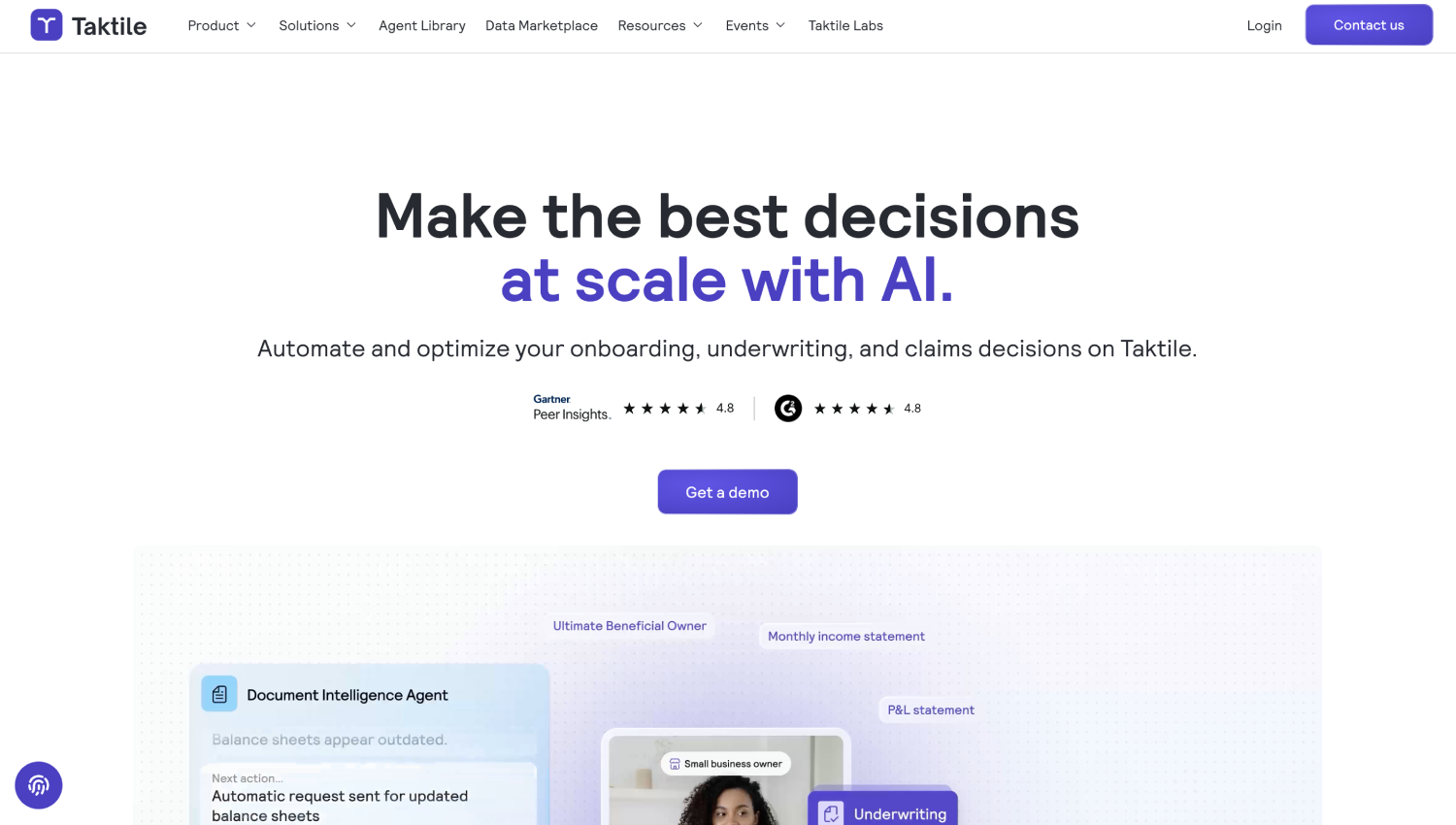
Taktile is a decision engine built around policy management. The core product is a visual decision flow builder where risk analysts can construct, test, version, and deploy underwriting logic without writing code. A credit analyst can add a new bureau threshold, adjust a debt-to-income cutoff, or shadow-test a policy change against live traffic, all without filing an engineering ticket. That operational independence is the product’s central value proposition.
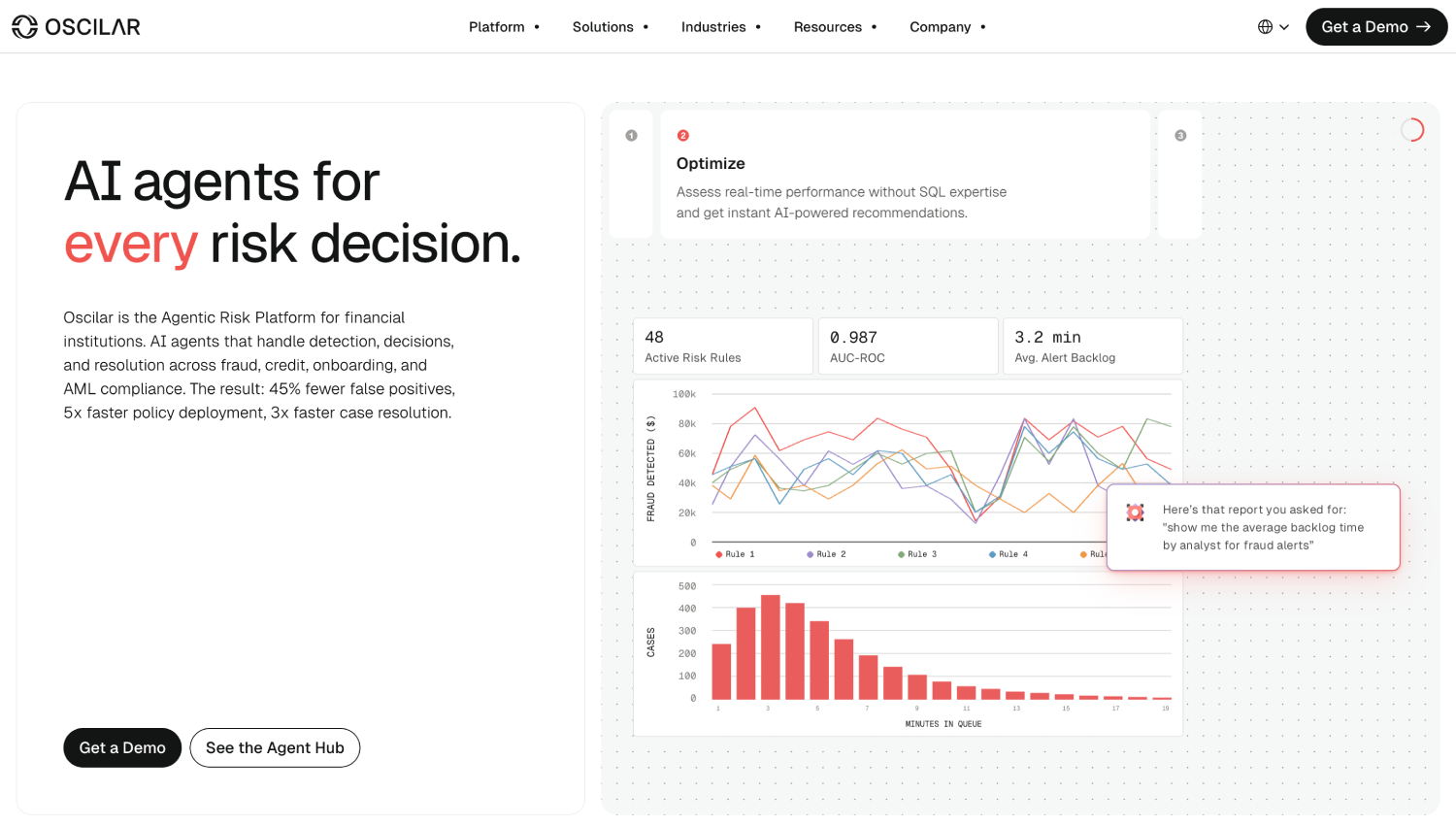
Oscilar positions itself as an AI-native risk platform. The decisioning layer exists, but the differentiation sits in real-time ML scoring, behavioral signals, and the ability to incorporate model outputs directly into decision flows. Oscilar targets teams that want a unified surface for fraud prevention and credit decisioning, with AI scoring running alongside rule-based logic rather than separate from it.
The practical consequence: a lending team at a Series A consumer lender that wants to manage 40 policy rules across three loan products will find Taktile more directly useful on day one. A team that needs device intelligence, velocity checks, and a custom ML score feeding a single approval decision will find Oscilar’s architecture more coherent.
How Do Taktile and Oscilar Differ on Core Features?
| Feature | Taktile | Oscilar |
|---|---|---|
| Decision flow builder | Visual, no-code, analyst-owned | Visual builder with AI node support |
| ML model integration | External models via API input | Native ML scoring, built-in model nodes |
| Fraud signals | Via third-party integrations | Native behavioral and device signals |
| Policy versioning and audit trail | Full version control, change history | Available, less emphasized in positioning |
| Shadow mode / champion-challenger | Yes, built-in | Yes, available |
| Data integrations (bureaus, alt data) | Pre-built connectors plus custom API | Pre-built connectors plus custom API |
| Real-time decisioning latency | Sub-second for rule-based flows | Sub-second, including ML inference |
| Primary buyer persona | Risk analysts, credit ops leads | Risk engineers, fraud and credit combined teams |
| Deployment model | Cloud, API-first | Cloud, API-first |
The fraud signal difference deserves emphasis. Taktile treats fraud prevention as something you wire in through third-party integrations, such as pulling a signal from Socure or SentiLink and routing it into a decision node. Oscilar treats fraud and credit as a unified risk surface, which means teams running both use cases benefit from shared context and consolidated case management. For teams with separate fraud and credit functions, that unification may be overhead. For teams where one analyst owns both problems, it is a genuine efficiency gain.
Which Platform Has Better Policy Management for Lenders?
Taktile’s policy management is its clearest structural advantage over Oscilar. Version control in Taktile works like a git-based system for underwriting logic: every policy change is tracked, comparable, and reversible. A risk team can run two policy versions simultaneously in shadow mode, compare approval rates and predicted default risk, then promote the better performer without any code deployment.
That workflow matters during regulatory audits. If an examiner asks why approval rates shifted in Q2, Taktile can surface the exact policy version active on any given date, along with who changed it and what the change was. That kind of audit trail is table stakes for lenders operating under FCRA or ECOA obligations. Our fintech product and compliance readiness checklist covers what regulators actually look for in decisioning documentation, and policy versioning is consistently one of the higher-scrutiny areas.
Oscilar has version history, but the platform’s positioning does not center on audit-friendliness the way Taktile’s does. Teams for whom policy governance is a primary concern, not a secondary feature, will find Taktile’s approach more deliberate.
How Does Oscilar’s AI Scoring Work in Practice?
Oscilar’s AI layer is not a black-box score appended to a decision. The platform lets risk engineers build decision flows that include model nodes, where a trained ML model runs inference as part of the flow itself, with its output feeding subsequent rule nodes. A team can configure a flow that checks bureau data, runs an income estimation model, applies rule-based cutoffs, and routes edge cases to manual review, all within a single orchestration layer.
The behavioral signal component adds real-time data about how an applicant interacted with the application form: typing patterns, session duration, device consistency. Those signals help surface synthetic identities and third-party fraud that bureau data alone misses. For lenders seeing application fraud alongside credit risk, that integrated view reduces the number of tools in the stack. Teams focused purely on third-party application fraud may want to compare this against dedicated solutions covered in our breakdown of top application fraud and synthetic identity tools for lenders.
The trade-off is complexity. Configuring ML nodes requires more technical fluency than building a rule tree in Taktile. A risk analyst without engineering support will spend more time in Oscilar’s setup phase than in Taktile’s.
What Does Each Platform Cost?
Neither Taktile nor Oscilar publishes pricing on their public websites. Both sell through a sales-led process with custom annual contracts. Volume of decisions, number of decision flows, and the number of data integrations typically drive the final contract value.
Custom pricing varies by team size, decision volume, and integration scope. For a detailed breakdown of how Taktile structures its contracts and what early-stage teams typically negotiate, see our breakdown of Taktile pricing, platform fees, and total cost.
One concrete cost variable: data integrations. Both platforms offer pre-built connectors to major credit bureaus and alternative data providers, but using multiple integrated data sources typically adds to the contract cost. A team pulling TransUnion, a bank data provider, and an income verification service through the platform will pay more than a team using a single bureau feed. Factor that into your total cost of ownership comparison, not just the platform license.
The FintechSpecs Decision Engine Fit Test: Four Signals That Point to the Right Choice
Most comparisons stop at feature lists. The more useful exercise is matching organizational context to platform architecture. Below is a structured framework, the FintechSpecs Decision Engine Fit Test, built around four signals that consistently separate the right choice from the regrettable one.
Signal 1: Who owns policy changes day to day?
If a credit analyst or risk ops lead owns policy updates and needs to move without filing engineering tickets, Taktile’s no-code builder is built for that workflow. If a risk engineer or data scientist owns the decisioning layer and will be integrating model outputs regularly, Oscilar’s architecture fits better.
Signal 2: Do fraud and credit share a decisioning surface?
Teams running fraud signals and credit signals through separate systems and then aggregating the outputs before a decision should evaluate whether Oscilar’s unified surface would simplify that architecture. Teams that have already solved fraud detection with a dedicated vendor and only need the credit decisioning layer should not pay for that unification they will not use.
Signal 3: How mature is your ML infrastructure?
Oscilar’s ML node capability adds meaningful value only if the team can train, validate, and deploy models. A Series A lender without a data science function will not use those nodes and will be paying for capability they cannot operate. Taktile’s external model integration via API is more appropriate for teams that want to incorporate a third-party score without building internal ML infrastructure.
Signal 4: How often do regulators or investors ask about policy decisions?
Lenders under active regulatory scrutiny, or those preparing for a FDIC or state DFI examination, benefit from Taktile’s explicit audit trail. The ability to reconstruct exactly which policy version was active when a specific adverse action was issued is not a nice-to-have in a regulated lending environment. Running a credit decisioning platform proof of concept before signing a contract is the fastest way to stress-test this.
How Do Taktile and Oscilar Handle Data Integrations?
Both platforms connect to the main US credit bureaus (Experian, Equifax, TransUnion) and support alternative data sources through pre-built or custom API connectors. The practical integration question is whether the platform is the orchestration layer that calls those data sources, or whether you are passing pre-fetched data into the decision engine.
Taktile supports both patterns. You can configure the platform to call a bureau directly during a decision flow, or you can pass bureau data fetched by your own system into the decision. That flexibility matters for teams with existing data infrastructure that want to avoid paying double for data already in their stack.
Oscilar similarly supports both patterns and leans into real-time data calls as part of its native flow execution. Teams evaluating either platform for income and employment verification use cases should also compare standalone options covered in our guide to top income and employment verification APIs for lenders, since some teams prefer to own that integration layer independently of the decision engine.
A Worked Scenario: Series B Consumer Lender, $8M Monthly Originations
Consider a hypothetical Series B consumer lender originating $8 million per month across personal loans with three product tiers: a prime product, a near-prime product, and a secured product for thin-file borrowers. The risk team has two credit analysts and one part-time data scientist. Fraud is handled by a third-party vendor already integrated into the loan origination system.
In this scenario, Taktile is the more direct fit. The two credit analysts can own policy logic independently, running shadow tests on near-prime cutoffs without engineering support. The existing fraud vendor integration means Oscilar’s native fraud layer adds no incremental value. The data scientist can build external models and pipe scores into Taktile via API without needing Oscilar’s ML node infrastructure.
Flip the scenario: remove the third-party fraud vendor, add a second data scientist, and make fraud-credit correlation a live problem (say, synthetic identity attacks hitting the near-prime product). Now Oscilar’s unified surface starts to look more efficient. A single decisioning layer that surfaces behavioral fraud signals and credit risk simultaneously reduces tool sprawl and gives the data science team a native environment for model deployment.
The numbers in this scenario are illustrative, not sourced from vendor benchmarks. But the structural logic holds across actual growth-stage lenders with similar team compositions.
What Are the Deployment and Integration Requirements?
Both platforms are API-first and cloud-hosted, which means implementation primarily involves API integration with your loan origination system or application layer. Neither requires on-premise infrastructure. Implementation timelines vary by the complexity of your existing data flows, but teams with clean LOS architecture typically reach production within four to eight weeks.
Taktile offers an SDK and detailed API documentation. The platform’s design philosophy means risk analysts can start building decision flows in a sandbox environment before engineering completes the integration, which shortens the feedback loop between business logic and production deployment.
Oscilar’s integration involves similar API work, with additional configuration for ML nodes and behavioral signal collection if those features are in scope. Teams using Oscilar’s fraud layer will also need to instrument the client-side application to capture device and behavioral signals, which adds frontend work that Taktile’s rule-only deployment avoids.
Frequently Asked Questions
Is Taktile or Oscilar better for a first-time credit decisioning platform buyer?
Taktile is the better starting point for teams buying their first decision engine. The no-code policy builder reduces the learning curve, and the version control system builds good governance habits from the start. Oscilar’s ML capabilities and behavioral signals are powerful but require more technical fluency to configure and operate. Teams without a dedicated risk engineer on staff will move faster in Taktile during the first three to six months of deployment.
Can Taktile run machine learning models?
Yes, but not natively. Taktile accepts external model scores as API inputs within a decision flow. You run inference in your own environment or a third-party ML platform, then pass the score into Taktile as a data attribute that feeds rule logic. This works well for teams with existing model infrastructure. It is not the right fit for teams that want model training, deployment, and decisioning in a single vendor relationship.
Does Oscilar replace a standalone fraud detection tool?
For many teams, yes, partially. Oscilar’s behavioral signals and real-time velocity checks cover common fraud vectors like synthetic identities and first-party fraud patterns. However, teams with complex fraud portfolios may still need dedicated tools for specific use cases such as document fraud detection or account takeover prevention. Oscilar is best described as a unified risk platform that reduces the need for point solutions, not a complete replacement for every fraud vendor in a mature stack.
How does Taktile handle ECOA and FCRA adverse action requirements?
Taktile’s decision flows can be configured to output reason codes alongside credit decisions, as required under ECOA for adverse action notices. The platform’s version history supports the documentation trail regulators expect during examination. However, the specific reason code logic must be configured by the lender’s team to reflect the actual decisioning factors, which requires upfront policy design work rather than an out-of-the-box compliance output.
What does Taktile vs Oscilar pricing actually look like?
Neither platform publishes pricing on their public websites. Both sell through annual contracts negotiated based on decision volume, number of flows, and data integration scope. Early-stage teams should expect to negotiate based on projected monthly decision counts, since both platforms typically price on a per-decision or tiered volume basis. Requesting a detailed total cost of ownership breakdown during the sales process, including data connector costs, is worth doing before signing.
Can these platforms connect to my existing loan origination system?
Both Taktile and Oscilar are designed to sit alongside loan origination systems rather than replace them. Integration happens via API calls from your LOS to the decision engine. Most modern LOS platforms (including those covered in our comparison of best loan origination and management software platforms) support outbound API calls that can route to either platform. The configuration work lives primarily in mapping LOS data fields to the decision engine’s expected input schema.
Which platform is better for SMB lending versus consumer lending?
SMB lending typically involves more complex data inputs (business revenue, trade credit, UCC filings) and less standardized underwriting logic than consumer lending. Taktile’s flexible rule builder handles that complexity well, since analysts can construct multi-variable decision trees that reflect the idiosyncratic nature of small business credit. Oscilar’s ML nodes are also useful for SMB if the team has training data to build business-specific risk models. Neither platform is structurally limited to one market, but Taktile’s policy management approach has more natural fit for SMB where rules are heterogeneous and need frequent iteration.
Where Does Each Platform Fall Short?
Taktile’s constraint is model sophistication. Teams that want to move beyond rule-based decisioning into adaptive, self-improving credit models will hit the ceiling of Taktile’s native capability and need to build model infrastructure elsewhere, then pipe results in. That works, but it adds operational overhead that a more integrated platform could absorb.
Oscilar’s constraint is accessible complexity. The platform can do more, but that capability requires a higher-skilled operator. A risk team that does not have engineering support for ML node configuration will underuse the platform and pay for features that never run in production. There is also a meaningful question about vendor lock-in: the more behavioral and model infrastructure you build inside Oscilar, the harder the migration to another platform becomes. Any team evaluating either vendor should review the common fintech infrastructure mistakes that create long-term dependency problems before signing.
Conclusion
The practical difference between Taktile and Oscilar is a question of where your decisioning complexity actually lives. If the complexity is in the policy logic, the threshold tuning, and the governance of who changed what and when, Taktile is built to hold that weight. If the complexity is in the data science layer, where behavioral signals, model outputs, and rule logic need to operate as a unified system, Oscilar is the more coherent architecture for that problem.
Growth-stage lenders often underestimate the policy governance cost of credit decisioning. A platform that lets risk analysts move independently of engineering is not a convenience feature. It is the difference between a policy change that takes four hours and one that takes four weeks. On that dimension, Taktile’s lead is real and consistent across the team profiles where it matters most.
Run a realistic decision scenario through each platform’s sandbox and pay close attention to how long it takes a non-engineer on your team to make a meaningful policy change without help. That single test will tell you more than any feature matrix.