
- Business credit data is a separate provider category from consumer credit bureaus. Equifax, Experian, and TransUnion consumer files tell you almost nothing about a business entity’s payment behavior.
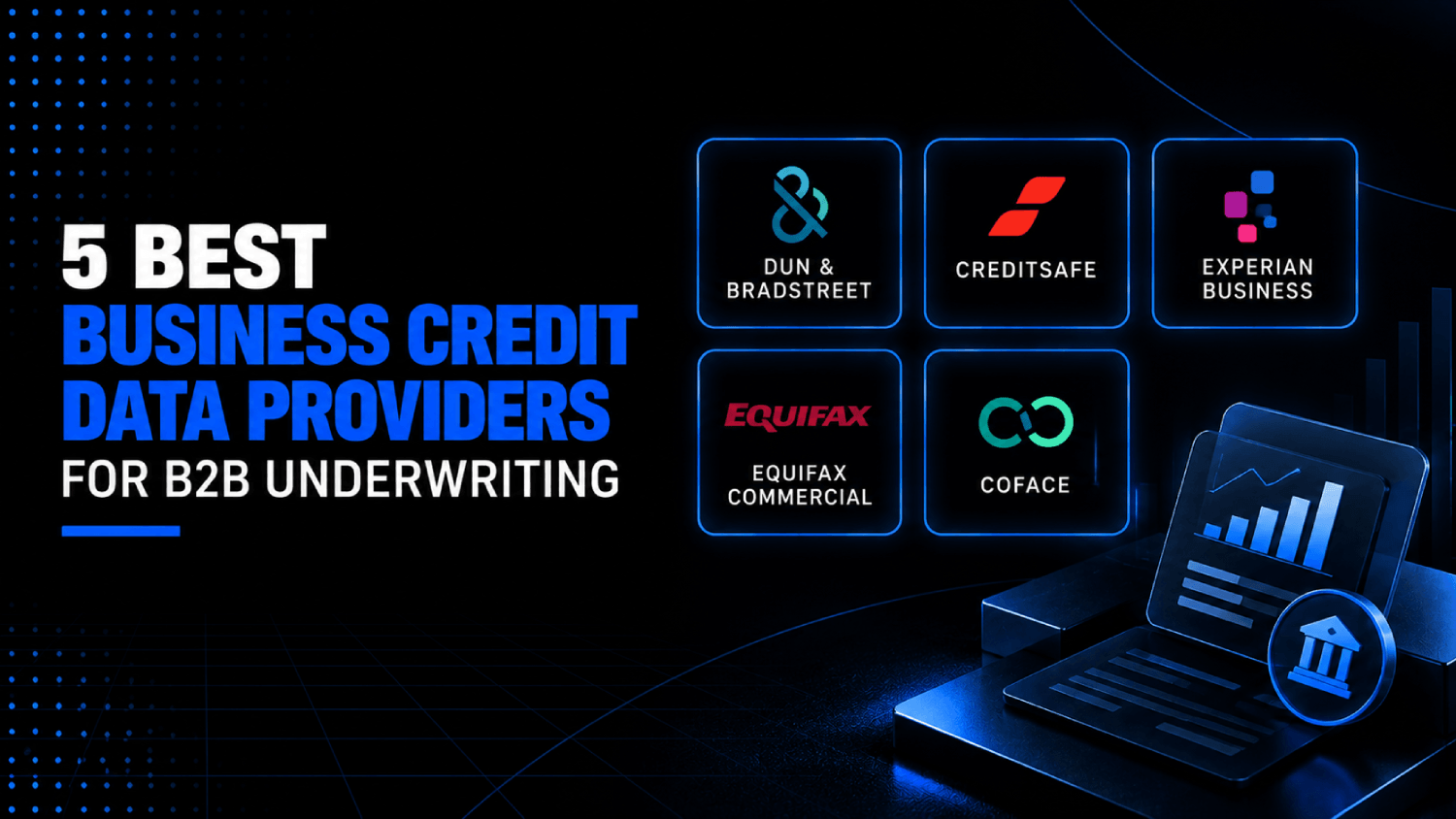
- The five core providers for B2B underwriting are Dun & Bradstreet, Equifax Commercial, Experian Business, Creditsafe, and Coface. Each pulls from different trade line pools, which means coverage gaps differ significantly.
- API access varies widely. Some providers offer modern REST APIs with same-day onboarding; others require enterprise contracts before you can run a single test query.
- Trade credit data, payment history from suppliers, and UCC filings are the signals that predict commercial default. Balances and revolving credit utilization matter far less than in consumer underwriting.
- For thin-file SMBs (under five years old, fewer than ten trade lines), supplementing bureau data with bank statement cash flow analysis closes the most decision gaps.
The best business credit data providers for B2B underwriting are Dun & Bradstreet, Equifax Commercial, Experian Business, Creditsafe, and Coface. Each maintains distinct trade line networks, covers different geographies, and offers different API access models. D&B leads on US commercial coverage depth and the DUNS identifier standard. Creditsafe leads on global SMB coverage and developer-friendly APIs. Experian Business and Equifax Commercial carry weight for lenders who need FCRA-governed reports. Coface is the default choice for cross-border trade credit risk in Europe and emerging markets.
Why Business Credit Data Is Not Consumer Credit Data
Most underwriting teams building B2B products start by calling their existing consumer bureau rep. That instinct is wrong and it costs time. Consumer files track individuals using Social Security Numbers and FCRA-governed data. Business credit files track legal entities using employer identification numbers, DUNS numbers, and trade references from suppliers, not payment accounts.
The scoring models are structurally different too. Consumer FICO scores weight revolving utilization and inquiry counts heavily. Commercial credit scores from providers like D&B weight payment delinquency on trade lines, days beyond terms (DBT), a measure of how many days late a business pays its trade creditors on average, and industry-level risk benchmarks. A business with excellent personal credit for its founder can carry a failing commercial credit profile, and vice versa.
There is also no equivalent to the Fair Credit Reporting Act’s dispute and accuracy requirements for most commercial credit data. Some products, particularly business credit reports sold to employers or used in certain lending decisions, fall under FCRA. But most commercial trade credit data is sold outside FCRA scope, which changes both the compliance burden and the data freshness expectations. If your use case touches FCRA, see our breakdown of FCRA compliance services for lending and credit data startups before signing a data agreement.
What Signals Actually Predict B2B Default?
Before evaluating providers, you need to know which data signals carry predictive weight in commercial underwriting. DBT is the single most predictive trailing indicator in commercial credit analysis. A company trending from 5 DBT to 25 DBT over two quarters is sending a distress signal that no financial statement analysis catches as early.
UCC filings matter because they reveal existing lien holders on business assets, which affects recovery assumptions in any secured lending structure. Industry risk benchmarks, which most major providers maintain by SIC and NAICS code, help normalize DBT figures. A 30 DBT in construction is not the same risk as a 30 DBT in professional services.
For SMBs with fewer than five trade lines on file, the traditional signals thin out. This is where bank statement cash flow data and alternative data sources become necessary supplements rather than nice-to-haves. Our article on bank statement analysis and cash flow underwriting APIs covers the tooling for that layer.
The FintechSpecs Commercial Credit Signal Stack
To evaluate providers consistently, we developed a framework called the Commercial Credit Signal Stack. It breaks the data a B2B lender actually needs into four distinct layers, from highest to lowest predictive reliability for small and mid-market borrowers.
Layer 1: Trade line history. Supplier-reported payment history, trade line age, and DBT. This is the core product of every major business credit bureau.
Layer 2: Public record data. UCC filings, tax liens, judgments, and bankruptcies. Available from most bureau APIs but data recency and coverage varies significantly by state.
Layer 3: Firmographic and entity data. Legal entity verification, years in business, SIC/NAICS codes, employee count estimates, and ownership structure. Critical for fraud prevention as much as credit risk. For the entity verification piece specifically, our KYB provider comparison covers that layer in depth.
Layer 4: Alternative and real-time signals. Bank cash flow data, payment network signals, and web-derived business health indicators. No single bureau owns this layer; it is assembled by combining bureau APIs with separate enrichment providers.
A lender relying only on Layer 1 from a single bureau will have blind spots, particularly for newer businesses and those operating in cash-heavy industries. The providers below differ most in how well they cover Layers 2 and 4.
Which Providers Actually Offer a Business Credit Bureau API?
Here is where the market separates into two camps. Providers with modern REST APIs and self-serve onboarding (Creditsafe, Experian Business) versus providers where API access requires negotiated enterprise agreements and integration timelines measured in weeks (D&B, Equifax Commercial). Neither camp is wrong for every buyer, but the friction difference matters for early-stage teams.
| Provider | API Access Model | Primary Strength | Coverage Focus | FCRA Products Available |
|---|---|---|---|---|
| Dun & Bradstreet | Enterprise contract required; REST API via D&B Direct+ | US trade line depth; DUNS standard | US and international | Yes |
| Creditsafe | Self-serve API; sandbox available | Global SMB coverage; developer experience | 160+ countries | Yes (US) |
| Experian Business | API available; contract required for production | US FCRA compliance; Intelliscore Plus model | US primary | Yes |
| Equifax Commercial | Enterprise API; partner program for access | Blended commercial/consumer data for sole proprietors | US primary | Yes |
| Coface | API available; primarily enterprise contracts | Trade credit insurance data; emerging market coverage | International focus | No (EU GDPR governed) |
Dun & Bradstreet: Best for US Trade Line Depth
Dun & Bradstreet maintains the largest commercial trade line database in the US by most industry counts, built around the DUNS number identifier that has become the default entity standard for federal contracting and supplier onboarding. Their D&B PAYDEX score, which runs from 0 to 100, is one of the few commercial credit scores that most B2B procurement teams recognize by name, which matters when your underwriting output needs to be explainable to a borrower.
The tradeoff is access friction. D&B Direct+, their API product, requires a commercial agreement before you can run production queries. Sandbox access is available but scoped. Pricing is not publicly disclosed and is negotiated based on query volume and product selection. For early-stage lenders or platforms evaluating fit, this creates a longer sales cycle than alternatives.
D&B is the right choice when you are underwriting established US businesses with multi-year operating histories and need the deepest available trade line coverage. For thin-file SMBs or companies under two years old, D&B’s coverage advantage shrinks considerably.
Creditsafe: Best API Experience and Global Coverage
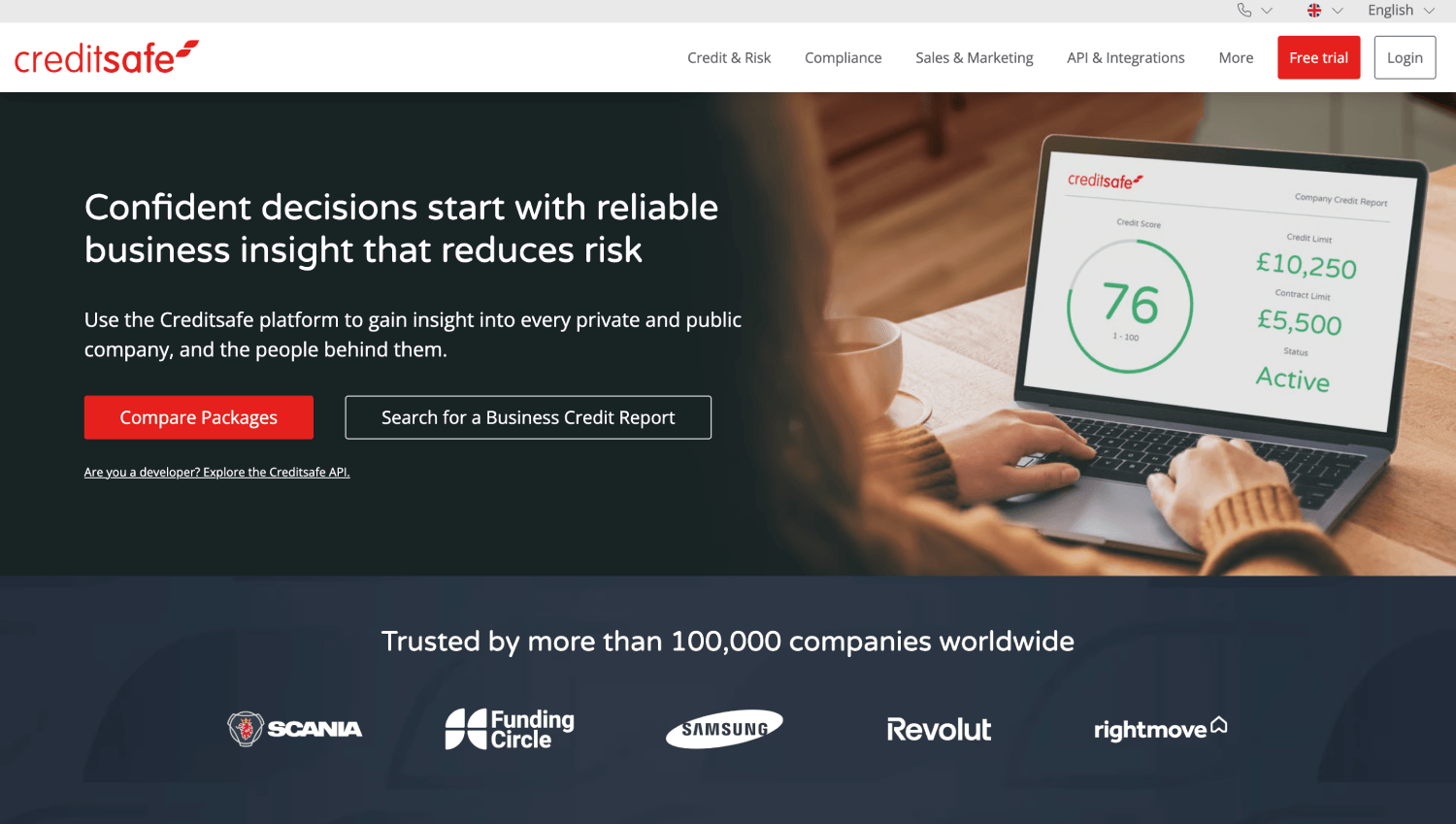
Creditsafe is the provider most often cited by product and engineering teams building commercial credit data into their platforms, largely because their API is the most accessible in the category. Sandbox credentials are available without a sales call, documentation is current, and the REST API follows standard patterns. For a team evaluating multiple providers in parallel, that difference in time-to-first-query is significant.
Coverage spans over 160 countries, which makes Creditsafe the default choice for platforms serving international SMBs or lenders with cross-border portfolios. Their US coverage is solid for businesses with established trade lines, though deep US trade history still favors D&B. Creditsafe also offers FCRA-governed reports for US consumer-purpose decisions.
Pricing is not publicly listed by query and requires a sales conversation, but Creditsafe is generally positioned at a lower price point than D&B for comparable US SMB coverage. Teams building a B2B credit data API integration and prioritizing time-to-market should start here.
Experian Business: Best for FCRA-Governed Commercial Lending

Experian Business carries the Intelliscore Plus model, which is one of the more widely cited commercial credit scores in US lending decisions. Their data set includes trade payment data, public records, and business demographic information. For lenders where the underwriting decision falls under FCRA jurisdiction, Experian Business is a natural fit because of the infrastructure they have built for dispute handling and adverse action notice support.
The business credit report API requires production credentials obtained through a contract, not self-serve. Experian does offer a partner program that simplifies access for platforms building embedded lending products. One notable capability is blended scoring for sole proprietors, where Experian can combine the business file with the owner’s consumer file to produce a fuller risk picture for entities that may not have extensive trade lines on the commercial side.
If your B2B lending product touches sole proprietors or single-member LLCs heavily, Experian Business’s ability to pull and blend both file types in a single query saves significant integration work.
Equifax Commercial: Best for Blended Consumer-Commercial Risk Models

Equifax Commercial operates the same way Experian Business does for FCRA-governed products, with similar access requirements and enterprise contracting. Their differentiation is in the depth of integration between commercial and consumer data, which is most useful when underwriting micro-businesses where the owner and the business credit profile are nearly inseparable.
Equifax Commercial’s commercial credit database includes trade payment data, business registrations, and public records. Their Small Business Credit Risk Score is used by US lenders and card issuers as a decisioning input, though Equifax does not publicly disclose which institutions use it as a primary model. API access goes through Equifax’s developer portal but production access requires a formal partnership agreement.
For lenders already using Equifax for consumer credit decisioning, adding Equifax Commercial reduces the number of vendor relationships and can simplify data governance. For lenders who do not already use Equifax on the consumer side, the integration overhead does not carry the same return.
Coface: Best for International Trade Credit Risk
Coface approaches commercial credit data from a trade credit insurance background, which shapes what their reports contain. Where D&B and Experian optimize for trade line payment history, Coface reports emphasize country risk, sector risk, and financial statement analysis alongside payment behavior. For B2B platforms facilitating cross-border transactions or lenders with international SMB exposure, that framing is more useful than a PAYDEX equivalent.
Coface maintains data on businesses in over 200 countries. Their API is available but is primarily accessed through enterprise contracts rather than self-serve. Pricing is not publicly listed. For a US-only lender, Coface is not a primary choice. For any platform with meaningful exposure to European, Latin American, or Asian counterparties, Coface is worth evaluating alongside Creditsafe for international coverage.
How Do These Providers Handle Thin-File SMBs?
Every provider above struggles with the same segment: businesses under three years old, operating in cash-heavy industries, with fewer than five supplier trade lines reporting. This is a large part of the US small business population, and it is also the segment most fintech lenders are trying to serve.
No bureau completely solves this. The practical approach most B2B lenders use is to treat bureau data as a first-pass filter and supplement it with bank account cash flow data for businesses that return thin or no-hit results. A company with two years of consistent revenue deposits, stable monthly outflows, and no NSF history is a meaningfully different credit risk from one with identical (absent) bureau data but volatile cash flow patterns.
This is also where the broader data enrichment layer matters. For a fuller picture of what supplemental data providers cover in underwriting contexts, our review of data enrichment APIs for fintech underwriting covers the adjacent tooling.
What Should a B2B Lender Actually Budget for Business Credit Data?
None of the five providers above publish per-query pricing. All require sales conversations, and pricing scales by query volume, product type, and contract length. Per-report costs are not publicly disclosed by any of the major providers and vary based on negotiated volume tiers and product selection. Creditsafe is generally positioned more competitively for mid-volume buyers than D&B or Experian Business, based on market positioning, though exact figures require a direct quote.
The more important budget variable is integration and compliance overhead. If your product requires FCRA-governed reports, you need adverse action notice infrastructure, a dispute handling process, and potentially a permissible purpose agreement review. Those are not report costs but they are real costs. Our analysis of the real cost of compliance in fintech SaaS breaks down how these regulatory layers add up by stage.
Early-stage platforms evaluating commercial credit data for the first time should request sandbox access from at least two providers before committing to a contract. Creditsafe and Experian Business both offer this. The data quality difference in your specific segment may be more decisive than any pricing negotiation.
Frequently Asked Questions
What is a business credit bureau API and how does it differ from a consumer credit API?
A business credit bureau API provides programmatic access to commercial credit data, including trade payment history, UCC filings, business registrations, and commercial credit scores like D&B’s PAYDEX or Experian’s Intelliscore Plus. Consumer credit APIs pull FICO scores and payment history tied to Social Security Numbers under FCRA. Business credit APIs use entity identifiers like DUNS numbers or EINs. The scoring models, compliance frameworks, and data sources are fundamentally different between the two.
Which business credit data provider has the best API for developers?
Creditsafe offers the most accessible API experience in the category, with sandbox credentials available without a formal sales process, current REST documentation, and coverage across 160-plus countries. Experian Business also offers a developer-accessible API with reasonable documentation, particularly for US FCRA-governed use cases. D&B and Equifax Commercial require enterprise agreements before production API access, which adds weeks to evaluation timelines for early-stage teams.
Do I need FCRA compliance for commercial credit data?
It depends on the use case. Commercial credit data used for B2B lending decisions between two businesses generally falls outside FCRA scope. However, if your product is used to make credit decisions about individuals (sole proprietors, personal guarantors) or if your commercial product meets certain statutory definitions, FCRA obligations can apply. Experian Business and Equifax Commercial both offer FCRA-governed commercial products. If you are unsure, review your permissible purpose with legal counsel before signing a data agreement.
What data does a business credit report API typically return?
A standard business credit report from a major provider typically includes a commercial credit score, trade line payment history with DBT (days beyond terms), UCC filing records, tax liens and judgments, business registration details (state, date of incorporation, structure), industry classification codes, and in some cases financial statement summaries. Coverage depth varies significantly by provider and by how long the business has been operating. Newer businesses often return partial files.
How do B2B lenders handle businesses with no credit history?
Thin-file SMBs are underwritten through supplemental data sources layered on top of bureau data. Bank account cash flow analysis, revenue data from payment processors, accounts receivable aging, and alternative trade data (from niche networks outside the major bureaus) are the primary tools. Most production underwriting models for SMB lenders use bureau data as a first filter and route thin-file applications to a cash flow underwriting track rather than declining them outright.
Can I get trade credit data through a single API provider?
No single provider covers all trade credit data. The major bureaus compile trade data from suppliers and creditors who voluntarily report to them. Because reporting is voluntary, each bureau has different coverage depending on which creditors submit data to them. Some creditors report to all major bureaus; many report only to one. For the most complete trade line picture on a given business, lenders running high-value underwriting decisions often pull from two providers and merge the results.
Is Dun & Bradstreet still the standard for commercial credit data?
D&B remains the most recognized name in US commercial credit data and the DUNS number is the dominant entity identifier for federal contracting and supplier onboarding. For depth of US trade line coverage on established businesses, D&B is still the reference point. Where D&B has lost ground is in developer accessibility, international SMB coverage, and pricing flexibility for early-stage platforms. Creditsafe has taken share in those segments specifically.
How to Choose Between These Providers
The decision comes down to three variables: your borrower segment, your geographic footprint, and your integration timeline. For established US businesses with multi-year histories, D&B’s trade line depth is hard to match. For international SMBs or platforms that need to move quickly, Creditsafe’s API access model and global coverage is more practical. For FCRA-governed lending products where compliance infrastructure matters as much as data quality, Experian Business or Equifax Commercial are the natural starting points, particularly if you are already in their partner programs.
Most mature B2B lenders end up using two providers in production: one for primary decisioning and one as a coverage fallback for no-hit or thin-file returns. The cost of dual bureau access is real but smaller than the loss from declining creditworthy businesses due to coverage gaps. Build your evaluation around what you will do when a business returns no hit from your primary provider. That answer will tell you which second provider to add. For teams building AI-assisted credit models on top of this data, our overview of AI underwriting and credit decisioning platforms covers how that layer connects to raw bureau data in practice.
The instinct to treat business credit data as a subset of consumer credit infrastructure is understandable but it produces the wrong architecture decisions. Business credit data is its own category, with its own identifiers, its own scoring logic, and its own provider network. Getting that foundation right determines whether your underwriting model can actually differentiate risk, or whether it is pattern-matching on incomplete signals from the wrong source.