
- Most fintech founders budget for legal fees and a compliance tool or two. The actual cost includes people, audits, vendor risk reviews, support overhead, and product delays that never show up in a compliance line item.
- KYC/AML, PCI DSS, and SOC 2 each carry their own cost structure. Running them in parallel, which most growth-stage fintechs must, multiplies the total significantly.
- Compliance spending as a share of revenue tends to be highest at seed stage, not at Series A or beyond, because fixed costs hit before revenue scales to absorb them.
- The hidden cost most founders miss is not the audit. It is the engineering time, onboarding friction, and customer support load that compliance requirements generate every quarter.
- Stage-appropriate compliance planning does not mean doing less. It means sequencing investments so you are not paying Series A prices on a pre-seed runway.
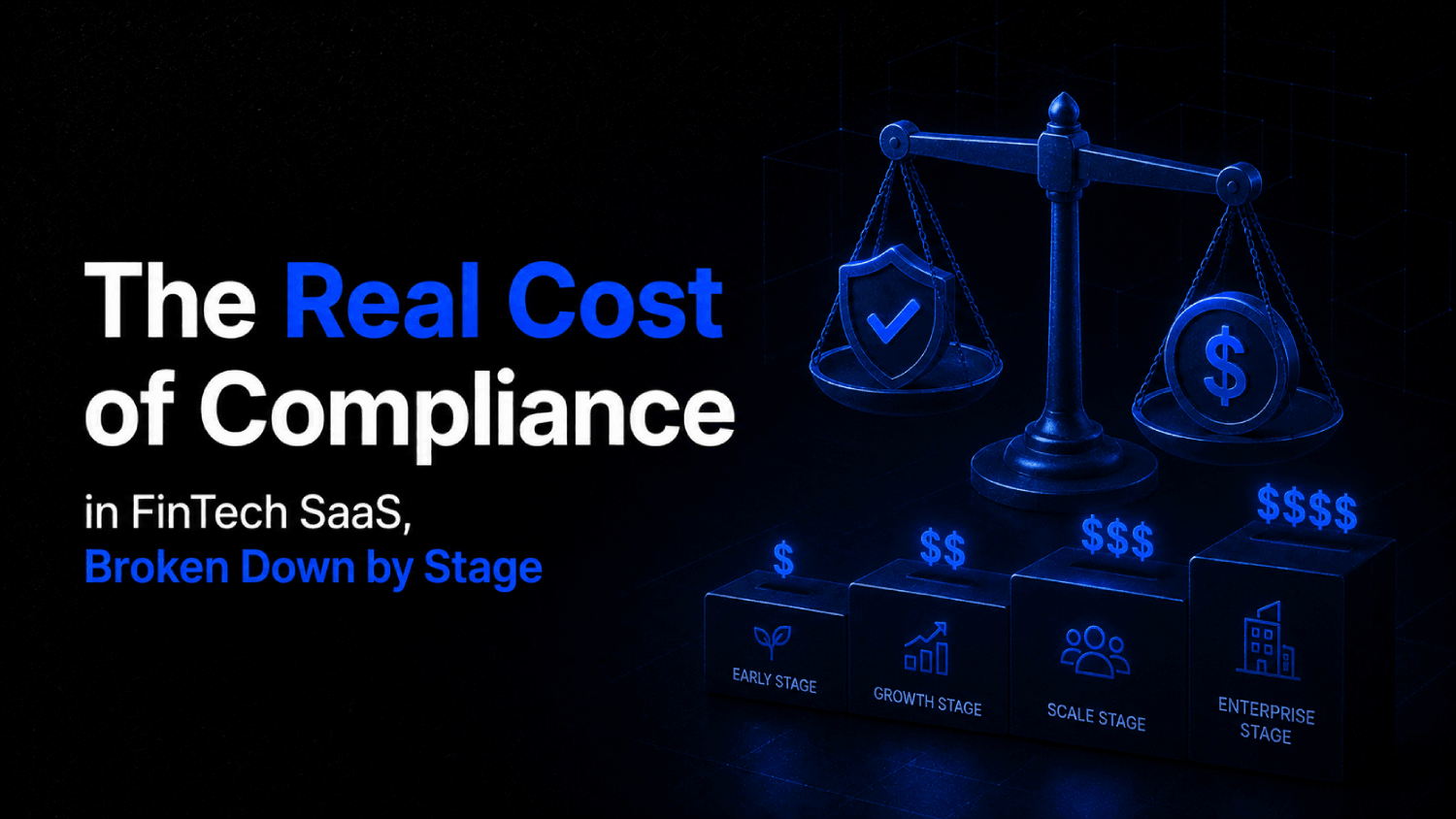
Compliance costs in fintech SaaS scale sharply with stage. At pre-seed, a founder can manage basic KYC and PCI requirements for $30,000 to $80,000 per year using third-party tooling. By Series A, when SOC 2, AML programs, and dedicated compliance staff enter the picture, total annual spend commonly exceeds $250,000. Growth-stage companies operating across multiple regulatory frameworks routinely spend $500,000 to over $1 million per year on compliance, a figure that excludes indirect costs like engineering rework and onboarding drop-off. The overall range is wide by design, product type, regulatory scope, and the indirect costs described below all move the number substantially.
Why Most Fintech Founders Underestimate Compliance Costs
The default mental model treats compliance as a checklist: hire a lawyer, buy a tool, pass an audit. That framing misses most of the actual spend. Compliance in fintech SaaS is an operational function with recurring costs, not a one-time event.
The categories founders consistently miss include: engineering time spent building and maintaining compliance controls, customer support load driven by identity verification failures and transaction holds, onboarding drop-off caused by friction in KYC flows, and the vendor due diligence burden that comes with every new third-party integration. None of these appear in a “compliance budget” line item, but all of them are compliance costs.
There is also a sequencing problem. Founders often defer compliance investment until a bank partner, enterprise customer, or regulator forces the issue. That reactive approach typically costs more than proactive planning because it compresses timelines, adds premium rates for urgent legal work, and creates technical debt that slows the product for years. For more on how this plays out at scale, the 10 compliance mistakes that can destroy your fintech startup covers the failure patterns in detail.
What Does the Cost of Compliance in Fintech SaaS Actually Cover?
A realistic compliance budget spans seven categories. Most planning documents address two or three.
Legal and Regulatory Counsel
Outside counsel for licensing, regulatory guidance, and contract review is the cost founders think of first. Rates for fintech-specialized attorneys typically run $400 to $900 per hour, and retainer arrangements for early-stage companies often start at $3,000 to $8,000 per month. Annual spend in this category alone ranges from $25,000 at pre-seed to well over $100,000 at Series A if the company is pursuing a money transmitter license or navigating state-by-state registration.
Compliance Technology and Tooling
This includes KYC/AML platforms, transaction monitoring software, document verification tools, and compliance management systems. Vendors in this space include Sumsub, Persona, Alloy, Sardine, and Unit21. Pricing varies significantly by volume, with per-verification costs ranging from $0.50 to $5.00 or more depending on the check depth. Monthly platform fees range from a few hundred dollars at entry tiers to $10,000 or more for enterprise configurations.
PCI DSS Compliance
For SaaS companies that handle payment card data, PCI DSS compliance carries both direct and indirect costs. According to Stripe’s public resource on PCI compliance costs, the expense varies by merchant level. Level 4 merchants (the smallest category) can complete a Self-Assessment Questionnaire for a few hundred dollars. Level 1 merchants, required for companies processing over 6 million transactions annually, face costs for a Qualified Security Assessor audit that commonly runs $15,000 to $40,000 per year, plus ongoing infrastructure changes to maintain compliance. For most SaaS founders, the practical approach is to minimize PCI scope by routing card data through a certified processor like Stripe or Adyen, which shifts much of the PCI burden to the processor rather than the company. The difference between scope reduction and full scope compliance can be tens of thousands of dollars annually.
SOC 2 Audits and Security Certifications
SOC 2 Type I audits typically cost $10,000 to $25,000. SOC 2 Type II audits, which cover a period of observation (usually 6 to 12 months) and are required by most enterprise customers and bank partners, typically cost $30,000 to $60,000 for the audit itself. Add readiness preparation and remediation work from a firm like Vanta, Drata, or Tugboat Logic, and total first-year spend for SOC 2 Type II routinely exceeds $50,000. Annual renewal costs for Type II are lower but not trivial, typically $20,000 to $40,000 depending on scope and auditor.
People: Compliance Staff and Fractional Officers
A full-time Chief Compliance Officer in fintech commands a base salary of $150,000 to $250,000 depending on market and experience. Most seed-stage companies cannot justify that hire. Fractional CCO services fill the gap at roughly $5,000 to $15,000 per month, depending on engagement depth. At Series A, most companies need at least one dedicated compliance analyst or manager at $70,000 to $120,000 annually. By growth stage, teams of three to six compliance professionals are common, and the people cost alone can reach $500,000 to $700,000 per year when benefits and overhead are included.
Engineering and Product Time
This is the category most founders leave off the spreadsheet entirely. Building and maintaining KYC flows, adverse action notices, dispute handling, data retention policies, and audit logging consumes real engineering capacity. A conservative estimate for a seed-stage team is 10 to 20 percent of total engineering time annually. At Series A, compliance-related engineering work, including integrations, incident response, and regulatory updates, can consume one to two full-time engineer equivalents per year. At an average fully-loaded engineering cost of $180,000 to $220,000 per head, that translates to $180,000 to $440,000 in compliance-driven engineering spend that never appears in a compliance budget.
Customer Support Overhead
KYC friction, account flags, and transaction holds generate support tickets. According to Didit.me’s fintech compliance budgeting research, identity verification failure rates for automated systems can run 5 to 15 percent depending on the customer population, and each failed verification that requires manual review or customer escalation costs real support time. For a company onboarding 1,000 new users per month with a 10 percent friction rate, that is 100 compliance-related support interactions monthly. At even $8 to $15 per resolved ticket (a common benchmark for scaled support operations), this adds up to meaningful annual spend that traces directly to compliance requirements.
Compliance Costs by Stage: Pre-Seed Through Growth
The table below shows realistic annual compliance cost ranges by stage. These figures draw on publicly available pricing, published audit cost ranges from firms active in the space, and salary benchmarks from fintech job markets. They represent cash-out costs only and do not include the engineering and support overhead described above, which can add 50 to 100 percent on top of these figures at each stage.
| Cost Category | Pre-Seed | Seed | Series A | Growth Stage |
|---|---|---|---|---|
| Legal and regulatory counsel | $10,000 to $25,000 | $25,000 to $60,000 | $60,000 to $120,000 | $120,000 to $300,000+ |
| KYC/AML tooling | $5,000 to $15,000 | $15,000 to $50,000 | $50,000 to $150,000 | $150,000 to $500,000+ |
| PCI DSS compliance | $500 to $3,000 (SAQ) | $3,000 to $15,000 | $15,000 to $40,000 | $40,000 to $80,000+ |
| SOC 2 (Type I or II) | Not typically required | $15,000 to $40,000 (Type I) | $40,000 to $75,000 (Type II) | $30,000 to $60,000 (renewal) |
| Compliance staff (people cost) | $0 to $10,000 (fractional) | $10,000 to $60,000 (fractional CCO) | $120,000 to $250,000 (1-2 FTEs) | $300,000 to $700,000 (team) |
| Compliance software platforms | $2,000 to $8,000 | $8,000 to $30,000 | $30,000 to $80,000 | $80,000 to $200,000+ |
| Total estimated direct cost | $17,500 to $61,000 | $76,000 to $255,000 | $315,000 to $715,000 | $720,000 to $1,840,000+ |
The jump from seed to Series A is the most disorienting for founders. The PCI and legal costs increase incrementally. The step change comes from hiring compliance staff and completing a full SOC 2 Type II audit, both of which enterprise customers and institutional banking partners typically require before signing. This is often the first year compliance costs cross $300,000, and it happens before the revenue base has expanded enough to absorb it comfortably.
According to Didit.me’s fintech compliance budgeting guide, early-stage fintechs often allocate 5 to 10 percent of revenue to compliance. At seed stage with $1 million in ARR, that implies $50,000 to $100,000 in annual compliance spend, which aligns with the lower end of the seed range above. The percentage tends to fall as revenue scales, but the absolute dollar figure keeps rising, which is the more relevant planning variable.
What KYC and AML Compliance Actually Costs at Each Stage
KYC and AML represent the most volume-sensitive part of the compliance budget. The cost structure has two components: the per-verification cost and the platform or monitoring fee. These scale independently, which catches founders off guard.
A pre-seed company running 100 to 500 verifications per month using a vendor like Persona or Sumsub might pay $0.50 to $2.00 per verification, with minimal platform overhead. At seed stage, with 1,000 to 5,000 monthly verifications and the addition of ongoing transaction monitoring (a distinct AML requirement from identity verification), the combined KYC/AML cost can reach $3,000 to $8,000 per month. At Series A and beyond, with high-volume transaction monitoring, enhanced due diligence for higher-risk customers, and SAR (Suspicious Activity Report) filing infrastructure, monthly costs routinely exceed $10,000 before staff time is counted.
The build-vs-buy decision matters here. Custom KYC infrastructure built in-house can reduce per-verification cost at scale, but the development investment is substantial. Most fintech SaaS companies at seed through Series A are better served by third-party vendors. The best fraud detection and risk tools for fintech startups covers the vendor options in more depth, including tools that bundle identity verification with transaction risk scoring.
The Compliance Costs That Never Appear in Any Budget
Beyond the line items, compliance generates four categories of indirect cost that compound over time.
Product Velocity Tax
Every new feature that touches payments, identity, or financial data requires compliance review before shipping. At seed stage this might add one to two weeks to a sprint. At Series A, with formal compliance sign-off processes, it can add three to six weeks per feature. Over a year with 10 to 15 significant feature releases, the cumulative delay represents months of lost product velocity. This has a direct impact on competitive positioning and revenue timing, neither of which appears in a compliance budget.
Vendor Risk Management
Every third-party integration requires a vendor due diligence review once you are operating under a formal compliance program. For a fintech with 20 to 40 active vendors, annual vendor risk reviews can consume 40 to 80 hours of compliance staff time and trigger periodic security assessments of key vendors. If you are using a banking-as-a-service platform as part of your stack, that relationship typically requires the most intensive ongoing oversight, including contractual compliance obligations that flow downstream to your own operations.
Onboarding Conversion Loss
KYC friction reduces onboarding conversion. An identity verification step that fails 10 to 15 percent of legitimate applicants represents direct revenue loss, not just a support cost. For a company converting 500 sign-ups per month at a $100 average first-month value, a 10 percent friction-driven drop-off costs $5,000 per month in foregone revenue. That is $60,000 per year from a compliance requirement, and it is invisible in most compliance cost analyses. The reasons fintech users drop off during onboarding explores how these friction points compound across the full funnel.
Incident Response and Remediation
When a compliance failure occurs, whether a data breach triggering notification requirements, an AML filing error, or a PCI scope violation, the remediation cost typically dwarfs the cost of the control that would have prevented it. External counsel for a regulatory inquiry runs $20,000 to $100,000 or more depending on severity. Most seed-stage companies have no budget for this scenario. Building a modest reserve into the compliance budget, or carrying appropriate errors and omissions and cyber liability insurance, is a cost that belongs in the planning model.
A Pre-Launch Compliance Cost Checklist by Stage
The following represents minimum viable compliance for each stage, not comprehensive coverage for all product types. Highly regulated products (lending, crypto, insurance) carry additional requirements not fully captured here.
Pre-Seed (0 to $500K ARR)
- Privacy policy, terms of service, and data processing agreements reviewed by counsel
- PCI SAQ completed if accepting payment cards (or scope eliminated via Stripe/Adyen integration)
- Basic KYC vendor integrated for identity verification if handling user funds or financial accounts
- GDPR and CCPA data handling baseline implemented if applicable to user base
- Incident response plan documented, even if minimal
Seed ($500K to $5M ARR)
- Formal AML program documented and implemented if operating as or with a money services business
- SOC 2 Type I initiated (readiness assessment at minimum)
- Fractional CCO or compliance counsel on retainer
- Vendor due diligence process established for key integrations
- BSA/AML training for all relevant staff
- State-by-state licensing review completed for target markets
Series A ($5M to $20M ARR)
- SOC 2 Type II audit completed
- Full-time compliance hire or senior fractional CCO
- Transaction monitoring system implemented with SAR filing capability
- Annual independent compliance testing (internal audit or external reviewer)
- Board-level compliance reporting in place
- PCI QSA engagement if volume warrants Level 1 or Level 2 classification
Growth Stage ($20M+ ARR)
- Dedicated compliance team with clear ownership of AML, BSA, data privacy, and product review
- Annual third-party compliance audit
- Formal vendor risk management program with tiered review cycles
- Regulatory change management process with documented ownership
- Enhanced due diligence program for high-risk customer segments
- Regulatory capital and reserve planning if applicable to product type
Companies building on embedded finance infrastructure should also review the obligations that flow from their BaaS provider relationship. Many BaaS platforms pass regulatory obligations down to the fintech operator, and founders often discover these requirements well after launch. The critical mistakes companies make when choosing fintech infrastructure covers how these downstream obligations surface in practice.
How to Build a Realistic Fintech Compliance Budget
Start with your regulatory surface area, not with a percentage of revenue. The compliance budget for a B2B SaaS tool that white-labels payments differs substantially from the budget for a company holding customer funds, issuing cards, or operating as a money transmitter. Product type determines regulatory scope, and regulatory scope determines cost more than stage does.
Model three buckets separately: cash costs (legal, audits, tooling, staff), engineering costs (estimate as engineer-weeks per quarter and multiply by fully-loaded cost), and revenue impact costs (onboarding friction, support overhead, feature delays). Most founders only model the first bucket. Adding even rough estimates for the second and third will produce a more accurate total and a more defensible ask in a fundraising conversation.
Plan for the compliance requirements of your next stage, not just your current one. A seed company that starts SOC 2 readiness early, rather than waiting for a Series A enterprise prospect to demand it, typically saves $20,000 to $40,000 in compressed timeline premiums and avoids the deal-blocking scenario where a signed LOI stalls because the security review cannot close in time. The fintech SaaS scale checklist for reaching $10M ARR frames this kind of forward-looking operational planning in the context of the full business, not just compliance.
Frequently Asked Questions
1. How much does KYC/AML compliance cost for a fintech startup?
At pre-seed, a basic KYC integration using a vendor like Persona, Sumsub, or Alloy typically costs $5,000 to $15,000 annually, depending on verification volume. At seed stage, adding AML transaction monitoring brings the combined cost to $15,000 to $50,000 per year. At Series A, with higher volumes, a formal AML program, and independent testing requirements, total KYC/AML spend commonly reaches $50,000 to $150,000 annually before staff time is counted. See the stage-by-stage breakdown above for the full cost structure.
2. What does PCI compliance cost for a SaaS company?
PCI compliance cost depends on merchant level and how much card data the company directly handles. SaaS companies that route all card processing through a PCI-certified processor like Stripe or Adyen typically qualify for a Self-Assessment Questionnaire at $500 to $3,000 annually. Companies that store, process, or transmit card data directly face higher costs, including potential QSA audit fees of $15,000 to $40,000 per year at higher merchant levels. Minimizing PCI scope through tokenization and processor delegation is the primary cost control lever here.
3. How much does SOC 2 compliance cost?
A SOC 2 Type I audit, which assesses controls at a point in time, typically costs $10,000 to $25,000 for the audit itself. SOC 2 Type II, which covers an observation period and is required by most enterprise customers, typically costs $30,000 to $60,000 for the audit. First-year total spend including readiness tools like Vanta or Drata and remediation work commonly exceeds $50,000. Annual renewal audits for Type II typically run $20,000 to $40,000, assuming controls are already in place and documented.
4. What compliance budget should a fintech startup plan for?
According to Didit.me’s fintech compliance budgeting guide, early-stage fintechs often allocate 5 to 10 percent of revenue to compliance. In absolute terms, a pre-seed company should budget $30,000 to $80,000 annually for direct compliance costs. Seed-stage companies should plan $75,000 to $250,000. Series A companies should expect $300,000 to $700,000 in direct compliance spend before indirect costs like engineering time and onboarding friction are included. These figures vary significantly based on product type and regulatory scope.
5. What compliance costs do fintech founders most commonly miss?
The most consistently overlooked costs are engineering time consumed by compliance controls (often 10 to 20 percent of total engineering capacity), customer support overhead from identity verification failures and transaction disputes, onboarding conversion loss from KYC friction, and incident response costs when compliance failures occur. Vendor risk management, which requires annual due diligence reviews of all key third-party integrations, is another cost that founders rarely budget for before they are in the middle of a bank partner audit.
6. Does using a BaaS platform reduce compliance costs?
It can reduce the cost of certain controls by shifting regulatory responsibility to the bank partner, but it does not eliminate compliance obligations for the fintech operator. Most BaaS platform agreements pass significant compliance requirements downstream, including AML program obligations, customer due diligence requirements, and audit cooperation duties. The compliance cost reduction from BaaS is real for licensing and certain reporting obligations, but founders who assume BaaS eliminates their compliance burden typically discover otherwise when their bank partner conducts its first program review.
7. How do compliance costs affect fintech SaaS margins?
At seed stage, direct compliance costs of $75,000 to $250,000 on $1 million to $3 million in ARR represent 8 to 25 percent of revenue, which is a material gross margin drag. At Series A, direct costs of $300,000 to $700,000 on $5 million to $15 million ARR represent 5 to 15 percent of revenue. The margin impact is most severe in the $1 million to $5 million ARR window, when compliance costs are scaling faster than revenue. The hidden costs that kill fintech SaaS margins covers how compliance interacts with other margin pressures across the full cost structure.
The Right Mental Model for Compliance Spending
Compliance is not a tax you pay once to get a license and forget. It is an ongoing operational function with a cost structure that scales with your product complexity, customer volume, and regulatory footprint. The founders who manage it best treat it the way they treat infrastructure: something that requires investment ahead of the need, not in reaction to a crisis.
The stage-based cost table in this article gives you a planning baseline. The indirect cost categories, engineering time, support overhead, onboarding friction, vendor management, are what separate a realistic compliance model from an optimistic one. Adding them to your planning model will not make compliance cheaper. It will make your runway projections accurate, which matters more.
The practical implication: compliance budget conversations should include your engineering lead and your head of support, not just your legal counsel. The costs live in their departments. The plan should too.