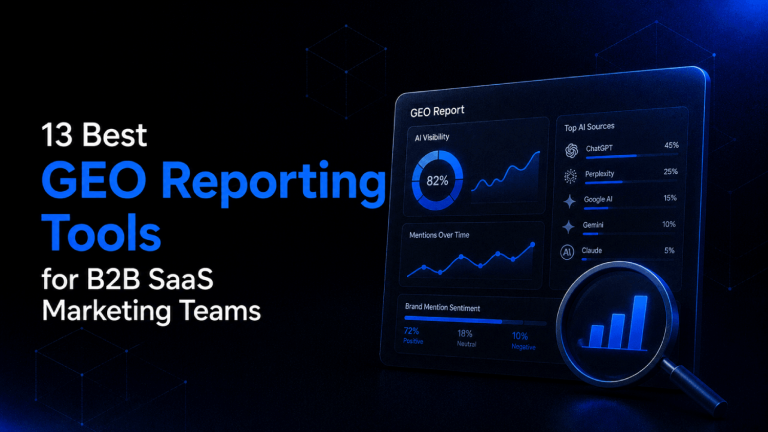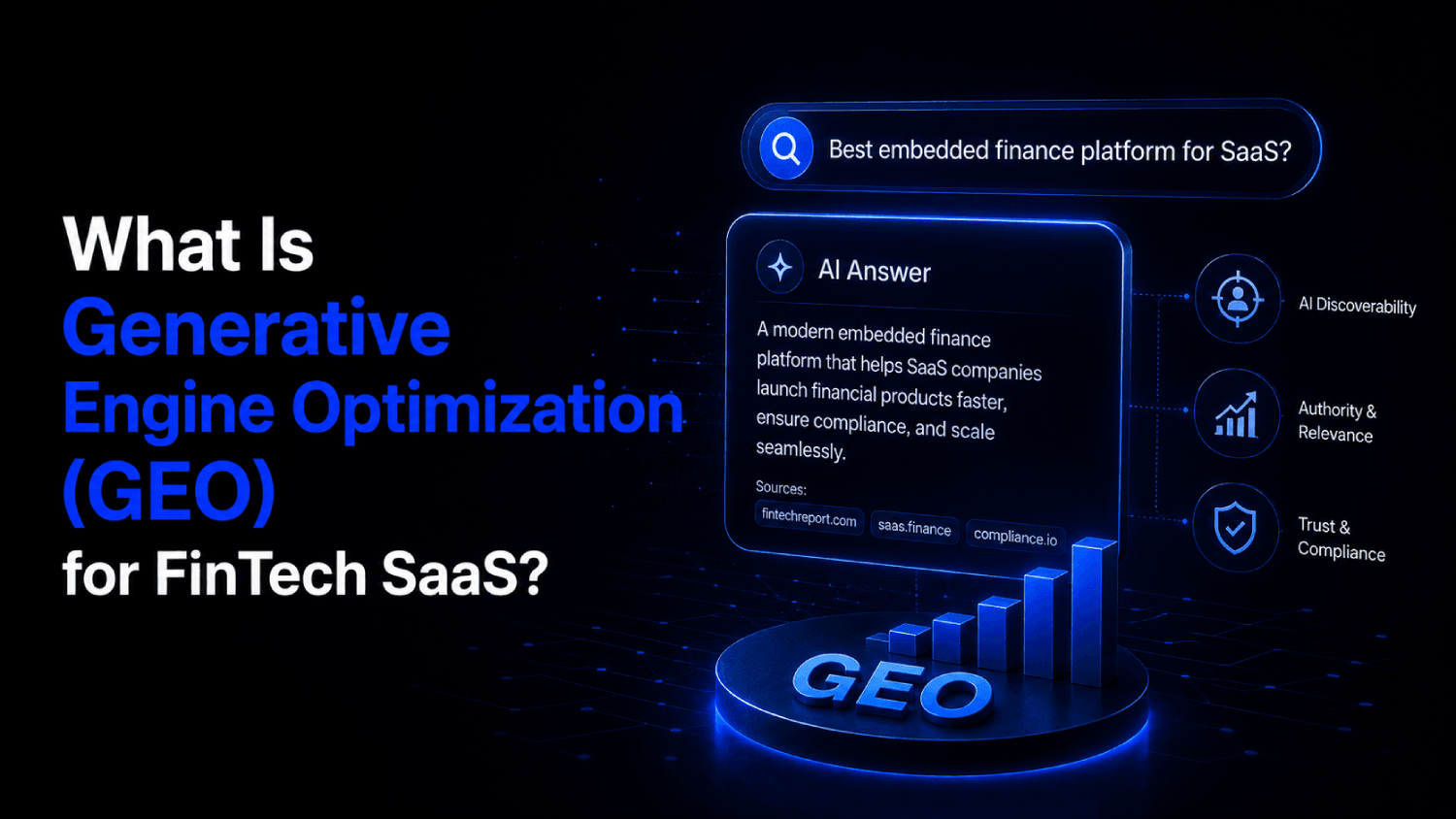

- Generative engine optimization for fintech SaaS is the practice of making your brand, content, and product pages retrievable, citable, and accurately represented inside AI-generated answers from tools like ChatGPT, Perplexity, and Google AI Overviews.
- GEO and SEO share some foundations but diverge sharply on what “winning” looks like. SEO wins a ranked link. GEO wins a quoted sentence inside an answer a buyer never leaves.
- For fintech SaaS companies, GEO carries higher stakes than almost any other vertical because AI models apply a trust filter to financial content, and brands without clear authority signals get excluded entirely.
- The structural difference between fintech content that gets cited by AI and content that does not comes down to four factors: source authority, claim precision, named entity density, and answer completeness.
- Most fintech teams are optimizing for last decade’s search model. The buyer reading an AI-generated answer about payment infrastructure or KYC providers will never see your organic ranking.
Generative engine optimization (GEO) for fintech SaaS is the practice of structuring content so that large language models retrieve, quote, and accurately attribute it when generating answers to user queries. It means ensuring that when a buyer asks an AI tool which payment infrastructure to use, which KYC provider to evaluate, or how banking-as-a-service pricing works, your brand and your content appear in the answer, correctly represented, with your name attached.
Why Fintech SaaS Teams Are Getting This Wrong
Most fintech marketing teams discovered the term “GEO” sometime in the past 18 months and filed it under “AI SEO, something to revisit later.” That delay is expensive. Buyers at seed-to-Series B companies are already using ChatGPT and Perplexity to shortlist vendors before they ever run a Google search. If your product is not in the AI answer, you are not in the shortlist.
The specific problem for fintech is that AI models treat financial content differently. Tools like ChatGPT, Perplexity, and Google Gemini apply what researchers sometimes call a “trustworthiness filter” to YMYL (Your Money or Your Life) content. That filter rewards sources with demonstrable expertise, consistent citation by other credible sources, and clearly structured factual claims. Generic fintech blog content written for keyword density fails all three.
The second error is treating GEO as a content volume play. Publishing more articles does not improve AI retrieval. What matters is whether each piece of content answers a specific query completely, uses precise terminology, and earns citations from the broader web. A single well-structured comparison page on KYC provider pricing will outperform twenty shallow blog posts about “the future of identity verification.”
What Is Generative Engine Optimization, Exactly?
Generative Engine Optimization (GEO) is the set of practices that improve the probability of your content being retrieved and cited by a large language model when it constructs an answer. The term was formalized in academic research, including a 2023 paper from Princeton, Georgia Tech, and other institutions that studied how content characteristics affect citation rates in AI-generated answers.
The mechanisms are different from traditional SEO in a foundational way. A search engine ranks pages. A generative engine synthesizes an answer from multiple sources and may or may not name those sources. Optimizing for a ranked link and optimizing for an extracted citation require different strategies.
Three things drive AI citation behavior:
- Source authority: AI models weight content from sources that are consistently cited elsewhere on the web. A publication that other credible sites reference is more likely to be pulled into a generated answer than one that exists in isolation.
- Claim precision: Vague assertions (“payment processing is complex”) are not citable. Specific, well-structured factual claims (“Stripe charges 2.9% plus 30 cents per transaction on its standard plan, per their public pricing page”) give a model something to extract and attribute.
- Answer completeness: AI models prefer sources that fully answer a query within a single section. If your H2 on “how does KYC pricing work” only addresses one pricing model and the reader needs to click three links to get the full picture, a model will pull from a more complete source instead.
How Does GEO Work Differently From SEO for Fintech?
SEO and GEO share some technical DNA. Page speed, crawlability, structured data, and inbound links still matter. But the divergence is significant enough that treating GEO as “SEO with extra steps” produces mediocre results in both disciplines.
| Dimension | Traditional SEO | Generative Engine Optimization (GEO) |
|---|---|---|
| Primary goal | Rank a URL in search results | Be quoted or cited inside an AI-generated answer |
| Success metric | Position, CTR, organic traffic | Citation rate, brand mentions in AI responses, attributed quotes |
| Content format | Keyword-matched, long-form pages | Self-contained, extractable answer blocks |
| Link signals | Backlink volume and domain authority | Citation by credible named sources, journalistic attribution |
| YMYL handling | E-E-A-T signals for ranking | Hard trust filter, exclusion of low-authority financial content |
| Query matching | Keyword density and semantic matching | Complete answer to the likely intent, not just the surface query |
| Fintech impact | Drives discovery via search click | Drives brand inclusion in AI shortlists before search happens |
For a deeper comparison of how these two disciplines diverge in practice for B2B SaaS, the GEO vs SEO breakdown for B2B SaaS on FintechSpecs covers the tactical differences with specifics.
Why Fintech Is a Higher-Stakes GEO Environment Than Most SaaS Verticals
A buyer researching project management software who gets a wrong AI recommendation loses a few weeks. A fintech founder who follows a bad AI recommendation on payment infrastructure, banking-as-a-service providers, or compliance tooling can lose months of engineering time and face regulatory exposure. AI models reflect this asymmetry in how they source financial answers.
Perplexity and ChatGPT both apply source filtering that is noticeably stricter on financial queries. When a user asks “which banking-as-a-service provider should I use for a lending startup,” the model does not randomly sample the web. It pulls from sources it has indexed as credible, frequently cited, and consistent on the topic. If your brand has published one blog post on BaaS and that post is not cited anywhere else, it will not appear in that answer regardless of how well it ranks on Google.
The vertical also compounds the problem through fragmentation. Fintech SaaS covers payment processing, embedded finance, KYC and AML compliance, open banking, fraud detection, and BaaS, among others. Each sub-vertical has its own query clusters. A company that has strong AI visibility on payment infrastructure questions may be completely absent from AI answers about fraud tooling, even if they offer both. GEO requires topical coverage by sub-vertical, not just brand-level authority.
The FintechSpecs GEO Signal Stack: What AI Models Actually Look For in Fintech Content
After analyzing the structure of fintech content that earns consistent AI citations versus content that does not, a clear pattern emerges. FintechSpecs tracks these patterns across fintech sub-verticals to identify which structural signals correlate with AI retrieval. We call the resulting framework the FintechSpecs GEO Signal Stack: four layers of signal that, when present together, materially increase the probability of AI retrieval for fintech content. The Stack is specific to fintech’s YMYL environment, the weighting differs from what generic GEO frameworks describe for less regulated verticals.
Layer 1: Named Entity Density
AI language models are trained to associate expertise with specificity. Content that names real products, companies, regulatory frameworks, and pricing structures signals domain authority. A paragraph that says “some payment processors charge additional fees” is less retrievable than one that says “Stripe’s standard interchange-plus pricing differs structurally from Adyen’s interchange++ model, and the distinction matters for SaaS businesses processing above a certain monthly volume.” Named entities give a model something to anchor on.
Layer 2: Extractable Answer Blocks
Every H2 section in GEO-optimized content should answer its headline question completely within the first two to three sentences. The remaining content can add depth, but the core answer cannot be buried below a paragraph of context. AI models extract the most direct, self-contained answer to a query. If your answer requires reading six paragraphs before arriving at the point, a model will skip to a source that front-loads the answer.
Layer 3: Cross-Citation Presence
A source that other credible sites reference earns disproportionate weight in AI retrieval. For fintech content, this means being cited by fintech journalists, included in industry roundups, referenced in developer documentation, and linked by other authority publications. This is the hardest layer to manufacture and the most durable competitive advantage. It takes time, but it compounds.
Layer 4: Claim Precision and Source Attribution
AI models favor content that attributes its claims. Saying “according to Stripe’s public pricing page” or “per the CFPB’s published guidelines” gives a model a chain of attribution it can follow. Unattributed assertions, especially in financial content, get discounted. This applies even to illustrative scenarios: labeling a worked example as hypothetical (“consider a Series A lender processing $2M per month”) is more trustworthy to a model than presenting the same numbers without context.
What GEO Looks Like in Practice for a Fintech SaaS Company
Consider a Series B payments SaaS company that helps e-commerce platforms manage multi-currency settlement. Their organic search traffic is healthy, but their brand never surfaces when a buyer asks ChatGPT “what are the best multi-currency settlement tools for SaaS platforms.” The gap is not their product. The gap is their content architecture.
Their existing blog posts are written for SEO keyword matching. The H2s say things like “Understanding Multi-Currency Settlement” rather than “How Does Multi-Currency Settlement Work for SaaS Platforms?” Their pricing page has no structured data. Their comparison content describes their own product without naming competitors or explaining the structural trade-offs between approaches. No credible third-party publication has cited them by name on this topic.
A GEO-oriented rebuild looks different. Each major query their buyers ask gets a self-contained answer block that names the relevant companies, pricing models, and regulatory considerations explicitly. Their comparison of settlement approaches names Adyen, Stripe, and Airwallex by name and explains the structural differences rather than the marketing differences. Their FAQ section answers questions exactly as a buyer would type them into Perplexity. And they work to earn citations from credible publications covering fintech infrastructure.
The result is not more traffic from Google. The result is the company’s name appearing in AI-generated shortlists that their buyers consult before they ever run a search. That is a different kind of visibility, and it sits further up the funnel.
Teams building toward this kind of AI visibility often run into the same internal friction points documented in the GTM mistakes that slow fintech SaaS growth, particularly around content investment being deprioritized in favor of paid acquisition.
Is LLM SEO the Same as GEO for Fintech?
The terms “LLM SEO,” “AI SEO,” “answer engine optimization (AEO),” and “GEO” are used interchangeably in most marketing content. For practical purposes, they describe the same discipline: making content retrievable by AI systems that generate answers rather than return links. GEO is the most widely adopted term in academic and practitioner literature, so FintechSpecs uses it as the default.
The distinction that does matter is between optimization for retrieval (getting included in the model’s source pool) and optimization for citation (being named as the source when the model answers). Most GEO practitioners conflate the two. Retrieval is a prerequisite, but citation requires the additional layer of claim precision and source attribution described in the Signal Stack above. A model can use your content to inform its answer without crediting you by name. Citation is the outcome that actually drives brand awareness.
How Does AI Search Handle Fintech YMYL Content?
YMYL (Your Money or Your Life) is a category designation used by Google to identify content where inaccurate information could cause financial or physical harm. AI systems apply analogous filters. For fintech content, this means that a blog post from an unknown domain discussing payment processing compliance carries less weight than the same information from a publication with documented expertise and external citations.
The practical implication: fintech SaaS companies need to build topical authority before their GEO efforts pay off. Publishing a single well-structured article on KYC pricing will not move the needle if it exists on a site with no history of being cited on that topic. GEO is a compounding strategy. The first six months of work builds the foundation. The returns arrive later.
This dynamic is why fintech brands that have invested in editorial depth, not just content volume, tend to appear in AI answers far ahead of competitors who have published more but with less specificity. Depth beats breadth in AI retrieval, particularly in regulated verticals.
Which GEO Signals Matter Most for Fintech SaaS Sub-Verticals?
Not all fintech queries are equal in AI retrieval difficulty. Some sub-verticals have clear authority players that dominate AI answers. Others are wide open because no brand has built sufficient topical depth.
| Fintech Sub-Vertical | Primary Query Type | Key GEO Signal | AI Retrieval Difficulty |
|---|---|---|---|
| Payment infrastructure | Comparison, pricing | Named entity density, pricing specificity | High (crowded) |
| Banking-as-a-Service | How-it-works, vendor selection | Structural explanation, named provider list | Medium |
| KYC / identity verification | Comparison, cost, approval rates | Claim precision, regulatory citation | Medium |
| Fraud detection and risk | How-to, tool selection | Named tools, use-case specificity | Medium-low |
| Embedded finance APIs | Vendor comparison, integration depth | Technical specificity, developer citation | Low (underserved) |
| Fintech compliance | Regulatory, cost, timeline | Regulatory framework naming, stage-specific detail | Low (underserved) |
Compliance content is particularly underserved in AI answers because most compliance content is either produced by law firms (generic and inaccessible) or by SaaS vendors (promotional). Editorial content that names real regulatory requirements, real cost ranges, and real timelines fills a gap that AI models actively look for. The real cost of compliance in fintech SaaS, broken down by stage, is the kind of structured, stage-specific content that earns AI citations precisely because it does not exist in generic form elsewhere.
Why Does GEO Matter for SaaS Specifically?
SaaS buying decisions already skew heavily toward self-service research. A VP of Finance evaluating spend management platforms does not call a sales rep first. They ask Perplexity, they search Reddit, they check G2. AI-generated answers have inserted themselves into the early stages of this research loop, before the buyer has formed a shortlist.
For SaaS companies, being excluded from AI answers is not just a content problem. It is a pipeline problem. If the AI answer to “what are the best fintech spend management platforms for a 200-person company” names three competitors and not you, you have been filtered out of the consideration set before any human ever evaluated you. That is not recoverable by a better demo or a lower price.
The fintech SaaS companies building the most durable AI visibility right now are doing it through editorial depth, not through prompt engineering or technical tricks. They are building the kind of content that a skeptical financial journalist would cite, because that is precisely what AI models are trained to retrieve. For teams thinking about what this means for GTM investment, the fintech SaaS GTM stack used by high-growth teams covers how content fits into a broader acquisition architecture.
Frequently Asked Questions
What does GEO mean in the context of fintech?
GEO stands for Generative Engine Optimization. In fintech, it refers to the practice of structuring content so that AI tools like ChatGPT, Perplexity, and Google AI Overviews retrieve, quote, and attribute it when answering questions about financial products, infrastructure, and services. It is distinct from geographic targeting, which is a separate marketing discipline also abbreviated as GEO.
Is generative engine optimization different from SEO?
Yes, in important ways. SEO optimizes a page to rank in a list of links. GEO optimizes content to be extracted and cited inside an AI-generated answer where no list of links appears. The technical foundations overlap, including crawlability, structured data, and inbound links, but the content strategy diverges sharply. GEO rewards self-contained answer blocks, named entity density, and claim precision over keyword matching and page authority alone.
Why does GEO matter more for fintech than for other SaaS verticals?
AI models apply stricter trust filters to financial content because errors in this category carry real consequences for users. This means that fintech content from low-authority or thinly-cited sources gets excluded from AI answers at a higher rate than equivalent content in less regulated verticals. Fintech brands without clear editorial authority and cross-citation presence are systematically excluded from AI-generated shortlists, regardless of their organic search rankings.
What is LLM SEO, and is it the same as GEO?
LLM SEO, AI SEO, answer engine optimization (AEO), and GEO all describe the same general practice: optimizing content for retrieval by AI systems that generate answers. GEO is the most established term in both academic research and practitioner communities. The meaningful distinction is between retrieval, getting included in a model’s source pool, and citation, being named as the source in the generated answer. Both matter, but citation is the outcome with direct brand value.
How long does it take for GEO efforts to show results?
GEO is a compounding strategy with a longer feedback loop than paid search. Fintech companies typically see meaningful improvement in AI citation rates after six to twelve months of consistent effort, provided the work includes both content restructuring and cross-citation building. The delay exists because AI models need to index updated content, and cross-citation authority builds gradually. Short-term wins are possible through structured data improvements and FAQ optimization, but durable AI visibility requires sustained investment.
Can a fintech startup build GEO visibility without a large content team?
Yes, but the strategy needs to be narrow. A small team that builds deep topical authority in one fintech sub-vertical, publishing content that is more precise and more citable than anything currently ranking, will outperform a larger team publishing broadly. Identify the three to five queries your ideal buyers are asking AI tools during vendor evaluation. Build self-contained, expert-level answers to those queries. Get cited by at least two credible third-party publications. That is a viable GEO program for a team of one or two.
What fintech content gets cited most by AI tools?
Comparison content with named pricing, regulatory explainers with specific framework citations, and vendor analyses that name trade-offs explicitly are the most frequently cited formats in AI answers for fintech queries. Generic “ultimate guides” and content that avoids naming competitors or quoting specific figures perform poorly in AI retrieval. The pattern is consistent: AI models prefer content that commits to a specific, verifiable claim over content that hedges or stays at the category level.
How do I know if my fintech brand is appearing in AI answers?
Manual query testing is the most direct method. Run your target queries through ChatGPT, Perplexity, and Google AI Overviews and record whether your brand appears, how it is described, and which sources are cited. There are emerging tools that automate this tracking, including some GEO agencies specializing in fintech AI search visibility that provide citation monitoring as part of their service. Baseline the results now so you have a comparison point as your GEO program matures.
The Underlying Mechanic That Most Fintech Teams Miss
GEO is not a new set of tactics layered on top of SEO. It is a different model of how content earns influence. SEO assumes a searcher who will evaluate multiple results and choose one. GEO assumes a buyer who reads one synthesized answer and moves on. The content that wins in that second environment is not the content with the most backlinks or the most keyword matches. It is the content that a language model trusts to be accurate, complete, and attributable.
For fintech SaaS specifically, that trust standard is high enough to be a real barrier. The companies appearing in AI answers about payment infrastructure, embedded finance, and compliance tooling right now are there because they built credible editorial presence before AI search became the default for buyer research. That window is narrowing. The brands that build it now will be embedded in AI answers when competitors are still trying to rank on page one of Google.
The most durable fintech GEO advantage is not technical. A well-structured FAQ is table stakes. What actually separates cited sources from invisible ones is the commitment to publishing content a skeptical CFO would trust, content that names real numbers, real trade-offs, and real products, and that earns the kind of references that signal authority to a language model. That commitment looks a lot like journalism. It produces the same kind of compounding return. And for fintech teams thinking through where GEO fits inside a broader growth strategy, the 13 fintech metrics that actually matter beyond vanity growth offers a useful frame for evaluating whether AI visibility is moving the numbers that matter.