
- Most fintech GTM stacks fail not because of missing tools, but because they are built for generic SaaS buying cycles, not the compliance-heavy, multi-stakeholder, trust-first decisions fintech buyers actually make.
- The stack layers that matter most in fintech are the ones most teams skip: proof assets, security review acceleration, onboarding handoff quality, and revenue quality measurement.
- A fintech deal can die at five distinct points that have nothing to do with outbound or CRM: during security review, during procurement, during legal, during implementation scoping, and during the 90-day post-close period.
- The right stack is not about having more tools. It is about having the right tool at each trust-building stage of the buyer’s process.
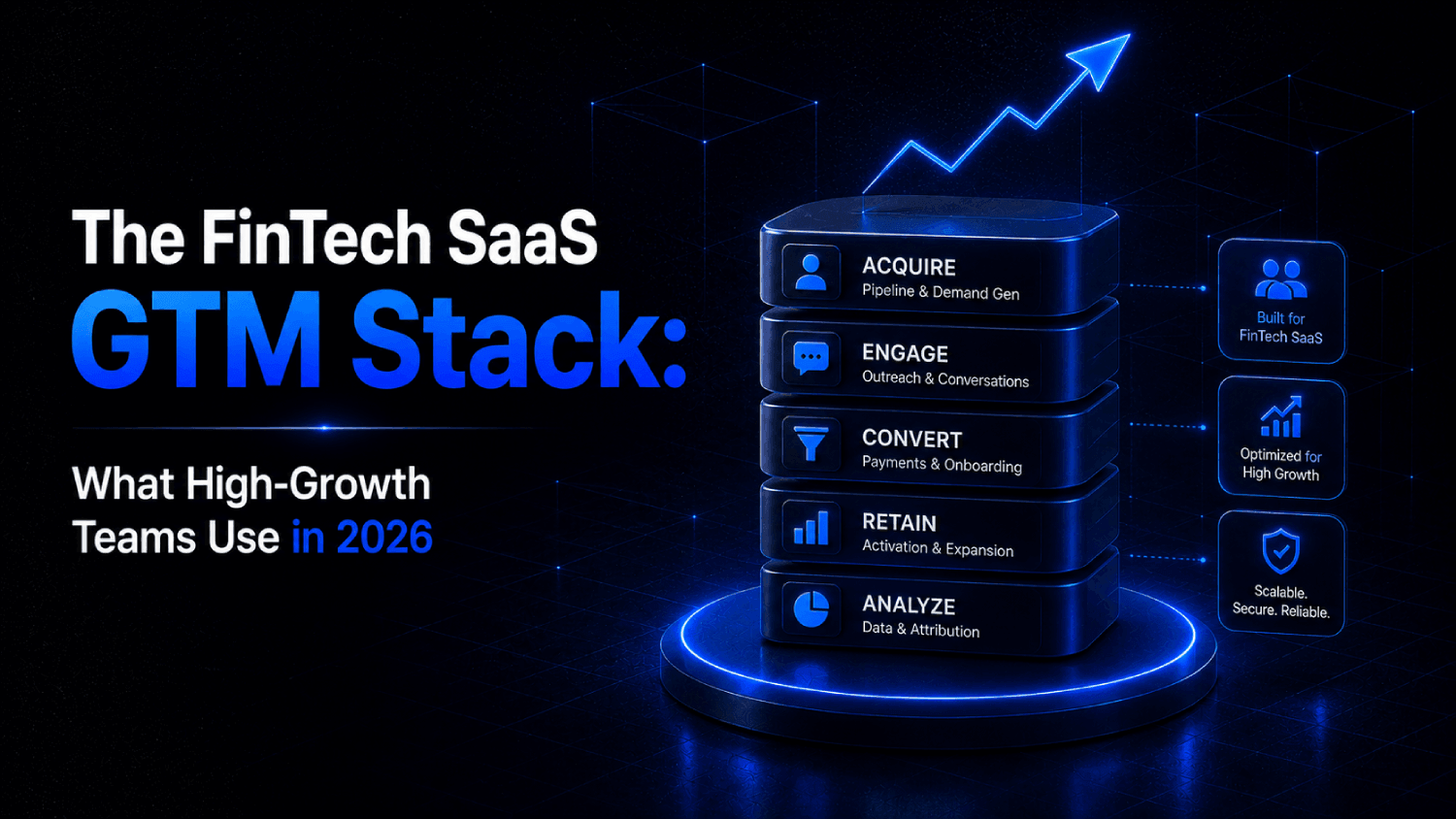
A fintech SaaS GTM stack covers eight functional layers: CRM, data enrichment, outbound, content and proof assets, security review, onboarding handoff, analytics, and revenue quality measurement. Generic SaaS stacks stop at four. The extra four layers are where fintech deals are won or lost, because fintech buyers are evaluating vendor risk and implementation readiness, not just product fit.
Why a Generic SaaS GTM Stack Breaks Down in Fintech
A standard SaaS GTM stack assumes that if you get the right person to a demo, close logic takes over. Fintech does not work that way. The buyer is often a VP of Finance or a Chief Compliance Officer who will route your product through a security team, a legal team, a procurement team, and sometimes a board committee before any contract is signed.
The sales cycle in fintech is longer, and the reasons deals fall apart are different. It is rarely price. It is more often: your SOC 2 report is not current, your implementation timeline is unclear, or your security questionnaire responses took three weeks. A CRM, an outbound tool, and a marketing automation platform cannot fix any of those problems. You need purpose-built infrastructure at each stage.
Understanding what your GTM stack needs to do at every buying stage is the first step. The go-to-market strategies that work in fintech SaaS share one trait: they treat trust as a conversion rate problem, not a brand problem.
What Does a Full Fintech SaaS GTM Stack Actually Look Like?
Here is a functional map of what high-growth fintech teams actually run, broken into eight layers. Some tools appear in more than one layer because they serve dual purposes.
| Stack Layer | Primary Function | Common Tools | Where Teams Cut Corners |
|---|---|---|---|
| CRM | Deal tracking, pipeline hygiene, multi-contact management | Salesforce, HubSpot, Attio | Single contact per account, no buying committee mapping |
| Data Enrichment | ICP qualification, firmographic and technographic signals | Clay, Apollo, Clearbit | Enriching only on first touch, not throughout cycle |
| Outbound | Sequenced outreach, deliverability, intent-triggered triggers | Outreach, Salesloft, Instantly, Smartlead | Generic sequences not adjusted for compliance-aware buyers |
| Content and Proof Assets | Case studies, compliance docs, trust pages, ROI calculators | Notion, Highspot, Seismic, custom trust portals | No buyer-stage mapping for which asset goes when |
| Security Review Acceleration | Vendor questionnaire response, compliance evidence packaging | Vanta, Drata, Tugboat Logic, SafeBase | Treating security review as a reactive bottleneck |
| Onboarding Handoff | CS handoff quality, implementation scoping, time-to-value tracking | Vitally, Gainsight, Arrows, Rocketlane | No formal handoff doc, AE disappears at close |
| Analytics | Pipeline visibility, attribution, conversion rates by stage | Mixpanel, Amplitude, Heap, Google Analytics 4 | Tracking top-of-funnel only, not stage-to-stage conversion |
| Revenue Quality | NRR, GRR, expansion tracking, churn signals | Chargebee, Stripe Billing, ChartMogul, Baremetrics | Reporting only MRR, missing contraction and expansion |
Which CRM Setup Actually Works for Fintech B2B Deals?
Salesforce remains the default for fintech companies raising Series B and beyond, primarily because enterprise procurement teams expect it and because its object model handles complex multi-contact deal structures. The trade-off is cost and configuration overhead. Salesforce is not a tool you can deploy meaningfully in a week.
HubSpot serves seed-to-Series A teams well. Its marketing and sales integration is tighter out of the box, and the free and Starter tiers make it accessible for teams that have not yet formalized their rev ops function. The limitation surfaces when deals involve five or more stakeholders across departments, where HubSpot’s buying committee tracking requires workarounds.
Attio is gaining ground with founders who want a flexible, data-model-first CRM. It handles relationship intelligence and workspace-level account views better than HubSpot at the same price point. For product-led fintech companies that want CRM data tied closely to product usage signals, Attio’s API-first architecture is worth evaluating.
The consistent failure mode across all three: teams set up one contact per account. Fintech deals routinely involve a champion, an economic buyer, a compliance approver, and a technical evaluator. If your CRM does not map all four and track their engagement separately, your pipeline forecasting will be wrong.
How Should Fintech GTM Teams Handle Data Enrichment?
Enrichment is not a one-time step at list import. In fintech, the ICP changes as you learn which customer segments actually activate, retain, and expand. Running enrichment at first touch and never again means you are qualifying on stale data.
Clay has become the default enrichment layer for operators who want to combine multiple data sources without building a custom waterfall. It connects to LinkedIn data, Apollo, Clearbit, and custom webhooks, letting you build enrichment flows that trigger on deal stage changes, not just on list upload. The pricing scales with usage and is published on their site.
Apollo bundles enrichment with outbound sequencing, which makes it attractive for smaller teams that cannot afford separate tools for each function. The contact data quality is competitive, though some fintech compliance officers and legal buyers are harder to surface because they are less active in the databases Apollo draws from.
HubSpot acquired Clearbit, and the product now leans toward firmographic enrichment, making it better for mid-market and enterprise account targeting than for SMB. Its real-time enrichment on form fills is particularly useful for product-led fintech companies where the buyer submits a signup form before talking to sales.
What Outbound Approach Works for Compliance-Aware Fintech Buyers?
Fintech buyers, particularly CFOs, compliance leads, and risk officers, read differently than product or engineering buyers. Generic outbound sequences that emphasize speed, growth, or “10x your revenue” framing tend to generate distrust from exactly the buyers who control the purchase decision.
Sequences that perform better in fintech emphasize specificity about the buyer’s regulatory context, reduce hyperbole, and front-load credibility signals. Referencing a relevant compliance standard, a shared customer type, or a documented integration with a tool they already use converts at a higher rate than benefit-led cold copy.
Outreach and Salesloft are the enterprise standards for sequencing. Both have deliverability infrastructure, analytics on open and reply rates, and integrations into Salesforce and HubSpot. For teams at Series A and below on tighter budgets, Instantly and Smartlead offer deliverability-focused outbound at a fraction of the cost, without the deal intelligence features the enterprise tools carry.
Intent data layered into outbound triggers is worth evaluating. Bombora tracks B2B research behavior at the company level, surfacing accounts that are actively researching topics relevant to your product. For fintech companies selling to mid-market and enterprise buyers, intent-triggered sequences consistently outperform spray-and-pray list outbound. Note that intent data quality varies meaningfully by segment, and it is stronger for software buyers than for compliance or legal decision-makers.
The GTM mistakes that slow fintech SaaS growth most often trace back to outbound that treats a compliance officer the same as a product manager. They are not the same buyer, and they do not respond to the same copy.
What Content and Proof Assets Do Fintech Buyers Actually Need?
This is the layer most fintech GTM teams underinvest in. Not content in the blog-and-webinar sense, but the specific documents and trust signals that move a deal through procurement and legal review.
Fintech buyers need: a one-page security and compliance summary (not a 40-page whitepaper), reference customer contacts in their industry or use case, a clear data handling and privacy policy written in plain language, and documented integration specs for the tools they already run. These assets do not require a content marketing team. They require someone to own the “trust package” the same way a sales engineer owns the technical demo.
Sales enablement platforms like Highspot and Seismic let reps surface the right document at the right deal stage without hunting through shared drives. For smaller teams, a well-organized Notion workspace with version-controlled assets and stage-tagged documents does the same job at lower cost.
Public trust pages, a dedicated URL listing your certifications, audits, and compliance posture, have become a meaningful conversion asset in fintech specifically. Buyers often check these before a second call. SafeBase makes publishing a trust center straightforward, with access controls so you can gate certain documentation for qualified prospects.
How Do High-Growth Fintech Teams Handle Security Review Without Losing Deals?
Security review is where fintech deals die quietly. The champion loves the product. The demo went well. Then the security questionnaire sits unanswered for three weeks, the quarter closes, and the deal slips.
The solution is treating security review as a proactive GTM function, not a reactive CS problem. That means having pre-completed questionnaire responses ready before procurement asks, maintaining an up-to-date SOC 2 Type II report, and having a point person who can respond within 48 hours to custom security questions.
Vanta and Drata are the two dominant platforms for continuous compliance monitoring and evidence collection. Both automate the evidence-gathering process for SOC 2, ISO 27001, and HIPAA, and both generate questionnaire-ready documentation as a byproduct. Vanta’s pricing is not publicly listed, but Drata publishes pricing on request. The cost is meaningful for early-stage teams, but the deal-cycle acceleration tends to justify it. The real cost of compliance in fintech SaaS by stage covers this trade-off in more detail.
For questionnaire automation specifically, SafeBase and Tugboat Logic maintain response libraries that your team updates once and draws from across every inbound security review. The time savings in deals with enterprise buyers that run 200-question security questionnaires are significant.
What Does a Strong Onboarding Handoff Look Like in Fintech GTM?
The AE-to-CS handoff is a revenue event, not an administrative one. In fintech, a poor handoff translates directly into a 90-day activation failure, which translates into churn at the first renewal. The reasons fintech users drop off during onboarding almost always include information gaps created at the handoff stage.
Rocketlane is purpose-built for implementation project management and client-facing onboarding. It creates shared workspaces between your team and the customer, with milestone tracking and time-to-value visibility. For fintech products with technical implementation requirements, this transparency reduces the “where is my implementation” support noise that kills CS team capacity.
Vitally and Gainsight serve the ongoing CS motion after initial onboarding. Both track product usage signals, health scores, and expansion indicators. Gainsight is the enterprise default with pricing to match. Vitally targets Series A-to-C companies with a lighter-weight interface and faster implementation.
Arrows sits at the lighter end of the spectrum for teams that need a structured onboarding plan but not a full CS platform. It integrates directly with HubSpot and creates customer-facing onboarding checklists that reduce the back-and-forth email thread that characterizes poor onboarding experiences.
Which Analytics Setup Gives Fintech GTM Teams Actual Pipeline Visibility?
The analytics failure in most fintech GTM stacks is measuring the wrong funnel. Top-of-funnel metrics, traffic, MQLs, demo requests, are easy to track and easy to report. Stage-to-stage conversion rates, security review cycle time, and legal review duration are harder to track and far more informative.
For product analytics, Mixpanel and Amplitude are the two standard options. Mixpanel’s event-based model gives granular funnel analysis with less pre-configuration. Amplitude’s strength is its cohort analysis and behavioral charts, which are more useful for product teams optimizing activation than for GTM teams tracking deal stages.
Heap captures all user interactions retroactively, which is useful for teams that have not yet defined which events matter. You can go back and build funnels after the fact. The trade-off is database size and query performance at scale.
For revenue reporting, ChartMogul and Baremetrics both provide MRR, ARR, churn, and expansion tracking on top of billing data from Stripe, Chargebee, or Recurly. ChartMogul is the more flexible option for companies with complex plan structures. Baremetrics is faster to set up and better for teams that need a readable dashboard rather than deep custom reporting.
Revenue quality metrics, net revenue retention, gross revenue retention, contraction MRR, are where most fintech SaaS teams have the weakest visibility. The fintech metrics that actually matter beyond vanity growth covers which numbers to prioritize and why ARR alone is insufficient for assessing business health.
How Should Early-Stage vs. Growth-Stage Fintech Teams Prioritize Stack Build?
Not every layer needs to be in place on day one. The priority order differs significantly by stage.
| Stage | Must-Have Layers | Can Defer | Common Mistake |
|---|---|---|---|
| Pre-seed to Seed | CRM (HubSpot free), enrichment (Apollo), one outbound tool | Sales enablement platform, dedicated CS tool | Over-investing in outbound tech before product-market fit |
| Series A | CRM, enrichment, outbound, security review (Vanta or Drata), onboarding handoff | Seismic, Gainsight, intent data | No trust package ready when enterprise prospects start asking |
| Series B+ | Full eight-layer stack, dedicated rev ops, Salesforce, intent data, security review automation | Nothing. All eight layers should be operational. | Running Series B deals on a Series A stack, creating pipeline leakage |
The point at which most fintech teams hit a wall is Series A to Series B. The CRM and outbound tools that worked at $1M ARR do not scale to the multi-stakeholder deals that define the path to $10M ARR. The fintech SaaS scale checklist for reaching $10M ARR maps out the operational changes required at each ARR threshold.
What Does This Stack Cost to Run?
Costs vary significantly by vendor, plan tier, and seat count, and many enterprise tools do not publish pricing publicly. The table below reflects publicly available starting prices at the time of writing. Treat these as floor estimates. Enterprise contracts for Salesforce, Outreach, Gainsight, and Seismic are negotiated and can run significantly higher.
| Tool | Starting Price (Publicly Listed) | Notes |
|---|---|---|
| HubSpot Sales Hub Starter | $15/seat/month (as of HubSpot’s public pricing page) | Free tier available with limited features |
| Salesforce Sales Cloud | $25/seat/month Starter (as of Salesforce’s public pricing page) | Most fintech teams run Professional or Enterprise tiers |
| Apollo.io Basic | Free tier available; paid plans from $49/seat/month (Apollo’s public pricing page) | Includes enrichment and sequencing |
| Clay | Free tier available; Starter from $149/month (Clay’s public pricing page) | Usage-based above free tier |
| Instantly | From $37/month (Instantly’s public pricing page) | Focused on email deliverability and sequencing |
| Vanta | Not publicly listed; contact sales | SOC 2, ISO 27001, HIPAA automation |
| Drata | Not publicly listed; contact sales | Compliance automation, similar positioning to Vanta |
| ChartMogul | Free up to $10k MRR; paid from $99/month (ChartMogul’s public pricing page) | Revenue analytics on top of billing data |
| Arrows | From $300/month (Arrows’s public pricing page) | HubSpot-native onboarding plans |
| Rocketlane | From $19/seat/month (Rocketlane’s public pricing page) | Implementation and onboarding project management |
A seed-stage fintech team running HubSpot Starter, Apollo, Instantly, and ChartMogul can assemble a functional four-layer stack for under $300 per month. The Series B full stack with Salesforce, Outreach, Clay, Vanta, Gainsight, and Highspot will run materially higher, with costs dependent on seat counts and negotiated contracts. The hidden costs that compress fintech SaaS margins includes a breakdown of how GTM tooling spend can creep up unexpectedly between funding rounds.
Frequently Asked Questions
1. What is a GTM stack in fintech?
A GTM stack in fintech is the collection of software tools a go-to-market team uses to acquire, convert, and retain customers. In fintech specifically, this includes not just CRM and outbound tools but also compliance documentation platforms, security review automation, onboarding infrastructure, and revenue quality analytics. The fintech version is more complex than generic SaaS because buyers are evaluating vendor risk and regulatory posture alongside product fit.
2. What CRM do most fintech SaaS companies use?
HubSpot is the most common choice for seed-to-Series A fintech companies because of its lower cost, faster setup, and built-in marketing integration. Salesforce becomes the standard at Series B and beyond, primarily because enterprise procurement teams expect it and because its data model handles complex multi-stakeholder deals better. Attio is an emerging option for product-led companies that want a more flexible, API-first CRM architecture.
3. Why does security review matter for GTM?
Security review is a late-stage deal blocker in fintech sales. Enterprise and mid-market buyers route new vendor relationships through a security approval process that can take weeks without preparation. Teams that treat security review as a proactive function, with pre-completed questionnaires and an up-to-date SOC 2 report, close faster and with less deal slippage. Tools like Vanta, Drata, and SafeBase reduce the manual work involved in keeping compliance evidence current and accessible.
4. What analytics tools do fintech GTM teams use?
Most fintech GTM teams run two analytics layers: product analytics and revenue analytics. Mixpanel and Amplitude are the product analytics standards. ChartMogul and Baremetrics handle revenue reporting, translating billing data into MRR, ARR, churn, and net revenue retention metrics. The gap most teams have is in pipeline analytics, specifically stage-to-stage conversion rates and cycle time by deal type, which requires CRM reporting configured intentionally rather than out of the box.
5. How does a fintech GTM stack differ from a standard SaaS stack?
The core difference is the addition of trust-building infrastructure. A standard SaaS GTM stack typically covers CRM, outbound, and marketing automation. A fintech stack needs two additional layers that matter more in regulated buying contexts: proof and compliance documentation assets, and security review automation. Fintech buyers are evaluating whether your company is a safe vendor to work with, not just whether your product solves a problem. The stack needs to support both conversations simultaneously.
6. What outbound tools work best for fintech sales?
Outreach and Salesloft are the enterprise standards with deep CRM integrations, deliverability infrastructure, and deal intelligence features. For Series A and below, Instantly and Smartlead offer deliverability-focused sequencing at lower cost. The tool matters less than the sequence strategy: fintech buyers, particularly compliance and finance leaders, respond poorly to generic benefit-led copy and respond better to sequences that reference their regulatory context, customer type, or existing tech stack.
7. When should a fintech startup invest in a dedicated CS platform?
A dedicated CS platform becomes worth the cost when a team has more than 30 active accounts and churn signals are difficult to catch early without automated health scoring. Before that point, a structured HubSpot deal stage process and a customer-facing onboarding checklist in Arrows or a shared Notion workspace covers the essentials. Gainsight targets enterprise teams. Vitally and ChurnZero are more appropriate for mid-market SaaS companies at Series A to Series B that want CS automation without the Gainsight implementation overhead.
8. What revenue metrics should fintech GTM teams track beyond MRR?
Net revenue retention and gross revenue retention are the two metrics that distinguish healthy fintech SaaS businesses from ones masking churn with new bookings. Contraction MRR, the revenue lost from plan downgrades, is often invisible in MRR-only reporting. Expansion MRR from upsells and seat growth indicates product stickiness. Time-to-value, measured from contract close to first meaningful usage milestone, predicts 90-day churn risk better than any engagement metric at the time of close.
The Real Constraint in Fintech GTM Is Not Tools
Every team above Series A has access to the same tools. The constraint is whether those tools are configured to serve the actual buying process of a fintech customer, or whether they are configured the same way a generic SaaS company would configure them. Salesforce used as a contact database is not the same as Salesforce configured with a buying committee map, stage exit criteria, and a security review milestone. The same applies across every layer of the stack.
The teams that close faster are not running exotic tools. They have decided that trust is a GTM function, not a brand function, and they have staffed and tooled accordingly. That means someone owns the security questionnaire response time. Someone owns the proof asset library. Someone tracks implementation success as a revenue metric, not a cost center metric. The tools just make those decisions visible and repeatable.
Building this stack in stages is the right approach for most teams. Get the CRM, enrichment, and outbound right first. Then add the proof asset layer and security review infrastructure before your first enterprise deal, not during it. The onboarding and revenue quality layers come next, and they pay back in NRR, which compounds in ways that new bookings alone cannot.