
- Plaid leads on developer experience and connection breadth, but its pricing model can become a real cost center at scale.
- MX delivers the most enriched transaction data and the strongest categorization engine, making it the better fit for lending, wealth, and institutional products.
- Finicity (now part of Mastercard) has a structural advantage in mortgage and income verification use cases, with direct data-sharing agreements at major banks.
- The right provider depends on your use case, not on which name you recognize first.
- All three face competitive pressure as the Consumer Financial Protection Bureau’s open banking rule pushes the industry toward standardized APIs.
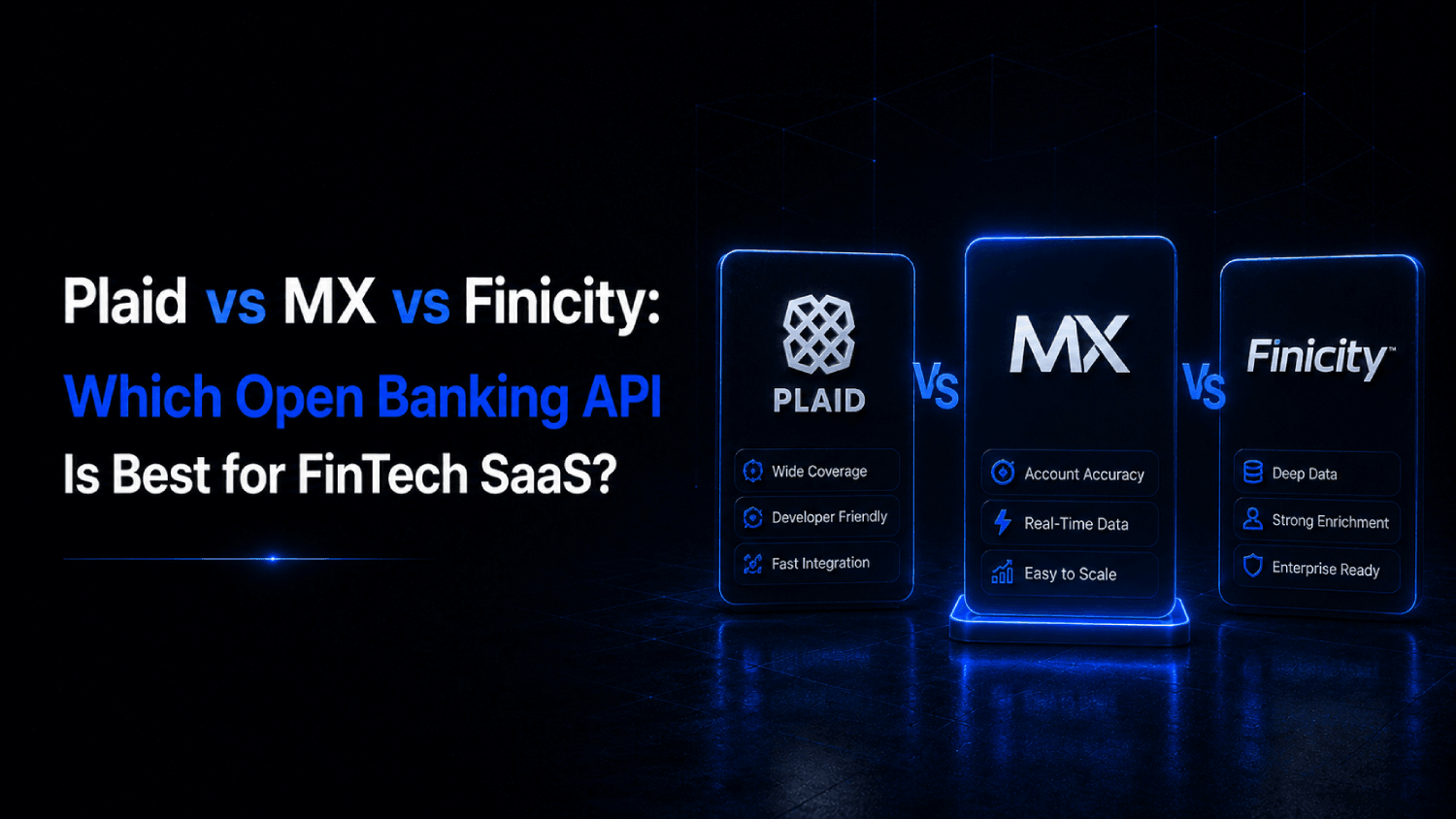
For most fintech SaaS products comparing Plaid vs MX vs Finicity, Plaid is still the right starting point, but it is not always the right long-term answer. MX is the better choice when data quality and enrichment matter more than connection speed. Finicity has a clear edge in mortgage, lending, and income verification workflows, backed by Mastercard’s direct bank relationships. The decision turns on use case, user base, and how much your product depends on clean versus broad data.
Why Most Fintech Teams Default to Plaid Without Questioning It
Plaid became the default open banking API by building the best developer experience in the category. Its documentation is clear, its sandbox works reliably, and its Link interface reduced bank connection friction to a few taps. For a founding team shipping fast, that matters more than almost anything else.
The problem is that developer experience and production performance are different things. Teams that chose Plaid for speed at seed stage sometimes find themselves renegotiating pricing at Series B or dealing with data gaps that didn’t show up in testing. MX and Finicity exist because there are real scenarios where Plaid’s defaults don’t hold.
This comparison covers what each provider actually does well, where each one falls short, and which use cases push you toward each one. If you want to understand how open banking fits into a broader fintech infrastructure stack, the 10 Best Fintech APIs for SaaS overview covers the full picture.
What Is Each Provider and How Did They Get Here?
Plaid
Plaid was founded in 2013 and became the connective tissue for a generation of consumer fintech apps, including Venmo, Robinhood, and Coinbase. Its core product is bank account linking, identity verification, and transaction data retrieval via a clean API. Plaid connects to thousands of financial institutions across the United States, Canada, and parts of Europe.
A proposed acquisition by Visa for $5.3 billion was blocked by the Department of Justice in 2021 on antitrust grounds, according to DOJ filings at the time. Plaid remained independent and has since expanded its product surface to include income verification, identity, payment initiation, and fraud signals.
MX Technologies
MX Technologies, referred to as MX throughout this comparison, positions itself differently from Plaid. Rather than leading with connection breadth, MX leads with data quality. Its transaction enrichment and categorization engine is widely considered the strongest in the space. MX works heavily with banks and credit unions, which gives it a different institutional profile than Plaid’s developer-first approach.
MX has also built a data connectivity layer that aggregates from multiple underlying sources, meaning it sometimes acts as an aggregator-of-aggregators. That adds resilience but also adds abstraction, which some engineering teams find harder to reason about.
Finicity (Mastercard)
Finicity was acquired by Mastercard in 2020 for approximately $825 million. The acquisition gave Finicity direct data-sharing agreements with major US banks, which improved connection quality and reduced reliance on credential-based screen scraping.
Finicity is especially strong in mortgage verification, income verification, and cash flow analysis, largely because of its relationships with major lenders and its integration into Mastercard’s existing financial data infrastructure.
Mastercard has since folded Finicity’s products into its Mastercard Open Banking portfolio, so the same capabilities appear under Finicity, Mastercard Open Banking, and Mastercard Data Connect depending on which contract and which documentation set you are reading.
Plaid vs MX vs Finicity: The Pairwise Verdicts
The three-way framing hides the fact that most teams are really deciding between two providers, not three. Here is the direct answer for each pairing.
Plaid vs MX
Plaid wins on coverage and speed to production. MX wins on data quality. They are not the same product: Plaid is primarily a connectivity and data-access layer, while MX adds a heavy enrichment and analytics layer on top of raw transaction data.
MX’s customer base also skews toward banks and credit unions rather than developers and startups, which shows up in a slower sales cycle and a steeper integration curve. Choose Plaid if missing an obscure institution is your biggest risk. Choose MX if displaying clean, correctly categorized transactions to users is what your product is actually selling.
Plaid vs Finicity
Finicity wins on verification and on connection stability at major national banks. Plaid wins on the long tail, on brokerage and wallet coverage, and on developer onboarding. The deciding question is whether your product needs verification outputs that a regulated underwriting system will accept.
If it does, Finicity’s Verification of Assets and Verification of Income and Employment products are accepted by Freddie Mac’s automated underwriting process, which Plaid’s equivalents do not match at the same regulatory acceptance level. If it does not, Finicity’s enterprise-first onboarding is friction you are paying for without using.
MX vs Finicity
This pairing comes up less often and has the cleanest answer. MX is the choice for consumer-facing products where transaction data is displayed, categorized, or analyzed. Finicity is the choice for lending workflows where a verification report is the deliverable. Both have stronger institutional footing than Plaid, and neither is the right pick for a two-person team shipping a consumer app in a month.
How Do Plaid, MX, and Finicity Actually Connect to Banks?
Connection method matters more than most teams realize. There are three tiers: direct OAuth connections with the bank’s API, tokenized credential exchange, and screen scraping as a fallback. Each tier carries different reliability, refresh rates, and regulatory exposure.
Plaid has invested heavily in OAuth partnerships and claims connections to thousands of institutions, but a meaningful portion of those connections still rely on credential-based methods at smaller banks. Connections through OAuth are more stable and more likely to persist through bank security updates. Connections via credentials break more often and require users to re-authenticate.
For scale, Plaid documents connections to more than 12,000 institutions, MX and Finicity each publish figures in the 15,000 to 16,000 range, and Envestnet Yodlee claims more than 17,000 data sources, though each provider counts data sources differently and none of these totals says anything about how reliably a specific institution connects.
Finicity’s position inside Mastercard has accelerated its direct API agreements with major US institutions. According to publicly available information, Finicity has direct connections with institutions including JPMorgan Chase, Bank of America, Wells Fargo, and Capital One, which reduces fallback scraping significantly for high-volume users.
MX aggregates across multiple data pipelines and has its own direct relationships with financial institutions, particularly credit unions and regional banks. That footprint is deeper than Finicity’s, which is concentrated at the largest national institutions, and its OAuth coverage has expanded as the industry has moved away from screen scraping under regulatory pressure.
Which Provider Connects Best to Specific Banks and Brokerages?
The three-way comparison only takes you so far, because most products do not lose users at the vendor level. They lose them at one institution that fails to connect. Connection quality is institution-specific, and the answer for Bank of America is not the answer for a $400 million credit union in Ohio.
Three rules cover most of the decision:
- At the largest national banks, Finicity’s Mastercard-negotiated direct agreements are the stronger bet. Publicly documented agreements cover institutions including JPMorgan Chase, Bank of America, Wells Fargo, and Capital One, which removes the credential fallback that causes most reauthentication events.
- At regional banks, community banks, and credit unions, Plaid’s institution count and MX’s credit union depth both beat Finicity. Finicity’s advantage is concentrated at the top of the market rather than across the long tail, and a product whose users bank at Comerica, Synovus, East West Bank, or PenFed will feel that difference quickly.
- At brokerages, wallets, and neobanks including Robinhood, Coinbase, PayPal, Venmo, Cash App, E*TRADE, and SoFi, Plaid is usually the only provider with production-grade coverage. Those platforms built against Plaid rather than the reverse, which is a distribution fact rather than a technical one, and it is unlikely to change quickly.
Institution coverage at the banks and platforms teams ask about most
The pattern below reflects connection type rather than measured success rate, because connection type is what you can verify before signing and it is what predicts reauthentication. A documented direct or OAuth agreement means the connection survives most bank login changes. A credential-based connection does not.
| Institution | Plaid | MX | Finicity | Practical default |
|---|---|---|---|---|
| JPMorgan Chase | Connects | Connects | Documented direct agreement | Finicity |
| Bank of America | Connects | Connects | Documented direct agreement | Finicity |
| Wells Fargo | Connects | Connects | Documented direct agreement | Finicity |
| Capital One | Connects | Connects | Documented direct agreement | Finicity |
| Large nationals with no documented direct agreement: US Bank, Citibank, PNC, Truist, TD, Santander US, HSBC US, BMO | Connects | Connects | Connects | Verify connection type per provider before choosing |
| Regional banks: Regions, Comerica, Synovus, East West, Zions, Flagstar, KeyBank, Fifth Third, M&T, First Citizens, First Horizon, Citizens, Old National, Pacific Premier, Wintrust | Connects, broadest long tail | Connects, deep regional relationships | Narrower than either | Plaid or MX |
| Credit unions: PenFed, Bethpage, Alliant, Navy Federal | Connects | Connects, strongest credit union footprint | Narrower | MX |
Brokerages and wallets: Robinhood, Coinbase, PayPal, Venmo, Cash App, E*TRADE, SoFi, Charles Schwab | Production-grade coverage | Limited | Limited | Plaid |
FintechSpecs verified the direct-agreement column against each provider’s public institution directory. Do not read the Plaid and MX columns as an absence of quality at the largest banks, because both connect there. Read them as an absence of a publicly documented direct agreement, which is a narrower and more useful claim.
The practical test is narrower than a vendor comparison, and it is the first two steps of the institution-first fit test at the end of this article: inventory your top 20 institutions, then ask each vendor for connection success rate and reauthentication frequency on those specific institutions over the last 90 days. Most will share institution-level numbers under NDA when asked directly.
Where Each Provider Has a Clear Advantage
Plaid’s Strengths
Developer experience remains Plaid’s biggest edge. The Plaid Link component handles the user-facing connection flow and is tested across an enormous variety of mobile and web contexts. For a team that doesn’t want to own that UI layer, Plaid removes a significant engineering burden.
Plaid’s institution coverage is the broadest of the three, which matters for consumer-facing products where users arrive with accounts at obscure credit unions or regional banks. Missing a bank connection is a user drop-off event, and Plaid’s long tail of institution coverage is hard to replicate.
Its product expansion into identity verification, income verification (Plaid Income), and payment initiation (Plaid Signal, Plaid Transfer) means teams can consolidate more of their data layer under one vendor. That consolidation reduces integration complexity, though it increases Plaid dependency. For a broader look at how fintech API stacks fit together, the best embedded finance APIs for SaaS companies is worth reviewing alongside this comparison.
MX’s Strengths
Transaction enrichment is where MX genuinely outperforms. The company’s categorization engine cleans merchant names, assigns spending categories, and flags recurring transactions with higher accuracy than what Plaid delivers out of the box. For products that need to display clean financial data to users, or that run underwriting or affordability analysis on top of transaction history, MX’s data quality reduces downstream engineering work.
MX also has a stronger institutional sales motion, which means larger banks and credit unions that want to offer data aggregation to their own customers are more likely to be running MX white-label products. If your product sells into financial institutions rather than directly to consumers, MX’s existing relationships open doors that Plaid’s consumer-first brand doesn’t.
Categorization granularity and ambiguous merchants
Granularity is where enrichment differences become visible to end users. MX returns merchant, category, and subcategory levels, which is what lets a product distinguish spending patterns rather than lumping them into broad buckets. The harder cases are merchants that operate across categories, where the same restaurant chain appears as dine-in, takeout, and grocery depending on the transaction.
Providers differ meaningfully here, and the only reliable way to evaluate it is to send the same 500 transactions from your own user base to each provider’s sandbox and compare the output by hand. For a broader view of enrichment options beyond these three, the best data enrichment APIs for fintech underwriting comparison covers the payroll, identity, and business-data layers as well.
Finicity’s Strengths
Finicity is the most defensible choice for lending and mortgage use cases. Its Verification of Assets (VOA) and Verification of Income and Employment (VOIE) products are used directly by lenders and integrated into several major loan origination systems. Freddie Mac accepts Finicity’s asset verification reports as part of its automated underwriting process, which is a structural advantage no other aggregator in this comparison can claim at the same scale.
The Mastercard backing also gives Finicity a credibility story in enterprise and regulated environments that neither Plaid nor MX can match with the same specificity. Compliance teams at large financial institutions are more comfortable with a Mastercard entity than with an independent fintech.
If verification rather than connectivity is the deliverable you are buying, the wider set of income verification APIs for lenders includes payroll-connected providers that sit outside this three-way comparison entirely.
How Do Pricing Models Compare?
None of the three providers publishes a public rate card, and none offers self-serve pricing tiers you can compare without talking to sales. All three price on usage, negotiated through their sales teams, with rates varying by volume, use case, and which product modules you enable.
Plaid’s pricing has historically been item-based, meaning you pay per connected account (or “Item”), with separate charges for different API products. The company moved away from flat-rate pricing tiers and toward consumption-based pricing, which means costs can scale unpredictably as your connected user base grows. Teams that built financial projections around Plaid pricing in early fundraising rounds have sometimes encountered meaningful discrepancies at scale. The hidden costs that compress fintech SaaS margins covers this pattern in broader context.
MX pricing is also negotiated, and the company skews toward longer-term enterprise contracts. Its pricing reflects the higher data quality it delivers, and teams typically report that MX is not the cheapest option at small volume but can be competitive at enterprise scale with enrichment factored into the total cost.
Finicity’s pricing through Mastercard’s sales motion is enterprise-focused and not publicly disclosed. For verification products specifically, pricing is often per-report rather than per-connection, which aligns with how lenders think about per-application costs.
Four variables move every quote, and knowing which one dominates your usage is what makes the three quotes comparable:
- What you are billed against. Plaid bills per connected account and per API product, MX bills against an enterprise contract with volume commitments, and Finicity bills per verification report for its lending products. A per-report model looks expensive next to a per-account model until you calculate reports per funded loan.
- Which modules you enable. Identity, income, investments, and payment initiation are priced separately at all three, and the base connectivity rate tells you very little about the final invoice.
- Refresh frequency. Daily refreshes on a large connected base cost materially more than on-demand pulls, and this is the variable teams most often leave out of early projections.
- Volume commitment length. MX and Finicity both discount against longer commitments, which is why they are frequently uncompetitive at pilot volume and competitive at scale.
The practical takeaway: get quotes from all three before committing, and model the cost at 3x your current volume.
Use Case Comparison: Which Provider Fits Which Product?
| Use Case | Plaid | MX | Finicity | Recommended Starting Point |
|---|---|---|---|---|
| Consumer fintech (budgeting, neobanks) | Strong connection breadth, best Link UX | Better data enrichment and categorization | Adequate, not optimized for consumer UX | Plaid for user experience; MX if data quality drives retention |
| Lending and underwriting | Income and asset verification products available | Strong cash flow analysis and categorization | Leading VOA and VOIE, Freddie Mac accepted | Finicity for mortgage and traditional lending; MX for alternative underwriting |
| Wealth management and investment platforms | Investment data API, adequate coverage | Strongest enrichment for portfolio aggregation | Asset verification, less investment-specific depth | MX for data richness; Plaid for speed to market |
| Accounting and bookkeeping SaaS | Transaction retrieval is solid | Best categorization reduces manual reconciliation | Less relevant for accounting workflows | MX if categorization accuracy directly reduces support tickets |
| B2B payments and treasury | Plaid Signal for ACH risk, balance checks | Bank verification and balance checks available | Account verification via Mastercard rails | Plaid for ACH-focused workflows; Finicity where Mastercard relationships add trust |
| B2B SaaS embedded finance | Easiest integration, widest third-party support | Better fit for institutional or regulated B2B buyers | Strong where compliance and audit trail matter | Plaid to start; MX or Finicity as buyer profile becomes more institutional |
What Do Connection Reliability and Data Freshness Actually Look Like?
Connection reliability is the metric that matters most in production and the one that’s hardest to evaluate before you commit. All three providers experience connection failures when banks update their authentication flows, and all three have recovery processes, but the timelines differ.
Plaid has historically been criticized for connection instability at specific large institutions, particularly when those institutions update their login flows. The company has invested in OAuth partnerships to reduce this, but any product with high re-authentication rates will see user drop-off that is hard to attribute clearly to the aggregator.
FintechSpecs monitors 25 fintech infrastructure providers on a rolling 90-day basis, including all three aggregators in this comparison. In the most recent window, MX led on all three incident measures we track.
| Provider | Incidents | Cumulative downtime | Mean time to recovery | Incidents in peak hours | Advertised SLA |
|---|---|---|---|---|---|
| MX | 3 | 19 minutes | 6.3 minutes | 33% | Not published |
| Plaid | 6 | 47 minutes | 7.8 minutes | 33% | 99.9% |
| Finicity | 5 | 63 minutes | 12.6 minutes | 60% | Not published |
Finicity’s peak-hour concentration matters more than its raw downtime for any product with a daytime onboarding funnel, because an incident during business hours lands on users who are mid-signup. Plaid is the only one of the three that publishes an advertised SLA. Full methodology and the other 22 providers are in the 2026 fintech infrastructure reliability report.
Data freshness varies by institution and connection type. OAuth connections typically refresh within hours; credential-based connections can lag by a day or more. MX’s multi-source aggregation provides fallback when a primary connection degrades, which is a structural reliability argument. Finicity’s direct agreements with major banks mean those connections are more stable than the industry average for those specific institutions.
How Are Plaid, MX, and Finicity Handling the CFPB Open Banking Rule?
The Consumer Financial Protection Bureau finalized its Personal Financial Data Rights rule under Section 1033 of Dodd-Frank in October 2024. The rule requires financial institutions to make customer data available through standardized APIs on request, prohibits charging for that access, and phases in compliance deadlines by institution size. The rule has been litigated since finalization and its compliance deadlines have moved, so treat any specific date as current only as of the date on this page and check the status before building a timeline against it. FintechSpecs tracks the current position in its Section 1033 open banking compliance guide.
This regulatory shift changes the competitive dynamics in ways worth understanding. Screen scraping loses its technical and legal justification as direct APIs become mandated. Providers with more direct bank relationships, including Finicity through Mastercard and MX through its institutional network, are better positioned for the post-1033 environment. Plaid has been an active participant in open banking standard-setting through organizations like the Financial Data Exchange (FDX), but its historical reliance on credential-based fallback connections is a risk factor in a world where banks can technically block that access.
For teams making a multi-year infrastructure bet, the regulatory trajectory favors providers with the deepest direct API relationships. Understanding how compliance fits into your broader infrastructure decisions is worth reviewing alongside a fintech product and compliance readiness checklist.
Developer Experience and Integration Complexity: A Real Comparison
Plaid’s developer documentation is the most extensive of the three. The sandbox environment covers most production scenarios accurately, the client libraries are actively maintained across major languages, and the community of developers who have already built with Plaid means most edge cases have been discussed publicly. For a two-person engineering team, Plaid gets you to production faster.
All three ship a hosted bank-linking flow and mobile SDKs, so the real question is not whether you can hand off that screen but how much control you keep over it: Plaid Link is the most heavily tested and the least customizable, MX gives more configuration in exchange for setup work, and Finicity Connect sits between them with naming that now varies across Mastercard’s documentation.
MX’s developer experience has improved significantly, but it carries more setup complexity, particularly around institution whitelisting and account data configuration. Teams that use MX tend to report a steeper initial integration curve followed by fewer post-launch data quality issues.
Finicity’s developer experience has been through some turbulence post-Mastercard acquisition, with product naming and documentation consolidated under Mastercard Open Banking in some contexts. The tools are functional, but developers working independently rather than through an enterprise sales relationship will find the onboarding path less intuitive than Plaid’s. For a larger engineering team with a dedicated integration sprint, this is manageable. For a solo developer on a two-week integration timeline, it’s friction.
If integration complexity sits inside a broader infrastructure evaluation, the pattern of critical fintech infrastructure mistakes is worth reviewing before committing to any single provider.
How Do Privacy Practices and Data Use Policies Differ?
All three providers have faced scrutiny over how they use the financial data they access. Plaid settled a class-action lawsuit in 2022 for $58 million over allegations that it collected more financial data than users authorized and shared it with third parties. The settlement did not constitute an admission of wrongdoing, but it produced changes to Plaid’s data use practices and disclosure requirements.
MX and Finicity have faced less public litigation on data practices, but the underlying tension in the aggregator model is the same for all three: they hold significant amounts of sensitive financial data, and monetization of that data beyond direct API fees is a legitimate concern for enterprise buyers and their legal teams.
When evaluating any of these providers, enterprise buyers should request a data processing agreement, ask explicitly whether transaction data is used for purposes beyond delivering the API product, and review the provider’s data retention policies. This is especially relevant for products serving regulated industries. The compliance mistakes that can destroy fintech startups covers data governance failures in detail.
Are There Situations Where None of the Three Is the Right Answer?
Yes. If your product operates primarily outside the United States, all three of these providers have limited non-US coverage. Plaid has expanded to Canada and parts of Europe, but it is not the right choice for a product that needs deep European bank coverage. TrueLayer, Tink, or Yapily are more appropriate in that context.
If you are building a product that needs real-time payment initiation rather than data aggregation, the aggregator model itself may not be the right starting point. PaymentsOS, Volt, or bank-direct integrations through your banking-as-a-service provider may be more appropriate. The best banking-as-a-service platforms for fintech startups covers that layer of the stack. If you are already running payments on Stripe, Stripe Financial Connections against Plaid is the narrower comparison to make before adding a fourth vendor.
There are also cases where layering multiple providers makes sense. A lending product might use Finicity for its formal verification reports and Plaid for lightweight bank linking in its consumer onboarding flow. The operational complexity of maintaining two integrations is real, but the use-case fit is often worth it.
There is also a fourth option that is neither of these three nor a straight replacement: routing layers such as Quiltt sit above the aggregators and let you run more than one without rewriting the integration, which is a different decision from picking a primary provider. The Quiltt and Finicity comparison covers where that abstraction helps and where it adds a layer you do not need, and the ranked list of Plaid alternatives for US bank data connectivity covers the wider US set including Envestnet Yodlee, Akoya, and Teller.
How do you split traffic between two providers?
Route by institution rather than by percentage. Percentage splits give you two half-tested integrations and no clean signal about which provider is failing where, while institution-based routing sends each connection to the provider most likely to hold it. Four steps make it operational:
- Send institutions where one provider has a documented direct or OAuth agreement to that provider.
- Keep the second provider as the fallback for everything else, including the long tail.
- Instrument connection success and reauthentication events by institution, not in aggregate.
- Let those numbers update the routing table, so the decision is not frozen at whatever you believed during integration.
The cost is two vendor relationships, two data models to normalize, and the engineering work to keep the routing table honest. That cost is worth paying when a single provider’s gaps are concentrated in institutions your users actually hold, and not worth paying to hedge against a risk you have not measured.
Side-by-Side Feature Summary
| Dimension | Plaid | MX | Finicity |
|---|---|---|---|
| Institution coverage (US) | Broadest long tail | Strong, credit union depth | Strong at major banks |
| OAuth / direct API connections | Growing, still has credential fallback | Growing, multi-source resilience | Strong at major banks via Mastercard |
| Data enrichment and categorization | Adequate | Strongest in category | Adequate |
| Income and asset verification | Available (Plaid Income) | Available | Strongest (Freddie Mac accepted VOA/VOIE) |
| Developer experience | Best documentation, fastest start | Good, steeper initial curve | Adequate, complex onboarding |
| Enterprise / institutional sales | Available, skews startup-friendly | Strong institutional motion | Enterprise-first via Mastercard |
| Non-US coverage | Canada, limited Europe | Primarily US | Primarily US |
| Pricing model | Consumption-based, negotiated | Enterprise contract, negotiated | Enterprise, per-report for verification |
| Regulatory positioning (post-CFPB 1033) | Active in FDX standards | Strong institutional relationships | Strongest direct bank agreements |
Bank transaction data is only one input to a credit decision, and the consumer credit data APIs for thin-file underwriting comparison covers the bureau and alternative-data layers that sit alongside it.
Frequently Asked Questions
1. Is Finicity or Plaid better for a lending product?
Finicity is better for formal lending workflows, specifically mortgage origination and income verification. Its Verification of Assets and Verification of Income and Employment products are accepted by Freddie Mac’s automated underwriting system, which gives lenders a compliance-grade data source that Plaid’s equivalent products do not match at the same regulatory acceptance level. For alternative lenders or fintech products using bank data for informal credit scoring, Plaid or MX may be sufficient, but for traditional mortgage and consumer lending, Finicity has a structural advantage.
2. Which provider has the best transaction categorization?
MX is widely regarded as having the strongest transaction enrichment and categorization engine among the three. It cleans merchant names, assigns spending categories, and identifies recurring transactions with higher accuracy than Plaid’s default data output. This matters most for products where users see their transaction history directly, such as budgeting apps, personal finance tools, or wealth platforms, as well as for backend products that run financial analysis without manual cleaning.
3. Can you use Plaid and Finicity together in the same product?
Yes, and some teams do exactly this. A common pattern is using Plaid for the consumer-facing bank linking experience, where its Link component and broad institution coverage reduce drop-off, while using Finicity for formal verification reports that feed into a lending or compliance workflow. The operational cost is two API integrations to maintain, two vendor relationships to manage, and two data models to normalize. For products where the use cases are clearly distinct, this overhead is often justified.
4. How does the CFPB’s Section 1033 rule affect these providers?
The rule shifts advantage toward providers holding direct API agreements and away from those relying on credential-based access, which is why Finicity’s Mastercard relationships and MX’s institutional network are better positioned than Plaid’s credential fallback. FintechSpecs covers the obligations, deadlines, and current legal status in its Section 1033 compliance guide.
5. What is the Financial Data Exchange (FDX) and why does it matter?
The Financial Data Exchange is an industry body developing a common standard API for financial data sharing in North America. All three providers participate. FDX adoption means that over time, the technical differentiation between aggregators may narrow, because banks will offer standardized API endpoints rather than custom integrations. The competition will shift toward data quality, enrichment, verification products, and enterprise services rather than raw connectivity. This is why data depth, not just connection count, matters more as an evaluation criterion going forward.
6. Is MX available to startups or only to financial institutions?
MX sells to both segments, but its go-to-market motion is more oriented toward banks, credit unions, and established fintech companies than toward early-stage startups. A seed-stage company without revenue or institutional references may find the MX sales process slower than Plaid’s self-serve developer onboarding. That does not mean MX is unavailable at the startup stage, but teams should account for a longer sales cycle and contract negotiation compared to Plaid’s faster developer activation.
7. How do these providers handle user consent and data access revocation?
All three provide mechanisms for users to revoke access to their financial data. Plaid has a consumer portal where users can see and disconnect their linked accounts. MX and Finicity provide similar revocation capabilities, though the specific implementation varies by how the API is integrated. Under the CFPB’s Section 1033 framework, clear revocation rights will be a compliance requirement rather than a voluntary feature, so all three providers are aligning their products with those requirements. Enterprise buyers should verify that any implementation provides clear, user-facing revocation flows that meet their own compliance obligations.
8. Is Plaid or Finicity better for Bank of America connections?
For Bank of America specifically, Finicity has the stronger structural position, because Mastercard’s direct data-sharing agreement covers Bank of America and removes the credential fallback that causes most reauthentication events. Plaid also connects to Bank of America, and for a consumer product where Link’s user experience reduces drop-off, that difference may not be worth switching for. The pattern holds more broadly: Finicity is the safer choice at the largest national banks, and Plaid is the safer choice once your users start arriving with accounts at regional banks, credit unions, and brokerage platforms.
9. Is Plaid or Finicity better for Wells Fargo and Chase connections?
Finicity holds the stronger structural position at both, for the same reason it does at Bank of America: Mastercard’s documented direct data-sharing agreements cover Chase, Bank of America, Wells Fargo, and Capital One, which removes the credential fallback that causes most reauthentication events. Plaid connects to all four and its Link flow still converts better in a consumer onboarding funnel, so the difference is worth acting on only if reauthentication is measurably costing you users. The rule to carry forward is that the four largest national banks are where Finicity’s advantage is concentrated, and it thins out quickly below them.
10. Which provider connects best to Venmo, PayPal, Cash App, Robinhood, and Coinbase?
Plaid, and it is not close. Those platforms built their account-linking against Plaid rather than the reverse, so Plaid is usually the only one of the three with production-grade coverage across wallets, neobanks, and brokerages including E*TRADE and SoFi. This is a distribution fact rather than a technical one, which also means it is unlikely to change quickly. If a meaningful share of your users hold balances in wallets or brokerage accounts rather than at banks, this single constraint decides the vendor question before coverage, enrichment, or pricing enter the discussion.
11. Is Plaid or MX better for regional banks and credit unions?
Both beat Finicity here, and the choice between them depends on which segment dominates your user base. Plaid’s long tail of institution coverage is the broadest of the three, which matters for a consumer product where users arrive from banks you have never heard of. MX has deeper relationships with credit unions and regional institutions, which shows up as fewer credential-based connections at names like PenFed, Bethpage Federal Credit Union, Comerica, Synovus, and East West Bank. Finicity’s advantage is concentrated at the largest national banks, so a product serving a regional or credit union membership will feel that gap early.
12. Which provider requires the least reauthentication?
Reauthentication frequency tracks connection type rather than vendor. OAuth and direct API connections persist through most bank security updates, while credential-based connections break whenever an institution changes its login flow. That means the provider requiring the least reauthentication is whichever one holds a direct agreement with the specific institutions your users bank with. Ask each vendor for the share of your top 20 institutions served over OAuth or a direct agreement rather than asking for an overall reauthentication rate, because the overall number is an average across a long tail you may not have any users in.
The FintechSpecs Institution-First Fit Test
FintechSpecs uses this four-step test when evaluating aggregators for coverage, and the order matters, because coverage errors are cheaper to fix than data-model errors.
Most aggregator evaluations start with the vendor and work down to the institutions. That order produces the wrong answer, because vendor-level averages hide the institutions that will actually cost you users. Four checks, run in this order:
- Institution inventory. List the top 20 institutions your users already hold accounts at, or the top 20 from your closest competitor’s supported list if you have not launched. This list, not the vendor’s total institution count, is your coverage requirement.
- Connection type per institution. For each of those 20, establish whether each vendor connects through OAuth or a direct agreement, or through credentials. Credential connections are where reauthentication and drop-off come from, and the ratio matters more than the total.
- Data depth against product need. Decide whether your product sells raw connectivity, clean categorized data, or a verification report. Those three answers point to Plaid, MX, and Finicity respectively, and getting this wrong is more expensive than getting coverage wrong.
- Cost at 3x volume. Model quotes from all three at three times your current connected accounts, with enrichment and verification priced in. The provider that is cheapest at 1,000 connected accounts is frequently not cheapest at 100,000.
A team that runs these four checks in this order rarely ends up defaulting to the most recognized name, and rarely has to renegotiate at Series B.
The Real Decision Framework
Plaid’s default status in fintech is earned but not permanent. For a consumer fintech product that needs broad bank coverage and wants to ship quickly, Plaid is still the fastest path. Its developer experience and institution reach are genuine advantages that neither MX nor Finicity has fully closed.
The calculus shifts when data quality becomes a product differentiator rather than a backend commodity. A personal finance app whose revenue depends on accurate spending insights, or a B2B SaaS product that runs financial analysis for clients, will find that MX’s enrichment layer reduces engineering overhead and improves end-user trust in ways that Plaid’s raw transaction data does not. For lending products that need verification outputs accepted by regulated underwriting systems, Finicity through Mastercard is the clearest choice.
The most durable mental model is this: Plaid is a connectivity provider that has added data features. MX is a data company that has connectivity. Finicity is a verification infrastructure company backed by the world’s largest payment network. Those are three different value propositions, and matching yours to the right one is worth more than defaulting to the most recognized name.