
- Stripe Financial Connections is free when used inside Stripe’s ACH payment flow, making it the cheaper default if your stack already runs on Stripe.
- Plaid covers more US financial institutions and returns richer transaction data, which matters for lending underwriting, income verification, and personal finance apps.
- Financial Connections does not offer Plaid’s full product suite: no income verification API, no investments data, no liabilities endpoint, and no standalone identity layer.
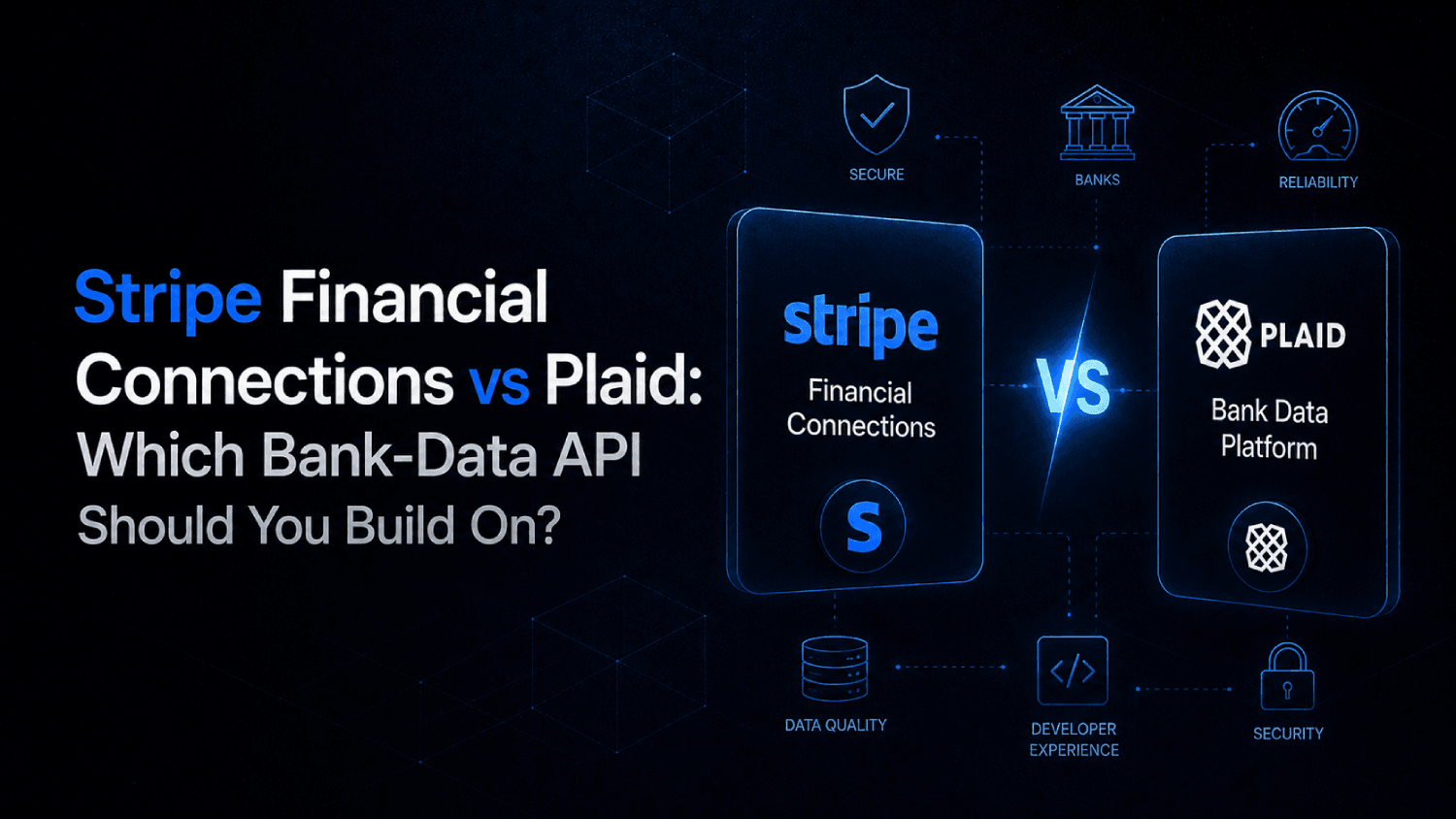
- The real comparison in Stripe Financial Connections vs Plaid is not about which API is more sophisticated. It is about whether your use case fits inside Stripe’s payment stack or needs bank data as an independent layer.
- Most seed-to-Series A teams building on Stripe do not need Plaid. Most lending, credit, or multi-processor teams still do.
Stripe Financial Connections is the right default for teams already processing payments through Stripe who need ACH bank account verification, instant account authentication, or basic balance checks. Plaid is the stronger choice when your product requires deep transaction history, income verification, investment account data, or bank connectivity that lives outside Stripe’s payment stack. The cost difference is real but secondary to use-case fit.
Why Most Fintech Teams Keep Asking This Question
Plaid has been the default bank-linking API for so long that many developers treat it like a utility. It is just there, like Twilio or Stripe itself. Then Stripe launched Financial Connections and gave teams already on Stripe a reason to look twice.
The common assumption is that Plaid is the professional-grade option and Financial Connections is a lite version for companies that could not get a Plaid deal. That framing is wrong, but so is the overcorrection. Financial Connections is genuinely capable for a specific set of use cases. Outside those use cases, it is not a substitute.
This piece compares the two across coverage, product depth, pricing, and use-case fit. It is not a feature checklist. It is a decision framework for teams who know what they are building and want to know which API actually supports it.
What Does Stripe Financial Connections Actually Do?
Stripe Financial Connections lets users connect a bank account and share financial data directly through a Stripe-hosted UI. The core outputs are account ownership verification, account and routing numbers for ACH, real-time balances, and basic transaction history. Stripe positions it as an open banking platform, but the practical function is bank account authentication inside a Stripe-powered payment flow.
The key integration point is Stripe’s ACH infrastructure. When a user pays via ACH through Stripe, Financial Connections handles the bank linking step. That tight coupling is where the product earns its keep. Outside that context, you are using a bank data API that lacks several product endpoints Plaid has built over years.
Financial Connections supports three primary data permissions: account data (numbers, ownership), balances, and transactions. Stripe’s developer documentation does not list an income verification product, a liabilities endpoint, or an investments data feed. Those gaps matter depending on what you are building.
What Does Plaid Actually Do, and Where Does It Go Further?
Plaid started as a bank connectivity layer and has since built a product suite that sits on top of that connectivity. The core is the same: link a bank account, pull data. The difference is how many directions Plaid can pull from there.
Plaid’s product lineup includes Auth (account and routing number verification), Transactions (up to 24 months of history), Identity (account ownership matching), Income (payroll and bank-based income verification), Liabilities (student loan and credit card data), Investments (holdings and transactions), and Assets (account snapshots for mortgage underwriting). That is a broader surface area than Financial Connections offers today.
Plaid also covers a larger number of US financial institutions. A developer who documented switching from Plaid to Stripe Financial Connections and back reported that Stripe’s bank coverage was not as comprehensive and that many of their users’ banks were not supported, a finding that held even as Stripe expanded its network. Plaid’s network remains deeper for long-tail institutions, credit unions, and regional banks.
How Does Pricing Compare Between Stripe Financial Connections and Plaid?
This is where the story gets interesting, and where the Hacker News commentary about Stripe’s listed rates being “30-200% higher than Plaid rates” deserves context.
According to Stripe’s public pricing page, Financial Connections charges $1.50 per account linked when used outside of Stripe payment flows, and $0.10 per account when used to complete instant bank payments through Stripe ACH. The ACH payment itself costs 0.8% capped at $5.00 per transaction. When Financial Connections is bundled into that ACH flow, the incremental cost of account linking approaches zero relative to the payment fee.
Plaid does not publish standard per-call pricing publicly. According to Plaid’s pricing page, costs are based on a monthly active user model and are available on request. Plaid has historically offered a free development tier and negotiated pricing at scale. Independent developer reports suggest Plaid Auth runs in the range of $0.30 to $0.50 per connected user per month, though actual contract pricing varies significantly by volume and use case.
The practical comparison looks like this for a team running ACH payments through Stripe:
| Scenario | Stripe Financial Connections | Plaid Auth |
|---|---|---|
| Bank linking inside Stripe ACH flow | $0.10 per account linked | $0.30-$0.50/MAU (estimated, contract-based) |
| Standalone bank account verification (not ACH) | $1.50 per account linked | Negotiated pricing |
| Transaction history pull | Included with linked account | Separate Transactions product, additional cost |
| Income verification | Not available | Available via Plaid Income product |
| Free tier / sandbox | Yes, for development | Yes, development access available |
The $1.50 standalone price is notably higher than what Plaid typically charges per Auth call at meaningful volume. The HN comment about Stripe’s rates being higher is accurate in the standalone context. Inside a Stripe ACH flow, the math flips, and Financial Connections is almost always cheaper when you factor in that you are not adding a second vendor.
Coverage and Use-Case Fit: A Side-by-Side View
| Use Case | Stripe Financial Connections | Plaid | Winner |
|---|---|---|---|
| ACH bank account verification (Stripe-powered payments) | Native, low-cost | Works but adds vendor overhead | Financial Connections |
| Instant bank payment authentication | Supported | Supported via Auth | Tie (prefer FC if on Stripe) |
| Real-time balance check | Supported | Supported | Tie |
| Transaction history (90 days) | Supported | Supported | Tie |
| Transaction history (24 months) | Not available | Supported | Plaid |
| Income verification | Not available | Plaid Income | Plaid |
| Payroll data | Not available | Plaid Payroll / Income | Plaid |
| Investment account data | Not available | Plaid Investments | Plaid |
| Liabilities (student loans, credit cards) | Not available | Plaid Liabilities | Plaid |
| Mortgage / asset reporting | Not available | Plaid Assets | Plaid |
| Bank coverage depth (US, long-tail institutions) | Good, expanding | Broader, more mature | Plaid |
| Multi-payment processor support | Requires Stripe stack | Processor-agnostic | Plaid |
| Standalone / non-Stripe product embedding | Possible but more expensive | Purpose-built for this | Plaid |
Do You Still Need Plaid If You Are Already on Stripe?
For most seed and Series A companies running a single-processor ACH stack through Stripe, the honest answer is no. If your only bank data need is confirming a user owns the account they want to pay from, Financial Connections handles that natively and at lower total cost. Adding Plaid on top means a second vendor contract, a second set of API keys, and a second data privacy agreement to manage.
The answer changes the moment your product needs data Stripe does not return. Building a cash flow underwriting model for a lending product? You need 12 to 24 months of transaction history and possibly income verification. Financial Connections maxes out well before that. Building a personal finance app that aggregates investment accounts, credit cards, and loans? Plaid covers that entire surface. Financial Connections does not.
There is also the multi-processor scenario. Companies that route ACH through Stripe and card payments through Adyen, or that offer payout rails across multiple processors, cannot depend on Financial Connections as their bank data layer because the product is tethered to Stripe’s payment infrastructure. Plaid sits upstream of the payment rail and stays neutral. That architecture matters at scale, especially for vertical SaaS platforms building embedded payments across multiple rails.
The FintechSpecs Coverage-Depth Test: How to Decide in Four Checks
Most bank-data API comparisons stop at a feature table. The problem is that feature tables tell you what a product does, not whether it is enough for your specific product. The FintechSpecs Coverage-Depth Test reframes the Stripe Financial Connections vs Plaid decision as a four-check filter designed to surface the right answer in under ten minutes. Each check maps to a genuine failure mode, teams that skipped it ended up rebuilding their bank data integration.
Check 1: Payment processor lock-in tolerance. If your ACH payments run entirely through Stripe today and you expect that to hold for at least 18 months, Financial Connections is the path of least resistance. If you are on multiple processors or evaluating a switch, Plaid’s processor-agnostic positioning wins immediately.
Check 2: Data depth requirement. List every data field your product logic actually reads today, not theoretically. If that list includes transaction history beyond 90 days, income signals, payroll, liabilities, or investment data, Financial Connections cannot support it and Plaid is the only serious option on this list.
Check 3: Institution coverage for your user base. If your users are concentrated at large national banks (Chase, Bank of America, Wells Fargo, Citi), Financial Connections coverage is adequate. If you serve users at credit unions, regional banks, or community banks, test Plaid’s coverage against your actual user bank distribution before committing.
Check 4: Vendor footprint tolerance. Two vendors means two contracts, two compliance reviews, two SDKs, and two error surfaces. For a five-person engineering team, that overhead is not trivial. If Financial Connections covers your use case, the single-vendor benefit of staying inside Stripe is real.
Which Product Wins for a Lending Startup?
A lending startup needs bank data for three things: identity confirmation, cash flow underwriting, and fraud screening. Financial Connections can handle the first. It falls short on the second and third at any meaningful depth.
Consider a company building a revenue-based financing product for small businesses. They need to pull 12 months of bank transactions, categorize inflows and outflows, and flag irregular patterns. Stripe’s transaction data endpoint does not reach 12 months. Plaid’s Transactions product does, and Plaid’s signal layer adds categorization metadata that speeds up the underwriting model significantly.
For lending, the data enrichment stack for underwriting teams typically includes Plaid Transactions plus a categorization layer, or Plaid Income for employment-based lending. Financial Connections is not a substitute in that flow. If you are building a consumer lender, BNPL product, or business credit tool, start with Plaid.
What About Privacy, Compliance, and Data Agreements?
Both products require user consent for data access and comply with standard financial data regulations. Stripe Financial Connections operates under Stripe’s existing privacy framework, which simplifies the compliance conversation if you are already a Stripe customer. You are not adding a new data controller relationship.
Plaid has its own privacy policy, end-user consent flow, and data deletion obligations. Plaid settled a class-action lawsuit in 2022 over how it handled user credentials, which prompted significant changes to its data practices. The current Plaid product uses tokenized connections rather than stored credentials, but the episode is worth knowing about if your legal team is reviewing vendor risk. For a full compliance review framework, the Fintech Product and Compliance Readiness Checklist covers vendor data agreements as a separate line item.
Neither product is a regulatory landmine for a standard fintech use case. The difference is that adding Plaid means one more vendor in your data processing agreements and one more entity your users are consenting to share data with. Some enterprise customers will notice that.
What the “Already on Stripe” Advantage Actually Means
The single most underweighted factor in this comparison is integration debt. Plaid’s API is well-documented and its Link UI has been embedded in thousands of products. But if you are already running Stripe Payments, Stripe Billing, and Stripe Connect, adding Financial Connections does not require a new SDK evaluation, a new webhook architecture, or a new error handling layer. You already know how Stripe behaves.
That matters more for early-stage teams than large ones. A two-person platform team at a seed company does not have bandwidth to maintain two separate bank data integrations. If Financial Connections covers the use case, the integration cost advantage is a real number, even if it does not appear on a pricing page.
Teams further along in their infrastructure build, evaluating their full fintech infrastructure stack, tend to make this a more deliberate architectural call rather than a default. At that point, the coverage gaps in Financial Connections are usually what forces the Plaid decision.
Frequently Asked Questions
Is Stripe Financial Connections cheaper than Plaid?
Inside a Stripe ACH payment flow, Financial Connections costs $0.10 per linked account, which is lower than Plaid’s typical per-user pricing for Auth. Outside of Stripe’s payment stack, the standalone rate of $1.50 per linked account is higher than what Plaid charges at volume. The answer depends entirely on how you are using the connection. If your payments run through Stripe, Financial Connections is almost always the cheaper path.
Should I use Plaid or Stripe Financial Connections for ACH bank account verification?
If you are processing ACH payments through Stripe, use Financial Connections. It is natively integrated, cheaper, and eliminates a vendor. If you are processing ACH through any other payment processor or need bank verification that lives outside a Stripe payment flow, Plaid is the more flexible choice and offers deeper institution coverage.
Which bank data API has better US institution coverage?
Plaid covers more US financial institutions, particularly credit unions, regional banks, and community banks. Stripe Financial Connections supports major national banks and continues to expand its network, but developer accounts and published comparisons consistently show Plaid with a larger supported institution list. For products serving users across a wide range of bank types, Plaid reduces connection failure rates.
Can Stripe Financial Connections replace Plaid for a lending startup?
Not currently. Lending underwriting typically requires extended transaction history (12 to 24 months), income verification, and cash flow categorization. Stripe Financial Connections does not offer an income verification product and does not return transaction history at the depth Plaid Transactions provides. Lending startups should treat Plaid as the default and evaluate Financial Connections only for the payment authentication step, not the data underwriting layer.
Is Stripe Financial Connections safe and privacy-compliant?
Yes. Financial Connections uses Stripe’s standard security infrastructure, requires explicit user consent, and does not store raw bank credentials. Data access is scoped to the permissions a user grants. From a compliance standpoint, it inherits Stripe’s existing data processing agreements, which simplifies the vendor review process for teams already under a Stripe contract.
What are the main Plaid alternatives beyond Stripe Financial Connections?
The most commonly evaluated Plaid alternatives for US fintech teams are MX, Finicity (now part of Mastercard), and Akoya. Each has different institution coverage profiles, pricing models, and data product depth. MX skews toward financial wellness and PFM use cases. Finicity is strong in mortgage and credit decisioning. For a detailed breakdown, the Plaid vs MX vs Finicity comparison covers those trade-offs directly.
What happens if a user’s bank is not supported by Stripe Financial Connections?
Stripe Financial Connections falls back to microdeposit verification when instant bank linking is not available. Microdeposit verification takes one to two business days, which creates friction in signup or payment flows that expect instant verification. Plaid offers broader instant verification coverage, so the fallback rate is lower. For products where instant verification is critical to conversion, Plaid’s coverage depth directly affects onboarding completion rates.
The Decision Most Teams Get Wrong
The default assumption in most developer forums is that Plaid is the serious choice and Financial Connections is a shortcut for teams that did not want to go through a procurement process. That framing has it backwards for one specific and common scenario: a company processing ACH payments through Stripe that needs nothing more than account ownership verification and a balance check. In that scenario, Plaid is the more expensive, more complex choice with no meaningful product advantage.
Where teams go wrong is extending that logic too far. The moment your product logic needs bank data that is not a payment authentication event, Financial Connections starts leaving gaps. Income verification, extended transaction history, non-Stripe payment rails, credit union coverage at scale: these are not minor gaps. They are the cases that sent at least one documented team back to Plaid after building on Financial Connections.
The right mental model for Stripe Financial Connections vs Plaid is not about which vendor is more capable in the abstract. It is about where your bank data need sits relative to Stripe’s payment stack. If the need is fundamentally a payment need, Financial Connections is purpose-built and cheaper. If the need is a data need that happens to involve payments, Plaid is still the more capable API. Build the decision around your data requirements, not around which vendor you already know.