
- Credit bureau data alone misses most of the signal that separates a good borrower from a risky one, especially for thin-file consumers and early-stage businesses.
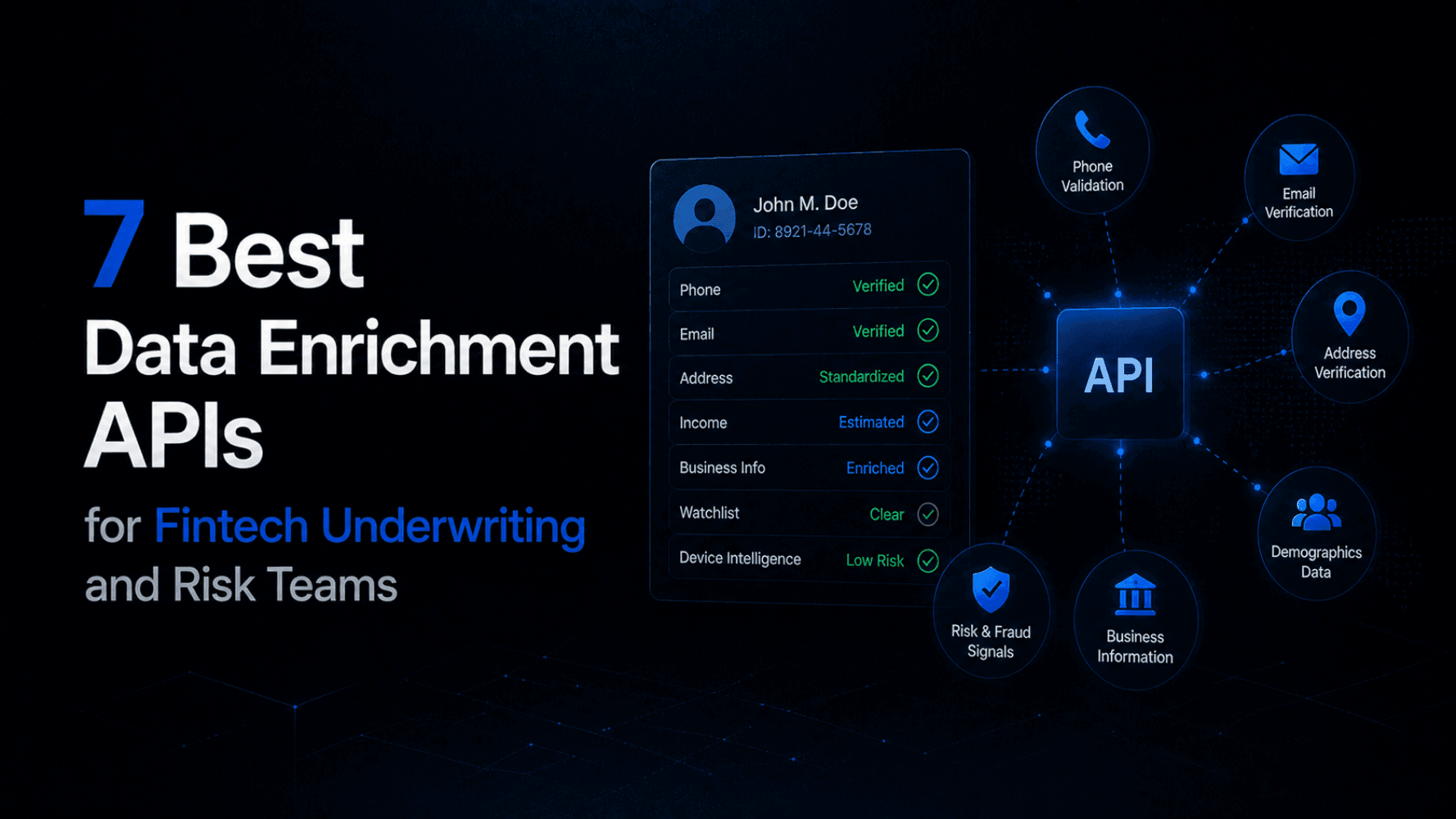
- The best data enrichment APIs for fintech underwriting fall into six distinct categories: consumer credit, payroll and income, cash flow, SMB business identity, fraud and identity, and alternative financial behavior.
- Coverage, compliance posture (FCRA, GLBA, CCPA), and data freshness matter more than the size of the database.
- Most teams need two to four data sources, not one, and the combinations differ depending on whether you are underwriting consumers, SMBs, or gig workers.
- Pricing is mostly volume-based and rarely published; build in negotiation room at contract time.
The strongest data enrichment APIs for fintech underwriting span six categories: payroll and income verification (Argyle, Pinwheel, Atomic), cash flow and bank transaction data (Plaid, MX, Finicity), business identity and SMB intelligence (Middesk, Enigma), consumer credit alternatives (Nova Credit, Experian Boost-adjacent APIs), and fraud and identity signals (Socure, Persona). Coverage, FCRA compliance posture, and API reliability separate the production-ready options from the promising pilots.
Why Underwriting Teams Are Buying More Than One Data Source
Credit bureau pulls from Equifax, Experian, and TransUnion still anchor most lending decisions. But they were designed for a financial system where borrowers had long credit histories, salaried employment, and fixed addresses. That profile describes a shrinking share of the applicant pool.
Gig workers, recent immigrants, early-career borrowers, and small business owners often have thin or nonexistent bureau files. Even well-qualified borrowers with long credit histories can have bureau data that is 30 to 45 days stale by the time you pull it. An underwriting model built solely on bureau data will systematically price out borrowers it could profitably serve and approve borrowers whose current financial situation has deteriorated.
The shift toward alternative and enriched data is not a trend. It is a correction. Risk teams at lenders like Upstart and Blend built early advantages precisely by incorporating non-bureau signals. Which APIs give your team the best signal-to-noise ratio, and whether you can integrate them without creating a compliance liability, is where the real vendor selection work happens.
If you are building out your full fintech risk stack, the best fraud detection and risk tools for fintech startups covers the broader toolchain that sits alongside these data enrichment APIs for fintech underwriting decisions.
The FintechSpecs Data Signal Stack: A Framework for Evaluating Underwriting APIs
Before comparing specific vendors, teams need a consistent evaluation lens. The FintechSpecs Data Signal Stack frames every enrichment API across four dimensions:
- Signal freshness: How recent is the underlying data? Payroll data verified yesterday is worth more than income claimed on a stated application from six weeks ago.
- Coverage depth: What percentage of your actual applicant pool does this source cover? A 90% hit rate on suburban homeowners may drop to 40% on gig workers or immigrants.
- Compliance posture: Is the data permissioned for FCRA-regulated credit decisions? Many alternative data providers are not FCRA-certified, which means using their data in an adverse action notice creates legal exposure.
- Integration cost: What is the realistic time from API key to production, and does the vendor’s data model match how your decisioning engine ingests attributes?
Run every vendor on this list through those four checks before signing a contract. The vendors that fail on coverage or compliance are often the ones with the best marketing.
One pattern that comes up repeatedly: teams evaluating data enrichment APIs for fintech underwriting tend to anchor on the demo hit rate a vendor shows rather than running their own coverage test on a representative sample of declined or indeterminate applications. The FintechSpecs Data Signal Stack is designed to prevent that. Coverage on your actual applicant population, not the vendor’s aggregate book, is the only number that matters for your approval rate.
Which 7 Data Enrichment APIs Are Best for Fintech Underwriting Teams?
| Provider | Primary Category | Best For | FCRA Compliant | Pricing Model |
|---|---|---|---|---|
| Plaid | Cash flow / bank data | Consumer and SMB cash flow underwriting | Yes (Income, Assets) | Per call, volume tiers |
| Argyle | Payroll and income | Gig and salaried income verification | Yes | Per connected account |
| Pinwheel | Payroll and income | Direct deposit switching + income verification | Yes | Per call / connected account |
| Middesk | Business identity / KYB | SMB underwriting, business verification | Yes (business reports) | Per report |
| Enigma | SMB intelligence | Small business credit risk, revenue estimation | Yes | Custom / volume |
| Socure | Fraud and identity | Identity fraud risk scoring at onboarding | Yes | Custom enterprise |
| Nova Credit | Consumer alternative credit | Thin-file and immigrant applicant underwriting | Yes | Per pull |
1. Plaid: Cash Flow and Bank Data for Consumer and SMB Underwriting
Plaid is the most widely deployed bank data API in North America, and its underwriting-specific products go well beyond basic account linking. Plaid’s Income product verifies employment and income from bank transaction history, pay stubs, and direct deposit data, and it is FCRA-certified for use in credit decisions.
The Transactions product delivers categorized, enriched bank transaction data that underwriting models can use for cash flow analysis, spending pattern assessment, and recurring income identification. According to Plaid’s product documentation, the Enrich API can categorize and clean transaction data even from non-Plaid sources, which matters if you are ingesting data from multiple open banking connections.
Where Plaid wins and where it does not
Plaid’s coverage across major US financial institutions is strong. The weakness is on smaller community banks and credit unions, where connection reliability can be inconsistent. For SMB underwriting specifically, the data is useful but not purpose-built: you will see business checking account flows, but Plaid does not offer the EIN-linked business identity verification that SMB lenders typically need as a complement.
Pricing is volume-based and not publicly listed on a standard pricing page. Teams should expect negotiated contracts once volume exceeds a few thousand calls per month.
2. Argyle: Payroll Data for Income Verification Across Gig and Traditional Employment
Argyle connects directly to payroll systems, HR platforms, and gig platforms to pull verified income, employment history, and pay schedule data. It covers over 500 payroll providers, including ADP, Workday, Gusto, and gig platforms like Uber, Lyft, DoorDash, and Instacart.
For lenders serving gig workers or mixed-income borrowers, Argyle is one of the few APIs that provides real payroll data rather than bank-inferred income estimates. The difference in signal quality is meaningful: payroll-sourced income data includes exact pay frequency, employer identity, and employment status, none of which you can reliably infer from transaction patterns alone.
What the compliance posture looks like
Argyle operates as a consumer reporting agency (CRA) under FCRA, which means the data it provides can be used in adverse action decisions. That matters more than most teams realize during early vendor evaluation. Many alternative data providers offer interesting signals but are not structured as CRAs, which effectively rules them out for regulated credit decisions without significant legal work on your end. Argyle’s FCRA posture removes that obstacle.
3. Pinwheel: Payroll Connectivity With a Direct Deposit Switching Edge
Pinwheel covers a similar set of payroll sources as Argyle and is also FCRA-compliant for income and employment verification. Where Pinwheel differentiates is in its direct deposit switching capability, which lets lenders and neobanks redirect a borrower’s paycheck to a new account as part of the underwriting or onboarding flow.
For lenders building loan products where repayment is tied to paycheck timing, that feature is practically a conversion tool. A borrower who switches direct deposit to your platform creates a repayment signal that goes beyond static income verification.
Argyle vs. Pinwheel: which one to choose
The coverage overlap between Argyle and Pinwheel is substantial. Teams typically make the call based on two factors: which one has better coverage for their specific applicant demographics (gig-heavy vs. traditionally employed), and which one’s developer experience fits their integration timeline. Both APIs are production-ready. Running both in parallel is costly and rarely necessary. Pick one, test coverage on your actual applicant population before committing.
4. Middesk: Business Identity and KYB for SMB Underwriting
Middesk is the most purpose-built KYB and business identity API on this list. It verifies business registration, beneficial ownership, address, industry classification, and lien status by pulling from state filing databases, the IRS, OFAC, and other authoritative sources in real time.
For SMB lenders, the practical value is this: you can confirm that a business is legally registered in the state it claims, check whether the EIN matches the entity name, and flag businesses with active tax liens or bankruptcy filings before making a credit decision. These are foundational checks that many early-stage lending teams handle manually or skip entirely.
Where Middesk sits in the underwriting workflow
Middesk belongs at the top of the SMB underwriting funnel, before cash flow or revenue analysis. If the business does not pass identity verification, running an Enigma revenue query or a Plaid cash flow pull wastes money. Layer Middesk first, then add financial signal on top. Pricing is per business report; the company does not publish standard rates publicly, so costs scale with volume.
Our comparison of the best KYB providers for fintech onboarding gives a fuller view of the business verification options beyond Middesk alone.
5. Enigma: SMB Revenue Intelligence and Small Business Risk Data
Enigma aggregates data from public records, commercial databases, and transaction networks to build revenue and activity estimates for millions of US small businesses. Unlike Middesk, which focuses on identity and legal verification, Enigma’s primary value is financial signal: how much revenue is a business likely generating, and is that revenue trending up or down?
Enigma’s SMB credit risk products are used by lenders, card networks, and B2B credit teams to underwrite businesses that do not have audited financials or traditional credit files. Their data covers brick-and-mortar businesses particularly well, including restaurants, retailers, and service businesses that are chronically underserved by traditional business credit bureaus like Dun and Bradstreet or Experian Business.
A practical scenario for Enigma in SMB underwriting
Consider a small business lender evaluating a $50,000 working capital loan to a three-year-old restaurant. The owner has a personal FICO of 680, but the business has no formal credit history and limited bank records available. A Middesk pull confirms the LLC is in good standing. An Enigma query returns an estimated monthly revenue range, industry benchmarks, and a stability flag based on commercial activity signals. That combination gives an underwriter far more to work with than bureau data alone, without requiring the applicant to produce tax returns or financial statements.
6. Socure: Identity Fraud Risk Scoring for Underwriting Intake
Socure is not a traditional data enrichment API in the income or cash flow sense. It is an identity verification and fraud risk scoring platform that belongs at the very beginning of the underwriting workflow, before any financial data is pulled.
Socure’s ID+ platform uses machine learning models trained on a consortium of identity data from financial institutions, telecom providers, and other sources to predict the probability that an applicant is who they claim to be. Its Sigma Fraud Score and document verification products flag synthetic identities, third-party fraud, and first-party misrepresentation before you spend API credits on deeper data pulls.
Why fraud scoring belongs in the underwriting stack, not just the fraud team
Risk teams often treat fraud and credit underwriting as separate workflows with separate tools. That separation creates gaps. A borrower with a synthetic identity can pass a credit bureau pull if the fabricated identity has a manufactured credit history. Socure’s fraud signals run orthogonally to bureau data, which is exactly why combining them is more valuable than either alone.
For a broader look at how fraud prevention tools interact with user experience at the application stage, the analysis of fraud prevention versus user experience trade-offs in fintech is relevant context.
7. Nova Credit: Thin-File and International Consumer Credit Data
Nova Credit translates international credit bureau data from countries including Canada, Mexico, India, the UK, Australia, and others into a US-equivalent credit report format. It also offers Cash Atlas, a cash flow underwriting product for consumers without traditional credit history.
For lenders targeting immigrants, international students, or thin-file consumers, Nova Credit addresses a coverage gap that no domestic bureau can fill. A recent immigrant from India with a strong CIBIL credit history is invisible to Equifax and TransUnion. Nova Credit surfaces that history in a format underwriters can act on, under an FCRA-compliant framework.
Who actually needs Nova Credit
If your applicant population skews toward native-born, long-term US residents with established credit files, Nova Credit adds limited value. The product is purpose-built for specific demographic and geographic coverage gaps. Lenders in markets with high immigrant populations, student lenders, and employers offering earned wage access to international workers are the clearest use cases. The per-pull pricing model means you only pay when the product is relevant.
How Should Teams Combine These APIs for Different Underwriting Scenarios?
No single API covers the full signal set an underwriting model needs. The right combination depends on the loan product and the borrower type.
| Underwriting Scenario | Recommended Data Stack | Key Gap to Watch |
|---|---|---|
| Salaried consumer loan | Bureau + Argyle (payroll) + Socure (fraud) | Bureau data may be 30-45 days stale |
| Gig worker personal loan | Pinwheel or Argyle + Plaid (cash flow) + Socure | Gig income is variable; need 6-12 months of earnings history |
| Thin-file or immigrant consumer | Nova Credit + Plaid (cash flow) + Socure | International bureau data may not be available for all countries |
| SMB working capital | Middesk (identity) + Enigma (revenue) + Plaid (bank data) | Enigma revenue estimates, not audited figures |
| SMB line of credit | Middesk + Enigma + Plaid + personal bureau pull | Personal guarantee still required; do not skip the individual credit check |
Building out the data layer for SMB lending connects directly to the compliance obligations that come with it. Our breakdown of FCRA compliance services for lending and credit data startups covers what to put in place before you scale.
What Does Compliance Look Like When Using Alternative Data APIs?
FCRA is the primary compliance framework for data used in credit decisions in the US. If a data source influences whether you approve, deny, or price a loan, it needs to come from an FCRA-certified consumer reporting agency, or you need to use it in a way that does not constitute a consumer report under the statute.
This distinction has real consequences. Several alternative data providers offer genuinely predictive signals, such as social graph data, rental payment history from smaller landlords, or utility payment records, but are not structured as CRAs. Using those signals to generate an adverse action decision without proper legal structuring creates regulatory exposure. Before signing any data contract, confirm the vendor’s CRA status or get a legal opinion on how their data can be used in your decisioning flow.
GLBA applies to the handling and storage of customer financial data. CCPA and state equivalents govern how you collect and use consumer data if you have California applicants. These are not optional compliance items. Regulators have taken enforcement actions specifically against lenders using unverified or improperly licensed data sources in automated decisioning systems. The compliance cost of getting this wrong is orders of magnitude larger than the cost of getting it right during vendor selection.
For a stage-by-stage view of what compliance actually costs and where the hidden obligations appear, the real cost of compliance in fintech SaaS is worth reading before you finalize your data stack budget.
Frequently Asked Questions
What data do underwriters use beyond credit bureau reports?
Underwriters increasingly use payroll and employment data from platforms like Argyle and Pinwheel, bank transaction and cash flow data from APIs like Plaid and MX, business identity and revenue intelligence from providers like Middesk and Enigma, and fraud and identity signals from tools like Socure. For thin-file or international applicants, providers like Nova Credit translate foreign credit histories into US-compatible formats. The combination used depends on the borrower type and loan product.
What is data enrichment in underwriting?
Data enrichment in underwriting is the process of supplementing standard application data with verified third-party signals to improve the accuracy of a credit decision. This includes appending income verification, employment history, bank cash flow patterns, business identity records, and fraud risk scores to the applicant file before a decisioning model runs. Enriched data helps lenders approve more qualified applicants while reducing default risk, particularly for borrowers who are invisible or underrepresented in traditional bureau data.
Are alternative data APIs FCRA compliant for credit decisions?
Not all of them. FCRA compliance requires a data provider to be structured as a consumer reporting agency (CRA) and to follow specific rules around permissible purpose, adverse action notices, and data dispute rights. Providers on this list, including Argyle, Pinwheel, Plaid (for its Income and Assets products), Nova Credit, Middesk, and Socure, have FCRA-compliant offerings. Other data providers in the alternative data space may offer predictive signals that are not structured for regulated credit decisions. Always confirm CRA status with your legal team before integrating a new data source.
How many data enrichment APIs does a fintech underwriting team actually need?
Most production underwriting stacks use two to four data sources. A consumer lender might run bureau data, one payroll verification API, and a fraud scoring layer. An SMB lender would typically add business identity verification and revenue intelligence on top of bank cash flow data. Running more sources increases coverage but also increases cost per application and integration complexity. The goal is the minimum number of data sources that covers your applicant population with sufficient signal depth for the risk model to perform reliably.
What is the difference between Argyle and Pinwheel?
Both Argyle and Pinwheel are FCRA-compliant payroll connectivity APIs that verify income and employment by connecting directly to payroll systems and gig platforms. Argyle’s coverage is broad across traditional payroll providers and gig economy platforms. Pinwheel adds a direct deposit switching product that lets lenders redirect a borrower’s paycheck to a specific account as part of onboarding. Teams choosing between them should test coverage rates against their actual applicant population, since both have overlapping but not identical payroll provider networks.
Can Plaid be used for underwriting, or just account linking?
Plaid offers dedicated underwriting-grade products beyond basic account linking. Its Income product verifies employment and income from payroll, bank deposit history, and pay stub uploads, and it is certified for FCRA-regulated credit decisions. The Assets product provides a verified account balance and transaction history snapshot suitable for mortgage and consumer lending applications. Plaid’s Enrich API also enriches and categorizes transaction data, including from non-Plaid bank connections, which makes it useful for cash flow analysis in both consumer and SMB underwriting.
What is the best data enrichment API for SMB underwriting specifically?
For SMB underwriting, no single API covers everything. The standard combination is Middesk for business identity and legal verification, Enigma for revenue and activity intelligence, and Plaid or MX for bank cash flow analysis. Middesk confirms that the business legally exists and is in good standing. Enigma estimates revenue and commercial activity for businesses without audited financials. Plaid or MX surfaces the actual cash flow from the business checking account. Layer all three before making a credit decision on a small business applicant.
How does Nova Credit differ from traditional credit bureau data?
Traditional US credit bureaus, Equifax, Experian, and TransUnion, only contain credit history generated within the United States. Nova Credit pulls credit bureau data from partner bureaus in over a dozen countries and translates it into a US-compatible format that lenders can use for underwriting decisions. This fills a coverage gap for immigrants, international students, and foreign nationals who have strong credit histories abroad but no US credit file. Nova Credit also offers Cash Atlas, a cash flow underwriting product for US consumers without traditional credit history.
What Matters Most When Choosing Between These Providers
Coverage on your actual applicant population beats everything else. A vendor with 90% overall market coverage may have 50% coverage on gig workers, immigrants, or sole proprietors, which is exactly the population where you need the most help. Before signing any data contract, run a coverage test on a sample of recent declined or indeterminate applications from your own pipeline. If a provider cannot cover a meaningful share of that sample, it will not move your approval rate or loss rate in a meaningful way.
Compliance posture is not a box-checking exercise. The risk teams that have run into regulatory problems with alternative data were not ignoring compliance. They were using vendors whose FCRA status was ambiguous, whose adverse action documentation was inadequate, or whose data sources they had not fully diligenced. The vendors on this list have established compliance frameworks, but your legal team still needs to review how you are using each data source in your decisioning logic. That work is harder than the API integration and matters more in the long run.
The deeper issue is that underwriting quality is a product of model architecture, not just data volume. Adding a fifth or sixth data source rarely improves model performance as much as teams expect. The real gains come from combining two or three high-quality, orthogonal signals: one that verifies identity, one that verifies income or revenue, and one that flags fraud risk. Build the stack lean, test coverage rigorously, and only expand when a clear signal gap in your decisioning shows up in loss data. That discipline is harder to maintain when vendors are promising lift that sounds compelling on a sales call, and it is the clearest separator between underwriting teams that build durable models and those that accumulate API costs without improving decisions.
Teams also evaluating the broader fintech API infrastructure around their underwriting stack may find the roundup of best fintech APIs for SaaS useful as a complement to this guide.