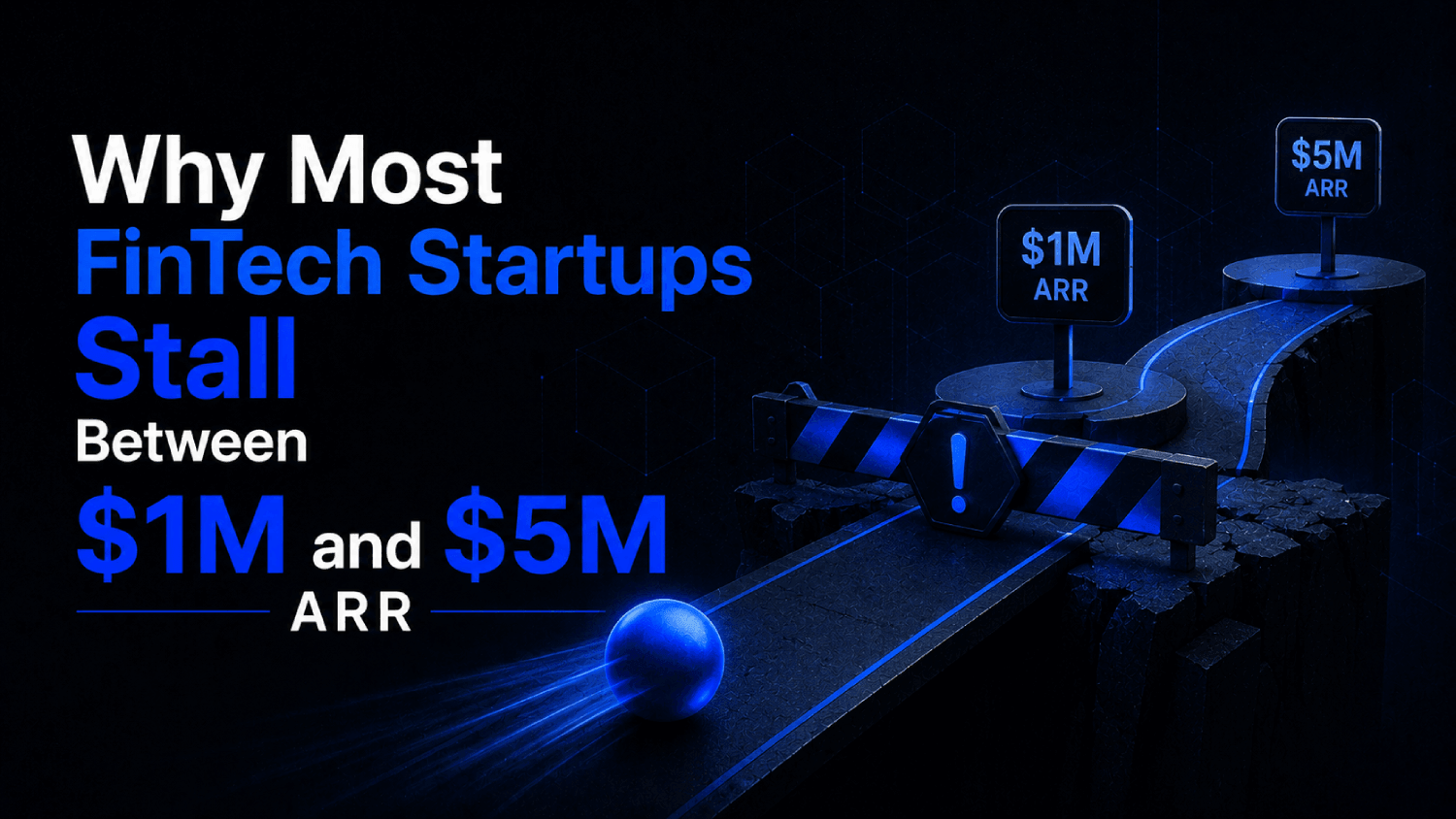

- Most fintech startups that stall between $1M and $5M ARR have real product-market fit. The ceiling comes from founder-dependent sales, manual operations, compliance gaps, and positioning that made sense at $500K but breaks under pressure at $3M.
- The $1M-to-$5M range is where early distribution tricks stop working and repeatable systems have not yet been built. It is a structural problem, not a market size problem.
- Infrastructure fragility surfaces here too. Payment failures, KYC drop-off, and bank partner constraints that were tolerable at low volume become churn drivers at scale.
- Unit economics that looked healthy at $1M often deteriorate significantly by $3M as CAC rises, support costs compound, and gross margins shrink under payment processing and compliance overhead.
- Breaking through requires fixing whichever bottleneck is binding first, not doing everything at once.
Understanding why fintech startups stall between $1M and $5M ARR starts with recognizing that founder-led traction, which drove initial growth, cannot be reproduced at scale without repeatable positioning, systematic acquisition, automated operations, and compliant infrastructure. The bottleneck is rarely market size. It is almost always the gap between how the first million dollars was earned and what the next four million actually require.
What Actually Causes the Fintech Growth Plateau Between $1M and $5M ARR
The conventional diagnosis is wrong. Founders who hit a wall at $2M or $3M typically blame sales execution or the total addressable market. Both explanations feel satisfying and both are usually wrong.
The first million in ARR gets built on signal-rich, high-trust relationships: the founder’s network, early design partners, word-of-mouth in a tight vertical, or one channel that worked before anyone optimized it. These customers closed because of the founder’s credibility, their patience with a rough product, and their tolerance for manual processes. They were not a preview of the broader market. They were an exception to it.
At $2M to $5M, the exceptional customers are gone. The startup is now selling to buyers who do not know the founder, who have more alternatives, and who expect the operational maturity of a company two years ahead in development. That mismatch between what the business delivers and what buyers at this stage expect is the actual growth plateau.
What Are the Six Core Bottlenecks That Stall Fintech Startups at This Stage?
Six distinct failure modes account for nearly every fintech growth stall in this ARR band. They rarely arrive alone.
| Bottleneck | What It Looks Like | Why It Surfaces Here | What It Costs You |
|---|---|---|---|
| Positioning decay | Messaging written for early adopters, not mainstream buyers | ICPs shift as the market expands beyond the founding network | Longer sales cycles, higher CAC, low conversion from outbound |
| Founder-dependent acquisition | Deals close when the founder is in the room, stall when they are not | No playbook has been documented; AEs cannot replicate founder insight | Revenue ceiling tied to founder’s calendar; sales team underperforms |
| Non-repeatable GTM motion | Multiple channels each producing a few deals but no channel producing consistently | Early growth used shotgun tactics; no single motion has been stress-tested | Marketing spend without predictable pipeline output |
| Unit economics deterioration | Gross margins declining as ARR grows; CAC rising faster than LTV | Payment processing costs, compliance overhead, and support costs compound at scale | Burn increases; investors question the business model |
| Compliance and regulatory friction | Deals stalling in legal/security review; enterprise prospects requiring certifications not yet achieved | Compliance was deferred at seed stage; buyers at this ARR band have procurement teams | Lost enterprise deals; regulatory risk accumulates |
| Infrastructure fragility | Payment failures, onboarding drop-off, downtime incidents that were tolerable at low volume | Early infrastructure choices optimized for speed, not resilience or scale | Elevated churn; support burden; trust erosion |
Why Does Positioning Break Down After $1M ARR in Fintech?
Early-stage positioning often works because it is narrow by accident. The founding team knows one vertical deeply, or the first customers were in one geography, or the use case was specific enough that the product almost sold itself. That specificity is a feature at $500K. It becomes a liability when the sales team tries to expand the ICP without updating the message.
The symptom is a growing gap between what the homepage says and what the sales team actually pitches. The homepage still targets the founding persona. The sales team is chasing a different buyer, with a slightly different problem, and closing at a lower rate than the original cohort because the message does not match the new buyer’s language.
The fix is not a rebrand. It is diagnosing which ICP actually closed in the last 12 months, which ones churned, and what language the high-retention customers used to describe the problem before they bought. Most fintech founders skip this because it feels like a marketing exercise. It is actually a revenue exercise. For a deeper look at where GTM messaging breaks down at this stage, the 11 GTM mistakes that slow down fintech SaaS growth piece covers the specific patterns that show up most often.
How Does Founder-Led Sales Create a Revenue Ceiling in Fintech?
Founder-led sales is not a strategy. It is a phase. The problem is that most fintech founders do not recognize when the phase has ended.
The tell is a sales team that consistently underperforms what the founder achieves in the same number of meetings. This is not an indicator of bad salespeople. It is an indicator that the knowledge required to close deals lives only in the founder’s head, and has never been extracted, documented, or transferred. When a founder says “I need better salespeople,” the real diagnosis is usually “I have never written down why customers actually buy from us.”
The transition to repeatable sales requires three things: a written ideal customer profile with disqualifying criteria, a discovery framework that surfaces the specific pain the product solves, and a library of objections with responses that actually reflect how the founder handles them. None of this is complicated. All of it is consistently skipped at the $1M-to-$3M stage because the founder is still closing enough deals to avoid confronting the structural problem. For a detailed look at what distinguishes founder-led growth from an enterprise sales motion, and when to shift, the founder-led growth vs. enterprise sales in fintech SaaS analysis walks through the decision points.
What Happens to Unit Economics Between $1M and $5M ARR in Fintech?
Gross margins in fintech SaaS are structurally lower than pure SaaS from the start. Payment processing fees, bank partner costs, KYC and AML overhead, and fraud tooling all sit in cost of goods sold in a way that engineering infrastructure costs in traditional SaaS do not. At $1M ARR, these costs are manageable. By $3M to $5M, they can hollow out the business.
The specific problem is that these costs do not scale linearly. Payment volume grows, which triggers higher processing fees in absolute terms. Compliance costs grow as the company expands to new states or product lines. Fraud losses, which were small at low volume, become material. Support tickets compound because fintech products touch money, and users with money problems are not patient.
Founders who modeled the business at $1M ARR with a 70% gross margin often find themselves at 55% or lower by $4M ARR, and cannot identify exactly where the margin went. The answer is usually spread across five line items, each of which seemed acceptable individually. The hidden costs killing fintech SaaS margins piece breaks down each category with specifics that most financial models miss at seed stage.
The CAC Problem Compounds the Margin Problem
Early customers arrived cheaply because they were warm leads, referrals, or direct outbound to the founder’s network. The CAC on those deals was artificially low. When the company tries to acquire customers outside the founding network, CAC rises, sometimes dramatically, because the product has not been proven in cold acquisition contexts.
By the time the company is at $3M ARR, it is often spending significantly more to acquire each new customer than it did for the cohorts that built the first million. If LTV is not growing proportionally, which it often is not because churn is higher in the new customer cohorts, the payback period extends and the path to $5M becomes harder, not easier, with each passing quarter.
How Does Compliance Friction Stall Fintech Startups at This ARR Range?
Seed-stage fintech companies routinely defer compliance work. This is rational at the $500K stage where survival is the priority. It becomes irrational at $2M to $3M ARR where enterprise buyers and regulated counterparties start running procurement reviews.
The pattern is consistent: a startup lands a few small customers without much security scrutiny, grows to $2M ARR, and then begins targeting companies that are large enough to have legal and compliance teams. Those buyers ask for SOC 2 Type II, specific data residency guarantees, BSA/AML program documentation, or evidence of proper licensing. The startup either stalls in vendor review for months or loses the deal outright.
This is not just about enterprise sales. Consumer-facing fintech products face their own version of this at the banking partner level. Bank partners providing the underlying infrastructure for payments, accounts, or lending have their own compliance requirements, and fintech startups that have grown quickly often find their bank partner relationships under stress precisely when they need them most. The fintech product and compliance readiness checklist covers what a company at this stage should have in place before pursuing larger contracts or new regulated activities.
Licensing Gaps Create Hard Ceilings
Some fintech products hit a literal geographic or product ceiling because they lack the licenses to operate in certain states or to offer certain product types. A startup that built a payments product for one state can grow within that state, but the moment it tries to expand, it discovers that licensing in additional states requires either money, time, or both. The growth plateau in this case is not a sales problem. It is a regulatory constraint, and the only fix is budget and lead time.
Why Does Infrastructure Fragility Become Visible at Scale?
Infrastructure decisions made at seed stage are almost always made under time pressure. The founding team chooses whichever payment processor, KYC provider, or banking API gets them to market fastest. This is the right call at $200K ARR. The costs surface at $2M to $3M ARR when volume exposes the limits of the early stack.
Payment failure rates that were 1% at low volume become a material churn driver at high volume. KYC drop-off during onboarding, which was a nuisance at 50 signups a week, translates into thousands of lost customers at 500 signups a week. Downtime that was forgiven by early adopters is unforgivable to a CFO who selected your product after a proper evaluation.
The compounding effect is that every infrastructure failure generates a support ticket, which generates a cost, which erodes the gross margin that was already thin. The 10 critical mistakes when choosing fintech infrastructure article documents the specific technical decisions that tend to create the most downstream pain at scale. For founders still building or rebuilding their payment layer, the best payment infrastructure tools for SaaS founders comparison covers the options that hold up under production-level volume.
Fraud Losses Scale Faster Than Revenue
At $1M ARR, fraud losses are often small enough to absorb without a formal program. At $4M ARR, that same fraud rate on a higher transaction volume produces losses that appear on the income statement and generate chargebacks that threaten processor relationships. The startup that never built a proper fraud detection layer because it was expensive and complicated at seed stage now faces a more expensive and more complicated retrofit under active attack.
What Is the Most Common Sequence in Which These Bottlenecks Surface?
The bottlenecks do not arrive in random order. There is a typical sequence, which makes diagnosis faster if you know what to look for.
- Positioning decay surfaces first, usually around $1.5M to $2M ARR. Conversion rates from outbound drop. Marketing spend increases without proportional pipeline growth. The team attributes it to bad leads or weak salespeople.
- Founder-dependent acquisition becomes visible around $2M ARR when the company hires its first or second AE who consistently underperforms relative to founder-led deals. Sales cycles lengthen.
- Unit economics deterioration shows up in the $2M to $3M range on a quarterly business review. Gross margins are tracking lower than the model assumed. Nobody is quite sure why.
- Compliance friction surfaces hard when the first significant enterprise prospect goes through a security review. It can appear earlier if the company is expanding product lines into regulated territory.
- Infrastructure fragility is often invisible until a specific incident: a payment failure at high volume, an onboarding drop-off spike, or a banking partner relationship under stress.
- Churn acceleration is the downstream result of most of the above. It shows up last in the data but it is the hardest to recover from because it requires fixing upstream causes, not just improving customer success.
How Do Fintech Startups Actually Break Through the $5M ARR Ceiling?
There is no universal sequence, but there is a reliable principle: fix the binding constraint first. The most common mistake is running GTM optimization in parallel with infrastructure work in parallel with compliance remediation, spreading resources thin and making incremental progress on all fronts while making breakthrough progress on none.
The diagnostic question is: what would have to be true for revenue to grow 30% next quarter? If the answer is “more qualified leads,” positioning and GTM are the binding constraint. If the answer is “faster deal cycles with enterprise buyers,” compliance and credentialing are the binding constraint. If the answer is “lower churn from the current base,” infrastructure and product are the binding constraint.
Companies that break through the $5M ceiling almost always have one thing in common: they picked the specific bottleneck that was costing them the most revenue and fixed it with concentrated effort. The fintech SaaS scale checklist for reaching $10M ARR provides a structured framework for sequencing these priorities, including which investments tend to compound versus which ones are one-time fixes.
Pricing Model Misalignment Is an Underrated Blocker
One bottleneck that does not get enough attention at this stage is pricing architecture. Many fintech startups price the product at seed stage using a flat subscription model that made sense when the product had limited functionality. By $2M ARR, the product has expanded significantly, but the pricing model has not changed. Customers who are getting significant value pay the same as customers who barely use it. Expansion revenue is zero. Net revenue retention (NRR) sits at or below 100%.
The fix is usually moving toward usage-based or seat-expansion pricing that reflects actual value delivered. This is not a trivial change operationally, but it is one of the highest-impact moves available to a fintech startup in this ARR band. A business with 110% NRR grows meaningfully faster than an identical business at 95%, compounding each year. The best pricing models in fintech SaaS covers how different structures affect expansion dynamics at this stage.
Frequently Asked Questions
1. How many startups actually reach $1M ARR?
The share of funded startups that reach $1M ARR is a minority. Most SaaS and fintech startups raise seed capital without reaching meaningful commercial traction. Exact figures vary by cohort and vintage year, and no single authoritative study tracks this across all geographies and verticals. What is consistent across founder communities and investor data is that $1M ARR is a genuine signal of early product-market fit, not a given outcome from raising a seed round.
2. What is the success rate of fintech startups specifically?
Fintech startups fail at rates consistent with or higher than general software startups because they carry additional regulatory and operational risk. The specific failure points include bank partner loss, licensing failure, fraud-driven losses, and enterprise deal stalls from compliance gaps. None of these risks exist at the same magnitude in non-fintech SaaS, which means the population of fintech companies that reach $5M ARR and beyond is smaller proportionally than the SaaS baseline.
3. Why does fintech growth slow specifically after $1M ARR rather than before or after?
The $1M mark is where founder-network distribution is typically exhausted. The first million comes from people who trust the founder or were found through the founding team’s direct reach. Those channels saturate. The next four million require systematic, cold-market acquisition, which demands different skills, different messaging, and different infrastructure. The transition is not gradual. It is a cliff that most fintech founders only recognize after they have been stuck for two or three quarters.
4. Are fintech scaling challenges different from general SaaS scaling challenges?
Yes, in two material ways. First, fintech products have cost structures that include payment processing, compliance, and financial infrastructure costs that pure SaaS does not. This creates margin pressure that compounds as volume grows. Second, fintech products operate in regulated environments where missing a compliance requirement does not just slow growth, it can halt the business. A general SaaS company can defer compliance work longer without existential risk. A fintech company cannot.
5. What metrics indicate a fintech startup is approaching a growth stall?
Four early indicators stand out. Outbound conversion rates declining quarter over quarter while inbound holds steady suggests positioning decay. Sales cycle length increasing while close rate drops suggests the product is moving upmarket without the credentialing to match. Gross margin compressing more than two to three percentage points per quarter suggests cost structure deterioration. NRR dropping below 100% suggests churn is outpacing expansion, which compounds negatively at every ARR level.
6. How does compliance debt hurt fintech growth at this stage?
Compliance debt accumulates silently during rapid early growth, then surfaces as a hard ceiling when the company tries to sell into enterprise accounts, expand to new states, add licensed product categories, or deepen banking partner relationships. Each of those growth vectors requires a compliance posture the company does not have. The cost of remediation is higher at $3M ARR than it would have been at $500K, both in dollar terms and in opportunity cost from deals lost during the remediation period.
7. Should fintech startups try to fix all six bottlenecks at once?
No. Trying to fix positioning, sales process, unit economics, compliance, infrastructure, and pricing simultaneously at the $2M to $4M ARR stage typically results in slow progress on all fronts and a cash burn rate that exceeds what the business can sustain. The more effective approach is identifying which single bottleneck is most directly responsible for revenue not closing or customers not staying, fixing that constraint to the point where it is no longer binding, and then addressing the next constraint in sequence.
8. What does the growth trajectory of fintech startups look like past $5M ARR?
Companies that break through $5M ARR with solid unit economics, repeatable acquisition, and compliant infrastructure tend to accelerate past that point rather than stall again. The reason is that many of the foundational investments made to break the $5M ceiling, a documented sales playbook, a compliance program, scalable infrastructure, a pricing model with expansion mechanics, produce compounding returns as the business grows. The next significant stall point tends to appear around $10M to $15M ARR when the team itself becomes the constraint. For what to expect at that stage, the growth bottlenecks after $10M ARR in fintech SaaS piece covers the next phase of structural challenges.
The Common Thread Across Every Stall
Every fintech startup that stalls between $1M and $5M ARR built something real. The product works. Customers pay. The founding team is capable. None of those things are in question. The stall happens because the methods that produced the first million cannot produce the next four, and the team has not yet built the systems that can.
The trap is diagnosing the symptom instead of the cause. Slow revenue growth gets blamed on the market, on the sales team, on timing. Those are rarely the actual causes. The actual cause is almost always one or two structural gaps that have never been named, let alone fixed. A founder who can identify which of the six bottlenecks is most binding in their specific business has already done the hardest part of the work.
The path from $1M to $5M ARR in fintech is not about working harder within the existing system. It is about recognizing which parts of the existing system were never designed to scale, and replacing them with ones that are.