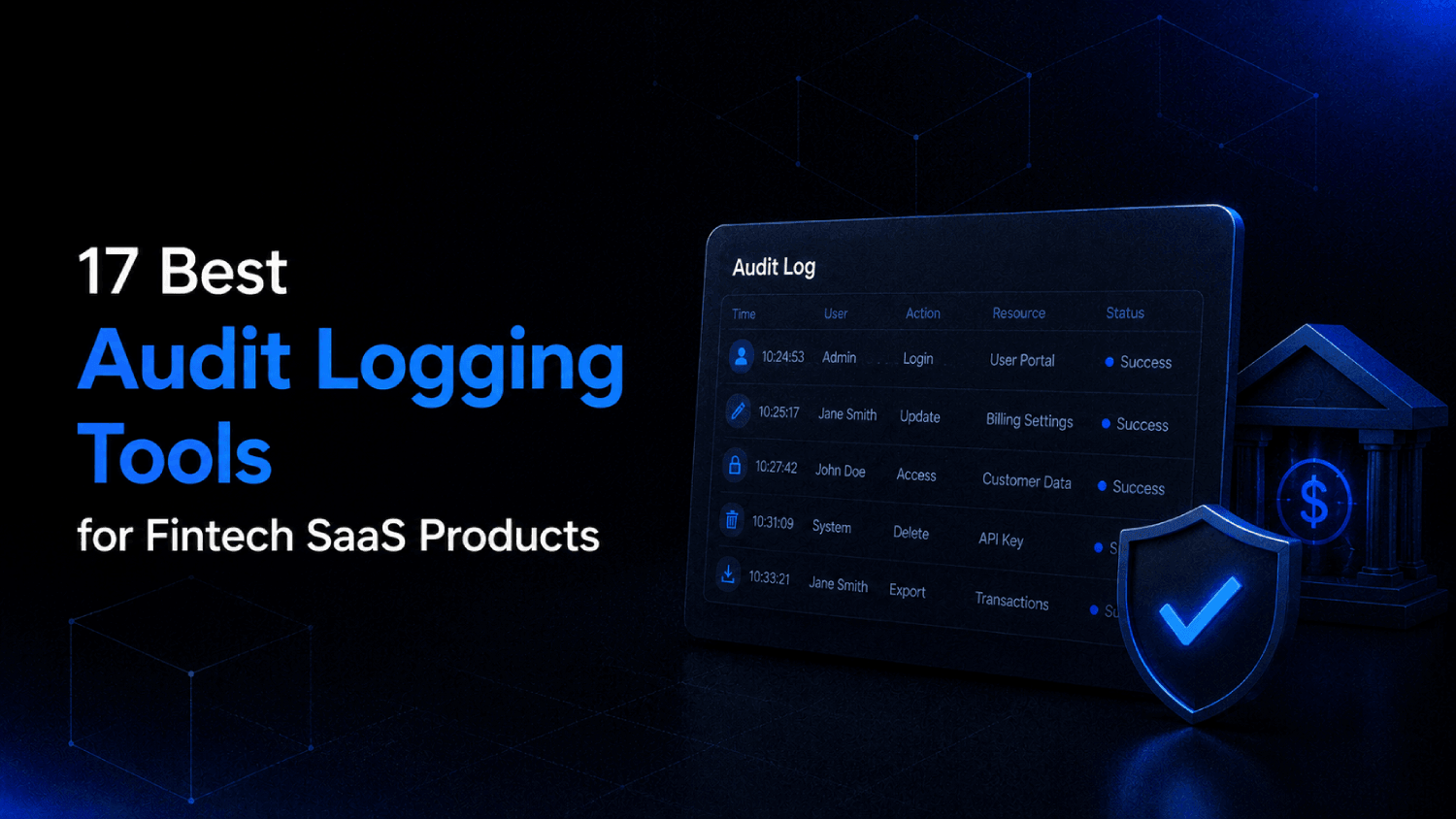

- Audit logs are not an engineering afterthought. Enterprise buyers, SOC 2 auditors, and security reviewers will ask to see them before signing contracts.
- The fintech SaaS tools that win enterprise deals have granular, exportable, tamper-evident audit logs. The ones that lose deals treat logging as a nice-to-have.
- There are purpose-built audit logging tools, SIEM platforms, and observability tools that include audit trails. Each fits a different budget and team size.
- The right choice depends on whether you need logging for internal security, external compliance reporting, or buyer-facing trust signals during sales reviews.
- Several tools on this list are embeddable, meaning you can expose audit logs directly inside your product for your customers, not just your own ops team.
The best audit logging tools for fintech SaaS products include purpose-built solutions like WorkOS, Datadog, and Panther for security teams, plus embeddable audit trail APIs like Warrant and AuditLogs for product teams that need customer-facing log visibility. The right tool depends on whether the primary driver is SOC 2 compliance, enterprise sales readiness, support investigation speed, or internal fraud detection. Most fintech SaaS products need more than one layer. Choosing the right audit logging tools for fintech SaaS is ultimately a revenue decision as much as an engineering one.
Why Audit Logging Is a Revenue Problem, Not Just an Engineering One
Most product teams treat audit logs as internal infrastructure: something engineering sets up so the security team can investigate incidents. That framing costs deals. When a mid-market or enterprise buyer reaches the security review stage, one of the first things their InfoSec team requests is a sample audit log export showing who accessed what data, when, and from which IP. If you cannot produce that in under 30 minutes, the deal slows down or dies.
SOC 2 Type II requires demonstrating continuous monitoring and logging over an audit period, typically six to twelve months. Auditors want to see log retention policies, access control events, and evidence that logs are tamper-evident. Companies that build this infrastructure early spend less time scrambling during their first SOC 2 audit. Companies that bolt it on at the last minute pay for it twice: once in engineering time and once in audit delays.
There is also a support dimension. When a customer calls to dispute a transaction or claims they did not authorize a configuration change, the fastest resolution is pulling a timestamped log that shows exactly what happened and who initiated it. Without that, support tickets escalate, churn risk rises, and the customer’s trust in your product erodes. If you are building in fintech, where trust is the actual product, losing that investigation capability is not a minor inconvenience.
What Should a Fintech Audit Log Actually Capture?
A minimal viable audit log records four things: the actor (who), the action (what), the target (which resource), and the timestamp (when). A production-grade fintech audit log adds the source IP, the session ID, the result (success or failure), and enough context to reconstruct the event without needing to query a separate database. That context is what separates a log that satisfies a checkbox from one that actually answers investigator questions.
For fintech specifically, the high-value event types to capture include: user authentication and session activity, permission and role changes, financial transaction initiations and approvals, configuration changes to payment routing or risk rules, data exports, and API key creation or revocation. Many tools claim to cover all of these. Fewer do it in a way that is queryable, exportable, and immutable by default.
The FintechSpecs Audit Log Readiness Stack: Three Layers Every Product Needs
A useful way to think about audit logging infrastructure in fintech SaaS is as three distinct layers, each serving a different audience. Drawing on the criteria that appear repeatedly in SOC 2 audits, enterprise security reviews, and fintech compliance readiness assessments, we organize these requirements into what we call the FintechSpecs Audit Log Readiness Stack: a layered framework that maps logging tools to the specific audience each layer must satisfy, customers and enterprise buyers, auditors and internal security teams, and regulators requiring long-term evidence.
Layer 1: Application-level event logging captures user actions inside your product. This is what your customers, support team, and enterprise buyers want to see. It needs to be queryable, filterable by user or resource, and exportable as CSV or JSON. This layer is often the most neglected because it requires intentional instrumentation, not just passive log collection.
Layer 2: Infrastructure and access logging captures system-level events: SSH access, cloud console logins, database queries, and admin panel activity. This is what SOC 2 auditors and internal security teams care about. Tools like Datadog, AWS CloudTrail, and Panther operate here.
Layer 3: Compliance log storage and delivery handles long-term retention, tamper-evident storage, and structured export for regulatory review. Some tools span all three layers. Most specialize in one or two. Knowing which layer you are missing is more useful than picking a tool before you know the gap.
17 Best Audit Logging Tools for Fintech SaaS Products
This list covers tools across all three layers of the Readiness Stack. Each entry names what the tool does well, who it is best for, and where it falls short. Pricing is noted where publicly available.
1. WorkOS Audit Logs
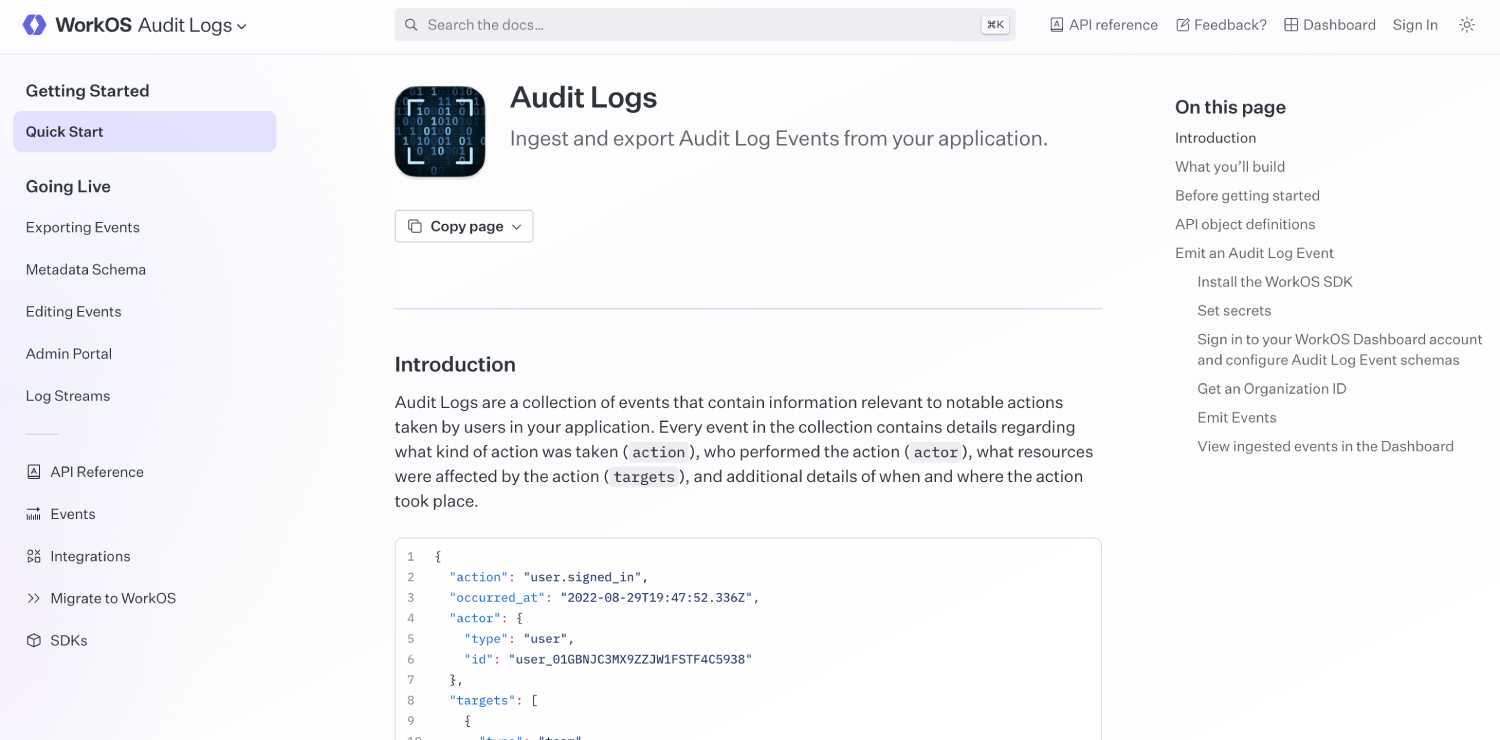
WorkOS Audit Logs is purpose-built for SaaS companies that need enterprise-grade, customer-facing audit trails without building the infrastructure themselves. It provides a structured API for ingesting events, a hosted log viewer that can be white-labeled inside your product, and CSV exports that enterprise buyers can pull themselves. WorkOS handles tamper-evident storage and retention policy enforcement. For a fintech team preparing for SOC 2 or closing enterprise accounts, this is one of the fastest paths from zero to a demo-ready audit log feature. Pricing is not publicly disclosed for the audit log module; WorkOS asks teams to contact sales.
2. Datadog Audit Trail
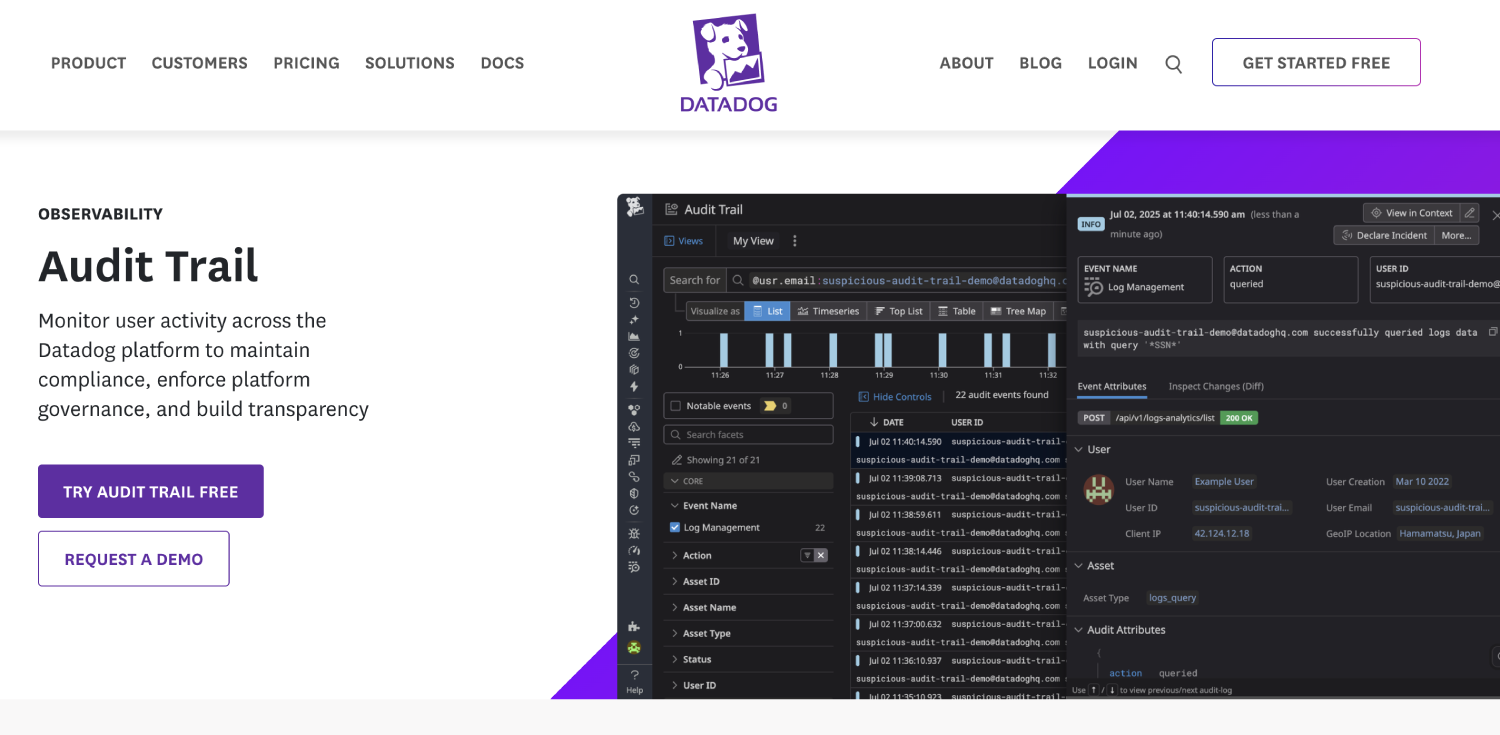
Datadog’s Audit Trail product captures activity across the Datadog platform itself (who accessed dashboards, modified monitors, changed API keys) and integrates with broader log management for infrastructure events. For fintech teams already using Datadog for observability, enabling Audit Trail is low friction. It is not a replacement for application-level event logging, but it covers Layer 2 and Layer 3 comprehensively. Datadog’s public pricing varies by volume and plan; Audit Trail is included in certain Security and Compliance bundles.
3. AWS CloudTrail
AWS CloudTrail logs every API call made to your AWS account, including who made it, from which IP, and what the result was. For fintech products running on AWS, CloudTrail is non-negotiable infrastructure. It covers IAM changes, S3 access, Lambda invocations, and RDS events. CloudTrail logs are automatically delivered to S3 and can be forwarded to CloudWatch or a SIEM. The first management event trail is free per AWS’s public pricing page; data event logging and CloudTrail Lake query fees apply at additional cost.
4. Panther
Panther is a cloud-native SIEM built for security teams at growth-stage and enterprise companies. It ingests logs from AWS, GCP, Okta, GitHub, and dozens of other sources, then applies detection rules written in Python to surface anomalies and compliance violations in real time. For fintech teams with a dedicated security engineer or small security team, Panther offers more detection flexibility than most managed SIEM products. Pricing is not publicly listed; Panther operates on a volume-based model with sales-assisted onboarding.
5. Sumo Logic
Sumo Logic combines log management, security analytics, and compliance reporting in a single cloud platform. It has pre-built compliance apps for PCI DSS, SOC 2, and HIPAA that map log events to control requirements, which cuts the time compliance teams spend manually correlating evidence. For fintech companies managing multiple regulatory frameworks simultaneously, Sumo Logic’s compliance dashboards reduce audit prep time meaningfully. Pricing is consumption-based and varies by ingest volume; Sumo Logic publishes plan tiers on its pricing page.
6. Elastic (ELK Stack / Elastic Security)
Elastic Security gives fintech engineering teams maximum flexibility over how logs are stored, indexed, and queried. The open-source ELK stack (Elasticsearch, Logstash, Kibana) is self-hostable, which matters for companies with strict data residency requirements. The managed Elastic Cloud offering handles infrastructure. Elastic’s SIEM capabilities include detection rules aligned to the MITRE ATT&CK framework. The trade-off is operational complexity: Elastic requires more engineering investment to tune and maintain than a managed product like Datadog.
7. Splunk
Splunk is the dominant enterprise SIEM and log analytics platform. If you are selling into large financial institutions, there is a reasonable chance their security operations team runs Splunk. Being able to export logs in Splunk-compatible formats or offer a Splunk integration can reduce friction during enterprise security reviews. Splunk’s own pricing is workload-based and not publicly listed in detail; it is generally more expensive than cloud-native alternatives and better suited to companies with dedicated security operations teams.
8. Sentry
Sentry is primarily an error monitoring tool, but its breadcrumb and event capture system functions as an application-level audit trail for debugging purposes. For early-stage fintech products that need visibility into user actions that preceded an error or unexpected state, Sentry’s event timeline is genuinely useful for support investigations. It is not a compliance logging solution, but it fills the application observability gap cheaply while a team builds out more formal audit infrastructure. Sentry’s developer plan is free; team and business plans start at publicly listed rates on their pricing page.
9. Segment

Segment is a customer data platform that, when instrumented correctly, functions as an application-level event log for user actions. Every track() call represents a user event with properties, timestamps, and identity resolution. For product teams that already use Segment for analytics, the event stream doubles as an audit trail for product-level activity. The limitation is that Segment is not designed for immutable, compliance-grade log storage, so events should be forwarded to a dedicated data warehouse or SIEM for retention and tamper protection. Pricing is volume-based.
10. Okta System Log
Okta’s System Log API provides a detailed record of authentication events, MFA challenges, session activity, user provisioning changes, and admin actions within your Okta tenant. For fintech companies using Okta for identity, this log is a primary source of truth for access control events. It integrates with most SIEM tools via streaming. Okta retains system log data for 90 days on most plans; longer retention requires forwarding to external storage.
11. Warrant
Warrant is a fine-grained authorization API that includes built-in audit log functionality for permission checks and access control events. For fintech SaaS teams building role-based or attribute-based access control, Warrant logs every authorization decision, meaning you can answer not just “did this user access this resource” but “was that access authorized, and by what policy.” That level of granularity is valuable during security reviews where buyers ask to verify that access controls are enforced at the application layer, not just the UI. Pricing is available on their site.
12. AuditLogs.com
AuditLogs is a dedicated API for adding customer-facing audit logs to SaaS products. It handles ingestion, storage, filtering, and display so that product teams do not have to build a custom log viewer from scratch. For fintech products that need to expose audit trails to enterprise customers as a self-serve feature (common in HR, treasury, and payments software), AuditLogs reduces the build time from weeks to days. Pricing details are available on request.
13. Teleport
Teleport is an infrastructure access platform that logs every SSH session, Kubernetes exec, database query, and web application access with full session recording. For fintech companies where engineers or support staff access production databases, Teleport provides a tamper-evident audit trail of exactly what was executed during each session, not just that a session occurred. This level of detail matters for PCI DSS compliance, where demonstrating that database access is logged and reviewed is a specific control requirement. Teleport Community Edition is open source; Teleport Enterprise pricing is sales-assisted.
14. LogRocket
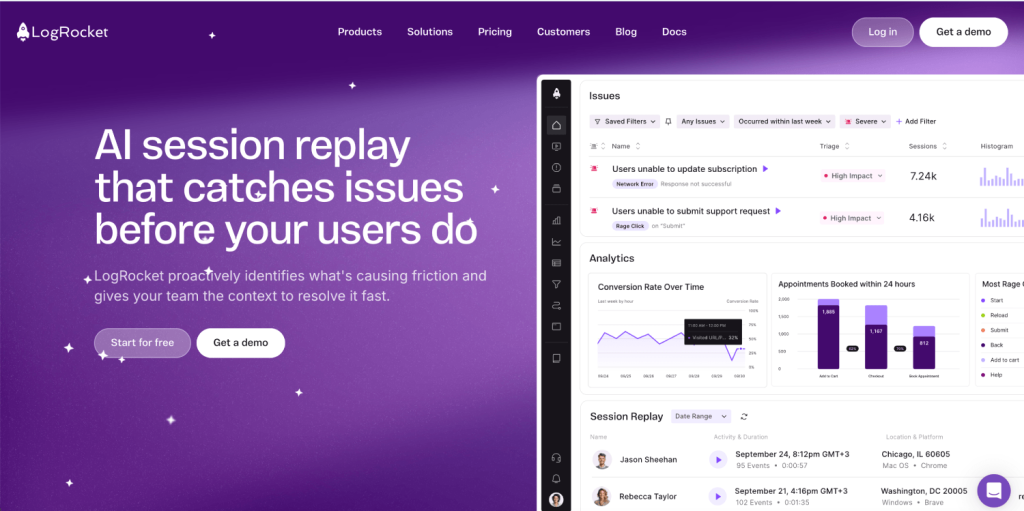
LogRocket records user sessions in your web application, capturing every click, network request, and console error alongside a video replay. For support investigations where a customer claims “the system did X when I did Y,” LogRocket provides a complete playback of the session. It is not a compliance logging tool, but it is the fastest way to resolve a disputed user action in a product without asking the customer to reproduce the issue. Pricing is per session volume and available on their site.
15. Axiom
Axiom is a log analytics platform built for high-volume ingest at low cost compared to Datadog or Splunk. For fintech teams generating large volumes of application and infrastructure logs who find Datadog pricing prohibitive at scale, Axiom provides a queryable, fast alternative with a generous free tier. It does not have the compliance-specific dashboards of Sumo Logic or the detection rules of Panther, but as a raw log storage and query layer for teams building custom compliance reporting, it is cost-effective. Axiom publishes its pricing publicly.
16. Propel Data
Propel is a data API platform that some fintech teams use to build real-time, customer-facing analytics and audit dashboards. By streaming application events into Propel and exposing a query API, product teams can build highly filtered audit log views for enterprise customers without maintaining a custom data pipeline. This is less a dedicated audit logging tool and more an infrastructure layer for teams that want full control over how logs are presented to customers. Pricing is usage-based.
17. Vanta
Vanta is a compliance automation platform that pulls audit evidence from connected integrations (AWS, GitHub, Okta, Heroku, and many others), maps it to SOC 2, ISO 27001, and other framework controls, and produces a continuous compliance dashboard. For fintech founders preparing for their first SOC 2 audit, Vanta does not replace audit logging infrastructure but it dramatically reduces the time spent collecting and organizing evidence from the logging tools you already have. Pricing is not publicly listed and is structured by framework and company size.
How Do These Tools Compare on Key Fintech SaaS Criteria?
| Tool | Best For | Audit Log Layer | Customer-Facing Logs | SOC 2 Relevant | Public Pricing |
|---|---|---|---|---|---|
| WorkOS Audit Logs | Enterprise SaaS readiness | Application (Layer 1) | Yes | Yes | No |
| Datadog Audit Trail | Observability-first teams | Infrastructure (Layer 2) | No | Yes | Partial |
| AWS CloudTrail | AWS infrastructure logging | Infrastructure (Layer 2) | No | Yes | Yes |
| Panther | Security teams with detection needs | SIEM (Layer 2/3) | No | Yes | No |
| Sumo Logic | Multi-framework compliance | SIEM + Compliance (Layer 3) | No | Yes | Partial |
| Elastic / ELK | Engineering-heavy teams, data residency | All layers (self-managed) | Buildable | Yes | Partial |
| Splunk | Enterprise security operations | SIEM (Layer 2/3) | No | Yes | No |
| Sentry | Error-linked user activity debugging | Application (Layer 1) | No | No | Yes |
| Segment | Product analytics + event stream | Application (Layer 1) | No (buildable) | Partial | Yes |
| Okta System Log | Identity and access event logging | Infrastructure (Layer 2) | No | Yes | Partial |
| Warrant | Authorization-layer audit trails | Application (Layer 1) | Yes | Yes | Yes |
| AuditLogs.com | Customer-facing SaaS audit logs | Application (Layer 1) | Yes | Yes | On request |
| Teleport | Infrastructure access with session recording | Infrastructure (Layer 2) | No | Yes | Partial |
| LogRocket | Support investigation via session replay | Application (Layer 1) | No | No | Yes |
| Axiom | High-volume log storage, cost-sensitive teams | Infrastructure/Storage (Layer 3) | No | Partial | Yes |
| Propel Data | Custom customer-facing log dashboards | Application (Layer 1) | Yes (buildable) | No | Yes |
| Vanta | SOC 2 audit evidence aggregation | Compliance (Layer 3) | No | Yes | No |
Which Audit Logging Tool Should You Pick First?
Pre-seed to Series A companies with no SOC 2 and no enterprise customers should start with AWS CloudTrail (or GCP’s equivalent) plus Sentry. That combination covers infrastructure access logging and application-level debugging with minimal cost and setup time. It does not satisfy a full SOC 2 audit, but it gets you past a casual security questionnaire and gives your support team something to work with during incident investigations.
Series B companies pursuing SOC 2 Type II or closing their first enterprise contracts need WorkOS Audit Logs or AuditLogs.com for Layer 1, Datadog or Panther for Layer 2, and Vanta to aggregate evidence across both. That stack supports the three most common buyer-facing audit requests: a filterable log of user actions inside your product, evidence of infrastructure access controls, and a structured SOC 2 report. Building all three in-house is possible but takes engineering quarters that most teams cannot spare. This is one of those areas where the hidden cost of build-vs-buy shows up later than founders expect.
Companies selling into regulated financial institutions should evaluate Splunk compatibility and confirm log exports match formats their buyers already use. That is not about which tool is technically superior; it is about reducing friction in the buyer’s security review process. If an enterprise buyer’s security team already runs Splunk and you can hand them a Splunk-compatible log file, you remove a step from their evaluation. That matters when a deal is 90 days deep and security sign-off is the last gate.
What Do Enterprise Buyers Actually Look for in a Fintech Audit Log Review?
Enterprise security reviews in fintech consistently ask for the same set of deliverables. They want to see that logs are tamper-evident (written once, not editable), that they are retained for at least 12 months, that they are queryable by user and by resource, and that access to the logs themselves is controlled and audited. Many vendors claim to satisfy these requirements but cannot produce a sample export during a live demo.
The most common failure point is retention. Teams set up logging but do not configure retention policies, so logs rotate out after 30 or 90 days. When an auditor asks for evidence of access events from eight months ago, there is nothing to show. Setting log retention to 13 months on initial setup costs nothing and eliminates a recurring audit problem. This also connects to broader compliance readiness: if you are working through a SOC 2 or ISO 27001 process, your fintech compliance checklist should include log retention as a first-day configuration item, not a pre-audit scramble.
The second most common gap is missing events. Teams instrument the happy path (successful login, successful transaction) but skip failed attempts, permission denials, and admin overrides. Auditors specifically look for evidence that failed access attempts are logged, because that is how you demonstrate that unauthorized access is detectable. Logging only successes is the equivalent of a bank that only records completed withdrawals.
How Does Audit Logging Connect to Fraud Detection in Fintech SaaS?
Audit logs and fraud signals are different data streams that reinforce each other. A fraud detection system flags anomalous transactions. An audit log explains what happened before and after the flag: who initiated the transaction, whether any account settings were changed in the preceding 48 hours, and whether the user’s session showed unusual access patterns. Without the audit log, a fraud alert is an alarm with no context. With it, your risk team can triage in minutes rather than hours.
For fintech products that handle payment flows or financial account management, application-level audit logs function as a secondary fraud detection layer. If a user suddenly exports a full customer data set, changes their MFA method, and initiates a large transfer in the same session, each of those events is individually explainable. Together, in sequence, they are a pattern that a well-instrumented audit log surfaces immediately. Teams building serious fraud detection infrastructure should treat audit log data as an input to their detection rules, not a separate archive. For more on building that detection layer, the comparison of fraud detection and risk tools for fintech startups covers the broader stack.
Frequently Asked Questions
What are the four types of audit trails in fintech SaaS?
The four main types are application audit trails (user actions inside the product), infrastructure audit trails (server, cloud, and database access), transaction audit trails (financial event records with amounts, parties, and status), and compliance audit trails (structured evidence mapped to specific regulatory controls). Most fintech products need all four, but they are typically captured by different tools. Application and transaction trails require deliberate instrumentation. Infrastructure trails come from cloud providers and identity tools. Compliance trails are usually assembled from the other three by a platform like Vanta.
Does SOC 2 require audit logs?
SOC 2 Type II requires evidence of continuous monitoring, which includes logging of logical access, system changes, and security events over the audit period. Auditors will request sample log exports and evidence that access to logs is itself controlled. The specific controls covered depend on which Trust Service Criteria your audit includes, but CC6 (Logical and Physical Access Controls) and CC7 (System Operations) both generate logging requirements. A fintech company pursuing SOC 2 without a functioning audit log stack will face findings that delay certification.
Can audit logs be used as evidence in a dispute with a customer?
Tamper-evident audit logs with accurate timestamps are generally admissible as supporting evidence in commercial disputes and can resolve most customer service escalations without escalating to legal proceedings. The key requirements are immutability (the log cannot be edited after the fact), accurate time synchronization (logs must use a consistent time source, typically NTP-synced), and completeness (the log must capture the specific event in question). Many SaaS companies have resolved disputed charges, unauthorized access claims, and account takeover allegations by presenting a complete, timestamped audit trail to the customer.
What is the difference between an audit log and a system log?
A system log captures low-level infrastructure events: server restarts, process crashes, memory errors, and system calls. An audit log captures business-meaningful events: a user changed a permission, a payment was initiated, an admin exported a customer list. System logs are for engineers debugging infrastructure. Audit logs are for security teams, compliance officers, and enterprise buyers verifying accountability. Fintech products need both, but conflating them is a common mistake that results in neither serving its intended audience well.
How long should fintech SaaS companies retain audit logs?
SOC 2 auditors typically review the prior 6 to 12 months of log data. PCI DSS requires one year of audit log retention with three months immediately available for analysis. As a practical baseline, 13 months of retention covers the most common audit periods with a one-month buffer. Companies operating under specific regulatory frameworks (FINRA, SEC, banking regulations) may face longer retention requirements. Most cloud log storage is inexpensive enough that defaulting to 24 months adds minimal cost while eliminating most retention-related audit findings.
Are customer-facing audit logs worth building?
For fintech SaaS products selling to mid-market and enterprise buyers, customer-facing audit logs are a direct sales enabler. Enterprise InfoSec teams routinely ask during security reviews whether customers can pull their own activity logs without filing a support ticket. A self-serve audit log export reduces that friction to zero and signals to buyers that your product was designed with enterprise accountability in mind. Products without this feature often get flagged as not enterprise-ready, which extends sales cycles. Tools like WorkOS Audit Logs and AuditLogs.com exist specifically to reduce the build time for this feature to days rather than quarters.
What events should a fintech SaaS product log at minimum?
At minimum, a fintech SaaS product should log: all authentication events (success, failure, MFA challenges), all permission and role changes, all financial transaction initiations and state changes, all configuration changes to payment, risk, or routing settings, all data export events, and all API key creation and revocation. Each event should include the actor identity, source IP, timestamp, session ID, event type, target resource, and outcome. Logging only the subset of events where something went wrong is insufficient for SOC 2 and provides no value during security investigations or customer disputes.
How do I choose between a purpose-built audit log tool and a SIEM for fintech?
Purpose-built audit log tools like WorkOS or AuditLogs.com are optimized for application-layer events and customer-facing log visibility. They are faster to implement and better suited for product teams building enterprise features. SIEMs like Panther, Sumo Logic, and Splunk are optimized for security event detection, correlation across multiple data sources, and compliance reporting across infrastructure. Most mature fintech products need both: a purpose-built tool for product-level events and a SIEM for infrastructure and security monitoring. Starting with just one is fine early on, but plan for both as you scale toward enterprise and regulated market segments.
Audit Logging Is a Buyer Signal, Not a Backend Detail
The companies that treat audit logging as infrastructure debt tend to discover its importance at the worst possible moment: in the middle of a security review that is blocking a large contract, or during a SOC 2 audit with a deadline, or when a customer escalates an incident and your support team has nothing to show them. Building the logging stack before those moments is not just good engineering practice; it is a commercial decision. A fintech product that can produce a clean, queryable, exportable audit trail in under 30 minutes during a security review looks fundamentally different from one that cannot.