
- A demo and a pricing sheet reveal almost nothing about how a vendor will perform under audit, during an outage, or when you need to migrate away.
- The most expensive vendor mistakes happen at contract signing, not at go-live. Switching costs, compliance ownership, and data portability terms are buried in agreements most teams never fully read.
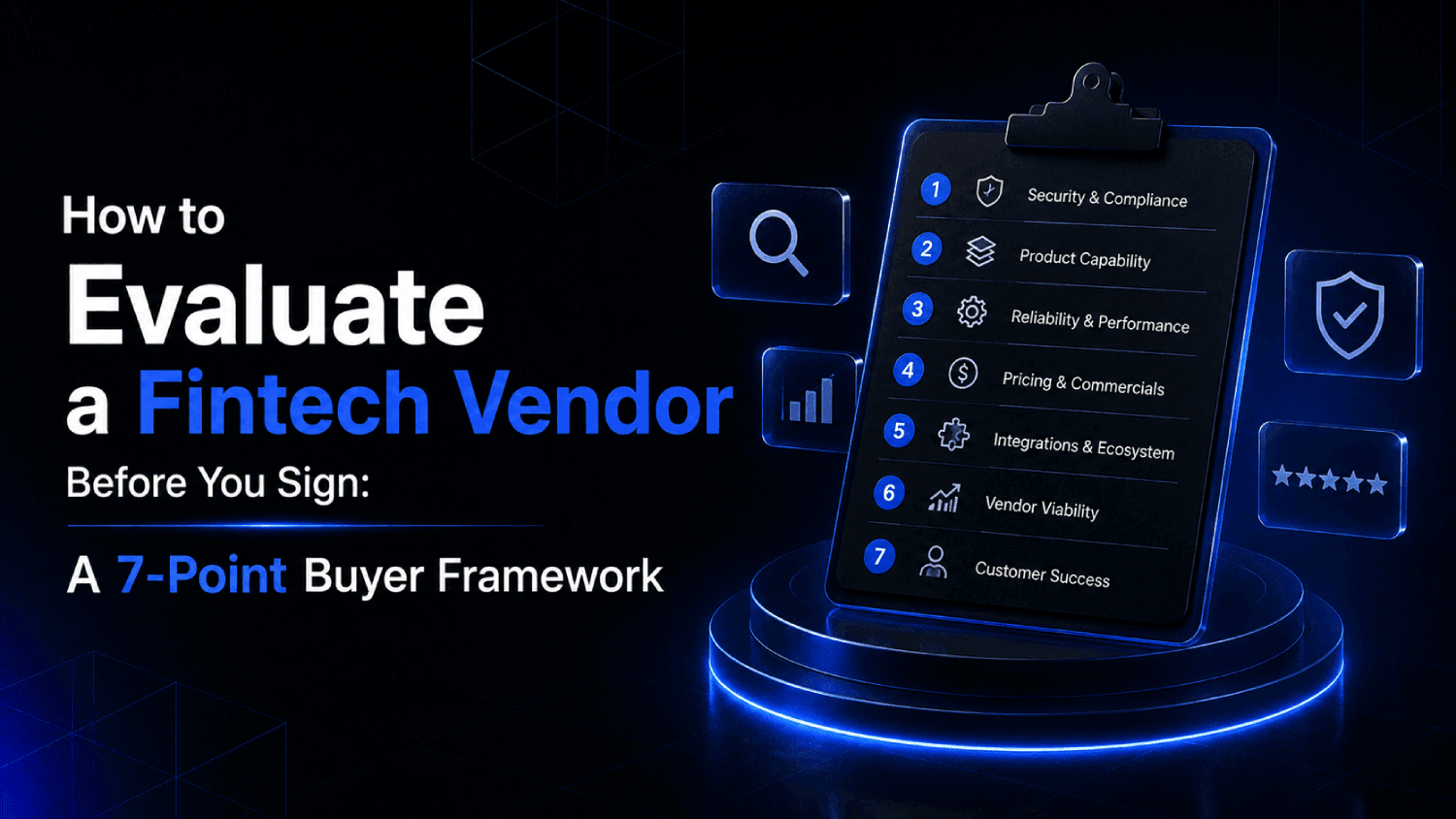
- The FintechSpecs CREST Framework gives you seven scored criteria to compare vendors on the same terms: Compliance Load, Reliability Record, Economics (total), Support Access, and Technology Roadmap, plus two often-skipped checks on Switching Cost and References.
- Red flags are more reliable than green flags. A vendor that refuses to share uptime data, avoids compliance ownership questions, or cannot provide a live customer reference warrants elimination, not negotiation.
- Price is almost always the wrong primary filter. Infrastructure lock-in and regulatory exposure carry costs that dwarf a 10 basis point difference in processing fees.
To evaluate a fintech vendor properly, score each candidate across seven criteria: compliance load and ownership, reliability and uptime evidence, total cost of ownership (not just headline pricing), support access and response commitments, technology roadmap alignment, switching cost and data portability, and verifiable customer references. Eliminate any vendor that cannot produce clear answers on all seven before contract signature.
Why Most Teams Pick the Wrong Fintech Vendor
Most vendor selections follow the same sequence: run a demo, compare pricing tiers, pick the vendor whose sales team was most responsive. That sequence works adequately for a project management tool. It fails badly for fintech infrastructure, where the wrong pick can mean a regulatory enforcement action, an outage during peak transaction volume, or a six-figure migration project you did not budget for.
The SERP around “how to evaluate fintech vendors” is dominated by generic checklists and investment valuation frameworks that confuse evaluating a vendor with valuing a company. Neither is what a buyer at a Series A payments startup or a VP Finance at a scaling SaaS company actually needs. What follows is a structured, repeatable method built specifically for that buyer.
If you are currently comparing fintech infrastructure options and want to know where common selection errors cluster, 10 Critical Mistakes When Choosing Fintech Infrastructure maps the failure modes in detail. This framework is the antidote to those mistakes.
Introducing the FintechSpecs CREST Framework for Fintech Vendor Evaluation
The CREST Framework is a seven-point vendor scoring methodology developed by FintechSpecs for B2B buyers evaluating fintech infrastructure, BaaS platforms, payment processors, fraud tools, KYC providers, and compliance automation. Each letter represents one evaluation pillar. Score vendors 1 to 5 on each pillar, weight the pillars by their importance to your specific situation, and use the aggregate score to compare candidates on identical terms.
The seven pillars are: Compliance Load, Reliability Record, Economics (total), Support Access, Technology Roadmap, Switching Cost, and References (verified). The acronym is CRESSTR, but the framework is called CREST to keep it memorable. The last two criteria (Switching Cost and References) are treated as pass/fail gates before the scored pillars even matter.
What Does Compliance Load Actually Mean in Vendor Evaluation?
Compliance load measures how much regulatory work a vendor shifts onto you versus how much it absorbs itself. This is one of the most consequential and least discussed dimensions of fintech vendor selection. A BaaS platform that hands you a sponsor bank relationship but leaves you to manage BSA/AML program design, SAR filing procedures, and Reg E dispute handling is not comparable to one that operates a managed compliance layer.
Ask each vendor to produce a responsibility matrix. Specifically, ask: who files SARs, who owns the BSA Officer role, who manages chargebacks, who is liable if a transaction is processed in violation of OFAC sanctions. If the vendor struggles to produce a clear written answer, that ambiguity will become your legal exposure at the worst possible time. For a detailed look at what compliance ownership actually costs by company stage, The Real Cost of Compliance in FinTech SaaS, Broken Down by Stage gives a granular breakdown.
Score this pillar low if the vendor expects you to build your own compliance stack on top of their rails. Score it high if they provide documented shared responsibility frameworks, can name which regulator oversees their banking partner, and carry their own SOC 2 Type II, PCI DSS Level 1 certification, and relevant state money transmitter licenses.
How Do You Verify a Vendor’s Reliability Record Before Signing?
Every vendor claims high uptime. The question is whether they can prove it. Ask for a link to their public status page. Ask for incident postmortems from the past 12 months. Ask for their contractual SLA, and then read the exclusions section carefully, because most SLAs define uptime in ways that exclude scheduled maintenance windows, third-party dependency failures, and partial degradations that still affect your users.
Uptime math matters here. A vendor with 99.9% uptime is down for roughly 8.7 hours per year. At 99.99%, that number drops to 52 minutes. For a payments processor handling time-sensitive transactions, an 8-hour annual outage is not theoretical. Ask what happened during their last major incident, how long recovery took, and what they changed afterward. A vendor with a clean incident history who cannot explain why it is clean is not more trustworthy than one with documented incidents and clear postmortems.
If the vendor does not have a public status page, that itself is informative. Most credible infrastructure providers maintain one through tools like Statuspage or Better Stack. Their absence suggests the vendor either has not scaled to the point where customers demand transparency, or they are actively avoiding it.
How Do You Calculate the True Economics of a Fintech Vendor?
Headline pricing is the starting point, not the answer. A payment processor advertising 2.9% plus 30 cents may charge additional fees for international cards, currency conversion, chargebacks, refunds, monthly minimums, PCI compliance, and account updates. A BaaS platform with a low monthly platform fee may charge separately for each API call, each virtual account, each KYC check, and each ACH transaction. Those per-unit costs compound fast at scale.
Build a unit economics model before you sign. Take your current or projected monthly transaction volume, average transaction value, and product mix. Apply the vendor’s full fee schedule to that model, not just the headline rate. Then add implementation cost, engineering time for integration, and the cost of any compliance work the vendor does not absorb. That total is your year-one cost. Year-two cost tends to be higher once volume discounts are exhausted and the vendor has pricing power over a customer who has already integrated.
The hidden costs in fintech vendor agreements are well-documented and genuinely damaging to margins. 15 Hidden Costs Killing Your Fintech SaaS Margins covers the line items that routinely surprise teams post-signature. Cross-reference that list against every vendor agreement before you sign.
A Worked Cost Scenario
Say a company processes $2 million per month in payments. Vendor A charges 2.5% with no monthly fee but charges $25 per chargeback, requires a $1,500 annual PCI compliance fee, and bills $0.10 per international transaction (roughly 20% of volume). Vendor B charges 2.7% with a $500 monthly platform fee, absorbs PCI compliance, and includes chargebacks in the rate. At this volume, Vendor A’s blended cost is higher than Vendor B’s, even though its headline rate is lower. That inversion is common, and most teams do not catch it before signing.
What Level of Support Can You Actually Expect After You Sign?
Support quality is the dimension that degrades fastest post-sales. The account executive who responded to your Slack messages in two hours during the sales process is replaced by a support queue the day after you go live. Get specifics in writing. What is the contractual first-response time for a P1 outage? Is there a dedicated technical account manager, or do you share a queue with every other customer? What are the escalation paths, and how fast does an issue reach an engineer?
For early-stage companies, this matters more than most realize. If you have a two-person engineering team, you cannot afford to spend three days debugging an integration issue because the vendor’s support tier only guarantees a response within 48 business hours. Ask to see a sample support ticket from an existing customer. Ask which plan level includes phone or Slack-based support. The difference between email-only and a shared Slack channel with a technical contact is not trivial.
One underrated test: open a pre-sales technical support ticket before you sign. Submit a genuine integration question as if you were already a customer. The speed and quality of that response is the most reliable signal you will get about post-sales support quality.
How Do You Evaluate a Vendor’s Technology Roadmap Without Trusting Their Marketing?
Vendors will show you a roadmap slide. That slide is aspirational at best, marketing at worst. A more useful approach is to ask how long core features have been in general availability. Features that have been in beta for 18 months are not features you can depend on. Ask what changed in the product in the last six months and whether those changes were delivered on time. Ask what percentage of roadmap items from the prior year were actually shipped.
Alignment matters as much as ambition. A vendor building toward enterprise ACH and wire capabilities is not well-matched with a consumer lending startup that needs real-time card issuance and installment payment logic. Build a list of the five product capabilities you expect to need in the next 18 months, then verify whether each is on the vendor’s roadmap, in GA, or not planned. A vendor who is two years away from a feature you need in six months is effectively the wrong vendor regardless of how good their current feature set is.
Publicly available developer changelogs are more reliable than sales-deck roadmaps. Stripe’s, Plaid’s, and Adyen’s changelogs are all public. For vendors without public changelogs, ask for the last three quarterly release notes. A vendor that cannot produce them has not been shipping consistently enough to document it.
What Are the Real Switching Costs If You Need to Leave?
This pillar functions as a gate rather than a scored criterion. Before you score any vendor on the other five dimensions, you need to understand what leaving costs. Infrastructure lock-in in fintech is asymmetric: easy to enter, expensive to exit. The switching cost question has three components.
First, data portability. Can you export your full transaction history, customer records, and ledger data in a standard format on demand? Some vendors charge for data exports or provide them only in proprietary formats that require additional engineering work to migrate. Ask for the specific export format, the timeline for a full data export, and whether there is a fee.
Second, contractual exit terms. What is the notice period? Are there early termination fees? Many multi-year vendor contracts include termination fees equal to the remaining contract value, which can be substantial. A two-year contract at $5,000 per month has $120,000 in potential termination exposure if you need to exit in month one.
Third, technical migration complexity. If the vendor uses proprietary APIs with no standard equivalents, migration requires rebuilding integrations from scratch. Compare this against vendors who build on ISO 20022, OpenBanking standards, or who have documented migration guides for customers moving away. The latter at least signals they have thought about portability.
How Should You Use References to Validate a Fintech Vendor?
References are the second pass/fail gate. If a vendor cannot provide at least two live customer references who are willing to speak with you, that is a reason to stop the evaluation, not to continue it with skepticism. Vendors with strong customer relationships produce references without friction. Vendors who stall, offer written testimonials instead of live calls, or connect you only with marquee logos that turn out to be on legacy contracts are revealing something.
When you do get on a call with a reference, ask narrow questions rather than open-ended ones. “Would you recommend this vendor?” produces a useless positive answer almost every time. “What was the last support issue you had, and how long did it take to resolve?” and “What feature were you promised that did not arrive on schedule?” produce useful information. Ask whether they have tried to export their data, and what that process looked like.
Seek references in your segment specifically. A reference from a large bank using a vendor’s enterprise tier tells you almost nothing about how that vendor serves a Series A startup on a self-serve plan. Ask for references who are at roughly your stage, processing roughly your volume, and building in your product category.
How to Apply the CREST Framework: A Scoring Template
Use this table to score each vendor across the seven pillars. Score 1 to 5 on the five scored dimensions. Mark Switching Cost and References as Pass or Fail before scoring the rest. A vendor that fails either gate is eliminated before the scored comparison begins.
| Pillar | What You Are Scoring | Weight (Suggested) | Vendor A | Vendor B | Vendor C |
|---|---|---|---|---|---|
| Switching Cost | Data portability, exit terms, migration complexity | Pass / Fail Gate | |||
| References (Verified) | Live references in your segment, honest answers | Pass / Fail Gate | |||
| Compliance Load | Who owns what; certs; documented responsibility matrix | 25% | /5 | /5 | /5 |
| Reliability Record | Public status page; uptime SLA; incident postmortems | 20% | /5 | /5 | /5 |
| Economics (Total) | Fully-loaded unit cost model; no surprises in fee schedule | 20% | /5 | /5 | /5 |
| Support Access | Contractual SLAs; escalation paths; pre-sales test | 20% | /5 | /5 | /5 |
| Technology Roadmap | GA features; changelog; delivery track record | 15% | /5 | /5 | /5 |
| Weighted Total | 100% |
Adjust weights to your situation. A regulated fintech building a lending product should weight Compliance Load higher, perhaps 35%, and reduce Technology Roadmap weight accordingly. A developer-first SaaS team embedding payments for the first time may weight Technology Roadmap and Support Access higher than Economics if they lack internal fintech expertise. The weights are not universal, but the pillars are.
What Are the Most Reliable Fintech Vendor Red Flags?
Red flags are more diagnostic than green flags in fintech vendor selection, because bad vendors have learned to simulate good signals. A polished demo, a strong reference deck, and a well-designed pricing page are table stakes now. The red flags are harder to manufacture.
- The vendor cannot provide a SOC 2 Type II report or actively discourages you from requesting it.
- The contract contains auto-renewal clauses with short notice windows (30 days or less) and meaningful price escalation rights.
- Pricing requires a custom quote for any volume above the lowest public tier, making comparison impossible before you are already invested in the conversation.
- The vendor’s public status page shows no historical incidents. No infrastructure operates without incidents. An empty incident history is usually a monitoring or disclosure failure, not a reliability achievement.
- The legal agreement places indemnification for regulatory violations entirely on you, even for processing errors that originate in their system.
- The sales team cannot answer technical questions without looping in a solutions engineer for every interaction, and those SE responses take more than two business days.
- The vendor references are all from one industry vertical, one company size, or one geography that does not match yours.
Many of these patterns appear repeatedly in the due diligence failures that lead to costly migrations. The Fintech Product and Compliance Readiness Checklist covers the internal readiness checks that should precede any vendor evaluation, so you know what you actually need before you enter the selection process.
How Does the CREST Framework Apply to RFP Processes?
If your organization runs a formal RFP process for fintech vendor selection, the CREST Framework maps directly onto RFP structure. Each pillar becomes an RFP section with specific required deliverables.
Compliance Load Section
Require vendors to submit a signed responsibility matrix, copies of their current SOC 2 Type II and PCI DSS certifications, and a list of the state money transmitter licenses they hold (if applicable). Do not accept “available upon request” as an answer during an RFP. If they will not commit it to paper during evaluation, they will not commit to it during operations.
Reliability Record Section
Ask for their public status page URL, their contractual uptime SLA with full exclusion language, and incident postmortems from the past 12 months. Evaluate both the number of incidents and the quality of the postmortems. A vendor who writes thorough postmortems is operating with engineering maturity. A vendor who writes “service restored” and closes the ticket is not.
Economics Section
Provide vendors with identical volume assumptions and ask them to build a full cost model against those inputs. This makes comparison possible. If vendors are allowed to self-define the pricing scenario, they will choose the scenario that makes them look best, which tells you nothing useful about comparative economics.
Support Access Section
Ask vendors to specify their support tiers in writing, including first-response time by severity level, whether dedicated technical contacts are available at your expected spend level, and escalation paths for production outages. Ask them to reference specific customers at your tier who can speak to support experience.
Technology Roadmap Section
Ask for a changelog or release history from the prior 12 months, a list of currently GA features relevant to your use case, and any features currently in beta with their expected GA date. Do not score beta features as available. A feature in beta is not a feature you can build on.
For teams evaluating payment infrastructure specifically, the 10 Best Payment Infrastructure Tools for SaaS Founders applies CREST-compatible criteria to the category, which makes it a useful companion during the RFP scoring phase.
Frequently Asked Questions About Fintech Vendor Evaluation
How long should a fintech vendor evaluation process take?
For a core infrastructure vendor (BaaS, payments processor, KYC platform), plan for six to ten weeks minimum if you are running a structured evaluation. Rushing below four weeks usually means skipping the compliance and legal review, which is where the most expensive surprises hide. For secondary tools with lower switching costs (analytics, dunning, tax compliance), two to three weeks is workable if you have already standardized your evaluation criteria.
Should pricing be the first or last criterion in vendor selection?
Pricing should be evaluated last among the five scored CREST pillars. The reason is sequencing: a vendor that fails on compliance load or reliability is not worth pricing out in detail. Evaluate the qualitative and compliance dimensions first, then narrow the field, then build the full cost model for the remaining finalists. Teams that start with pricing tend to anchor on a number and rationalize other weaknesses away from there.
What certifications should a fintech vendor hold before I consider them?
For payments infrastructure, PCI DSS Level 1 is the floor. For any vendor handling personally identifiable information or financial data, SOC 2 Type II is expected. FDIC-insured deposit products require the vendor to have a banking partner whose deposits are covered; ask for the name of the partner bank and verify the FDIC status directly. State-level money transmitter licenses vary by product type and geography. For vendor risk management tools specifically, 11 Best Vendor Risk Management Tools for Fintech Startups covers tools that can help track and verify these certifications over time.
What questions should I ask a BaaS or payments vendor before signing?
Ask: Who is your sponsor bank, and can I verify that relationship directly? What is your actual uptime over the last 12 months, not your contractual SLA? Who holds BSA officer responsibility for my program? What does data export look like, and what does it cost? What is your notice period for pricing changes? How are chargebacks handled, and who is liable for losses from processing errors? These seven questions surface more about a vendor’s real operating model than any demo will.
How do I compare fintech vendors fairly when they price very differently?
Standardize the inputs. Give every vendor the same monthly transaction volume, average transaction value, product mix, and expected monthly support ticket volume. Then ask each to produce a full-year cost projection against those inputs. This eliminates the cherry-picking problem where Vendor A models light usage and Vendor B models high usage. If a vendor refuses to quote against standardized inputs, treat that as a red flag about pricing transparency.
What is the single most overlooked factor in fintech vendor due diligence?
Data portability. Most teams evaluate what it is like to go live with a vendor but never evaluate what it would cost to leave. By the time you need to migrate, you are negotiating from a position of dependency. Review data export terms, formats, and fees before you sign, not when you have already decided to switch. Contract language that gives the vendor control over your data access during a dispute is common and almost universally bad for the buyer.
Do fintech vendor red flags change based on company stage?
Yes. A pre-seed company running a pilot can tolerate a vendor whose enterprise features are incomplete, because those features are probably not needed yet. A Series B company processing significant transaction volume cannot tolerate a vendor without a public uptime record or a dedicated technical contact. The CREST Framework’s weight adjustments are the mechanism for reflecting this: early-stage teams should weight Technology Roadmap and Economics higher, while later-stage companies should weight Compliance Load and Reliability Record higher.
How often should I re-evaluate existing fintech vendors?
Annual reviews are a reasonable baseline for core infrastructure vendors. A vendor’s compliance posture, uptime record, support quality, and competitive pricing can shift significantly over 12 months. Review triggers should include pricing changes, leadership changes, a vendor acquisition, or a public incident that was not properly disclosed. Many fintech operators set a calendar reminder to request updated SOC 2 reports and re-run the Economics pillar annually against their current volume, which often reveals that a vendor who was cost-competitive at $500,000 in annual volume is significantly less so at $5 million.
The CREST Framework One-Page Reference
Below is a condensed version of the framework suitable for sharing with your team, using in a board memo, or attaching to an RFP document.
| Pillar | Core Question | Required Evidence | Red Flag |
|---|---|---|---|
| Compliance Load | Who owns regulatory responsibility? | Signed responsibility matrix; SOC 2 Type II; licenses | No written responsibility matrix; deflects compliance questions |
| Reliability Record | What does their uptime history actually show? | Public status page; SLA with exclusions; incident postmortems | No public status page; zero disclosed incidents |
| Economics (Total) | What is the fully-loaded annual cost? | Fee schedule applied to your volume model; no surprise fees | Custom pricing only; hidden per-unit fees |
| Support Access | What support do you get after you sign? | Contractual SLAs; escalation paths; pre-sales test result | No contractual SLA; email-only at your spend level |
| Technology Roadmap | Will the product meet your needs in 18 months? | GA feature list; changelog; delivery track record | Key features in beta with no GA date |
| Switching Cost (Gate) | What does it cost to leave? | Data export terms; termination fees; migration complexity | Proprietary data formats; termination fees equal to contract value |
| References (Gate) | Do real customers in your segment validate the vendor? | Two live references; segment-matched; narrow questions | Written testimonials only; references not in your segment |
Teams evaluating BaaS platforms specifically can apply this framework alongside the detailed platform comparison in 10 Best Banking-as-a-Service Platforms for Fintech Startups, where each platform has been assessed against criteria that map directly onto the CREST pillars.
One Framework, Repeated Decisions
The value of a named, repeatable framework is not that it produces a perfect score every time. It is that it forces the same questions in the same order across every evaluation, which makes your decisions defensible to a board, auditable by a regulator, and comparable over time. A team that evaluated three payment processors using the same CREST scorecard can look back in 18 months and understand exactly why they chose the vendor they did, and whether the scores held up.
Most fintech vendor mistakes are not caused by bad judgment. They are caused by inconsistent judgment: evaluating Vendor A on price, Vendor B on product, and Vendor C on the strength of the relationship, then comparing scores that were never meant to be compared. The CREST Framework does not make the decision for you. It makes sure you are making the same decision every time.
The hardest part of vendor evaluation is not the scoring. It is the discipline to eliminate a vendor that fails a gate check even when that vendor is otherwise appealing. A vendor that cannot produce live customer references or clear data portability terms is telling you something real about how they operate. That information is worth more than any demo.