
- Most B2B SaaS teams treat payouts as an afterthought and end up duct-taping ACH batch files to a spreadsheet until a vendor complaints or a compliance audit forces a rebuild.
- A dedicated outbound payment API for SaaS handles rail selection, KYB/KYC verification, reconciliation hooks, and failure handling in one layer, which means less engineering debt and fewer unexplained holds.
- The providers in this list differ more on rail coverage and compliance tooling than on price. Picking the wrong one at Series A costs real re-platforming time at Series B.
- Stripe Treasury and Adyen Platforms are the safest bets for teams already inside those payment stacks. Trolley and Tipalti are built specifically for marketplace and contractor payouts. Dwolla owns the ACH-only mid-market.
- The FintechSpecs Payout API Stress Test (defined below) gives product and finance teams a five-point framework for evaluating any provider before signing a contract.
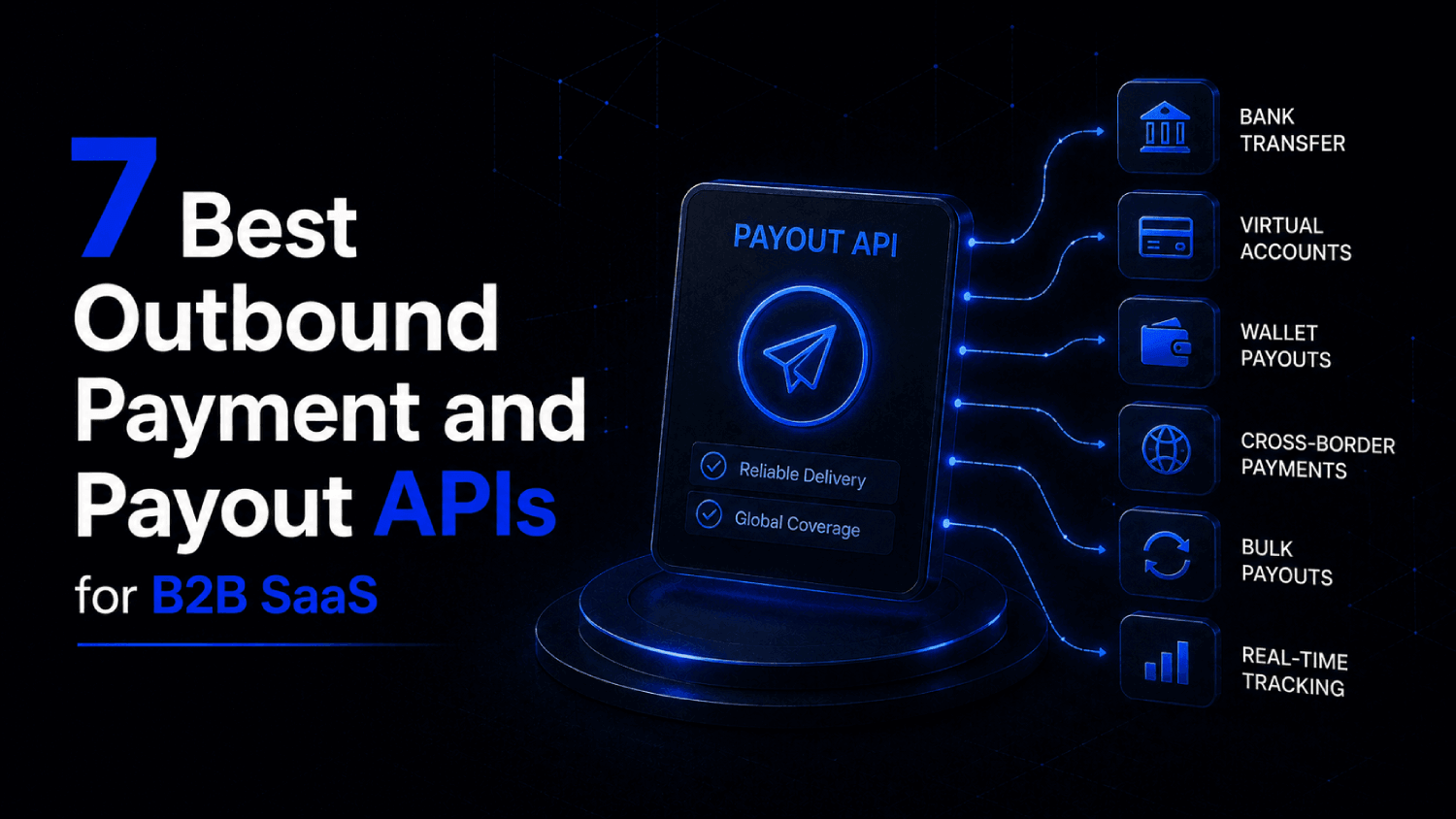
The best outbound payment APIs for B2B SaaS are Stripe Treasury, Adyen Platforms, Trolley, Tipalti, Dwolla, Payoneer, and Modern Treasury. Each targets a different use case: Stripe and Adyen suit embedded-finance builders; Trolley and Tipalti serve marketplace operators paying contractors globally; Dwolla handles high-volume ACH at lower per-transaction cost; Payoneer covers cross-border payouts to underserved corridors; Modern Treasury wires directly into bank rails with an audit-grade reconciliation layer.
Why Payouts Are Not the Easy Half of Money Movement
Accepting payments gets all the engineering attention because it touches the revenue path. Payouts sit on the cost side, so they get deferred. That logic breaks down the moment your product crosses one of three thresholds: paying more than 50 parties per month, operating in more than one jurisdiction, or handling funds on behalf of someone else.
At that point, a manual ACH batch process creates a compliance gap, not just an ops headache. You are now a money transmitter in the eyes of many state regulators, whether or not you have registered as one. The reconciliation problem compounds fast too. A failed payout that sits unmatched in your ledger for five days is a float liability and a support ticket from a vendor who has not been paid.
If you are evaluating payout infrastructure alongside your broader payments stack, the best payment infrastructure tools for SaaS founders covers the full money movement layer, including inbound rails. This article focuses specifically on the outbound side.
The FintechSpecs Payout API Stress Test
Every provider in this list was evaluated against five criteria. Call this the FintechSpecs Payout API Stress Test, and apply it before any demo call.
- Rail coverage: Does it support ACH, RTP, wire, card push, and international corridors? Or just one or two rails that will force you to add a second vendor later?
- KYB/KYC ownership: Does the API own identity verification for your payees, or does it push that back to you? Platforms that handle KYB reduce your compliance surface area materially.
- Wallet and account model: Can you hold funds in a platform wallet before disbursing, or is every payout a direct pull from your bank account? The wallet model opens float management and faster payouts.
- Reconciliation primitives: Does the API expose ledger entries, payment states, and failure codes at the transaction level, or do you have to infer status from a webhook and a CSV?
- US regulatory coverage: Is the provider licensed as a money transmitter in the states where your users operate? Or are you inheriting that licensing risk?
No provider in this list scores perfectly on all five. The point of the framework is to surface the trade-off before you are mid-integration.
How Do These Seven Providers Compare?
| Provider | Rail Coverage | KYB Included | Wallet/Account Model | Reconciliation API | US Coverage | Best For |
|---|---|---|---|---|---|---|
| Stripe Treasury | ACH, wire, RTP, card push | Yes (via Stripe Identity) | Financial Accounts (wallets) | Strong (events, balance objects) | Full (50 states) | Teams already on Stripe |
| Adyen Platforms | ACH, SEPA, wire, card payout | Yes (onboarding flows) | Balance Accounts per sub-merchant | Strong (Balance Platform API) | Full (50 states) | Marketplace operators, global scale |
| Trolley | ACH, wire, PayPal, Venmo, e-transfer | Yes (Tax + KYC module) | Batch payout queue | Moderate (webhook-based) | Strong | Contractor and creator payouts |
| Tipalti | ACH, wire, PayPal, local bank, card | Yes (KYBP, sanctions screening) | No native wallet; AP workflow | Strong (ERP sync, GL coding) | Full | Mid-market AP automation |
| Dwolla | ACH (same-day, standard), RTP | Partial (bank verification) | Funding Sources + Balance | Moderate (event log API) | Full (money transmitter) | High-volume ACH, lower cost |
| Payoneer for Businesses | ACH, wire, local bank, card | Partial (payee onboarding) | Payoneer balance accounts | Basic (report downloads) | Strong | Cross-border, emerging market corridors |
| Modern Treasury | ACH, wire, RTP, book transfers | No (bank-agnostic) | Virtual accounts per counterparty | Deepest in class (ledger API) | Full | Finance teams that need audit-grade ledgers |
1. Stripe Treasury: Best for SaaS Teams Already on Stripe
Stripe Treasury is the embedded finance layer that sits on top of Stripe’s existing payment infrastructure. It gives platforms the ability to issue Financial Accounts to their users, fund those accounts, and send outbound payments via ACH, wire, RTP, and card push, without leaving the Stripe API surface.
The key architectural advantage is that every payout originates from a Financial Account object, not directly from the platform’s bank account. That means the platform can hold, route, and release funds programmatically, which is the foundation of any serious payout product. Stripe handles the money transmission licensing, so you are not applying for state licenses before you ship.
Where Stripe Treasury falls short is customization. The Financial Account model is opinionated, and teams with complex multi-party splits or non-standard ledger requirements will hit the edges of the API faster than they expect. Pricing is not public for Treasury specifically; Stripe’s standard ACH pricing is listed on their public pricing page, but Treasury rates are negotiated. That matters if you are projecting unit economics at scale.
2. Adyen Platforms: Best for Marketplace Operators Who Need Global Rail Coverage
Adyen Platforms (previously called Adyen for Platforms) gives each sub-merchant or payee their own Balance Account, which functions like a mini ledger inside Adyen’s system. Funds collected from buyers settle into those Balance Accounts first, then get swept to the payee’s bank account on a schedule the platform controls.
The compliance story here is credible and well-documented. Adyen handles KYB onboarding for each sub-merchant, runs sanctions screening, and manages split-payment liability at the transaction level. For a marketplace that collects funds and disburses to third parties, that is a significant risk offset. Adyen’s global rail coverage across ACH (US), SEPA (Europe), and local bank transfer schemes in dozens of markets also means a single integration can power payouts to most of the world.
The trade-off is complexity. Adyen’s API is powerful but dense. The Balance Platform documentation assumes familiarity with concepts like ledger entries, booking dates, and settlement cycles. Teams without a dedicated payments engineer will move slowly. Adyen also does not publicly list pricing; it is volume-based and negotiated, which makes early-stage projections harder.
3. Trolley: Best for Contractor and Creator Payout Platforms
Trolley is purpose-built for platforms that pay large numbers of individual contractors, freelancers, or creators. The product wraps payout delivery, tax form collection (W-9, W-8BEN), and 1099/1042-S generation into one API, which means the compliance overhead of running a contractor payout program drops considerably.
Rail coverage for Trolley includes ACH, wire, PayPal, Venmo, and Interac e-Transfer in Canada. That PayPal and Venmo connectivity matters more than it sounds. Many freelancers in the US refuse to give out bank account details and prefer to receive to a PayPal balance instead. Platforms without that rail lose payees. Trolley’s public pricing page lists per-payout fees by rail type, which makes it one of the more transparent providers in this list for cost modeling.
Reconciliation is the weakest point. Trolley uses a webhook-driven model where status updates arrive as events, but it does not expose a double-entry ledger API the way Modern Treasury does. Teams running high-volume programs with complex GL requirements will need to build their own ledger layer on top.
4. Tipalti: Best for Mid-Market SaaS with Complex AP Workflows
Tipalti occupies a different position than the others on this list. It is less an API-first payout infrastructure provider and more an AP automation platform with a strong API for embedding payouts into external products. That distinction matters for product teams evaluating it as infrastructure versus finance teams looking to automate vendor payments.
Tipalti’s compliance layer is the deepest in this category. It screens payees against OFAC, runs Know Your Payee (KYP) checks, handles VAT validation for international payees, and generates tax documentation automatically. For a SaaS company paying hundreds of global vendors or affiliates, that compliance surface area would take significant internal engineering to replicate. According to Tipalti’s own documentation, the platform supports payment to payees in over 190 countries across multiple local bank transfer rails.
ERP integration is native. Tipalti syncs with NetSuite, QuickBooks, Xero, and SAP, and it codes GL entries at the transaction level. That makes it a strong fit for finance teams running a serious monthly close process. The API documentation is less developer-friendly than Stripe or Modern Treasury, and the product is priced as enterprise software, with costs that are not publicly listed.
5. Dwolla: Best for High-Volume ACH Programs That Need Cost Control
Dwolla is the most focused provider on this list. It does ACH, same-day ACH, and RTP, and it does those rails well. There is no card payout, no international transfer, no tax module. If your payout program is US-only and bank-account-to-bank-account, Dwolla’s per-transaction economics are hard to beat at scale.
The API design is clean. Dwolla uses a Funding Source model where each payee (called a Customer) has one or more verified bank accounts attached, and transfers move between Funding Sources through the Dwolla network. The Balance object functions as a float account that the platform can use to pre-fund payouts before sweeping to payees. That architecture reduces settlement lag and failed payment rates.
KYB is partial. Dwolla handles bank account verification through micro-deposit or Plaid-based instant verification, but full business identity verification is the platform’s responsibility. Teams building a payout product where they do not know their payees well need to add an identity layer. For platforms paying known vendors with verified banking relationships, this is not a problem. Dwolla’s pricing is available on their public pricing page, with plan tiers based on monthly volume.
6. Payoneer: Best for Cross-Border Payouts to Emerging Market Corridors
Payoneer for Businesses solves a specific problem that the other providers handle poorly: paying recipients in countries where ACH and SEPA do not reach, and where recipients may not have traditional bank accounts. Payoneer maintains local receiving accounts in dozens of markets, which lets payees receive in local currency without a SWIFT wire fee.
The payout API allows platforms to initiate transfers to any Payoneer account or to a payee’s bank account in supported markets. The developer experience is functional but not as polished as Stripe or Modern Treasury. Webhooks exist, but the reconciliation data is thinner, and bulk operations require more client-side logic to manage.
Compliance handling varies by corridor. In some markets Payoneer has full regulatory coverage; in others the platform operator carries more of the verification burden. Before using Payoneer as the sole payout infrastructure for a regulated product, reviewing the specific corridors you need against Payoneer’s licensing disclosures is necessary. This is a corridor-first choice, not an infrastructure-first one.
7. Modern Treasury: Best When Reconciliation Is the Core Engineering Problem
Modern Treasury takes a different approach than every other provider here. Rather than wrapping a bank or payment network directly, it sits as an orchestration layer on top of existing banking relationships. You connect your own bank accounts (or your BaaS provider), and Modern Treasury manages payment initiation, status tracking, and reconciliation through a ledger API.
The ledger is what the product is built around. Modern Treasury exposes double-entry bookkeeping primitives directly in the API, meaning every payment creates a matching ledger entry, and every reconciliation event updates the ledger in real time. For a fintech company running a complex funds flow (marketplace, lending, insurance escrow), this is the difference between a books-on-spreadsheets problem and a solved accounting infrastructure problem.
Rail coverage includes ACH, same-day ACH, wire, RTP, and book transfers between accounts at the same bank. International coverage depends on the connected banking partner. Modern Treasury does not do KYB directly; that is the platform’s responsibility. Pricing is not publicly listed and is negotiated based on payment volume. The product is best suited for engineering teams that want to own the banking relationship and use Modern Treasury as the logic layer on top. If you are building a product where the fintech product and compliance readiness framework is a primary concern, Modern Treasury’s audit trail is the cleanest available.
Which Outbound Payment Rails Actually Matter for B2B SaaS?
Not all payment rails are relevant to every SaaS product. The choice of provider should follow the choice of rails, not the other way around.
- ACH (standard, 2-3 business days): The default for US vendor and contractor payments. Low cost, widely supported, but the settlement lag creates float problems at scale.
- Same-day ACH: Available through most providers, typically at a higher per-transaction fee. Worth it for time-sensitive vendor payments where a 2-day lag causes friction.
- RTP (Real-Time Payments via The Clearing House): Instant settlement, 24/7, up to $1 million per transaction. Stripe Treasury, Dwolla, and Modern Treasury support it. Adoption among receiving banks is still growing, which means fallback logic to ACH is often required.
- Wire: High-value, high-speed, high-cost. Necessary for transactions above ACH limits or for same-day international settlement.
- Card push (Visa Direct, Mastercard Send): Fastest option for pushing funds to a debit card, often within 30 minutes. Stripe and Adyen support it. Per-transaction fees are higher than ACH.
- Local bank transfers (international): SEPA in Europe, Faster Payments in the UK, UPI in India, and dozens of similar local rails. Adyen and Payoneer have the broadest coverage here.
What Does a Payout API Actually Cost Per Transaction?
Pricing across this category is fragmented. Most enterprise-grade providers negotiate rates based on volume, which makes it hard to model unit economics until you have a signed contract. The providers that publish rates publicly are the exception.
Dwolla is the most transparent for ACH. Their public pricing page lists plan tiers with per-transaction fees, and the structure is straightforward enough to model against projected volumes. Trolley publishes per-payout fees by rail type on their pricing page. Stripe’s ACH pricing is listed publicly, but Treasury pricing is handled separately through sales. Adyen, Tipalti, and Modern Treasury all require a sales conversation before pricing is available.
As a modeled scenario: a mid-stage SaaS company running 2,000 contractor payouts per month at an average of $500 each would pay $500 per month in direct payout fees at a hypothetical $0.25 per ACH payout. Switch to same-day ACH at $1.00 per transaction, and the cost jumps to $2,000. Add card push at a percentage-based fee, and the model changes entirely. The rail mix determines the cost structure far more than the choice of provider. These are hypothetical figures for directional modeling; test them against actual quoted rates from any provider you shortlist.
The hidden costs that eat fintech SaaS margins breaks down how payment infrastructure fees compound across the P&L, which is worth reading before committing to a pricing model with any payout vendor.
What Does KYB in a Payout API Actually Mean?
KYB (Know Your Business) in the context of payout APIs is not the same as KYB for onboarding your own customers. It refers to verifying the identity and legitimacy of the entities or individuals you are paying out to, which has different regulatory requirements depending on whether those payees are businesses or individuals, and whether they are domestic or international.
Providers that own KYB for payees (Adyen, Tipalti, Trolley) collect business registration documents, run OFAC and sanctions screening, and maintain those records for audit purposes. That removes a significant compliance burden from the platform operator. Providers that leave KYB to the platform (Modern Treasury, Dwolla) give more flexibility but require the platform to build or buy identity verification separately. The best KYC providers for fintech SaaS covers the identity verification layer in detail if you are evaluating that as a standalone component.
Frequently Asked Questions
What is a payout API?
A payout API is a programmatic interface that lets a software platform initiate outbound money transfers to third parties, such as vendors, contractors, or marketplace sellers, without manual intervention. The API handles payment rail selection, payee verification, transaction status tracking, and reconciliation data. It is distinct from a payment gateway, which processes inbound transactions from customers.
What is the best outbound payment API for B2B SaaS?
For most B2B SaaS teams already on Stripe, Stripe Treasury is the lowest-friction path because it shares the same API surface and handles money transmission licensing. For marketplace operators paying global contractors, Trolley or Tipalti offer deeper compliance tooling. For teams where reconciliation accuracy is the primary engineering requirement, Modern Treasury’s ledger API is the strongest option in the market. Rail coverage and compliance scope should drive the decision, not brand familiarity.
What is the difference between a mass payout API and a disbursement API?
The terms are largely interchangeable in practice. “Mass payout API” typically describes platforms built for high-volume, many-to-many payments (e.g., paying 5,000 freelancers at once), while “disbursement API” often refers to structured fund releases in lending, insurance, or grants contexts. The underlying rail mechanics are the same. Trolley and Tipalti position themselves for mass payouts. Modern Treasury and Dwolla are commonly used for disbursement scenarios where ledger accuracy matters more than volume throughput.
How does a payout API handle failed payments?
Failed payments happen for several reasons: invalid routing numbers, closed accounts, returned ACH entries, or frozen recipient accounts. A well-designed payout API returns a machine-readable failure code via webhook, distinguishes between correctable failures (e.g., wrong account number) and final failures (e.g., account closed), and allows the platform to retry or reroute. Stripe Treasury, Modern Treasury, and Dwolla all expose granular failure codes. Payoneer’s error handling is less detailed, which creates additional reconciliation work for high-volume programs.
Do payout APIs require a money transmitter license?
It depends on the provider’s model. Stripe Treasury, Adyen, and Dwolla hold their own money transmitter licenses and extend that coverage to their platform customers, which means the platform operator does not need separate state licenses. Modern Treasury is an orchestration layer that sits on top of a bank or BaaS provider, so the licensing depends on that underlying banking partner. Payoneer holds licenses in the jurisdictions where it operates, but coverage varies by corridor. If you are unsure of your licensing exposure, the real cost of compliance in fintech SaaS outlines what these requirements look like by company stage.
What is a vendor payments API?
A vendor payments API is a payout API configured specifically for business-to-business outbound payments, typically used to pay suppliers, service providers, or partners automatically from within a SaaS product. Tipalti is the most purpose-built for this use case, with AP workflow tools, ERP sync, and GL coding built into the API layer. Dwolla and Modern Treasury are also commonly used for vendor payment automation where the ERP integration is handled separately.
Can a payout API handle international payments?
Yes, though coverage varies significantly. Adyen Platforms has the broadest international rail coverage among the providers listed here. Payoneer specializes in corridors that larger providers underserve, particularly in Southeast Asia, Latin America, and Africa. Trolley covers Canada, the US, and a range of international ACH equivalents. Stripe Treasury is primarily US-focused. Modern Treasury’s international coverage depends on the connected bank. Teams building a global payout product should map their target corridors against each provider’s coverage documentation before committing to an integration.
How do payout APIs handle tax compliance for 1099 or 1042-S reporting?
Trolley and Tipalti both include tax form collection (W-9, W-8BEN) and year-end 1099/1042-S generation as part of their payout platforms. This is a meaningful operational advantage for platforms paying more than 600 individuals per year in the US, where 1099-NEC filing thresholds apply. Stripe, Dwolla, Modern Treasury, and Adyen do not provide tax reporting modules; that work falls to the platform operator or a separate tax reporting service.
The Reconciliation Problem Is Bigger Than It Looks
Most engineering teams underestimate reconciliation until the first month-end close where a payment is in “pending” status in the payout API but the bank statement shows it as settled. That gap is not a bug. It is the difference between payment initiation time, bank processing time, and ledger posting time, and each provider handles those three timestamps differently.
Modern Treasury built its entire product around solving this. Every payment object has a full lifecycle from initiation through settlement, with ledger entries at each stage. Stripe Treasury exposes balance objects and event streams that approximate this. Dwolla’s event log gets you most of the way there for ACH. Trolley and Payoneer give you webhook events and downloadable reports, which work but require more client-side logic to reconcile against your internal ledger.
If your SaaS product is going to hold money on behalf of users, even briefly, reconciliation accuracy is not a reporting problem. It is a trust and liability problem. The real moats in fintech SaaS often come down to operational reliability, and payout accuracy is one of the clearest signals to your users that the infrastructure underneath their money works. Choosing a payout API with weak reconciliation primitives is a decision you will revisit at the worst possible time: during a financial audit, a regulatory inquiry, or a user dispute over a missing payment.
The providers that handle reconciliation well (Modern Treasury, Stripe Treasury, Adyen) all share one structural characteristic: they treat the ledger as a first-class API object, not as a report you generate after the fact. That distinction drives the evaluation more than any feature checklist. Embed payout infrastructure that can explain every dollar in real time, and the compliance, ops, and product benefits follow.