
- Crypto on-ramp APIs let your app accept fiat payments and deliver crypto to users without you touching an exchange license, custody arrangement, or KYC process.
- Provider choice comes down to four variables: US state coverage, supported payment methods, fees, and whether the widget or headless API fits your product architecture.
- MoonPay, Transak, and Ramp Network are the most commonly embedded options for US-licensed fintech apps; Onramper aggregates them if coverage gaps are a problem.
- Off-ramp support (crypto to fiat) is materially harder to source than on-ramp; fewer providers carry it at production scale in all 50 states.
- Stripe’s fiat-to-crypto on-ramp is the fastest integration path for teams already on Stripe, but it covers fewer assets than dedicated providers.
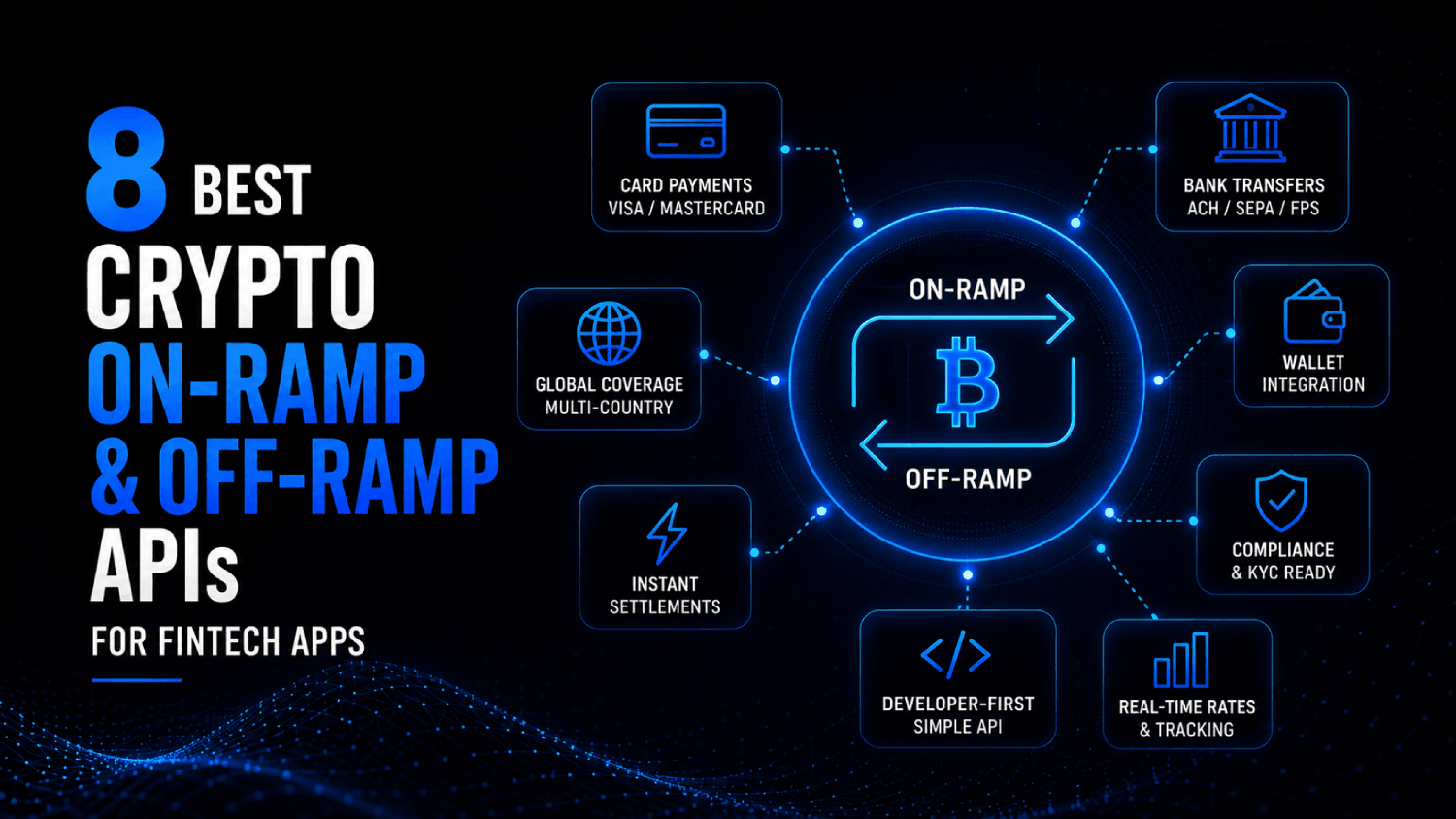
The eight crypto on-ramp and off-ramp API providers best suited for fintech apps are MoonPay, Transak, Ramp Network, Onramper, Stripe Crypto On-Ramp, Crossmint, Changelly, and Unlimit Crypto. Each handles KYC, licensing, and fiat processing on behalf of your platform. Your integration is either a hosted widget or a headless API call. Provider selection depends on US state coverage, fee structure, supported payment methods, and whether you need two-way fiat-crypto conversion.
Why On-Ramp APIs Exist and What They Actually Handle for You
The licensing problem is real. Offering fiat-to-crypto conversion in the US requires money transmitter licenses (MTLs) in most states, and getting one typically takes 12 to 24 months per state. On-ramp API providers have already done that work. When a user buys ETH through your app via MoonPay, MoonPay is the licensed money transmitter. You are a distribution partner.
That distinction matters for your legal team. You are not operating a virtual asset service provider (VASP). You are embedding a licensed third party’s transaction flow into your product. The KYC checks, identity verification, sanctions screening, and SAR filing obligations sit with the on-ramp provider. Your compliance surface area shrinks to vendor due diligence and, in some cases, a referral agreement review.
Off-ramps run the same model in reverse: a user sends crypto, the provider liquidates it and sends fiat via bank transfer or card. Off-ramp coverage is consistently thinner than on-ramp coverage because the provider needs payout banking relationships in each target market, not just payment acceptance. That asymmetry is worth understanding before you commit to a provider.
If your product also needs stablecoin settlement rails rather than retail on-ramp flows, the stablecoin payment API comparison on FintechSpecs covers that category separately. The two categories overlap but serve different use cases.
What Does “Crypto On-Ramp API” Actually Mean for a Product Team?
In practice, an on-ramp integration takes one of two shapes. The first is a hosted widget: a prebuilt iframe or redirect flow that the provider manages, which you embed with an API key and a few configuration parameters. The second is a headless API: you build your own UI and call the provider’s endpoints for quote fetching, KYC initiation, and transaction status. Most providers offer both modes at different tiers.
The widget path is faster to ship, typically a day or two of engineering time. The headless path gives you full UX control but requires substantially more integration work and usually a commercial agreement with volume commitments. For most Series A and B teams, the widget is the right starting point.
Fee structures matter more than they look at first glance. Consider a hypothetical: a consumer app processing $500,000 per month in fiat-to-crypto volume at a blended 1.5% network fee plus a provider spread of 1.0%. That is $12,500 per month in transaction costs. Drop the provider spread to 0.5% and the monthly delta is $2,500, or $30,000 per year. At scale, spread differences compound fast.
The FintechSpecs On-Ramp Selection Matrix
Before evaluating specific providers, apply what we call the FintechSpecs On-Ramp Selection Matrix: four criteria checked in order, where a hard failure on any criterion eliminates a provider regardless of its other qualities.
- Licensing coverage: Does the provider hold MTLs in every US state your users live in? Ask specifically about New York (BitLicense is separate from MTL), Texas, and California, which have the longest approval timelines and the most enforcement activity.
- Payment method fit: Does the provider accept the funding methods your users actually have? ACH is cheapest but slowest. Credit and debit cards are fast but carry higher fees and chargeback risk. Apple Pay and Google Pay matter for mobile conversion rates.
- Off-ramp availability: If you need two-way flows, does the provider support off-ramp in the same markets, or will you need a second vendor for that leg?
- Integration model: Widget, headless API, or both? What is the documentation quality and the estimated time to a production-ready integration?
Providers that pass all four checks move into a fee and conversion rate comparison. Providers that fail on licensing or payment method fit are eliminated regardless of how competitive their fees are.
Fee, Coverage, and Integration Comparison Table
| Provider | On-Ramp | Off-Ramp | US Coverage | Typical Fee Range | Integration Mode | Payment Methods |
|---|---|---|---|---|---|---|
| MoonPay | Yes | Yes | Most states (not NY for some assets) | 1.0% to 4.5% depending on method | Widget + Headless API | Card, Apple Pay, bank transfer, PIX |
| Transak | Yes | Yes | US + 160+ countries | 0.5% to 2.0% (varies by method and asset) | Widget + API | Card, ACH, Apple Pay, SEPA |
| Ramp Network | Yes | Yes | US (state coverage varies) | 0.49% to 2.9% | Widget + Headless (Ramp Instant) | Card, Apple Pay, Google Pay, bank |
| Onramper | Yes (aggregator) | Yes (aggregator) | Depends on underlying providers; 175+ payment methods | Pass-through + small aggregator margin | Widget + API | 30+ on-ramps aggregated |
| Stripe Crypto On-Ramp | Yes | No | US (with Stripe’s MTL coverage) | 1.5% + card network fees | Hosted session (embedded) | Card, Apple Pay, Google Pay |
| Crossmint | Yes | Limited | US + select international | Not publicly listed; contact required | Widget + Headless API | Card, ACH |
| Changelly | Yes | Yes | International primary; US coverage varies | 0.25% to 2.0% | API (B2B-focused) | Card, bank transfer |
| Unlimit Crypto | Yes | Yes | 200+ assets; global coverage | Zero integration fee; transaction fees apply | Single API | Card, bank transfer |
Fee ranges above reflect publicly available pricing where disclosed. Several providers do not publish full rate cards and negotiate fees based on volume. Always request a commercial term sheet before building, not after.
Which Providers Are Best for US-Licensed Fintech Apps?
MoonPay: Best for production-grade on-ramp with brand recognition
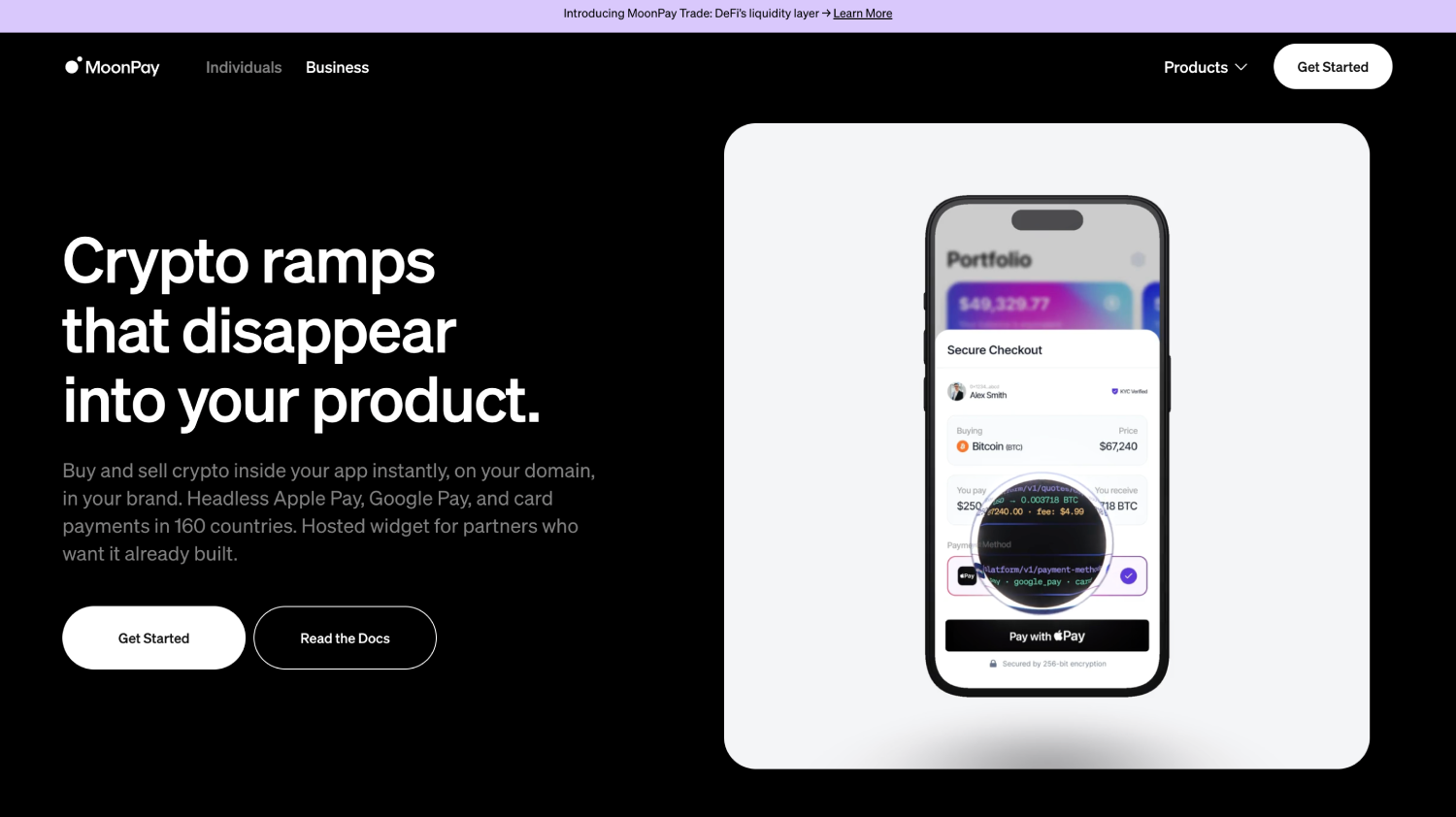
MoonPay is one of the most widely embedded on-ramp providers in the market. Its developer documentation is detailed, the widget integrates quickly, and the brand is recognized enough that users at the checkout step are less likely to abandon. The headless API option gives product teams full UX control, but it requires a commercial agreement. New York coverage is asset-dependent due to the state’s BitLicense requirements, so check the specific asset list against your use case before committing.
MoonPay supports off-ramp as well, though the off-ramp product has historically been less broadly available than the on-ramp. Their fee structure runs higher on card payments than on bank transfers. Teams targeting high card-usage demographics should model the blended fee carefully.
Transak: Best for international coverage alongside US
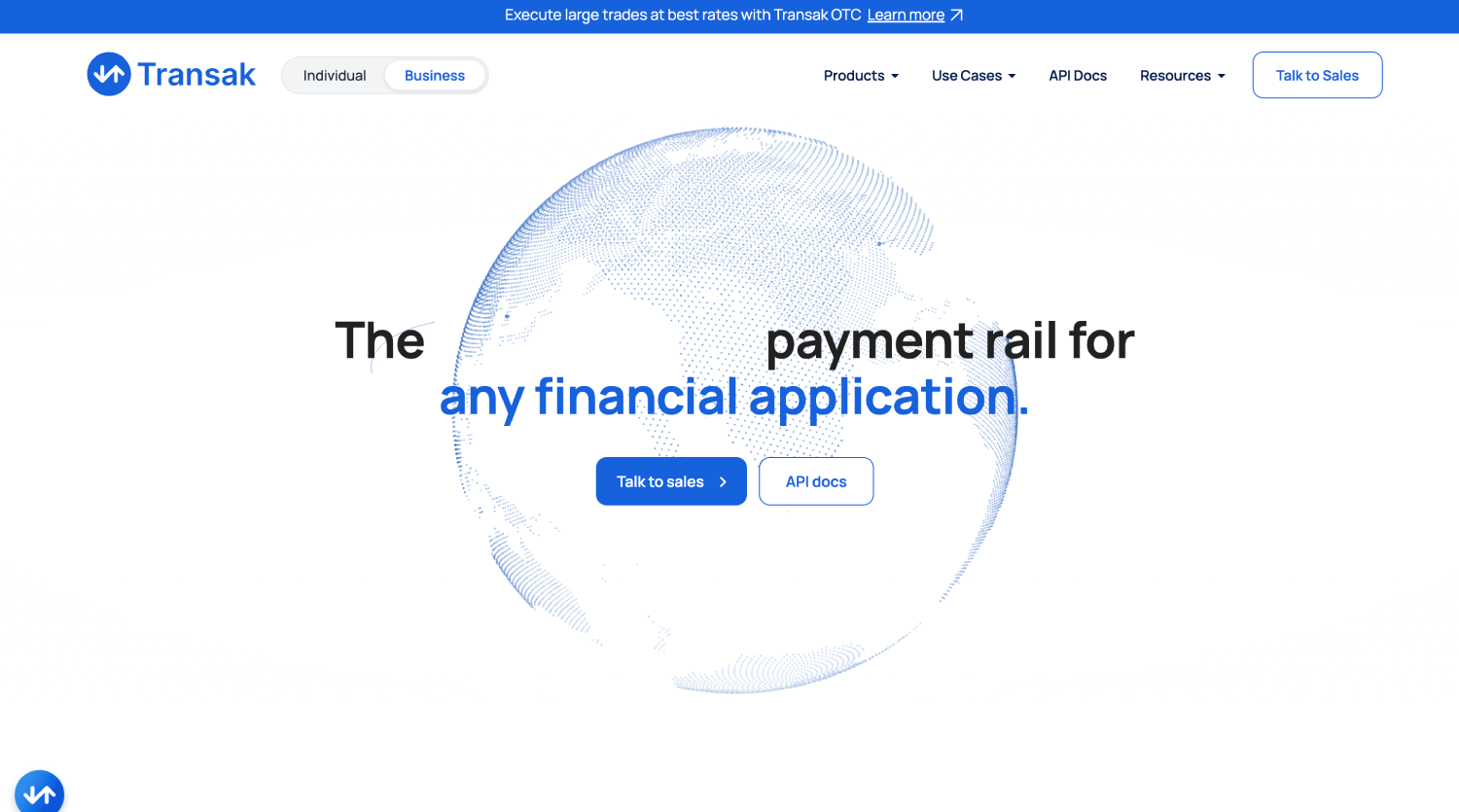
Transak supports more than 160 countries and covers a wide payment method set including ACH, SEPA, and card. For fintech apps with users outside the US, Transak removes the need to source a separate international on-ramp provider. Their published fee structure shows rates starting at 0.5% for certain methods, which is competitive, though card-funded transactions carry higher fees. Transak also offers a no-code widget for fast deployment and an API for teams that need deeper integration control.
Ramp Network: Best for mobile-native apps prioritizing conversion rates
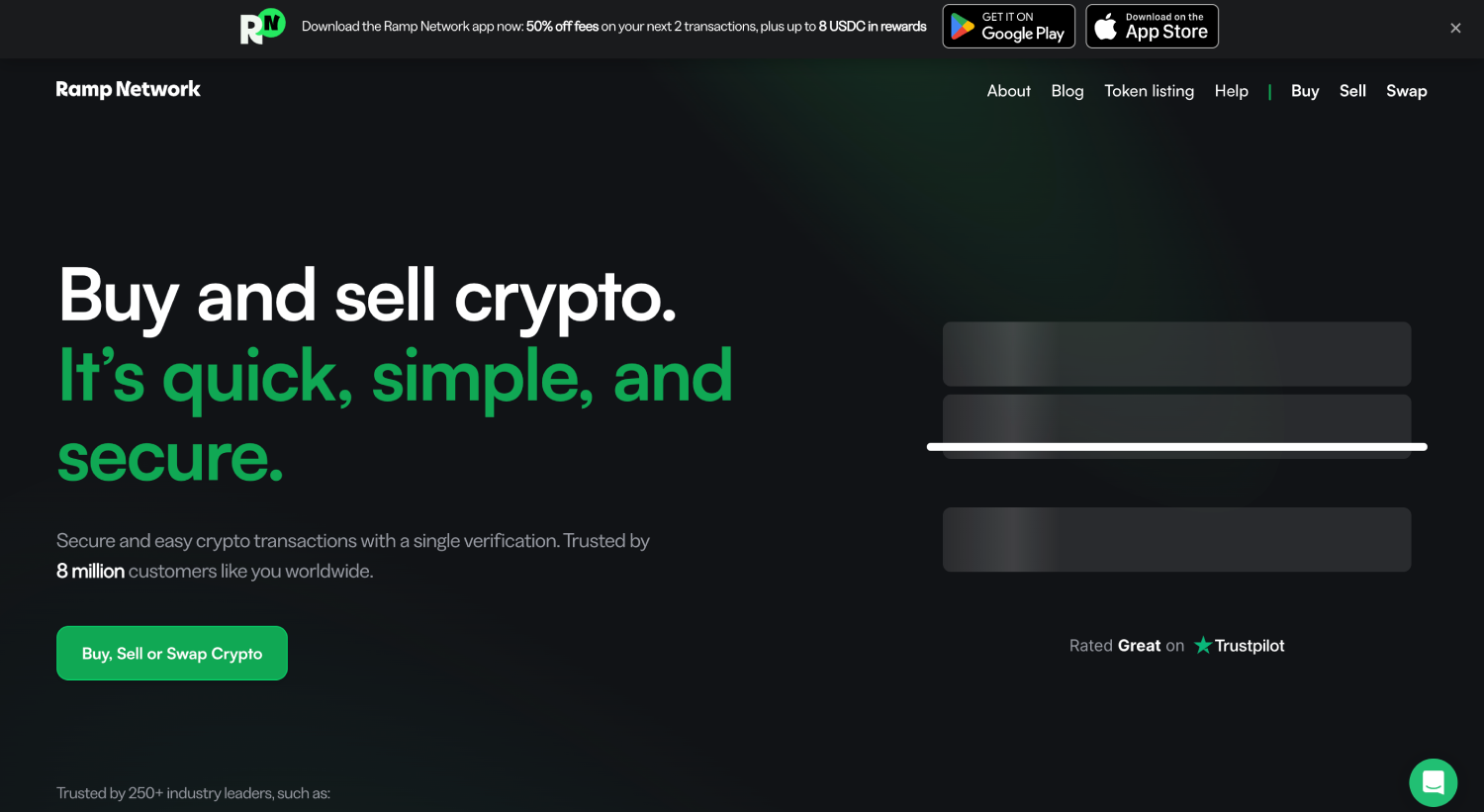
Ramp Network has built its product around reducing friction at the point of purchase. Their Apple Pay and Google Pay integration is among the smoothest in the category, which matters significantly for mobile conversion. Ramp Instant is their headless API variant, designed for wallets and apps that want full control over the purchase flow. Their published fees start at 0.49%, though rates scale with payment method and volume tier.
Onramper: Best when a single provider’s coverage is not enough
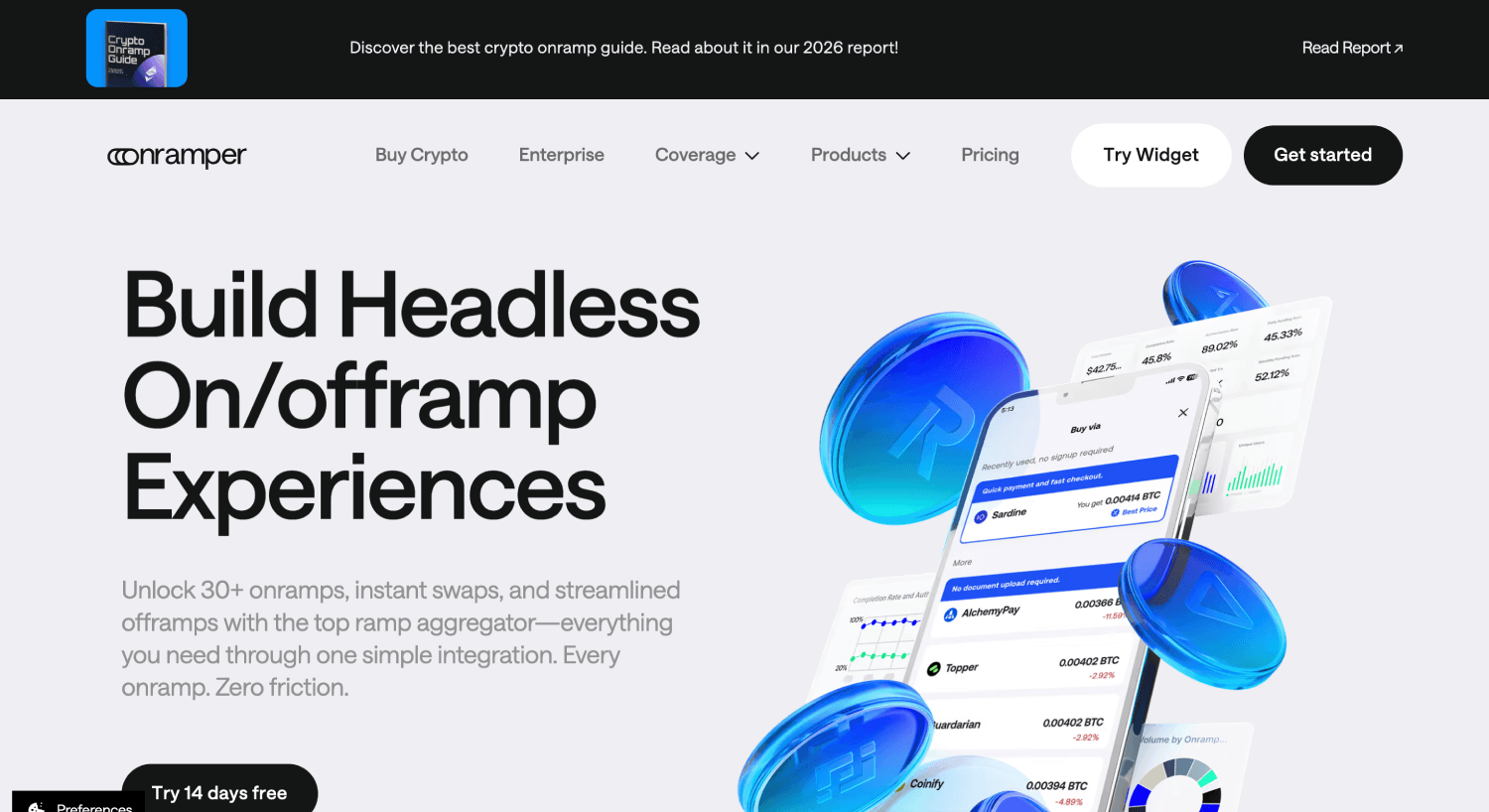
Onramper is an aggregator, not a direct on-ramp provider. A single Onramper integration connects your app to more than 30 underlying on-ramp providers and over 175 payment methods. The practical value is redundancy: if one underlying provider is down or does not cover a specific state or asset, Onramper routes around it. The cost is a small aggregator margin on top of the underlying provider’s fee. For teams that want best-available-rate logic and built-in failover, Onramper is the cleanest solution.
Stripe Crypto On-Ramp: Best for teams already on Stripe’s stack
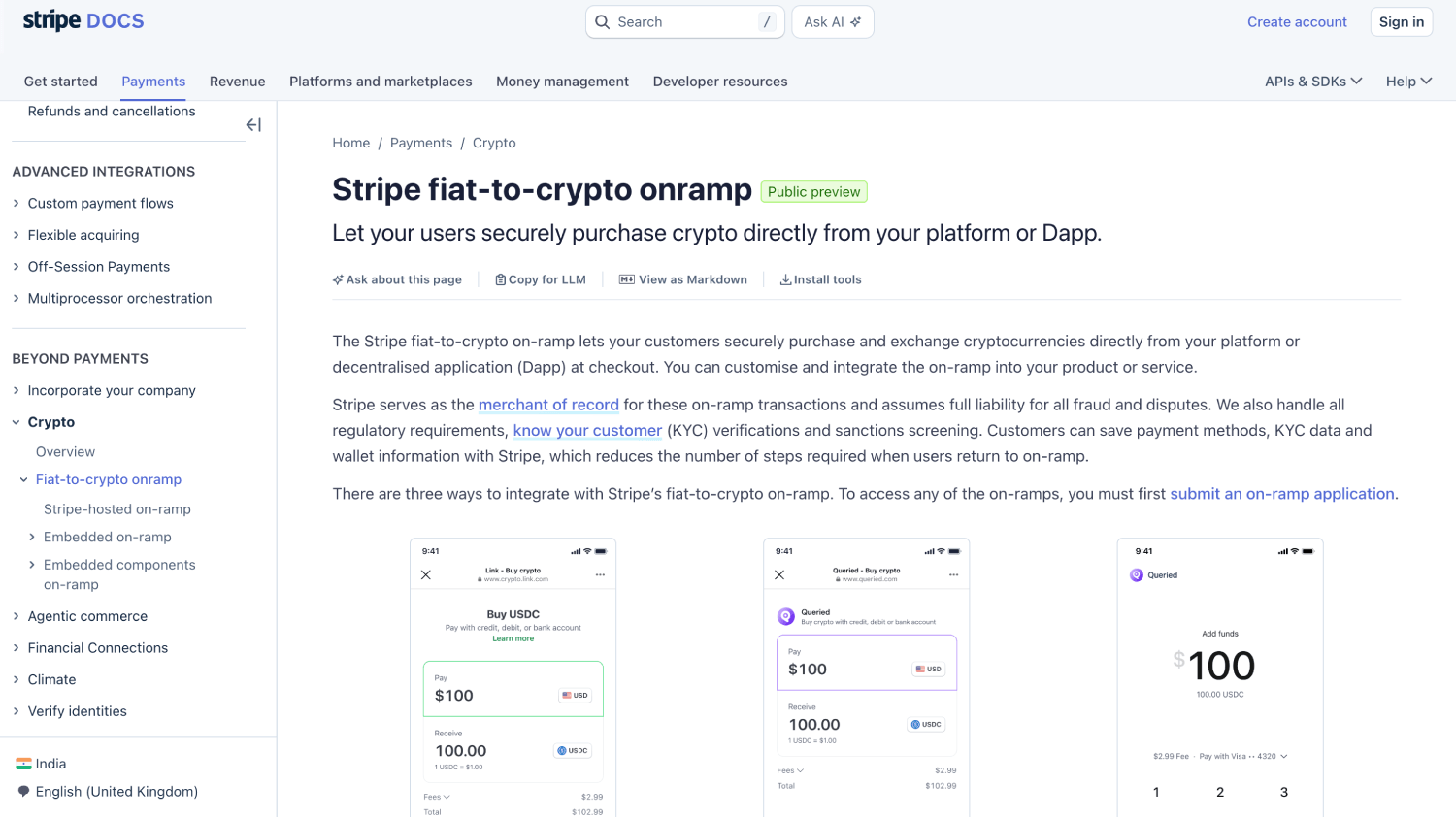
Stripe’s fiat-to-crypto on-ramp, documented in their developer docs, is an embedded hosted session that handles the full purchase flow including KYC and compliance. For teams already using Stripe for payments, the integration cost is minimal and the trust signal with users is high. The major limitation is that Stripe’s on-ramp does not include an off-ramp. It also covers a narrower asset list than dedicated providers. If your users only need to buy a handful of major assets and you are already a Stripe customer, this is the fastest path to production.
Crossmint: Best for NFT and stablecoin-adjacent use cases
Crossmint offers both headless APIs and a plug-and-play widget for fiat-to-crypto on-ramp, with a particular focus on stablecoins and NFT commerce flows. Their positioning is more web3-native than the other providers on this list, which makes them well-suited for platforms sitting at the intersection of fiat commerce and onchain activity. Pricing is not publicly listed; contact is required for commercial terms.
Changelly: Best for B2B-oriented API integration with exchange flexibility
Changelly approaches the on-ramp and off-ramp problem as a B2B API provider. Their API is designed for products that need programmatic access to crypto conversion rather than a hosted widget. International coverage is strong; US coverage should be verified against your specific state list. Their published fee structure shows competitive rates starting at 0.25% for certain asset pairs. Teams building exchange-adjacent products or wallets with heavy programmatic needs will find the Changelly API more natural to work with than widget-first providers.
Unlimit Crypto: Best for zero-integration-fee entry with broad asset support
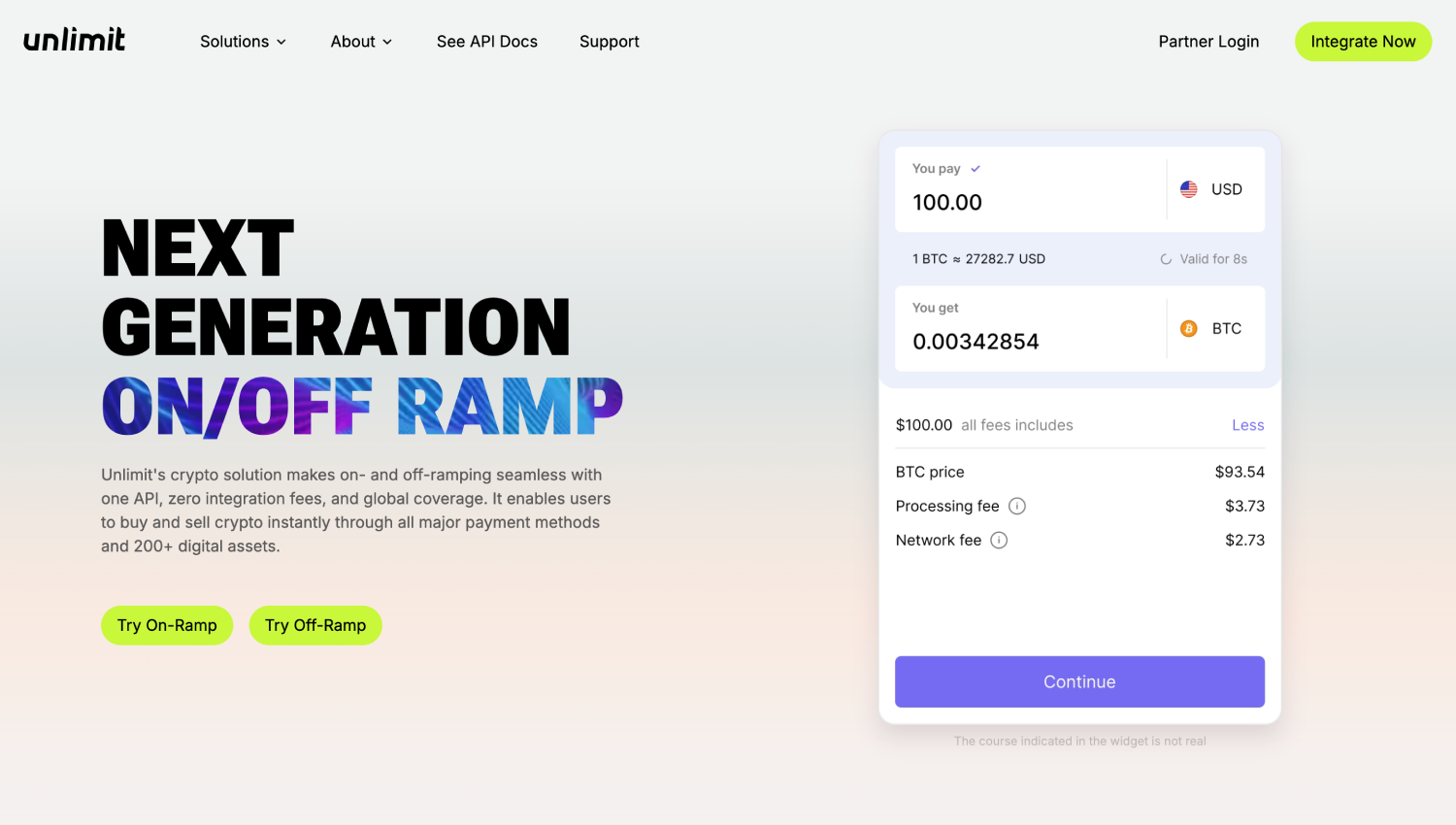
Unlimit Crypto, which appears in Alchemy’s directory of fiat on-ramp providers, markets itself around zero integration fees and support for over 200 assets through a single API. That asset breadth is meaningful for platforms where users want access to long-tail tokens, not just BTC and ETH. Transaction fees still apply; zero integration fee refers to the cost of accessing the API itself. Global coverage is broad, though US state-level detail should be confirmed directly with their team.
Licensing Model Breakdown: What “Licensed” Actually Means for Your Compliance Team
Every provider on this list operates as a licensed money transmitter or partners with one. The licensing structure matters because it determines who is the regulated entity in any transaction your users execute. In the US, the relevant licenses are state-level MTLs (required in 49 states), the New York BitLicense (a separate and more demanding requirement), and FinCEN registration at the federal level.
When you embed an on-ramp API, your compliance posture shifts. You are not the money transmitter. You may still have bank secrecy act (BSA) obligations as a referral partner depending on your business model, and your legal counsel should review the specific referral or distribution agreement each provider offers. Some providers require a commercial partnership agreement before going live; others let you start with self-serve API keys and formalize later.
The fintech compliance readiness checklist on FintechSpecs covers the broader vendor review process for regulated third parties. On-ramp providers are a category where vendor due diligence is not optional. Ask each provider for their current MTL list by state, their BitLicense status for New York, and their approach to SAR filing and OFAC screening before signing anything.
On-Ramp Widget vs. Headless API: Which Integration Model Fits Your Product?
The widget path wins on speed. A competent engineer can embed a MoonPay or Transak widget in a day. The provider manages the UI, the KYC flow, the error states, and the transaction confirmation screen. You configure parameters (currency, asset, wallet address) and the widget handles the rest. The trade-off is limited brand control and some friction at handoff points.
The headless API path wins on UX control. You build every screen, call the provider’s endpoints for quotes and transaction initiation, and the experience feels native to your product. The engineering cost is 2 to 4 weeks minimum for a solid implementation, plus ongoing maintenance. Headless integration also typically requires a commercial agreement with minimum volume thresholds.
The right answer depends on your stage. Pre-launch or early-stage products should use a widget. Post-product-market-fit teams with meaningful volume and a strong design team should consider headless. Many providers support both, letting you start with a widget and migrate to headless later without switching vendors.
What Do Crypto Off-Ramp Providers Handle That On-Ramp Providers Don’t?
Off-ramping is operationally harder than on-ramping. Accepting fiat and delivering crypto requires a payment processor and a crypto custody relationship. Converting crypto to fiat and delivering it to a bank account requires the provider to liquidate the asset, absorb exchange rate risk for the settlement window, and then push funds through ACH or wire to a user’s bank. That last step requires banking relationships that are not always easy to maintain.
Several providers on this list offer off-ramp in name but with geographic or asset restrictions that matter. MoonPay off-ramp, Ramp Network off-ramp, and Transak off-ramp are the most commonly cited for US production use cases. Stripe does not offer off-ramp at all. If your product requires crypto-to-fiat conversion as a core feature rather than an edge case, prioritize providers with confirmed off-ramp coverage in your target states before evaluating any other criteria.
Teams building products that touch the broader fintech API stack should also consider how off-ramp flows connect to banking rails. ACH settlement windows and bank partner relationships downstream of the off-ramp provider can add 1 to 3 business days to the user’s fiat receipt time, which affects product experience significantly.
How to Evaluate Conversion Rates Across On-Ramp Providers
Published fees are not the same as effective cost to your users. The spread between the mid-market crypto price and the rate a provider quotes at checkout is often larger than the headline fee percentage. Providers make money on both the fee and the spread, and the spread is rarely disclosed upfront.
The best way to evaluate this is to run live quote comparisons across providers using the same input parameters: same fiat amount, same asset, same payment method, at the same time. Most providers expose a quotes endpoint for exactly this purpose. MoonPay’s developer docs, for instance, describe an Onramp Quotes API that returns estimated conversion amounts across assets and networks. Run those quotes in parallel with Transak, Ramp Network, and Onramper’s best-available-rate logic and compare the effective delivered amount, not just the fee percentage shown at checkout.
For a concrete benchmark: on a $200 USDC purchase via card, the difference between a 1.5% all-in effective rate and a 3.5% all-in effective rate is $4. That sounds small, but users buying $200 at a time are often your most frequent transactors. At 10,000 transactions per month, the effective cost difference to your users is $40,000 monthly. Conversion rates compound.
Frequently Asked Questions About Crypto On-Ramp APIs
Can I convert fiat to crypto using an API without holding a money transmitter license?
Yes. Crypto on-ramp API providers like MoonPay, Transak, and Ramp Network hold the required money transmitter licenses on your behalf. When you embed their API or widget, your users are transacting with the licensed provider directly. Your platform acts as a distribution channel, not a money transmitter. You still need to review the partnership agreement and may have limited BSA obligations depending on your business structure, but you do not need your own MTL to offer the feature.
What is the difference between an on-ramp and an off-ramp in crypto?
An on-ramp converts fiat currency (USD, EUR) into cryptocurrency and delivers it to a user’s wallet. An off-ramp converts cryptocurrency into fiat and delivers it to a user’s bank account or card. On-ramps are more widely available and easier to integrate. Off-ramps require the provider to liquidate crypto, absorb exchange rate risk, and push funds through banking rails, which makes off-ramp coverage narrower and off-ramp fees generally higher than on-ramp fees.
Which crypto on-ramp API is fastest to integrate?
Stripe’s crypto on-ramp is the fastest for teams already using Stripe, often a few hours of engineering time using their hosted session model. For teams not on Stripe, MoonPay and Transak both offer widgets that can be embedded in a day with a self-serve API key. Onramper’s widget is also fast to deploy and provides access to multiple underlying providers through a single integration. Headless API integrations across any provider take significantly longer, typically two to four weeks of engineering time.
Do crypto on-ramp APIs handle KYC and identity verification?
Yes. KYC is handled by the on-ramp provider, not by the embedding platform. When a user purchases crypto through a MoonPay, Transak, or Ramp Network integration, those providers collect and verify identity documents, run sanctions screening, and meet their regulatory KYC obligations. Your platform does not see or store the identity data. This is one of the primary compliance advantages of using a third-party on-ramp provider versus building a proprietary flow. The KYC provider comparison on FintechSpecs covers identity verification separately for use cases where you are owning the KYC process.
Can I use a crypto on-ramp API in all 50 US states?
Coverage varies by provider and by asset. Most major providers (MoonPay, Transak, Ramp Network) cover the majority of US states, but New York is frequently restricted or limited because it requires a separate BitLicense in addition to standard money transmitter licensing. Texas and Hawaii have also historically presented coverage gaps. Always request a current state-by-state coverage list from any provider before building, and verify it is current since licensing status changes.
What is an on-ramp aggregator and when should I use one?
An on-ramp aggregator like Onramper connects your app to multiple underlying on-ramp providers through a single integration. When a user initiates a purchase, the aggregator routes to the best available provider based on the user’s location, preferred payment method, and available rates. Aggregators are useful when a single provider’s coverage is insufficient, when you want built-in redundancy against provider downtime, or when you want best-rate routing without maintaining relationships with multiple providers. The trade-off is a small margin added by the aggregator on top of the underlying provider’s fee.
How does the fee structure work for crypto off-ramp providers?
Off-ramp fees typically include a transaction fee percentage, a spread on the crypto-to-fiat conversion rate, and sometimes a fixed withdrawal fee for bank transfer. Total effective cost often runs 1% to 3% above the mid-market rate, depending on provider, asset, and destination market. Some providers charge higher fees for faster settlement. When modeling off-ramp economics, compare the delivered fiat amount against a same-moment mid-market rate, not just the stated fee percentage.
Should I build a crypto on-ramp in-house or use an API provider?
Building in-house means acquiring money transmitter licenses in up to 49 states (a process taking 12 to 24 months and costing six figures or more in legal and licensing fees), building KYC infrastructure, securing banking relationships, and managing ongoing compliance. For the overwhelming majority of fintech apps, that is not the right path. API providers exist specifically to carry that burden. The only case for building in-house is a company already holding MTLs and custody infrastructure for other reasons, where adding on-ramp is incremental rather than greenfield.
What This Decision Actually Comes Down To
Most product teams overthink the provider comparison and underthink the coverage verification. Pick two or three providers that pass the FintechSpecs On-Ramp Selection Matrix, run live quote comparisons against the same transaction parameters, and check their current state coverage list against your actual user geography. That sequence eliminates most of the decision.
The embedded payment infrastructure decision for crypto mirrors what teams go through when choosing broader payment infrastructure tools: the right answer is rarely the one with the lowest headline fee, it is the one with the fewest hidden gaps at the moment your users actually need it. For on-ramp, that gap is usually state coverage or New York BitLicense status. For off-ramp, it is banking rail availability in your target markets.
Start with a widget integration using Transak or MoonPay for US-first apps, or Onramper if you need geographic redundancy from day one. Migrate to a headless API when volume justifies the engineering investment and when conversion rate differences at your transaction scale make the build worth it. The providers are ready for production. The bottleneck is almost always the team’s own verification work before signing.