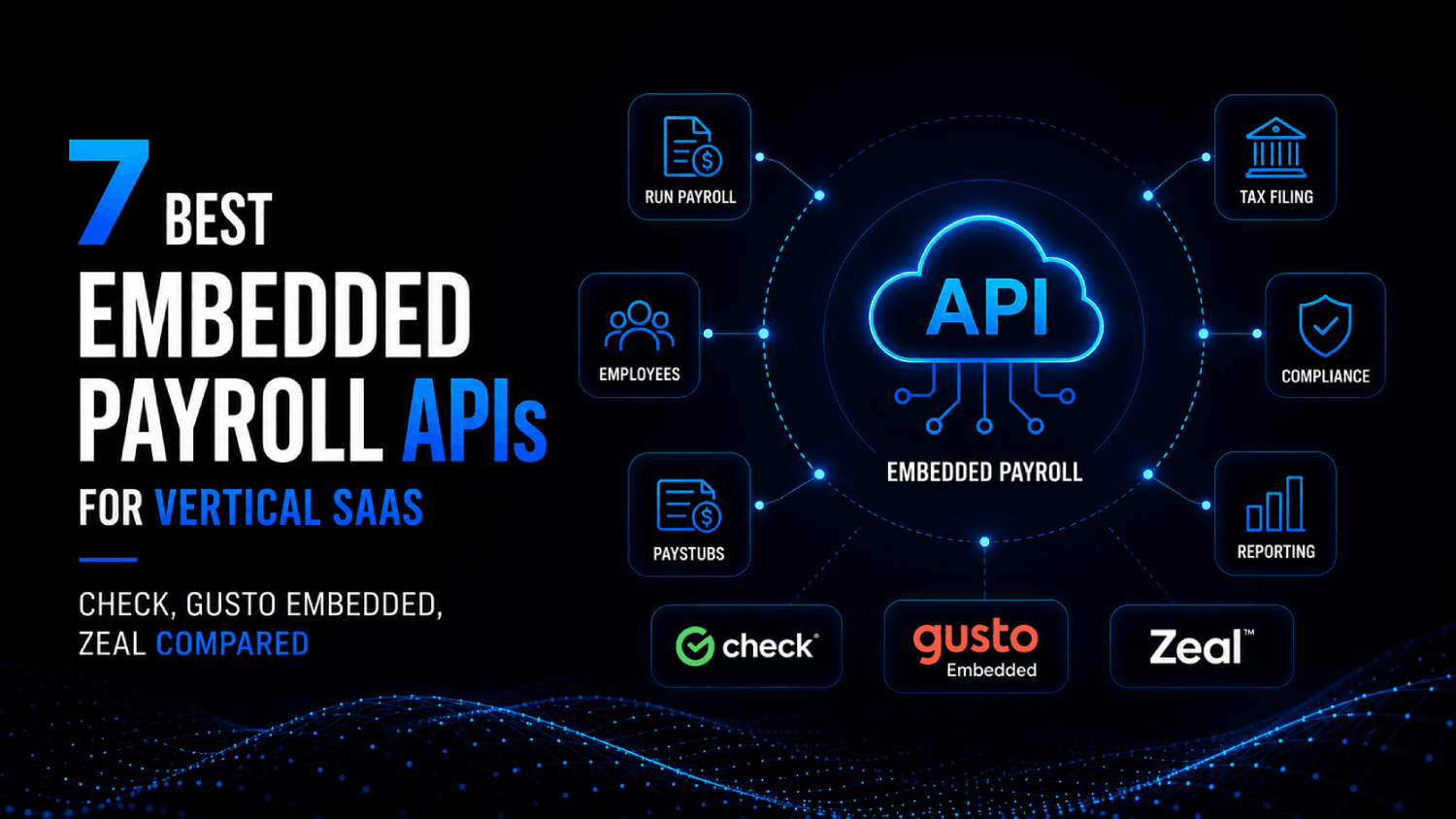

- Embedded payroll providers like Check, Gusto Embedded, and Zeal carry federal and state tax filing on your behalf, so you are not becoming a payroll company, you are reselling one’s infrastructure.
- The compliance burden that keeps most vertical SaaS founders away from payroll is already solved at the infrastructure layer. The real decision is how much control over UX, pricing, and margins you want to retain.
- Check gives the most white-label flexibility and targets developer-first teams building proprietary payroll UX. Gusto Embedded brings a recognizable brand and faster time to market. Zeal competes on pricing transparency and contractor-first workflows.
- Tax filing coverage, states supported, and who holds the employer of record liability vary meaningfully across providers. Those differences matter more than API design once you go live.
- Most vertical SaaS platforms that ship payroll price it as a per-employee-per-month add-on, which converts existing users rather than requiring new sales motion.
The best embedded payroll APIs for vertical SaaS are Check, Gusto Embedded, Zeal, Rippling Embedded, Salsa, Paychex Flex Embedded, and Fingercheck. Each handles federal and state tax filing and remittance as part of their infrastructure, which means your platform never needs to register as a payroll provider, manage tax agency accounts, or hold payroll funds. The compliance layer is already built. Your job is to pick the provider whose API model, pricing structure, and state coverage match where your customers actually operate.
Why Payroll Is the Highest-Retention Revenue Line Vertical SaaS Can Add
Payroll processes on a fixed clock. Every two weeks, your customer logs in, runs a payroll, and has a reason to stay. No other embedded finance product, not payments, not lending, not banking, creates that kind of mandatory recurring engagement. Platforms that add payroll see churn rates that are structurally lower because switching payroll providers mid-quarter carries real business risk for the customer.
The revenue math is also straightforward. A vertical SaaS serving 500 small businesses, each with 8 employees on average, at $6 per employee per month, generates $288,000 in annual recurring revenue from payroll alone, layered on top of existing subscription revenue. That number does not require acquiring a single new customer. It comes from upselling the base you already have. If you are evaluating pricing models in fintech SaaS, embedded payroll is one of the cleaner per-unit attach plays available to a vertical platform.
The misconception most founders carry is that offering payroll means becoming a payroll company, which would require state registrations, tax agency relationships, and liability for misfiled returns. That was true before payroll infrastructure APIs existed. Today, the embedded payroll model transfers that compliance burden to the provider. Your platform is the front end. The provider is the back end.
Build vs. Embed: Why Almost No Vertical SaaS Team Should Build Payroll from Scratch
Building payroll from scratch means maintaining tax tables for all 50 states plus DC, registering with state unemployment agencies, filing 940s and 941s with the IRS, handling W-2s and 1099s at year end, and managing the ACH timing windows that determine when employees get paid. One tax rule change in a state where you have 40 customers can trigger a sprint that derails your product roadmap for weeks.
The operational surface area is enormous. Payroll compliance spans federal income tax withholding, FICA (Social Security and Medicare), FUTA, state income tax in 41 states, state unemployment insurance in all 50, plus local taxes in cities like New York, Philadelphia, and Detroit. That is not an API call. That is an ongoing legal and compliance operation requiring dedicated tax expertise.
Embedded payroll APIs solve this by making the provider the payroll service provider of record for tax purposes. When Check or Gusto Embedded files a 941 for your customer, that filing goes out under their tax ID infrastructure, not yours. Your engineering team writes API calls. The provider handles the regulatory relationship. For the vast majority of vertical SaaS teams, the embedded route produces a shippable payroll product in weeks rather than years, at a fraction of the ongoing compliance cost. The fintech infrastructure stack now has a payroll layer with the same API-first design pattern as payments, banking, and lending.
The FintechSpecs Payroll Provider Stress Test
Before comparing specific providers, it helps to have a consistent evaluation lens. Most comparison articles list features. This one applies what we call the FintechSpecs Payroll Provider Stress Test, four criteria that expose the real operational risks of picking the wrong embedded payroll partner. Each provider section below scores against these same four criteria, so you can track how the trade-offs compound across the field rather than evaluating each provider in isolation.
Tax filing completeness: Does the provider file and remit to all 50 states, or does it cap out at a subset? Providers that cover fewer states force you to turn away customers in those states, or manage the gap manually.
Liability ownership: When a tax filing error occurs, who bears the penalty? Some providers contractually accept tax accuracy liability; others push it back to the platform. Read the partner agreement before signing.
Margin architecture: Does the provider charge a flat per-employee fee you mark up, or does it take a revenue share from what you charge your customers? Flat fees let you set your own margin. Revenue shares cap your upside as you scale.
Contractor and worker type coverage: Many vertical SaaS platforms serve industries with high contractor ratios, like home services, construction, or staffing. If the provider’s API handles W-2 employees but treats 1099 contractors as an afterthought, you will hit product gaps quickly.
7 Best Embedded Payroll APIs for Vertical SaaS
1. Check
Check is the provider most developer-first vertical SaaS teams end up choosing when they want maximum white-label control. Check’s API gives platforms access to the raw payroll calculation and tax filing engine without forcing any Check-branded UI on the customer. Your platform owns the entire user experience, and Check operates invisibly in the background.
According to Check’s public documentation, the platform supports all 50 states and DC for tax filing and remittance, handles federal, state, and local tax filings, and manages year-end W-2 and 1099 production. Check processes both employees and contractors through the same API, which matters for platforms in industries with mixed workforces. The platform is built specifically for vertical SaaS partners rather than for end employers, so the API design reflects the multi-tenant architecture most SaaS teams are building.
Check does not publicly list its per-employee pricing on its website. Pricing is negotiated through a partner agreement, which is standard for infrastructure-layer payroll providers targeting platforms at scale. For smaller platforms just getting started, that requires a sales conversation before you can model unit economics.
Against the Stress Test: Tax filing completeness is strong across all 50 states and local jurisdictions per public documentation. Liability ownership terms are in the partner agreement, not the marketing site , get them in writing. Margin architecture is flat PEPM, which gives you full control over your retail price. Contractor coverage is native to the API, not an add-on.
2. Gusto Embedded
Gusto Embedded brings Gusto’s decade of payroll infrastructure to platforms that want faster time to market without building UI from scratch. Gusto’s embedded product lets platforms offer payroll under their own brand while relying on Gusto’s existing tax filing, compliance, and HR infrastructure underneath. According to Gusto’s public developer documentation, the embedded API provides access to company and employee onboarding, payroll run processing, and tax filing workflows.
The tradeoff relative to Check is flexibility versus speed. Gusto Embedded ships with more pre-built UI components and workflows, which gets a team to a working product faster but reduces how much you can customize the experience. For vertical SaaS platforms where payroll is an add-on feature rather than the core product, that tradeoff often works in Gusto’s favor. Gusto’s name recognition also carries trust with end employers who recognize the brand, which can reduce the friction of convincing a small business to switch their payroll.
Pricing for Gusto Embedded is not publicly listed. Partners go through Gusto’s platform team to negotiate terms. Gusto’s end-employer pricing on its direct product starts at $40 per month plus $6 per person per month as listed on their public pricing page, but embedded partner pricing is separate and negotiated.
Against the Stress Test: Tax filing completeness mirrors Gusto’s direct product, which covers all 50 states. Liability ownership needs to be confirmed in the partner agreement , Gusto’s direct product carries tax accuracy commitments that do not automatically transfer to partner contracts. Margin architecture is negotiated, with less public visibility into wholesale rates than Zeal. Contractor coverage is supported but was not the design origin of the product; platforms with high 1099 ratios should confirm workflow depth before signing.
3. Zeal
Zeal positions itself as the most developer-transparent embedded payroll option, with publicly documented pricing and a design that prioritizes contractor and on-demand pay workflows. Zeal’s API covers all 50 states for tax filing and handles W-2 employees, 1099 contractors, and on-demand pay (also called earned wage access) through a single integration.
Zeal’s public pricing page lists fees per payroll run and per employee, which is unusual in this category. That transparency lets a platform model unit economics before starting a sales conversation. For vertical SaaS teams serving gig, staffing, or home services markets where a large share of the workforce is 1099, Zeal’s contractor-native design is a genuine product differentiator rather than a marketing claim.
Zeal is smaller than Check and Gusto by partner count, which means its network of integrations is narrower and its support team handles fewer edge cases at volume. For early-stage platforms with straightforward payroll needs, that is not a problem. For platforms expecting high payroll complexity across many states from day one, the relative youth of Zeal’s platform is worth weighing.
Against the Stress Test: Tax filing completeness covers all 50 states per public documentation. Liability ownership should still be confirmed in the partner agreement despite the general transparency of Zeal’s pricing documentation. Margin architecture is the most favorable on this list for early-stage teams because public pricing lets you model the spread before any sales conversation. Contractor coverage is the strongest native implementation in the category.
4. Rippling Embedded
Rippling offers an embedded payroll product built on the same infrastructure that powers its direct HR and payroll platform. Rippling’s embedded path gives vertical SaaS partners access to payroll, benefits, and HR workflows, which makes it a fit for platforms that want to offer a broader suite rather than standalone payroll. The unified employee record that spans payroll, time tracking, and HR is a real advantage for platforms in industries like healthcare SaaS or construction tech where workforce management spans multiple data types.
The embedded product is not as API-pure as Check. Rippling’s embedded model leans toward licensing its existing product experience rather than giving platforms raw infrastructure to build on top of. That means faster time to market and a richer out-of-box feature set, but less flexibility to build a fully custom UX. Pricing is not publicly listed and requires direct contact with Rippling’s partnerships team.
Against the Stress Test: Tax filing completeness is strong given Rippling’s direct product scale. Liability ownership is opaque pre-contract , this is where the Stress Test matters most for Rippling, because the embedded partner agreement differs from the direct employer agreement. Margin architecture involves negotiated pricing with less flexibility to undercut on PEPM than Check or Zeal. Contractor coverage is supported but secondary to the W-2 employee workflow that is Rippling’s design origin.
5. Salsa
Salsa is purpose-built for vertical SaaS, positioning itself as payroll infrastructure rather than a payroll product. Salsa’s model is the most API-native on this list after Check, giving platforms control over the tax calculation and filing layer while exposing the data needed to build custom compensation workflows. Salsa supports all 50 states and covers W-2 employees and 1099 contractors.
Salsa explicitly targets platforms in industries like home services, construction, restaurants, and staffing, which means its API design accounts for irregular pay periods, tipped wages, and piece-rate compensation that generic payroll APIs handle poorly. If your vertical has non-standard pay structures, Salsa is worth evaluating before defaulting to Check or Gusto. Pricing is not publicly listed.
Against the Stress Test: Tax filing completeness covers all 50 states, with above-average handling of edge cases like tipped wages and piece-rate compensation. Liability ownership requires partner agreement review , Salsa’s vertical-specific design does not automatically mean clearer liability terms. Margin architecture is negotiated PEPM with no public benchmarks. Contractor coverage is solid, and the irregular pay period support is a genuine differentiator for the construction and home services verticals where contractor-to-employee ratios are high.
6. Paychex Flex Embedded
Paychex offers embedded payroll through its Paychex Flex platform, which gives vertical SaaS partners access to one of the largest payroll processing networks in the US. Paychex’s embedded offering targets platforms that serve mid-market employers, roughly 50 to 1,000 employees, where the complexity of multi-state payroll, union rules, and benefits administration becomes significant.
Paychex brings enterprise-grade compliance depth and a broad state coverage map built over decades. The tradeoff is that Paychex’s API is not as developer-friendly as Check or Zeal, and the partner onboarding process reflects an enterprise sales motion that moves slowly for early-stage SaaS teams. It is the right fit for platforms already serving mid-market employers who need the compliance track record, not for seed-stage teams shipping their first payroll feature.
Against the Stress Test: Tax filing completeness is the strongest on this list by track record, including local jurisdiction depth that smaller providers cannot yet match. Liability ownership terms reflect Paychex’s institutional compliance culture , more likely to have explicit contractual commitments than a newer provider, but still requires review. Margin architecture is negotiated and typically less favorable for low-volume partners. Contractor coverage is supported but mid-market W-2 payroll is where Paychex’s depth is clearest.
7. Fingercheck
Fingercheck offers a white-label payroll API that sits at the intersection of time tracking, HR, and payroll. Its embedded product is used by platforms that want to bundle workforce management with payroll rather than selling payroll standalone. Fingercheck handles federal and state tax filing and covers a broad range of pay types including hourly, salaried, and contractor.
Fingercheck is a smaller provider than Check or Gusto, which means its state coverage and compliance depth in edge cases (local taxes, specific state unemployment rules) should be verified against your customer base’s actual geography before signing. For platforms serving primarily small employers in major metro areas with simple payroll structures, Fingercheck’s white-label depth and time-tracking integration are real advantages. For platforms with complex multi-state exposure, due diligence on tax accuracy liability is required.
Against the Stress Test: Tax filing completeness should be verified directly, particularly for local jurisdictions , this is the single biggest flag Fingercheck raises under the Stress Test. Liability ownership terms require careful review given the provider’s smaller scale. Margin architecture requires direct contact for pricing. Contractor coverage is supported across pay types, but the time-tracking integration is the primary product differentiator rather than contractor workflow depth.
States Covered, Tax Filing, and Pricing: Provider Comparison Table
| Provider | All 50 States + DC | Federal Tax Filing | State Tax Filing | Year-End (W-2/1099) | Contractors Supported | Public Pricing | Best For |
|---|---|---|---|---|---|---|---|
| Check | Yes | Yes | Yes | Yes | Yes | No (negotiated) | Developer-first, fully custom UX |
| Gusto Embedded | Yes | Yes | Yes | Yes | Yes | No (negotiated) | Faster time to market, brand trust |
| Zeal | Yes | Yes | Yes | Yes | Yes (contractor-native) | Yes (public) | Gig, staffing, on-demand pay |
| Rippling Embedded | Yes | Yes | Yes | Yes | Yes | No (negotiated) | Payroll + HR + benefits bundle |
| Salsa | Yes | Yes | Yes | Yes | Yes | No (negotiated) | Non-standard pay structures, restaurants, construction |
| Paychex Flex Embedded | Yes | Yes | Yes | Yes | Yes | No (negotiated) | Mid-market employers, enterprise compliance |
| Fingercheck | Verify against your states | Yes | Yes | Yes | Yes | Contact required | Time tracking + payroll bundle, SMB |
Gusto Embedded vs Check: How to Choose Between the Two Market Leaders
Most vertical SaaS evaluations narrow to Gusto Embedded or Check once the team rules out building in-house. The choice between them comes down to one question: do you want to sell payroll as a feature or as a product?
If payroll is a feature you are adding to a broader SaaS, Gusto Embedded’s pre-built UI components, recognizable brand, and faster implementation path make it the better default. Your engineering team spends less time on UI and more time on the core product. Your customers see a familiar interface, which reduces support tickets during rollout. The cost is that you cannot fully differentiate the payroll experience from what Gusto’s direct competitors offer.
If payroll is a core product that defines your platform’s competitive position, Check is the better choice. Check’s API gives you the tax engine, the state registrations, and the ACH infrastructure without prescribing any UI. You build the experience entirely. That means more engineering investment upfront, but it also means the payroll product your customers see is distinctly yours. Check’s architecture is also the better fit if you plan to build adjacent features, like earned wage access, compensation benchmarking, or payroll-linked lending, on top of the payroll data later.
One structural difference that matters operationally: Check does not serve end employers directly. It is a pure infrastructure provider. Gusto does serve employers directly through its consumer-facing product, which means Gusto’s embedded business competes with its own direct sales team at some margin. That dynamic is not a dealbreaker, but it is worth asking Gusto’s partnerships team how they manage channel conflict at the contract level.
How Vertical SaaS Platforms Actually Price Embedded Payroll
The most common model is a per-employee-per-month (PEPM) charge billed to the employer through your platform. You pay your infrastructure provider a wholesale PEPM rate and charge your customers a marked-up retail rate. The spread between those two numbers is your payroll gross margin.
To make this concrete across different platform profiles, consider three illustrative scenarios. A home services SaaS with 600 employers averaging 10 employees each, paying $3 PEPM wholesale and charging $8 PEPM retail, generates $576,000 annually at roughly 62% gross margin on the payroll line. The margin is clean because the compliance costs sit at the infrastructure layer, not the per-customer layer. A restaurant tech SaaS with 200 employers averaging 25 employees each , heavier headcount, more hourly workers, more pay runs per month , at the same $3/$8 PEPM spread generates $480,000 annually on payroll, but may also add a per-run fee given the weekly pay cycles common in food service, pushing effective revenue higher. A construction SaaS with 150 employers averaging 20 employees each, but spanning 8 to 12 states per employer due to project-based work, faces a different margin profile: state complexity may push wholesale costs higher if the provider charges more for multi-state employers, compressing the spread to something closer to 40 to 50% unless you negotiate volume tiers early.
These scenarios are illustrative, not guarantees , your actual spread depends on the volume commitment you can bring to the negotiating table and the geographic concentration of your customer base. But running all three profiles before you pick a provider tells you whether a flat PEPM model (Check, Gusto) or a run-based model (Zeal) is more favorable for your specific customer mix. Providers with negotiated pricing give you more room to optimize as you scale. The economics of fintech SaaS gross margins make payroll particularly attractive because the compliance costs are mostly fixed at the infrastructure layer, not variable per customer.
Some platforms add a per-payroll-run fee on top of PEPM, which captures revenue from employers with more frequent pay cycles. Others bundle payroll into a higher SaaS tier rather than pricing it separately. Bundling simplifies the sales motion but obscures your payroll unit economics from investors, which matters more as you approach a Series B or C. If you are still working through how payroll fits your overall fintech SaaS scale plan, the pricing model decision and the provider decision are linked , get both right before you build.
What Tax Filing Liability Actually Means for Your Platform
Every embedded payroll provider files taxes on behalf of your customers, but the question of who is liable when a filing is wrong or late varies by contract. This is where founders underinvest in diligence. A tax penalty for a missed state unemployment filing can be hundreds to thousands of dollars per affected employer, and if your partner agreement pushes that liability to your platform rather than the provider, you are accumulating off-balance-sheet risk that compounds with every customer you add.
Check and Gusto Embedded both publish documentation around their tax accuracy commitments, but the specific liability terms live in the partner agreement, not the marketing website. Before signing with any provider, ask specifically: who bears the penalty when a federal or state tax filing is late or incorrect, and what is the remediation process? The answer should be in writing. If a provider answers this question vaguely during sales, treat it as a signal about how they handle problems after the contract is signed. The fintech product and compliance readiness checklist covers how to structure these vendor conversations at the diligence stage.
Local tax jurisdictions, including city and county income taxes in states like Pennsylvania, Ohio, and Michigan, are where most providers’ coverage gets complicated. A provider that covers 50 states for state-level filing may still leave local tax filing to your platform or to the employer. Map your customer base’s geographic concentration and confirm local tax handling before you go live.
Embedded Payroll API Frequently Asked Questions
What is an embedded payroll API?
An embedded payroll API is a software interface that lets a vertical SaaS platform offer payroll processing to its customers without building tax calculation, state registration, or filing infrastructure in-house. The API provider handles federal and state tax computation, filing, and remittance. The platform builds the user experience on top of that infrastructure and bills customers for payroll as part of its product. Providers in this category include Check, Gusto Embedded, Zeal, and Salsa.
Do embedded payroll providers handle all 50 states?
The major embedded payroll API providers, including Check, Gusto Embedded, Zeal, Rippling, and Salsa, cover all 50 states and DC for federal and state payroll tax filing and remittance. Local tax coverage, which includes city and county income taxes in states like Pennsylvania and Ohio, varies by provider and should be confirmed against your specific customer geography before signing a partner agreement. Fingercheck’s local coverage should be verified directly given its smaller scale.
How do vertical SaaS platforms make money from embedded payroll?
Vertical SaaS platforms typically pay their payroll infrastructure provider a wholesale per-employee-per-month (PEPM) rate and charge their customers a higher retail PEPM rate. The margin between those rates is the platform’s gross profit on payroll. A secondary revenue source is per-payroll-run fees for employers who pay weekly or bi-weekly rather than semi-monthly. Some platforms also earn revenue by offering payroll-adjacent products like earned wage access or payroll-linked lending built on top of the payroll data.
What is the difference between white-label payroll and embedded payroll?
White-label payroll typically refers to licensing a complete payroll product that you rebrand as your own, with limited ability to customize the underlying functionality. Embedded payroll refers to integrating a payroll API into your own product, giving your team control over the user experience, data flows, and feature set. Check is embedded in the purest sense. Gusto Embedded sits between the two, offering an API with pre-built UI components. The distinction matters because it determines how much engineering investment you need and how differentiated your payroll product can be.
How long does it take to integrate an embedded payroll API?
Integration timelines depend heavily on how much custom UI you build. Platforms using Gusto Embedded’s pre-built UI components report going live in a matter of weeks. Platforms building fully custom experiences on Check’s API typically take two to four months for a production-ready integration, depending on team size and payroll complexity in their specific vertical. Year-end tax forms, multi-state employer onboarding, and contractor 1099 workflows add the most integration complexity regardless of provider.
Can I use an embedded payroll API if my customers are in multiple states?
Yes, and multi-state support is one of the primary reasons to use an embedded payroll API rather than building in-house. Providers like Check, Gusto Embedded, and Zeal handle state tax registration, withholding calculation, and filing for employers with employees in multiple states. The employer does not need separate state registrations for each state where employees work. The payroll provider manages those registrations as part of the service. Confirm with any provider which states they cover before assuming universal coverage.
What should I ask an embedded payroll provider before signing?
Ask six questions: Which states do you cover for tax filing and remittance, including local jurisdictions? Who bears the liability for a tax filing penalty? What is your remediation process for tax errors? Do you handle 1099 contractors as a native workflow or as an add-on? What are your ACH cutoff times for direct deposit, and what happens when a pay date falls on a bank holiday? What is the pricing structure at different employer volumes, and is it per-employee or per-run? Getting written answers to all six before you sign prevents the most common post-launch problems.
Which Embedded Payroll API Should You Choose?
Check is the right call for teams building payroll as a differentiated core product in a vertical where the user experience itself is a competitive advantage. Gusto Embedded is the right call for teams adding payroll as a high-retention feature layer on top of a broader SaaS product, where speed to market and brand trust matter more than UX control. Zeal wins when your customers are predominantly contractors or gig workers, because its API was designed around that use case from the start rather than adapted from a traditional employee payroll engine.
For teams in industries with non-standard pay, Salsa is worth a serious look before defaulting to the two market leaders. For platforms already serving mid-market employers with complex HR needs, Rippling’s bundle is worth the more cumbersome API. Paychex is the choice when your buyer is a 200-person employer who needs a compliance track record their CFO can point to.
Payroll is not a feature you add and forget. It is a compliance operation running on a two-week clock for every customer on your platform. The provider you choose becomes a permanent operational partner, not a vendor you can swap when a better API comes out. Run the FintechSpecs Payroll Provider Stress Test against every provider you shortlist , score each one on tax filing completeness, liability ownership, margin architecture, and contractor coverage before you get to contract negotiation. Get liability terms in writing. Map your customer geography against the provider’s state coverage. The platforms that have turned payroll into a moat did not pick the most-marketed provider. They picked the one whose infrastructure matched their specific vertical’s workforce complexity, and then built something their customers could not easily move off of. As you think through where embedded payroll fits in your broader infrastructure decisions, the embedded finance APIs available to SaaS companies shows how payroll connects to adjacent products like banking, lending, and card issuing that compound the switching cost further. And if you are still working through vendor selection methodology more broadly, the 7-point fintech vendor evaluation framework applies directly to embedded payroll partner decisions.