
- AI credit memo software extracts borrower financials, spreads statements, and drafts memo scaffolding with citations back to source documents, so analysts review rather than transcribe.
- Audit trails improve under automation because every extracted figure links to a specific page and line in the source document, which manual spreading rarely achieves.
- The tools in this category split into two jobs: financial spreading (structured data extraction from tax returns and statements) and full memo generation (narrative drafts, covenant analysis, risk flags).
- Pricing across this category is almost entirely custom and quote-driven. Any vendor that publishes a rate card is the exception, not the rule.
- The realistic analyst-time recovery for a mid-market commercial lender running 40 to 60 deals per quarter sits between 15 and 25 hours per analyst per month, based on vendor-published case studies. No single study is independently audited, so treat this as a directional range, not a guaranteed benchmark.
The best AI credit memo and financial spreading tools in this category are Spreading AI, Accend, Blooma, Baker Hill, Lendio, Cascade, and Monit. Each handles a different piece of the commercial credit workflow, from OCR-based tax return spreading to full credit committee package generation. The right choice depends on whether your bottleneck is document ingestion, memo drafting, or covenant monitoring after close.
Why Do Commercial Lenders Still Spend 6+ Hours Per Deal on Spreading?
Ask any credit analyst at a community bank or regional lender where the time goes, and the answer is consistent: re-keying numbers from PDFs. A three-year spread of a borrower’s Schedule K-1, two years of business tax returns, and interim financials can take a senior analyst three to five hours before a single sentence of the credit memo is written. That is not analysis. That is transcription.
The manual process compounds risk in a second way most credit teams do not discuss openly: when a human re-keys 400 data points from a scanned tax return, transcription errors enter the spread. Those errors propagate into debt service coverage ratios, global cash flow calculations, and ultimately into credit committee decisions. A tool that pulls figures directly from source documents and timestamps each extraction does not just save time. It removes an entire class of error.
The category of AI credit memo software addresses this by doing the extraction and formatting work programmatically, then presenting the analyst with a structured spread and, in the more advanced tools, a narrative draft of the credit memo. The analyst’s job shifts from building the spread to auditing it. That shift is where the meaningful time recovery happens.
How Does the FintechSpecs Spreading Stack Test Work?
Evaluating tools in this category is harder than comparing payment APIs because vendors in this space do not publish audited accuracy benchmarks for public comparison, demos use clean sample documents rather than the messy 80-page tax returns real lenders see, and pricing is uniformly custom. We developed what we call the FintechSpecs Spreading Stack Test to create a consistent evaluation lens across all seven tools.
The test has four criteria. First, source fidelity: does every extracted figure link back to a specific document, page, and line item so an examiner can trace it? Second, document breadth: can the tool handle 1065 partnership returns, Schedule K-1 attachments, rent rolls, personal tax returns, and interim QuickBooks exports in a single workflow, or only clean GAAP statements? Third, memo completeness: does the tool produce a structured narrative with risk factors and recommended structure, or just a populated spread template? Fourth, workflow integration: does it connect to existing loan origination systems or require analysts to live in yet another platform?
No tool in this category scores perfectly on all four. The ones that do spreading exceptionally well tend to be weaker on memo generation. The full-memo platforms often sacrifice granular source traceability for narrative coherence. That trade-off is the central decision a credit team needs to make before choosing.
Which AI Tools Actually Spread Financial Statements?
Spreading AI
Spreading AI is the narrowest and most purpose-built tool in this list. It focuses almost entirely on automating the extraction and normalization of borrower financial statements, including personal and business tax returns, compiled statements, and rent rolls. The platform maps extracted data to a standardized chart of accounts, which matters for lenders that need comparability across a portfolio of borrowers who file very differently.
Source fidelity is the product’s strongest trait. Every figure in the output spread carries a reference back to the originating document and location, which satisfies the audit trail requirement that typically makes compliance officers nervous about automation. The company does not publish pricing publicly, so budget planning requires a direct conversation.
Spreading AI fits best at banks and credit unions running high volumes of small business and commercial real estate deals where spreading speed is the primary bottleneck. It does not try to draft the narrative memo. If your team needs a draft credit committee package alongside the spread, pair it with a memo generation tool or plan to write that section manually.
Accend
Accend covers more of the credit workflow than pure spreading tools do. It handles financial statement extraction, global cash flow spreading, and covenant monitoring in one platform, which reduces the number of handoffs between systems during underwriting. That end-to-end coverage is what earns it a spot in both this list and the AI underwriting spoke on FintechSpecs.
The covenant monitoring piece is worth calling out specifically. Most spreading tools stop at origination. Accend tracks ongoing covenant compliance against spread financials after a loan closes, alerting relationship managers when a borrower’s DSCR or leverage ratio approaches a trigger threshold. For lenders with large C&I portfolios, that post-close monitoring capability materially reduces the manual labor of annual review cycles.
Accend does not publish pricing. The platform targets community banks, credit unions, and CDFI lenders with existing loan origination workflows they want to augment rather than replace.
Blooma
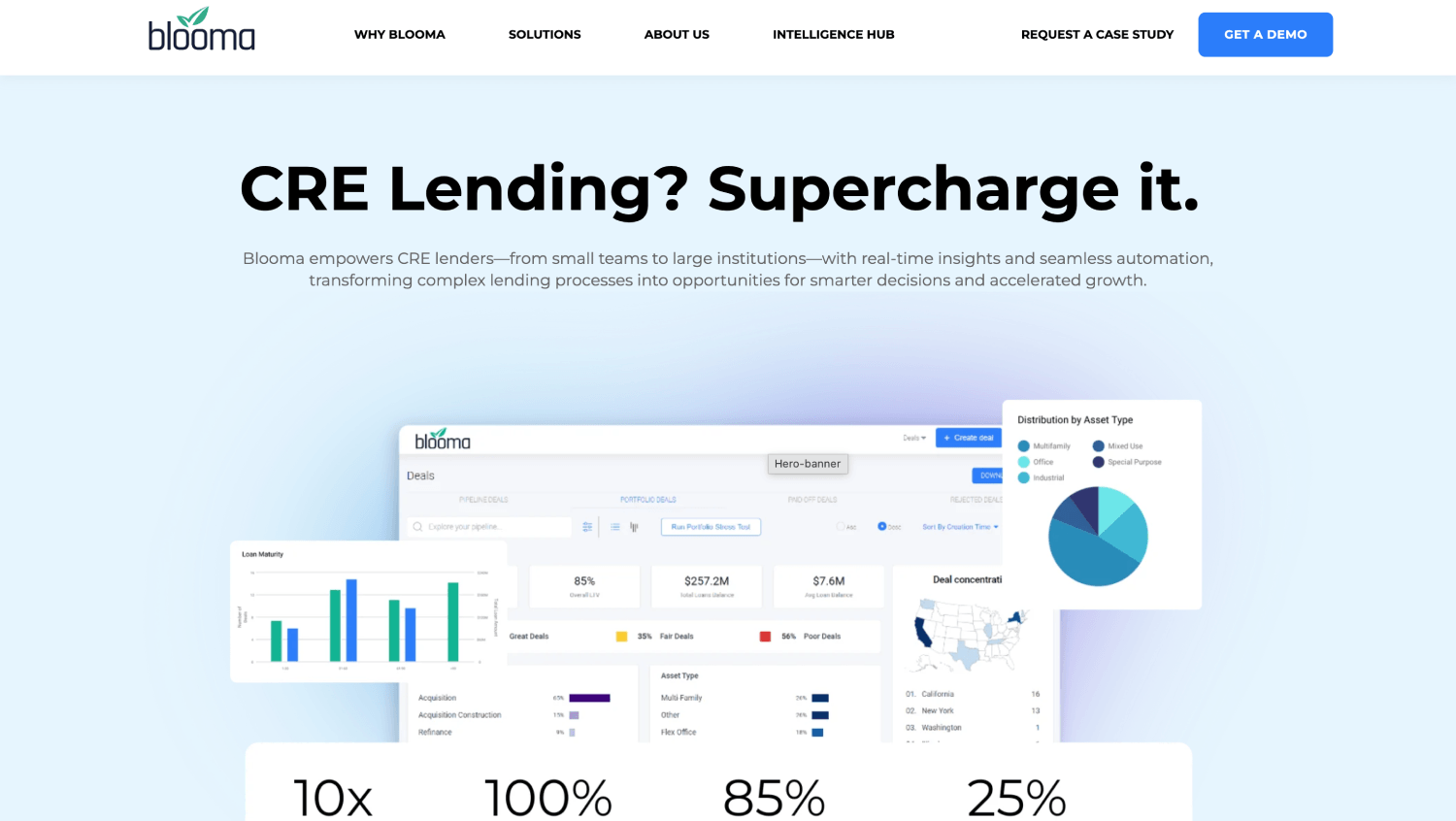
Blooma is built specifically for commercial real estate lending. It ingests rent rolls, property financials, and market comparables to produce automated underwriting memos for CRE deals. The product is distinct from the general commercial credit tools above because it incorporates property-level data alongside borrower financials, which changes the analysis framework significantly for income-producing properties.
Blooma generates a structured credit memo draft including a property summary, financial analysis, and risk assessment narrative. For lenders doing multifamily, office, or retail deals, having the underwriting memo and the spread come from the same system reduces reconciliation errors between the two documents. Pricing is quote-based.
Lenders doing C&I or SBA deals will find Blooma a poor fit because it is not designed for operating company financials. Its value is specific to real property cash flows and CRE underwriting logic.
Baker Hill
Baker Hill is a legacy commercial lending platform that has added AI-assisted spreading and memo generation capabilities to its loan origination system. The key distinction from the standalone tools above is integration depth. Baker Hill’s spreading module lives inside its broader LOS, so the spread flows directly into the credit decision workflow without any file transfer or copy-paste step.
For community banks already on Baker Hill’s NextGen LOS, the AI spreading upgrade is the path of least resistance. For lenders not already in the Baker Hill platform, evaluating it as a standalone spreading tool makes little sense. The total implementation footprint is large, and the value comes from the integrated workflow, not from the AI extraction model alone.
Baker Hill does not publish module-level pricing publicly. Implementation timelines for new customers are measured in months, not weeks, which matters for teams evaluating urgency.
Lendio
Lendio sits at a different point in the market than the other tools on this list. It is primarily a small business lending marketplace, but its platform includes automated financial data ingestion and standardized credit analysis output for lenders using its network. For community lenders or CDFIs that source deals through Lendio’s marketplace, the financial spreading happens as part of the application flow, and analysts receive pre-populated deal packages rather than raw borrower documents.
The limitation is control. Lenders that want to configure their own spreading templates, define their own DSCR calculation methodology, or apply institution-specific credit policy rules will find Lendio’s standardized output too rigid. It is a good fit for lenders willing to accept a common framework in exchange for deal flow and reduced document collection burden. Lendio does not publish platform pricing for lenders publicly.
Cascade

Cascade approaches the credit memo problem from the data modeling side. It is a financial planning and analysis tool that some commercial lenders have adapted for spreading and credit analysis, particularly at fintechs and non-bank lenders that do not have legacy LOS infrastructure. The tool handles multi-entity financial consolidations well, which matters for complex borrowers with holding company structures.
Cascade is not a purpose-built credit memo platform. Lenders using it for spreading are configuring a general FP&A tool to approximate credit-specific workflows, which creates flexibility but also creates ongoing maintenance burden. Teams that choose this path usually have strong internal finance and analytics talent that can build and maintain the configuration. Pricing is available on request.
Monit

Monit connects to borrower accounting systems directly, pulling live financial data rather than relying on document uploads. For lenders working with small business borrowers that use QuickBooks Online, Xero, or similar platforms, Monit provides continuous financial monitoring that updates the borrower’s spread in real time without requiring periodic document collection from the borrower.
The real-time feed model changes the monitoring cadence fundamentally. Instead of waiting for annual tax returns or quarterly statement submissions, a relationship manager can see a borrower’s current revenue trend, cash balance, and expense ratios on a rolling basis. That shifts covenant monitoring from a reactive process to a proactive one. Monit does not publish pricing, and the product targets bank relationship managers rather than analysts, which affects where it fits in the workflow.
What Does Each Tool Actually Do in a Real Deal?
Consider a hypothetical but operationally realistic scenario: a community bank credit analyst is underwriting a $3.2 million C&I term loan for a regional HVAC contractor with three operating entities, two years of business tax returns per entity, a personal return for the guarantor, and interim financials through the most recent quarter. That is roughly 240 pages of documents and somewhere between 600 and 900 individual data points to extract and normalize before the spread is complete.
Under a manual process, that spread takes four to six hours. A tool like Spreading AI or Accend can process the same document set and produce a normalized spread in under 30 minutes, with every figure traceable to its source page. The analyst then spends one to two hours reviewing the output, checking edge cases like depreciation add-backs and non-recurring income items, and flagging anomalies for discussion in the credit memo. Total analyst time on the spreading phase drops from five hours to roughly 90 minutes. Across 40 deals per quarter, that recovers approximately 140 analyst hours per analyst per quarter, roughly four full work weeks. These figures are illustrative of the workflow mechanics, not independently verified benchmarks.
The memo generation tools, Blooma for CRE and the more advanced configurations of Baker Hill, then take the verified spread and produce a narrative draft with risk factors, collateral analysis, and recommended loan structure. That draft is not the final memo. It is a starting point that a senior credit officer edits and approves. But a two-hour edit of a solid draft is faster than writing from a blank page, and the institutional knowledge about what a good memo requires stays with the credit officer rather than being embedded in the AI output.
| Tool | Primary Use Case | Memo Generation | Covenant Monitoring | Best Fit |
|---|---|---|---|---|
| Spreading AI | Financial statement extraction and spreading | No | No | High-volume community banks, SBA lenders |
| Accend | End-to-end underwriting and post-close monitoring | Partial | Yes | Community banks, CDFIs, credit unions |
| Blooma | CRE underwriting and memo drafting | Yes | No | Commercial real estate lenders |
| Baker Hill | Integrated LOS with AI spreading | Yes | Partial | Community banks on Baker Hill LOS |
| Lendio | Marketplace-sourced deal pre-packaging | Partial | No | CDFIs and community lenders in Lendio network |
| Cascade | Multi-entity financial modeling and spreading | No | No | Non-bank lenders with analytics teams |
| Monit | Live accounting data monitoring | No | Yes | Banks monitoring small business borrowers |
Does Automated Spreading Actually Improve Audit Outcomes?
The assumption most credit teams carry into evaluating these tools is that automation introduces audit risk. The logic seems sound: if AI makes an extraction error, and that error propagates into a credit decision, a regulator reviewing the file would find a gap between the source document and the spread that the analyst never caught. That is a legitimate concern for a poorly designed tool. It is not an accurate description of how the leading tools in this category work.
Purpose-built spreading tools are architected around source traceability by design. Every extracted value in Spreading AI’s output, for example, carries a reference pointer back to the exact document, page, and field from which it was pulled. An examiner reviewing a credit file can trace any figure in the spread to its origin in seconds. Manual spreading, by contrast, typically produces a spread with no embedded citation trail. An examiner who questions a figure has to ask the analyst to reconstruct how they arrived at it, which is slower and less reliable.
The audit trail argument for AI spreading is actually stronger than the argument for manual spreading, provided the lender validates extraction accuracy during implementation and builds a review step into the workflow. The review step is non-negotiable. These tools are not autonomous decision-makers. They are draft-generation systems, and a trained analyst reviewing AI output is functionally equivalent to a quality control step that manual spreading rarely has.
For lenders building out their underwriting stack more broadly, the credit decisioning platform comparison on FintechSpecs covers how spreading feeds into the broader decision engine, including rule-based policy overlays and model-based scoring.
What Should a Lender Evaluate Before Choosing AI Credit Memo Software?
Three questions tend to separate lenders that implement these tools successfully from those that shelve them after six months. First: what document types does your portfolio actually generate? A lender focused on SBA 7(a) deals sees a very different document mix than a lender doing large C&I credits or multifamily CRE. The tool needs to handle your specific document types, not a generic sample set.
Second: where does the spread go after it is built? If your analysts produce a spread in one system and then manually re-enter figures into your LOS or credit memo template, you have eliminated one transcription step and added another. The value compounds when the spread output flows directly into the downstream workflow without manual intervention.
Third: what is your credit policy configuration requirement? Most AI spreading tools produce a normalized output based on a standard chart of accounts. If your institution calculates global cash flow, DSCR, or borrower net worth using methodology that differs from the vendor’s default, you need to understand how configurable those calculations are before you sign a contract. A tool that automates the wrong calculation at high speed creates more risk than slow manual spreading.
Lenders evaluating broader fintech infrastructure decisions alongside this one may find the common fintech infrastructure mistakes guide useful context, particularly the sections on integration assumptions and vendor lock-in dynamics.
How Much Do AI Financial Spreading Tools Cost?
Pricing across this entire category is opaque and quote-dependent. No tool reviewed in this article publishes a public rate card. Vendors in this space typically price on a combination of loan volume, number of analyst seats, and deal complexity. A community bank doing 200 commercial loans per year will receive a materially different quote than a regional bank doing 2,000.
The range is wide enough to affect procurement strategy. Based on industry conversations rather than verified rate cards, annual contract values at smaller lenders have been described as starting below $50,000, with enterprise deployments involving LOS integration, custom configuration, and dedicated support running into six-figure annual commitments. Neither figure should be used as a planning benchmark without getting a direct quote from the vendor.
A more useful frame is opportunity cost. If a senior analyst’s fully loaded compensation runs in the range typical for mid-market banking roles, and compensation data for credit analysts varies significantly by institution size and geography, and a meaningful share of working hours goes to manual spreading, the labor recovered by automation may justify the contract value well before accounting for speed-to-close improvements. The arithmetic is worth running with your own salary and volume numbers rather than industry averages. For lenders thinking through total cost of ownership for fintech tool procurement more broadly, the fintech vendor evaluation framework on FintechSpecs provides a structured seven-point approach.
How Does AI Credit Memo Software Connect to Broader Underwriting Infrastructure?
Financial spreading is one layer in a larger underwriting stack. The spread feeds into credit scoring models, which feed into credit policy decisioning, which feeds into committee presentation packages. AI tools that sit at only one layer of this chain create integration work at every handoff point. Tools that connect multiple layers reduce total system complexity.
For lenders building out the full stack, the document ingestion and spreading layer covered in this article typically interfaces with three other categories of tool: cash flow analysis platforms like Ocrolus or Heron Data for bank statement analysis alongside tax-return spreading, credit decisioning engines for policy rule application, and loan origination systems where the final memo and decision are recorded. The Ocrolus vs Heron Data vs Prism Data comparison covers the bank statement analysis layer specifically, which often runs in parallel with financial statement spreading for the same borrower.
Data enrichment also plays a role for lenders that want to supplement borrower-submitted financials with third-party verification. The data enrichment API comparison for underwriting teams covers vendors that add business credit, UCC filing, and public records data alongside the financial spreading output.
Frequently Asked Questions
What is AI credit memo software?
AI credit memo software extracts financial data from borrower documents including tax returns, financial statements, and rent rolls, normalizes it into a standardized spread, and in some cases generates a narrative credit memo draft. The analyst reviews and approves the output rather than building it from scratch. The core value is moving analysts from data entry to data review, which recovers time and reduces transcription errors in the underwriting process.
How accurate is automated financial spreading compared to manual spreading?
Purpose-built spreading tools trained on commercial loan document types perform extraction accurately on clean documents and flag ambiguous items for analyst review rather than guessing. Accuracy degrades on poor-quality scans, handwritten notes, and non-standard statement formats. The practical benchmark is whether the AI spread requires less review time than building a manual spread from scratch, not whether it achieves 100% accuracy. Most vendors in this category claim high extraction accuracy on standard tax return formats, but no vendor publishes audited accuracy benchmarks publicly.
Does automated spreading satisfy bank examiner requirements?
It depends on how the tool is configured and how the lender documents the review process. AI spreading tools that produce source-cited output, where every figure links back to its originating document, satisfy the documentation trail requirement better than manual spreading in many cases. The critical requirement is that a qualified analyst reviews and approves the spread before it is used in a credit decision. Lenders should confirm with their primary regulator how AI-assisted underwriting outputs should be documented in the credit file.
Can these tools handle tax return spreading, including K-1s and Schedule C?
The purpose-built tools, Spreading AI and Accend specifically, are designed to handle partnership returns including Schedule K-1 attachments, S-corporation returns, personal returns with Schedule C and E, and corporate returns. The general FP&A tools like Cascade require custom configuration to handle tax-return-specific logic. CRE-focused tools like Blooma typically handle property financials and personal returns but are not optimized for complex multi-entity business tax return structures.
What is the difference between financial spreading software and credit memo software?
Financial spreading software extracts and normalizes borrower financial data into a standardized format, typically a multi-year comparative spread. Credit memo software generates the narrative analysis document that a credit committee uses to make a lending decision. Some tools do both. Blooma and Baker Hill produce both spread output and a memo narrative. Spreading AI focuses on the spread only. Understanding which piece your team needs guides the selection, because the tools optimized for spreading accuracy are not always the same tools that produce the best memo drafts.
How long does implementation typically take for AI spreading tools?
Standalone spreading tools with API-based document submission can be operational within a few weeks for lenders without complex LOS integration requirements. Tools embedded in a full loan origination system, like Baker Hill’s AI spreading module, have implementation timelines measured in months because they require system configuration, data migration, and user training across the lending workflow. Lenders evaluating urgency should weigh the standalone-versus-integrated trade-off early in the process.
Which AI spreading tool is best for commercial real estate lenders?
Blooma is the purpose-built choice for CRE lenders because it incorporates property-level data, rent rolls, and market comparables alongside borrower financials. General commercial spreading tools handle the borrower financial statement side but do not model property cash flows or CRE-specific underwriting logic natively. CRE lenders using a general spreading tool alongside a separate property analysis workflow face a reconciliation step that Blooma eliminates by design.
Do these tools replace senior credit judgment?
No, and the vendors do not claim they do. The tools automate data extraction and structural formatting. The judgment calls on risk grading, loan structure, collateral adequacy, and credit policy exceptions remain with the credit officer. The practical effect is that senior analysts spend their time on the judgment layer rather than the transcription layer, which is where their expertise adds value. Lenders that have tried to eliminate the review step from these workflows have encountered the same quality and compliance problems they were trying to solve.
The Decision That Actually Matters
The credit teams that implement AI spreading tools successfully share one thing: they defined what problem they were actually solving before evaluating vendors. Teams that need to reduce spreading time on high-volume small business deals have different requirements than teams trying to improve the consistency of credit committee packages for large C&I credits. The tools in this article are not interchangeable, and the ones that do one job well are almost always weaker at the other.
The audit trail argument deserves more weight than most credit departments give it during evaluation. Manual spreading leaves no documented chain between source documents and spread figures. AI spreading tools that embed source citations create a stronger evidentiary record than the process they replace. Regulators reviewing AI-assisted underwriting files are looking for documented human review, not for the absence of automation. A well-documented AI-assisted spread with analyst sign-off is a defensible file. A manual spread with no citation trail is not inherently safer.
The lenders that will recover the most value from this category are the ones that treat the AI output as a first draft requiring expert review, not as a finished product. That framing keeps the analyst in the loop, maintains institutional credit culture, and satisfies examiner expectations, while still recapturing the hours that currently disappear into re-keying data from PDFs. The tools are ready. The implementation risk is almost entirely organizational, not technological.