- Employer-integrated EWA is not payday lending. The CFPB’s 2024 advisory opinion clarified that employer-sponsored EWA programs without mandatory fees do not constitute credit under TILA, giving the model a cleaner regulatory posture than most fintech categories.
- Platforms serving hourly workforces are losing RFPs to competitors who bundle EWA as a benefit. Workforce management and HR SaaS buyers increasingly treat on-demand pay as table stakes, not a differentiator.
- The model split matters more than the vendor list. Employer-integrated EWA pulls wages from confirmed payroll data and recovers via payroll deduction. Direct-to-consumer EWA lends against estimated wages and recovers via ACH from a bank account. Those are very different risk profiles for a platform to carry.
- DailyPay, Payactiv, and Clair are the three anchors in this category. Each serves a different buyer: DailyPay for enterprise volume, Payactiv for cost-sensitive mid-market, Clair for platforms that want an API-first embedded model.
- Rain (the EWA provider, not the stablecoin card company of the same name) and Tapcheck are not covered here. This list focuses on providers with published API access or clear platform partnership paths.
The best earned wage access providers for platforms in 2026 are DailyPay, Payactiv, Clair, Earnin, Branch, Gusto Wallet, ZayZoon, and Wagestream. For platforms embedding EWA via API, Clair and Branch offer the clearest developer paths. For enterprise employer integrations, DailyPay and Payactiv dominate. For cost-sensitive mid-market or international workers, ZayZoon and Wagestream respectively fill gaps the big three do not cover well.
Why Platforms Are Embedding EWA Now, Not Later
Workforce platforms that ignored EWA two years ago are now watching it appear in competitor demos and RFP checklists. The shift is not about the technology, which has been available for years. It is about the regulatory clarity that arrived in 2024.
The CFPB issued a formal advisory opinion confirming that employer-integrated EWA programs, where the advance is funded by the employer and recovered through payroll deduction without mandatory fees, do not meet the definition of credit under the Truth in Lending Act. That ruling removed the biggest objection platforms had: that embedding EWA would expose them to consumer lending compliance obligations. It did not make all EWA non-credit. Direct-to-consumer models that charge mandatory fees or interest still face scrutiny. But the employer-sponsored path got a green light.
The business case is straightforward for hourly workforce platforms. Turnover is expensive, and EWA is one of the few benefits that hourly workers consistently rank as meaningful. A platform that can tell an employer “our software includes on-demand pay” wins deals that an identical product without it loses. That dynamic is now common enough to appear in sales cycle data across HR tech, workforce management, and vertical SaaS categories.
For deeper context on how EWA sits within the broader embedded finance stack, the best embedded finance APIs for SaaS companies covers the adjacent infrastructure decisions that typically get evaluated alongside EWA.
Employer-Integrated vs Direct-to-Consumer EWA: Which Model Should Platforms Choose?
Every EWA provider on this list fits into one of two models, and the model determines your regulatory exposure, your recovery mechanics, and your employer sales motion. Picking the wrong model is harder to fix than picking the wrong vendor.
Employer-integrated EWA works by pulling verified wage accrual data from payroll or time-and-attendance systems. The employee sees what they have earned through the current pay period. They request an advance up to some percentage of that amount. The advance is funded, and when payroll runs, the advance is deducted before the employee receives their net pay. Recovery is certain because it happens inside the payroll flow. This is the model the CFPB advisory opinion covers, and it is the model that enterprise HR buyers recognize as a benefit rather than a loan product.
Direct-to-consumer EWA does not require employer participation. The provider estimates earned wages using bank account transaction history, pay stubs, or employment verification, then advances against that estimate. Recovery happens via ACH debit from the employee’s bank account on payday. The model serves workers whose employers have not signed up for anything, which is a real distribution advantage. It also carries more underwriting risk, more regulatory ambiguity, and a recovery mechanism that fails when bank balances are low, which is exactly the scenario EWA users often face.
For platforms, the choice usually reduces to this: if your customers are employers or HR/payroll buyers, employer-integrated EWA is the right path. It sells as a benefit, not a financial product. If your platform serves gig workers, independent contractors, or workers at non-participating employers, a direct-to-consumer or hybrid model may be necessary. Several providers on this list offer both, which lets platforms start with one and expand.
The FintechSpecs EWA Platform Fit Test
Before evaluating specific vendors, run four checks against your platform’s architecture and go-to-market position. This framework exists because most EWA shortlists fail not at the vendor level but at the integration design level.
Payroll data access: Can you deliver verified wage accrual data to the EWA provider in real time or near real time? Without this, employer-integrated EWA cannot function accurately, and you default to estimate-based models with worse recovery rates.
Recovery routing: Does your platform control the payroll disbursement flow, or does a third-party processor handle it? Employer-integrated EWA requires payroll deduction, which means someone in your stack needs to intercept the net pay calculation before disbursement.
Worker identity: Can you authenticate workers at enrollment without adding friction that kills adoption? Providers differ significantly on KYC requirements for EWA. Some use employer-verified identity (low friction), others require full bank-link verification (higher friction, higher drop-off).
Revenue model alignment: Does your business benefit from EWA being free to workers, or do you want a revenue share on transaction fees? Payactiv’s free-access model and DailyPay’s fee-per-transfer model create very different incentive structures for a platform partner.
If you cannot answer the first two checks cleanly, start with a direct-to-consumer provider as a bridge. If you can answer all four, you are ready to evaluate the employer-integrated tier.
The 8 Best Earned Wage Access Providers for Platforms
| Provider | Model | API Access | Best For | Worker Fee |
|---|---|---|---|---|
| DailyPay | Employer-integrated | Yes (partner API) | Enterprise employers, high-volume hourly workforces | Per-transfer fee |
| Payactiv | Employer-integrated | Yes | Cost-sensitive employers, Walmart/retail | 5 free options; fee for expedited delivery |
| Clair | Employer-integrated (API-first) | Yes (embedded) | Platforms building native EWA into their product | Free (revenue via debit interchange) |
| Earnin | Direct-to-consumer | Limited | Workers without employer participation | Optional tip / Lightning Speed fee |
| Branch | Hybrid | Yes (platform API) | Gig/hourly platforms, staffing, logistics | Free (instant fee for expedited) |
| Gusto Wallet | Employer-integrated (payroll-native) | Via Gusto embedded payroll | SMBs already running Gusto payroll | Free for Gusto payroll customers |
| ZayZoon | Employer-integrated | Yes (HCM integrations) | Mid-market employers, franchise/retail chains | $5 flat fee per advance |
| Wagestream | Employer-integrated | Yes | UK/European and multinational workforces | Flat fee per withdrawal (employer can subsidize) |
1. DailyPay

DailyPay is the largest employer-integrated EWA provider by enterprise footprint, with deployments across healthcare, retail, hospitality, and logistics. It integrates directly with payroll and time-and-attendance systems, pulls accrued wage data, and disburses to a DailyPay card, bank account, or prepaid card. Recovery happens via payroll deduction.
The platform partner path involves connecting your payroll data feed to DailyPay’s integration layer. DailyPay handles the worker-facing app, compliance, and funding. Pricing for workers is per-transfer, meaning workers pay a small fee each time they pull wages early. The company does not publish specific fee amounts on its public site, and pricing is negotiated at the employer level.
DailyPay is the right choice when your platform serves large enterprise employers (1,000-plus employees) in industries with high turnover, where the benefit’s visibility in recruiting materials matters as much as the mechanics. It is not the right choice for platforms that want to own the user experience end to end, because DailyPay’s worker app is DailyPay-branded.
2. Payactiv

Payactiv holds a notable regulatory position. It received a formal CFPB approval order in 2021 confirming its employer-sponsored model does not constitute credit, making it the most explicitly regulated employer-integrated EWA provider in the US market. According to Payactiv’s public site, it is the only EWA provider offering five free access methods, with fees applying only to expedited delivery.
That fee structure matters for platform sales. An employer presenting EWA as a free benefit to workers has a stronger retention narrative than one where workers see per-transaction charges. Payactiv’s ACH transfer, Payactiv card, Amazon purchases, Uber rides, and bill pay are all available without a per-advance fee, as stated on their public product documentation as of mid-2026. Faster transfers carry a fee that Payactiv does not publicly itemize at the tier level.
Payactiv integrates with most major HCM and payroll platforms including ADP, Paychex, Ceridian, and Kronos. It is best suited for mid-market employers in retail, food service, and healthcare where cost sensitivity is high and the free-access model is a meaningful selling point.
3. Clair

Clair is the provider most worth watching if you are building a platform that wants to embed EWA natively rather than white-label a third-party app. Its published integration guide with Check (the embedded payroll infrastructure company) describes a technical path where platforms using Check’s payroll API can connect Clair’s EWA layer directly, giving workers same-day access to accrued wages through an employer-sponsored, payroll-integrated flow.
Clair’s business model is interchange-driven rather than fee-per-advance. Workers get advances for free; Clair earns revenue when workers use the Clair debit card for purchases. That model aligns well with platforms that want to offer EWA as a zero-cost benefit without taking on a revenue-share obligation. It also means Clair needs workers to actually use the card, which shapes how they design the product experience.
For platforms that have already evaluated embedded payroll APIs for vertical SaaS, Clair is the natural EWA pairing. The Check integration is the clearest published API path in the employer-integrated EWA category as of mid-2026.
4. Earnin

Earnin is the largest direct-to-consumer EWA app in the US by brand recognition. It does not require employer participation. Workers connect their bank account and provide work verification, and Earnin estimates earned wages using that data, allowing withdrawals up to a limit. Recovery happens via ACH on payday.
Earnin’s model is technically tip-based, with a Lightning Speed fee for instant transfers. Regulators have scrutinized this fee structure as potentially equivalent to interest, and several state attorneys general have investigated the company. The CFPB’s 2024 advisory opinion explicitly did not cover direct-to-consumer models with fees, leaving Earnin in a more ambiguous regulatory position than employer-integrated providers.
For platforms, Earnin is not a natural integration partner. It is a standalone consumer app, not an API-first B2B product. It appears here because platform decision-makers evaluating EWA need to understand the consumer-facing alternative their workers may already be using, and why the employer-integrated model is structurally different.
5. Branch
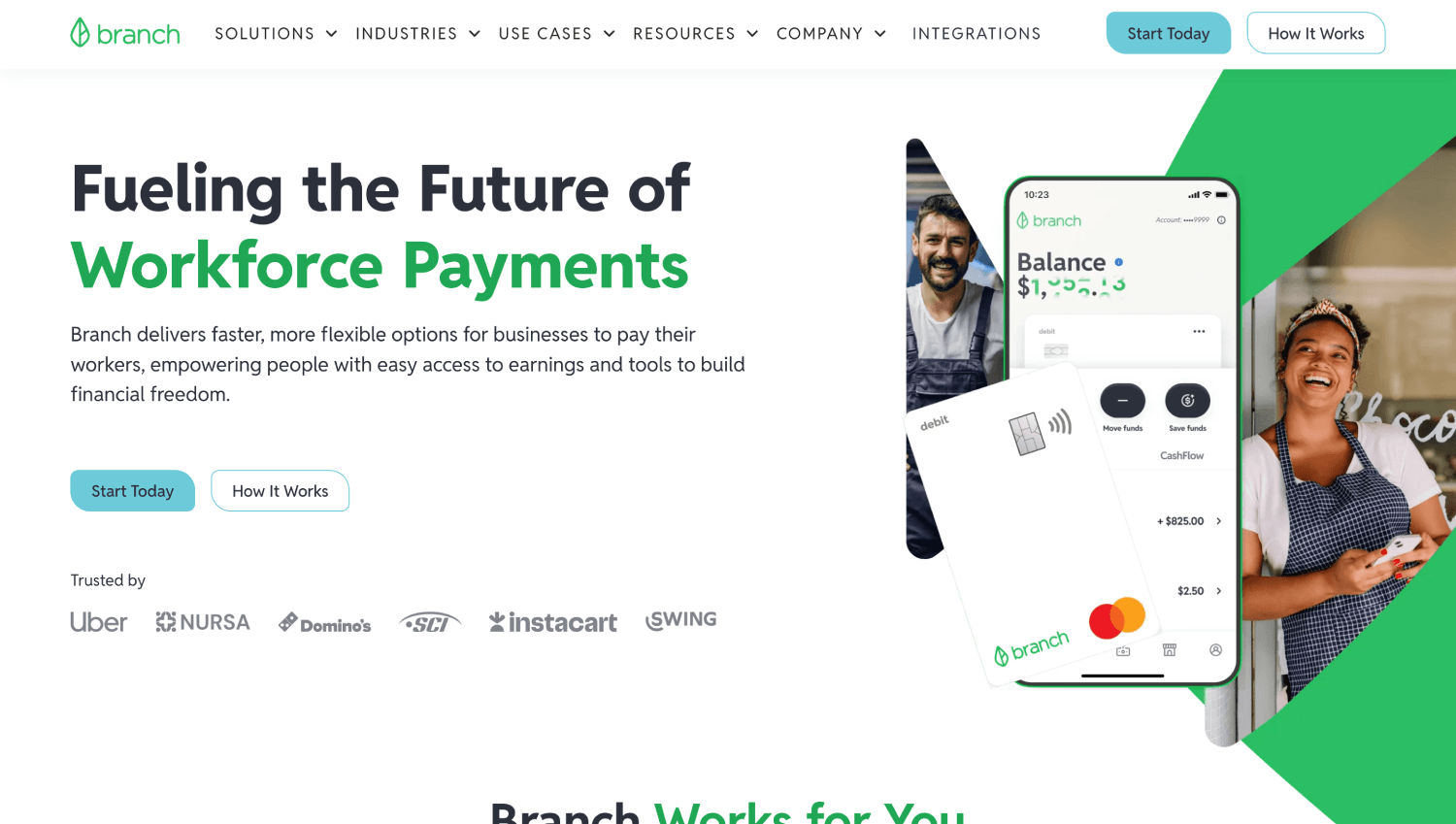
Branch occupies a genuinely useful middle position: it operates as both an employer-integrated EWA provider and a banking and disbursement platform for hourly workers. Its platform API is designed specifically for workforce apps, staffing platforms, and logistics networks that need to both pay workers and offer them wage access between pay cycles.
Branch’s model is hybrid in a meaningful way. For employers who integrate, it pulls verified wage data and uses payroll deduction for recovery. For workers at non-integrated employers, it offers limited direct-to-consumer access. Instant transfers to non-Branch accounts carry a fee; transfers to the Branch Wallet are free, as described on Branch’s public product pages.
The platform use case where Branch stands out is gig economy and staffing. If your platform pays workers directly (rather than through a traditional payroll processor), Branch can handle both the outbound disbursement and the EWA layer in a single integration. That reduces the vendor count compared to running a separate payout API and a separate EWA provider.
Platforms that already use instant payout infrastructure should review how Branch compares to their current setup. The leading instant payout providers for gig and creator platforms covers the disbursement side of that decision in detail.
6. Gusto Wallet

Gusto Wallet is the EWA offering built into Gusto’s payroll platform. It is not a standalone EWA product and it is not available via API independent of Gusto’s payroll stack. If your platform already runs on Gusto’s embedded payroll infrastructure, Gusto Wallet is essentially already available to your workers at no additional integration cost.
Workers using Gusto Wallet can access a portion of their accrued wages before payday through the Gusto app, with recovery via payroll deduction. Gusto does not charge workers a fee for standard access, according to its public product documentation. The product is tightly coupled to Gusto’s payroll engine, which is both its strength and its constraint.
Gusto Wallet is best for SMB-focused platforms that have embedded Gusto’s payroll and want to add EWA without a separate vendor relationship. It is a poor fit for platforms serving employers outside the Gusto network, or for platforms that need to offer EWA to non-payroll workers like contractors or gig workers.
7. ZayZoon

ZayZoon is a Canadian-founded EWA provider with strong North American mid-market penetration, particularly in franchise chains, retail, and food service. It integrates with over 100 HCM and payroll platforms including ADP, Paylocity, Paycom, and Ceridian, making it one of the broadest integration networks in the category.
ZayZoon charges workers a flat $5 fee per advance rather than a percentage-based or subscription fee, as stated on its public pricing page as of mid-2026. That structure is easy for workers to understand and avoids the appearance of interest. Employers pay a platform fee to ZayZoon; the specific amount is not publicly disclosed and is negotiated based on workforce size.
For platforms targeting franchise operators or regional chains that use mid-market HCM software, ZayZoon’s integration breadth reduces implementation friction significantly. A staffing platform that serves clients across five or six different payroll systems will find ZayZoon’s pre-built connectors faster to deploy than building custom integrations with a provider that covers fewer systems.
8. Wagestream

Wagestream is the dominant employer-integrated EWA provider in the UK and has expanded to markets including the US, Spain, Australia, and Mexico. For platforms with multinational workforce coverage, it is the only EWA provider on this list with genuine multi-market operational infrastructure.
Wagestream’s model is employer-funded with a flat fee per withdrawal, and employers have the option to subsidize the fee so workers access wages at no cost. The company also embeds savings tools, financial coaching, and budgeting features into its worker app, positioning the product as a broader financial wellness offering rather than pure EWA.
US-only platforms with no international ambitions have less reason to choose Wagestream over providers with deeper US payroll integrations. For platforms serving healthcare, hospitality, or logistics employers with UK or European operations, Wagestream eliminates the need to run parallel EWA vendors across geographies.
How Do EWA Providers Integrate with Payroll Systems via API?
The integration architecture determines how reliable and compliant your EWA program actually runs. There are three common patterns, and each has different implications for a platform builder.
Payroll data feed integration: The EWA provider receives a file or API call with each worker’s accrued wages, either in real time as hours are logged or on a scheduled basis (daily or per pay period). This is the most accurate model because the advance limit is based on verified data. Clair, DailyPay, and ZayZoon all support this approach through their platform APIs and HCM connectors.
Payroll deduction file: After an advance is issued, the EWA provider sends a deduction file to the payroll processor before the payroll run, instructing it to reduce the worker’s net pay by the advance amount. This is how employer-integrated EWA achieves certain recovery. Building this flow requires either direct integration with a payroll processor or access to the payroll deduction input mechanism. Platforms running embedded payroll infrastructure have this capability natively; platforms that sit above a third-party payroll provider need a data partnership to make it work.
Bank account recovery (direct-to-consumer path): The EWA provider links to the worker’s bank account via open banking, estimates earned wages, and debits the repayment on payday. No payroll system integration required. This is how Earnin and most DTC EWA apps work. It is faster to deploy but carries higher recovery failure rates in exactly the income-volatile populations EWA targets.
Platforms evaluating EWA API infrastructure should also review how it connects to their broader fintech stack. The best fintech APIs for SaaS covers the API evaluation framework that applies across all embedded financial products, including data quality, latency, and error handling requirements.
Does Offering Earned Wage Access Actually Reduce Hourly Worker Turnover?
The retention benefit claim is real but context-dependent. Several EWA providers publish retention data from their own customer bases, which means the figures are not independently verified and selection bias applies (employers who adopt EWA may already be more engaged with worker benefits broadly).
DailyPay, Payactiv, and others have published case studies showing meaningful reductions in voluntary turnover at specific employer clients. These figures are employer-reported and appear in provider marketing materials. No independently audited, peer-reviewed studies have isolated EWA as a causal variable. That does not mean the effect is not real. It means the exact magnitude is harder to claim with precision.
What is well-documented is worker demand. Survey data from multiple workforce research organizations consistently shows that a majority of hourly workers would prefer access to wages as they are earned rather than waiting for a biweekly pay cycle. In tight labor markets, that preference translates into job selection behavior. An employer offering EWA has a recruiting advantage over one that does not, particularly for shift-based roles in healthcare, logistics, and food service.
Illustrative scenario (not a claimed outcome from any specific study or provider): Consider a staffing platform managing 5,000 active hourly workers with a 60% annualized turnover rate. At a conservative cost-per-replacement of $1,500 per worker (recruiting, onboarding, lost productivity), annual turnover costs exceed $4.5 million. If adding EWA reduces voluntary turnover by even 5 percentage points, the math produces roughly $375,000 in annual savings before accounting for employer productivity gains. This is the type of business case a VP of Finance at a workforce platform should be able to construct when evaluating EWA vendor costs against retention impact, the inputs should be replaced with your own verified workforce data before presenting internally.
What Does EWA Cost Employers and Platforms?
Employer costs for EWA fall into two categories: platform fees paid to the provider, and funding costs if the employer fronts the capital for advances.
Most employer-integrated EWA providers fund advances from their own capital and recover via payroll deduction, which means the employer does not carry the credit risk or fund the float. The employer pays a platform or per-employee fee. Specific fee amounts are negotiated and not publicly disclosed by DailyPay, Payactiv, or most enterprise-tier providers.
ZayZoon’s worker-facing $5 flat fee (as stated on their public pricing page as of mid-2026) means the employer’s direct cost can be minimal if the program is structured so workers bear the transaction cost. Payactiv’s free-access model shifts more cost to the employer or to the platform economics Payactiv earns through its bank partnerships.
For platforms taking a revenue share on EWA, the economics typically look like a small per-transaction or per-employee-per-month fee that the platform receives for routing volume to the EWA provider. The amount varies by contract and is not publicly benchmarked. Platforms should negotiate this term explicitly rather than accepting the default partner agreement.
Compliance costs are a separate line. Even under the CFPB’s 2024 advisory opinion, employer-integrated EWA programs need documented policies, worker disclosures, and internal audit trails. The fintech product and compliance readiness checklist covers the documentation and policy requirements that apply to financial product embeds, including EWA.
What Did the CFPB’s 2024 EWA Advisory Opinion Actually Change?
The CFPB issued an advisory opinion in 2024 addressing employer-integrated EWA programs. The opinion concluded that EWA products that meet specific criteria do not constitute credit under the Truth in Lending Act and do not require TILA disclosures. The criteria include: the employer sponsors and funds the program, advances are limited to wages the worker has already earned, no mandatory fees are charged to the worker for access, and recovery happens exclusively via payroll deduction.
This matters because TILA compliance is expensive and shapes product design significantly. An EWA product classified as credit would require APR disclosures, a process that makes EWA look like a high-cost loan because the annualized equivalent of a $5 fee on a $200 five-day advance is well above typical loan APRs. The advisory opinion lets qualifying programs avoid that framing entirely.
The opinion does not preempt state law. Several states have their own EWA regulations, including California, Nevada, Missouri, and others. Some states have passed laws that define EWA and impose specific requirements on providers, including registration or licensing. Platforms operating nationally need to confirm their EWA partner’s state-by-state compliance posture before launch.
The opinion also does not cover direct-to-consumer models with mandatory fees. Earnin and similar apps remain in a gray zone that state regulators have continued to probe. This regulatory gap is one concrete reason why employer-integrated EWA is the defensible choice for platforms that cannot afford regulatory interference with a core product feature.
Frequently Asked Questions
Is earned wage access legal in the US?
Employer-integrated EWA programs that meet the CFPB’s 2024 advisory opinion criteria are not classified as credit under federal law and do not require TILA disclosures. Direct-to-consumer models with mandatory fees operate in a more ambiguous space and face ongoing state-level regulatory activity. State laws vary significantly: California, Nevada, Missouri, and several other states have passed or proposed EWA-specific legislation. Any platform launching EWA nationally needs state-by-state legal review before going live.
How do employers offer earned wage access without a payroll system change?
Most employer-integrated EWA providers handle the payroll system integration themselves through pre-built connectors with ADP, Paychex, Ceridian, Paylocity, and other major HCM platforms. The employer typically does not modify their payroll system. Instead, the EWA provider reads accrued wage data from the HCM and submits a deduction file before each payroll run. Employers using niche or proprietary payroll systems may need a custom data feed, which adds integration lead time.
What is the difference between employer-integrated and direct-to-consumer EWA?
Employer-integrated EWA verifies accrued wages through payroll data and recovers advances via payroll deduction. It requires employer participation and carries lower regulatory risk under the CFPB’s 2024 framework. Direct-to-consumer EWA estimates wages using bank transaction history and recovers via ACH debit on payday, with no employer involvement required. DTC models have higher recovery failure rates and more regulatory exposure, particularly in states that treat fee-based EWA as a loan product.
Does ADP offer earned wage access?
ADP has been reported to offer on-demand pay functionality within certain ADP payroll tiers, including ADP TotalSource and certain ADP Run tiers. ADP has also been reported to have a partnership arrangement with DailyPay; however, the precise structure and branding of that relationship has not been independently verified by FintechSpecs against current public documentation from both companies, and readers should confirm current availability directly with ADP. For platforms not running ADP payroll natively, third-party EWA providers like ZayZoon and Payactiv offer ADP integrations through standard HCM connectors.
Which EWA provider has the best API for platform embedding?
Clair has the most clearly documented API path for platforms that want to embed EWA natively, particularly for platforms using Check’s embedded payroll infrastructure. Branch offers a platform API designed for gig economy and hourly workforce apps that handle their own disbursements. DailyPay and Payactiv offer integration APIs for employer onboarding and data exchange, but their worker-facing experience remains provider-branded. Platforms that want to control the worker UX end to end should evaluate Clair or Branch before the enterprise-tier providers.
Can EWA platforms serve gig workers and independent contractors?
Employer-integrated EWA requires a W-2 employment relationship with payroll data to function. Independent contractors do not have accrued wages in the payroll sense, so the standard employer-integrated model does not apply. Branch and some hybrid providers extend a version of EWA to gig workers by using earnings history from the platform itself rather than a formal payroll system. Direct-to-consumer apps like Earnin also serve contractors through bank account-linked income estimation, but with the recovery risk and regulatory ambiguity that model carries.
What does EWA stand for?
EWA stands for earned wage access. It describes any mechanism that allows workers to access wages they have already earned before their scheduled payday. The category also goes by the names on-demand pay, early wage access, and wage streaming. The term “wage streaming” specifically refers to real-time or near-real-time wage accrual visibility, where workers can see and access wages as hours are logged rather than waiting for a pay period to close. Wagestream, despite its name, uses a scheduled-access model rather than true continuous streaming.
Which EWA Provider Should You Put on Your Shortlist?
Platform builders evaluating EWA partners are almost always choosing between two very different products dressed in similar language. The employer-integrated model is a payroll infrastructure play. The direct-to-consumer model is a consumer fintech play. Running them through the FintechSpecs EWA Platform Fit Test before you draft an RFP saves months of misaligned conversations.
For most workforce SaaS, HR tech, and staffing platforms, the shortlist is Clair plus one of the enterprise-tier providers. Clair handles the API-native embedding for platforms that want to own the experience. DailyPay or Payactiv handles the employer-facing sales motion for customers who want a branded, compliance-reviewed benefit program. Those two roles do not overlap well, and trying to use one provider for both usually means compromising on at least one of them.
The regulatory environment has finally caught up to what the employer-integrated EWA model actually is: a payroll timing adjustment, not a lending product. Platforms that treat it as a lending product during vendor evaluation will over-engineer the compliance layer and under-invest in the worker experience that drives adoption. The providers that win platform deals in 2026 are winning them on payroll integration depth and worker adoption rates, not on regulatory hedging.