- Bridge is built for fintechs that want stablecoin issuance and orchestration under one roof, with Stripe distribution and reserve yield sharing already baked in.
- Zero Hash is the better fit for regulated platforms that need a compliance proxy, where the vendor holds MSB licenses and takes on counterparty obligations so you do not have to.
- Pricing is not publicly disclosed by either vendor, so any side-by-side rate comparison circulating online is speculative.
- The real differentiation is not features but liability: Bridge asks you to build on its rails while owning more of your own compliance stack; Zero Hash takes on more of that regulatory surface area on your behalf.
- Switching cost is high on both platforms because wallet provisioning and stablecoin issuance touch core ledger infrastructure.
Bridge and Zero Hash both offer API-driven stablecoin infrastructure for US fintechs, but they serve different buyer profiles. Bridge is stronger for teams that want open stablecoin issuance, reserve yield participation, and distribution through the Stripe network. Zero Hash is stronger for platforms that want a licensed compliance intermediary to handle counterparty obligations, making it easier to launch crypto features without holding your own money transmitter licenses in every US state.
Bridge vs Zero Hash: One-Paragraph Verdict and Quick-Choice Table
If your team wants to issue stablecoins, share in reserve yield, and build on a platform connected to Stripe’s distribution network, Bridge is the more direct path. If your team wants to embed crypto settlement or trading features without absorbing the full regulatory weight of doing so, Zero Hash acts as a licensed intermediary that sits between you and the blockchain, handling much of the compliance surface area. Neither is a general-purpose choice. The decision turns almost entirely on where you want to hold regulatory risk.
| Choose Bridge if… | Choose Zero Hash if… |
|---|---|
| You want to issue your own stablecoin or USDC-backed instrument | You want to embed crypto features without acquiring your own MSB licenses |
| Reserve yield sharing is part of your revenue model | Counterparty compliance should sit with the vendor, not your team |
| You are already in the Stripe network or want Stripe distribution | You are a broker-dealer, neobank, or regulated entity needing a licensed intermediary |
| Stablecoin orchestration across multiple chains is core to your product | Your use case is crypto-backed settlement, B2B payments, or trading infrastructure |
| You want developer-first API tooling with per-user wallet provisioning | You need white-label custody and settlement with existing compliance documentation |
| Your investors or acquirers are likely to be in the Stripe orbit | You need a vendor with a demonstrated track record in institutional and enterprise accounts |
What Do Bridge and Zero Hash Actually Do?
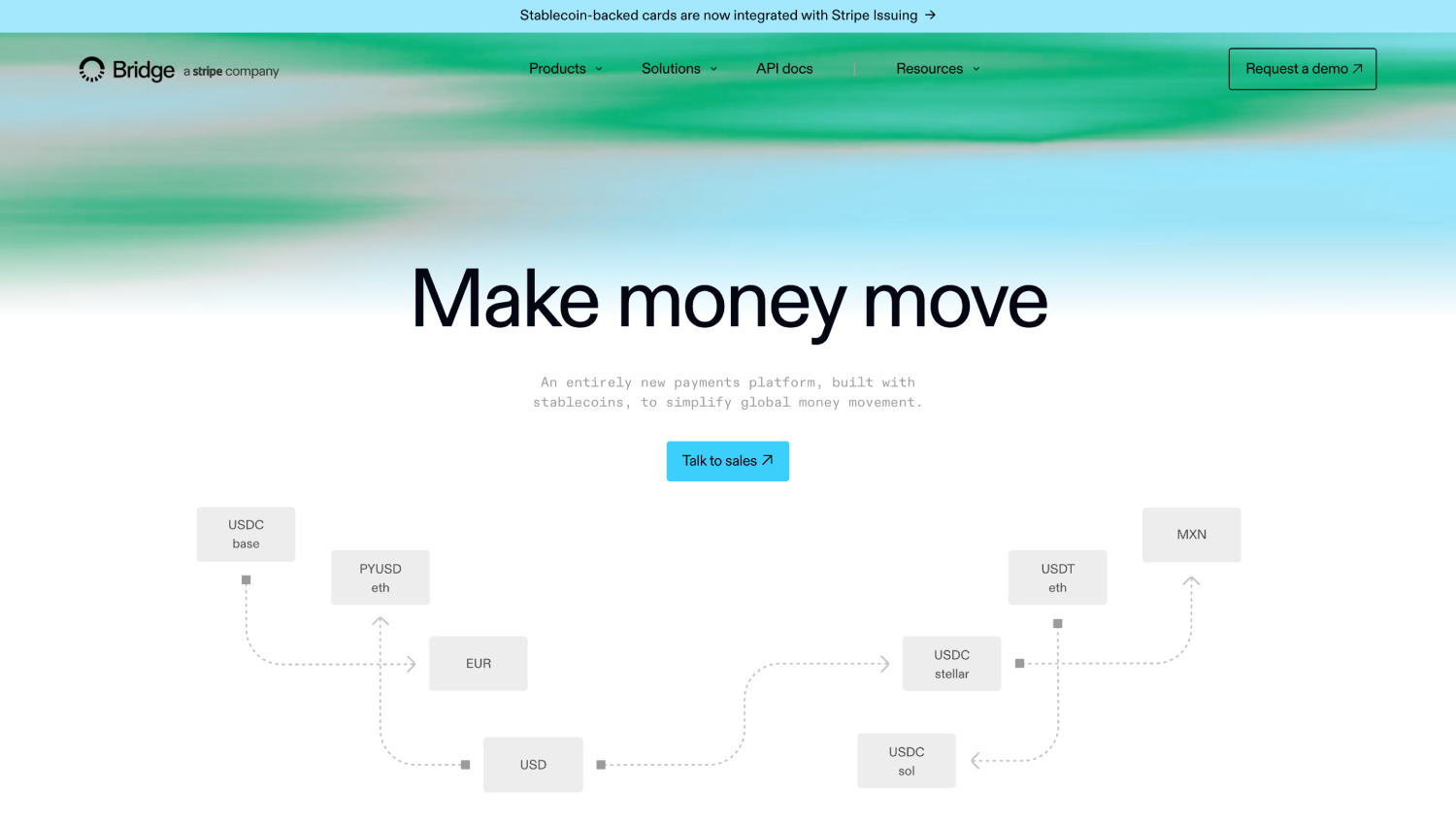
Bridge is a stablecoin orchestration and issuance platform. According to the Bridge homepage, stablecoin-backed cards are now integrated with Stripe Issuing, and the platform lists regulatory entities including Bridge Ventures LLC, Bridge Building Inc, and Bridge Building S.A. Its core product lets developers provision blockchain wallets on a per-user basis, move value across chains using USDC and other stablecoins, and issue stablecoins under what it calls Open Issuance, where the issuer participates in the yield generated by the underlying reserves.
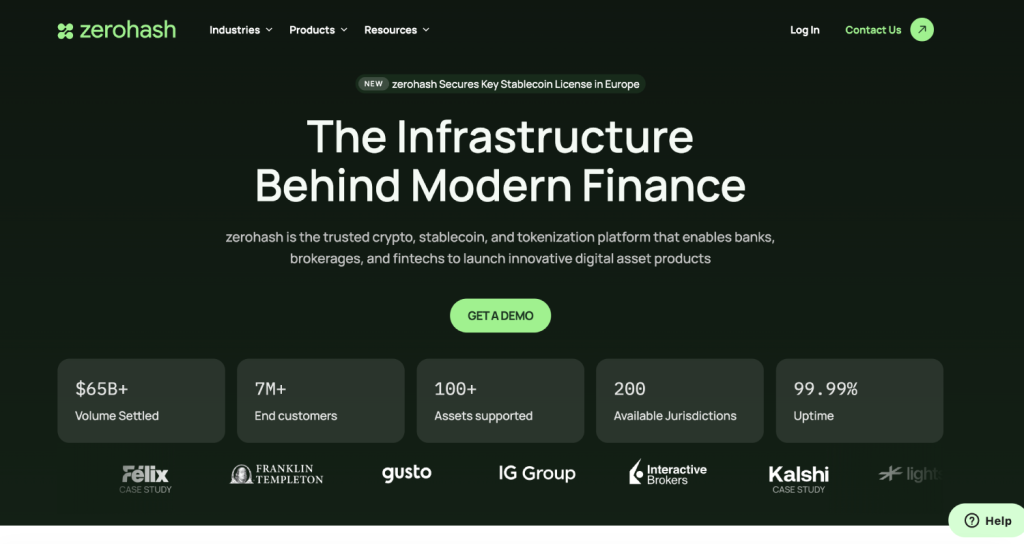
Zero Hash operates differently. It is a licensed financial services company that functions as a compliance proxy, meaning it holds the regulatory licenses so that its fintech clients can offer crypto features without obtaining their own state-by-state money transmitter licenses. A neobank embedding a crypto wallet or a broker-dealer adding stablecoin settlement routes through Zero Hash’s infrastructure and license stack. The platform handles custody, settlement, and the associated KYC and AML obligations at the infrastructure layer.
The surface-level APIs look similar. Both expose REST endpoints, both support USDC, and both target fintech builders. The separation emerges when you trace where regulatory accountability lives after integration.
How Does US Regulatory Coverage Compare Between Bridge and Zero Hash?
Zero Hash describes itself as “the trusted crypto, stablecoin, and tokenization platform” and reports coverage across 200 available jurisdictions, according to its public website. The company is registered as a money services business with FinCEN and holds money transmitter licenses in multiple US states. Its compliance infrastructure is the product, not an attachment to it. When a fintech integrates Zero Hash, the platform’s license stack covers the crypto leg of transactions, which is the part that typically requires state-level MTL coverage. This is why regulated entities such as broker-dealers and neobanks have historically found Zero Hash easier to clear through their own legal and compliance teams. For context on what individual state MTL coverage costs and requires, the state-by-state money transmitter license cost breakdown is worth reviewing before your sales conversations.
Bridge’s approach to US compliance sits differently. Its product is oriented around issuance and orchestration rather than acting as a licensed intermediary on your behalf. Builders integrating Bridge for stablecoin issuance will still need to assess their own licensing posture depending on what they are doing with the stablecoin on the other side of the API. If you are already working through the state-by-state money transmitter licensing process, Bridge is workable. If you are trying to skip that process entirely, Zero Hash is the more direct answer.
Neither vendor’s public documentation gives a precise state-by-state license list, so buyers should request this in writing during the sales process and have outside counsel verify coverage for their specific use case before signing.
What Does Integration Actually Look Like for Each Platform?
Bridge exposes a REST API with per-user wallet provisioning. A developer can create a blockchain address for each end user and route stablecoin transfers through Bridge’s orchestration layer, which handles chain abstraction and settlement. The developer documentation is publicly accessible and written for engineers who already understand how stablecoin rails work. Onboarding for a seed-stage team without prior crypto infrastructure experience will involve a meaningful learning curve, particularly around custody models and how Bridge handles key management.
Zero Hash integration involves connecting to their settlement API, which routes fiat-to-crypto and crypto-to-fiat conversions through their licensed infrastructure. The integration model assumes that Zero Hash sits in the middle of every transaction as a licensed counterparty. That structure simplifies compliance documentation because the regulatory exposure is clearly owned by Zero Hash, but it also means your product’s stablecoin features are mediated by a third party’s operational processes. Settlement timing, supported assets, and geographic reach are all governed by Zero Hash’s own infrastructure rather than being directly configurable by your engineering team.
For teams evaluating integration depth, it helps to frame the question this way: Bridge gives you more direct control over the rails and more of the underlying product decisions, at the cost of owning more compliance responsibility. Zero Hash gives you a faster path to regulatory safety, at the cost of a layer of indirection between your product and the underlying infrastructure. This control-versus-compliance trade-off is the single most important axis for any US fintech to map before shortlisting vendors.
How Do Bridge and Zero Hash Handle Compliance Ownership?
Zero Hash’s compliance ownership model is its primary product differentiation. When you route transactions through Zero Hash, their KYC, AML, and transaction monitoring obligations are part of the service contract. They file SARs, run OFAC screening, and maintain the compliance documentation that regulators and bank partners require. For a fintech that is still building out its own compliance infrastructure, this is a material operational benefit. It is also why fintech teams with experienced compliance officers sometimes find Zero Hash limiting: you are dependent on their compliance timeline and policy decisions, not your own.
Bridge’s compliance model is more modular. The platform handles compliance for what it directly controls, namely the stablecoin issuance and wallet orchestration layer, but your team retains responsibility for the compliance obligations that attach to your end users. If you are building a product where stablecoins are an intermediate settlement mechanism and your users never directly hold crypto, the compliance surface area is smaller. If your users are directly holding or transferring stablecoins, your team needs to have its own compliance infrastructure in place. The fintech compliance readiness checklist is a useful tool for mapping exactly which obligations your product creates before you commit to either platform.
Bridge vs Zero Hash Pricing: What Is Publicly Known?
Neither Bridge nor Zero Hash publishes pricing on their public website. Both vendors operate on a custom-contract model, which is standard for infrastructure at this layer. Any specific per-transaction fee or basis-point rate cited without a direct quote from a signed contract should be treated as speculative.
What is publicly known about their pricing structures:
- Bridge’s Open Issuance model includes reserve yield sharing, meaning issuers participate in the interest generated by the fiat reserves backing stablecoins. The exact yield-sharing percentage is contract-specific and not publicly disclosed.
- Zero Hash charges for settlement and custody services on a per-transaction or volume-tiered basis, but the exact rates are not on their public pricing page.
- Both platforms require a sales conversation before pricing is shared, which means budget planning requires at minimum a discovery call.
For any team running a formal vendor evaluation, this is a non-trivial friction point. Get pricing in writing early, ask specifically about minimum monthly fees, volume commitments, and what happens to unit economics at $1M, $5M, and $25M in monthly transaction volume. These are not hypothetical questions: the economics of stablecoin infrastructure can shift dramatically at scale, and locking into a contract before modeling that curve is one of the more common hidden cost traps in fintech infrastructure.
What Are the Contract Terms and Switching Costs?
Switching costs on either platform are high. The reason is structural: both Bridge and Zero Hash integrate at the wallet and ledger level. If your product provisions wallets through Bridge, those wallets are Bridge wallets. Moving end users to a different infrastructure provider means migrating wallet addresses, potentially requiring users to move funds, and rebuilding the wallet provisioning logic from scratch. That is not a weekend project.
Zero Hash’s switching cost is similarly embedded in the compliance layer. If Zero Hash is filing your SARs and running your OFAC screening, migrating away requires either building that infrastructure internally or signing a parallel compliance agreement with a new vendor before you can exit. Regulatory continuity during a vendor migration is a real operational risk, not a theoretical one.
Both vendors are enterprise contract businesses, which means minimum commitments, multi-year terms, and legal review cycles. Teams at seed to Series A should factor in the reality that these contracts are written for Series B and later companies with legal resources. Running a structured evaluation before signing, including the 35-question stablecoin infrastructure RFP, will surface terms that may not appear in the first contract draft.
Which Platform Has Better Developer Experience?
Bridge’s developer documentation is publicly accessible, which is itself a differentiation. Engineers evaluating the platform can review API reference docs, understand the wallet provisioning model, and prototype before committing to a sales process. This matters for teams where engineering leadership is driving the vendor decision, not procurement.
Zero Hash’s developer documentation is available but gated in parts, which reflects its enterprise sales motion. The platform is designed to be implemented with support from Zero Hash’s integration team rather than independently by a developer working from public docs alone. This is not a criticism: at the compliance proxy layer, a more guided integration often produces cleaner results. But it does mean the time from first contact to first API call is longer on Zero Hash than on Bridge.
For a practical illustration: say a four-person engineering team at a Series A neobank wants to add stablecoin settlement to their payouts product within a 60-day sprint. Bridge’s public API surface gives them a faster start on the technical side, but their compliance team will need to be involved from day one to map out what Bridge does not own. Zero Hash’s integration timeline is likely longer, but the compliance questions are answered as part of the onboarding process. Neither is universally faster. The faster path depends on whether your engineering or compliance team is the binding constraint.
Is Zero Hash Trustworthy for Enterprise Use?
Zero Hash’s website lists 2017 as its operational start date. The company has processed institutional-scale volume for clients including broker-dealers, neobanks, and crypto exchanges, holds licenses in multiple US states, is registered with FinCEN, and operates under regulatory frameworks that require audited financial controls. Its client roster has historically included names that would not take on a vendor without significant diligence. Buyers should verify Zero Hash’s current license roster and operational history directly through their sales and compliance disclosure process, and request SOC 2 Type II documentation as part of any formal evaluation.
The more relevant trust question for enterprise buyers is not whether Zero Hash is trustworthy in a general sense, but whether it is operationally resilient at your transaction volume and whether its compliance posture matches your regulators’ expectations. Those are due-diligence questions, not reputation questions. Any fintech evaluating Zero Hash should request SOC 2 Type II reports, a detailed breakdown of which licenses cover which transaction types, and references from clients at a comparable transaction volume and regulatory profile.
Does Bridge Have Its Own Stablecoin?
Bridge offers Open Issuance, which is its stablecoin issuance infrastructure that allows fintechs and other issuers to create their own stablecoin instruments backed by fiat reserves. The issuer, not Bridge itself, controls the stablecoin’s brand and parameters. Bridge provides the underlying issuance rails, reserve management infrastructure, and reserve yield sharing. Bridge does not operate a widely circulated public stablecoin under its own brand in the way that Circle operates USDC or Tether operates USDT, but the platform allows other entities to issue stablecoins using its infrastructure.
This distinction matters for buyers. If you want to issue a stablecoin under your brand, Bridge’s Open Issuance is a direct solution. If you want to settle in an existing stablecoin like USDC without issuing your own, both platforms support that use case, and the choice between them reverts to the compliance ownership and integration questions already covered.
How Do Bridge and Zero Hash Compare on Supported Assets and Chains?
Both platforms support USDC and operate across multiple blockchains, but the precise list of supported assets and networks is not fully published by either vendor and changes as the platforms expand. Bridge’s orchestration layer is designed to abstract chain complexity, meaning developers route transfers without needing to manage chain-specific logic directly. Zero Hash supports a range of digital assets for settlement and custody beyond stablecoins, including native crypto assets, which makes it relevant for platforms that need to support crypto trading or custody alongside stablecoin settlement.
For buyers building a purely stablecoin-focused product, the asset and chain breadth difference between the two platforms is unlikely to be decisive. For buyers who anticipate adding native crypto support later, Zero Hash’s broader asset coverage is worth noting. Either way, confirm the specific chains and assets you need are live in production, not on the roadmap, before signing a contract.
The FintechSpecs Infrastructure Positioning Matrix for Stablecoin Vendors
Most stablecoin infrastructure comparisons are organized by features. That framing misses the more important question: where does this vendor’s product boundary end and your responsibility begin? FintechSpecs uses the Infrastructure Positioning Matrix to map this across four axes for any stablecoin vendor evaluation.
- Compliance ownership boundary: What does the vendor own, and what remains your obligation?
- Product surface control: How much of the user-facing behavior can you configure directly without going back to the vendor?
- Exit portability: If you switch vendors in 24 months, what do you lose and what can you take with you?
- Revenue model alignment: Does the vendor’s pricing model reward your growth, or does it extract more as you scale?
Mapped against this framework, Bridge scores high on product surface control and revenue model alignment for issuance use cases, because yield sharing grows with reserve volume. It scores lower on compliance ownership boundary because you carry more of that responsibility yourself. Zero Hash inverts this: high compliance ownership, lower product surface control, and a revenue model that is more opaque at scale.
Neither profile is wrong. They serve different operator types. The mistake most buyers make is picking based on feature lists before answering which profile matches their actual operating constraints. Teams building toward Series B fundraising, where compliance posture is a diligence item, should weight the compliance ownership axis heavily. Teams building developer products where time-to-integration and API flexibility drive adoption should weight product surface control. For a broader view of how stablecoin infrastructure vendors compare beyond these two, the ranked list of stablecoin infrastructure providers covers additional options across the same decision criteria.
Bridge vs Zero Hash: Full Feature and Fit Comparison
| Dimension | Bridge | Zero Hash |
|---|---|---|
| Primary use case | Stablecoin issuance and orchestration | Crypto settlement and compliance proxy |
| Stablecoin issuance | Yes, Open Issuance with yield sharing | Settlement and custody, not branded issuance |
| Reserve yield sharing | Yes | Not a standard published feature |
| Compliance ownership | Partial (issuer retains significant obligations) | Higher (acts as licensed intermediary) |
| US MSB/MTL license coverage | Bridge’s own licensing posture; buyers should verify directly | Zero Hash holds its own US state licenses |
| Per-user wallet provisioning | Yes, core feature | Yes, within custody architecture |
| Native crypto asset support | Primarily stablecoin-focused | Broader asset coverage including native crypto |
| Public developer documentation | Publicly accessible | Partially gated |
| Public pricing | Not disclosed | Not disclosed |
| Stripe Issuing integration | Yes, stablecoin-backed cards integrated with Stripe Issuing per Bridge’s public site | No |
| Ideal buyer | Teams building stablecoin-native products | Regulated fintechs adding crypto features |
| Integration complexity | Moderate (more developer control) | Moderate to high (guided enterprise onboarding) |
| Switching cost | High (wallet and ledger-level integration) | High (compliance infrastructure dependency) |
Frequently Asked Questions
Is Zero Hash trustworthy for a regulated fintech?
Zero Hash lists 2017 as its operational start date on its public website, holds money transmitter licenses in multiple US states, and is registered with FinCEN as a money services business. It has served institutional clients including broker-dealers and neobanks. Trust in a regulatory context means verifiable licenses, audited controls, and demonstrated operational history at scale. Buyers should request SOC 2 Type II documentation, a current license roster, and client references at comparable transaction volumes before making a final decision. General reputation is not a substitute for documented due diligence.
Who are Zero Hash’s main competitors?
Zero Hash’s primary competitors in the embedded crypto infrastructure and compliance proxy category include Bridge, BVNK, and Paxos. For specific use cases such as crypto settlement and stablecoin treasury management, platforms like Fireblocks and Anchorage Digital also compete on portions of the stack. The relevant competitor set depends on whether a fintech needs licensed intermediary services, pure custody, stablecoin issuance, or cross-border settlement. Zero Hash competes most directly with platforms that combine compliance ownership with settlement infrastructure.
Does Bridge have its own stablecoin?
Bridge does not operate a widely circulated public stablecoin under its own brand. Instead, it offers Open Issuance infrastructure that allows fintechs and other entities to issue their own branded stablecoins backed by fiat reserves, with the issuer participating in the yield generated by those reserves. Bridge provides the issuance rails, reserve management, and distribution infrastructure. If you want to issue a stablecoin under your company’s brand, Bridge’s Open Issuance product is specifically designed for that use case.
How does Zero Hash work as a compliance proxy?
Zero Hash sits as a licensed intermediary between your fintech product and the blockchain. When a user on your platform initiates a crypto transaction, the transaction routes through Zero Hash’s licensed infrastructure. Zero Hash handles KYC and AML obligations at the infrastructure layer, files regulatory reports where required, and maintains the compliance documentation that regulators and bank partners expect. Your product interacts with Zero Hash’s API; Zero Hash handles the regulated activities. This model lets fintechs launch crypto features without obtaining their own state-level money transmitter licenses for the crypto leg of transactions.
What is Bridge vs Zero Hash pricing?
Neither Bridge nor Zero Hash publicly discloses pricing. Both operate on custom enterprise contracts negotiated through their sales teams. Bridge’s Open Issuance model includes reserve yield sharing, meaning pricing is partly linked to the interest generated by reserve assets. Zero Hash’s pricing is volume-based and contract-specific. Any per-transaction rate or basis-point figure cited online without attribution to a signed contract should be treated as speculative. Budget planning requires a direct sales conversation with each vendor and an explicit request for pricing at your anticipated transaction volumes.
How long does it take to integrate Bridge or Zero Hash?
Integration timelines are not publicly disclosed by either vendor and vary significantly based on product complexity, team experience with crypto infrastructure, and compliance readiness. Bridge’s publicly accessible developer documentation allows engineers to begin technical evaluation before a formal sales engagement, which can compress the timeline for technically sophisticated teams. Zero Hash’s integration is more guided and enterprise-oriented, meaning onboarding typically involves their integration support team. A realistic estimate for a production-ready integration at either platform, factoring in compliance review and testing, is several weeks to several months depending on use case complexity.
Can a seed-stage fintech work with Bridge or Zero Hash?
Both platforms are primarily oriented toward Series A and later companies with existing compliance infrastructure and engineering resources to manage a complex integration. Seed-stage teams can engage with both, but should be realistic about contract minimums, legal review overhead, and the internal compliance work required before a stablecoin product can go live. Bridge’s public documentation makes it somewhat more accessible early, but neither vendor operates a self-serve onboarding flow designed for pre-revenue teams. A seed-stage team with specific stablecoin infrastructure needs should start with a discovery call to understand minimum commitment requirements before investing significant engineering time.
What is the risk of switching stablecoin infrastructure vendors after launch?
Switching costs are structurally high on both platforms. Bridge integrations embed at the wallet provisioning level, meaning user wallets are tied to Bridge’s infrastructure. Migrating means moving wallet addresses and rebuilding provisioning logic. Zero Hash integrations embed at the compliance layer, meaning a migration requires establishing parallel compliance coverage with a new vendor before exiting. Either migration creates regulatory continuity risk if not managed carefully. Teams should negotiate data portability and migration assistance terms into the initial contract, not after the fact. For a framework to run this evaluation before signing, the fintech vendor evaluation framework covers the key contract and exit terms to verify upfront.
Conclusion
The surface-level similarity between Bridge and Zero Hash is real: both are API-first, both support stablecoin rails, and both target US fintechs. But they are solving different problems. Bridge is infrastructure for teams that want to be in the stablecoin business, issuing instruments, participating in yield, and building products where stablecoins are the primary value delivery mechanism. Zero Hash is infrastructure for teams that want crypto features in their product without becoming a crypto company themselves, where the licensed intermediary model absorbs the regulatory complexity so the fintech can focus on its core product.
The worst outcome in this evaluation is choosing based on which platform has the better marketing site or the faster initial sales response. The decision should trace directly from one question: does your company want to own the stablecoin layer, or does it want a licensed partner to own that layer on your behalf? That single answer points clearly to one platform over the other, and it should drive every subsequent conversation about pricing, integration, and contract terms. Teams still early in that analysis will find the broader stablecoin payment API comparison useful for mapping the full vendor field before narrowing to two.
One final point on timing. The GENIUS Act (proposed US stablecoin regulation) and broader US stablecoin regulatory developments in 2025 and 2026 are shifting what compliance posture looks like for any platform operating in this space. What a vendor’s license coverage meant in 2023 may not reflect what regulators expect in 2026. Any contract signed without explicit language about how the vendor handles regulatory change and what remedies exist if their compliance posture shifts is a contract with an unpriced risk. Get that language in writing. Both platforms are capable of operating in the evolving US regulatory environment, but the terms of how they share that regulatory burden with you are negotiable, and they are worth negotiating hard.