
- A feature checklist and a vendor demo are the two weakest inputs for choosing stablecoin payment infrastructure. They show best-case scenarios, not failure modes.
- Hidden costs in stablecoin infrastructure typically appear in FX conversion fees, on-chain gas pass-throughs, minimum volume commitments, and data egress charges, none of which surface in a standard sales pitch.
- Regulatory exposure sits with your company, not your vendor. A provider’s MSB license or BitLicense does not automatically cover your product’s flows unless the contract says otherwise, in explicit terms.
- A structured RFP with a weighted scorecard and a mandatory proof-of-concept forces vendors to compete on operational reality rather than roadmap promises.
- The questions that disqualify vendors fastest are about custody models, settlement finality, and what happens when the vendor fails or gets acquired.
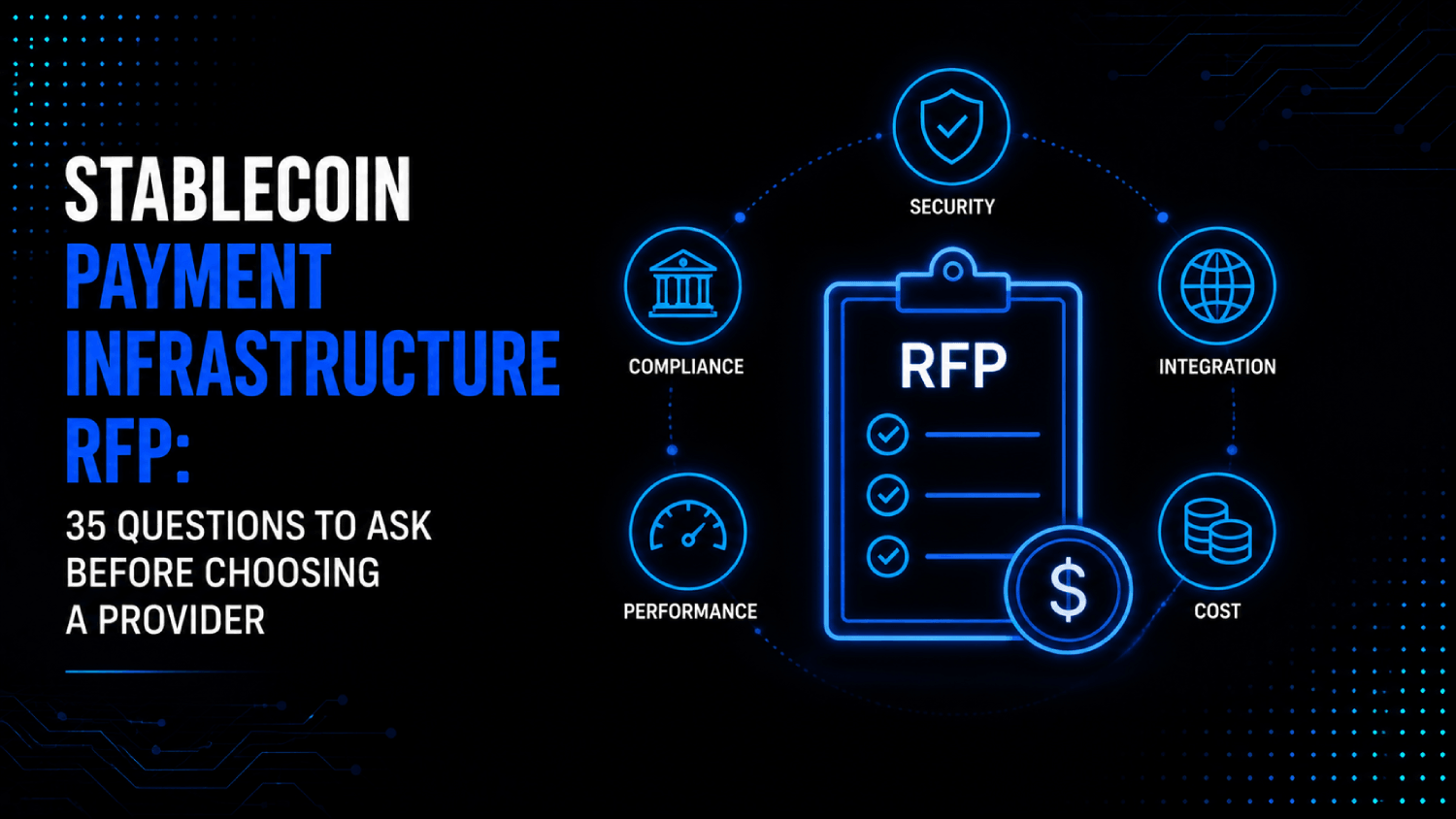
A stablecoin payment infrastructure RFP is a structured evaluation document that procurement teams send to vendors like Bridge, Zero Hash, BVNK, Conduit, and Circle Payments to assess technical architecture, compliance coverage, fee structure, and contractual lock-in before signing. The 35 questions below are organized into seven evaluation categories with a weighted scorecard, disqualifying criteria, and proof-of-concept success metrics your team can use immediately.
Why Sales Demos Fail as the Sole Evaluation Tool for Stablecoin Infrastructure
Most vendors build demos around the happy path: a USDC transfer from a US wallet to a US bank account, confirmed in seconds, with clean webhooks. What a demo does not show is what happens at 2am when an on-chain network experiences congestion, or when a compliance flag freezes a $400,000 disbursement during your end-of-month payroll run. A vendor’s demo environment almost never reflects production-grade gas handling, real KYC latency, or the actual settlement window for stablecoin-to-fiat conversions.
The deeper problem is that stablecoin infrastructure sits at the intersection of payment operations, blockchain settlement, and financial regulation, three domains where the consequences of a wrong vendor choice are not just operational but legal. If your provider does not hold the right money transmitter licenses in the states where your users receive funds, your company may be the entity operating without authorization. That risk does not appear on a feature comparison slide.
For a broader look at how fintech infrastructure vendors actually structure their revenue models (including the line items they rarely volunteer), how fintech infrastructure companies actually make money is worth reading before you open any vendor conversation.
What Is the FintechSpecs Seven-Layer Stablecoin Vendor Stress Test?
This framework structures the 35 RFP questions below into seven evaluation layers. Each layer targets a different failure mode. The scoring weight assigned to each reflects how often that failure mode is both catastrophic and non-obvious before go-live.
The seven layers are: Regulatory and Licensing Coverage, Technical Architecture and Reliability, Stablecoin and Asset Support, Fee Structure and Total Cost of Ownership, Compliance Infrastructure, Contract Terms and Lock-In, and Operational Support and Incident Response. Every question below maps to one of these layers. Vendors who cannot answer a question fully in writing during the RFP process should be treated as failing that question, not as pending.
Layer 1: Regulatory and Licensing Coverage (Weight: 25 Points)
This layer carries the highest weight because it is the one where gaps create non-discretionary legal exposure for your company. A vendor may hold a New York BitLicense and an MSB registration with FinCEN, but neither automatically covers you if you are disbursing funds to contractors in Texas and California through their API. The distinction between “we are licensed” and “our license covers your product’s specific use case in your specific jurisdictions” is everything.
Question 1: Which state money transmitter licenses do you currently hold?
Ask for the full list and verify it against your user geography. Demand the dates of issuance. A license obtained six months ago may still be under conditions.
Question 2: Does your licensing cover our specific product flow?
Describe your exact use case in the RFP (e.g., B2B cross-border payout from US company to Mexico-based contractors in USDC). Ask whether their licensing applies to that flow, in writing, with their legal team’s sign-off.
Question 3: Are you registered with FinCEN as a Money Services Business?
This is baseline. If the answer is no or uncertain, disqualify immediately.
Question 4: How are you approaching GENIUS Act compliance?
The GENIUS Act compliance obligations for stablecoin issuers and payment providers are evolving quickly. Ask vendors specifically what product changes they have made or are planning in response, and when those changes ship.
Question 5: Who holds regulatory responsibility if a transaction violates state money transmission rules?
Get this answer in the contract, not just verbally. The standard vendor position is that you, the platform, are responsible. If that is the case, your compliance team needs to know before signing.
Layer 2: Technical Architecture and Reliability (Weight: 20 Points)
Stablecoin rails introduce failure modes that fiat-only infrastructure does not have: on-chain congestion, reorg risk, gas price spikes, and smart contract vulnerabilities. A vendor who routes USDC payments over Ethereum mainnet handles congestion differently than one who routes over Solana or Base. That is not a trivial architectural difference. It affects your settlement finality guarantee, your fee floor, and your disaster recovery posture.
Question 6: What is your documented uptime SLA, and what is your actual 12-month uptime history?
Ask for both. Vendors with 99.9% SLAs but no historical data to back it up are offering a contractual placeholder, not an operational commitment.
Question 7: How do you handle on-chain network congestion affecting settlement time?
The honest answer involves either gas fee buffers, retry logic, fallback chains, or some combination. Any vendor who says congestion “rarely affects us” without explaining the mechanism is not answering the question.
Question 8: What is your settlement finality model, and at what block confirmation count do you credit funds to my platform?
On Ethereum, one confirmation is not final. On Solana, finality is faster but not instantaneous. Ask for the specific confirmation threshold per chain and the resulting settlement window.
Question 9: Do you operate your own nodes, or do you rely on third-party RPC providers?
Vendors who rely entirely on shared RPC infrastructure from providers like Alchemy or Infura inherit that provider’s outage risk. Ask about their redundancy model.
Question 10: What is your documented recovery time objective (RTO) and recovery point objective (RPO) for a full infrastructure failure?
If they cannot give you specific numbers, they have not done the exercise. Both figures belong in the contract as binding SLA terms, not marketing appendices.
Layer 3: Stablecoin and Asset Support (Weight: 15 Points)
Not all stablecoin providers support the same assets, chains, or conversion paths. A vendor who supports USDC on Ethereum but not on Solana or Base forces you to choose a chain before you have validated which one your counterparties actually use. For B2B cross-border flows, USDT is often more liquid in certain corridors than USDC. If your vendor only supports one stablecoin, that is a product constraint, not a security posture.
Question 11: Which stablecoins do you support, and which are in active production versus beta?
Ask specifically: USDC, USDT, PYUSD, EURC, and any regional stablecoins relevant to your corridors. Get written confirmation of production status for each.
Question 12: Which chains are in production, and what is your process for adding new chain support?
If Solana support is on the roadmap, ask for a ship date with contractual accountability. Roadmap commitments that do not appear in the contract are not commitments.
Question 13: How do you handle stablecoin depeg events?
After the USDC depeg in March 2023, during which USDC briefly traded below $0.90 on secondary markets, vendors who had no protocol for that scenario left their clients holding unsettled funds. Ask specifically what their response protocol is, including at what threshold they halt or flag transactions.
Question 14: Do you support programmable payments or conditional disbursements via smart contracts?
Enterprise-grade stablecoin infrastructure increasingly supports embedded logic, such as automatic splits, escrow conditions, or time-based release. If you need this, verify it is in production, not demo.
Layer 4: Fee Structure and Total Cost of Ownership (Weight: 20 Points)
The gap between a vendor’s advertised transaction fee and your actual blended cost per transaction is where deals quietly fall apart. Stablecoin infrastructure vendors commonly charge in at least three separate ways: a transaction fee, a conversion spread on stablecoin-to-fiat or fiat-to-stablecoin legs, and a custody or holding fee for balances sitting in their managed wallets. Gas fees may be passed through at cost, at a markup, or absorbed into the spread. There is no standard. Ask about every layer.
For a structural view of how infrastructure vendors package and hide these charges, 15 hidden costs killing your fintech SaaS margins provides useful context before you run the numbers.
Question 15: What is your full fee schedule, including transaction fees, conversion spreads, gas handling, and custody fees?
Ask for this in a table, with line items. Request the most recent version of the rate card, not a sales deck summary.
Question 16: How do you handle gas fee volatility, and is gas ever passed through to us at a markup?
Some vendors absorb gas into their spread and charge a flat fee. Others pass gas through at cost. Others mark it up. None of these approaches is inherently wrong, but you need to know which model you are buying before you price your own product.
Question 17: Are there minimum monthly volume commitments, and what are the consequences of falling below them?
Minimum volume commitments are a common source of surprises in year two. A $50,000 monthly minimum that seemed achievable at signing may generate penalty fees if your stablecoin volumes are seasonal or slower to ramp than projected.
Question 18: What is the all-in cost for a $50,000 USDC-to-fiat disbursement in our primary corridor?
Ask for a worked example using your actual transaction profile. Any vendor who cannot model this before the contract is signed will not be able to invoice you accurately after it is signed.
Question 19: How do conversion rates get set, and how often can they change without notice?
Some vendors lock FX conversion rates for a defined window. Others reprice at transaction time. The difference can be material for large disbursements, especially in volatile FX corridors.
Layer 5: Compliance Infrastructure (Weight: 10 Points)
Stablecoin payments have more compliance surface area than a standard ACH transfer. Every on-chain transaction is publicly visible on a blockchain explorer, which means your counterparty’s wallet history is also visible. A vendor without wallet screening tools is one OFAC-sanctioned counterparty away from a serious regulatory event.
Question 20: What blockchain analytics tools do you use for wallet screening, and against which sanction lists?
The standard in the industry involves integration with providers like Chainalysis or Elliptic for OFAC, FATF, and adverse media screening. Ask for the specific lists and the update frequency.
Question 21: Do you perform pre-transaction wallet screening, post-transaction monitoring, or both?
Pre-transaction screening catches known bad actors before funds move. Post-transaction monitoring catches emerging risks. A mature compliance infrastructure needs both. Vendors who do only post-transaction screening are reacting to problems, not preventing them.
Question 22: How do you handle the Travel Rule for transactions above the $3,000 threshold?
FATF’s Travel Rule requires that originator and beneficiary information accompany qualifying transfers. Ask which Travel Rule protocol they use (TRUST, OpenVASP, Sygna, or another), and whether that protocol covers your counterparty jurisdictions.
Question 23: What KYC/KYB data do you collect, and can you share your approval rate benchmarks?
Vendors who handle KYC/KYB on your behalf should be able to tell you their approval rates and the average time-to-decision. High friction here directly affects your onboarding conversion.
Question 24: Do you generate SAR-ready reports, and in what format?
If your compliance team needs to file Suspicious Activity Reports, the vendor’s data export format matters. Ask whether their monitoring data integrates with your existing compliance stack.
Layer 6: Contract Terms and Lock-In (Weight: 5 Points)
This layer carries the lowest point weight but generates some of the highest post-signature regret. Contract lock-in in stablecoin infrastructure takes several forms: proprietary wallet formats that make asset portability difficult, data retention clauses that prevent you from exporting transaction history, and auto-renewal terms on multi-year contracts that require 90-day notice to cancel.
Question 25: What are the data portability provisions if we migrate to a different provider?
Ask specifically: can you export your full transaction history, wallet address history, and user KYC records in a machine-readable format? Some vendors treat this data as proprietary.
Question 26: What happens to our users’ funds and pending transactions if your company is acquired or ceases operations?
This question makes vendors uncomfortable, which is why it is worth asking. The answer belongs in the contract, with specific provisions for client asset segregation and a wind-down plan.
Question 27: What are the auto-renewal and termination notice requirements?
A 90-day notice window on a contract with a 12-month term means you have roughly three months per year to evaluate whether to stay. If that window passes unnoticed, you are automatically renewed. This is a standard practice. It is also easy to miss during a busy quarter.
Question 28: Does the contract include indemnification provisions if a regulatory action stems from your compliance failure?
Vendors commonly indemnify clients only for their own gross negligence. If a transaction is flagged due to the vendor’s inadequate OFAC screening, you want contractual recourse. Have your counsel review this clause specifically.
Layer 7: Operational Support and Incident Response (Weight: 5 Points)
A failed stablecoin disbursement is not abstract. If you are running a cross-border payroll for 200 contractors and a transaction fails at 11pm on a Friday, your support tier determines whether that resolves in 20 minutes or three business days.
Question 29: What support tier is included in the contract, and what are the SLA response times by severity?
P1 incidents, defined as complete service outages or frozen funds, should carry a response SLA measured in minutes, not hours. Get this in writing with financial remedies attached.
Question 30: Do you offer a dedicated technical account manager or support engineer for our account?
Shared support queues are not sufficient for production payment infrastructure. Ask at what volume tier dedicated support is available, and whether it costs extra.
Question 31: How are on-chain transaction failures communicated to our platform, and what is the remediation process?
Failed on-chain transactions can occur for reasons outside the vendor’s control (network congestion, insufficient gas, receiving wallet restrictions). Ask for their specific incident playbook for each failure type.
Disqualifying Questions: Four Answers That Should End the Evaluation
Some RFP responses disqualify a vendor regardless of their score on other criteria. These four questions cut through positioning and expose fundamental operational risk.
- Can you demonstrate that client assets are segregated from your operating capital? If the answer is no, or if the vendor cannot provide documentation, the operational risk is unacceptable. Client assets should never sit commingled with the vendor’s balance sheet.
- Have you experienced any regulatory enforcement actions, consent orders, or license suspensions in the last 36 months? A yes is not automatically disqualifying, but it requires a detailed explanation and remediation documentation before proceeding.
- Can you confirm in writing that your licensing covers our specific product flow in our target jurisdictions? If the vendor deflects this to “consult your counsel,” they are not covering the risk. You need their legal team’s written confirmation, not a verbal assurance from sales.
- What is your process if we terminate the contract within the first 90 days due to performance failure? Vendors who do not have a defined early termination for cause provision are building exit friction into the contract by default.
The RFP Vendor Scorecard: Weighted Evaluation Matrix
| Evaluation Layer | Max Points | Scoring Criteria | Disqualifier? |
|---|---|---|---|
| Regulatory and Licensing Coverage | 25 | Full license list, jurisdiction match, written confirmation of use-case coverage | Yes |
| Technical Architecture and Reliability | 20 | Documented SLA, historical uptime, settlement finality model, node ownership | No |
| Fee Structure and TCO | 20 | Full rate card, gas model, worked example for your corridor, volume minimums | No |
| Stablecoin and Asset Support | 15 | Production assets confirmed, chain support, depeg protocol | No |
| Compliance Infrastructure | 10 | Wallet screening stack, Travel Rule protocol, SAR-ready reporting | Yes |
| Contract Terms and Lock-In | 5 | Data portability, wind-down provisions, indemnification clauses | Conditional |
| Operational Support | 5 | P1 SLA in minutes, dedicated TAM availability, incident playbook | No |
Score each vendor out of 100. Any vendor failing a disqualifier layer should not advance to contract negotiation regardless of their aggregate score. A vendor with 78 points and no disqualifying gaps is more valuable than one with 91 points and an unresolved compliance coverage question.
How to Structure a Proof of Concept That Exposes Hidden Failures
A POC with clear success metrics does more due diligence in two weeks than a six-month vendor relationship that never gets tested under stress. The goal is not to confirm that the vendor works. It is to find out where they break.
Question 32: Will you support a structured 14-day POC with defined pass/fail criteria before contract signature?
Any serious vendor will say yes. A vendor who resists a bounded POC is either protecting a gap or has a sales motion that relies on momentum over evidence.
Question 33: Can we test failure scenarios, including failed transactions, wallet screening flags, and a simulated support incident?
The POC should include at least one deliberately flagged transaction (using a test wallet with a synthetic adverse history), one failed disbursement with a retry simulation, and one support ticket filed at a non-business hour. All three should be evaluated against the SLA commitments in the draft contract.
POC Success Metrics
| Test Scenario | Pass Threshold | Failure Trigger |
|---|---|---|
| USDC-to-fiat settlement latency | Within documented settlement window 95% of test transactions | Any settled transaction outside window with no proactive alert |
| Wallet screening flag response | Flag generated before funds move, alert delivered within 5 minutes | Transaction settles through without generating a compliance alert |
| P1 support ticket response | First response within SLA window, resolution path communicated within 2x SLA | No first response within contracted P1 window |
| Transaction failure and retry | Failure surfaced via webhook within 60 seconds, retry logic documented | Silent failure with no webhook event and no resolution path |
| Data export | Full transaction history exported in structured format within 24 hours of request | Export requires manual vendor effort or is unavailable |
Contract Red Flags: What to Look for Before You Sign
Contract review for stablecoin infrastructure requires attention to clauses that would not appear in a standard SaaS agreement. These are the five patterns that most often signal downstream problems.
Question 34: Does the contract allow the vendor to change fee schedules with less than 30 days’ notice?
Any fee schedule change with fewer than 30 days’ written notice is a risk to your own pricing model. If you are charging your customers based on a blended cost assumption, a fee change with five days’ notice can make those contracts unprofitable. Negotiate a minimum 60-day notice window for any fee schedule change, with a right to terminate without penalty if the change materially increases your costs.
Question 35: Is there a unilateral right to modify the product or deprecate features without notice?
Some vendor contracts include language that allows them to change API behavior, deprecate endpoints, or modify settlement mechanics with no notice obligation. For payment infrastructure, this is operationally dangerous. Any endpoint deprecation or settlement behavior change should require at minimum 90 days’ advance notice.
Other contract red flags to review with counsel: liability caps set below your annual transaction volume, mandatory arbitration clauses that waive class action rights, “acceptable use” provisions that give the vendor discretion to suspend your account without a defined cure period, and auto-renewal terms that activate without a proactive opt-out confirmation.
If you are making this decision as part of a broader platform build, the Fintech Product and Compliance Readiness Checklist covers the vendor-side compliance questions your team should resolve before and after you sign.
Applying the Framework: An Illustrative Scenario
Consider a Series B marketplace paying 1,400 international contractors monthly across 12 countries, with the majority of payouts denominated in USDC on Solana. The platform processes roughly $6 million in monthly disbursements. Under the FintechSpecs Seven-Layer Stress Test, their highest-risk layers are Regulatory Coverage (they need MSB coverage or a licensed partner in each payout corridor) and Technical Architecture (Solana’s settlement finality model differs materially from Ethereum, and their vendor needs documented confirmation thresholds for Solana specifically, not just a generic “fast settlement” claim).
Their lowest-risk layer, counterintuitively, is Stablecoin Support: USDC on Solana is widely supported in production by most serious vendors. Their actual differentiation test is whether a vendor can provide written licensing confirmation for their specific 12-country corridor, model their all-in TCO at $6M monthly volume with seasonal spikes, and pass a POC that includes a simulated compliance flag on a contractor wallet. The vendor who can do all three in writing advances. The vendor who answers only the first question fully, hedges on the second, and skips the POC entirely does not.
For a direct comparison of the leading vendors in this space, the BVNK vs Bridge vs Conduit stablecoin infrastructure comparison and the 11 best stablecoin infrastructure providers for fintechs provide a starting shortlist without repeating the evaluation criteria here.
Frequently Asked Questions
What should a stablecoin payment infrastructure RFP include?
A complete stablecoin payment infrastructure RFP should cover seven areas: regulatory licensing and jurisdiction coverage, technical architecture and settlement finality, supported stablecoins and chains, full fee structure including conversion spreads and gas handling, compliance infrastructure including wallet screening and Travel Rule support, contract terms covering data portability and termination rights, and operational support SLAs. Include disqualifying criteria and a structured POC framework with defined pass/fail metrics.
How do you evaluate a stablecoin API vendor’s compliance coverage?
Request the vendor’s full state money transmitter license list and verify it against your user geography. Ask them to confirm in writing that their licensing covers your specific product flow and target jurisdictions. Review their wallet screening stack (Chainalysis, Elliptic, or equivalent), their Travel Rule protocol, and whether they generate SAR-ready reports. Compliance coverage that is verbal rather than contractual should not be relied upon.
What are the hidden costs in stablecoin payment infrastructure?
Hidden costs in stablecoin infrastructure typically appear in four places: conversion spreads on stablecoin-to-fiat or fiat-to-stablecoin legs, gas fee pass-throughs (sometimes marked up above network cost), minimum monthly volume commitment penalties, and data egress or export fees when migrating off the platform. Ask each vendor for a worked cost example using your actual transaction profile before signing.
What is the GENIUS Act, and how does it affect stablecoin vendor evaluation?
The GENIUS Act is US federal legislation that establishes a regulatory framework for payment stablecoin issuers, including reserve requirements, audit obligations, and restrictions on who can issue stablecoins. For vendor evaluation, ask each provider what product or compliance changes they are making in response, and by when. A vendor with no clear GENIUS Act compliance roadmap represents regulatory continuity risk for platforms building on their infrastructure.
How long should a stablecoin infrastructure POC take?
A meaningful POC requires 14 days at minimum. The first week should cover happy-path transaction flows, API integration verification, and data export testing. The second week should test failure scenarios: a flagged wallet, a failed transaction with retry logic, and an off-hours support incident. Vendors who resist a 14-day POC with defined pass/fail criteria are an evaluation signal in themselves.
What contract terms create the most lock-in with stablecoin infrastructure vendors?
The highest-risk lock-in provisions are: data portability restrictions that prevent exporting transaction history or KYC records, unilateral fee schedule change rights with fewer than 30 days’ notice, auto-renewal terms requiring 90-day advance notice to cancel, and acceptable-use clauses giving the vendor discretion to suspend your account without a defined cure period. Each of these should be reviewed by your legal counsel and negotiated before signature.
Do I need a separate KYC/AML stack if my stablecoin infrastructure vendor includes compliance?
Most stablecoin infrastructure vendors include some level of KYC and wallet screening, but their coverage may not match your product’s specific risk profile or your compliance team’s reporting requirements. Ask whether their compliance data integrates with your existing AML stack, whether you can export raw screening results, and whether their KYC approval rates and decision logic are visible to you. Vendor-managed compliance is a starting point, not a complete solution for most regulated products.
What the RFP Process Is Actually Screening For
A structured RFP does something a vendor demo cannot do: it forces the vendor to make written representations. Written representations create contractual accountability. When a vendor writes that their licensing covers your corridor, that claim can be audited. When they commit to a P1 response SLA of 15 minutes, that can be tracked. Verbal answers in a demo room belong to no one.
The 35 questions above are also a filter on vendor maturity. A provider who cannot answer questions about their settlement finality model, their gas fee methodology, or their wind-down provisions in writing is telling you something about how they operate in production. The inability to answer is data.
Your contract with a stablecoin infrastructure provider is ultimately a set of bets about what will go wrong. The RFP process is the only chance you have to make those bets consciously, with specific evidence about where each vendor is most likely to fail. Run the process before the contract, not after you discover the gaps at 2am during a production incident.