
TLDR
- Sales-tax APIs handle what you charge customers. 1099 APIs handle what you pay contractors. They solve different problems, and conflating them creates real IRS exposure.
- Any US platform that pays a contractor $600 or more in a calendar year must collect a W-9, file a 1099-NEC, and e-file with the IRS. Missing the January 31 deadline triggers per-form penalties.
- The right 1099 API depends on your volume, whether you need W-9 collection baked in, and whether you want a managed filing service or raw API calls you control.
- Abound and Trolley are built specifically for gig and marketplace platforms. Track1099 and Tax1099 suit internal teams filing at scale. Sovos and Avalara serve enterprise compliance programs with multi-form breadth.
- State-level 1099 direct reporting requirements now cover most major US states, meaning federal e-file alone is no longer enough for most platforms.
The best 1099 API for most platforms paying US contractors is Abound, because it combines W-9 collection, TIN matching, federal and state e-file, and corrections into a single REST API designed for embedded use. Track1099 is the strongest alternative for teams that want a filing-first service with transparent per-form pricing and no minimum volume. Sovos and Avalara cover enterprise compliance programs that need 1099 alongside ACA, W-2, and global reporting from one vendor.
Why Your Sales-Tax Tool Won’t Handle 1099 Obligations
Sales-tax tools like Avalara AvaTax, TaxJar, and Vertex solve a specific problem: calculating and remitting tax on revenue you collect from customers. They sit on the revenue side of your ledger. The 1099 e-file obligation sits on the expense side, triggered every time your platform pays a contractor, freelancer, or independent seller.
These are governed by entirely different IRS rules. Section 6041 of the Internal Revenue Code requires information returns when you pay $600 or more to a non-employee for services in a calendar year. The form is a 1099-NEC for contractor payments or a 1099-MISC for rents, royalties, and other income. Nothing in a sales-tax compliance stack touches this.
The practical gap shows up fast. A marketplace platform using Avalara for sales-tax nexus management may have zero infrastructure for collecting W-9s from its seller base, running TIN (Taxpayer Identification Number) validation against the IRS, generating 1099 PDFs, or submitting the IRS FIRE (Filing Information Returns Electronically) file format. Those are entirely separate engineering problems, and a purpose-built 1099 API is the faster path to solving them. Our broader look at tax compliance tools for Stripe-based SaaS covers the sales-tax layer in detail, but this article is about the contractor-payment layer those tools ignore.
What Does a 1099 API Actually Do?
A 1099 API handles some combination of five discrete workflows. Not every vendor covers all five, and understanding which ones you need is the fastest way to shortlist.
W-9 collection and TIN matching: Before you can file anything, you need a valid taxpayer identification number from the payee. A good API provides hosted W-9 collection forms (or embeddable UI components), stores the data, and runs it through the IRS TIN matching program to catch mismatches before filing season.
1099-NEC and 1099-MISC generation: The API takes payment data, maps it to the correct form fields, and produces IRS-compliant PDF copies for payee delivery.
Federal e-file via IRS FIRE: The IRS requires electronic filing for most filers submitting 10 or more information returns as of the 2024 tax year. Vendors that are approved IRS FIRE transmitters handle the file format, submission, and acknowledgment tracking on your behalf.
State e-file and direct reporting: Most US states now require direct reporting of 1099s, separate from the federal Combined Federal/State Filing (CF/SF) program. This is where many platforms get caught: the federal program covers only some states, and requirements vary by state and form type.
Corrections and amendments: When a payee disputes an amount or a TIN is wrong, you need a workflow to file corrected forms. APIs that handle this programmatically save significant manual effort at scale.
The FintechSpecs 1099 API Evaluation Matrix
Choosing a 1099 API without a structured framework leads to re-platforming a year later. The FintechSpecs 1099 API Evaluation Matrix uses five criteria that actually differentiate vendors at the decision stage:
- Embed depth: Can the W-9 collection and payee portal embed natively in your product, or does your user get redirected to a vendor-branded page?
- State coverage: Does the vendor file directly with states that require direct reporting, not just rely on the federal CF/SF program?
- TIN match timing: Does TIN matching run at onboarding (preferred) or only at year-end filing (a problem)?
- Corrections workflow: Are corrected 1099s handled programmatically via API, or does your team have to log into a dashboard?
- Volume economics: Is there a per-form fee, a platform fee, or both? At what volume does the pricing model flip against you?
Run every vendor below through these five checks before committing. A vendor that scores well on embed depth but relies entirely on CF/SF for state filing is a liability if you pay contractors in California, which requires direct reporting.
Which 1099 APIs Should Platforms Actually Consider?
| Vendor | Primary Use Case | W-9 Collection | State Direct Filing | Corrections API | Pricing Model |
|---|---|---|---|---|---|
| Abound | Embedded contractor tax for platforms | Yes, API + hosted | Yes | Yes | Per-form + platform fee |
| Track1099 | Filing service, internal teams | Yes, W-9 requests | Yes (selected states) | Yes | Per-form, volume tiers |
| Trolley | Global payouts + 1099/1042-S | Yes | Varies | Yes | Per-transaction + per-form |
| Tax1099 | Multi-form filing, API or dashboard | Yes | Yes (40+ states) | Yes | Per-form, tiered |
| Sovos | Enterprise 1099 + ACA + W-2 | Yes | Yes, all states | Yes | Contract, custom |
| Avalara 1099 | Enterprise, existing Avalara customers | Yes | Yes | Yes | Contract, custom |
| Yearli (Greenshades) | Mid-market, payroll-adjacent 1099 | Yes | Yes | Yes | Per-form + annual plan |
| 1099-etc (A-Datum) | Desktop/hosted, high-volume batch | Limited | Yes | Yes | License fee |
| Workmarket (ADP) | Contractor management + 1099 | Yes, full onboarding | Yes | Yes | Contract, custom |
| Deel | Contractor payroll + 1099 | Yes | Yes (US) | Yes | Per-contractor/month |
1. Abound: Best 1099 API for Embedded Platforms
Abound is built for the exact scenario most platforms face: you pay freelancers or contractors through your own product and need 1099 compliance invisible to your user. The API covers W-9 collection, real-time TIN matching against IRS records, 1099-NEC and 1099-MISC generation, federal e-file, state direct reporting, payee copy delivery, and corrections.
The design assumption is that your product is the surface, not Abound’s. W-9 collection can be embedded via hosted components or driven entirely through API calls if you want to build your own UI. TIN matching runs at onboarding, not just at year-end, which catches bad TINs before they compound into a filing problem.
Abound does not publish flat per-form pricing publicly as of this writing. Pricing is discussed directly with their team and varies by volume and feature set. That makes it less useful for back-of-napkin estimates but typical for a vendor targeting Series A and later platforms that need a procurement conversation anyway.
Best for: marketplaces and gig platforms that pay domestic US contractors and want 1099 compliance fully embedded in their own product experience.
2. Track1099: Best 1099 Filing API for Volume Filers
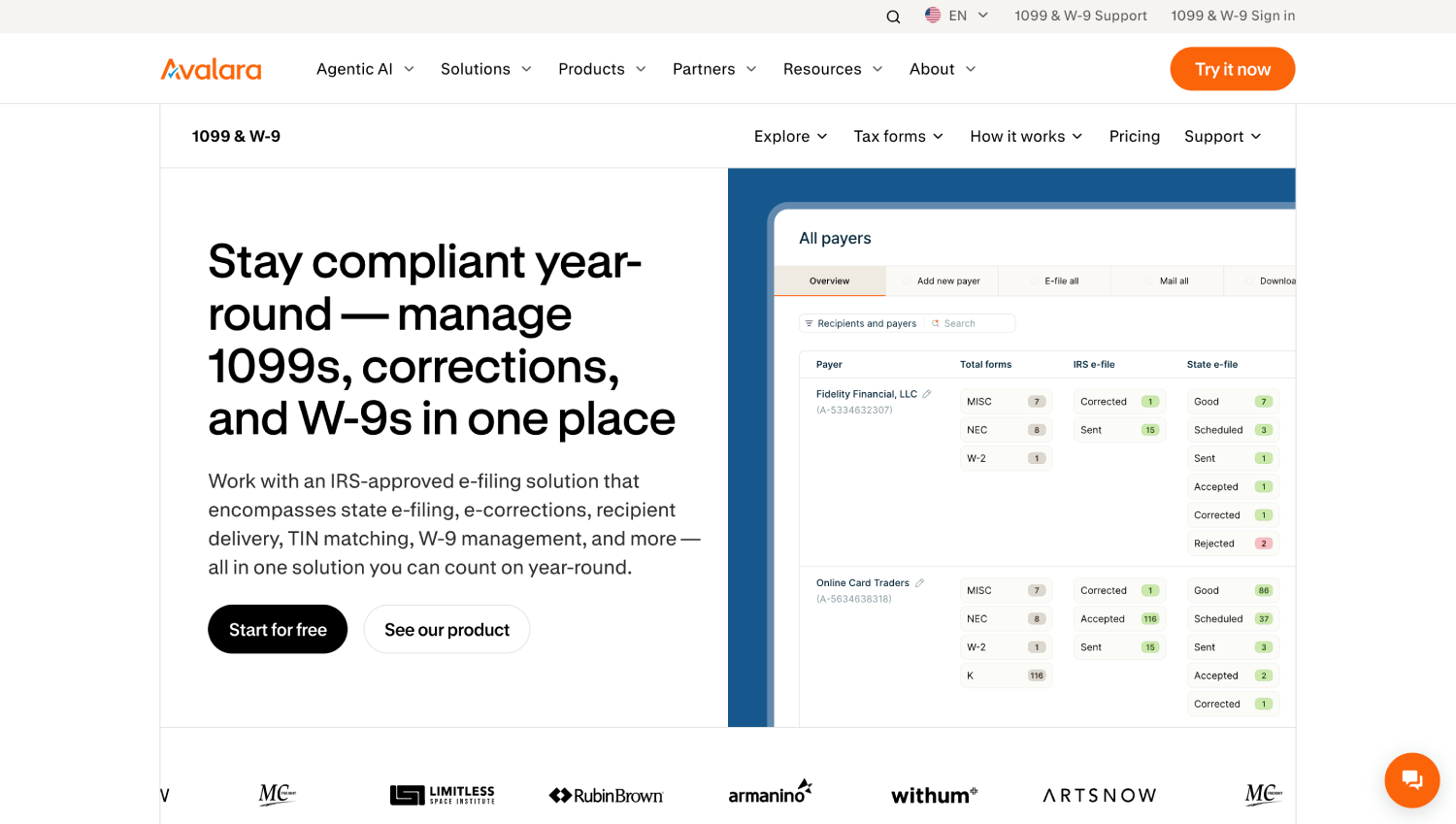
Track1099 is an IRS-approved e-file transmitter that handles 1099-NEC, 1099-MISC, 1099-K, W-2, and several other return types. It offers both a web interface for manual filing and an API for programmatic submission. The API is straightforward: POST payment data, receive confirmation, track status.
W-9 collection is available through Track1099’s W-9 request workflow, which sends payees a link to complete the form online. The completed data flows back into the filing system automatically. State filing covers states that accept direct reporting, and Track1099 publishes state-by-state coverage documentation.
Pricing is per-form with volume tiers, and Track1099 publishes its rates publicly on its pricing page. That transparency is a meaningful differentiator at the evaluation stage. Teams that want to model cost at 5,000 forms versus 50,000 forms can do the math without a sales call.
Best for: finance and engineering teams at companies with 1,000 to 100,000+ annual filings who want API control, transparent pricing, and no minimum contract.
3. Trolley: Best for Platforms That Also Handle Global Payouts
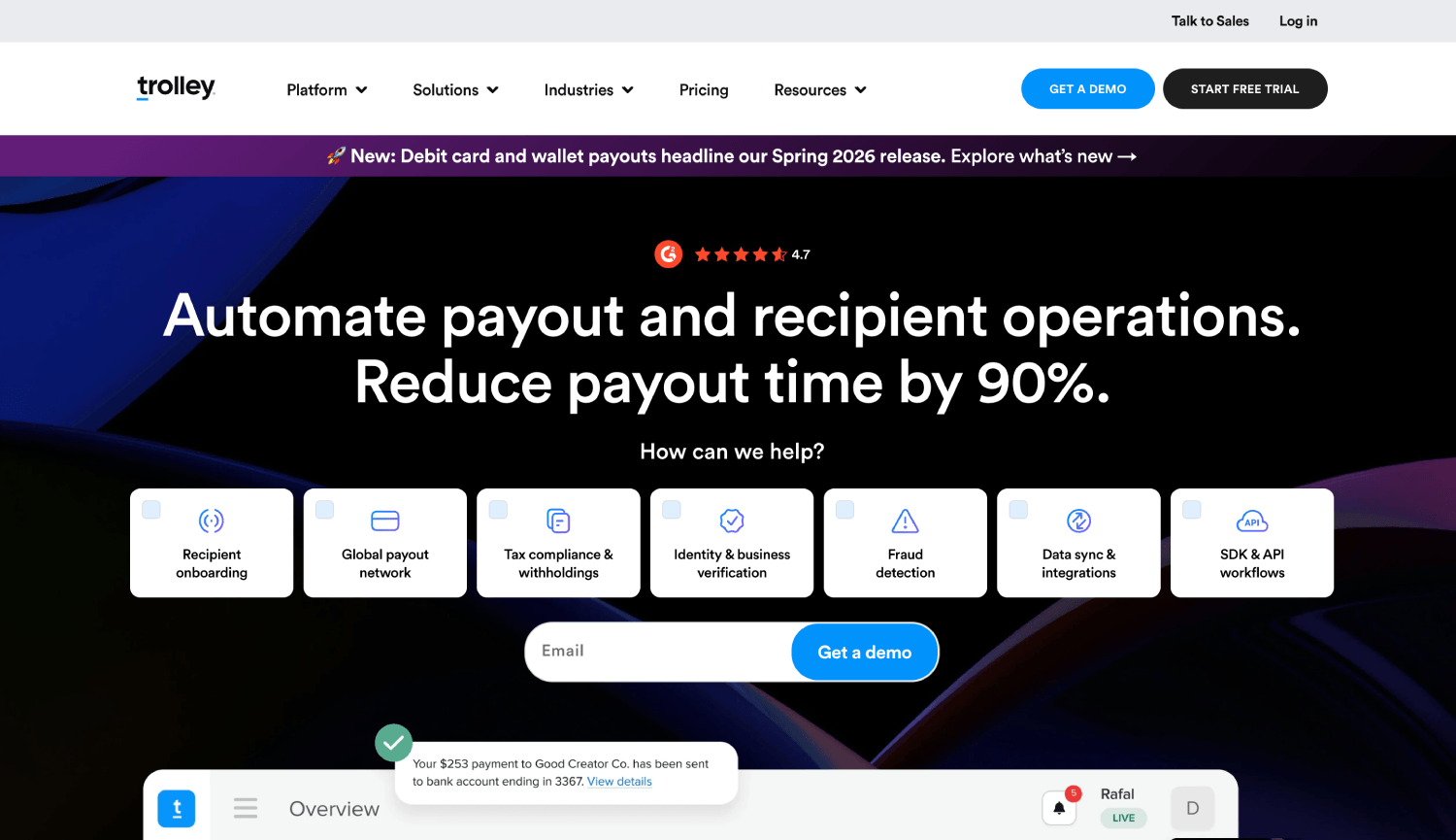
Trolley combines an outbound payments API (ACH, wire, PayPal, and other rails in 200+ countries) with US tax compliance. For platforms paying a mix of US 1099 contractors and international recipients, Trolley handles both the payout and the tax form in the same workflow, which cuts significant integration complexity.
The tax module covers 1099-NEC, 1099-MISC, 1099-K, and 1042-S for foreign payees. W-8 collection (the international equivalent of W-9) is included alongside W-9, which matters for platforms with a global contractor base. Trolley collects tax forms during payee onboarding, validates them, and files the appropriate form based on residency.
The trade-off: if you do not need the payout rail and already have payment infrastructure, Trolley’s per-transaction pricing model adds cost that a filing-only vendor would not. The platform is priced as a payout-plus-compliance bundle, not a standalone tax API.
Best for: creator economy platforms, affiliate networks, and marketplaces paying both US and international contractors where consolidating payout and tax compliance in one vendor makes sense. Our comparison of outbound payment and payout APIs covers the payout rail decision in more depth.
4. Tax1099: Best for Multi-Form Filing with Strong State Coverage
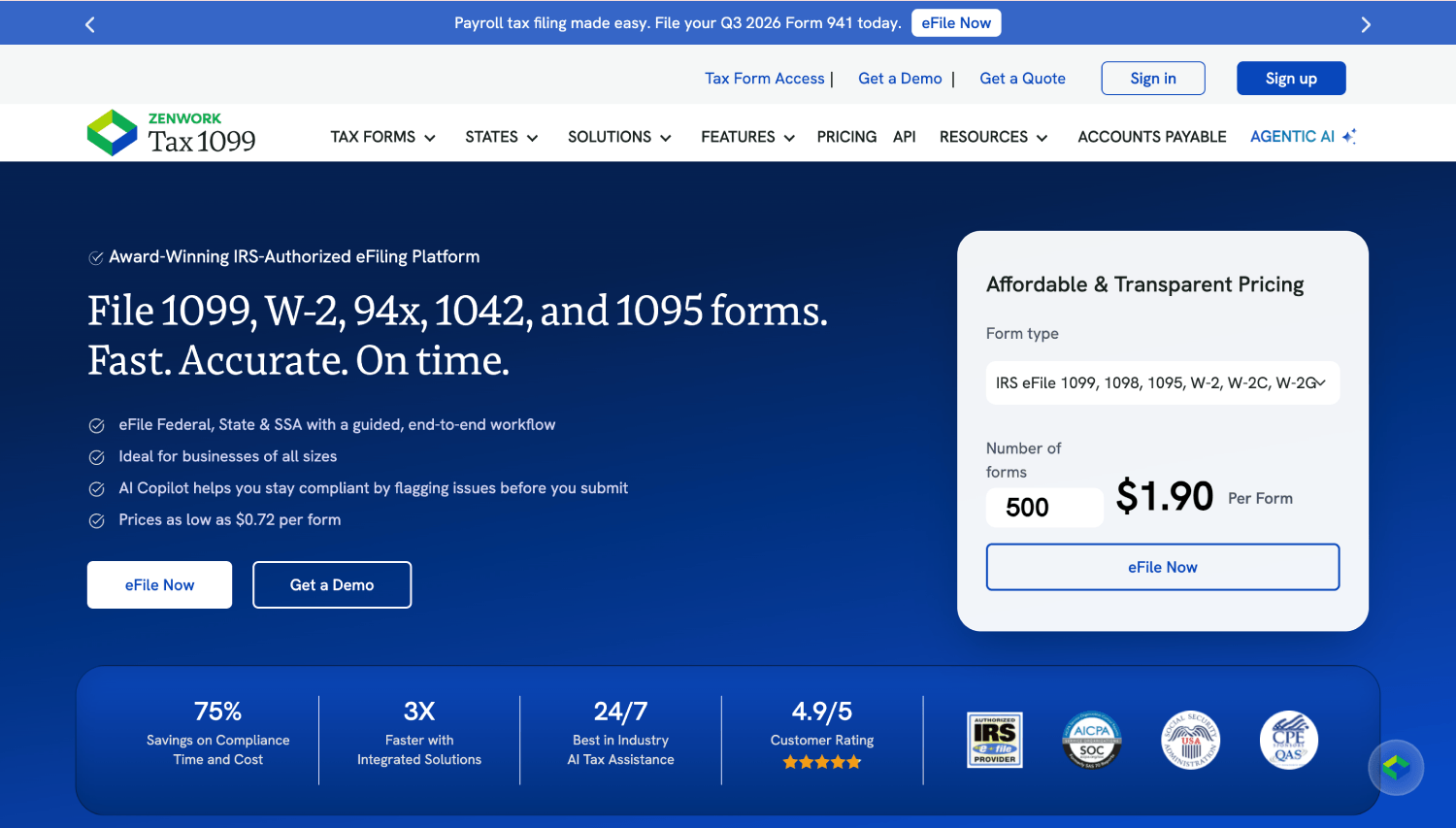
Tax1099 by Zenwork handles over 40 IRS form types and files directly with 40-plus states that require direct reporting. The coverage breadth is the main reason to consider it over narrower alternatives. If your platform generates 1099-K volume from payment card transactions alongside 1099-NEC contractor payments, Tax1099 handles both without requiring a second vendor.
The API documentation is developer-friendly, and Tax1099 maintains an active developer portal with sandbox access. W-9 collection is available through a hosted portal that sends payees collection requests by email. TIN matching is available as a bulk upload pre-filing check.
Pricing is per-form with public tiers, and Tax1099 lists its rates on its public pricing page. Volume discounts apply at thresholds their site documents. There is no minimum volume requirement, which makes it accessible for platforms still in early contractor growth.
Best for: platforms that file multiple 1099 form types and need confirmed state direct filing coverage, without an enterprise contract requirement.
5. Sovos: Best 1099 API for Enterprise Compliance Programs
Sovos is one of two vendors in this list (alongside Avalara) that treats 1099 as one module inside a broader global compliance platform. Sovos handles 1099-NEC, 1099-MISC, 1099-K, ACA (1095-B/C), W-2, and international withholding tax reporting across dozens of countries.
For a company with 50,000-plus contractor payments annually, complex entity structures, or existing IRS withholding obligations, Sovos handles the program end-to-end. That includes state direct reporting for all states that require it, corrections management, audit support, and regulatory update maintenance when IRS rules change mid-year.
Pricing is contract-based and not publicly disclosed. Sovos targets finance teams at large enterprises and mid-market companies, not early-stage platforms running a few thousand forms per year. Implementation timelines reflect that: expect a longer onboarding cycle than a lighter API-first vendor.
Best for: public companies, large enterprises, or Series C+ platforms with multi-form compliance obligations and the budget for a managed enterprise relationship.
6. Avalara 1099 (formerly 1099 Pro): Best for Existing Avalara Customers
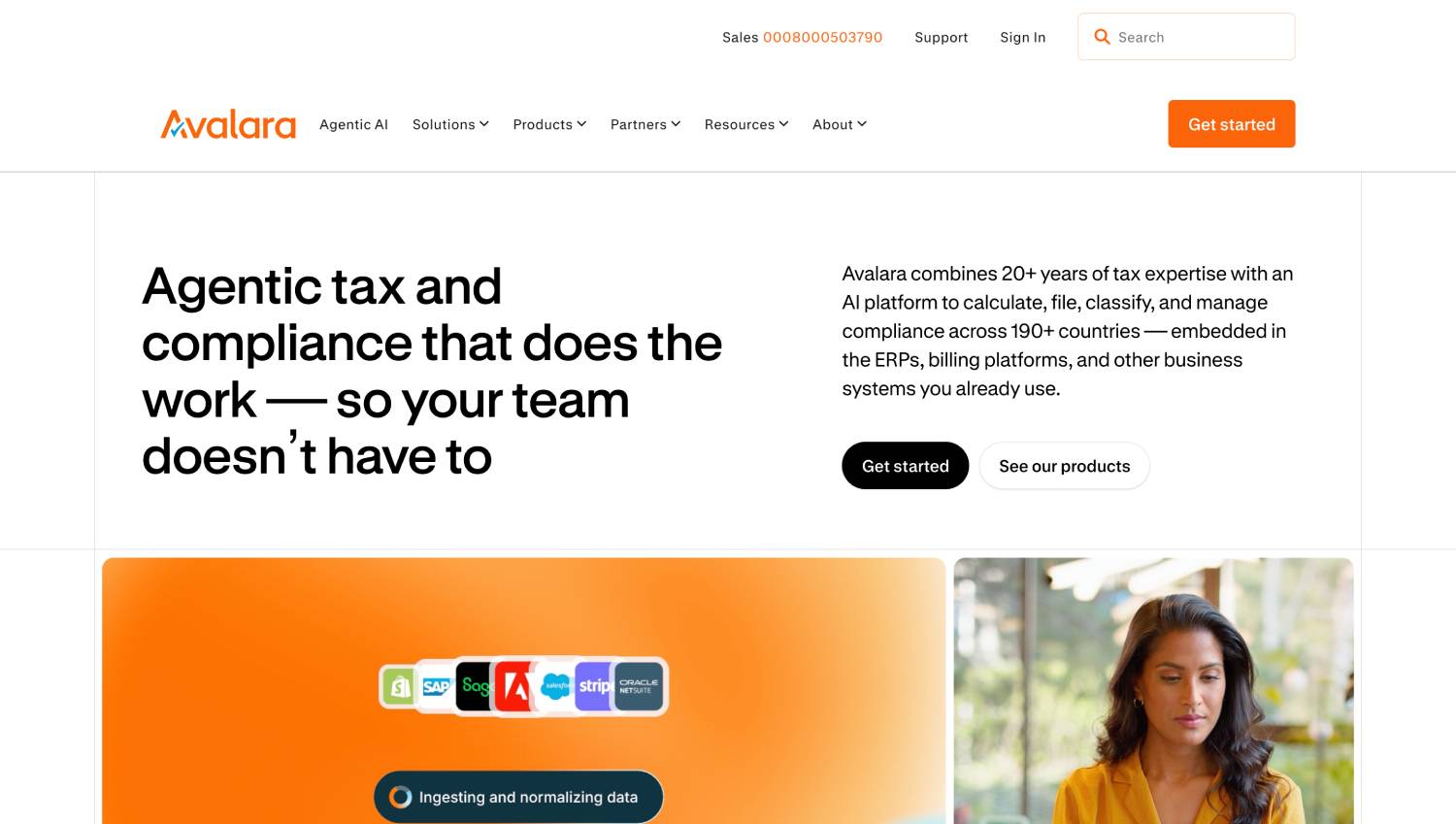
Avalara 1099 handles W-9 collection, TIN matching, 1099-NEC and 1099-MISC filing, state direct reporting, and corrections. Its practical advantage is consolidation: if your platform already uses Avalara for sales tax, adding 1099 means one vendor relationship, one contract, and one integration point for both tax functions.
For a platform not already in Avalara’s stack, that consolidation advantage disappears, and the pricing for 1099 as a standalone product becomes harder to justify against more focused alternatives. Avalara does not publish 1099-specific pricing publicly; it is bundled into custom quotes.
Best for: companies already using Avalara for sales-tax compliance that want to extend into contractor 1099 without adding a second vendor. For teams evaluating both tax layers together, the Fintech Product and Compliance Readiness Checklist is a useful starting point for scoping the full obligation picture.
7. Yearli by Greenshades: Best Mid-Market 1099 Filing Platform
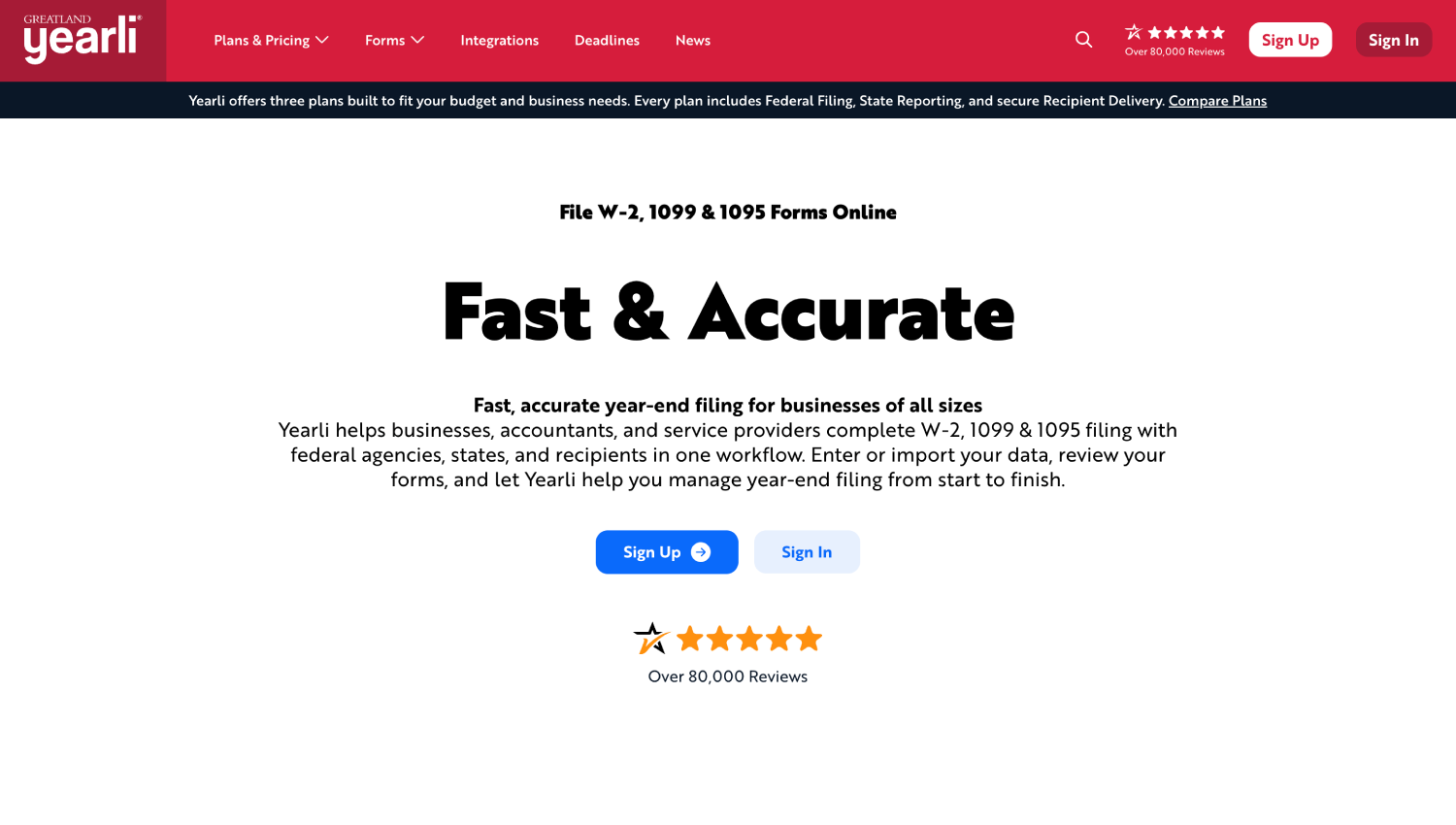
Yearli, developed by Greenshades, covers 1099-NEC, 1099-MISC, 1099-R, W-2, and related forms. It offers a web-based interface for manual filers and an API for programmatic integration. The platform handles federal and state direct filing, payee copy delivery (postal or electronic), and corrections.
Yearli’s pricing model combines an annual platform fee with per-form charges, and the company publishes rate information on its site. The platform sits between lightweight API-first vendors and full enterprise suites. It handles more form types and has better state coverage than simple per-form filing services, without the implementation overhead of Sovos or Avalara.
Best for: mid-market companies with payroll-adjacent 1099 filing needs, particularly those paying 1099-R distributions or handling W-2 alongside contractor forms.
8. 1099-etc by A-Datum: Best for High-Volume Batch Filing
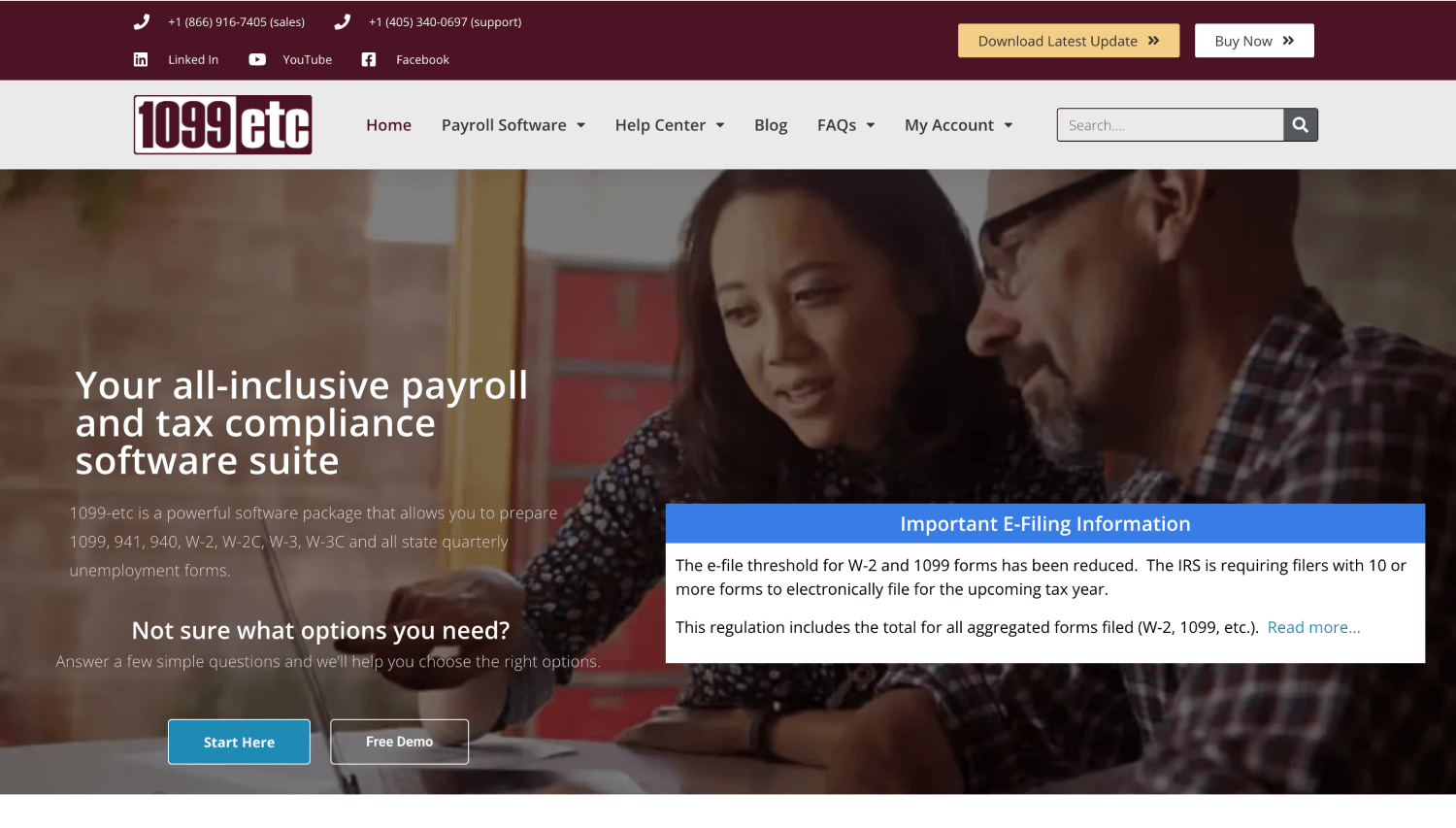
1099-etc from A-Datum is a long-standing IRS-approved e-file platform with a licensing model rather than per-form pricing. For companies filing very high volumes of forms annually, the per-form economics of SaaS-based alternatives eventually flip, and a license-fee model becomes cheaper.
The product handles 1099-NEC, 1099-MISC, 1099-K, W-2, and dozens of other form types. It includes state direct filing. The interface is functional but not developer-first. API integration is available but less polished than purpose-built 1099 API vendors.
W-9 collection support is limited compared to Abound or Trolley, so platforms that need embedded payee onboarding will need to handle that separately. The value proposition is the cost ceiling: a fixed annual license covers unlimited forms, which beats per-form pricing at sufficient scale.
Best for: high-volume filers where per-form pricing is the primary cost driver and developer experience is a secondary concern.
9. Workmarket (ADP): Best When Contractor Management Is the Primary Need
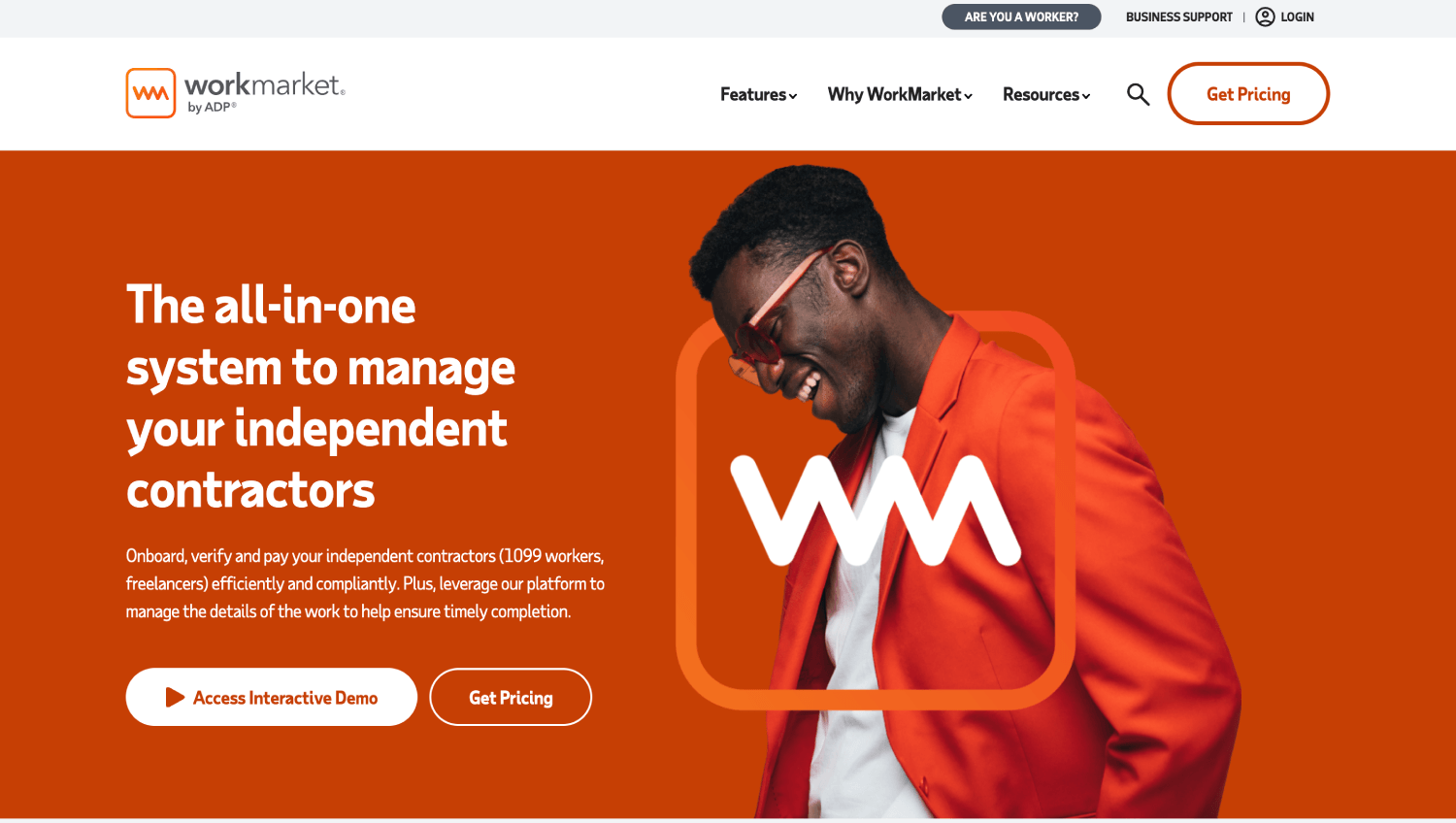
Workmarket, now owned by ADP, is a contractor management platform with 1099 compliance built in. It handles contractor onboarding, classification, time tracking, payments, and 1099 filing as an integrated system. For companies that need to manage the full contractor relationship, not just file tax forms, Workmarket covers more surface area than a pure 1099 API.
The 1099 filing is handled by ADP’s infrastructure, which means enterprise-grade state coverage and corrections handling. Pricing is contract-based and not publicly disclosed. Implementation is heavier than a standalone filing API.
Best for: companies managing large contractor workforces where 1099 compliance is one requirement inside a broader contractor operations problem, not the only one.
10. Deel: Best When International Contractors Complicate the Picture
Deel is primarily a global contractor payroll platform, and its US 1099 compliance capability is built into that broader offering. When you onboard a US contractor through Deel, it collects the W-9, validates the TIN, makes payments, and handles the 1099-NEC filing at year-end. The filing is not a separate API call; it is automatic based on payment activity tracked in Deel.
The per-contractor monthly fee makes Deel more expensive per-payee than a filing-only vendor at scale. A platform paying 10,000 US contractors annually would pay significantly more with Deel than with Track1099 or Tax1099. But for companies already managing contractors through Deel for international payments, adding US 1099 coverage without a second vendor is a reasonable trade-off. Our breakdown of embedded payroll APIs for vertical SaaS covers the broader payroll-plus-compliance decision for platforms considering this layer.
Best for: companies already using Deel for global contractor management that want US 1099 handled without a second integration.
What Does US State 1099 Direct Reporting Actually Cover?
This is the piece most platforms get wrong. The IRS Combined Federal/State Filing program forwards certain 1099 forms to participating states automatically. But not all states participate, not all form types are covered, and some states that do participate still require a separate state filing for certain thresholds.
The table below reflects participation status as publicly documented by the IRS Combined Federal/State Filing program and state revenue agency guidance. Requirements change annually; confirm current status with your chosen vendor before each filing season.
| State | Direct 1099 Reporting Required? | Participates in CF/SF? | Key Notes |
|---|---|---|---|
| California | Yes | No | File directly with CA FTB; CF/SF not accepted |
| New York | Yes | Yes (partial) | 1099-NEC requires direct filing separately |
| Texas | No state income tax | N/A | No 1099 filing obligation at state level |
| Florida | No state income tax | N/A | No 1099 filing obligation at state level |
| Illinois | Yes | Yes | CF/SF covers 1099-NEC; confirm current status with IL DOR each year |
| Massachusetts | Yes | Yes (partial) | Some form types require direct submission |
| Virginia | Yes | Yes | CF/SF participation covers 1099-NEC; confirm annually with VA Tax |
| Pennsylvania | Yes | No | Requires direct submission to PA DOR |
State requirements change annually. Any vendor that cannot confirm its current state coverage for the specific form types you file is a risk. Ask vendors explicitly whether they handle California FTB direct reporting and Pennsylvania direct reporting, since those are the two states most likely to trip up platforms relying on CF/SF alone.
How Do 1099 API Pricing Models Compare at Scale?
The pricing math changes significantly depending on your filing volume. To illustrate the dynamics: a platform filing 20,000 1099-NECs annually at a hypothetical per-form rate of $1.50 would spend $30,000 per year before any platform or state filing fees. At 100,000 forms, that same rate produces $150,000 annually, at which point a license-fee model or custom enterprise pricing becomes economically relevant. For actual current per-form rates, consult Track1099’s public pricing page and Tax1099’s public pricing page directly, as both vendors publish tiered rates that change periodically.
The inflection point for most platforms is somewhere between 25,000 and 50,000 annual forms. Below that threshold, per-form pricing from Track1099 or Tax1099 is typically the lowest total cost. Above it, negotiating a custom contract with Sovos, Avalara, or switching to a license-fee model like 1099-etc changes the economics meaningfully.
One cost that per-form pricing often understates: state direct filing fees are sometimes additive. A vendor charging $1.00 per federal form may charge an additional $0.50 to $1.50 per state form. At volume, state filing fees can equal or exceed the federal filing cost. Confirm the all-in per-form cost including state filing before comparing vendors. The hidden costs that kill fintech SaaS margins often include exactly this kind of per-unit fee that compounds quietly.
Frequently Asked Questions
What is a 1099 API and how does it work?
A 1099 API is a programmatic interface that automates IRS information return filing. Platforms send payment data to the API, which generates 1099-NEC or 1099-MISC forms, runs TIN validation against IRS records, files electronically through the IRS FIRE system, handles state direct reporting, delivers payee copies, and processes corrections. Most 1099 APIs also include W-9 collection workflows so platforms can gather taxpayer information before filing season.
When does a platform have to file a 1099-NEC?
A US platform must file a 1099-NEC for any contractor, freelancer, or independent service provider who receives $600 or more in payments during a calendar year, provided the recipient is a US person or entity (not a C-corporation). The filing deadline is January 31 for both the IRS copy and the payee copy. Late filing triggers per-form IRS penalties that scale with how late the filing is.
Does my platform need W-9 collection before I can file 1099s?
Yes. Without a valid W-9 on file, you do not have the contractor’s Taxpayer Identification Number, which is required for the 1099. If a contractor refuses to provide a W-9, the IRS requires you to apply backup withholding at 24% of their payments and remit that amount to the IRS. Running TIN matching after W-9 collection, before year-end filing, catches mismatches early and prevents IRS B-Notices.
What is IRS TIN matching and which vendors offer it?
TIN matching is a pre-filing verification step where you submit a payee’s name and Taxpayer Identification Number to the IRS to confirm they match IRS records. A mismatch means the 1099 will generate an IRS B-Notice and may trigger backup withholding requirements. Abound, Track1099, Tax1099, Trolley, Sovos, and Avalara 1099 all offer TIN matching. The difference is timing: Abound and Trolley run it at onboarding; some others run it as a bulk pre-filing check.
What is the difference between the IRS CF/SF program and state direct filing?
The Combined Federal/State Filing program forwards certain 1099 data to participating states as part of the federal e-file process, eliminating a separate state filing for covered states and form types. However, states like California and Pennsylvania do not participate in CF/SF and require their own separate direct submissions. Several states that do participate still require separate filings for specific form types or above certain thresholds. A 1099 API that relies solely on CF/SF for state compliance will miss these states.
Can I use a 1099 API for 1099-K filings from payment card transactions?
Yes. Tax1099, Track1099, Sovos, and Avalara 1099 all support 1099-K filings in addition to 1099-NEC and 1099-MISC. The 1099-K reporting threshold for third-party payment platforms has changed multiple times between 2022 and 2025. The IRS originally lowered the threshold from $20,000 to $600 effective for tax year 2022, then issued transition relief delaying that change through subsequent years while it phased in a $5,000 interim threshold for tax year 2024. The current applicable threshold depends on which tax year you are filing; consult IRS guidance on Form 1099-K directly for the current rule. Confirm with your chosen vendor that their 1099-K workflow reflects the threshold in effect for your filing year.
Is there a minimum volume to use a 1099 API?
Track1099 and Tax1099 have no stated minimum volume. Abound and Trolley are typically accessed through a commercial conversation, and their minimums depend on the engagement structure. Sovos and Avalara are contract-based and generally target larger organizations. For platforms filing fewer than 100 forms annually, a dashboard-first vendor like Track1099 or Tax1099 is almost always more cost-effective than an API-first enterprise solution.
How does 1099 filing for gig platforms differ from standard contractor filing?
Gig platforms often pay thousands of contractors with highly variable annual totals, where many recipients cross the $600 threshold mid-year and others do not. This creates a dynamic filing obligation that needs real-time payment tracking to know who will require a form. Vendors like Abound and Trolley are designed for this pattern: they track cumulative payments per payee throughout the year and generate filing queues automatically when thresholds are crossed, rather than requiring a year-end batch upload.
What to Do Before You Contact a Vendor
Before reaching out to any vendor in this list, answer three questions internally. First, what form types do you actually need: 1099-NEC only, or also 1099-MISC, 1099-K, or 1042-S for international payees? Second, do you need the W-9 collection and TIN matching embedded in your product, or is a back-office workflow acceptable? Third, how many forms do you expect to file in year one, year two, and year three, given your contractor growth trajectory?
Those three answers narrow the list fast. A platform filing 1099-NEC only, needing embedded W-9 collection, and projecting 10,000 forms in year one lands at Abound or Track1099. A platform with multi-form needs, heavy state filing obligations, and 100,000-plus forms annually lands at Sovos, Avalara, or Tax1099. A platform paying both US and international contractors with complex payout rail requirements lands at Trolley or Deel.