
- Enterprise KYB evaluations routinely shortlist six to eight vendors, but fewer than half can handle beneficial ownership cascades, multi-jurisdictional registry pulls, and ongoing monitoring inside a single API contract.
- Entity resolution capability, not just document verification, is the differentiator that separates enterprise-grade vendors from mid-market tools dressed up in enterprise pricing.
- The vendors that consistently appear in large fintech RFPs are Middesk, Alloy, Trulioo, Socure, Baselayer, and Dun and Bradstreet, each with distinct strengths that map to different buyer profiles.
- Procurement teams that shortlist without a structured evaluation framework waste three to six months in proof-of-concept cycles that never isolate the right variable.
- Pricing across this category is almost entirely custom and undisclosed, but the cost drivers are predictable: verification volume, registry depth, UBO traversal, and monitoring cadence.
The enterprise KYB vendors that reliably appear on RFP shortlists for large fintechs and financial institutions include Middesk, Alloy, Trulioo, Socure, Baselayer, and Dun and Bradstreet. Each covers business identity verification and registry lookups, but they diverge sharply on entity resolution depth, beneficial ownership traversal, global registry coverage, and ongoing monitoring. The right shortlist depends on whether your primary constraint is US domestic speed, cross-border coverage, or integrated identity orchestration across both KYB and KYC layers.
What Actually Separates Enterprise KYB from Business Verification
Business verification confirms that a legal entity exists. Enterprise KYB goes several layers deeper: it maps beneficial ownership structures, traverses holding company hierarchies, screens all discovered entities against sanctions and adverse media, and then monitors the entire graph for changes over time. That distinction matters because most RFP failures happen when procurement teams conflate the two and evaluate vendors on a capability the incumbent already delivers adequately.
The operational gap shows up at scale. A vendor that handles 500 verifications per month cleanly may produce unacceptable error rates at 50,000 when registry rate limits, manual review queues, and exception-handling logic all interact. Enterprise buyers need to stress-test that behavior before signing a multi-year contract.
Entity resolution adds another dimension entirely. It answers not just “does this business exist” but “is this the same entity we saw under a different name in a different jurisdiction three years ago.” Graph-based matching, alias detection, and historical corporate record linkage are what separate the vendors worth shortlisting from those that belong on a mid-market list. For a detailed look at how this capability is evaluated in practice, the FintechSpecs overview of entity resolution software for fraud and compliance teams covers the underlying technology in depth.
The FintechSpecs Enterprise KYB Shortlist Framework
Before reviewing individual vendors, procurement teams benefit from a structured lens. The FintechSpecs Enterprise KYB Shortlist Framework uses four gates that every vendor must pass before earning a spot on the RFP list. These are not weighted scores. They are binary: a vendor either qualifies or it does not.
- Registry Gate: Can the vendor pull live data from all state-level US registries and at least 40 international jurisdictions programmatically, not via manual analyst requests?
- UBO Gate: Does the vendor traverse beneficial ownership chains to at least four layers of depth, and does that traversal happen inside the API response rather than as a separate workflow?
- Monitoring Gate: Does the vendor offer continuous or near-real-time monitoring on verified entities, with webhook-based alerts, rather than periodic batch re-screening?
- Orchestration Gate: Can KYB decisions feed directly into a broader risk decisioning layer, either natively or via a documented integration with identity orchestration platforms?
Vendors that fail the Registry Gate belong on a domestic-only shortlist. Vendors that fail the UBO Gate are appropriate for low-risk B2B onboarding but not for regulated financial institutions with FinCEN beneficial ownership requirements. The Monitoring and Orchestration Gates tend to separate vendors that were built for enterprise buyers from those that retrofitted enterprise features onto a smaller product.
Which KYB Vendors Are Shortlisted in Enterprise RFPs?
Middesk
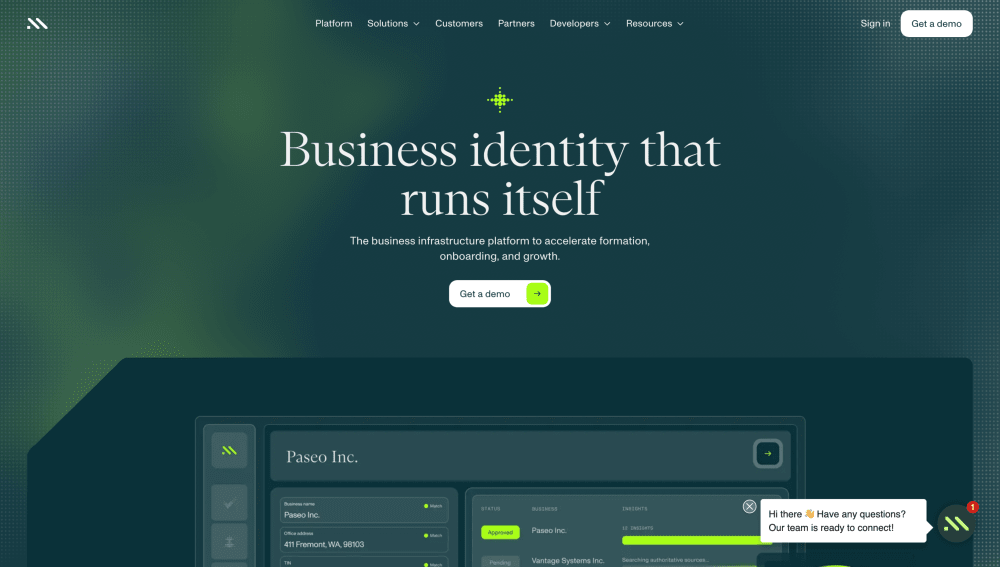
Middesk is the vendor most frequently cited in domestic US enterprise RFPs, particularly among fintech lenders, neobanks, and payments companies onboarding US-registered businesses. Its core product pulls from Secretary of State registries across all 50 states, IRS EIN validation, USPS address verification, and business credit data. The turnaround on standard verifications is fast enough that it fits into real-time onboarding flows without a manual review buffer.
Where Middesk earns its RFP placement is in its business-of-record infrastructure: the ability to return a structured legal entity profile that includes DBA names, registered agents, filing history, and status flags. Compliance teams at Series B and later companies use this to meet FinCEN CDD requirements without building their own registry-scraping logic. The FintechSpecs comparison of Middesk versus Baselayer for high-risk onboarding breaks down exactly where each vendor wins on specific buyer profiles.
Middesk does not publicly disclose pricing. Based on the structure of their commercial offerings, costs are volume-tiered and negotiated at the enterprise level. Buyers should expect a minimum commitment discussion for accounts above a certain monthly verification volume.
Alloy
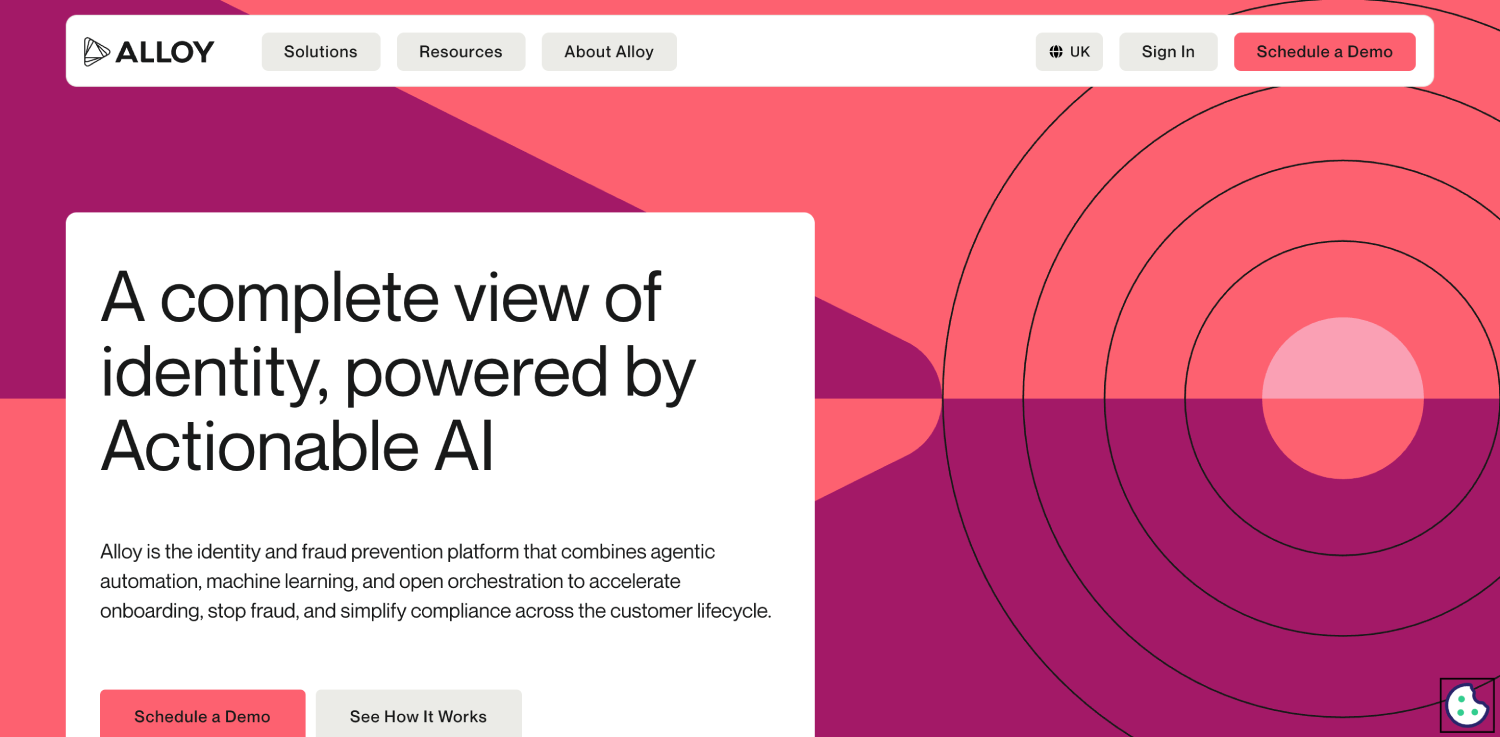
Alloy occupies a different position on enterprise shortlists. It is primarily an identity orchestration platform that includes KYB as a module alongside KYC, transaction monitoring, and fraud decisioning. For buyers who want a single vendor contract covering both individual and business identity verification, Alloy is often the only platform that delivers that in a genuinely integrated way rather than through a patchwork of acquired products.
The trade-off is depth. Alloy’s KYB capability is strong for US-based entities and for buyers who prioritize workflow orchestration over raw registry breadth. It connects to third-party data sources including Middesk, which means some enterprise buyers use both: Middesk for data and Alloy for decisioning logic. That two-vendor setup is common at regulated institutions with complex policy engines. The head-to-head between Alloy and Middesk as KYB platforms covers that decision in detail.
Trulioo

Trulioo is the default choice when an enterprise RFP specifies global KYB coverage. Trulioo’s business verification product covers entities in over 200 countries and territories, drawing on a network of local registry partners, commercial data providers, and document verification pipelines. For multinational fintechs, cross-border payment companies, and crypto exchanges with global user bases, Trulioo is frequently the only vendor that can deliver a single API contract covering both consumer KYC and business KYB at that geographic scope.
The practical limitation is consistency. Data quality in Tier 1 markets like the US, UK, Canada, Germany, and Australia is high. In emerging markets, the coverage depends on local partner relationships that vary in freshness and completeness. Buyers should ask Trulioo for match rate benchmarks in their specific target jurisdictions before shortlisting it for markets outside North America and Western Europe. For a direct comparison with Sumsub on combined KYB and KYC workflows, the FintechSpecs analysis of Trulioo versus Sumsub for fintech onboarding covers that trade-off.
Socure
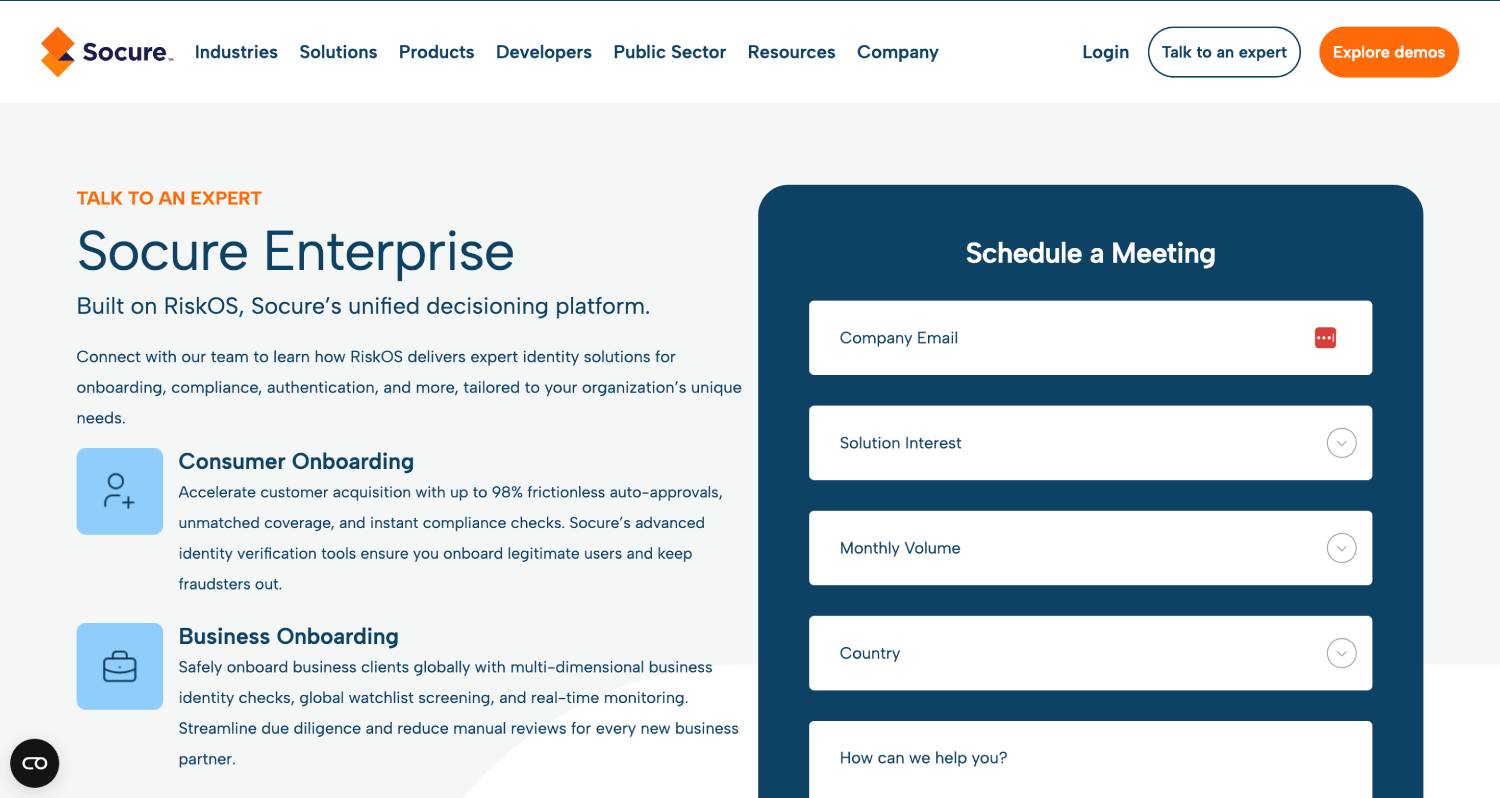
Socure built its reputation on consumer identity verification and synthetic fraud detection, but it has expanded into business identity through its entity verification product lines. In enterprise RFPs where KYC and KYB are evaluated together, Socure appears on shortlists because of its predictive modeling layer, which applies consortium fraud signals to business verification in addition to individual identity checks.
Socure’s positioning in enterprise KYB is strongest when the buyer already uses Socure for consumer KYC and wants to extend that contract rather than introduce a second vendor. Pure-play KYB buyers who do not need the consumer identity stack will find that Middesk or Baselayer delivers more registry depth for the same spend. Socure does not publicly disclose KYB pricing as of publication.
Baselayer
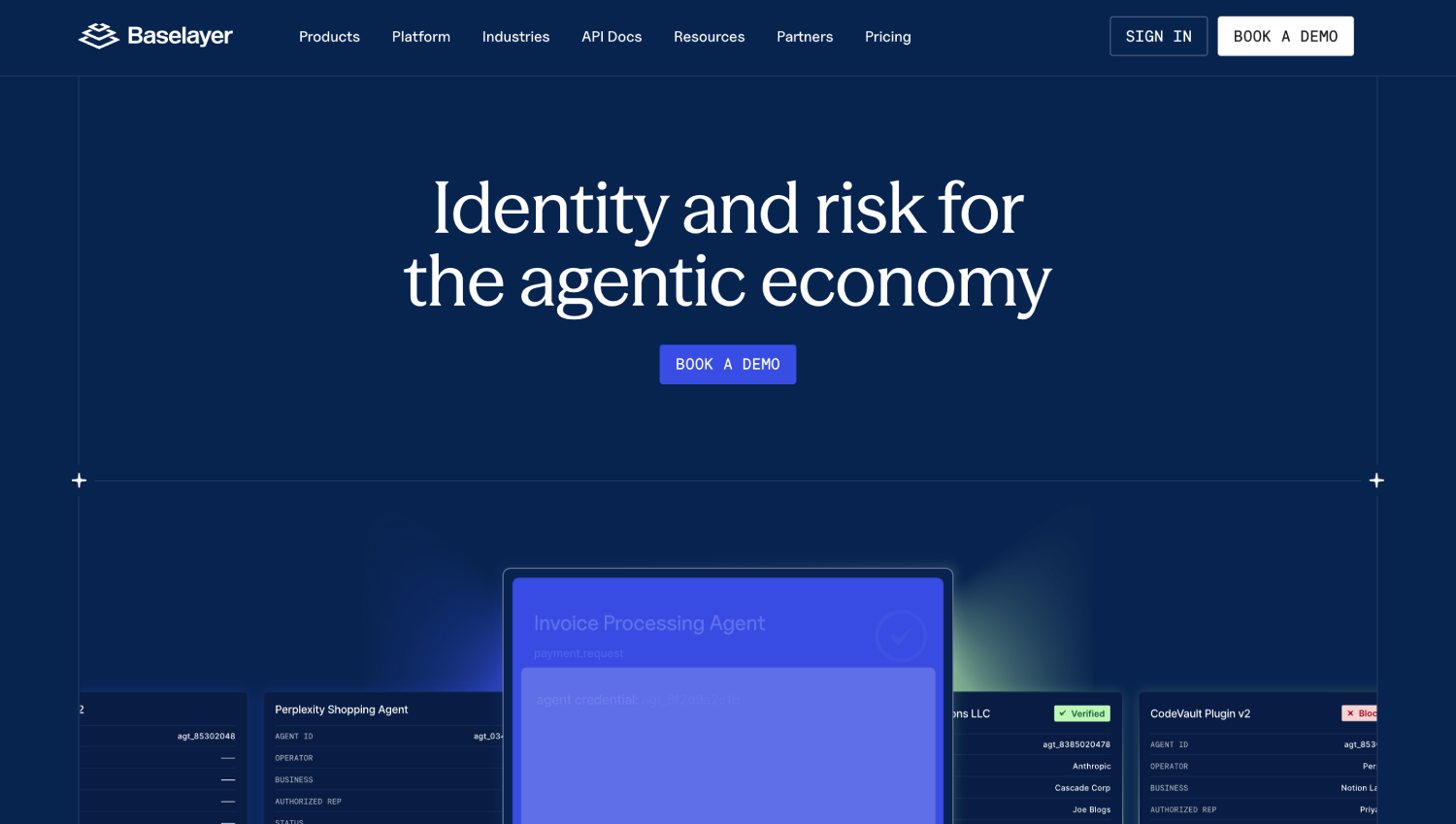
Baselayer targets high-risk onboarding use cases: crypto companies, money service businesses, and fintech platforms operating in verticals with elevated fraud and compliance exposure. Its differentiation is in UBO traversal depth and the ability to handle complex corporate structures including shell companies, nominee directors, and multi-layered holding arrangements. Buyers who get burned by vendors that can verify simple LLCs but fail on complex international structures tend to land on Baselayer.
Baselayer is a narrower tool than Middesk or Alloy. It is built for compliance-first buyers who need maximum ownership graph depth and are willing to trade breadth of registry coverage for depth of entity analysis. It does not serve as a one-stop identity orchestration platform. Buyers with straightforward US onboarding needs and no high-risk segment will find it over-engineered for their situation.
Dun and Bradstreet
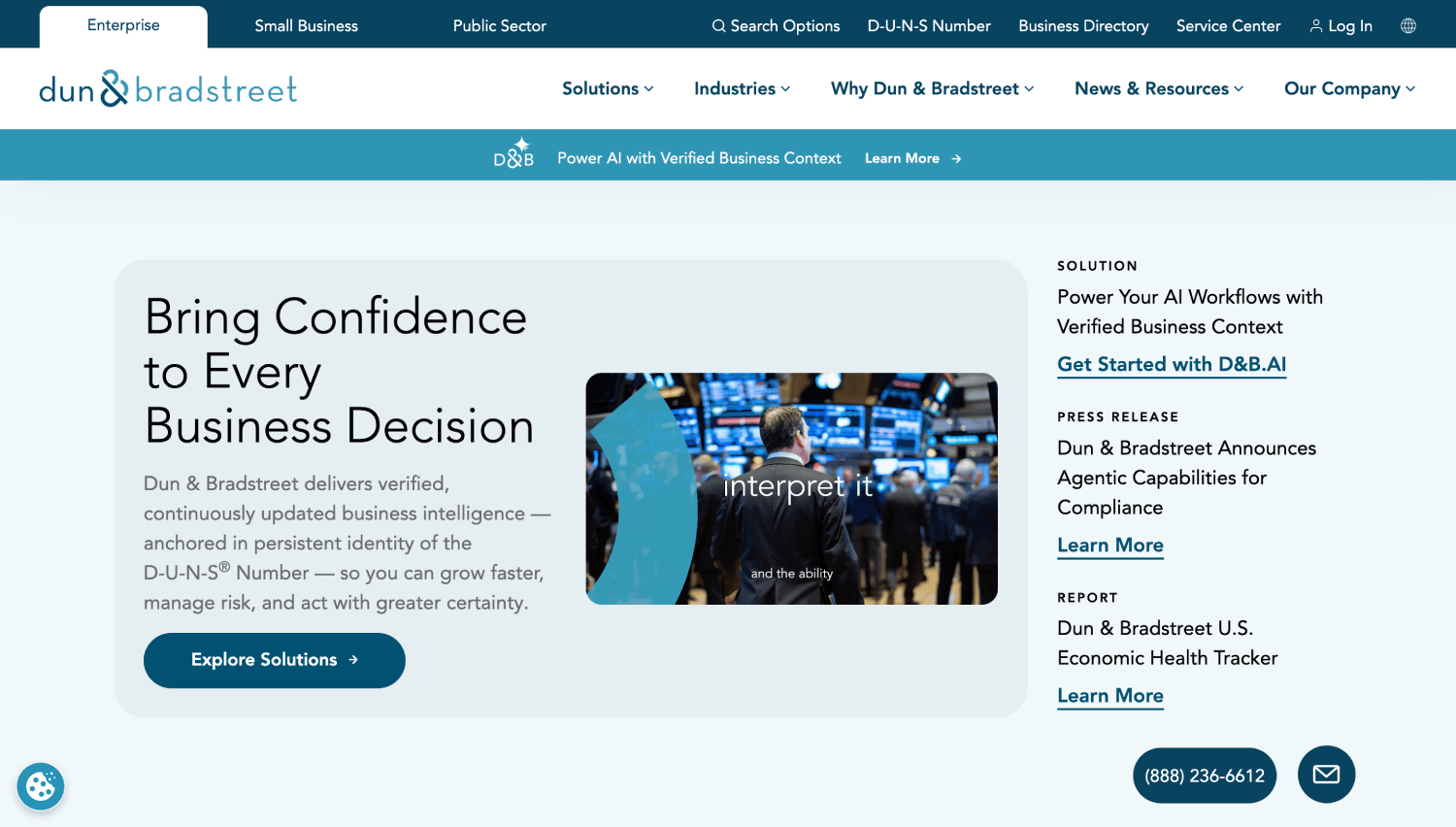
Dun and Bradstreet is the legacy enterprise option that appears on shortlists primarily because of its Data Universal Numbering System (DUNS) number infrastructure and its presence in large financial institution vendor panels that were built before the API-first KYB generation existed. Its coverage of global company records is extensive, and its beneficial ownership data product reaches into private company structures across major markets.
The honest assessment is that D&B competes on existing relationships and data breadth more than on developer experience or API responsiveness. Engineering teams at fintech companies often report that the D&B integration experience is slower and more complex than modern API-first competitors. D&B belongs on shortlists for enterprise buyers inside large banks and financial institutions where incumbent vendor relationships carry procurement weight, and for buyers who need the DUNS identifier specifically for regulatory or counterparty reporting purposes.
ComplyAdvantage
ComplyAdvantage appears on enterprise KYB shortlists specifically for its sanctions screening, adverse media monitoring, and PEP identification layer. It is not a business registry verification tool. It is the AML screening component that sits alongside a registry verification vendor in a complete KYB stack. Buyers who evaluate ComplyAdvantage as a standalone KYB replacement are mis-categorizing it. Those who understand it as the screening and monitoring layer of a two-vendor KYB architecture will find it very strong for ongoing entity surveillance.
Vendor Comparison Table for Enterprise KYB RFPs
| Vendor | Primary Strength | US Registry Depth | Global Coverage | UBO Traversal | Ongoing Monitoring | Best Fit |
|---|---|---|---|---|---|---|
| Middesk | US entity data quality and speed | All 50 states | Limited | Moderate | Yes | US-focused fintech lenders and neobanks |
| Alloy | Identity orchestration across KYB and KYC | Strong via integrations | Moderate | Moderate | Yes | Platforms wanting unified identity decisioning |
| Trulioo | Global registry and document coverage | Strong | 200+ countries | Moderate | Yes | Multinational fintechs and cross-border payments |
| Socure | Predictive fraud modeling, KYC plus KYB bundle | Strong | Moderate | Moderate | Yes | Existing Socure KYC customers adding KYB |
| Baselayer | Deep UBO traversal for high-risk entities | Strong | Targeted | Deep (4+ layers) | Yes | Crypto, MSB, high-risk fintech onboarding |
| Dun and Bradstreet | DUNS identifier, legacy enterprise data breadth | Strong | Extensive | Strong | Yes | Large banks with incumbent vendor relationships |
| ComplyAdvantage | Sanctions, PEP, adverse media screening | N/A (screening only) | Global | N/A | Real-time alerts | AML screening layer in a two-vendor KYB stack |
What Does Enterprise KYB Actually Cost?
No vendor in this category publicly discloses pricing for enterprise tiers. Pricing is negotiated based on monthly verification volume, the number of data sources accessed per verification, UBO traversal depth, and whether ongoing monitoring is included or metered separately. Buyers who go into RFP conversations without volume benchmarks get anchored on whatever the vendor’s opening number is.
The most predictable cost drivers are: verification volume (the primary lever), registry pull complexity (international registries cost more than domestic state-level pulls), UBO depth (each additional ownership layer typically adds per-entity cost), and monitoring cadence (real-time monitoring is priced higher than monthly batch re-screening). For context on how compliance spend scales by company stage, the FintechSpecs analysis of the real cost of compliance in fintech SaaS by stage provides a useful benchmark framework.
The practical range for enterprise contracts covering 10,000 to 100,000 verifications per month spans a wide band. Buyers should model their expected annual volume before entering vendor conversations and ask for per-unit pricing at three volume tiers to understand how costs scale.
What RFP Questions Actually Differentiate These Vendors?
Most enterprise KYB RFPs include generic questions about uptime, SOC 2 compliance, and data retention. Those questions do not differentiate vendors in this category because every vendor on this shortlist meets baseline infrastructure requirements. The questions that actually reveal differences are operational and technical.
- What is your match rate on businesses with fewer than three years of filing history in [specific state or jurisdiction]?
- How does your system handle entities with multiple DBA names registered across different states?
- At what ownership threshold does your UBO traversal stop, and is that threshold configurable?
- When a monitored entity triggers a status change, what is the latency between the registry update and the webhook delivery?
- If a registry is temporarily unavailable during verification, does the API return a degraded response with partial data or a failure, and how is that logged?
- How are disputed or incorrect registry records handled, and what is the remediation SLA?
Vendors that struggle with these questions in a sales conversation will struggle operationally. The answers reveal whether the product was designed for enterprise edge cases or whether the engineering team patched them in later. For buyers evaluating broader vendor readiness, the FintechSpecs framework for evaluating a fintech vendor before signing covers due diligence across all seven critical dimensions.
How Should a Perpetual KYB and Ongoing Monitoring Strategy Change Your Shortlist?
Most buyers focus their RFP on the onboarding verification event. Enterprise-grade programs treat onboarding as one data point in a continuous monitoring relationship. A business that passes KYB at onboarding can change beneficial ownership, lose its good standing with a state registry, or appear in adverse media six months later. The vendor that handles the initial verification may not be the right vendor to own ongoing monitoring, and building a two-vendor architecture for this is common at mature programs.
The vendors with the strongest ongoing monitoring capabilities in this category are Middesk for US entity status changes, ComplyAdvantage for AML-related signals, and Alloy for buyers who want monitoring logic embedded in a broader risk policy engine. For buyers building out a full perpetual KYB program, the FintechSpecs guide to perpetual KYB and ongoing monitoring platforms covers the additional vendors that specialize in continuous surveillance rather than point-in-time verification.
Worked Scenario: What a Two-Tier KYB Stack Looks Like at a Series C Fintech
Consider a US-based payments platform processing onboarding for small and medium businesses across 50 states with roughly 8,000 new business verifications per month and a portfolio of 60,000 active monitored entities. The compliance team needs to meet FinCEN CDD and BSA requirements, with a legal team that has specifically flagged UBO accuracy as the primary audit exposure.
In this scenario, the verification layer would typically go to Middesk for domestic registry depth and speed, with API responses structured to feed directly into the platform’s internal risk scoring model. The monitoring and AML screening layer would run through ComplyAdvantage, configured to watch all 60,000 active entities for sanctions list changes, adverse media, and PEP emergence. The orchestration logic tying those two signals into a unified compliance action would live in Alloy or in the platform’s own policy engine.
That three-vendor architecture is more expensive than a single-vendor approach, but it outperforms any single vendor on accuracy at each specific function. The cost justification is straightforward: a SAR filing failure or a regulatory enforcement action at that scale carries penalties that dwarf the incremental cost of the strongest available tool at each layer.
Frequently Asked Questions
What is the difference between KYB and entity resolution for enterprise buyers?
KYB (Know Your Business) is the compliance process of verifying that a business entity is legitimately registered, identifying its beneficial owners, and screening them against watchlists. Entity resolution is the technical capability to determine whether two records refer to the same real-world entity, even when names, addresses, or identifiers differ. Enterprise buyers need both: KYB for regulatory compliance and entity resolution to detect fraud, duplicate accounts, and related-party risks across large business portfolios.
Which KYB vendors support beneficial ownership requirements under FinCEN CDD rules?
Middesk, Alloy, Baselayer, Trulioo, and Dun and Bradstreet all offer beneficial ownership identification as part of their enterprise product lines. Baselayer is specifically designed for complex UBO traversal and handles multi-layered holding structures that simpler tools miss. Buyers should confirm during RFP whether the vendor’s UBO data is pulled from authoritative registry sources or inferred from commercial databases, as that distinction affects defensibility in a regulatory examination.
Can a single KYB vendor handle both onboarding verification and ongoing monitoring?
Most enterprise-grade vendors offer both, but performance quality often differs between the two functions. Middesk is strongest at point-in-time onboarding verification for US entities. ComplyAdvantage is strongest at ongoing AML signal monitoring. Alloy handles both through an orchestration approach. Mature compliance programs at large fintechs frequently run separate vendors for each function rather than accepting a weaker capability at one layer to preserve a single-vendor contract.
How long does an enterprise KYB RFP process typically take?
Procurement cycles for enterprise KYB contracts at regulated financial institutions typically run three to six months from initial vendor outreach to signed contract, with proof-of-concept testing consuming the largest portion of that time. Buyers who arrive at the RFP stage with a pre-built evaluation scorecard and defined technical acceptance criteria can compress the POC phase significantly. The vendors that move fastest through POC cycles are generally those that offer well-documented sandbox environments with representative test data.
What should procurement teams ask about data freshness in KYB products?
Registry data freshness varies by jurisdiction and vendor. Some vendors pull live from state APIs; others use a cached dataset that may lag by days or weeks. The critical question is: for each jurisdiction where you need coverage, when was the underlying registry data last synchronized, and how is data staleness flagged in the API response? A vendor that returns a confident verification result based on 30-day-old registry data represents a different compliance risk than one pulling live data.
Is Dun and Bradstreet still relevant for enterprise KYB shortlists?
D&B retains relevance in two specific situations: when the buyer needs the DUNS number as a structural identifier for counterparty or regulatory reporting, and when the buyer is a large bank where D&B is already on the approved vendor panel and the incremental cost of qualification for a new vendor exceeds the capability gap. For growth-stage fintechs with no legacy D&B relationship, the API-first competitors offer faster integration, better developer documentation, and more transparent data sourcing.
Do enterprise KYB vendors offer custom risk models?
Alloy and Baselayer offer the most configurable policy and risk logic at the enterprise level, allowing buyers to define custom decisioning rules based on their specific regulatory context and risk appetite. Middesk focuses on data delivery and leaves policy logic to the buyer’s system. Trulioo offers workflow configuration for multi-jurisdiction scenarios. Dun and Bradstreet provides scored risk products rather than configurable logic. Buyers that need a truly custom decisioning layer should prioritize vendors with documented policy engine APIs over those that deliver a fixed risk score.
Building an RFP-Ready Shortlist Without Wasting Six Months
The mistake most procurement teams make is treating KYB vendor evaluation as a feature comparison exercise. It is not. The features are similar enough across the leading vendors that a feature matrix rarely produces a clear winner. The decision lives in operational performance: match rates on your specific entity population, latency under your actual volume, and the quality of exception handling when a registry lookup fails or returns ambiguous results. Those answers only emerge from a properly scoped proof of concept, not from a vendor demo.
A defensible shortlist for an enterprise RFP in this category has three to five names, each justified by a specific capability requirement. Middesk earns its spot for US domestic depth. Trulioo earns its spot for global coverage. Baselayer earns its spot if your entity population includes high-risk business types with complex ownership. Alloy earns its spot if you want KYB and KYC inside the same orchestration layer. ComplyAdvantage earns its spot as the AML screening component in a two-vendor architecture. Any vendor that cannot answer the six operational RFP questions listed above should not make it to the POC stage.
The vendors that lead KYB for large fintechs are not necessarily the vendors with the most impressive sales decks. They are the ones whose data holds up under audit, whose APIs degrade gracefully under load, and whose ongoing monitoring catches the entity changes that your compliance team would otherwise miss until it was too late. That is the standard an enterprise shortlist should be built around.