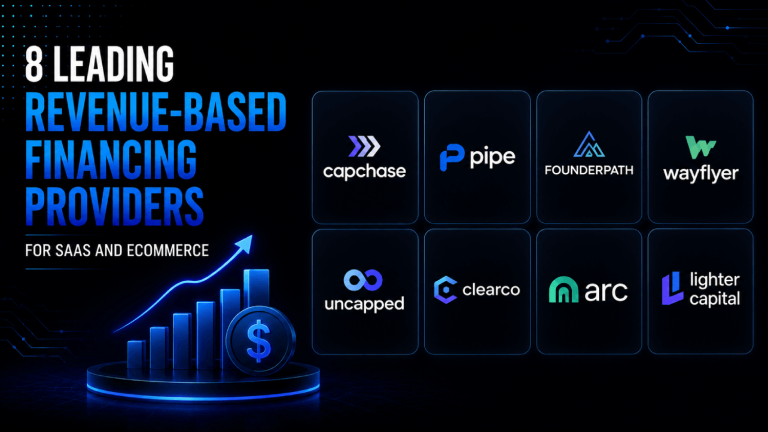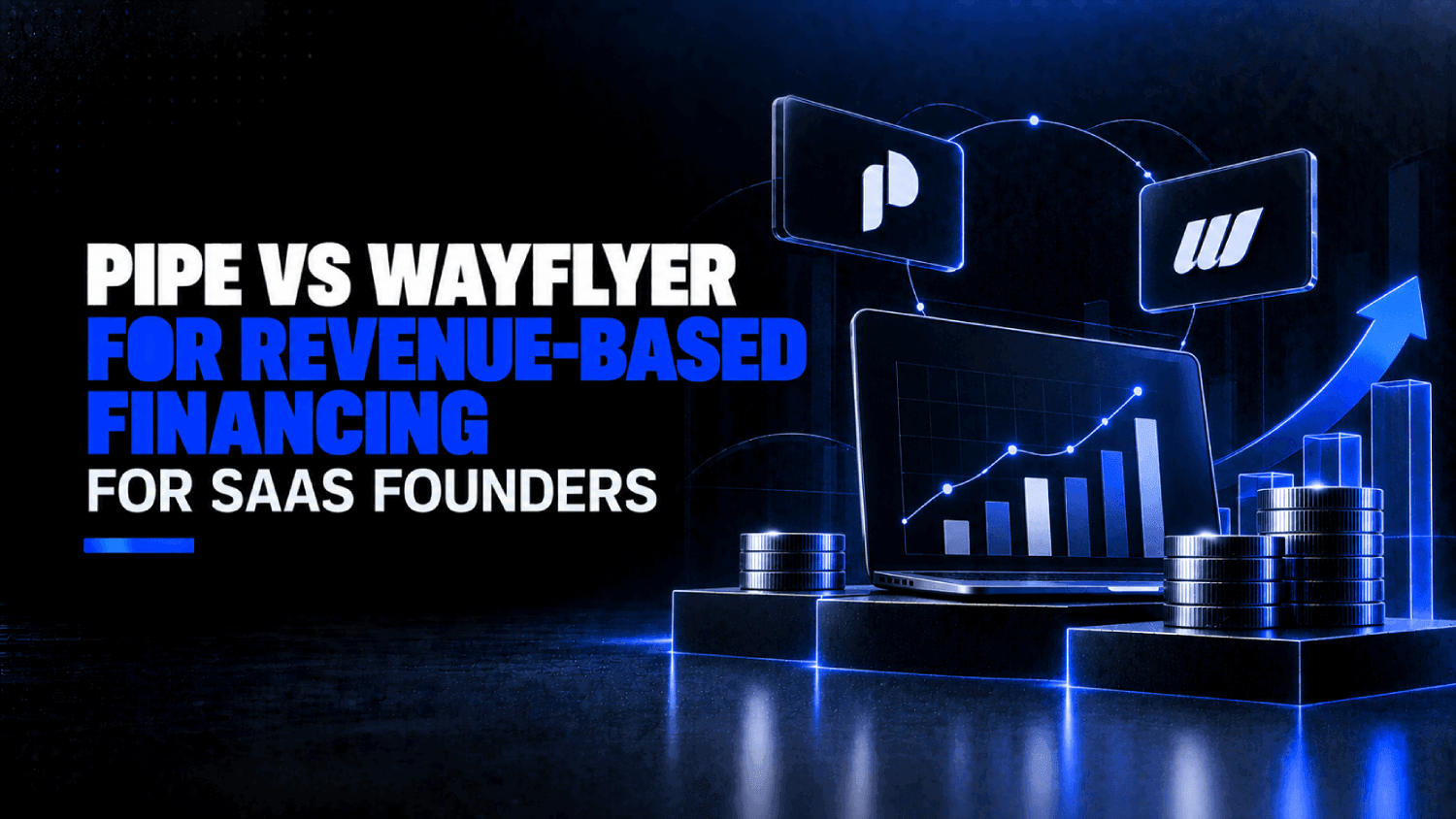

- Pipe suits SaaS founders with predictable subscription revenue and no inventory. Wayflyer is built for ecommerce operators who need capital tied to purchase orders and ad spend cycles.
- Both are revenue-based financing, but the underwriting logic is fundamentally different: Pipe reads your MRR, Wayflyer reads your marketing data and inventory turnover.
- Pipe’s capital comes faster for software companies because their revenue signals are cleaner. Wayflyer’s advance sizing accounts for seasonal spikes that SaaS models rarely experience.
- For a SaaS founder comparing the two, the right answer is usually Pipe. For a DTC or ecommerce brand, Wayflyer wins on product fit almost every time.
- Neither product replaces equity or venture debt at scale, but both can fund growth without dilution at the pre-Series A stage.
Pipe is the better choice for SaaS founders seeking revenue-based financing on recurring subscription revenue, because its underwriting model is purpose-built for MRR-driven businesses. Wayflyer is purpose-built for ecommerce and DTC brands, using marketing performance and inventory data to size advances. If you run a SaaS business, Wayflyer’s model will likely undervalue your revenue and add friction during underwriting. If you run an ecommerce brand, Pipe’s model may not account for your inventory cycles.
Why Pipe and Wayflyer Are Not the Same Product
Both platforms advance capital against future revenue without taking equity. That’s where the similarity ends. Pipe treats your contracted recurring revenue as a financial asset. Wayflyer treats your marketing ROI and inventory velocity as the underwriting signal.
Pipe’s original model was built around trading SaaS subscription contracts: a founder with $50,000 in MRR could access a portion of their annualized revenue upfront, with repayment coming from the same recurring cash flows. Pipe has since evolved into a broader working capital platform, but the SaaS revenue model remains central to how it prices and underwrites deals.
Wayflyer was built for a different problem entirely. DTC and ecommerce brands generate revenue in spikes tied to ad campaigns, seasonal promotions, and inventory cycles. Wayflyer’s underwriting pulls data directly from Shopify, Google Ads, Facebook Ads, and other ecommerce platforms to project revenue forward. That’s a genuinely different dataset than what Pipe reads.
How Does Each Platform Actually Underwrite a Deal?
Pipe’s Underwriting: MRR as the Primary Signal

Pipe connects to your billing and revenue data, typically through integrations with Stripe, QuickBooks, and similar platforms. It evaluates your monthly recurring revenue, churn rate, contract length, and customer concentration. A SaaS business with low churn and multi-year contracts gets better terms than one with high churn and month-to-month subscriptions.
For SaaS founders, this is favorable because MRR is clean, contractual, and predictable. Pipe can size an advance quickly when the revenue signal is unambiguous. As of the time of writing, Pipe’s public pricing page does not display a standard rate card; actual rates require going through their application process.
Wayflyer’s Underwriting: Marketing Data Meets Inventory Logic
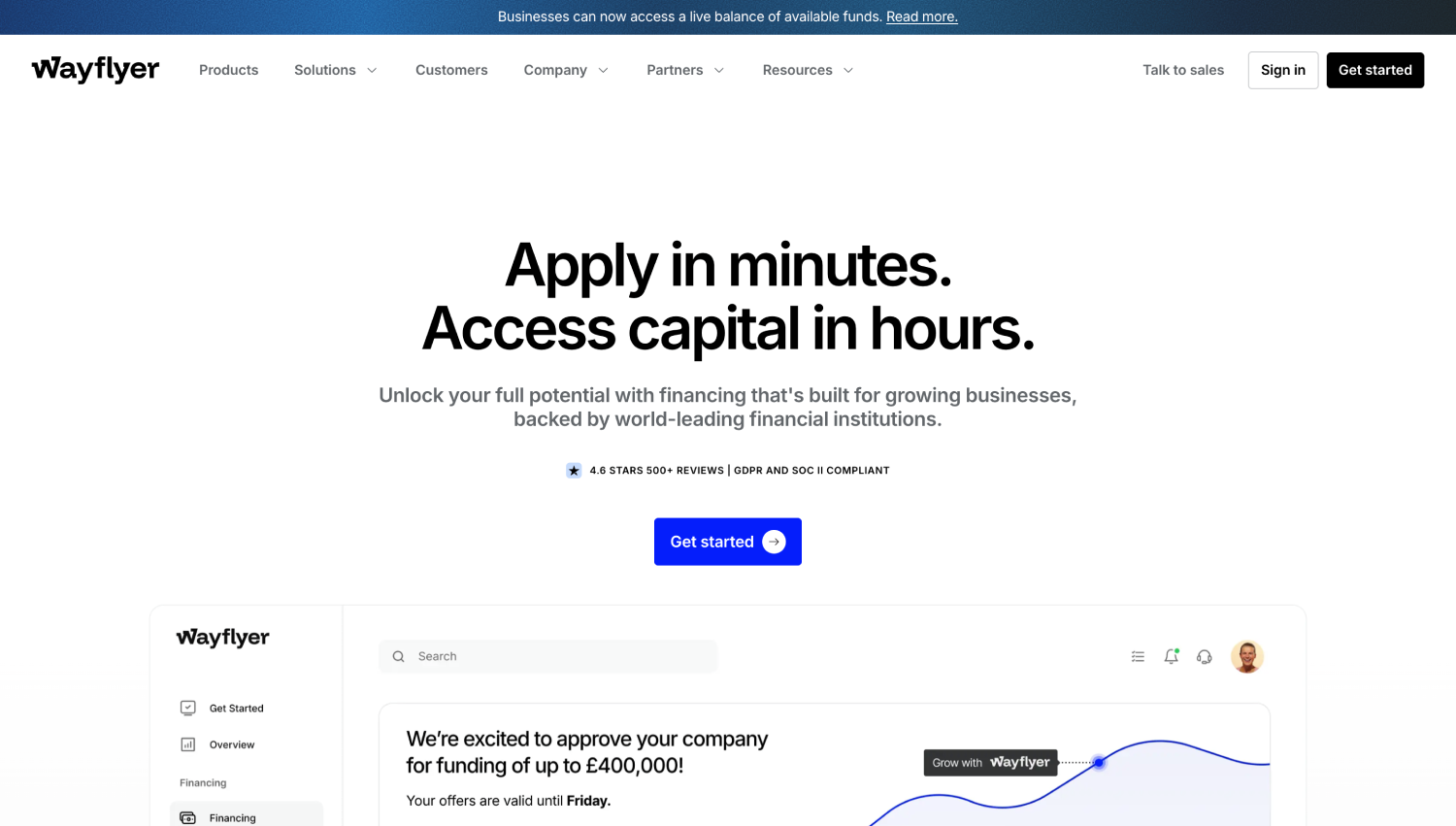
Wayflyer integrates with Shopify, WooCommerce, Amazon, and major ad platforms to build a picture of revenue that includes marketing efficiency (ROAS, CAC) and inventory turnover. It advances capital specifically for paid media and inventory purchases, with repayment structured as a percentage of daily revenue.
This model suits ecommerce well because it sizes advances against the revenue that inventory and ad spend will generate, not just what you’ve already earned. For a SaaS business without inventory or paid acquisition as its primary growth driver, Wayflyer’s framework generates a thinner, less favorable picture of the business. As of the time of writing, Wayflyer’s public site does not publish a standard fee schedule; advance amounts and factor rates are determined through their underwriting process.
Pipe vs Wayflyer: Feature and Fit Comparison
| Criteria | Pipe | Wayflyer |
|---|---|---|
| Primary business model served | SaaS, subscription software | Ecommerce, DTC, Amazon sellers |
| Core underwriting signal | MRR, churn, contract data | Shopify revenue, ad platform ROAS, inventory |
| Revenue requirement | Not displayed on public pricing page; requires established MRR | Not displayed on public site; requires ecommerce revenue history |
| Repayment structure | Fixed payments from recurring revenue | Percentage of daily revenue |
| Capital use case | Growth, hiring, product, general working capital | Inventory purchases, paid media |
| Integrations | Stripe, QuickBooks, accounting tools | Shopify, WooCommerce, Google Ads, Meta Ads |
| Equity dilution | None | None |
| Funding speed | Not publicly disclosed | Not publicly disclosed |
What Does Pipe vs Wayflyer Actually Cost?
Neither Pipe nor Wayflyer publishes a standard rate card on their public sites. Both price on a deal-by-deal basis after underwriting. Revenue-based financing typically uses a flat fee or factor rate rather than an APR, which makes direct cost comparisons between providers genuinely difficult without running both applications.
For Pipe, the cost depends on how strong your MRR profile looks: churn rate, contract length, and customer concentration all move the price. A SaaS company with 2% monthly churn and annual contracts will get materially better terms than one with 6% monthly churn and month-to-month subscriptions.
For Wayflyer, cost depends on your marketing efficiency and inventory turnover. A brand with strong ROAS and fast inventory cycles presents as lower risk. Wayflyer has historically structured repayment as a percentage of daily sales, which means slow sales periods extend the repayment window automatically.
Anyone evaluating either platform should model the total cost, not just the factor rate. If Pipe charges a 6% flat fee on a 6-month advance, the effective annualized rate is closer to 12%. Always convert factor rates to APR equivalents before comparing to venture debt or a line of credit. The hidden costs inside SaaS financing are rarely obvious from the headline number.
The Founder Revenue Profile Test: Who Should Use Pipe?
A useful way to evaluate fit is what this analysis calls the Founder Revenue Profile Test: four questions that map your revenue structure to the right RBF platform.
1. Is your revenue contractual and recurring? If you have annual or multi-year contracts generating predictable MRR, Pipe’s underwriting works in your favor. If your revenue is transactional and variable, Pipe’s model works against you.
2. Does your revenue depend on inventory? If yes, Wayflyer’s advance sizing accounts for the cash cycle between buying stock and converting it to sales. Pipe does not model inventory. Ecommerce brands that use Pipe often find the advance amount underwhelming precisely because of this gap.
3. Is paid media your primary growth lever? Wayflyer is explicitly designed to fund ad spend, with repayment tied to the revenue that spend generates. Pipe does not underwrite against marketing ROI. SaaS companies that grow primarily through product-led growth or sales are better aligned with Pipe.
4. How seasonal is your revenue? SaaS companies typically show flat or steadily growing revenue curves. Ecommerce brands show spikes. Pipe’s model is optimized for the former. Wayflyer’s daily revenue repayment structure is designed for the latter, slowing repayment automatically during off-peak periods.
A Worked Scenario: SaaS Founder Comparing Both Platforms
The following is a modeled hypothetical to illustrate how each platform’s underwriting logic applies to a typical SaaS profile. Take a B2B SaaS company with $180,000 MRR, 3.5% monthly churn, a mix of annual and monthly contracts, and no physical inventory. The founder needs $500,000 to fund two engineering hires and accelerate a product launch.
Under Pipe’s model, the underwriting focuses on that MRR signal and contract data. Annualized revenue runs roughly $2.16 million. Depending on churn and contract mix, Pipe might advance somewhere between 30% and 70% of annualized revenue, subject to their current underwriting criteria. The MRR signal is clean, the integration with Stripe takes hours, and the process moves quickly.
Under Wayflyer’s model, the same company has a problem. There is no Shopify store. There is no ad account to connect. The ROAS signal that Wayflyer’s underwriting relies on does not exist in a product-led SaaS company. Wayflyer would likely decline to underwrite this deal or offer a fraction of what Pipe would, because the revenue signals Wayflyer reads simply aren’t present.
Now reverse the scenario: a DTC skincare brand with $400,000 in monthly Shopify revenue, a strong Meta Ads ROAS, and a need to front $300,000 for Q4 inventory. Wayflyer reads all of that data directly. Pipe, looking for MRR, sees a transactional revenue pattern with no contract structure and no churn metric that maps to its model. Pipe is the wrong tool.
Does Pipe Work for Ecommerce, or Can Wayflyer Work for SaaS?
Pipe has expanded beyond its original SaaS focus and does serve some ecommerce businesses. But the product still performs better when there is a recurring revenue structure to underwrite against. Ecommerce founders should expect a less customized experience and potentially less favorable advance sizing compared to a platform purpose-built for their model.
Wayflyer has focused its product on ecommerce and has not made significant moves into SaaS underwriting. SaaS founders who try Wayflyer typically find the integration requirements don’t match their tech stack and the underwriting criteria don’t reflect how SaaS businesses generate revenue. It is not designed for you, and the product reflects that.
For SaaS founders evaluating their full range of options, the broader field of revenue-based financing providers includes players beyond Pipe and Wayflyer, some with hybrid models that may be more flexible.
How Does RBF Compare to Venture Debt and Equity for SaaS?
Revenue-based financing sits between a revolving credit line and dilutive equity. Pipe and Wayflyer both take no equity, require no personal guarantee in most cases, and offer faster deployment than a traditional bank loan. The tradeoff is cost: RBF is almost always more expensive than bank debt and often more expensive than venture debt from firms like Western Technology Investment or Hercules Capital.
Venture debt typically requires you to have raised institutional equity first and comes with warrants. RBF requires neither. For a pre-Series A SaaS company that has not raised institutional equity but has real MRR, Pipe’s model can bridge a runway gap without giving up board seats or cap table complexity.
The practical question is whether the cost of capital justifies the growth the capital funds. If $500,000 in Pipe financing funds two engineers who ship a feature that reduces churn from 4% to 2%, the math can work in the company’s favor. If the capital is going into a cost center rather than a revenue-generating investment, RBF’s higher cost becomes a pure drag. Founders thinking about this trade-off should track the right metrics before drawing down. The fintech metrics that actually move this decision are net revenue retention, payback period on acquired customers, and burn multiple.
Pipe Alternatives Worth Knowing for SaaS Founders
Clearco (formerly Clearbanc) offers capital for both SaaS and ecommerce with a revenue-share model. Capchase focuses specifically on SaaS and advances against annual contract value, similar to Pipe’s original premise. Lighter Capital targets tech companies with established revenue and offers term loans structured around revenue. Parafin operates as an embedded working capital provider through platforms rather than directly. Each has a different underwriting lens, and for SaaS founders the differences between Capchase and Pipe are worth evaluating in parallel. More on how embedded working capital providers position themselves is covered in this comparison of embedded working capital APIs.
Frequently Asked Questions
Is Pipe or Wayflyer better for SaaS founders?
Pipe is better for SaaS founders. Its underwriting model is built around recurring subscription revenue, MRR, churn, and contract data, which maps directly to how SaaS businesses generate predictable cash flows. Wayflyer’s underwriting relies on ecommerce signals: Shopify revenue, ad platform ROAS, and inventory data. A SaaS company without those inputs will get a worse result from Wayflyer, or no offer at all.
What are Pipe’s terms and fees?
Pipe does not publish a standard rate card on its public pricing page. Terms are determined through underwriting and vary based on your MRR, churn rate, contract length, and customer concentration. Founders should request a quote directly and convert any factor rate to an APR equivalent before comparing Pipe’s offer against venture debt or a bank line of credit. The company uses a flat fee structure rather than an interest rate in the traditional sense.
Does Wayflyer fund SaaS companies?
Wayflyer is primarily designed for ecommerce and DTC brands and has not positioned itself as a SaaS lender. Its core integrations are with Shopify, WooCommerce, Amazon, and major ad platforms. SaaS companies typically lack the data inputs Wayflyer’s underwriting requires, making it a poor fit. SaaS founders should evaluate Pipe, Capchase, or Lighter Capital instead.
How fast can you get capital from Pipe or Wayflyer?
Neither Pipe nor Wayflyer publicly discloses guaranteed funding timelines. Speed generally depends on how cleanly your revenue data connects to their integrations and how quickly underwriting can verify your revenue signals. Both platforms are faster than traditional bank loans. For the fastest results, connect all required integrations before applying and make sure your billing data is clean and up to date.
Is revenue-based financing a good option before Series A?
For a SaaS company with established MRR but no institutional equity on the cap table, revenue-based financing can be a practical way to fund growth without dilution. The cost is higher than bank debt, but the eligibility requirements are lower and there are no equity warrants. The key test is whether the funded activity generates enough incremental revenue to justify the financing cost within the repayment window.
Can you use Pipe or Wayflyer for hiring?
Pipe positions its capital as general working capital, which can include hiring. Wayflyer has historically focused on inventory and paid media spend, making it less flexible for operational expenses like headcount. If you need capital specifically for engineering or sales hires, Pipe is the more appropriate platform. Some alternatives like Capchase and Lighter Capital also offer working capital for operational growth.
What revenue does Pipe require to apply?
Pipe does not publish a minimum revenue threshold on its public website. The company has historically worked with early-stage SaaS companies but requires some established MRR to underwrite against. Founders at very early stages with minimal recurring revenue are unlikely to qualify. For precise eligibility criteria, the application process itself is the most reliable filter.
The Real Distinction Most Founders Miss
The instinct to compare Pipe and Wayflyer as two versions of the same product is understandable but wrong. They share a capital structure but not an underwriting philosophy. Pipe is reading your recurring revenue as a proxy for future cash flow reliability. Wayflyer is reading your marketing and inventory efficiency as a proxy for revenue generation capacity. Those are different bets about what makes a business creditworthy.
SaaS founders who approach Wayflyer often get confused by the friction: mismatched integrations, questions about ad spend that don’t apply, and advance offers that feel disconnected from the business’s actual revenue quality. That friction is not a process failure. It is the product telling you it was built for someone else.
The more useful decision for a SaaS founder is not Pipe versus Wayflyer but Pipe versus Capchase versus venture debt, calibrated to your ARR, churn, and the specific use case the capital will fund. Wayflyer belongs in a different comparison set entirely, one that includes Clearco and Shopify Capital for ecommerce operators. Getting that sorting right before you start applications saves weeks and prevents a diluted offer from the wrong platform from distorting your sense of what your business is actually worth to a lender who understands it. Founders working through the broader infrastructure and financing decisions at this stage should also pressure-test their growth assumptions against the full fintech SaaS scale checklist before drawing down capital.