
- Most platforms assume merchant cash advances require a standalone funder relationship. They do not. A growing set of API providers let SaaS platforms, marketplaces, and vertical software companies embed MCA products directly into their dashboards.
- The best merchant cash advance APIs handle underwriting, capital deployment, and repayment collection, so the platform takes a revenue share without touching the credit risk.
- The critical split is between white-label MCA APIs (full brand control, more compliance overhead) and embedded MCA programs (provider manages the balance sheet, faster to launch).
- Factor rates, advance sizes, and repayment mechanics vary significantly by provider. Matching the right API to your merchant base and data access determines whether the product actually converts.
- Compliance exposure scales with how much of the decisioning you own. Platforms that want revenue share without lending licenses should look for fully managed programs, not raw underwriting APIs.
The best merchant cash advance APIs for platforms include Parafin, Pipe, Capchase, Kanmon, and Liberis. These providers let SaaS companies, marketplaces, and vertical software platforms embed a cash advance product without holding a lending license. The platform connects via API, shares transaction or revenue data for underwriting, and earns a revenue share on funded advances. Capital stays on the provider’s balance sheet. Repayment is collected automatically through daily or weekly revenue splits.
Why Most Platforms Overlook Embedded MCA as a Product Line
Merchant cash advances carry a reputation problem. The standalone MCA industry is cluttered with aggressive funders, confusing factor rates, and weak disclosure standards. Platform operators who could offer working capital to their merchants often dismiss MCA entirely because of what they associate with the category.
That association is outdated for the embedded context. What API-first MCA providers have built since roughly 2020 is structurally different. The platform does not originate loans. It shares data, surfaces an offer, and earns a cut when a merchant accepts. The funder handles compliance, collections, and credit loss. From a product standpoint, it behaves more like an interchange revenue line than a lending operation.
The actual barrier is not regulation or complexity. It is that most platform operators do not know this infrastructure exists, or they conflate it with building a lending product from scratch. That is the gap this article addresses.
What Does a Merchant Cash Advance API Actually Do?
A merchant cash advance API gives a platform programmatic access to a funder’s underwriting engine, offer generation, and repayment infrastructure. The platform passes merchant data (revenue history, payment volume, account age) through the API. The provider runs decisioning and returns an offer. The merchant accepts or declines inside the platform’s UI. Funded capital moves to the merchant. Repayment comes back as a fixed percentage of daily or weekly sales.
The API layer typically covers four functions: data ingestion for underwriting, offer retrieval and display, disbursement initiation, and repayment tracking. Some providers expose all four as separate endpoints. Others bundle them into a single SDK or white-label UI kit. The degree of customization available at each layer determines how native the experience feels inside your product.
Factor rates (the multiplier applied to the advance to determine total repayment) are set by the provider, not the platform. A factor rate of 1.25 on a $10,000 advance means the merchant repays $12,500. The platform’s economics come from a revenue share on that spread, not from setting the rate itself.
The FintechSpecs MCA API Evaluation Stack
Evaluating a merchant cash advance API requires a different lens than evaluating a payment or banking API. The technical integration is often the easiest part. The harder questions are economic and operational.
The FintechSpecs MCA API Evaluation Stack frames the decision across four layers:
- Capital layer: Who holds the balance sheet? Does the provider fund from their own capital, a credit facility, or institutional investors? Balance sheet stability affects advance availability during credit contractions.
- Data layer: What inputs drive underwriting? Providers that can ingest your native transaction data (rather than requiring Plaid-linked bank accounts) typically produce higher approval rates for your merchant base.
- Economics layer: What is the revenue share structure, and are there minimums? Some providers offer 2-5% of funded volume as a referral fee. Others offer higher shares in exchange for exclusivity or data-sharing commitments.
- Compliance layer: What licenses does the provider hold? Who is the lender of record? Platforms that want zero lending-related compliance exposure need a provider that owns the full regulatory stack.
Running a candidate provider through all four layers before a demo removes the noise from sales conversations and surfaces the real constraints early.
Which Providers Offer Merchant Cash Advance APIs for Platforms?
Parafin
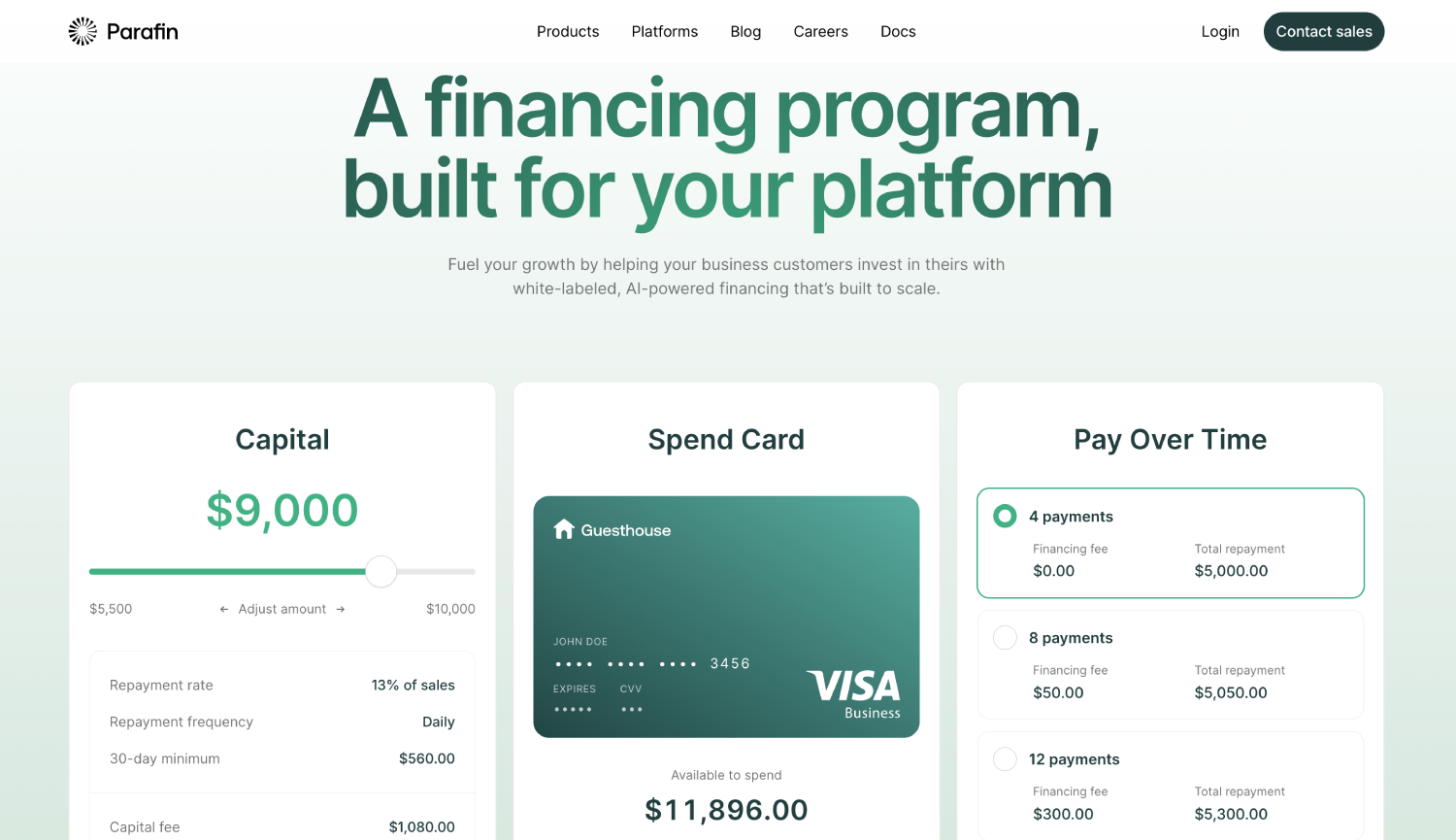
Parafin is purpose-built for platform-embedded capital. The model is explicit: Parafin sits entirely behind the platform’s brand, funds advances from its own balance sheet, and handles all compliance. Platforms that process payments or have access to merchant revenue data can pass that data to Parafin’s underwriting engine via API to generate pre-qualified offers.
Parafin works best for platforms with high transaction volume and established merchant cohorts. The approval rates are tightly tied to how much longitudinal revenue data the platform can share. Marketplaces and payment facilitators with 12-plus months of merchant history per seller tend to see the strongest offer acceptance. Parafin does not publicly disclose its revenue share structure. Pricing details require a direct conversation with their partnerships team.
The platform-facing integration includes a white-label dashboard component and a REST API for offer generation and status tracking. FintechSpecs has covered Parafin previously in the context of embedded working capital APIs for B2B platforms, where it ranked as the strongest option for high-volume payment platforms specifically.
Pipe

Pipe started as a revenue-based financing platform for SaaS companies and has since broadened to serve platforms embedding capital products. The core product translates predictable recurring revenue into an advance, making it a natural fit for SaaS-adjacent verticals and subscription-heavy merchant bases rather than pure transaction-based businesses.
For platforms, Pipe offers a revenue advance API that ingests billing or subscription data and generates advance offers based on forward revenue. The repayment structure aligns with subscription cycles rather than daily sales splits, which reduces friction for merchants with lumpy daily volume. Pipe’s approach works well for software platforms serving SMBs with subscription billing. It is a weaker fit for marketplaces with highly variable daily GMV, where Parafin’s transaction-based model produces more accurate underwriting.
Capchase
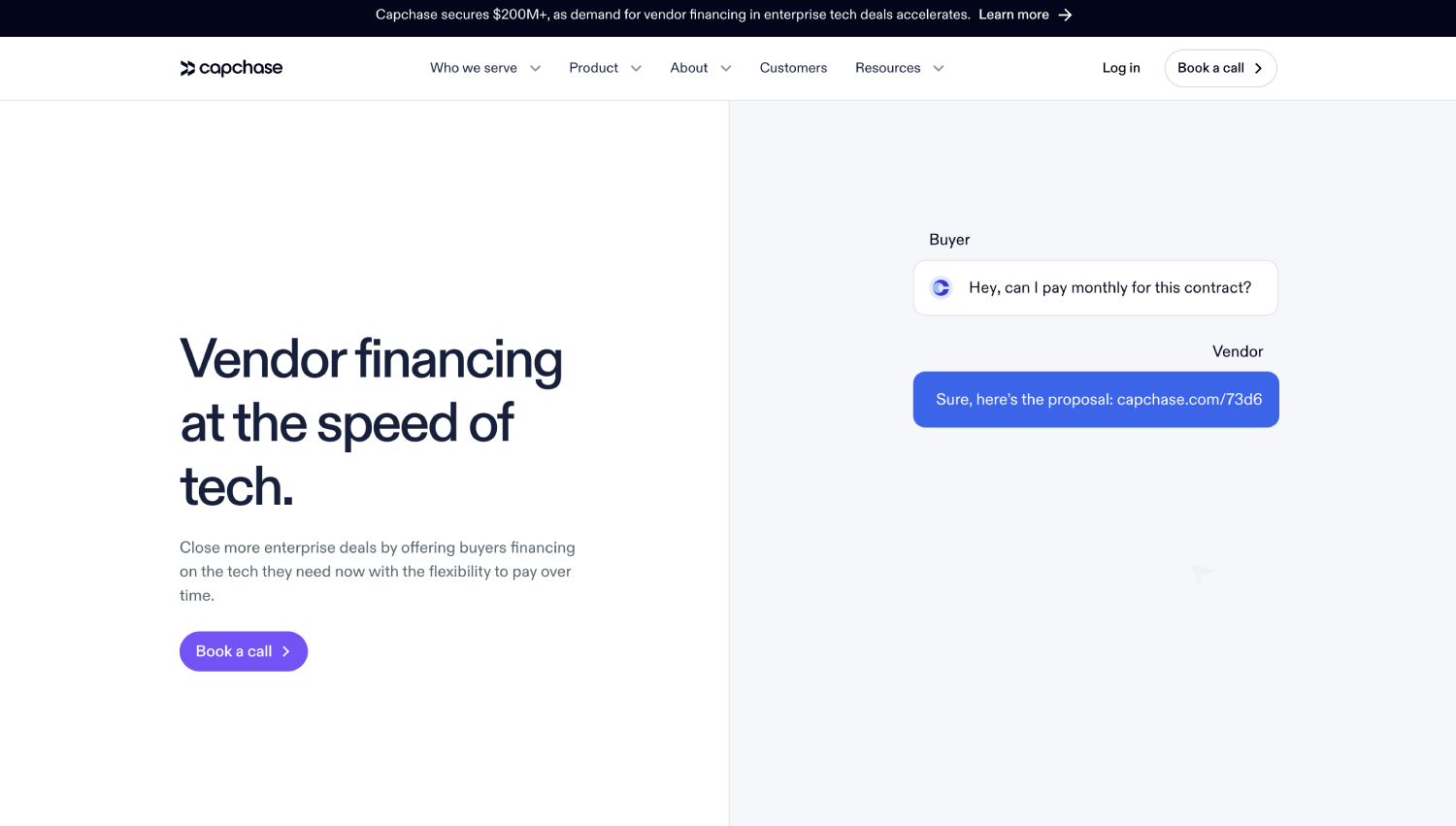
Capchase focuses primarily on SaaS and recurring-revenue businesses. Their embedded product, Capchase Pay and Capchase Grow, can be surfaced through platform partnerships. The product is structured as a revenue advance rather than a true MCA in the traditional sense. Merchants receive capital against contracted or recurring revenue, and repayment is tied to that revenue stream.
Capchase is most relevant for platforms serving B2B SaaS vendors or subscription businesses. If your merchant base is restaurants, retailers, or service businesses without recurring contracts, Capchase’s underwriting model will exclude a significant portion of potential applicants. The company does not publicly disclose partnership economics.
Kanmon
Kanmon is an API-first embedded lending platform that supports multiple credit product types, including merchant cash advances and term loans. The platform-facing model gives operators more control over product configuration than most white-label MCA APIs. Platforms can define credit product parameters within Kanmon’s framework while Kanmon manages the compliance and capital stack.
Kanmon’s multi-product approach makes it worth considering for platforms that want to offer both MCA and installment products from the same integration, rather than stitching together separate vendor relationships. The trade-off is integration complexity. A Kanmon implementation requires more configuration than a purpose-built MCA API like Parafin. For teams evaluating whether to build or buy lending infrastructure, the comparison between top embedded credit API providers is worth reviewing before committing to a single vendor.
Liberis

Liberis operates as an embedded revenue-based finance provider with a specific focus on payment platforms and merchant acquirers. Their API connects to partner platforms and uses payment processing data directly for underwriting, bypassing the need for open banking connections or manual bank statement uploads. This makes the approval flow materially faster for merchants on payment platforms that already route through the partner.
Liberis is particularly strong for payments-led platforms: ISOs, PayFacs, and vertical SaaS tools where payment processing is core to the product. Their UK and European presence is significant, but they do operate in the US market. Platforms evaluating Liberis should confirm US state coverage and lending license scope for their specific merchant geographies before proceeding.
Clearco (formerly Clearbanc)
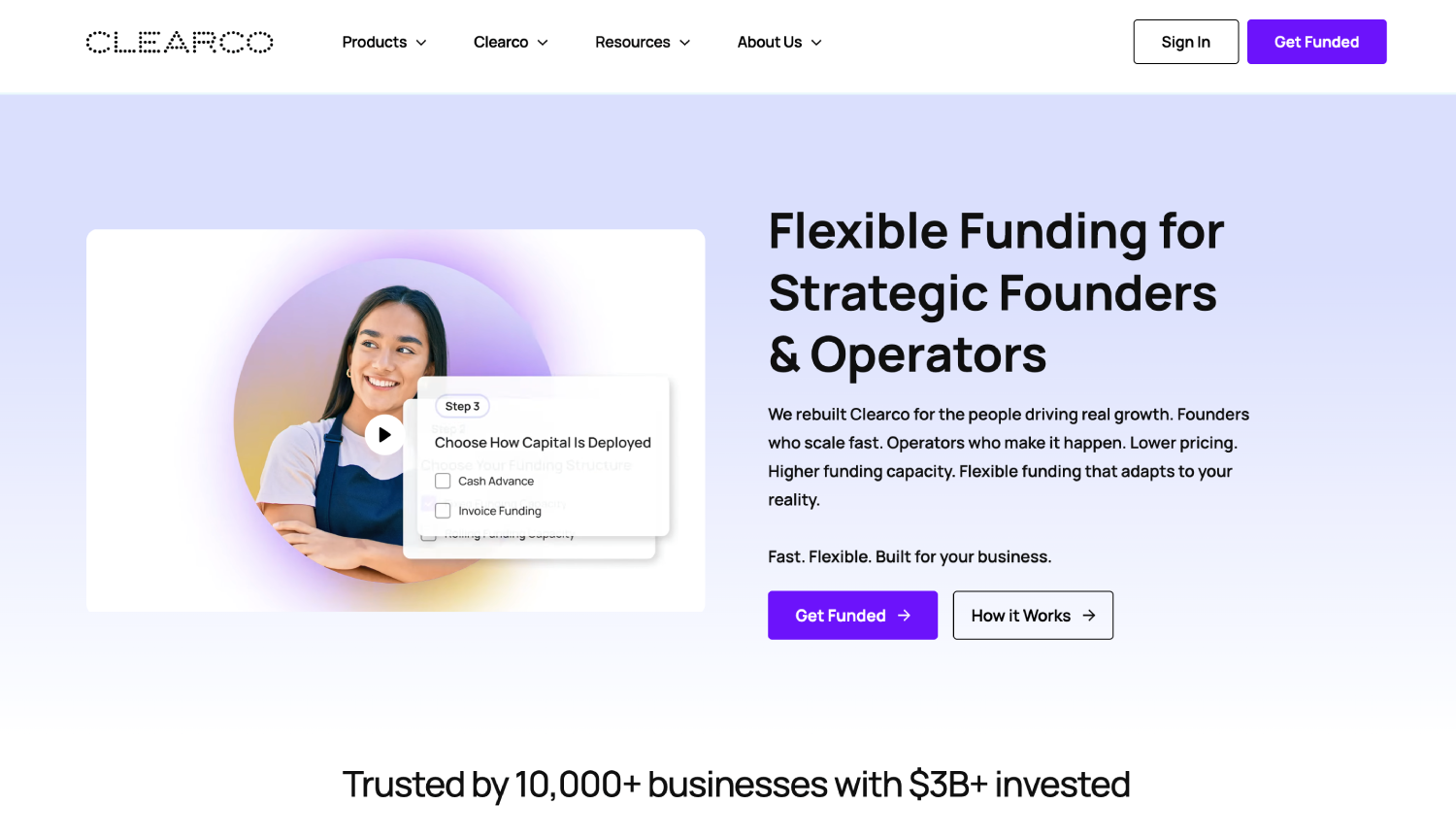
Clearco focuses on ecommerce and direct-to-consumer brands. Their capital product is structured as revenue-based financing with repayment tied to a percentage of weekly revenue. Clearco’s underwriting draws on advertising spend data, platform sales history, and revenue velocity, which makes it well-suited for ecommerce sellers where those signals are available and meaningful. The platform partnership model is more limited than Parafin or Liberis: Clearco does not offer the same depth of white-label configuration, and the product is less configurable for non-ecommerce verticals. For platforms serving ecommerce sellers specifically, it is a credible option. For platforms outside that category, the underwriting fit and partnership flexibility both narrow considerably. Clearco does not publicly disclose partnership economics.
How Do These MCA APIs Compare on Key Dimensions?
| Provider | Best Fit Vertical | Underwriting Data Source | Balance Sheet | White Label | Public Pricing |
|---|---|---|---|---|---|
| Parafin | Marketplaces, PayFacs | Platform transaction data | Parafin (own) | Yes | Not disclosed |
| Pipe | SaaS, subscription platforms | Billing/subscription data | Pipe (own + credit facility) | Partial | Not disclosed |
| Capchase | B2B SaaS vendors | Contracted recurring revenue | Capchase (own) | Via partnership | Not disclosed |
| Kanmon | Multi-product lending platforms | Platform data + open banking | Institutional capital | Yes | Not disclosed |
| Liberis | Payment platforms, PayFacs | Payment processing data | Liberis (own) | Yes | Not disclosed |
| Clearco | Ecommerce platforms | Ad data, platform sales | Clearco (own) | Limited | Not disclosed |
None of these providers publicly disclose their revenue share rates or platform pricing. Every engagement begins with a commercial discussion, and that opacity is itself a selection friction point: platforms cannot benchmark offers without running a full sales process in parallel across multiple vendors. Build that negotiation into your evaluation timeline, and run at least two providers simultaneously to create competitive pressure on economics.
What Does the Integration Process Actually Look Like?
The technical integration for a white-label MCA API typically runs in three phases. Understanding the sequence helps product and engineering teams scope the work accurately.
Phase 1: Data connection. The platform establishes a secure connection to share merchant revenue or transaction data with the provider. This is usually a webhook or a scheduled batch export. Providers that accept native platform data (your existing transaction records) move faster than those requiring a separate open banking connection through Plaid or a similar aggregator, since many merchants on a given platform will have already linked their accounts.
Phase 2: Offer surface. The provider’s API returns pre-qualified offers that the platform renders in its UI. Most providers supply a white-label UI kit or iFrame component to minimize frontend build time. Platforms that want deeper UX customization will need to build against the raw API endpoints, which adds engineering time but produces a more native experience.
Phase 3: Repayment integration. For MCA products specifically, repayment comes from a daily or weekly split of merchant revenue. If the platform processes payments for merchants, the repayment collection often runs through the platform’s existing payout infrastructure, which the provider hooks into during setup. If the platform does not touch payments, the provider collects directly from the merchant’s bank account via ACH.
A realistic timeline from contract signing to live product is six to twelve weeks for platforms with clean data pipelines. Platforms that need to build data infrastructure from scratch should budget longer. For context on how payment infrastructure complexity affects embedded finance timelines, the overview of top fintech APIs for SaaS covers integration depth across categories.
What Compliance Exposure Does the Platform Carry?
This is the question most platform operators underestimate. An embedded MCA API does not automatically insulate the platform from regulatory scrutiny. The degree of exposure depends on how the product is structured and what role the platform plays in the credit decision.
In a fully managed program, the API provider is the lender of record, holds the relevant state licenses (typically California Finance Lender License, plus licenses in other states), and owns the consumer-facing disclosures. The platform is a referral partner or marketing channel. Regulatory risk sits with the provider, not the platform.
In a co-branded or program-managed structure, the platform may take on more responsibility for disclosure, marketing compliance, and complaint handling. Some states (California, New York, Utah, Virginia, Georgia, and Florida have enacted or proposed commercial financing disclosure laws) require specific disclosure language for merchant cash advances regardless of who originates the advance. A platform marketing an MCA product in those states needs to understand what its disclosure obligations are, even if it is not the lender.
For platforms building out their compliance posture across multiple financial products, the Fintech Product and Compliance Readiness Checklist covers the layered obligations that accompany embedded lending.
A Worked Scenario: Vertical SaaS Platform Embedding MCA
The following is a purely illustrative scenario with hypothetical numbers, intended to show how program economics compound, not to project real outcomes for any specific platform or provider.
Consider a vertical SaaS company serving 3,000 restaurant owners. The platform handles table management, online ordering, and payment processing. Monthly GMV across the platform is $18 million. Average merchant processes $6,000 per month through the platform.
The platform partners with a white-label MCA provider that ingests 12 months of transaction history per merchant. Based on the merchant’s volume, the provider generates pre-qualified offers ranging from $5,000 to $30,000 with factor rates between 1.15 and 1.35. The platform surfaces offers inside its existing dashboard under a “Business Capital” module.
Assume 8% of eligible merchants accept an offer in year one. That is 240 merchants at an average advance of $12,000, representing $2.88 million in funded volume. At a 3% revenue share on funded volume, that is $86,400 in year-one revenue from a product that required no balance sheet capital and roughly four months of integration work. Actual share rates, approval percentages, and average advance sizes vary materially by provider, merchant quality, and data depth.
Frequently Asked Questions
What is a merchant cash advance API?
A merchant cash advance API is a programmatic interface that lets a software platform embed working capital offers into its product. The platform sends merchant data (revenue history, transaction volume) to the API provider, which returns a pre-qualified advance offer. The provider funds the advance and collects repayment as a percentage of the merchant’s ongoing revenue. The platform earns a revenue share on funded advances without holding a lending license or balance sheet exposure.
Do platforms need a lending license to offer MCA via API?
In a fully managed embedded program, no. The API provider acts as the lender of record and holds the required state licenses. The platform functions as a referral or marketing channel. Compliance exposure exists around marketing disclosures in certain states (California, New York, and others with commercial financing disclosure laws), but the platform does not originate the advance. Platforms should confirm the license structure explicitly with any provider before signing a partnership agreement.
How is a merchant cash advance different from a revenue advance API?
The terms are often used interchangeably but have a structural difference. A merchant cash advance is technically a purchase of future receivables, not a loan, which affects how it is regulated. A revenue advance API may produce a similar product or may structure the advance as a loan against contracted recurring revenue. The practical distinction matters for disclosure requirements and how repayment is structured. SaaS-focused providers like Pipe and Capchase tend to use the revenue advance framing. Transaction-based providers like Parafin and Liberis operate closer to the traditional MCA structure.
What data does a platform need to share to enable MCA underwriting?
Most providers need at least six months of merchant revenue or transaction history, though twelve months produces stronger approval rates. Payment platforms can typically share this natively. Platforms without direct payment data may need to connect via open banking (Plaid or similar) or request bank statement uploads from merchants, which increases friction and drops conversion. Liberis and Parafin specifically optimize for native payment platform data, which is one reason they tend to perform better for PayFac-model platforms than providers built around open banking inputs.
How long does it take to integrate a merchant cash advance API?
Six to twelve weeks is a realistic baseline for platforms with clean transaction data pipelines and dedicated engineering capacity. Platforms that need to build data export infrastructure, instrument new merchant data points, or build a custom UI rather than using a provider’s white-label components should expect the upper end of that range or beyond. The business setup (contract negotiation, compliance review, revenue share structure) often takes as long as the technical integration.
Can a platform offer MCA to merchants without processing their payments?
Yes, but the underwriting process becomes more friction-heavy. Providers that rely on native transaction data from the platform cannot access that data if the platform does not process payments. Instead, merchants must link their bank accounts via open banking or upload bank statements manually. Approval rates tend to be lower and the user experience is weaker. Platforms evaluating embedded MCA should honestly assess whether their data access supports a competitive offer flow before launching.
How to Choose Between These MCA API Providers
The selection criteria reduce to two practical questions. First: what data do you have access to? Platforms with deep native transaction data should prioritize Parafin or Liberis, both of which are built to ingest that data directly and produce higher approval rates as a result. Platforms serving subscription businesses without direct payment processing should look at Pipe or Capchase. Second: how much product control do you need? Kanmon offers the most configurability but requires more engineering. Parafin and Liberis offer faster time-to-launch with less flexibility.
Platforms that are earlier in their embedded finance path and have not yet committed to a payments or banking infrastructure strategy should read the broader comparison of embedded finance APIs for SaaS companies before narrowing to an MCA-specific vendor. The capital product decision rarely exists in isolation from payment and banking infrastructure choices.
Revenue share matters, but do not over-index on it in early negotiations. A provider offering 4% on a product with a 6% approval rate produces less revenue than one offering 2.5% on a product with a 14% approval rate. Push providers to share approval rate benchmarks from comparable platform cohorts. That number is more predictive of actual program economics than the headline revenue share figure.