
- Embedded insurance is a distinct API category from payments and lending , platforms can offer auto, renters, life, and business coverage without holding a carrier license.
- The provider field splits into two types: full-stack carriers that own the paper (Boost Insurance, Openly) and distribution-layer APIs that connect platforms to multiple carriers (Sure, Majesco, Cover Genius).
- Licensing is the hidden blocker , most platforms integrate as a managing general agent (MGA) or through a white-label program, not as an insurer, which shifts compliance burden to the API provider.
- Revenue share on gross written premium (GWP), not flat API fees, is the dominant pricing model , distributor commission splits are negotiated per deal and, based on publicly reported industry ranges, typically fall between 10% and 30% of premium, depending on the line of business and volume.
- The five providers below were selected on integration depth, carrier access, supported lines of business, and documented platform partnerships , not sponsorship order alone.
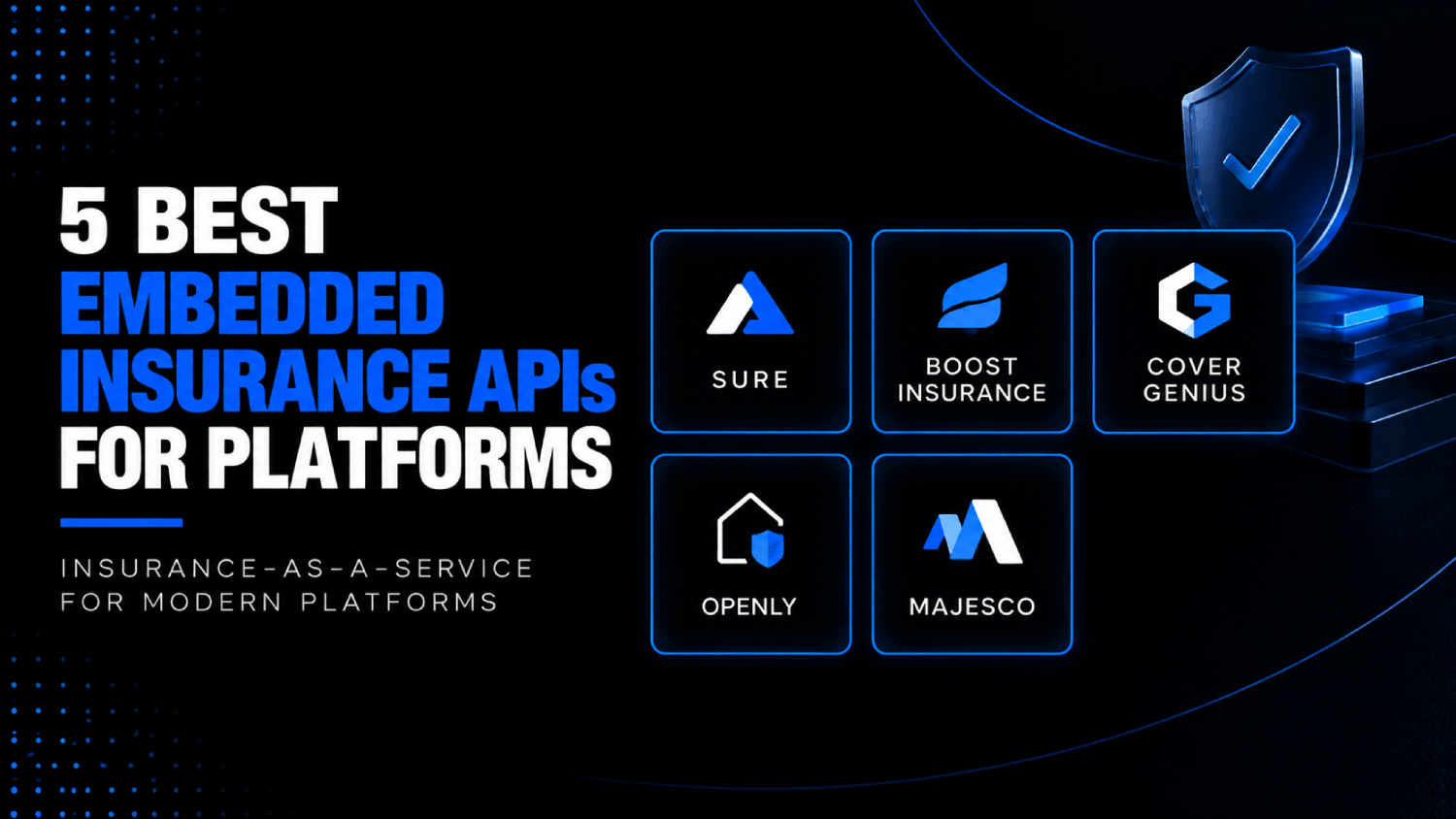
The best embedded insurance APIs for platforms in 2026 are Sure, Boost Insurance, Cover Genius, Openly, and Majesco. Each takes a different approach: Sure and Cover Genius operate as distribution layers connecting platforms to multiple carriers, Boost and Openly are API-first carriers that own the underlying insurance paper, and Majesco provides the insurance core technology for platforms building their own programs. The right choice depends on whether a platform needs fast distribution, carrier-level control, or the ability to underwrite its own risk.
What Is an Embedded Insurance API and How Is It Different From a Payments API?
A payments API moves money. An embedded insurance API binds coverage, issues a policy, and manages the full lifecycle of a risk contract , underwriting, premium collection, claims handling, and regulatory reporting. That lifecycle involves state-by-state insurance licensing, actuarial pricing, reinsurance treaties, and carrier relationships. None of that exists in a payments stack.
When a platform adds embedded insurance through an API, it is not just displaying a product , it is distributing a regulated financial product in each state where its users live. The API provider either holds the necessary licenses (as a carrier or MGA) or the platform must obtain its own. Most API providers structure deals so the platform qualifies as a licensed agent or operates under the provider’s MGA umbrella, which is why integration timelines for insurance APIs tend to run significantly longer than the two-week sprint that card-issuing APIs might require. Industry practitioners commonly cite 60 to 180 days as the working range, with most multi-state launches landing closer to 90 to 120 days once licensing, carrier approval, and compliance review are factored in.
This distinction matters because platforms evaluating their embedded finance API options often treat insurance as an afterthought behind lending and payments. It is a separate technical and regulatory category with different economics.
How Do Embedded Insurance Platforms Actually Make Money?
Insurance-as-a-service platforms generate revenue through premium commission, not transaction fees. A platform integrating an embedded insurance API typically earns a percentage of gross written premium (GWP) on each policy sold through its distribution channel. Carrier-side APIs like Boost earn underwriting profit and investment income on the float. Distribution-layer APIs like Sure earn a spread between what the carrier charges and what the end customer pays, then share a portion with the platform.
To illustrate the economic logic: a vertical SaaS company serving 50,000 independent contractors could embed a general liability policy into its platform. At a hypothetical $400 annual premium and a 20% distribution commission , both figures used here as illustrative round numbers, not sourced rates , that yields $80 per active policy per year. Scaled to 10,000 active policies, the resulting $800,000 in annual insurance revenue would sit on top of subscription fees, with no underwriting or claims exposure for the platform. The actual commission rate and premium will vary by line of business, carrier, and deal terms. The point of the example is directional: the per-policy economics are small, but they compound across a large user base without incremental acquisition cost.
The compliance economics are equally important. Platforms absorb no claims liability when they operate as distributors. The carrier or MGA holds the risk. But they do absorb licensing obligations, E&O exposure on advice, and potential regulatory scrutiny on how insurance is presented at point of sale. Your fintech compliance readiness posture directly affects how cleanly an insurance API integration lands.
What Is the FintechSpecs Insurance API Triage Framework?
Before evaluating individual providers, a platform needs to answer three questions. Call this the FintechSpecs Insurance API Triage: Paper, Distribution, and Depth.
Paper asks who holds the carrier license and absorbs underwriting risk. If the answer is “us,” the platform is building an MGA and needs carrier relationships, reinsurance, and actuarial capacity. If the answer is “the API provider,” the platform is a distributor and takes on agent licensing requirements instead.
Distribution asks how many states and lines of business the provider can support at launch. A gig economy platform with users in all 50 states needs broad geographic coverage on day one. A property management SaaS launching renters insurance in three states can start narrow and expand. Misaligning here creates a painful post-launch licensing scramble.
Depth asks what the API actually exposes. Can the platform customize underwriting questions, adjust premium structures, or access claims data programmatically? Or is it a thin quoting widget with limited configurability? For platforms where insurance is a core retention mechanism, depth matters more than speed to market.
Which Embedded Insurance API Providers Should Platforms Evaluate?
1. Sure
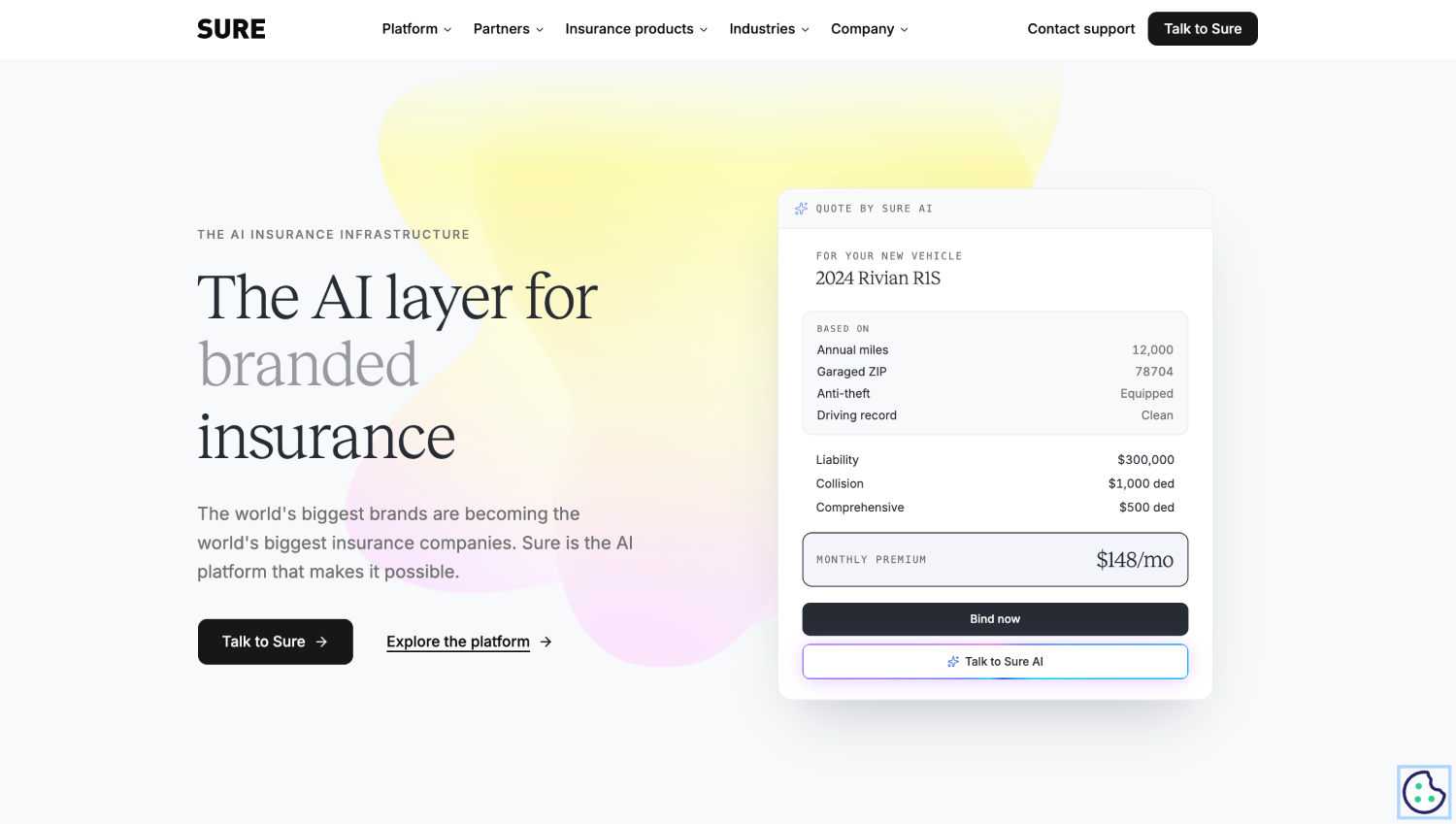
Sure operates as an insurance distribution platform that connects brands to multiple carriers through a single API. The company has published partnerships with brands including Chubb, Liberty Mutual, and Farmers, and has worked with platforms in travel, auto, and renters insurance categories. Its API supports quoting, binding, policy management, and claims initiation.
Sure’s model fits platforms that want fast access to carrier relationships without negotiating directly with insurers. The tradeoff is that carrier selection on the backend is partially Sure’s call , platforms do not always control which carrier writes a given policy. For platforms where brand consistency and carrier transparency matter to end users, that warrants a detailed contract conversation before signing.
Pricing is not publicly disclosed. Sure operates on a revenue-share model negotiated per partnership.
2. Boost Insurance
Boost Insurance is an API-first managing general agent (MGA) infrastructure platform. Unlike pure distributors, Boost provides the MGA infrastructure that allows platforms and other MGAs to launch insurance products without building their own carrier relationships or compliance stack from scratch. The platform covers commercial lines, renters, and specialty products.
Boost’s differentiated position is that it functions as an MGA-as-a-service layer , a platform that wants to launch its own branded insurance product with real underwriting flexibility can use Boost’s framework instead of applying for its own MGA license and negotiating carrier treaties independently. That is a meaningful compression of the 12-to-18-month timeline typically required to stand up an MGA from scratch.
Boost does not publish pricing publicly. Arrangements are structured per program based on the lines of business, premium volume projections, and underwriting scope.
3. Cover Genius

Cover Genius operates XCover, a global embedded insurance distribution platform. Its architecture targets large digital platforms , the company has published partnerships with Booking.com, Ryanair, and eBay, among others. XCover supports claims API integration, which means platforms can initiate and track claims programmatically rather than routing users to a separate insurer portal.
For North American platforms with international user bases, Cover Genius’s geographic reach across more than 60 countries is a genuine differentiator. Domestic-only platforms will find the international capability irrelevant, and Cover Genius’s enterprise focus means smaller platforms may face longer sales cycles and higher minimum commitment expectations.
Pricing is not publicly disclosed and is negotiated per partnership. Cover Genius does not publish a self-serve pricing page.
4. Openly

Openly is an API-first homeowners insurance carrier backed by Arch Insurance. Unlike distribution-layer providers, Openly is the carrier , it underwrites and holds the paper on homeowners policies. Platforms integrating Openly’s API distribute a single carrier’s product, not a marketplace of options.
That model suits specific use cases. A real estate or mortgage platform that wants to offer homeowners insurance at the point of closing benefits from Openly’s deep product focus in that line. The narrower scope , homeowners, dwelling fire, and related property lines , means Openly is not the right fit for platforms needing multi-line coverage across auto, health, or commercial categories. But for property-focused platforms, owning the full carrier relationship means faster claims decisions and tighter underwriting control than a distributor can offer.
Openly’s agent and platform pricing is not publicly listed. Their API program is accessed through a partnership application process.
5. Majesco
Majesco sits at a different layer of the stack. Rather than offering insurance products for distribution, Majesco provides cloud-based insurance core system software , policy administration, billing, claims management, and data analytics , that carriers, MGAs, and large platform operators use to run insurance programs. Their CloudInsurer platform is the infrastructure beneath programs rather than the consumer-facing API integration itself.
A platform evaluating Majesco is typically a company large enough to build or acquire its own insurance program and needs the back-office infrastructure to run it. That is a different buyer than a Series B SaaS company looking to add a renters insurance widget. Majesco belongs on this list because some platforms , particularly those in property management, automotive, or benefits administration , eventually outgrow distribution-layer APIs and need to run their own MGA or carrier program. Majesco is the infrastructure for that end state.
Majesco does not publish pricing. Implementation timelines are measured in months, not days, and typically involve a professional services engagement.
How Do These Providers Compare on Key Dimensions?
| Provider | Model Type | Lines of Business | Geographic Scope | Best Fit Platform Stage | Self-Serve Pricing |
|---|---|---|---|---|---|
| Sure | Distribution API (multi-carrier) | Auto, renters, travel, pet, life | US (50 states) | Seed to Series C, fast launch | No , negotiated |
| Boost Insurance | MGA infrastructure | Commercial, renters, specialty | US | Series A+ building own MGA | No , per program |
| Cover Genius | Distribution API (multi-carrier) | Travel, shipping, auto, renters, device | Global (60+ countries) | Series B+ with global users | No , negotiated |
| Openly | API-first carrier | Homeowners, dwelling fire | US (select states) | Property/mortgage platforms | No , partner application |
| Majesco | Insurance core software | All lines (infrastructure) | Global | Enterprise / own carrier program | No , PS engagement |
What Should Platforms Ask Before Signing an Embedded Insurance Agreement?
Every embedded insurance provider will tell you integration is straightforward. The friction shows up in four places that most platforms discover too late.
First, state licensing coverage on day one versus at full rollout. Some providers launch you in 20 states and expand over 12 months. If your user base is national, that creates a gap where users in unlicensed states see no offer , a UX dead end that can hurt conversion on the surrounding product too. Get a written state-by-state timeline before signing.
Second, claims API access. A policy that gets bound through an API but requires a phone call to file a claim is broken UX. Ask specifically whether the provider exposes a claims initiation endpoint, claims status tracking, and settlement notification webhooks. Cover Genius documents this as a core part of XCover. Not all providers match it.
Third, underwriting question configurability. Many platforms want to pre-fill underwriting questions from data they already hold , a property management platform knows square footage, a gig platform knows a worker’s income category. If the API does not allow pre-fill or question suppression, users face redundant data entry that kills conversion. This is a technical integration question, not a sales one, so ask for API documentation before the demo.
Fourth, what happens when the carrier relationship changes. Distribution-layer APIs like Sure can swap or add carriers without the platform’s involvement. If a carrier your users are enrolled with exits the program, how is that communicated? Who manages renewal routing? Get the carrier change protocol in writing. The fintech vendor evaluation framework applies directly here , carrier dependency risk is a form of third-party concentration risk.
Is Embedded Insurance a Real Monetization Layer or Just Feature Padding?
The honest answer depends on whether insurance is contextually relevant to the platform’s core transaction. Renters insurance offered at the point of lease signing converts. Travel insurance offered at flight checkout converts. General liability insurance offered inside an accounting dashboard probably does not. The product has to earn its place in the user flow.
Platforms that treat embedded insurance as a revenue afterthought , adding it to a settings page or a generic “financial services” tab , report poor attach rates. Platforms that integrate it into a specific moment of risk awareness (a new lease, a new vehicle, a new contract) report meaningfully higher conversion. That is an execution question as much as a provider question. Choosing the right API provider will not fix a poorly placed insurance offer.
For platforms where insurance is contextually appropriate, the revenue mechanics are durable. Insurance premiums recur annually, renewal rates for embedded policies are generally higher than standalone policies because switching requires effort the user rarely makes, and the platform earns commission on renewals with no incremental acquisition cost. That compounding effect is what makes the integration timeline worthwhile. Platforms thinking about monetization beyond payments should read the full breakdown of how fintech companies add revenue layers without degrading core UX.
How Does Embedded Insurance Fit Into a Broader Fintech Infrastructure Stack?
Most platform teams building embedded finance start with payments, then add lending, then hit a ceiling where additional credit products require more regulatory infrastructure than the team can absorb at their current stage. Insurance fits differently , it requires licensing compliance but no balance sheet exposure, no credit risk, and no capital requirements for the platform operating as a distributor.
That positions embedded insurance as one of the more accessible embedded finance products for Series A and Series B companies that have already launched embedded payments and want additional revenue surface. The most defensible fintech niches tend to be those where the platform can own multiple financial touchpoints with the same user , payments, credit, and insurance together create a stickiness that no single product achieves alone.
One caveat: insurance APIs add compliance complexity that interacts badly with teams that already have compliance debt. If a platform’s KYC, data handling, and state-by-state regulatory posture are not already clean, adding insurance licensing obligations accelerates the debt. The compliance mistakes that sink fintech startups are more common in embedded insurance than in payments because the licensing surface is wider and less familiar to most engineering teams.
Frequently Asked Questions
Do platforms need their own insurance license to embed insurance through an API?
Most platforms do not hold their own carrier license. Instead, they operate under the MGA or agent license held by the API provider, or they obtain a licensed agent appointment in the states where they distribute. The specific structure depends on the provider and the deal terms. Boost Insurance is designed to let platforms build under its MGA umbrella. Sure and Cover Genius typically structure platforms as appointed agents. Platforms should confirm the licensing arrangement with legal counsel before launch, since operating without proper appointment in a state is a regulatory violation.
How long does it take to integrate an embedded insurance API?
Integration timelines range from 60 days on the fast end (for narrow, pre-built quoting widgets with a single carrier) to six months or more for configurable, multi-state programs with claims API access. The technical integration itself is often the shortest part. State licensing appointments, carrier underwriting approval, and compliance review of marketing materials consume most of the timeline. Platforms should plan for 90 to 120 days as a realistic baseline for a US multi-state launch.
What lines of business can platforms embed through an API today?
The most commonly available lines through embedded insurance APIs are renters insurance, auto insurance, travel insurance, device protection, pet insurance, and small business general liability. Homeowners insurance is available through providers like Openly but with more geographic restrictions. Health, life, and workers compensation are available through select providers but carry heavier licensing requirements and are less common in embedded distribution programs.
What is the difference between a distribution-layer API and an API-first carrier?
A distribution-layer API (Sure, Cover Genius) connects a platform to multiple underlying carriers. The API provider manages carrier relationships, and the platform accesses a range of products through one integration. An API-first carrier (Openly) is the actual insurer , the platform distributes one company’s product directly. Distribution layers offer more product breadth and carrier optionality. API-first carriers offer tighter underwriting control and potentially faster claims decisions because there is no intermediary between the carrier and the platform.
How does revenue sharing work in embedded insurance partnerships?
Revenue sharing in embedded insurance is structured around gross written premium (GWP). A platform earning a distribution commission receives a percentage of the premium paid by the end customer. The exact percentage is negotiated per deal and depends on the line of business, premium volume, and the provider’s carrier arrangements. Industry sources typically cite distributor commission ranges of 10% to 30% of GWP, though rates outside that range are possible depending on the product and volume commitments. Platforms do not typically earn revenue on claims payments or investment income , those stay with the carrier. Renewal commissions are typically the same rate as new business commissions, which makes insurance revenue more predictable than one-time transaction fees.
Can embedded insurance APIs support white-label experiences?
Yes, but the degree of white-labeling varies by provider. Some providers allow the platform’s brand to appear throughout the quoting and policy management experience with no visible reference to the underlying carrier. Others require carrier or provider disclosure for regulatory reasons, particularly in states with specific disclosure rules. Platforms should request a demo of the full user flow , quote, bind, policy issuance, and claims initiation , before assuming the white-label experience matches their UX requirements.
The Single Most Important Insight Before You Choose
The provider category that fits a platform is determined by where the platform wants to be in three years, not just what it needs at launch. A company that wants to distribute someone else’s product and earn commission should start with Sure or Cover Genius. A company that wants to build its own branded insurance program with underwriting flexibility should engage Boost Insurance early, because standing up an MGA program takes time that cannot be compressed after the fact. A company that eventually wants to own carrier paper should understand that Openly and Majesco represent different points on that same trajectory toward full control.
None of these providers compete directly with each other. They occupy different layers of the same stack. The mistake most platforms make is treating this as a product selection decision when it is actually an architectural one. Choosing a distribution API when you eventually need MGA infrastructure means a painful migration in 24 months. Getting the architecture right at the start is worth the extra diligence time.
Insurance also compounds differently than payments. A user who renews their embedded renters policy annually costs the platform nothing to retain , no sales motion, no re-acquisition, no support ticket. That silent compounding on premium volume is what separates embedded insurance from embedded payments as a revenue layer. It rewards platforms that choose providers built for the long lifecycle of insurance relationships, not just the speed of the initial bind.