
- Skyfire, Payman, and Natural solve different problems: Skyfire handles agent identity plus real-time spend authorization, Payman routes payouts to human workers paid by agents, and Natural focuses on payment orchestration with dispute handling across multiple rails.
- Calling all three “payments for agents” misses the point. An agent-to-service spend problem maps to Skyfire. An agent-to-human payout problem maps to Payman. An orchestration and recovery problem maps to Natural.
- None of the three publish full public pricing as of mid-2026. Budget conversations happen through sales or developer waitlists.
- The FintechSpecs Agent Rail Fit Test below gives you a four-question decision path to identify which provider matches your architecture before you contact them for a technical evaluation.
- Disputes and refunds remain the sharpest differentiator: Natural is the only one of the three with orchestration-layer dispute routing as a named product feature.
Skyfire is best for AI startups that need agents to carry verified identities and spend credentials in real time. Payman fits teams where AI agents are coordinating payments to human workers or contractors. Natural is the right call when you are running agents across multiple payment rails and need orchestration, retry logic, and dispute resolution in a single layer. They are not interchangeable, and picking the wrong one adds months of rework.
For readers who arrived here comparing Skyfire vs Payman specifically, the short answer is that they are not direct competitors: Skyfire handles agent-to-service spending with identity enforcement, while Payman handles agent-to-human disbursements. The longer answer follows below.
Why Are Skyfire, Payman, and Natural Getting Compared Together?
All three launched or gained traction in 2024 and 2025, riding the same wave: developers building autonomous AI agents suddenly needed those agents to move money. That shared origin story is where the similarity ends.
The surface-level pitch from each company sounds nearly identical. “Payments for AI agents.” “Agent-native financial infrastructure.” Engineers evaluating the space for the first time see three logos pointing at the same whiteboard problem and assume the decision is arbitrary. It is not. The three companies carved out genuinely different positions in the agent payment stack, and those positions have real consequences for integration complexity, compliance surface area, and operational overhead once you are in production.
This comparison is built for founders and engineering leads at seed-to-Series B AI companies who are past the “do we need agent payment infrastructure?” question and are now asking which one to actually integrate. If you are still mapping the broader infrastructure layer, the overview of AI agent payment infrastructure providers is a better starting point.
What Does Each Company Actually Do?
Skyfire: Agent Identity Plus Real-Time Spend Authorization
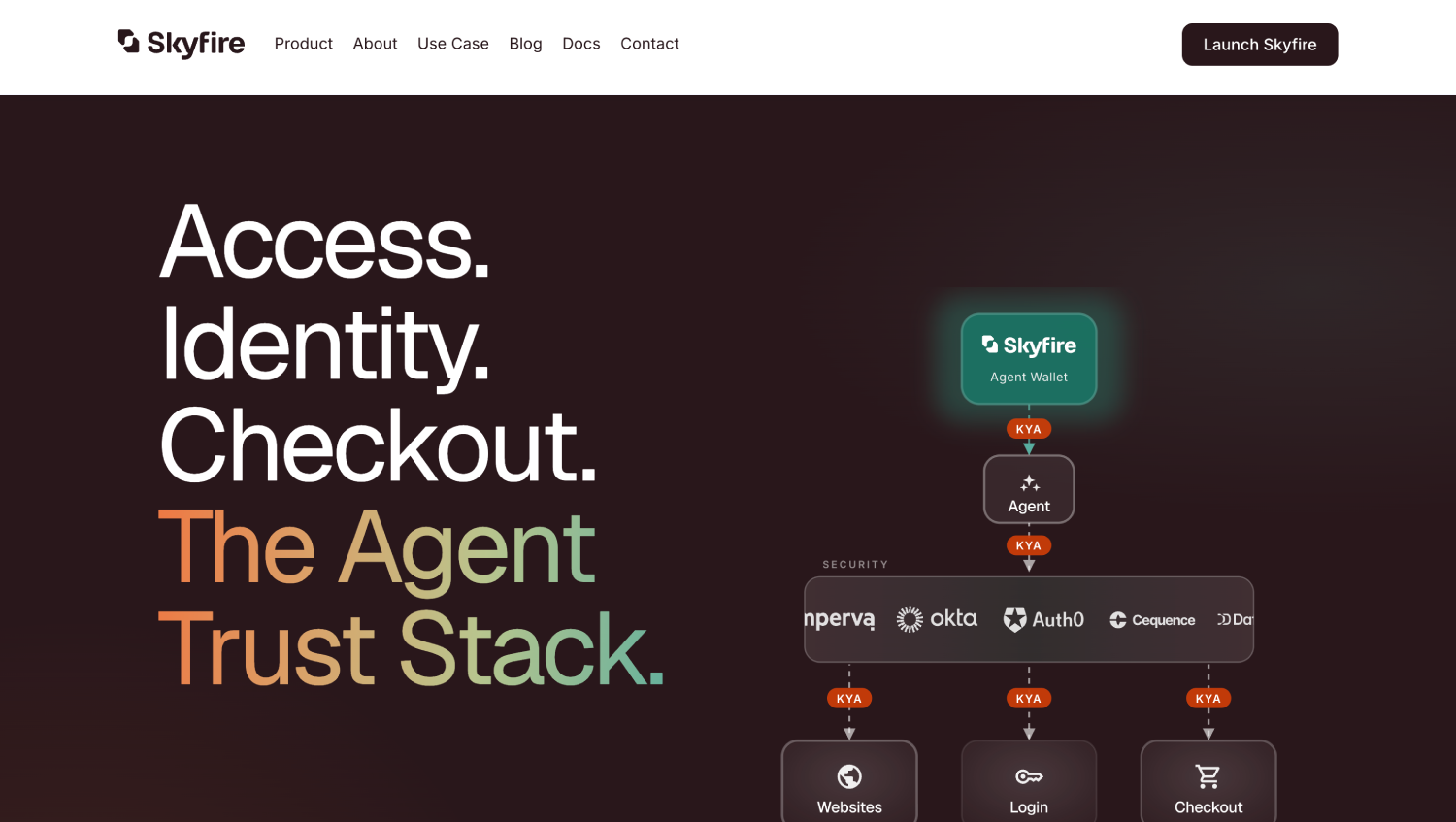
Skyfire is an agent payment network built around the idea that an agent needs a verifiable identity before it can spend money. The core product is a credentialing and payment layer: agents register with Skyfire, receive cryptographically signed credentials, and can then transact with any service provider inside the Skyfire network without a human approving each payment.
The spend authorization model is real-time and policy-driven. A developer defines what an agent is allowed to spend, on what categories, and at what thresholds. Skyfire enforces those rules at the transaction level, not at the account level. This matters because agent workflows can fan out across dozens of sub-tasks inside a single job, and per-transaction controls prevent a runaway agent from draining a budget before anyone notices.
Skyfire’s network-side pitch is also notable: service providers who join the network can accept payments from any credentialed agent without building their own agent authentication stack. That two-sided dynamic is what distinguishes Skyfire from a simple virtual card API bolted onto agent infrastructure.
Payman: Paying Human Workers Through AI Agents
Payman addresses a different direction of money movement. Most agent payment discussions assume the agent is paying for a service or API call. Payman focuses on the scenario where an AI agent is managing a workforce of human contractors and needs to pay them programmatically.
The product centers on a payment layer that AI agents can call to initiate payouts to verified human recipients. Payman handles the recipient verification side, so the agent does not need to trust an unverified wallet address or bank account. The human registers with Payman, gets verified, and the agent can then route compensation to them on task completion without a finance team member approving each disbursement.
This architecture shows up in agentic marketplaces, AI-coordinated gig platforms, and research pipelines where agents are farming tasks out to human annotators or specialists. It is a narrow use case, but for teams building in that space it removes an otherwise painful manual step from the payment loop.
Natural: Payment Orchestration and Dispute Handling Across Rails
Natural operates at a higher layer of the stack. Rather than issuing agent credentials or handling recipient verification, Natural sits between an agent and multiple downstream payment rails, routing transactions, managing retries, and handling disputes when payments fail or get contested.
The orchestration framing is the key differentiator. An agent running through Natural can attempt a payment across ACH, card, and crypto rails with fallback logic defined by the developer. If a payment on one rail fails, Natural can retry on another without the agent needing to know the mechanics of each rail’s failure modes. Dispute handling, which is the operational nightmare nobody talks about in agent payment pitches, is built into the product rather than left to the developer to wire up manually.
For teams building agents that transact at volume across varied payment types, Natural’s orchestration layer reduces what would otherwise be several months of internal plumbing into a configurable API. The case for payment orchestration platforms applies directly here, just shifted to an agent-native context.
How Do Skyfire, Payman, and Natural Compare on Core Dimensions?
| Dimension | Skyfire | Payman | Natural |
|---|---|---|---|
| Primary use case | Agent-to-service spending with identity | Agent-to-human contractor payouts | Multi-rail orchestration and dispute resolution |
| Money direction | Agent pays service providers | Agent pays human workers | Agent pays across multiple rails |
| Identity layer | Cryptographic agent credentials (core feature) | Human recipient verification | Not a primary focus |
| Spend controls | Per-transaction policy enforcement | Task-completion triggers | Rail-level routing rules |
| Dispute handling | Not a named feature | Not a named feature | Built-in orchestration-layer disputes |
| Multi-rail support | Skyfire network rails | Bank/wallet payouts | ACH, card, crypto, and others |
| Human-in-loop | Optional, policy-defined | Recipient is human by design | Developer-defined escalation |
| Public pricing (as of June 2026) | Not publicly disclosed | Not publicly disclosed | Not publicly disclosed |
| Best-fit company stage | Seed to Series B AI agent startups | Agentic marketplace or gig platform | Series A+ with multi-rail payment volume |
Which Provider Handles Agent Spend Controls Best?
Skyfire’s spend control model is the most granular of the three. A developer can define policy rules at the agent level: maximum per-transaction amounts, permitted merchant categories, time-window budgets, and rate limits. Because the policy is enforced at the network layer rather than in application code, it survives agent restarts, framework updates, and orchestration tool changes.
Payman’s spend controls are structured differently because the payout direction is reversed. The “control” is on who can receive money, not how much the agent can spend per task. A Payman integration verifies that recipients are real, verified humans before funds move. That is an access control, not a spending limit, and the distinction matters if your risk model cares about agent overspend rather than recipient fraud.
Natural applies spend controls at the routing layer. You can configure rules that direct certain transaction types to lower-cost rails and cap retries to prevent runaway retry loops from multiplying your payment volume unexpectedly. This is more useful for high-volume orchestration than for low-volume agents that need tight per-transaction guardrails. Teams building agents that make thousands of small API payments per day will find Natural’s rail-level controls more practical than Skyfire’s credential-level policies, while teams with one agent and a tight budget are better served by Skyfire’s granular limits.
How Does Each Platform Handle Disputes and Refunds for Agent Transactions?
This is where the gap between the three becomes starkest, and it is the question most buyers forget to ask during initial evaluations.
Natural is the only provider among the three that lists dispute handling as an explicit product capability. When an agent-initiated payment is contested or a rail returns an error that looks like a dispute rather than a simple failure, Natural’s orchestration layer can route that event through a defined resolution workflow rather than surfacing it as a raw webhook for the developer to interpret. For teams operating at volume, this saves meaningful engineering hours per month.
Skyfire does not surface dispute handling as a product feature. Disputes on agent-to-service transactions would likely require the developer to build resolution logic on top of the underlying payment method, whether that is a card network dispute process or an ACH reversal. That is not a knock on Skyfire given that its core value is pre-transaction (credentialing and authorization), but it is a gap to plan for.
Payman’s dispute scenario is structurally different because the counterparty is a verified human. A dispute in the Payman model is more likely to be a worker claiming non-payment or an agent triggering a payout before a task was confirmed complete. Payman handles the recipient verification step, but task-level dispute resolution sits with the developer’s application logic. Teams building agentic marketplaces should budget for a chargeback and dispute management layer on top of Payman rather than expecting it to be included.
The FintechSpecs Agent Rail Fit Test
Most teams pick an agent payment provider based on which founder they met first or which SDK had better documentation. This four-question decision path is designed to route you to the right rail before you start building.
Question 1: Is your agent paying a service or a person?
If the agent is paying for API calls, SaaS subscriptions, compute resources, or digital services, you are in Skyfire’s territory. If the agent is paying a human contractor, annotator, or gig worker on task completion, you are in Payman’s territory. If the answer is both, read on.
Question 2: Does your agent need a verifiable identity that service providers can trust?
If your agents are transacting with third-party services that need to authenticate them (not just charge them), Skyfire’s credentialing layer is doing something the other two are not. Without it, you are either building your own agent identity layer or asking every service provider to trust an unsigned API key.
Question 3: Are you transacting across more than one payment rail?
If your agent workflow touches card payments in one step, ACH in another, and crypto in a third, Natural’s orchestration layer prevents you from writing custom error handling and retry logic for each rail separately. Single-rail teams can ignore this. Multi-rail teams who skip it will rebuild it later at higher cost.
Question 4: Do you need dispute resolution handled at the infrastructure layer rather than in your application?
If the answer is yes, Natural is currently the only one of the three that addresses this directly. If you are early-stage and dispute volume is minimal, this can wait. If you are processing meaningful transaction volume, it cannot.
What Do Skyfire, Payman, and Natural Cost?
None of the three publish pricing publicly as of June 2026. All three require either a waitlist signup, a developer account application, or a direct sales conversation to get to pricing details. This is common in early-stage infrastructure companies and does not itself signal anything negative, but it does mean you cannot benchmark costs before committing engineering resources to an integration.
The absence of public pricing has a practical implication for finance teams: budget line items for agent payment infrastructure need to be estimated from usage projections rather than a rate card. The hidden costs that erode fintech SaaS margins apply here, particularly the pattern where per-transaction fees look small during development and compound unexpectedly at production volume.
When you do get to pricing conversations, ask each vendor explicitly about: per-transaction fees, monthly platform minimums, fees for dispute resolution events (Natural specifically), and whether human recipient verification carries a per-verification cost (Payman specifically). These are the line items most likely to drift between a pilot and a scaled deployment.
Which Agent Payment Rail Is Right for an AI Startup Integrating First?
Consider a seed-stage company building an AI research agent. The agent calls external APIs for data, pays for compute, and occasionally farms tasks to human analysts for review. In this scenario, the agent needs to spend on services (Skyfire’s domain) and pay humans on task completion (Payman’s domain). Running both integrations is feasible, and the two providers are not mutually exclusive.
What most early-stage teams should not do is start with Natural. Natural’s orchestration value compounds with transaction volume and rail diversity. A team making 200 agent payments a month on a single rail is paying for orchestration infrastructure it does not yet need. Natural makes more sense as a second or third infrastructure decision, after you have validated payment volume and identified the multi-rail problem in production.
Skyfire makes sense as a first integration for any team where agent identity is a real concern, meaning the service providers your agents are paying need to trust that a credentialed agent is making the call, not a rogue script. Payman makes sense as a first integration for any team where the primary payment problem is disbursing funds to a network of human task completers. These are cleanly separable decisions, and the mistake is treating them as a competitive choice when they often serve the same product simultaneously.
For teams evaluating how this layer fits into a broader payment stack, the best payment infrastructure tools for SaaS founders covers how agent payment rails sit relative to traditional processors, orchestration platforms, and embedded finance APIs.
How Do Skyfire, Payman, and Natural Compare on Supported Rails?
| Rail Type | Skyfire | Payman | Natural |
|---|---|---|---|
| Proprietary network | Yes (Skyfire network) | No | No |
| ACH / bank transfer | Via underlying rails | Yes | Yes |
| Card payments | Via network providers | Not primary | Yes |
| Crypto / stablecoin | Supported | Not primary | Yes |
| Cross-border | Network-dependent | Limited | Rail-dependent |
Real-time payment rail support (RTP/FedNow) is not publicly confirmed for Skyfire or Payman as of June 2026; Natural’s coverage is rail-dependent and should be verified directly. All three companies are actively expanding their rail coverage, and specific capabilities should be confirmed during technical evaluation.
What Are the Compliance Implications of Each Provider?
Agent payment infrastructure sits at an intersection that most compliance frameworks have not fully addressed yet. An AI agent initiating payments raises questions about authorization, liability, and auditability that traditional money movement regulation assumes a human initiator resolves.
Skyfire’s credentialing approach creates a documented authorization chain: the developer defines the policy, the agent acts within it, and each transaction carries a credential that identifies the agent and the authorizing policy. That audit trail is useful if a regulator or counterparty ever asks who authorized a specific payment.
Payman’s human verification layer creates a different compliance artifact: proof that funds went to a real, verified person rather than an anonymous wallet. For tax purposes, that recipient identity record matters, particularly for platforms that may have 1099 reporting obligations for contractor payments above IRS thresholds.
Natural’s orchestration layer creates a transaction log across rails, which is valuable for reconciliation but does not itself address the authorization question. Teams using Natural still need to document who or what authorized the agent to initiate payments in the first place. The fintech product and compliance readiness checklist covers the authorization and audit trail requirements that apply to programmatic payment systems, and most of those requirements translate directly to agent-initiated payments.
Frequently Asked Questions
Can I use Skyfire and Payman together in the same agent workflow?
Yes. They address different directions of money movement and are not mutually exclusive. Skyfire handles payments an agent makes to external services. Payman handles payments an agent distributes to human workers. A workflow where an agent buys API access via Skyfire and then pays a human reviewer via Payman is architecturally coherent. The integration overhead is two separate SDKs or APIs, which most teams can manage if they have identified both use cases in their product.
Does Natural replace Skyfire or Payman, or does it sit on top of them?
Natural operates at a different layer. It is an orchestration platform, not an identity or recipient verification system. In principle, Natural could route payments that originate from agent workflows regardless of how those agents are credentialed. Whether Natural integrates directly with Skyfire or Payman at a technical level is not publicly documented as of June 2026 and should be confirmed with each vendor during a technical evaluation call.
Which of the three handles high-frequency, low-value agent micropayments best?
Skyfire’s per-transaction policy enforcement model is designed for exactly this scenario: agents making many small payments across many service providers. The proprietary Skyfire network means those transactions do not necessarily hit standard card or ACH rails with per-transaction minimums. Natural’s orchestration layer also handles high-frequency scenarios but adds more operational complexity than a simple agent spend use case requires.
How do these providers handle failed payments when an agent is autonomous?
This is an underappreciated problem. A human-initiated payment failure surfaces to a person who can take corrective action. An agent-initiated payment failure surfaces to an automated workflow that may not know how to handle it gracefully. Natural’s retry and orchestration logic directly addresses this. Skyfire’s policy enforcement prevents unauthorized spend but does not itself define what an agent should do when a payment is declined. Payman’s task-completion trigger model reduces failure risk because funds do not move until a task is confirmed, but a failed disbursement still requires application-level error handling.
Are any of the three regulated as money transmitters?
None of the three publicly confirm money transmitter licensing as of June 2026, and FintechSpecs found no public regulatory disclosures or licensing filings during research for this article. The regulatory classification depends on how each company structures money movement and which state or federal licenses their banking partners hold. Any team building on these platforms for production payment volume should conduct their own legal review of money transmission applicability. The money transmitter license cost breakdown by state gives context on what those regulatory obligations look like if they fall to your company rather than the provider.
What should I ask during a technical evaluation call with any of these providers?
Ask for the specific dispute resolution flow documentation, not the general product overview. Ask for the rate of payment failures in production and what the developer experience is when a failure occurs. Ask whether spend policy changes take effect immediately or require a re-credentialing cycle. Ask about the audit log format and whether it is compatible with your existing compliance tooling. These questions surface operational realities that demo environments do not.
The Verdict: Who Should Pick Which Provider
The framing that all three are “AI agent payment startups” is technically accurate and operationally useless. Skyfire is a credentialing and authorization network solving the problem of agent identity at the point of payment. Payman is a disbursement platform solving the problem of paying humans through an automated agent layer. Natural is an orchestration platform solving the problem of running payments across multiple rails with built-in failure handling and dispute resolution.
If your agent is spending money on services and you care about what it is allowed to spend, start with Skyfire. If your agent is paying human contractors and you need verified recipients without manual finance team intervention, start with Payman. If your agent operates across multiple payment rails at meaningful volume and you need a layer that handles the operational mess that creates, build on Natural. The first two decisions can coexist inside the same product. Natural is typically an addition at a later stage of scale, not a replacement for either.
The one scenario where this gets complicated is an agent platform that handles all three simultaneously: agent-to-service spending, agent-to-human payouts, and multi-rail orchestration. At that point, no single vendor covers the full surface area, and the real infrastructure decision is which of the three gaps is most painful in production today. Solve that one first, and revisit the others when the next bottleneck surfaces.