
- Purpose-built agent payment infrastructure gives each AI agent its own wallet, virtual card, or stablecoin balance with per-agent spend limits and instant revocation, making autonomous transactions auditable in ways a shared corporate card never will be.
- The core providers in this space split into two models: card-and-wallet rails (Skyfire, Payman, Natural) and crypto-native or stablecoin-first rails (Nekuda, Skyfire’s USDC layer), with meaningful differences in settlement speed, compliance surface, and developer experience.
- Spend controls matter more than payment method: per-agent limits, merchant category restrictions, time-bound authorizations, and cryptographic agent identity are the features that separate purpose-built infrastructure from a Stripe key handed to a Python script.
- Every provider on this list is pre-Series B and actively courting design partners, which means sandbox access is fast, pricing is negotiable, and you have real influence over the roadmap if you move in the next six months.
- The right pick depends on whether your agents operate in fiat-only environments, need stablecoin settlement, or require MPC wallet custody, and no single provider dominates all three.
The best AI agent payment infrastructure providers in 2026 are Skyfire, Payman, Natural, Nekuda, AgentPay, Crossmint, and x402 Protocol infrastructure. Each of the first six issues programmatic payment credentials to individual agents, enforces per-agent spend caps, logs every transaction to an immutable audit trail, and supports instant credential revocation. x402 is included as the protocol-layer reference point for where agent payments are heading architecturally. The right choice depends on whether you need fiat card rails, USDC settlement, or MPC-based agent wallets.
Why Giving an AI Agent a Shared API Key Is Not a Payment Strategy
Most teams solving the “how does my agent pay for things” problem reach for the nearest Stripe key or a prepaid corporate card. It works for a demo. It fails at production scale for a specific reason: there is no way to attribute a charge, revoke access for one agent without killing the others, or prove to a compliance team that a specific agent made a specific purchase within an approved policy.
Consider a Series A company running 50 concurrent research agents, each capable of calling paid APIs, purchasing data enrichment, or booking compute. On a shared card, one runaway agent can burn the monthly budget in hours with no per-agent trail. Finance sees a lump sum on the statement. The audit log lives nowhere. That is not a payment infrastructure problem, it is a control architecture problem, and it is exactly what agent-native rails are designed to solve.
The analogy to corporate card infrastructure is instructive. Tools like Ramp and Brex solved the same problem for human employees: instead of one company card, each employee gets an individual card with individual limits and individual visibility. Agent payment infrastructure applies the same logic one layer down, to software. As covered in our breakdown of payment infrastructure tools for SaaS founders, programmable controls are increasingly table stakes for any operator managing spend at volume.
How to Evaluate Agent Payment Infrastructure: The FintechSpecs SCAR Framework
Every provider in this category will claim to offer “programmable payments for AI agents.” Most of them mean something different by it. The FintechSpecs SCAR Framework is a four-check evaluation model built specifically for buyers choosing agentic payment rails.
S , Spend Controls: Does the system support per-agent limits, merchant category codes (MCC) restrictions, time-bound authorizations, and daily or per-transaction caps? Blanket account limits do not count. Controls must be addressable at the individual agent level, not the team or account level.
C , Credential Architecture: How is agent identity represented? Is it a virtual card number, a public/private keypair, an MPC wallet, or an OAuth-scoped token? The architecture determines what the agent can authenticate to and what a revocation actually stops.
A , Audit and Attribution: Does every transaction log a machine-readable agent identifier, timestamp, merchant, amount, and policy decision? This is what compliance teams need and what most shared-card setups cannot produce retroactively.
R , Revocation Speed: How fast can you kill a credential for one agent without disrupting others? Instant revocation via API is the bar. Anything requiring a support ticket or manual review is not production-grade agent infrastructure.
Run every provider below through SCAR before opening a sandbox account. Most will pass on S and A. The differentiators are C and R.
Which Providers Actually Build for Agent-Native Payments in 2026?
The field has roughly a dozen entrants. This list covers six purpose-built providers with the clearest product-market fit, the most developer-ready APIs, and the most transparent positioning, plus x402 as the open protocol shaping where the category goes next. Two notable names are absent: Coinbase’s Agentic Wallets and Kite. Coinbase’s offering is real but lives inside a larger consumer crypto product, and the compliance surface for B2B agentic use cases is still being worked out publicly. Kite is an outreach target we are tracking for a future update.
1. Skyfire
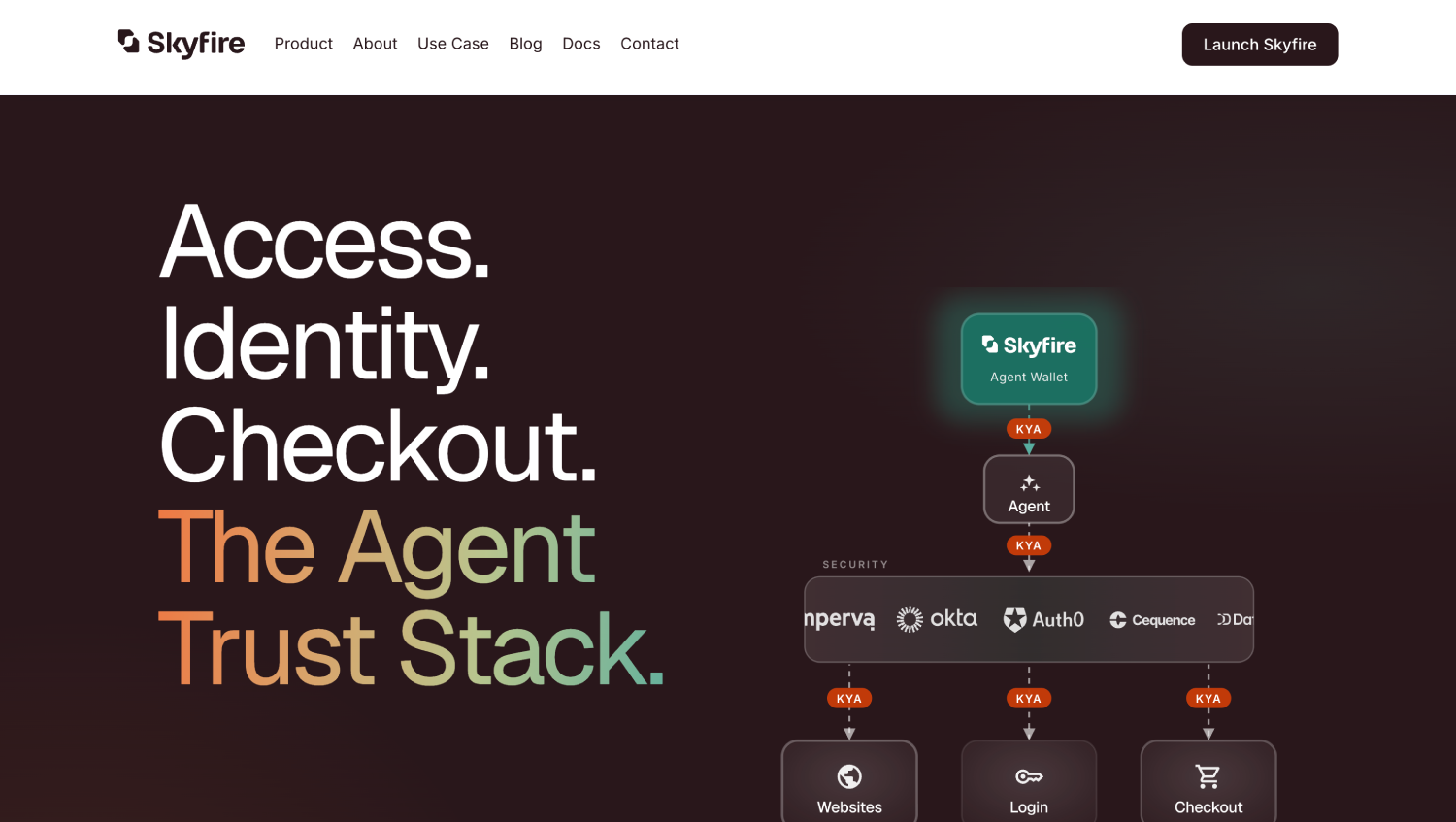
Skyfire is the most complete provider in this category as of mid-2026. It gives AI agents a wallet that holds both USDC and fiat, a virtual card for merchant-facing purchases, and an identity layer that lets receiving APIs or services verify the agent’s authorization before processing payment. The architecture is designed so that the human operator sets policy, the agent executes within that policy, and every transaction is signed with a cryptographic proof linking it to a specific agent identity.
Skyfire’s payment network is purpose-built for agent-to-service and agent-to-agent transactions, meaning you can pay another agent for a task result and settle in near real time without routing through a human approval step. The stablecoin layer matters here: USDC settlement avoids the 1-3 business day ACH delay that makes fiat-only rails impractical for high-frequency agentic workflows.
For teams building on LangChain, CrewAI, or custom agent orchestration, Skyfire publishes SDKs and the integration surface is API-first. Public pricing is not disclosed on their website; interested teams go through a sandbox request. Skyfire is the anchor pick for operators who need both card rails and crypto settlement from a single provider.
2. Payman
Payman focuses on the fiat side of agent payments, specifically on letting AI agents send money to real people and real vendors without a human in the loop for each transaction. The product centers on pre-approved payee lists, per-transaction limits set at the orchestration layer, and an approval workflow that the human operator configures once and the agent executes against repeatedly.
The positioning is more workflow-automation than agentic commerce. Payman is a better fit if your agent is executing recurring business tasks like paying a freelancer after a task completes or reimbursing a vendor after a verified delivery, rather than making ad hoc API purchases across unknown merchants. The spend control model is policy-first: you define allowed payees and amounts upfront, and anything outside that policy requires escalation.
Payman’s approach ties each agent to an operator account and requires that the human operator be verified before any agent under their account can transact. This makes compliance conversations easier. For a direct comparison of Payman against Skyfire and Natural on specific feature dimensions, the FintechSpecs Skyfire vs Payman vs Natural comparison covers each provider’s authorization model in depth.
3. Natural
Natural takes the card-issuing approach to agent payments. Each agent gets its own virtual card, issued programmatically via API, with limits and merchant restrictions set at issuance. The card can be used anywhere that accepts standard card rails, which is the key differentiator from wallet-native approaches: there is no merchant-side integration required.
This makes Natural the fastest path to production for agents that need to purchase from existing web services, SaaS tools, or marketplaces that have not adopted any agent-specific payment protocol. The trade-off is that Natural’s audit layer is card-statement-level rather than cryptographic. You get a transaction log per card, not a signed proof of agent authorization. For many enterprise compliance teams, that is sufficient. For security-first teams, it may not be.
Natural is best for operators who need to move quickly and cannot wait for merchant-side adoption of agent payment protocols. It sits closest to the existing corporate card infrastructure mental model, which also makes it easier to explain to a CFO who has never heard of an agent wallet.
4. Nekuda
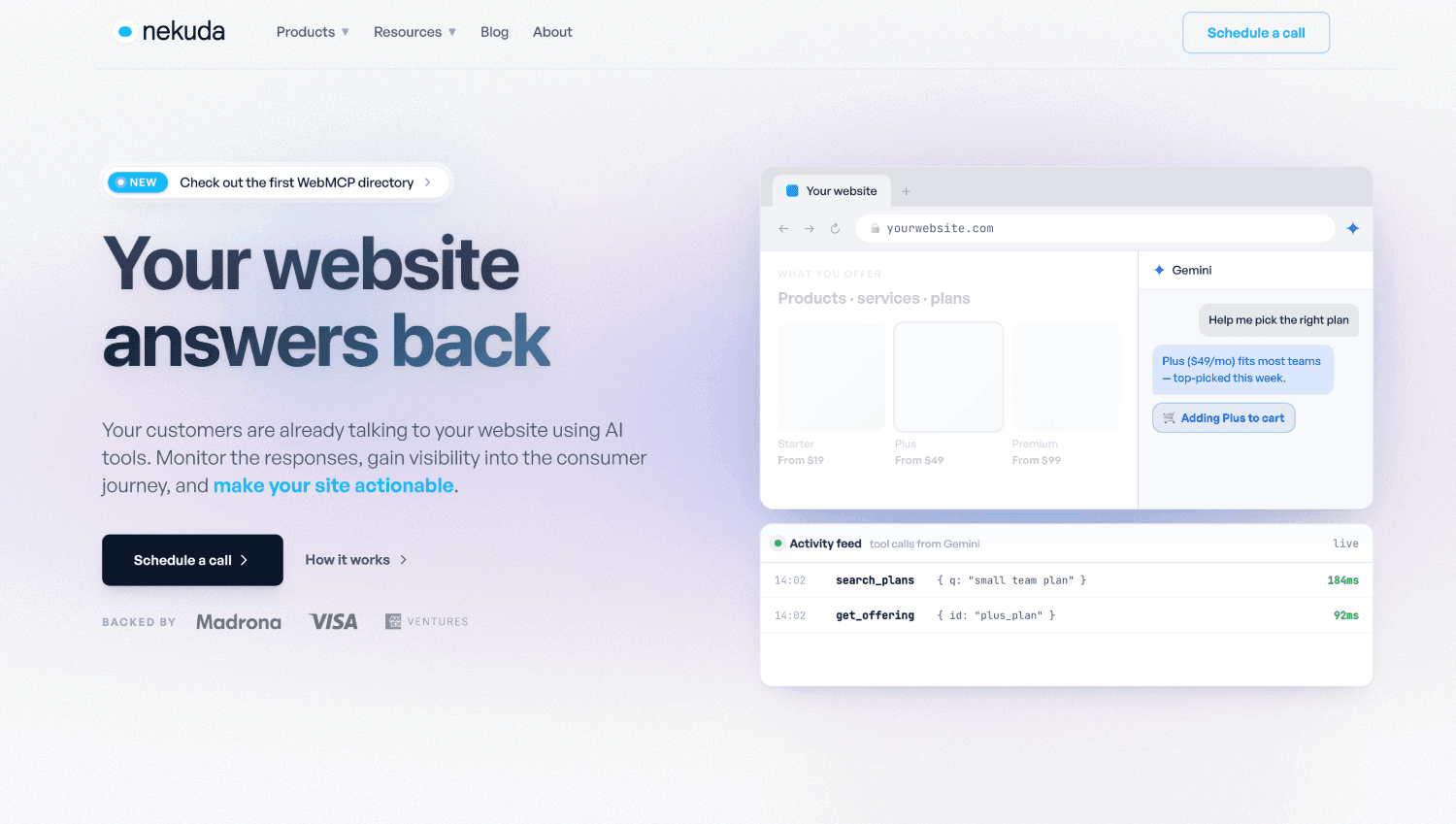
Nekuda appears to be building what it describes as a financial operating system for AI agents, centered on MPC (multi-party computation) wallets assigned to individual agents. The MPC approach, if implemented as the company describes, means the private key controlling an agent’s wallet is never held in one place, which would reduce custodial risk and make the system more defensible for enterprise security reviews.
Nekuda claims to support both on-chain and off-chain settlement and is positioning itself against the agentic payment rails problem at the infrastructure level rather than the application level. Their stated KYA (Know Your Agent) framework is designed to assign each agent a persistent identity that travels with it across transactions, allowing receiving parties to verify who they are transacting with before funds move. Verify current implementation scope directly with their team, as the company is earlier in its go-to-market than Skyfire or Payman and some of these capabilities may still be in design-partner beta.
Nekuda’s developer audience skews crypto-native. Teams building on Ethereum-compatible chains or needing programmable settlement logic , escrow, conditional release, multi-sig approval , will find the architecture the most expressive if it ships as described. Pricing is by design-partner arrangement; nothing is publicly listed.
5. AgentPay
AgentPay is a narrower product that focuses specifically on letting AI agents pay for API services and digital goods within defined budgets. The product is structured around a “budget envelope” model: the operator funds a budget, assigns it to one or more agents, and the agents draw from that envelope with every API call or purchase logged against it. When the envelope is depleted or a single transaction exceeds a per-call cap, the agent gets a payment failure response that it can handle programmatically.
The budget envelope model is the most intuitive spend control architecture for developers coming from a metered billing background. It maps directly to how teams already think about API rate limits and cost ceilings. AgentPay does not currently support stablecoin settlement or physical merchant transactions; the product is scoped to digital services. For teams building AI products that call other AI APIs , OpenAI, Anthropic, data vendors, enrichment services , AgentPay’s scoped approach reduces surface area and simplifies the compliance conversation.
6. Crossmint
Crossmint entered the agent payments space from a Web3 infrastructure background, initially focused on NFT and token distribution before pivoting toward wallet-as-a-service for AI agents. Their agent wallet product lets developers create and manage wallets for non-human entities, fund them with USDC or ETH, and assign spending policies programmatically.
Crossmint’s developer experience is among the strongest in this group. Their wallet API is well-documented, sandbox access is self-serve, and the SDK covers the most common agent frameworks. The caveat is that Crossmint’s compliance tooling is still maturing for traditional financial services contexts. Teams operating in regulated industries will need to do more of their own identity and authorization work. For teams building consumer-facing AI products where the agent needs a crypto-native payment method, Crossmint is the fastest path to a working integration. For a broader view of wallet infrastructure options, the wallet-as-a-service platform comparison on FintechSpecs covers the non-agent use cases in this category.
7. x402 Protocol: The Open Standard Worth Watching
x402 is not a company or a vendor , it is an emerging open protocol built on the dormant HTTP 402 “Payment Required” status code. It belongs on this list not as a drop-in provider, but as the architectural direction the entire category appears to be converging toward. Several infrastructure providers are now building x402-compatible payment layers, most notably within the Coinbase developer ecosystem, though the protocol itself is open and provider-agnostic.
The mechanism is simple: an API returns a 402 response with a payment payload, the agent pays the exact amount required using its wallet, and the API retransmits the response after payment confirmation. No pre-negotiated billing relationship is required. Any API can request payment; any agent with a compatible wallet can respond.
The current limitation is adoption: few production APIs have implemented 402 responses, and the tooling for building x402-compatible endpoints is still early. For teams building the APIs that agents will pay for , rather than the agents themselves , x402 is worth building toward now. For teams evaluating providers today, it is the lens through which to assess whether a given vendor’s architecture will be compatible with where the market is going. The FintechSpecs x402 spoke covers the protocol architecture and implementation details for API builders.
Side-by-Side: How the Seven Options Compare on SCAR Criteria
| Provider | Spend Controls (per-agent) | Credential Architecture | Audit and Attribution | Revocation Speed | Fiat Support | Stablecoin Support | Best For |
|---|---|---|---|---|---|---|---|
| Skyfire | Yes, policy-layer | Cryptographic agent identity + virtual card | Signed transaction log | API-instant | Yes | USDC | Full-stack agent commerce |
| Payman | Yes, payee allowlist + per-tx limits | OAuth-scoped operator account | Operator-level ledger | API-instant | Yes | No (as of public docs) | Agent-to-human/vendor payouts |
| Natural | Yes, per-card MCC restrictions | Virtual card (standard card rails) | Card statement-level | Card freeze via API | Yes | No | Agents buying from existing merchants |
| Nekuda | Yes, policy + MPC wallet (per company claims) | MPC wallet + persistent agent identity | On-chain + off-chain logs | API-instant | Yes | Yes, multi-chain (per company claims) | Enterprise security, agent-to-agent |
| AgentPay | Yes, budget envelope model | API key per agent budget | Per-call log | Budget depletion or manual freeze | Yes | No | Agents calling paid APIs |
| Crossmint | Configurable per wallet | MPC wallet | Wallet transaction history | API-instant | Limited | USDC, ETH | Crypto-native agent products |
| x402 Protocol | Protocol-level (per-call) | Wallet keypair | On-chain or provider-specific | Wallet revocation | No | Yes | API builders, future-proofing |
What Are Per-Agent Limits and Why Do They Matter More Than Account-Level Limits?
Account-level limits cap total spend across all agents in an organization. Per-agent limits cap what a single agent identity can spend, in a single transaction, per day, or per merchant category. The difference is not cosmetic.
Say a company runs five agents: one for competitive research, one for data enrichment, one for vendor outreach, one for code generation, and one for scheduling. The research agent needs access to paid data APIs costing up to $200 per query. The scheduling agent needs to book meeting rooms, capped at $50 per booking. On an account-level system, a misconfigured research agent can consume the entire monthly budget. On a per-agent system, it burns only what its own policy allows.
This is the same principle behind virtual card issuing for accounts payable teams: one card per vendor, each with its own limit and expiry. The virtual card issuing API comparison on FintechSpecs covers this pattern in depth for the AP use case. Agent payment infrastructure applies the same control model to software identities rather than supplier relationships.
How Do AI Agents Authenticate Before Making a Payment?
Authentication is where the providers diverge most sharply, and where the compliance risk is highest. There are three dominant approaches in production today.
The first is API key delegation: the human operator holds a master credential and the agent is issued a scoped sub-key. Payman and AgentPay use variants of this. It is familiar to developers, easy to revoke, but the agent has no cryptographic proof of its own identity beyond the key itself. Anyone who exfiltrates the key can impersonate the agent.
The second is virtual card issuance: each agent gets a card number with its own controls. Natural operates here. The card number is the identity. Revocation is a card freeze. The limitation is that standard card rails were designed for human cardholders, so the merchant-side data about who made a purchase is a 16-digit number, not a machine-readable agent identifier.
The third is cryptographic agent identity via MPC wallet: the agent holds a keypair, signs payment requests, and the receiving service can verify the signature before fulfilling the request. Skyfire and Nekuda are positioned here. This is the most verifiable model and the one most aligned with how KYA (Know Your Agent) frameworks are being developed across the industry. It is also the most complex to implement.
For operators who need to demonstrate to a compliance team that their agents have auditable, non-repudiatable payment credentials, the MPC wallet model is the defensible choice. For teams who need to ship in two weeks and answer compliance questions later, virtual cards are the pragmatic path. The compliance cost of that choice is real; the fintech product and compliance readiness checklist is a useful starting point for mapping what your stack will eventually need.
Which Agent Payment Provider Works with Both Cards and Stablecoins?
As of mid-2026, Skyfire is the only provider on this list that credibly supports both traditional card rails and USDC settlement from a unified product. Nekuda positions itself similarly but routes card-side transactions through partner infrastructure rather than a native card program, which adds a layer of operational dependency , and given how early Nekuda is, teams should verify current capabilities directly before designing around that assumption.
The practical reason to want both matters: agents operating across different merchant types will encounter both card-only checkout flows and crypto-native APIs that accept stablecoins. A travel booking tool accepts Visa. An AI API marketplace built on x402 accepts USDC. An agent that can only use one rail will fail at the other. Skyfire’s dual-rail architecture is the current answer to this, though the product is still evolving and teams should confirm current capabilities directly with their team during sandbox onboarding.
Stablecoin settlement for agent payments also resolves a latency problem that fiat-only rails cannot. ACH settlement takes one to three business days. USDC on a fast chain settles in seconds. For agents that need to confirm payment before proceeding with a task, the settlement speed difference is a functional requirement, not a preference. The leading stablecoin payment APIs for fintech platforms covers the settlement infrastructure layer underneath these agent payment products.
What Does an Agentic Commerce Stack Actually Look Like in Practice?
Take a hypothetical Series A company building an AI procurement agent that automates vendor sourcing, negotiation, and purchase order execution. The agent orchestration layer is built on LangChain. The agent needs to pay for three categories of spend: data enrichment APIs ($10-$50 per query), SaaS subscriptions for vendor databases ($200-$500 per month), and one-time purchases from vendor marketplaces (variable, up to $2,000 per transaction).
A functional agentic payment stack for this use case would look like this. Skyfire or Nekuda provides the agent wallet and identity layer, with a policy set that caps per-query spend at $75, subscription spend at $600 monthly per agent, and marketplace transactions at $2,500 with a human approval required above $1,000. Natural issues a virtual card for the marketplace purchases where card rails are required. AgentPay handles the API-call layer for high-frequency, low-value data enrichment queries, using its budget envelope model to cap the research agent’s daily spend at $500.
This is not a single-provider solution. The providers in this category are not yet full-stack, and the teams that ship the fastest are composing two or three of them together rather than waiting for one provider to cover every rail. That changes as the market matures, but for the next 12 months, a multi-provider composition is the realistic production architecture. For a broader view of how these pieces fit into a full infrastructure stack, the fintech infrastructure stack map shows where agent payment rails sit relative to ledgering, compliance, and core banking layers.
How Do Audit Trails for AI Agent Payments Work for Compliance?
The compliance question for agent payments is not whether your organization can make a payment; it is whether your organization can prove, after the fact, that a specific authorized agent made a specific approved payment within a documented policy. That standard is what regulators and internal audit teams require, and it is what most improvised agent payment setups cannot meet.
Purpose-built providers produce audit trails with four minimum fields: agent identifier (persistent, not ephemeral), transaction amount and currency, merchant or recipient identifier, and policy version that authorized the transaction. Skyfire’s signed transaction model includes cryptographic proof that the policy in effect at the time of the transaction authorized the amount. Payman’s operator-level ledger logs the payee allowlist version against each transaction. Natural’s card statement logs map to a card identifier, which maps to an agent record in the operator’s system if the operator has configured it correctly.
The gap in most of these systems is the “policy version” field. When a spend policy changes, which transactions were made under the old policy and which under the new one? This matters when a runaway agent is investigated retrospectively. Only providers that version their policies and log the version identifier at transaction time give you a clean answer. Ask this question directly during sandbox evaluation; it is not always documented in the public API reference.
Frequently Asked Questions About AI Agent Payment Infrastructure
Can AI agents make payments autonomously without human approval?
Yes, within a policy set by the human operator. Purpose-built agent payment infrastructure lets operators define spend limits, approved merchants, and transaction caps upfront. The agent then executes payments within those boundaries without per-transaction human approval. Transactions outside the policy require escalation or fail with an error response. The autonomy is real, but it operates inside a human-defined fence, not outside one.
What is a KYA (Know Your Agent) framework?
Know Your Agent is an identity verification and authorization model adapted from KYC (Know Your Customer) principles for non-human payment actors. In practice, it means assigning each AI agent a persistent, verifiable identity, typically backed by a cryptographic keypair or MPC wallet, that travels with the agent across transactions. Providers like Nekuda and Skyfire are building KYA into their authorization layers so that receiving services can verify who they are transacting with before funds move. The framework is not yet standardized across the industry, but it is the vocabulary regulators and enterprise compliance teams are beginning to use.
How do per-agent spend limits work technically?
Each agent is provisioned with its own credential (virtual card, wallet, or API key) at the infrastructure layer. The spend limits are attached to that credential, not to the operator account. When the agent initiates a transaction, the payment provider checks the request against the limit before authorizing. If the transaction exceeds the per-agent cap, the provider returns a declined or escalation response. The operator account is not touched. This is the same architecture as employee-level virtual cards in corporate spend management tools, applied to software identities.
What is the x402 protocol and how does it relate to agent payments?
x402 is an implementation of the HTTP 402 “Payment Required” status code, which allows APIs to request payment inline as part of a standard HTTP request-response cycle. An agent calls an API, receives a 402 response with a payment payload, pays the exact amount using its wallet, and the API responds with the requested data. No pre-negotiated billing relationship is required. The protocol makes true per-call micropayments between agents and APIs possible, which is architecturally cleaner than subscription billing for high-frequency, variable-usage agent workflows.
How fast can an agent payment credential be revoked?
The best providers in this category support API-instant revocation, meaning a single API call freezes the credential and all subsequent transactions are declined within seconds. Virtual card-based systems (Natural) revoke at card-freeze speed, which is also near-instant via the issuing API. MPC wallet-based systems (Skyfire, Nekuda) revoke by invalidating the agent’s authorization policy, which blocks new transactions without affecting any in-flight settlement. The gap to watch is in-flight transactions: confirm with each provider what happens to a transaction that was initiated milliseconds before a revocation call was processed.
Do I need a separate compliance review to deploy agent payments?
That depends on your existing licensing, your transaction volumes, and which provider you use. Providers that issue virtual cards do so through sponsor bank relationships and card network agreements, which means your compliance obligations are largely handled by the provider’s existing program. Stablecoin-native providers may require you to address money transmission or virtual currency regulatory questions depending on your jurisdiction. Regardless of provider, deploying software that makes autonomous payments on behalf of your company will trigger questions from your legal and compliance teams. The compliance blind spots guide for early-stage fintech covers the categories of regulatory risk most commonly missed by teams building novel payment products.
Can AI agents pay each other, not just pay merchants?
Yes, and this is the most technically interesting use case in agentic commerce. Agent-to-agent payments require both agents to have addressable payment identities, which is why MPC wallet architectures (Skyfire, Nekuda) are better suited than card-based approaches. In a card-based system, an agent cannot easily “receive” a card payment from another agent. In a wallet-based system, the receiving agent has a wallet address that the paying agent can send funds to programmatically. This makes multi-agent pipelines possible , one agent pays another for a completed subtask, settling in near real time without human intervention at any step.
The Control Architecture Is the Product
The fear that AI agents touching money is inherently reckless is understandable but slightly misframed. A shared corporate card given to an intern with no spend policy is reckless. An AI agent with its own credential, its own per-transaction limit, its own audit trail, and instant revocation is measurably more controlled than that. The problem has never been autonomous payment execution; the problem is execution without attribution, limits, or an off switch.
What this generation of providers is selling is not payments. It is control architecture with payments as the delivery mechanism. Skyfire’s cryptographic agent identity, Payman’s payee allowlist model, Nekuda’s MPC wallet approach, Natural’s per-card MCC restrictions: these are all different expressions of the same insight , that the value is in the guardrails, not the rails. The rails (Visa, ACH, USDC) already exist. What did not exist until recently was a programmable policy layer sitting between an autonomous software process and those rails.
Start with a sandbox account at one or two providers from this list this week, not because the space is moving so fast you will miss it, but because the providers who are validation-hungry right now will shape their roadmaps around early design partners. If your use case is fiat-first and you need to ship quickly, start with Natural or Payman. If you are building for agent-to-agent commerce or need stablecoin settlement, start with Skyfire or Nekuda. Run the SCAR framework against both, and let the C and R columns make the decision for you.