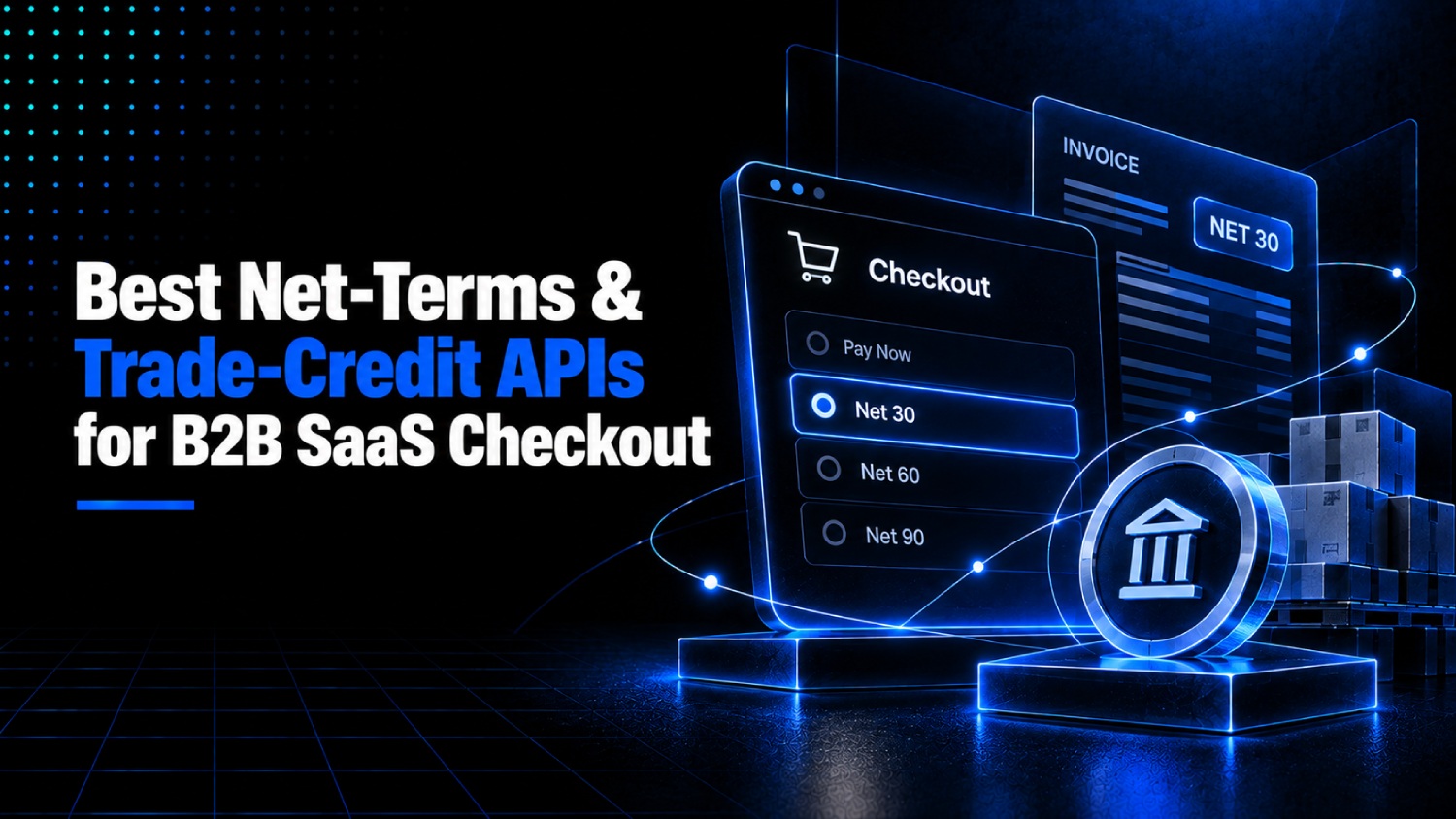

- Net terms APIs let B2B SaaS companies embed trade credit decisions at checkout, replacing email threads and spreadsheet approvals with a single API call.
- The five providers in this guide differ most on who holds credit risk: some fund net terms from their own balance sheet, others connect you to a credit facility you control.
- Underwriting speed, ERP sync, and buyer coverage geography are the three variables that actually differentiate these tools at the integration layer.
- Most B2B SaaS checkout flows convert 15-30% lower on invoice payment options simply because the approval happens hours or days after checkout, not at the moment of purchase.
- If you are choosing between a net terms API and a broader B2B BNPL platform, the API route gives you more control over UX but more responsibility for compliance and collections.
The best net-terms APIs for B2B SaaS checkout are Resolve, Kanmon, Parafin, Credibly, and Behalf. Each embeds trade credit decisions directly into a checkout flow via API, so buyers get a net-30 or net-60 approval in real time rather than waiting for a finance team to process paperwork. The right choice depends on who you want holding credit risk, how deeply you need ERP integration, and whether your buyers are SMBs or mid-market companies.
Why Net Terms at Checkout Is an API Problem, Not a Finance Problem
Most B2B finance teams still run net terms the same way they did in 2005. A buyer requests payment terms, a credit analyst pulls a Dun and Bradstreet report, someone in finance emails an approval, and the buyer gets invoiced three days later. By that point, the buyer has already evaluated a competitor.
The actual bottleneck is not credit judgment. It is latency. A decision that takes 72 hours offline takes under two seconds through a modern trade credit API. The underwriting logic is the same. The difference is where it lives: in a workflow tool that nobody touches until someone asks, or inside your checkout flow where buyers experience it without friction.
B2B SaaS companies selling to other businesses face a specific version of this problem. Their buyers are procurement-driven, accustomed to purchase orders and net payment terms. Offering only credit card checkout to these buyers is not neutral. It actively signals that the vendor does not understand how B2B procurement works. Embedding net terms at checkout closes that gap without building a lending operation internally.
This is distinct from the broader question of which B2B BNPL platform to use as a standalone product. If you want a fuller picture of the non-API platform options, the comparison of B2B BNPL and trade credit platforms covers that ground. This guide focuses specifically on APIs you can drop into a checkout, quote, or CPQ flow.
What Does a Net Terms API Actually Do?
A net terms API handles three jobs: credit decisioning, payment facilitation, and collections. Most providers handle all three, but the ownership of credit risk varies significantly across them.
At the decisioning layer, the API accepts buyer identity data (business name, EIN, address) and returns an approval decision, a credit limit, and eligible payment terms, typically net-30, net-60, or net-90. The better APIs also return a confidence score or decline reason that your UX can use to route buyers to alternative payment methods without dead ends.
At the payment layer, the API creates an invoice or purchase obligation on the buyer’s behalf, pays your platform immediately (less a fee), and owns the receivable. This is the funded model. In the unfunded model, the API manages the payment flow but your platform or a credit facility you control holds the receivable.
Collections is where most embedded net terms fail quietly. If a buyer goes 45 days past due on a net-30 invoice, someone has to chase them. API-first providers handle this through automated dunning, ACH debit authorization, and in some cases legal escalation. Platforms that outsource this to third parties introduce lag that shows up in your Days Sales Outstanding metric.
The FintechSpecs Net Terms API Stress Test: Four Checks Before You Integrate
Before evaluating any specific provider, run what we call the FintechSpecs Net Terms API Stress Test. These four checks surface the integration risks that vendor sales decks never mention.
Credit risk ownership: Ask the vendor directly who holds the receivable if a buyer defaults. If the answer is “we do,” you get predictable revenue but pay a higher discount rate. If the answer is “you do,” you get more economics but you also need a collections process and potentially a lending license depending on your state.
Underwriting latency under load: Request a synchronous response time SLA for the credit decision endpoint. Some providers quote sub-second average latency but have p99 times above 10 seconds during peak hours. A 10-second spinner at B2B checkout kills conversion just as surely as a decline.
Buyer coverage depth: Ask what percentage of US SMBs in your vertical will receive an approval, not just a response. A provider might return a decision on 95% of requests but approve only 40% of them. Coverage and approval rate are different numbers.
ERP writeback: Confirm whether approved net terms transactions automatically create invoices and payment records in your buyer’s accounting system. If a procurement manager approves a purchase with net-30 terms and it does not appear in their AP module, expect a dispute at day 31. Providers with native QuickBooks, NetSuite, or Sage integrations reduce this friction significantly.
Which Net Terms APIs Are Worth Evaluating?
The five providers below represent the serious options for B2B SaaS teams as of 2026. Each has a publicly documented API, a track record with software platforms, and a clear position on credit risk ownership.
Resolve
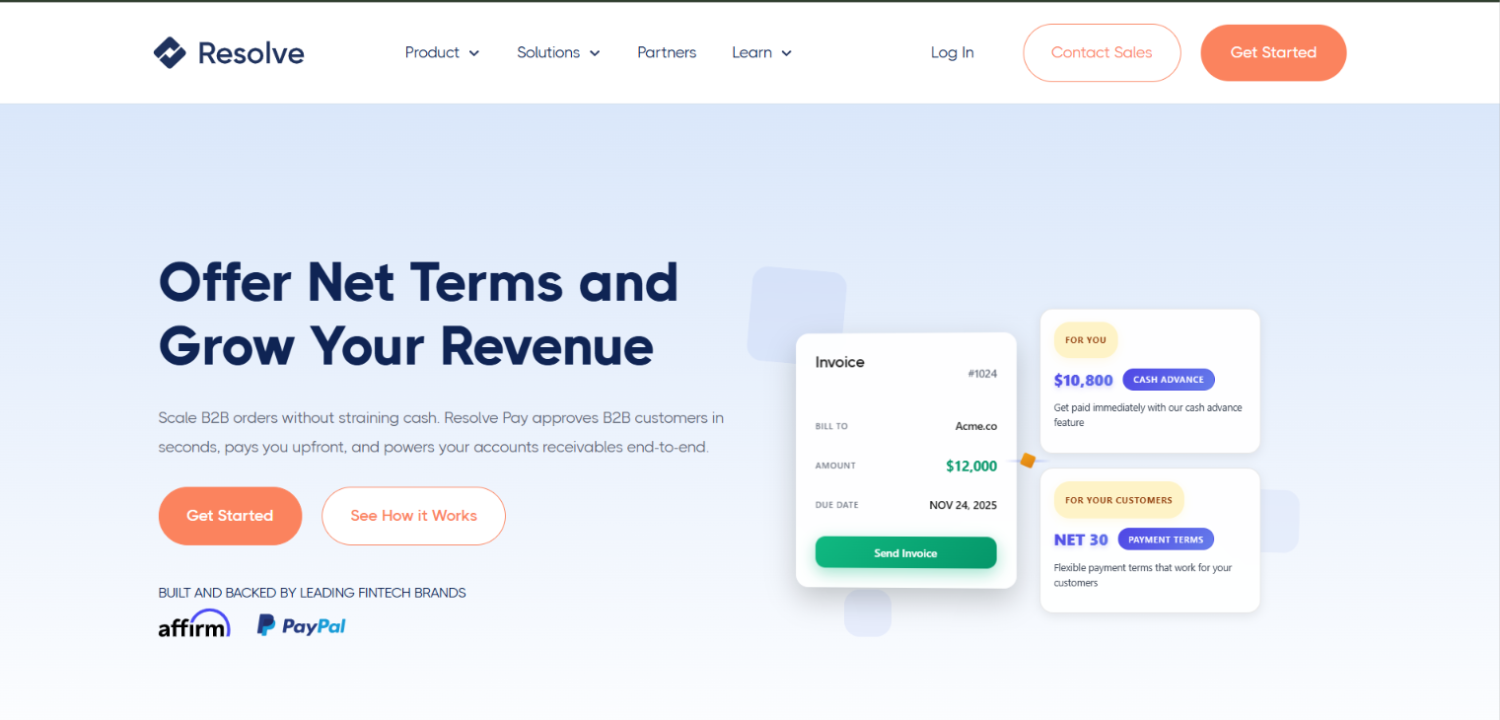
Resolve is the most checkout-native option on this list. The product was built explicitly for B2B sellers who want to embed net terms inside their existing payment flow rather than redirect buyers to a third-party financing page. Resolve funds the receivable on day one, paying the seller immediately at a discount, and handles collections against the buyer over the net term period.
The API returns credit decisions synchronously, which matters for checkout UX. Buyers submit minimal identity information at the point of purchase, and Resolve runs its underwriting against business credit bureaus and proprietary data in the background. The seller-facing dashboard shows approved limits, outstanding balances, and payment status without requiring a separate finance workflow.
Resolve’s primary limitation is buyer coverage. The platform concentrates on established US businesses with conventional credit profiles. Early-stage buyers or those without significant trade credit history may see lower approval rates. Resolve does not publicly list per-transaction fee rates; pricing is disclosed during onboarding discussions.
Kanmon
Kanmon positions itself as a B2B embedded credit infrastructure layer, meaning it is designed for platforms that want to white-label the net terms experience under their own brand rather than co-brand with a lender. The architecture separates the credit decisioning engine from the capital source, which gives platforms flexibility to connect their own credit facility or use Kanmon’s.
This matters for SaaS platforms at Series B or later that have negotiated a warehouse line and want to keep the economics of lending rather than paying a provider’s spread. Kanmon handles the compliance, underwriting, and payment infrastructure while the platform captures more margin per transaction. For earlier-stage teams without a credit facility, Kanmon can connect to capital partners, though the terms depend on the platform’s buyer portfolio quality.
The trade-off is integration complexity. Kanmon requires more developer time than a fully managed solution like Resolve. Teams that want net terms running in a weekend sprint should look elsewhere. Teams building a differentiated credit product inside their platform will find Kanmon’s architecture worth the investment. Kanmon is also covered in the embedded working capital API comparison, where it appears alongside Parafin and Pipe.
Parafin
Parafin approaches the net terms problem from a different angle. The platform uses transaction history data from the host platform to underwrite buyers, rather than relying primarily on external bureau data. For SaaS companies with rich purchase history on their platform, this produces higher approval rates for buyers who would otherwise look thin on a traditional credit report.
The API ingests transaction data from the host platform, builds a risk model specific to that platform’s buyer population, and surfaces pre-approved credit offers to eligible buyers. This works particularly well for marketplaces and vertical SaaS platforms where buyers transact repeatedly and the platform has 12 or more months of payment history to analyze.
Parafin’s weakness is that new platforms without historical transaction data cannot immediately access this underwriting advantage. The system improves as data accumulates, which means the first 6 months of integration may produce lower approval rates than the platform will eventually achieve. Pricing is not publicly listed; Parafin engages directly with platform partners.
Behalf

Behalf (Headline Logic) is one of the older players in this category, having operated since 2012. It offers embedded net terms for B2B checkout through a direct API integration and has a documented track record with manufacturing, wholesale, and industrial supply sectors. For B2B SaaS companies selling into these verticals, Behalf’s buyer coverage in that segment is an advantage.
Behalf funds transactions directly and pays sellers immediately, similar to Resolve. The buyer applies at checkout, receives a decision, and repays Behalf over the agreed term. The integration is well-documented, and Behalf has existing relationships with buyers in traditional B2B sectors who recognize the brand and are comfortable completing a Behalf-powered checkout.
The limitation for pure SaaS sellers is that Behalf’s UX and brand recognition skews toward physical goods commerce. A SaaS checkout embedded with Behalf’s flow may feel slightly mismatched to buyers expecting a software-native experience. The API itself functions correctly; the UX perception is the risk.
Credibly
Credibly is primarily a small business lender that has developed API integrations for embedded trade credit at the platform level. It sits slightly differently than the others on this list: rather than a pure embedded checkout API, Credibly operates as a capital partner that platforms can connect to for buyer financing decisions.
For B2B SaaS teams that want net terms without building any credit infrastructure themselves, Credibly offers a fast path. The integration is less developer-intensive than Kanmon, and approval decisions can be returned quickly for buyers who meet Credibly’s underwriting criteria. Credibly’s buyer qualification standards favor businesses with demonstrable revenue, which limits coverage for pre-revenue or very early-stage buyer companies.
Credibly does not publish API-specific pricing on its public pages. Sellers interested in the embedded integration contact their partnerships team directly.
Side-by-Side Comparison: Net Terms API Providers
| Provider | Who Holds Credit Risk | Underwriting Data Source | White-Label Available | Best Fit | Public API Pricing |
|---|---|---|---|---|---|
| Resolve | Resolve (funded model) | Business credit bureaus + proprietary | Partial | Checkout-native net terms, SMB sellers | Not publicly listed |
| Kanmon | Platform or Kanmon capital partner | Configurable per platform | Yes (full white-label) | Platforms building own credit product | Not publicly listed |
| Parafin | Parafin (funded model) | Platform transaction history | Yes | Marketplaces with repeat-buyer data | Not publicly listed |
| Behalf | Behalf (funded model) | Business credit bureaus | No | Industrial/wholesale B2B verticals | Not publicly listed |
| Credibly | Credibly (capital partner model) | Business revenue and credit history | No | Fast embedded financing without credit infra | Not publicly listed |
How Does a Net Terms API Integration Actually Work at Checkout?
The integration pattern for a net terms API at B2B SaaS checkout follows a predictable flow, but the implementation details matter more than most vendors admit during the sales process.
At the checkout page, your frontend calls the provider’s eligibility or pre-qualification endpoint with the buyer’s business information. This call should be asynchronous and non-blocking: the page renders all payment options, and net terms either appears or stays hidden based on the response. A synchronous blocking call that holds up the page until the credit decision returns is an anti-pattern that degrades checkout performance for all buyers, not just those applying for terms.
When a buyer selects net terms, a second API call initiates the full application and returns the approved credit limit and available term lengths. Your checkout UI displays the options, the buyer confirms, and your platform receives a webhook confirming the funded amount will arrive in your settlement account within one to two business days, depending on the provider.
The part most teams underestimate is order management sync. If your platform creates orders in Salesforce, syncs invoices to QuickBooks, or feeds into a warehouse management system, the net terms transaction needs to appear correctly in those systems. A purchase paid via net terms is not a completed payment from your ERP’s perspective. It is a receivable owed to the financing provider with a liability against your settlement expectation. Mapping this correctly at integration time prevents month-end reconciliation errors.
For teams building out their broader payment infrastructure, the overview of fintech APIs for SaaS provides useful context on how a net terms API fits into a complete payment stack alongside ACH, card, and wire rails.
What Should a B2B SaaS Team Budget for Net Terms API Costs?
None of the five providers in this guide publish per-transaction fee rates on their public pricing pages as of July 2025. This is standard practice in the B2B credit space, where pricing depends on the seller’s average order value, buyer creditworthiness distribution, term lengths offered, and expected default rates.
The economics follow a consistent model across funded providers. The provider pays the seller a percentage of the invoice amount immediately, typically between 1% and 5% less than the full invoice value, and then collects the full amount from the buyer over the term period. The spread is the provider’s margin. Sellers with large average order values, short terms, and creditworthy buyer pools pay smaller discounts. Sellers with high-risk buyer populations or long terms pay more.
For planning purposes: if your average B2B transaction is $5,000 and you offer net-60 terms, expect to model a 2% to 4% discount rate on every transaction funded by the provider. On $1 million in annual GMV through the net terms channel, that is $20,000 to $40,000 in annualized provider fees. Set against the incremental revenue from buyers who would not have purchased on card terms, this math typically works in favor of offering net terms, but it requires a realistic conversion uplift assumption, not a hopeful one.
Understanding how your payment infrastructure choices affect overall margin is worth examining closely. The analysis of FinTech SaaS gross margins covers how embedded financing costs interact with software margin in ways most founders do not model until it is too late.
Illustrative Scenario: Net Terms API at a $3M ARR Vertical SaaS
Consider a vertical SaaS company serving equipment rental businesses, sitting at $3 million ARR with an average contract value of $8,400 annually. Their checkout currently offers credit card and ACH. About 30% of their prospects request net-30 payment terms during the sales process, and the sales team handles each one manually, a process that takes three to five business days and requires a finance review.
After integrating a funded net terms API, the checkout offers net-30 as a payment option alongside card and ACH. Buyers in good standing receive an approval decision within the checkout session. The seller receives payment from the provider within two business days. The manual approval queue disappears.
The real gain in this scenario is not the three-to-five-day reduction in time-to-payment. It is the deals that close without ever requiring a sales conversation about payment terms. Buyers who would have emailed about net terms, waited for a response, and potentially evaluated a competitor in the interim instead complete checkout in the same session. Even a 10% improvement in conversion among the 30% of buyers requesting terms produces measurable ARR impact at this company’s ACV level.
What Are the Compliance Considerations for Embedding Net Terms?
Embedding a funded net terms API from a provider who holds the credit risk is structurally different from offering credit yourself. In the funded model, the provider is the lender. Your platform is a distribution channel. This distinction matters for licensing.
Your platform does not need a lending license to offer net terms through a funded provider. You are not extending credit; you are offering a payment option that a licensed lender provides. The provider holds the regulatory relationship with the buyer and is responsible for Truth in Lending Act disclosures, fair lending compliance, and collections practices.
The situation changes if you move to the Kanmon-style infrastructure model where your platform holds the receivable or draws on a warehouse line. In that structure, your platform may need state lending licenses depending on the jurisdiction and transaction type. The fintech product and compliance readiness checklist covers the licensing questions in detail and is worth reviewing before signing a contract that puts credit risk on your balance sheet.
Regardless of which provider you use, your checkout flow must clearly disclose that net terms financing is provided by a third party. Buyers need to know who holds their payment obligation and what the repayment terms are before they confirm purchase. Burying this in a terms-of-service link is a compliance risk that some providers will flag during integration review.
How Do Net Terms APIs Differ from Embedded Working Capital Tools?
Net terms APIs fund individual purchase transactions. Embedded working capital tools fund the buyer’s business operations more broadly, typically as a revolving credit line tied to revenue or platform activity.
The distinction matters at integration time. A net terms API fires at checkout: the buyer is purchasing something, they need a payment term, the API returns an approval for that specific transaction. An embedded working capital API, like those offered by Pipe or Parafin’s capital advance product, extends a credit line to the buyer that they can draw against independently of any single transaction.
For B2B SaaS checkout, net terms APIs are the right category. Working capital tools are better suited for platforms where buyers are operating businesses that need general liquidity, not just deferred payment on a software purchase. Mixing these up leads to integrating the wrong product and discovering the mismatch after several months of development work.
Frequently Asked Questions
What is a net terms API?
A net terms API is a programmatic interface that allows a software platform to offer deferred B2B payment terms, such as net-30 or net-60, directly within a checkout or invoicing flow. The API handles credit decisioning, payment facilitation, and in most cases collections. The seller receives payment immediately from the provider at a discount, and the buyer repays the provider over the agreed term.
Do I need a lending license to use a funded net terms API?
No. When a licensed third-party provider holds the credit risk and funds the transaction, your platform acts as a distribution channel, not a lender. The provider holds the regulatory relationship with the buyer. If you move to a model where your platform holds the receivable directly, state lending license requirements may apply depending on jurisdiction. Consult legal counsel before switching from a funded to a self-funded structure.
How fast do net terms API credit decisions return?
Most funded providers return synchronous credit decisions in under two seconds for buyers with conventional credit profiles. Decision times increase for buyers with thin credit files or when manual review is triggered. At integration time, confirm the p99 response time, not just the average, to understand the worst-case user experience at checkout.
What approval rates should I expect for my buyers?
Approval rates vary significantly by provider and buyer population. Platforms with high-revenue, established business buyers typically see approval rates above 60%. Platforms serving early-stage or thin-file businesses may see rates below 40% with bureau-driven underwriting. Parafin’s transaction-history model can improve this for platforms with repeat-buyer data. Ask each provider for approval rate benchmarks specific to your buyer vertical before committing to an integration.
How does net terms API pricing work?
None of the major net terms API providers publish per-transaction rates publicly as of July 2025. Pricing follows a discount rate model: the provider pays the seller a percentage below invoice value immediately, then collects the full amount from the buyer. Discount rates typically range from 1% to 5% depending on term length, average order value, and buyer credit quality. Negotiate based on your GMV volume and buyer creditworthiness distribution.
Can I white-label a net terms API under my own brand?
Kanmon and Parafin both support full white-label deployments where buyers see only your platform’s branding during the credit application and checkout experience. Resolve supports partial white-labeling. Behalf and Credibly co-brand the experience with their own identity, which may be a consideration for platforms where brand consistency in checkout is a product priority.
What happens if a buyer defaults on their net terms payment?
In the funded model, the provider absorbs the default risk and handles collections. Your platform received payment at transaction settlement and has no further exposure. In a self-funded or infrastructure model where your platform holds the receivable, your platform is responsible for collections and bears the credit loss. This is the most consequential variable when choosing between a fully funded API and an infrastructure-layer solution like Kanmon.
How do net terms APIs integrate with accounting systems?
Integration quality varies by provider. Resolve and Behalf offer basic reporting exports that your team can import into QuickBooks or NetSuite. Kanmon’s infrastructure approach allows custom ERP writeback as part of the platform build. None of the providers in this guide offer fully automated, real-time bidirectional sync with all major ERP systems out of the box. Budget integration engineering time for this, particularly if your buyers expect to see net terms invoices appear automatically in their AP workflows.
Which Net Terms API Should You Pick?
The funded model providers, Resolve, Behalf, Parafin, and Credibly, are the right starting point for teams that want net terms at checkout without managing credit risk. The difference between them comes down to vertical fit and buyer population. Parafin wins on platforms with transaction history data. Behalf wins in industrial and wholesale B2B. Resolve wins for checkout-native SaaS integrations where speed of decision matters most.
Kanmon is a different category of decision. It is infrastructure, not a service. The teams who should evaluate it are those who have already decided to build a credit product, have the engineering resources to do it correctly, and are thinking about net terms as a differentiated revenue line rather than a checkout convenience. That is a later-stage decision for most SaaS companies, and arriving at it too early costs months of engineering effort on a problem that a funded provider would have solved in days.
The broader principle worth holding onto: net terms at checkout is a revenue problem dressed up as a finance problem. The buyer experience is broken not because your finance team is slow but because the decisioning layer is offline. Moving it online, inside the checkout flow, is an API integration. Treat it like one.