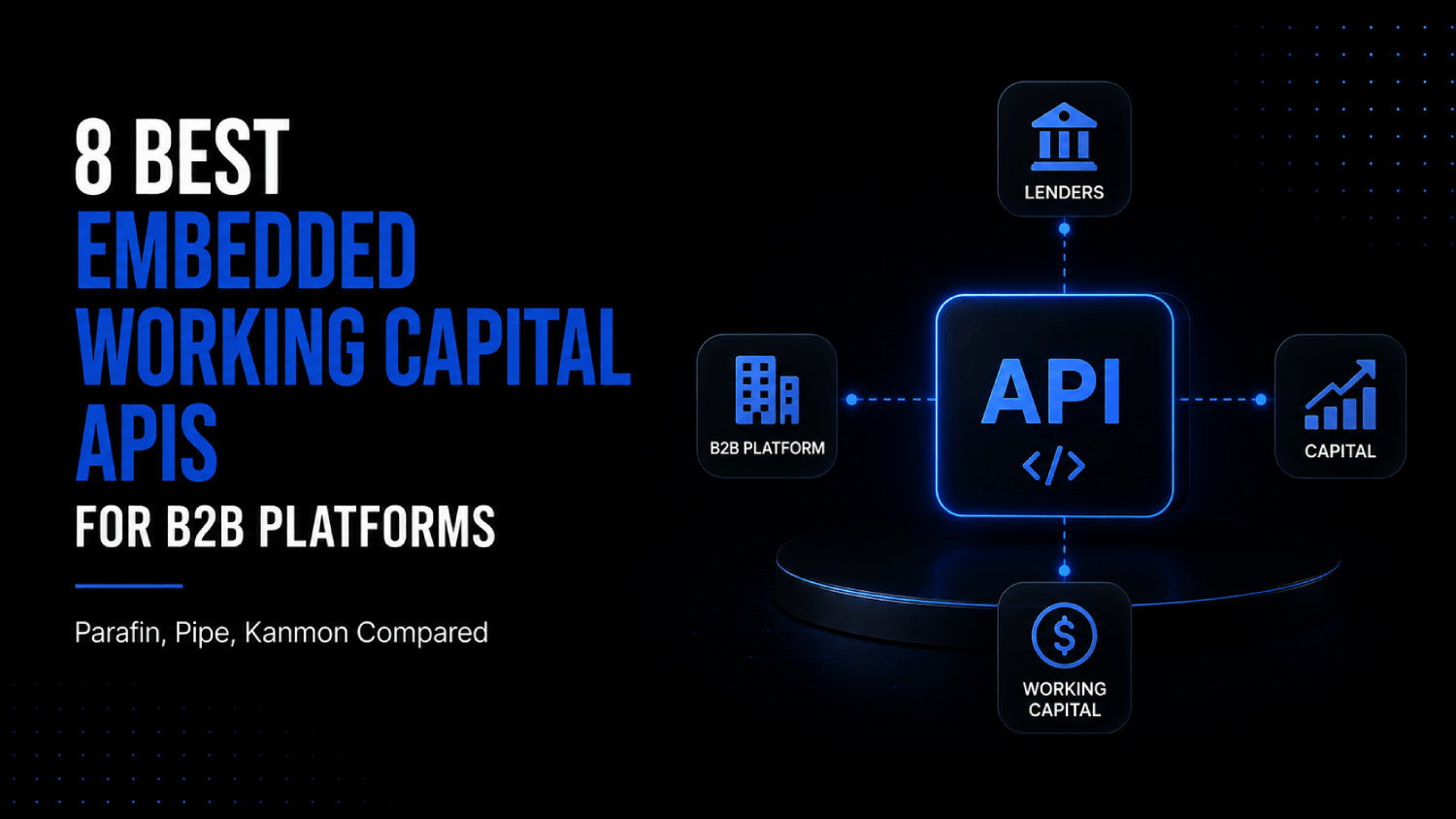

- Embedded working capital APIs let your platform offer merchant financing without holding a lending license, managing credit risk, or building underwriting from scratch.
- Parafin, Pipe, Kanmon, YouLend, Capchase, Clearco, Payability, and eCapital cover most platform types, but they differ sharply on funding model, merchant size, and how much white-labeling they allow.
- The three funding models (merchant cash advance, invoice factoring, and term loans) carry different economics for merchants and different integration requirements for your engineering team.
- Capital-as-a-service providers carry the balance sheet and regulatory exposure. Your platform earns a revenue share and keeps merchants inside your product.
- Platform fit matters more than feature lists. A B2B marketplace processing $500K/month in GMV has different needs than a vertical SaaS tool with 2,000 SMB subscribers.
The best embedded working capital APIs for B2B platforms in 2026 are Parafin, Pipe, Kanmon, YouLend, Capchase, Clearco, Payability, and eCapital. Each operates as a capital-as-a-service provider, meaning the platform integrates via API, merchants apply inside the platform’s interface, and the provider funds, underwrites, and collects repayment without the platform taking on lending risk or regulatory liability.
Why Most Platforms Get This Wrong Before They Even Start
Most platform operators assume that offering merchant financing means becoming a lender. That assumption is wrong, and it causes real cost. Platforms that think they need a lending license, a credit team, and a balance sheet typically either skip the opportunity entirely or spend 18 months building something a vendor could have provided in a quarter.
Capital-as-a-service flips the model. The provider underwrites the merchant, funds the advance or loan, and collects repayment, usually through a revenue split or fixed ACH pulls. The platform’s job is the integration: surface offers in the dashboard, pass merchant data to the provider’s API, and collect a revenue share on funded volume. The compliance infrastructure lives with the provider, not with you. For the compliance obligations that do land on your side during the integration process, the FintechSpecs Fintech Product and Compliance Readiness Checklist covers what to audit before going live.
Before going further: this article covers merchant cash advances, revenue-based financing, invoice factoring, and short-term term loans delivered through embedded APIs. It does not cover revolving credit lines, BNPL, or consumer lending products. If you are evaluating embedded credit facilities for B2B platforms, the FintechSpecs piece on embedded credit APIs for B2B platforms and marketplaces covers that adjacent category. The distinction matters because MCAs and factoring products sit outside most state lending laws, while revolving credit does not.
What Is the Difference Between MCA, Factoring, and Term Loan APIs?
Platforms evaluating embedded working capital APIs need to understand the three funding structures before selecting a vendor. The structure determines merchant economics, repayment mechanics, and what data your API integration needs to pass.
A merchant cash advance (MCA) is not technically a loan. The provider purchases a fixed dollar amount of the merchant’s future receivables at a discount. Repayment happens as a percentage of daily or weekly sales, so the payback timeline fluctuates with revenue. For merchants with lumpy income, this is lower-stress than fixed payments. For providers, it is faster to underwrite because the primary input is revenue history, not creditworthiness.
A factoring product converts outstanding invoices into immediate cash. The provider advances a percentage of the invoice face value (typically 70 to 90 percent), holds the rest as a reserve, and collects from the end customer directly. For B2B SaaS platforms whose merchants bill net-30 or net-60, factoring can compress a 45-day cash cycle to 48 hours. The API integration for factoring typically requires your platform to pass invoice data, customer payment history, and days-sales-outstanding metrics.
A term loan API operates closest to traditional lending. Fixed principal, fixed repayment schedule, fixed factor rate or APR. It suits merchants who need a specific capital amount for a specific purpose, like equipment or inventory, and who have predictable monthly revenue. Term products require richer underwriting data, which usually means deeper API permissions around bank accounts, accounting integrations, or payment processor history.
| Funding Model | Repayment Mechanic | Primary Underwriting Input | Best Platform Type | Typical Advance Range |
|---|---|---|---|---|
| Merchant Cash Advance | % of daily/weekly revenue | Payment volume history | Marketplace, payments platform | $2K to $500K+ |
| Invoice Factoring | Invoice collection from end customer | Invoice quality, customer creditworthiness | B2B SaaS, procurement platforms | $10K to $5M+ |
| Short-Term Term Loan | Fixed ACH pulls (daily/weekly/monthly) | Bank account + revenue history | Vertical SaaS with SMB merchants | $5K to $2M |
| Revenue-Based Financing | % of monthly revenue until repaid | MRR, churn, revenue trend | SaaS-native platforms | $10K to $3M |
The FintechSpecs Platform-Fit Stress Test for Capital APIs
Most vendor comparison guides rank providers by feature checklist. That approach misses the only variable that matters at the evaluation stage: which provider is built for your platform’s GMV, merchant type, and integration maturity. Below is a framework FintechSpecs calls the Platform-Fit Stress Test, four diagnostic questions to run before you evaluate a single vendor.
1. What is your average merchant’s monthly revenue? Providers like Parafin and Clearco are optimized for merchants doing $10K to $2M per month. eCapital and Kanmon can work with smaller or more irregular books. If your merchant base skews micro (under $5K/month), most of these providers will decline more than they fund.
2. Do you control the payment flow? MCAs repay through a split of daily receivables. If your platform processes payments directly, repayment can route automatically through your payment rails. If your merchants transact elsewhere, the provider needs a separate ACH agreement with the merchant, which creates friction and higher drop-off during application.
3. How much white-labeling does your brand require? Some providers (Parafin, Kanmon) offer deep white-label APIs where merchants never see the provider’s name. Others (Pipe, Capchase) are brand-visible by design. If your platform’s value proposition includes financial services as a proprietary feature, white-label depth is not optional.
4. What does your engineering team’s integration capacity look like? A REST API with sandbox documentation is table stakes. What varies is webhook architecture for offer state changes, data ingestion requirements (does the provider need a direct bank feed, or will your platform’s transaction history suffice?), and whether the provider has pre-built SDKs for your stack. Integrations that look like a two-sprint project often run six when the data-sharing architecture is underspecified.
Which Eight Providers Offer the Best Embedded Working Capital APIs?
1. Parafin
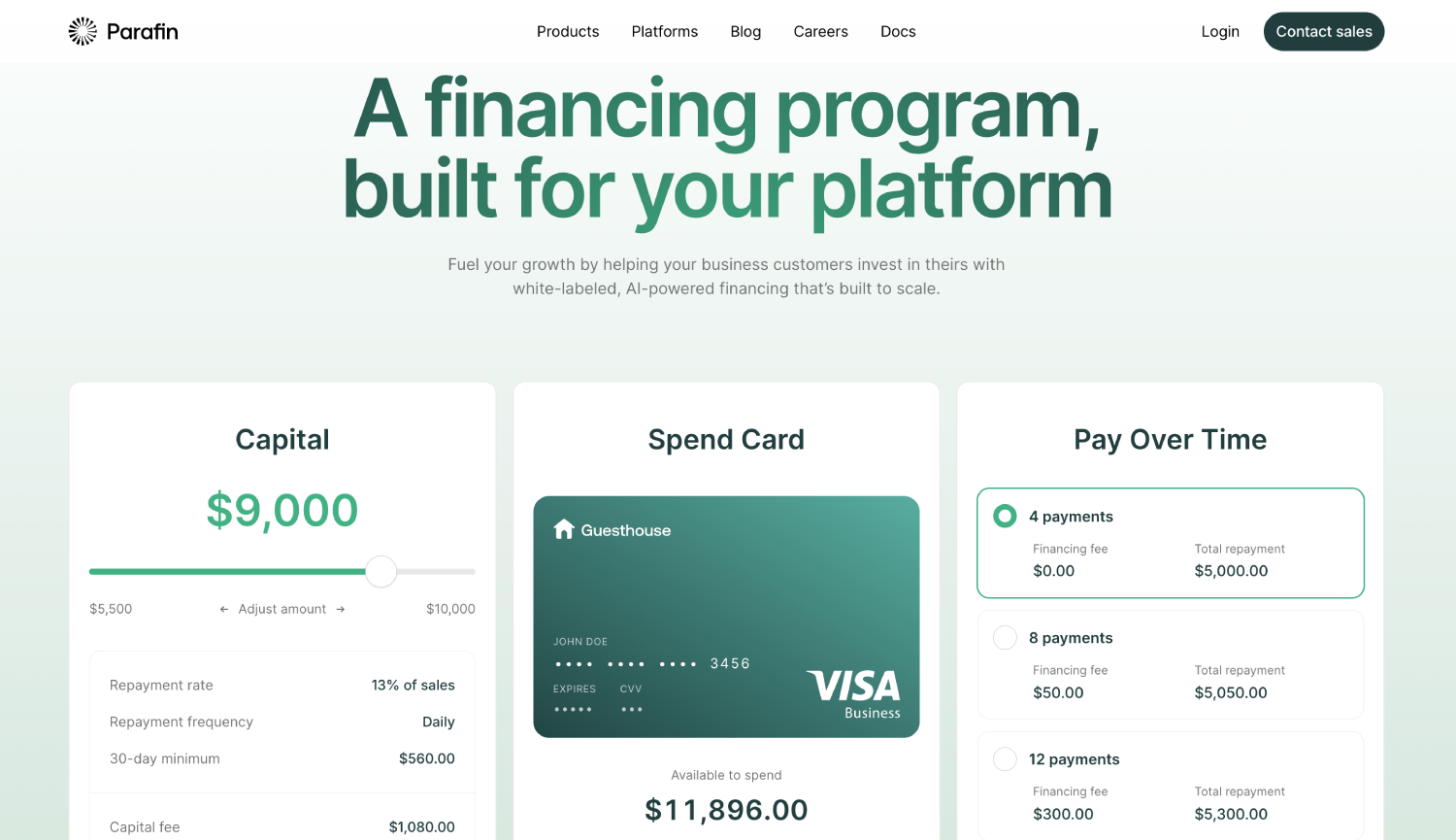
Parafin is the closest thing the market has to a purpose-built embedded capital infrastructure company. It was built specifically to power financing inside other platforms, not to sell capital to merchants directly. The API allows platforms to surface pre-qualified offers, run applications, and route repayment through existing payment flows without the merchant ever leaving the platform’s interface.
Parafin underwrites using the merchant data the platform already holds, which means integration depth drives offer quality. Platforms that pass richer transaction history see higher approval rates and larger advance amounts. The white-label support is thorough: offer pages, merchant dashboards, and repayment tracking can all reflect the platform’s branding. Parafin is best for: payment platforms and marketplaces with established GMV and direct payment rails.
2. Pipe

Pipe started as a recurring revenue trading platform for SaaS companies and has repositioned toward embedded capital for B2B platforms. Its API connects to a platform’s subscriber or revenue data and converts predictable future revenue into immediate advances. The pitch is straightforward for SaaS-native platforms: if your merchants bill on a subscription or retainer basis, Pipe can advance against that contracted revenue rather than past bank deposits.
The trade-off is that Pipe’s model depends on revenue predictability. Merchants with irregular or seasonal revenue will see lower advance amounts or more friction in the application flow. Pipe is best for: vertical SaaS platforms whose merchants bill subscriptions or retainers with low churn.
3. Kanmon
Kanmon offers what it describes as a business financing platform built for software companies that want to embed lending products without becoming lenders. Its API supports multiple product types including term loans, lines of credit, and invoice financing, which makes it more flexible than single-product providers. The technical integration is API-first with webhook support, and Kanmon handles underwriting, servicing, and compliance on the back end.
Kanmon is worth evaluating specifically if your merchant base spans industries with inconsistent revenue patterns. The multi-product architecture means you can offer a term loan to one merchant segment and invoice financing to another through a single integration. Kanmon is best for: B2B SaaS or marketplace platforms that need to serve merchants across multiple industries with different capital needs.
4. YouLend
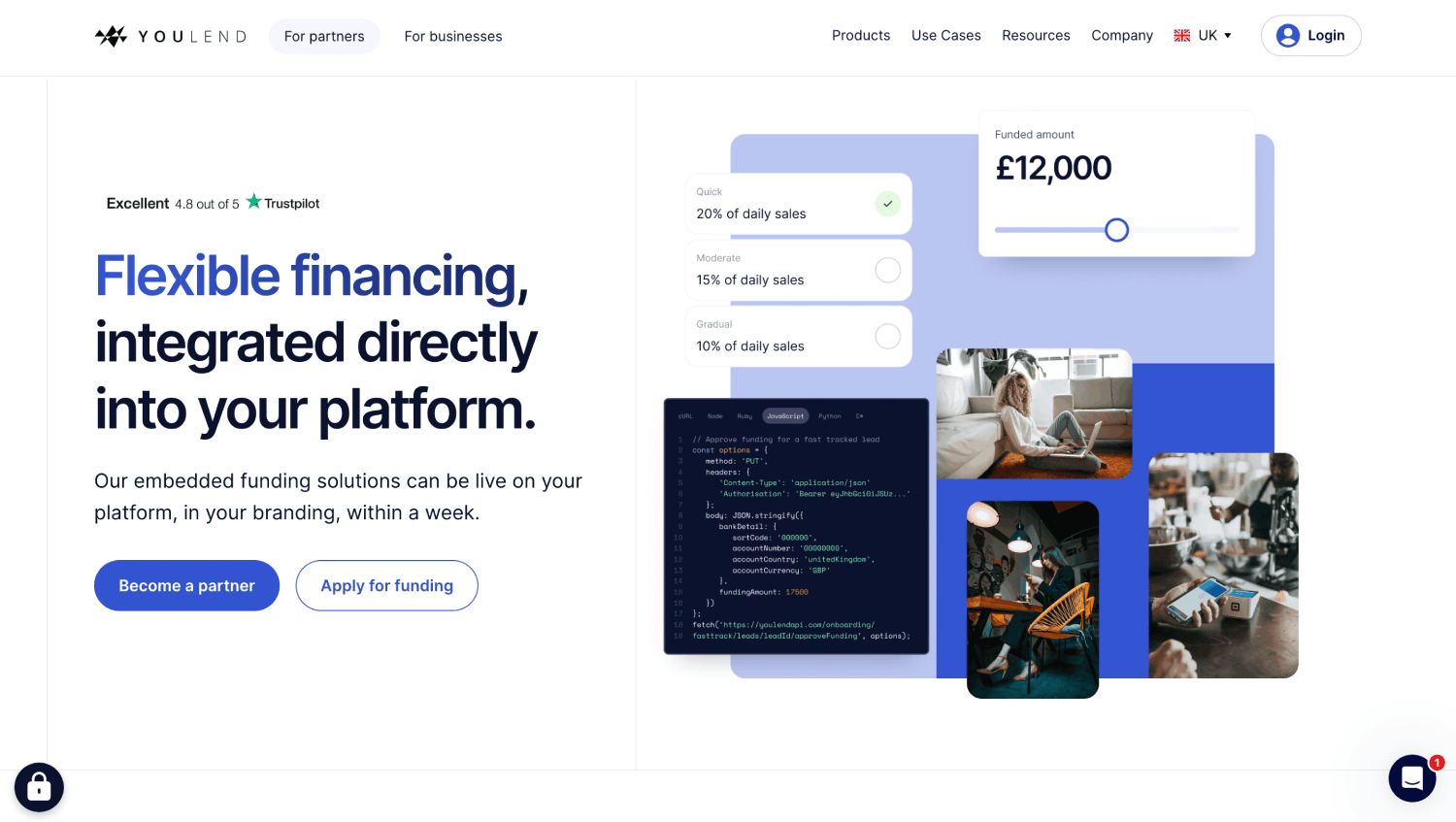
YouLend provides embedded revenue-based financing through a white-label API and has built integrations with payment platforms including major acquirers and ISOs. It operates in the US and UK, which matters if your platform serves merchants in both markets. Repayment is structured as a percentage of daily card sales, routed through the acquirer relationship.
YouLend’s strength is its acquirer-level integrations. If your platform partners with an acquiring bank or payment processor that YouLend has already connected with, the data pipeline for underwriting is mostly pre-built. YouLend is best for: payment platforms and ISOs with an existing acquiring relationship who want to add working capital as a product line.
5. Capchase
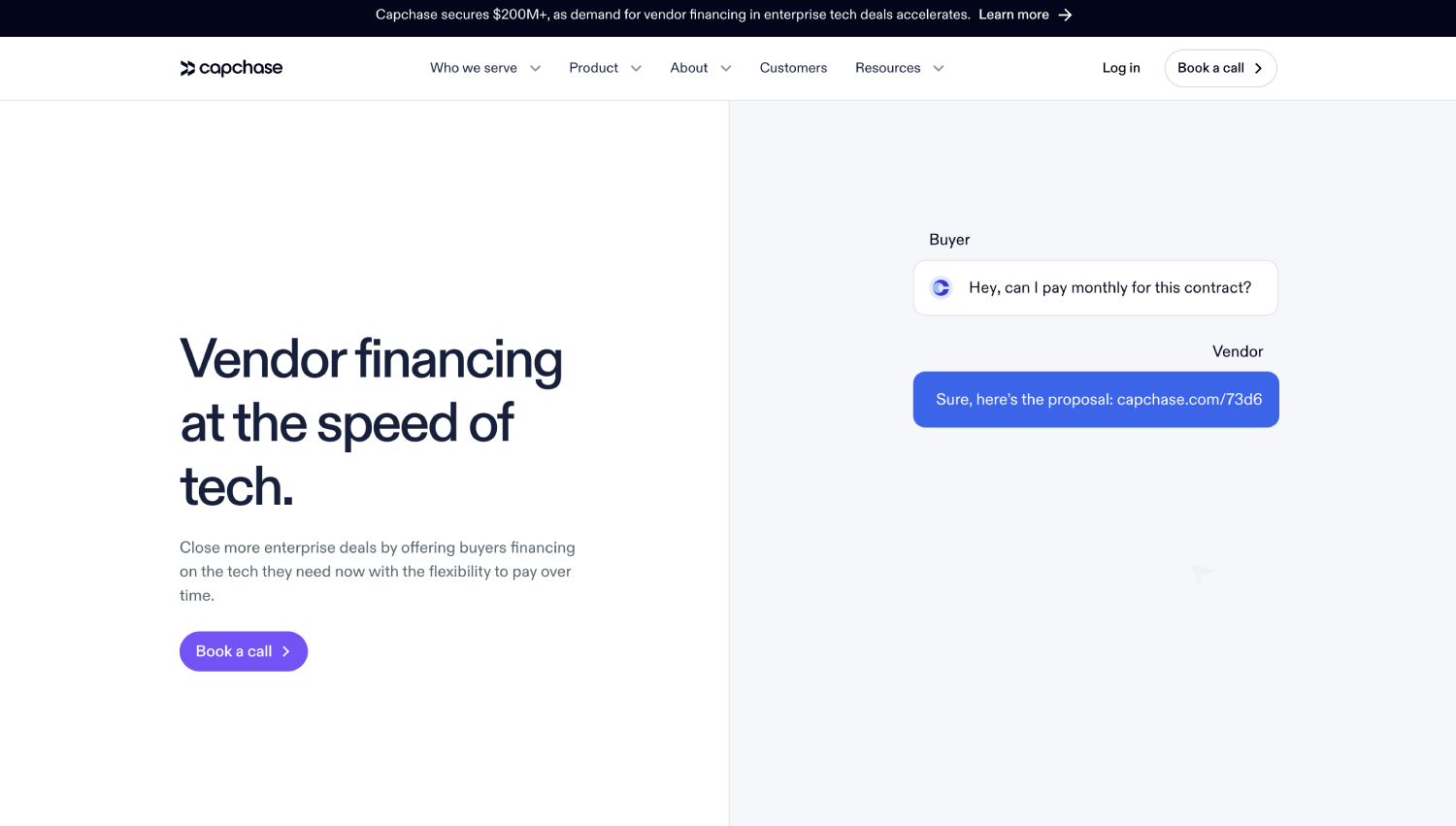
Capchase is designed for SaaS companies that want to advance their own ARR, but it has expanded into an embedded offering that lets platforms surface financing to SaaS merchants within their tools. Its Capchase Pay product also introduces a buy-now-pay-later mechanic for annual SaaS subscriptions, which is adjacent to working capital but worth noting for billing-focused platforms.
Capchase’s underwriting is deeply SaaS-native, pulling MRR, churn, and retention data. That specificity is an advantage for the right platform and a liability for everything else. A restaurant POS or logistics platform would be a poor fit. Capchase is best for: developer tools, billing platforms, or SaaS management tools whose merchants are themselves SaaS businesses.
6. Clearco
Clearco pioneered revenue-based financing for e-commerce and has since built API access for platforms that want to embed capital offers in their merchant dashboards. The underwriting model ingests Shopify, Stripe, and Amazon Seller data natively, which makes integration faster for e-commerce-adjacent platforms. Offers are sized against trailing revenue with a fixed fee rather than an interest rate.
Clearco’s limitation is category depth. It performs well for e-commerce merchants and DTC brands but lacks the breadth of underwriting models for B2B or service businesses. Clearco is best for: e-commerce platforms, Shopify-adjacent tools, and marketplace platforms whose merchants sell physical goods.
7. Payability
Payability focuses on marketplace sellers, particularly Amazon and other e-commerce marketplaces where payouts are delayed by 14 to 30 days. It advances against pending marketplace payouts, effectively compressing the payout cycle. The API allows platforms to surface daily advance offers against the merchant’s pending receivables from a marketplace.
Payability is narrower than most providers on this list. It solves a specific problem: marketplace payout lag. For platforms outside that use case, it is not the right fit. Payability is best for: e-commerce marketplace operators or aggregators where merchant payout delays are the primary capital constraint.
8. eCapital

eCapital covers the widest range of asset classes on this list, including invoice factoring, asset-based lending, equipment financing, and freight factoring. It operates primarily for small and mid-sized businesses and, as noted in its public documentation, allows platforms to integrate working capital offers via API directly into their dashboards. The product depth is better suited for platforms serving industries like trucking, staffing, and manufacturing than pure software platforms.
The trade-off is integration complexity. A broader product suite means more data requirements at underwriting and a heavier implementation lift. eCapital is best for: vertical SaaS platforms serving asset-heavy SMB industries where invoice factoring or equipment financing is the primary capital need.
How Do Embedded Working Capital APIs Generate Revenue for Platforms?
Platform revenue from embedded working capital typically takes one of three forms. Most providers offer a revenue share on the factor rate or fee charged to the merchant, paid to the platform per funded deal. Some providers offer a referral fee structure instead, a flat dollar amount per funded merchant regardless of advance size. A smaller number of providers allow platforms to set their own fee and keep the spread above the provider’s floor.
Consider a concrete scenario. Say a vertical SaaS platform with 1,500 SMB merchants integrates a capital API. Over a quarter, 120 merchants draw a total of $4.2M in advances at an average factor rate of 8%. If the platform earns a 1.5-point revenue share, that is $63K in incremental revenue for the quarter with no credit risk on the platform’s books. At 2 points, it is $84K. The share rate is negotiable and typically depends on the platform’s GMV, merchant quality, and exclusivity arrangement. None of these figures are publicly listed by any provider; the economics above are an illustrative model, not a published rate card.
For platforms evaluating whether embedded financing belongs in their monetization stack, the FintechSpecs analysis of how fintech companies monetize payments without harming UX covers the broader trade-off between revenue extraction and merchant trust.
What Technical Requirements Should You Audit Before Integrating?
Engineering teams often underestimate the data-sharing requirements at the API layer. Most providers need one or more of the following inputs to underwrite a merchant: processed payment volume by day or month (usually 6 to 12 months), bank account balances via open banking connection, outstanding invoices and aging schedules, or SaaS-specific metrics like MRR, churn rate, and subscriber count.
The integration architecture splits into two patterns. Pass-through APIs let your platform query the provider for a pre-qualified offer amount using merchant data you already hold, then surface that offer in your UI. The merchant applies without leaving your product. Redirect-based integrations push the merchant to the provider’s hosted application flow, which reduces your engineering lift but also reduces white-label fidelity and drop-off control. Most platforms targeting a high-quality embedded experience choose the pass-through model, even at higher initial build cost.
Webhook infrastructure matters more than most evaluations acknowledge. Capital offer states change: a pre-qualification becomes an application, an application becomes a funded deal, a funded deal enters repayment, a repayment fails. If your platform’s UI does not update in real time with these state changes, merchants get confused about their offer status, and your support queue fills with questions that should not exist. Evaluate webhook documentation depth, not just API documentation, before signing a provider agreement. For a broader look at how fintech vendor quality shows up in infrastructure decisions, the FintechSpecs piece on critical mistakes when choosing fintech infrastructure is worth reviewing before you sign anything.
Vendor Comparison: Who Is Each Provider Built For?
| Provider | Funding Model | White-Label Depth | Primary Merchant Type | Geographic Reach | Best Platform Type |
|---|---|---|---|---|---|
| Parafin | MCA / Revenue-Based | Deep white-label | SMB across categories | US | Payments platforms, marketplaces |
| Pipe | Revenue-Based Financing | Moderate | SaaS merchants, subscription businesses | US | Vertical SaaS with recurring-revenue merchants |
| Kanmon | Term Loan / Line of Credit / Invoice | Deep white-label | SMB, B2B across industries | US | Multi-industry B2B platforms |
| YouLend | Revenue-Based / MCA | Deep white-label | Card-processing merchants | US, UK | Payment platforms with acquirer relationships |
| Capchase | Revenue-Based Financing / ARR Advance | Moderate | SaaS companies | US, Europe | SaaS tooling platforms serving SaaS merchants |
| Clearco | Revenue-Based Financing | Moderate | E-commerce, DTC brands | US, Canada, UK | E-commerce platforms, Shopify-adjacent tools |
| Payability | Receivables Advance | Limited | Marketplace sellers (Amazon, etc.) | US | E-commerce marketplace aggregators |
| eCapital | Invoice Factoring / Asset-Based | Moderate | SMB in asset-heavy industries | US, Canada, UK | Vertical SaaS in trucking, staffing, manufacturing |
What Should You Negotiate in a Capital API Agreement?
Most platforms accept the first term sheet without questioning the revenue share structure, exclusivity clauses, or data ownership provisions. All three deserve scrutiny.
Revenue share rates are almost always negotiable above a minimum GMV threshold. If your platform can commit to a monthly funded volume floor, the rate improves. Get clarity on whether the share applies to the gross fee charged to the merchant or only the provider’s net fee after their cost of capital. Those two calculations can differ by 30 to 50 percent on the same deal.
Exclusivity clauses appear in some agreements and prohibit your platform from integrating a competing capital provider for a set period. A one-provider arrangement can make sense if the revenue share is strong and the approval rate is high. If the provider declines more than 40 percent of your merchants, exclusivity becomes a liability. Negotiate a carve-out for merchants the primary provider declines.
Data ownership is the most overlooked term. When the provider underwrites your merchants, they build a credit profile using data that originated on your platform. Clarify upfront whether that data can be used for the provider’s own direct outreach to those merchants after the agreement ends. Some providers restrict themselves to this explicitly. Others do not, and an expired partnership can mean a former vendor now markets directly to your merchant base.
Frequently Asked Questions
Do I need a lending license to offer embedded working capital through an API?
In most cases, no. Capital-as-a-service providers structure the arrangement so they are the lender of record, which means they hold the required licenses and bear regulatory responsibility for the credit product. Your platform acts as a referral partner or distribution channel. That said, your agreement may still require you to comply with certain marketing disclosure requirements and data privacy obligations. Review your specific provider agreement with legal counsel before going live, particularly if you are in California or New York, where commercial financing disclosure rules have expanded in recent years.
Which embedded working capital API is best for a small marketplace under $1M/month in GMV?
Kanmon and Parafin are worth evaluating first at that volume. Parafin is designed for platform-native deployments where your transaction data does the underwriting work, so lower GMV is less of a barrier if merchant-level transaction history is clean. Kanmon’s multi-product structure allows it to serve merchants with irregular revenue, which is common at smaller marketplaces. Clearco and Capchase both have implicit minimum revenue thresholds for merchants that can exclude early-stage platforms entirely.
What is the difference between revenue-based financing and a merchant cash advance?
Both structures collect repayment as a percentage of revenue, but the legal framing differs. An MCA is technically a purchase of future receivables, not a loan, which places it outside most state usury laws. Revenue-based financing is more often structured as a loan with a revenue-contingent repayment schedule, subject to lending regulations in some states. For platform operators, the practical difference is mostly in the provider’s disclosure requirements and how offers are described to merchants. From an integration standpoint, both structures work similarly at the API level.
How long does a typical embedded working capital API integration take?
Published documentation from providers typically describes two to eight weeks for a standard integration. Real-world timelines depend on three variables: the richness of merchant data your platform already holds, how deeply you want to white-label the experience, and whether your payment rails allow automatic repayment splits. Redirect-based integrations (where merchants leave your UI for the provider’s hosted flow) can go live faster, sometimes in days. Full pass-through white-label integrations with webhook state management typically run six to twelve weeks when accounting for QA, sandbox testing, and compliance review.
Can an embedded capital product increase platform churn?
Yes, if the merchant experience is poor. A merchant who applies for capital, gets declined with no explanation, and sees no follow-up offer is more likely to question the value of the platform overall. Approval rate and decline communication quality matter as much as integration depth. Before launch, negotiate with your provider on: minimum approval rate targets, decline reason codes passed back through the API, and re-offer timing for declined merchants. Platforms that treat embedded capital as purely additive revenue without monitoring merchant experience often see the metric move the wrong way. The FintechSpecs piece on how fintech products accidentally increase churn covers adjacent patterns worth reviewing.
Is API factoring different from traditional invoice factoring for SaaS platforms?
Traditional invoice factoring requires submitting invoices manually to a factor, verifying the debtor, and waiting for approval. API factoring automates that workflow. Your platform sends invoice data through the provider’s API, the provider’s underwriting model returns an advance decision in near real time, and the merchant receives funds within 24 to 48 hours. For SaaS platforms whose merchants carry net-30 or net-60 accounts receivable, API factoring converts a slow, document-heavy process into something that fits inside a software dashboard. eCapital and Kanmon both support invoice-based products through their API integrations.
What platform data do working capital providers require for underwriting?
It varies by provider and funding model. MCA providers primarily need processed payment volume history, typically 6 to 12 months. Revenue-based financing providers like Pipe or Capchase need MRR, churn rate, and subscriber count. Invoice factoring providers need outstanding invoices, invoice aging, and debtor payment history. Term loan providers typically require the broadest data set, including bank account history via open banking or bank statement upload. The more data your platform passes directly through the API, the faster underwriting runs and the higher approval rates tend to be for your merchants.
How do I evaluate whether my platform’s merchants are a good fit before integrating?
Run a pre-integration cohort analysis before signing any agreement. Pull your top 500 merchants by monthly revenue, calculate median monthly GMV, calculate the percentage with more than six months of transaction history on your platform, and estimate what percentage have consistent (not seasonal) revenue curves. Share that summary with two or three providers before contract discussions begin. Providers who have seen their own approval-rate data will tell you candidly whether your merchant mix qualifies. Signing an integration agreement with a provider whose underwriting model rejects 70 percent of your merchants is a poor use of engineering resources. For a structured approach to evaluating any fintech vendor before you commit, the FintechSpecs fintech vendor evaluation framework applies directly here.
Which Provider Should You Start With?
Parafin is the default first conversation for payment platforms and marketplaces with direct payment rails, because its underwriting model is designed around the data those platforms already hold. Kanmon earns a second look for any platform that needs multi-product flexibility across merchant segments. YouLend makes the most sense when an acquiring relationship is already in place and the integration path is pre-paved.
Pipe, Capchase, and Clearco are category-specific, and their fit is obvious from their underwriting models. If your merchants are SaaS businesses, Pipe or Capchase. If your merchants are e-commerce brands, Clearco. Trying to force either of those providers into a different merchant category is an integration effort that will show up in poor approval rates six months post-launch.
The providers on this list carry the balance sheet and the compliance burden. Your platform’s job is to build an integration that gets good merchant data to the underwriting model quickly and surfaces offers at the moment merchants are most likely to act, typically right after a high-revenue month or before a known spending event. Get those two things right, and embedded working capital becomes a product line that generates revenue, deepens platform stickiness, and costs your compliance team almost nothing. Get them wrong, and it is a support ticket category that confuses merchants and irritates your operations team.