
- Chargeback alert services intercept disputes before they post to your merchant account, giving you 24 to 72 hours to issue a refund and avoid the chargeback fee, ratio hit, and potential card brand fine entirely.
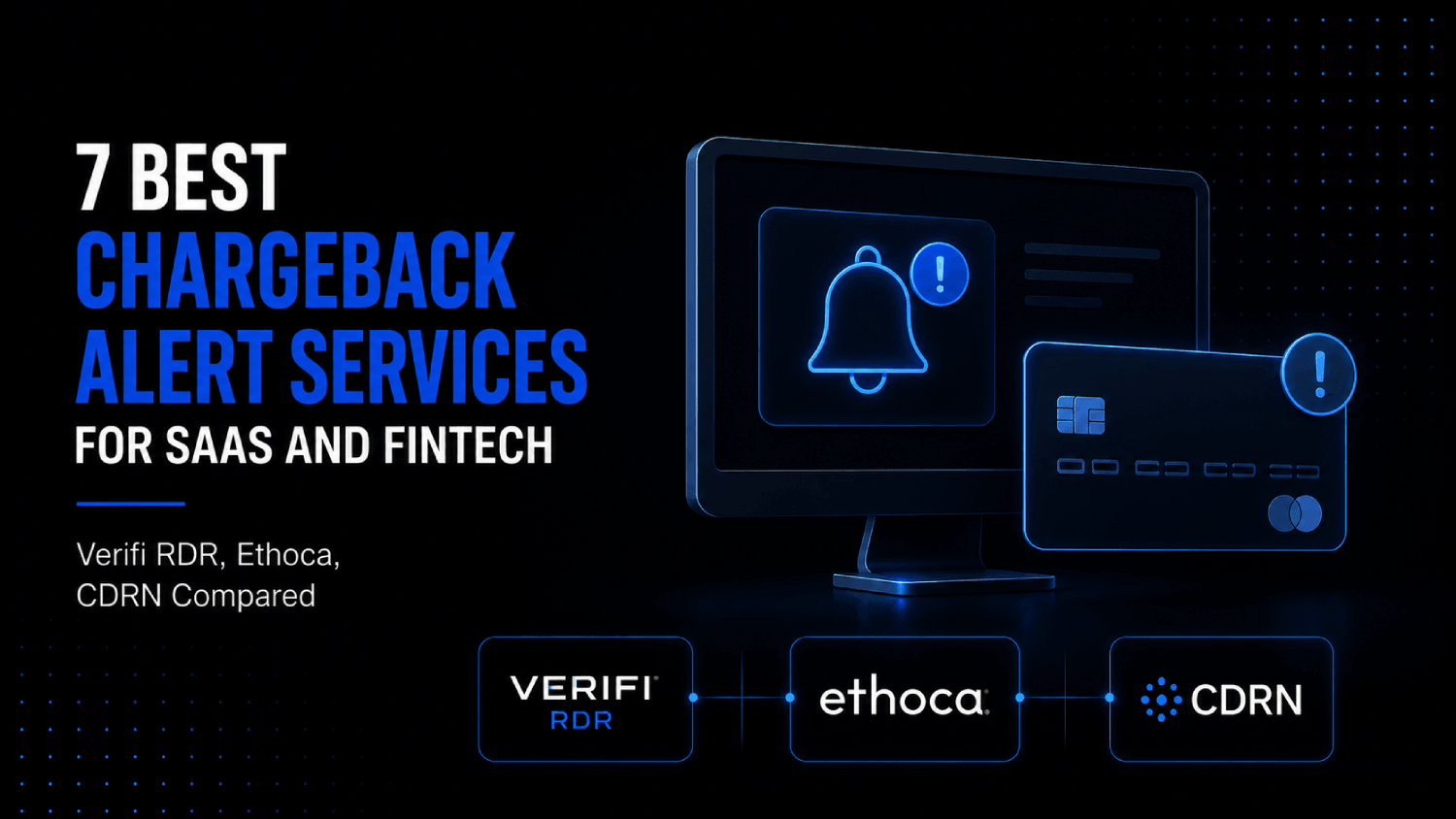
- There are three main alert networks: Verifi CDRN (Visa-owned), Visa RDR (automated, rule-based), and Ethoca Alerts (Mastercard-owned). Each covers different card networks and operates on a different response model.
- RDR is not the same as CDRN. RDR auto-resolves disputes using rules you set; CDRN sends a human-actionable alert. SaaS companies typically need both, plus Ethoca, to cover Visa and Mastercard meaningfully.
- No single provider gives you direct access to all three networks. You reach them through intermediaries like Chargeblast, Chargeflow, Justt, or Chargebacks911, who aggregate coverage and layer in dispute management.
- This page covers alert networks and prevention services specifically. For post-dispute representment and management software, see the 9 Best Chargeback Management Tools for B2B SaaS and Fintech.
Chargeback alert services notify merchants of an incoming dispute before the card network officially records it as a chargeback. When a cardholder contacts their bank, the alert fires immediately. The merchant then has a window, typically 24 to 72 hours, to refund the transaction and close the dispute before it ever posts. The three primary alert networks are Verifi CDRN and Visa RDR (both Visa-owned) and Ethoca Alerts (Mastercard-owned). Merchants access these networks through authorized resellers and dispute management platforms, not by signing up with Visa or Mastercard directly.
Why Alert Networks Exist as a Category Separate from Dispute Management
Most SaaS operators treat chargebacks as a recoverable problem. You get hit with a dispute, you gather evidence, you fight it. That framing costs money every time it plays out. A chargeback that posts means a $15 to $100 dispute fee from your acquirer, a ratio increment that nudges you toward card brand thresholds, and weeks of representment work with no guaranteed outcome.
Alert services operate upstream of all that. When a cardholder calls their bank, the issuer sends a signal to the alert network before filing a formal dispute. The merchant receives that signal, issues a refund, and the cardholder’s bank closes the case. No chargeback posts. No fee. No ratio hit. The per-alert cost varies by network and provider and is not publicly posted by any vendor in this space , but in most scenarios it runs below the acquirer dispute fee alone, before counting the revenue recovery value. When requesting quotes, ask for the per-alert rate explicitly; vendors quote based on volume tier and network mix.
The distinction matters for SaaS specifically because subscription billing generates a predictable chargeback profile: forgotten charges, billing descriptor confusion, and “friendly fraud” from customers who cancel informally instead of formally. These are exactly the dispute types that alerts handle well, because the merchant can refund the charge programmatically the moment the alert arrives, often before the customer even receives a response from their bank.
How Do Ethoca and Verifi Alerts Actually Work?
Both Ethoca and Verifi operate on the same general principle but through different card network infrastructure, with different issuer participation and different response mechanics.
Ethoca Alerts (Mastercard)
Ethoca, acquired by Mastercard in 2019, connects participating issuers to merchants through a notification system. When a participating issuer receives a dispute or fraud claim on a Mastercard (or supported non-Mastercard) transaction, Ethoca fires an alert to the merchant. The merchant has a set window to respond, usually by issuing a refund. If the merchant refunds in time, Ethoca notifies the issuer and the chargeback is stopped.
Ethoca’s network is not exclusively Mastercard. Because Ethoca is a separate data-sharing layer, some participating issuers also send alerts for Visa transactions processed through their institution. Coverage depends on which issuers have enrolled in the Ethoca network, not just which card brand is on the card.
Verifi CDRN (Visa)
Verifi, acquired by Visa in 2019, runs the Cardholder Dispute Resolution Network. CDRN works similarly to Ethoca: a participating issuer triggers an alert when a cardholder contacts them about a charge. The merchant receives the alert and has 72 hours to respond with a refund or a rebuttal. CDRN is Visa-network focused and covers Visa transactions at participating issuers.
Visa RDR (Rapid Dispute Resolution)
RDR is a different product entirely. Rather than sending a human-actionable alert, Visa RDR auto-resolves eligible disputes at the network level using merchant-defined rules. You configure a ruleset (refund everything under $150, or refund transactions older than 30 days, etc.), and when an eligible dispute hits, Visa automatically credits the cardholder and debits the merchant without the dispute ever becoming a formal chargeback. There is no alert to act on. It happens automatically.
RDR reduces chargeback ratio without requiring any manual response from your team. The tradeoff is that you lose the ability to evaluate individual cases. Every dispute that matches your rules gets auto-refunded, whether or not it was legitimate. For SaaS companies with strong unit economics and low average order values, this is usually the right call. For merchants with high-ticket transactions or a meaningful percentage of genuine friendly fraud, the automatic refund can become expensive.
CDRN vs RDR: Which Visa Tool Do You Actually Need?
This is the most common point of confusion among merchants evaluating chargeback alert services. CDRN and RDR are both Verifi products, both Visa-owned, and both prevent chargebacks. They are not interchangeable. The distinction is not merely technical , it determines how much control your team retains over disputed revenue.
| Feature | Verifi CDRN | Visa RDR |
|---|---|---|
| Response type | Merchant-actionable alert (72-hour window) | Automated resolution, no merchant action needed |
| Merchant control | Case-by-case decision | Rule-based, set once |
| Best for | High-AOV merchants, nuanced dispute review | High-volume, low-AOV SaaS and subscription |
| Coverage | Visa, at participating issuers | Visa, broader network reach via automation |
| Refund control | Merchant decides per alert | Auto-refund if rules match |
| Dispute fee avoided? | Yes, if merchant responds in time | Yes, automatically |
Most SaaS companies deploying alert networks run both. RDR handles the high-volume, low-friction cases automatically. CDRN catches cases that fall outside RDR’s ruleset or come from issuers where RDR participation is lower. Layering them covers more of the Visa dispute universe.
Visa vs Mastercard Alert Network Coverage: What Each Network Reaches
| Network | Owner | Primary Card Coverage | Other Card Coverage | Response Window | Automation Available? |
|---|---|---|---|---|---|
| Verifi CDRN | Visa | Visa | Limited | 72 hours | No (manual or API) |
| Visa RDR | Visa | Visa | No | Automatic | Yes (rules-based) |
| Ethoca Alerts | Mastercard | Mastercard, some Visa via issuer participation | Yes (issuer-dependent) | 24-72 hours | No (alert-based) |
No single alert network covers all transactions. A Visa card issued by a bank enrolled in Ethoca may generate an Ethoca alert, not a CDRN alert. Coverage is a function of issuer enrollment, not card brand alone. This is why stacking networks matters: merchants who run only one service see gaps, especially at issuers where the other network has stronger participation.
The FintechSpecs Alert Stack Audit: Four Checks Before You Enroll
Before picking a provider, run these four checks. This is what separates a productive enrollment from one that costs you per alert and reduces chargebacks by 8% instead of 40%.
Check 1: Know your chargeback source mix. Pull your last 90 days of disputes and segment them by card network. If 70% of your chargebacks come from Visa cards, prioritizing RDR and CDRN over Ethoca makes sense. If you process a lot of Mastercard volume, Ethoca is not optional.
Check 2: Identify your dispute reason code distribution. Alert networks work best on consumer-initiated disputes (friendly fraud, “I don’t recognize this charge,” billing descriptor confusion). They do not help with card-not-present fraud chargebacks where the transaction was genuinely unauthorized and the cardholder is not confused. If your dispute portfolio is 60% fraud codes, alerts will not move the needle much.
Check 3: Match your AOV to your automation appetite. RDR auto-refunds. If your average transaction value is $400 and a meaningful portion of disputed charges are from customers who could be retained with a phone call, auto-refunding everything is expensive. Lower-AOV SaaS with monthly billing cycles should lean into automation.
Check 4: Confirm your processor’s RDR access. RDR requires your acquiring bank or payment processor to be enrolled in the RDR program. Stripe, Adyen, and several other major processors support RDR, but not all acquirers do. Check before assuming your current stack supports it. This affects whether you need an intermediary and which intermediaries can actually activate the network for your account.
7 Best Chargeback Alert Services for SaaS and Fintech
1. Chargeblast
Chargeblast aggregates access to Ethoca, CDRN, and RDR through a single integration and positions explicitly toward SaaS and subscription merchants. The platform sends real-time alerts with a webhook or email notification and can auto-respond to alerts with a refund via your payment processor, removing the manual step. For engineering teams that want alert handling to be automated, this matters. Pricing is not publicly listed per alert on their marketing pages; the company quotes based on volume and network mix. They are the default recommendation for early-to-mid stage SaaS teams that want all three networks without building separate integrations for each.
2. Chargeflow
Chargeflow is primarily a chargeback management and representment platform, but it includes dispute alert coverage as part of its broader product. The alert component integrates with its AI-driven evidence generation, which means disputes that are not resolved by the alert can feed directly into a managed dispute response. For SaaS companies that want both prevention and representment under one roof, Chargeflow reduces the number of vendors to manage. Pricing is performance-based on the representment side; the alert pricing is custom and varies by volume.
3. Justt
Justt is an AI-driven chargeback management service that offers alert integrations alongside its automated dispute fighting. Justt’s differentiation is on the representment side (AI-generated responses that adapt based on reason codes), but merchants enrolled in its platform get dispute alert coverage as a layer of prevention. It suits merchants where representment quality matters as much as prevention rate, typically in markets with higher AOV or complex dispute reason code profiles. Pricing is not publicly listed.
4. Chargebacks911
Chargebacks911 is one of the longest-standing chargeback management vendors and offers access to Ethoca, CDRN, and RDR through its platform. It includes both alert services and managed representment. Enterprise-oriented pricing and a dedicated analyst model make it better suited to mid-market and larger merchants than to seed-stage startups. The depth of network relationships and the volume of issuer connections they have built over time is a genuine differentiator at scale.
5. Signifyd
Signifyd approaches the problem from the fraud side rather than the alert side. Its core product is a fraud protection guarantee: Signifyd approves orders and indemnifies the merchant against fraud chargebacks on approved transactions. For merchants where the primary chargeback driver is card-not-present fraud (not friendly fraud or billing confusion), Signifyd may be more effective than an alert network. It does not function as a traditional alert service, but it belongs in any honest comparison because it addresses the same revenue loss problem through a different mechanism.
6. Kount (an Equifax company)
Kount combines fraud prevention with chargeback alert integrations. It offers Ethoca and Verifi network access alongside its fraud scoring layer. The overlap of fraud signals and dispute data within one platform gives risk teams a unified view that pure alert services do not offer. Pricing is enterprise and custom. For fintech companies already running Kount for fraud, adding its alert services avoids a second vendor relationship. For smaller merchants without existing Kount infrastructure, the onboarding complexity may not be worth it.
7. Midigator (now part of Sift)
Midigator, acquired by Sift, was one of the most analytics-forward chargeback platforms before the acquisition. The combined Sift product now includes chargeback alert coverage, dispute analytics, and fraud signaling in one platform. For SaaS companies already using Sift for fraud, the chargeback module is a logical extension. For merchants evaluating Sift purely for dispute alerts, there are faster-to-implement options on this list.
Chargeback Alert Services Pricing: What You Actually Pay
| Provider | Alert Networks Covered | Pricing Model | Publicly Listed Pricing? | Best Fit |
|---|---|---|---|---|
| Chargeblast | Ethoca, CDRN, RDR | Per-alert + volume pricing | No (custom quote) | SaaS, subscription billing |
| Chargeflow | Ethoca, CDRN, RDR | Performance-based + custom alert fee | No (custom quote) | SaaS teams wanting prevention + representment |
| Justt | Ethoca, CDRN, RDR | Performance-based (representment) + alert fee | No (custom quote) | Higher-AOV, AI representment focus |
| Chargebacks911 | Ethoca, CDRN, RDR | Enterprise pricing, custom | No (custom quote) | Mid-market to enterprise |
| Signifyd | Guarantee model (not alert-based) | % of protected GMV | No (custom quote) | Fraud-driven chargeback exposure |
| Kount | Ethoca, Verifi | Enterprise, custom | No (custom quote) | Merchants already on Kount fraud stack |
| Midigator / Sift | Ethoca, Verifi, RDR | Platform fee + alert volume | No (custom quote) | Merchants already on Sift fraud stack |
No provider in this space publicly posts per-alert pricing on their marketing pages. The industry standard is a custom quote based on monthly transaction volume, dispute rate, and which networks you need to activate. Per-alert fees vary by volume tier and negotiation; no vendor we contacted publishes these figures. When requesting quotes, ask explicitly what you pay per alert, what happens when no action is taken (some providers still charge for alerts you miss), and whether RDR auto-refund costs are billed separately.
Understanding how chargeback costs compound with other payment processing expenses is worth doing before enrolling. The 15 Hidden Costs Killing Your Fintech SaaS Margins breaks down how dispute fees, processing markups, and compliance costs layer together.
What Is a Pre-Chargeback Alert and How Is It Different from a Chargeback?
A pre-chargeback alert is a notification sent to a merchant when a cardholder contacts their issuing bank to dispute a charge, but before the bank has formally filed that dispute with the card network. At that stage, the transaction has not posted as a chargeback on the merchant’s account. No fee has been assessed. The chargeback ratio has not moved.
A chargeback is the formal reversal of a transaction, initiated by the issuer after the dispute window has passed without resolution or after the issuer decides to proceed regardless. At that point, the merchant is assessed a dispute fee, the funds are debited from their account, and the incident counts against their chargeback ratio. Visa’s monitoring program threshold is 0.9% (dispute ratio) and Mastercard’s is 1.5% for their standard monitoring program. Exceeding thresholds leads to fines and, at extreme levels, potential termination of merchant account privileges.
The alert intercepts the dispute during the pre-chargeback phase. Issue a refund in response to the alert, and the cardholder’s bank closes the case. The chargeback never posts.
Is Ethoca Only for Mastercard?
Ethoca is Mastercard-owned but is not exclusively a Mastercard network. Ethoca connects issuers and merchants through a data-sharing layer. Some issuing banks that participate in Ethoca’s network also send alerts for Visa card transactions they issue. Whether a Visa transaction generates an Ethoca alert depends on whether the issuing bank has enrolled in Ethoca and chosen to include Visa transactions in its scope. Coverage varies by institution.
For full Visa coverage, CDRN and RDR remain the reliable path. Ethoca should not be treated as a substitute for Verifi products on Visa transactions.
Do Payment Gateways Include Chargeback Alert Services?
Some payment processors offer basic dispute notification, but this is not the same as alert network access. Stripe, for example, offers an Early Fraud Warning (EFW) system that flags transactions flagged by issuers under Visa’s TC40 and Mastercard’s SAFE fraud reporting. These are fraud signals, not pre-chargeback alerts. They do not give you the structured window to refund and close a dispute before it posts as a chargeback.
Stripe does support RDR for eligible merchants, but RDR configuration and access typically requires going through an intermediary or Verifi directly. Adyen has similar capabilities. Neither processor packages CDRN, RDR, and Ethoca into a single out-of-the-box solution for self-serve merchants.
For SaaS teams evaluating their payment stack more broadly, the 10 Best Payment Infrastructure Tools for SaaS Founders covers the full stack from processor to billing to compliance.
Frequently Asked Questions
What is RDR in Visa?
Visa Rapid Dispute Resolution (RDR) is an automated dispute resolution service operated by Verifi, a Visa subsidiary. When a cardholder initiates an eligible dispute, RDR checks the merchant’s pre-configured rules. If the transaction matches the rules, Visa automatically credits the cardholder and debits the merchant, stopping the dispute from becoming a formal chargeback. No alert is sent. No merchant action is required. RDR reduces chargeback ratio without manual intervention, making it particularly well-suited to high-volume, low-AOV SaaS billing.
Is RDR a chargeback?
No. RDR resolves the dispute before it is filed as a chargeback. When RDR processes a transaction, the cardholder receives a refund and the issuer closes the dispute case. The transaction does not post as a chargeback on the merchant’s account, does not count toward the merchant’s chargeback ratio, and does not trigger a dispute fee from the acquirer. The merchant does pay a per-transaction RDR fee, and the transaction amount is refunded, but the chargeback itself never happens.
What is the difference between CDRN and RDR?
Both are Visa/Verifi products that prevent chargebacks, but they operate differently. CDRN sends the merchant an alert when a cardholder contacts their bank. The merchant then has 72 hours to decide whether to refund or dispute the claim. RDR requires no merchant decision: it automatically refunds transactions that match the merchant’s preset rules. CDRN gives more control at the cost of requiring active management. RDR is fully automated but removes case-by-case judgment. Many merchants run both in sequence, with RDR handling eligible disputes first and CDRN catching the remainder.
How do Ethoca alerts work?
When a cardholder contacts their issuing bank about a charge, if that bank participates in Ethoca’s network, Ethoca sends an alert to the merchant. The merchant receives transaction details and has a set window (typically 24 to 72 hours) to respond. If the merchant issues a refund, Ethoca notifies the issuer, which closes the dispute. The chargeback never posts. If the merchant does not respond in time, the issuer proceeds with the formal dispute process. Merchants access Ethoca through authorized resellers and dispute management platforms, not directly through Mastercard.
What is a pre-chargeback alert?
A pre-chargeback alert is a notification sent to a merchant when a cardholder has contacted their bank about a transaction but before the bank has formally filed a chargeback with the card network. At the pre-chargeback stage, no fee has been assessed and the chargeback has not posted to the merchant’s account. The alert gives the merchant time to resolve the dispute, typically by issuing a refund, before it becomes a formal chargeback. Ethoca Alerts and Verifi CDRN are the two primary pre-chargeback alert networks. Visa RDR resolves disputes automatically rather than sending alerts.
Do chargeback alert services work for SaaS subscription billing?
Yes, and SaaS subscription billing is one of the clearest use cases. Subscription chargebacks typically stem from billing descriptor confusion, forgotten charges, or informal cancellations where the customer contacted their bank instead of the merchant. These are exactly the dispute types alert networks handle well. The merchant can trigger an automated refund via API the moment an alert arrives, resolving the case before it posts. Alert services are less effective against card-not-present fraud chargebacks, where the transaction was genuinely unauthorized, because the cardholder is not in a resolution-seeking mode.
Can I access Verifi and Ethoca directly without a third-party provider?
Technically yes, but practically no for most SaaS companies. Direct enrollment in CDRN or Ethoca requires working through your acquiring bank, meeting volume requirements, building API integrations to receive and respond to alerts, and maintaining the alerting infrastructure. RDR requires your processor to support the program. Third-party platforms like Chargeblast, Chargeflow, or Chargebacks911 aggregate these networks, handle the integrations, and manage the alert response flow, reducing the implementation burden to days rather than months. For merchants processing under $1M per month in disputed volume, the direct path is rarely worth the engineering overhead.
How to Choose: A Framework for SaaS Teams
Start with your data. Your chargeback reason code report tells you more than any vendor pitch. If the majority of your disputes are coded as “cardholder claims not to recognize the charge” or “subscription canceled but charged,” alert networks will intercept a meaningful share of them. If disputes are predominantly fraud codes where no legitimate transaction occurred, Signifyd’s guarantee model or a fraud detection layer deserves more budget than alert services.
From there, the provider choice narrows quickly. Chargeblast is the practical default for SaaS teams that want all three networks through a single integration without enterprise-tier pricing requirements. Chargeflow and Justt make sense if you also need managed representment for disputes that slip through. Chargebacks911 and Kount fit merchants with existing enterprise relationships or complex multi-processor environments. The fraud prevention and dispute alert overlap is also worth examining against your broader stack. The 10 Best Fraud Detection and Risk Tools for Fintech Startups maps where fraud tools end and dispute tools begin.
The structural mistake most merchants make is treating alert services as a replacement for the rest of their dispute operations. They are not. Alerts intercept a portion of disputes at enrolled issuers. Some disputes will always slip through, either because the issuer is not enrolled, the transaction type is ineligible, or the customer bypassed the pre-dispute stage entirely. Alert networks reduce your dispute volume. Representment tools recover revenue from disputes that post. You need both layers. For teams scaling payment operations and watching margins tighten, Why Most FinTech SaaS Margins Are Worse Than Founders Think puts dispute costs in the context of the broader unit economics picture that determines whether your payment stack is actually working for you.