
- WorldFirst and Airwallex serve different masters: WorldFirst is built around marketplace sellers and FX-heavy corridors; Airwallex is built around product teams that want a payout API with programmable logic.
- FX markup is where the real cost diverges. WorldFirst publicly advertises rates from 0.15% above mid-market on some corridors; Airwallex’s spread varies by corridor and is not always published upfront.
- Airwallex’s payout API covers more payment methods and supports more complex automation; WorldFirst’s batch payout tool caps at 200 recipients per batch and has no native webhook infrastructure for programmatic flows.
- For a US SaaS company paying contractors in Southeast Asia or Latin America, the corridor-level cost difference can move gross margin by 30 to 80 basis points per payout cycle.
- Neither provider is universally cheaper. The answer depends on your corridor mix, payout volume, and whether you need API-first automation or a dashboard-driven workflow.
WorldFirst is the better default for marketplace operators and SMB finance teams running high-volume FX payouts to Asia-Pacific and Europe through a browser dashboard. Airwallex wins for US SaaS and platform companies that need a developer-grade payout API, multi-currency wallets, and programmatic control over global disbursements. In the worldfirst vs airwallex decision, FX pricing diverges enough by corridor that assuming they cost the same is a margin mistake.
Why Most Cross-Border Payout Comparisons Get This Wrong
Most buyers comparing WorldFirst and Airwallex start with the wrong question. They ask “which one is cheaper?” when they should ask “cheaper for which corridor, at which volume, through which interface?” The two products have overlapping feature sets at the surface and genuinely different architectures underneath.
WorldFirst, which Ant Group acquired in 2019, was originally built for exporters and marketplace sellers receiving payments from platforms like Amazon and eBay. That heritage shows. The product is dashboard-centric, the support model skews toward human account managers, and the pricing is relatively transparent for major corridors.
Airwallex, founded in Melbourne in 2015 and now operating globally, was built with API access as a first-class feature from early on. The company’s investor base and product roadmap reflect a different ambition: replacing the legacy banking layer entirely, not just offering a better FX rate. That distinction matters when you are deciding where to route $500,000 a month in SaaS contractor payouts.
How Do WorldFirst and Airwallex Price FX and Transfer Fees?
WorldFirst’s public pricing advertises rates starting from 0.15% above mid-market for major currency pairs, though the actual rate on any given transfer depends on volume, the specific corridor, and whether you have a dedicated account manager. There is no monthly account fee for most business accounts.
Airwallex does not publish a single FX markup figure. According to Airwallex’s public pricing page, FX conversion fees apply and vary by currency pair, but exact spreads are disclosed at the time of transfer or through a quote. For API-driven payouts, enterprise clients negotiate rates directly. The lack of a published baseline makes upfront modeling harder.
Transfer fees are where the two products behave similarly for domestic-equivalent payouts (ACH, SEPA, local rails) and diverge for wire-based corridors. WorldFirst generally absorbs the SWIFT fee for transfers above a certain amount to key corridors; Airwallex charges a fee for SWIFT transfers that appears in its fee schedule by currency destination.
| Feature | WorldFirst | Airwallex |
|---|---|---|
| FX markup (published) | From 0.15% above mid-market (major pairs) | Not publicly listed; disclosed at quote time |
| Monthly account fee | None for standard accounts | None for standard; fee for premium tiers |
| Transfer fee (SWIFT) | Often waived on higher-value transfers | Per-transfer fee by destination currency |
| Batch payout limit | Up to 200 recipients per batch | Higher limits via API; dashboard varies |
| API availability | Limited; primarily dashboard-driven | Full REST API with webhooks and automation |
| Multi-currency wallets | Yes, for major currencies | Yes, 60+ currencies with local account details |
| Local rails coverage | Strong in APAC and Europe | Strong globally, including LatAm and Southeast Asia |
| US business eligibility | Yes | Yes |
What Does the Airwallex Payout API Actually Support?
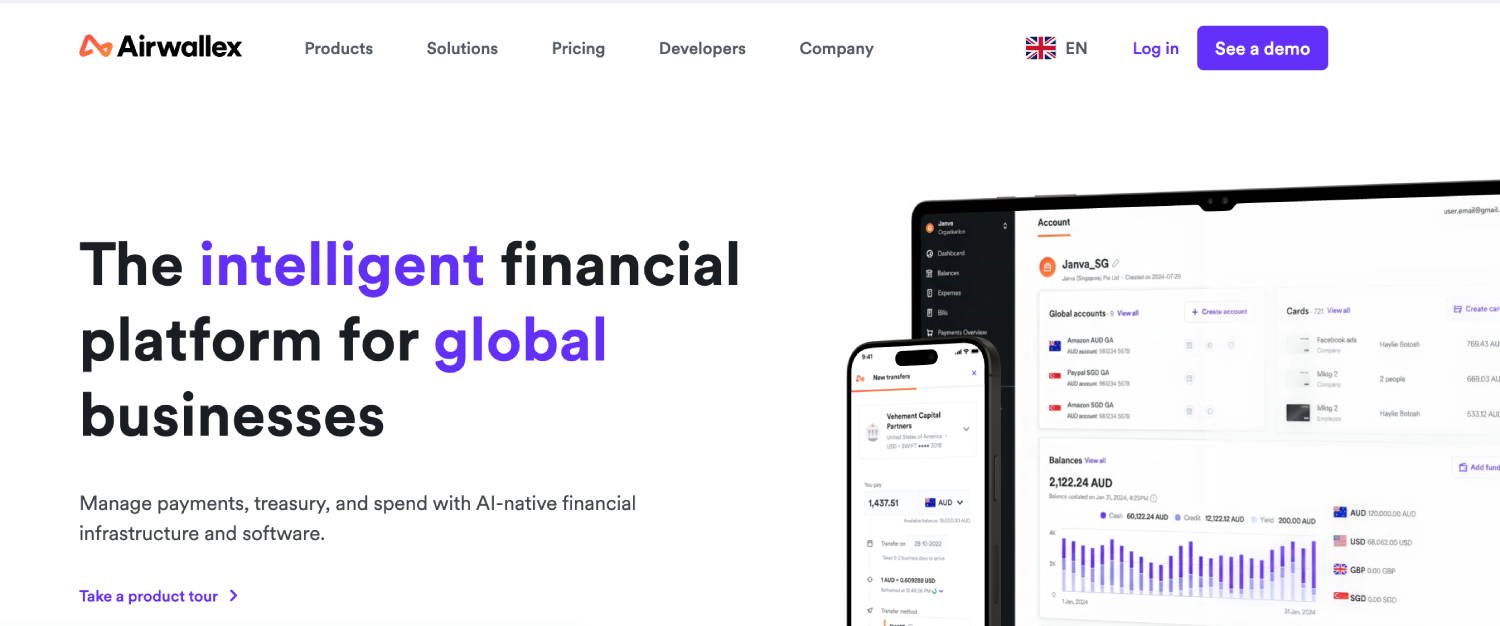
Airwallex’s payout API is a REST interface that supports creating beneficiaries, initiating transfers, querying payment status, and receiving webhooks on settlement events. According to Airwallex’s developer documentation, the API covers transfers to bank accounts across more than 150 countries, supports local payment rails in priority corridors, and allows batch transfers at scale without the 200-recipient ceiling that WorldFirst’s dashboard tool carries.
For a SaaS platform disbursing to freelancers or vendors programmatically, the webhook infrastructure matters. Airwallex fires events on transfer initiation, processing, and completion, which means your internal ledger can reconcile in near-real time rather than through manual export. WorldFirst does not offer a comparable webhook system for payout status updates.
The Airwallex API also supports multi-currency wallet funding, so a US company collecting revenue in GBP and EUR can hold those balances and pay out in local currency without converting twice. That double-conversion cost, converting USD to GBP on receipt, then GBP back to USD, then USD to the destination currency on payout, compounds across corridors in ways that rarely appear on a rate card but show up plainly in a quarterly finance review. The full hidden cost taxonomy for a payment infrastructure choice goes well beyond FX spread alone: it includes per-transfer SWIFT fees, failed payment retry costs, engineering hours spent on reconciliation workarounds, and settlement timing float. If you want to see how these infrastructure choices cascade into actual unit economics, the breakdown of hidden costs killing fintech SaaS margins covers this category in depth.
How Do WorldFirst Payouts Compare for Marketplace and B2B Use Cases?
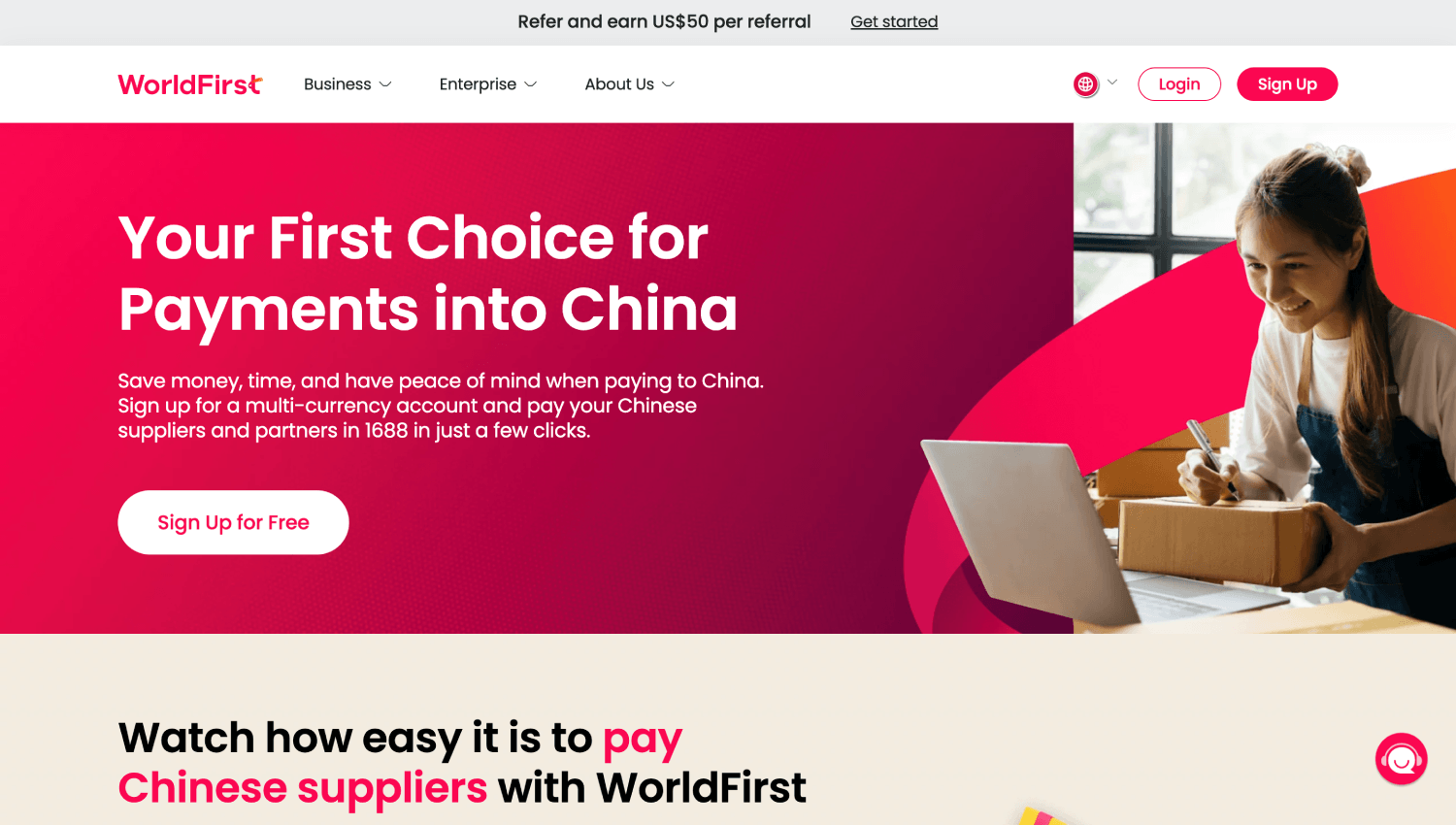
WorldFirst’s product strength is in the corridors that matter most for cross-border commerce: USD to CNY, GBP, EUR, AUD, and major APAC currencies. The platform is built around a relationship model where larger clients get rate negotiation support and dedicated contact points. That matters when you are moving significant FX volume and want a human to call when a transfer hangs.
The batch payment tool, which handles up to 200 transfers per upload, works well for monthly payroll-style runs or periodic contractor disbursements. It is not built for real-time or event-driven payout flows, and if your product needs to trigger a payout the moment a user completes an action, WorldFirst’s architecture is a poor fit.
WorldFirst is also the more accessible option for early-stage companies. Onboarding is straightforward, account approval timelines are generally faster than what engineering-heavy API platforms require, and the learning curve is low. For a 15-person company whose finance team handles payouts manually twice a month, that simplicity has real value.
The Corridor Cost Test: Where FX Pricing Actually Diverges
Here is where the “any provider is the same on price” belief breaks down. Consider a US SaaS company paying 80 contractors monthly: 30 in the Philippines (USD to PHP), 20 in India (USD to INR), 20 in Brazil (USD to BRL), and 10 in Germany (USD to EUR). Average payout per contractor is $1,200.
Total monthly outflow: $96,000. At a 0.5% FX spread, a middle-ground assumption for a mid-tier client on either platform, the FX cost is $480 per month, or $5,760 annually. That $480 figure covers spread cost only. It does not include per-transfer SWIFT fees (which can run $15 to $25 per wire on corridors without local rail support), failed payment retry fees, or the float cost of 3 to 5 day SWIFT settlement versus same-day local rail settlement. A company with 20 of its 80 contractors on SWIFT-only corridors could add another $300 to $500 in fixed transfer fees monthly on top of the spread. If one platform prices USD to PHP 0.3% tighter than the other on that corridor specifically, the annual savings on just that corridor is around $130 on $43,200 of volume. Multiply it across five corridors and factor in the fixed fee delta, and the total annual divergence between the two platforms can reach four figures without unusual volume.
WorldFirst historically prices well on APAC corridors, particularly USD to CNY and USD to SGD, reflecting its origins in Asian trade finance. Airwallex, also with deep APAC roots, competes hard on the same corridors but often wins on LatAm and emerging-market corridors where WorldFirst’s local rail coverage is thinner. Neither company publishes corridor-level spread tables for comparison, which means you need to request quotes from both for your specific mix before committing.
| Corridor | WorldFirst Strength | Airwallex Strength | Notes |
|---|---|---|---|
| USD to CNY | Strong (APAC heritage) | Strong | Competitive on both; negotiate volume rates |
| USD to EUR | Competitive | Competitive | SEPA rails on both; minimal spread difference |
| USD to GBP | Strong | Strong | Faster Payments available on both |
| USD to INR | Solid | Solid | IMPS/NEFT rails; check settlement timing |
| USD to PHP | Solid | Strong local rail access | Airwallex has broader local rail coverage |
| USD to BRL | Limited local rails | Stronger coverage | Brazil complexity favors Airwallex for volume |
| USD to MXN | Available via SWIFT | Local SPEI rails supported | Local rail access meaningfully reduces cost |
| USD to NGN | Limited | Available | Africa coverage is a differentiator for Airwallex |
Which Platform Has Better Developer Infrastructure for SaaS Payout Automation?
Airwallex is not close on this dimension. The platform has REST API documentation, SDKs, sandbox environments, and webhook support that a product or engineering team would recognize as production-grade. If you are building a SaaS product that needs to embed international payouts into your own UI or trigger disbursements from application logic, Airwallex is the infrastructure layer designed for that. WorldFirst is not.
WorldFirst’s API offering exists, but it is primarily oriented toward connecting to marketplace platforms (like Amazon Seller Central) and automating FX conversions rather than building custom payout flows. If you need programmatic control over beneficiary creation, transfer initiation, and status callbacks, WorldFirst requires more workaround effort than most engineering teams want to absorb. The comparison of cross-border payout APIs for US platforms covers the broader API-first provider set if WorldFirst and Airwallex both fall short of your technical requirements.
For teams who have already evaluated Airwallex in the context of multi-currency operations, the earlier Airwallex vs Wise analysis for US companies going global maps out how Airwallex’s account infrastructure compares at the product layer, which is a useful complement to the payout API evaluation here.
The FintechSpecs Corridor-Weight Decision Model
Most comparison frameworks ask you to score providers on feature lists. That produces ties, and it obscures the variable that actually determines cost: your specific corridor mix. The Corridor-Weight Decision Model is FintechSpecs’ structured alternative. Rather than evaluating WorldFirst and Airwallex against a generic global capability checklist, you weight each active payout corridor by monthly dollar volume and evaluate each provider against those corridors specifically. The model exists because no published rate card tells you what you will actually pay across a mixed corridor portfolio, only a weighted, quote-verified calculation does.
Step one: list every corridor you pay into, with monthly volume and payout count. Step two: request live quotes from WorldFirst and Airwallex for a representative transfer in each corridor. Step three: calculate total FX cost for each provider across your full corridor mix. Step four: add the integration cost, estimate engineering hours to build or maintain the connection given each provider’s API maturity. Step five: compare the 12-month total cost of each option, including spread, fixed transfer fees, and integration overhead.
The model consistently surfaces two findings that surprise buyers who start from a feature-list comparison. First, the provider with the better headline rate often loses when you weight corridors by volume, because their advantage is concentrated in corridors that represent a small share of your actual spend. Second, the integration cost for a developer-grade API like Airwallex’s frequently nets to zero or negative: faster settlement, fewer failed transfers, and reduced ops overhead can offset a wider FX spread on secondary corridors. For a broader audit of where payment infrastructure costs hide beyond FX, the FintechSpecs breakdown of outbound payment APIs for B2B SaaS walks through the full evaluation criteria.
Compliance, Licensing, and Who Actually Owns the Risk
Both providers hold money transmitter licenses across major jurisdictions and are regulated for cross-border transfers. WorldFirst is FCA-regulated in the UK and holds licenses across its operating markets, including FinCEN registration in the US. Airwallex holds licenses in the US (state MTLs), the UK (FCA), Australia (AUSTRAC), Singapore (MAS), and other major markets. Neither is a bank, so funds held in multi-currency wallets are not FDIC-insured.
For US companies, the practical compliance difference is minor for standard contractor payouts. Where it matters is in high-risk corridors or regulated industries. If your payouts trigger enhanced due diligence requirements, WorldFirst’s account manager model means you have a human contact to work through documentation. Airwallex’s compliance process is more self-service, which is faster in easy cases and slower when an edge case triggers a review. Getting compliance infrastructure right upstream matters more than most teams expect; the fintech product and compliance readiness checklist is a useful reference before any payout provider onboarding.
Frequently Asked Questions
Is WorldFirst a legitimate and safe payment platform?
WorldFirst is a legitimate cross-border payment provider, regulated by the FCA in the UK and registered with FinCEN in the United States. It was acquired by Ant Group in 2019 and continues to operate as a standalone brand. Client funds held in multi-currency accounts are safeguarded under UK e-money regulations, meaning they are held separately from operational funds, though they are not covered by FDIC or FSCS deposit insurance.
Who are Airwallex’s main competitors?
Airwallex’s direct competitors in the US market include Wise Business, WorldFirst, Payoneer, Tipalti for enterprise AP flows, and Stripe Connect for platform-level payouts. For API-first cross-border disbursements specifically, Airwallex competes with providers like Currencycloud (now part of Visa), dLocal for emerging markets, and Nium. The competitive set depends heavily on whether the buyer wants a multi-currency account, a payout API, or a full financial operations platform.
How does the Airwallex payout API work for SaaS platforms?
Airwallex’s payout API is a REST interface that allows platforms to create beneficiaries, initiate transfers, and receive webhooks on payment status changes. It supports transfers to bank accounts in over 150 countries, with local payment rails in key markets reducing cost and settlement time compared to SWIFT. Platforms can hold balances in 60-plus currencies and pay out in local currency. Full API documentation and sandbox access are available through Airwallex’s developer portal.
Does WorldFirst work for US-based SaaS companies?
WorldFirst accepts US-based business clients. US companies can open multi-currency accounts, send international transfers, and use the batch payment tool for contractor or vendor payouts. The platform does not accept US personal accounts, and certain marketplace-specific features require linking a supported selling platform. WorldFirst’s US product has fewer features than its UK and APAC offerings historically, though the gap has narrowed as the platform expanded globally post-Ant Group acquisition.
Which provider is better for paying contractors in Southeast Asia?
For Southeast Asian corridors including the Philippines, Vietnam, Thailand, and Indonesia, Airwallex generally has broader local rail coverage, which means faster settlement and lower transfer fees compared to SWIFT routing. WorldFirst is competitive on Singapore and established APAC markets but thinner on local rails in lower-volume Southeast Asian corridors. If your payout volume to the region is above $20,000 per month, running live quotes through both platforms on your specific corridor mix is worth the time before committing.
Can Airwallex replace a traditional bank for international payouts?
For many SaaS and platform companies, yes. Airwallex provides multi-currency accounts with local account details in major markets, outbound wire and local rail transfers, and virtual cards for expense management. It does not offer credit, lending, or FDIC-insured deposits. Companies that need a bank account for payroll, credit lines, or regulated banking services still need a traditional banking relationship. For cross-border payouts specifically, most operationally mature teams use Airwallex or a comparable platform in parallel with, not instead of, their primary bank.
Which is better for a company with mixed LatAm and APAC corridors?
Airwallex is the stronger choice when your corridor mix spans both Latin America and APAC. WorldFirst’s core strength is APAC and European corridors; its LatAm coverage is thinner, particularly for local rail access in Brazil and Mexico. Airwallex supports SPEI rails in Mexico and has broader coverage for Brazil, Colombia, and Chile than WorldFirst’s current offering. If LatAm represents more than 30% of your monthly payout volume by dollar value, that difference will show up in both cost and settlement time.
The Real Decision
The assumption that cross-border payout providers are interchangeable on price is wrong in a specific and calculable way. FX spreads vary by corridor, local rail access determines settlement time, and API maturity determines how much engineering time you burn maintaining the integration. None of that is visible from a feature comparison page.
Run the Corridor-Weight Decision Model before your next contract renewal: weight your corridors by volume, pull live quotes from both providers, add fixed transfer fees and integration overhead, and compare 12-month totals. WorldFirst will win that calculation for teams concentrated in major APAC and European corridors who manage payouts through a dashboard. Airwallex will win for teams that need API-first automation, LatAm coverage, or multi-currency wallet infrastructure. The math rarely lands where the pitch deck implies it will. And if your infrastructure evaluation extends beyond payouts into the full payment stack, the payment infrastructure tool comparison for SaaS founders covers the broader decision set with the same specificity.