
TLDR
- On Sept. 18, 2026, Ant International unveiled what it calls the industry’s first full-stack AI-native financial suite for global merchants, spanning payments, accounts, FX, treasury, and growth across Alipay+, Antom, WorldFirst, and Bettr.
- The headline operator product is WorldFirst for Enterprise Account for Agent (AFA): a business account built for autonomous AI agents, with know-your-agent (KYA) smart contracts, live monitoring, intervention controls, and a feedback loop for agent tuning (primary release).
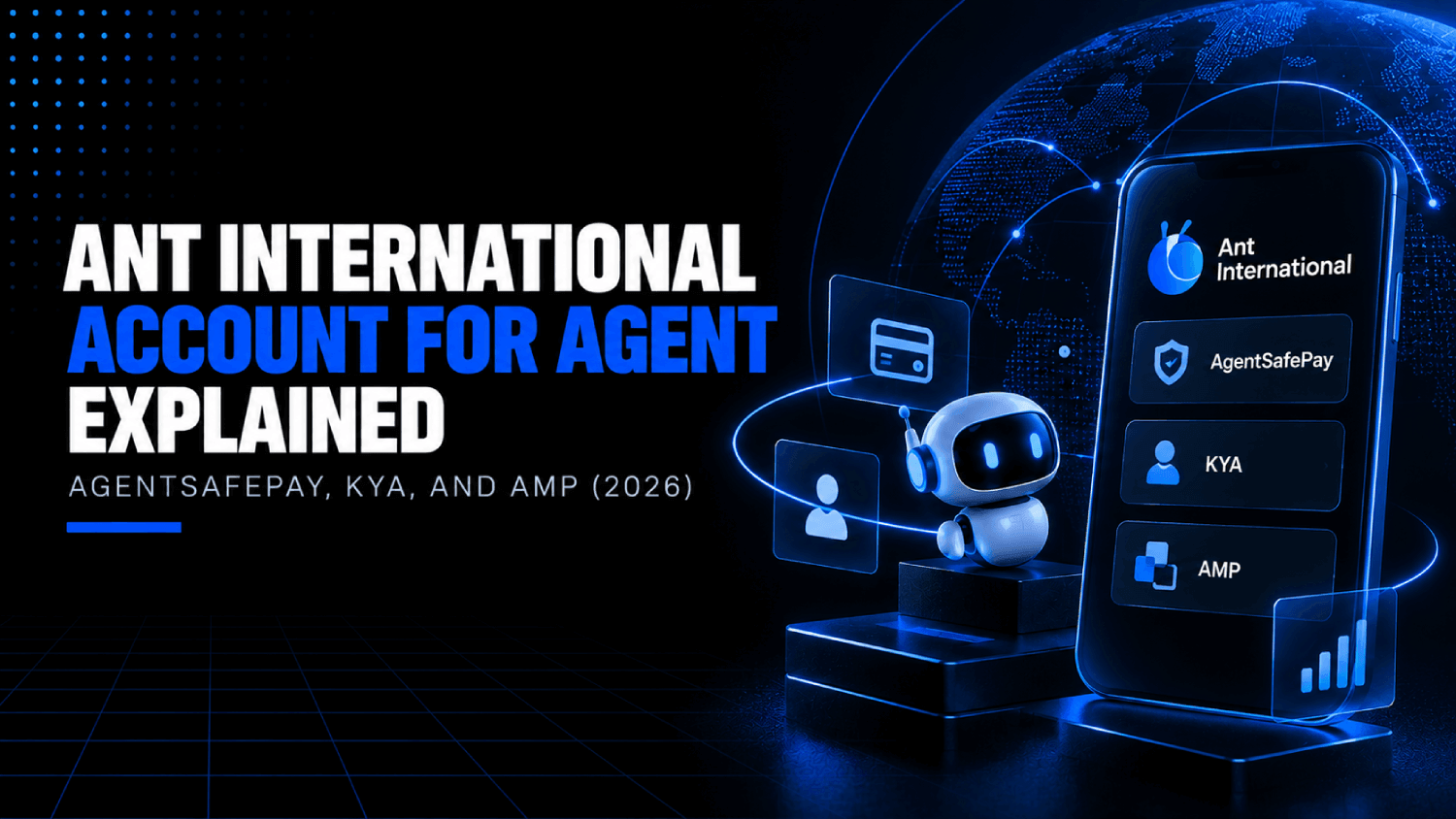
- Risk packaging sits next to the account: AgentSafePay claims a 100% fund-back guarantee against agent-specific losses such as prompt injection and intent misinterpretation, and the Alipay+ Agentic Mobile Protocol (AMP) supports agent-to-agent settlement down to $0.000001, with 10 wallet partners and 7 acquirers in Phase 1 since April 2026.
- Ant says 89.5% of Antom merchants deployed FinAI solutions in the past 12 months and 81.4% of payment tasks were completed with AI help. Those figures are vendor-reported, not independently audited (PYMNTS).
- For operators: this is a wallet, cross-border account, and KYA rail signal, not another “best agent payment providers” list. Pair it with FintechSpecs’ protocol and identity posts, and ask what AgentSafePay actually covers before you treat a fund-back guarantee as a risk transfer.
If you run cross-border merchant payments, treasury, or agent spend controls, Sept. 18, 2026 is not a consumer-shopping demo. It is Ant International arguing that agents need accounts, not just tokens.
One day after Mastercard and Alchemy pushed everyday Agent Pay credentials on card rails, Ant put a different object on the table: a business account an AI agent can hold, inside WorldFirst, with KYA contracts and a fund-back product aimed at agent-specific failure modes. That sits on the same operator surface as AI agent identity verification, best AI agent payment infrastructure, ACP vs AP2 vs x402, and WorldFirst vs Airwallex.
The question for builders is no longer “can an agent recommend a checkout?” It is “who holds the balance, who proves the agent is allowed to move it, and who pays when the model is prompt-injected?”
What happened
On Sept. 18, 2026, Ant International published a primary product release from its VOYAGE merchant event in Shanghai. CEO Peng Yang presented a full stack of AI-native solutions for payment, account, FX, treasury, and growth to more than 1,100 executives.
Verified claims from that release (vendor-stated):
- Close to 100 key products across four pillars: Alipay+, Antom, WorldFirst, and Bettr.
- Two proprietary models: Antom 3-in-1 Transformer (payment foundation model, 10B+ parameters, sequential + tabular + graph modalities) and FalconTST (FX and liquidity forecasting, 8.5B+ parameters, claimed >93% accuracy).
- Agent-native trust layer: dynamic KYA tied to AMP, plus AgentSafePay as a fund-back guarantee for agent-specific risks.
- Account for Agent (AFA) inside WorldFirst for Enterprise: framed as the world’s first truly agentic business account, with KYA-enabled smart contracts, full-chain security control, dynamic monitoring and intervention, and a feedback mechanism for continuous agent tuning.
- AMP Phase 1: live since April 2026, 10 Alipay+ wallet partners and 7 acquirers, with nano A2A settlement as small as $0.000001.
- Network scale claims: 53 digital wallets, 10 national QR schemes, 150 million merchants, 2B+ consumer accounts, 210 markets, 25M+ average daily transactions.
- Adoption claims: 89.5% of Antom merchants deployed FinAI solutions in the past 12 months; 81.4% of payment tasks completed with AI help.
- WhaleRTP (blockchain wholesale settlement) processed 45% of Ant International’s cross-border volume in 2025, with claimed 60% lower working capital needs and 23% higher liquidity yield.
PYMNTS and FinTech Global both frame AFA as a business account an AI agent can hold, with live monitoring and human intervention. PYMNTS also notes that AgentSafePay’s claim materials did not publish caps, exclusions, or claim timelines.
Peng Yang said: “The future fintech leader delivers two things: a future-ready trust infrastructure and foundational FinAI models that combine complex types of deep data and rich domain expertise, and a full stack of connected AI-native solutions across payment, account, FX, treasury and growth operations that prepare them for today and the fully agentised future.”
Flag: adoption rates, model accuracy, chargeback reductions (up to 87% for leading LLM subscription clients), FX cost cuts (30% to 60%), and the “industry’s only / world’s first” labels are Ant-attributed. Treat them as launch thesis until audited case studies or third-party benchmarks appear. AgentSafePay terms are not in the public release.
What Account for Agent, AgentSafePay, and AMP actually do
Account for Agent (AFA)
WorldFirst is Ant’s global account brand. In the Sept. 18 release, WorldFirst for Enterprise Account for Agent is described as a business account designed for autonomous agents rather than human operators alone.
What the public description implies for operators:
- Agent as account principal (within policy): the agent holds or operates a scoped account object, not only a one-time card token.
- KYA smart contracts: identity and permission boundaries are meant to be machine-checkable before spend or transfer.
- Runtime control: dynamic monitoring plus the ability for the business to intervene.
- Tuning loop: feedback for continuous agent adjustment (vendor framing; no public SLA for how fast a kill switch propagates).
This is a different product shape from yesterday’s Mastercard AgentCard / Agent Pay path, where the agent gets tokenized card credentials for everyday online merchants. AFA is closer to BaaS / global account thinking: balance, FX, treasury adjacency, and policy enforcement on the account itself. See also FintechSpecs’ BaaS platforms and WorldFirst vs Airwallex for the adjacent comparison lane (do not treat this news post as a replacement for those listicles).
AgentSafePay
Antom AgentSafePay is positioned as a security product offering a 100% fund guarantee against losses from:
- Intent misinterpretation
- Malicious prompt injection
- Other “agent-specific” risks
Ant calls it an industry first. PYMNTS flags the missing public claim terms.
Operator read: a fund-back guarantee is a commercial risk transfer, not a cryptographic proof that the agent acted correctly. Before you price it into your own P&L:
- What event codes qualify as “agent-specific”?
- Are social-engineering and merchant disputes included or excluded?
- Is there a per-incident or annual cap despite the “100%” marketing line?
- How fast is reimbursement, and in which currency?
- Does coverage require AMP / AFA / Antom Shield to be in the path?
Until those answers are contractual, treat AgentSafePay as a sales differentiator, not a completed underwriting product.
Alipay+ Agentic Mobile Protocol (AMP)
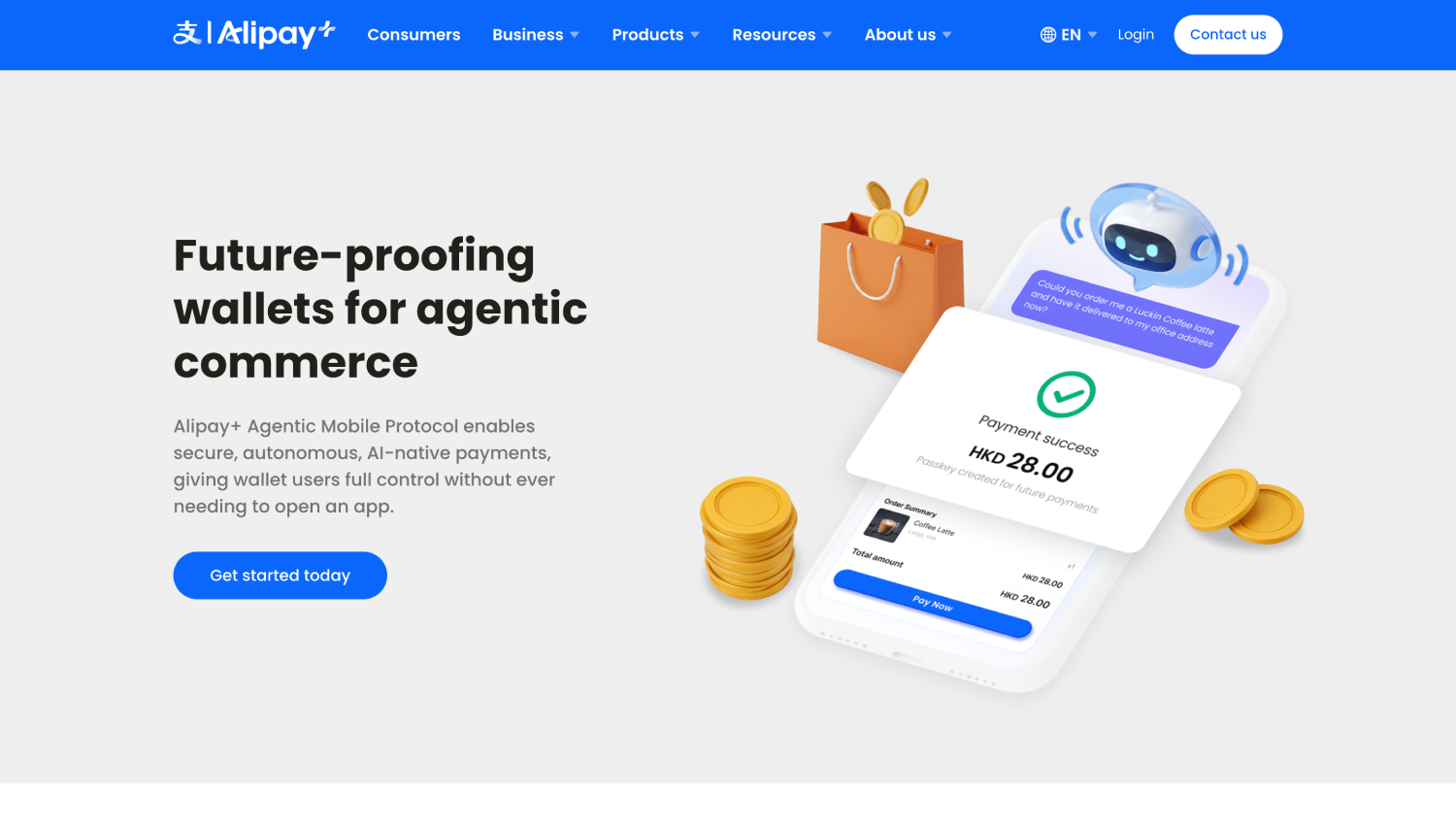
AMP is Ant’s open payment protocol for digital wallets, super apps, smart devices, and other mobile interfaces so AI agents can pay without rewriting every wallet UX.
Phase 1 facts from the release:
- Live since April 2026
- 10 Alipay+ wallet partners and 7 acquirers
- Permission model: authorize the task, not hand over the full account
- Real-time visibility and control of agents
- Faster agent-to-wallet linking (claimed 50% fewer steps)
- Nano A2A settlement down to $0.000001
AMP also sits in a KYA interoperability conversation with Mastercard and Visa via BuildFin.ai / MAS-related industry work (PYMNTS context). That is parallel to Mastercard’s Verifiable Intent and Visa Trusted Agent framing, not a replacement for either.
How this sits vs card Agent Pay, x402, and specialist agent rails
Do not collapse these into one “agent payments” bucket. Use FintechSpecs’ existing depth posts for vendor shortlists; use this section for the Sept. 18 map.
| Lane | What Sept. 18 mainly moves | What it does not replace |
|---|---|---|
| Agent account + treasury | WorldFirst AFA, Wyn, Falcon FX / Whale pooling | Your BIN sponsor, US BaaS charter path, or existing Airwallex/WorldFirst RFP |
| Wallet / QR agent rails | AMP Phase 1 wallets and acquirers | US card acceptance for everyday ecommerce |
| Agent risk transfer | AgentSafePay fund-back marketing + KYA | Your own fraud orchestration and ATO stack |
| Card network Agent Pay | Separate Mastercard/Visa credential path (Alchemy AgentCard, etc.) | Ant’s AFA itself |
| Open machine protocols | Competitive pressure on nano A2A settlement | x402 providers, Skyfire vs Payman vs Natural |
Practical operator map:
- Need card acceptance at long-tail online merchants today → card Agent Pay / Intelligent Commerce path.
- Need cross-border wallet, QR, and account automation across Ant’s merchant network → AFA + AMP.
- Need HTTP-native machine micropayments outside Ant’s wallet graph → x402 and specialist infra.
- Need agent identity attestation independent of any one network → KYA / agent identity providers.
Risk, controls, and what treasury / risk teams should ask
Agent accounts change the blast radius. A stolen or prompt-injected agent that holds a balance is closer to a compromised employee ledger than a single declined card auth.
Controls Ant calls out
- KYA smart contracts and permission boundaries
- Task-scoped authorization (not full account handover)
- Real-time monitoring and intervention
- AgentSafePay fund-back for named agent failure modes
- Antom Shield as a two-layer security story (classic fraud + agent-specific)
What you still have to design
- Instruction mismatch: the agent follows a literal budget and still violates policy. A fund-back product may not treat that as “prompt injection.”
- Multi-agent A2A loops: nano settlement makes recursive agent payments cheap. You need velocity, graph, and policy checks from fraud tooling, not marketing guarantees alone.
- Jurisdiction and licensing: AFA sits in WorldFirst’s enterprise account stack. Confirm which entity, which markets, and which regulated activities apply before you put US or EU client funds in the path.
- Interoperability theater vs production: Visa/Mastercard/Ant KYA work is real industry coordination, but each network still keeps its own verification. Your runbook must name the system of record per rail.
- Model claims vs ops SLAs: FalconTST and Antom 3-in-1 numbers are launch metrics. Ask for market-specific uplift, not global averages.
Who should care, and what to ask Ant / WorldFirst / Antom
Prioritize a deep read if you:
- Run cross-border ecommerce, OTA, or digital entertainment checkout on Alipay+ / Antom
- Own treasury or FX for merchants already on WorldFirst
- Build agent procurement, supplier-pay, or A2A workflows that need wallet rails
- Are writing RFPs that mix card Agent Pay, BaaS accounts, and agent identity
Concrete questions
- In which legal entities and markets is AFA live vs waitlisted for fall/winter 2026 rollout?
- What fields are bound in the KYA contract (agent ID, principal, spend caps, merchant allowlist, time window)?
- What is the intervention latency when a human kills an agent mid-session?
- Publish AgentSafePay terms: covered events, caps, exclusions, claim SLA, and required product stack.
- How does AMP evidence attach to disputes when the counterparty is another agent?
- How does AFA relate to existing WorldFirst multi-currency accounts and World Card issuance (17 currencies in the Wyn SME flow)?
- If you already use Mastercard Verifiable Intent or Visa Trusted Agent, what is the mapping to Ant KYA, and what breaks when they disagree?
The take: accounts are the missing object, guarantees need contracts
Ant’s Sept. 18 launch is a category clarification. Card networks are racing to put agent spend on familiar acceptance. Open protocols are racing to make machines pay machines. Ant is saying agents also need accounts, FX, treasury, and a named loss product when the software is the actor.
That is useful for operators who already live in Alipay+ / Antom / WorldFirst land. It is not a reason to scrap x402 shortlists or Mastercard Agent Pay work. It is a reason to put three lines on every agent-payments architecture diagram: credential, account, and proof of authorization, then ask which vendor owns each failure mode.
If you are shipping an agent that moves money across borders, integrate for reach on the rails you already have, then instrument for blame. Know which system holds the balance, which system can freeze it in under a second, and which contract pays when the model hallucinates a “safe” transfer.
FAQ
When did Ant International announce Account for Agent?
Sept. 18, 2026, via Ant International’s primary release at the VOYAGE merchant event in Shanghai, with same-day coverage from PYMNTS and FinTech Global.
What is Account for Agent (AFA)?
AFA is WorldFirst for Enterprise’s agentic business account: an account object designed for autonomous AI agents, with KYA smart contracts, monitoring, intervention, and a tuning feedback loop (vendor description).
What is AgentSafePay?
AgentSafePay is Antom’s security product that claims a 100% fund-back guarantee against losses from prompt injection, intent misinterpretation, and other agent-specific risks. Public claim terms were not detailed in the launch release.
What is the Agentic Mobile Protocol (AMP)?
AMP is Alipay+’s open protocol for agent payments across wallets, super apps, and mobile interfaces. Phase 1 (since April 2026) includes 10 wallet partners and 7 acquirers, with nano A2A settlement down to $0.000001.
Does this replace Mastercard Agent Pay or x402?
No. AFA/AMP are strongest on Ant’s wallet, QR, and WorldFirst account graph. Card Agent Pay solves long-tail card acceptance. x402 and specialist infra solve open machine micropayments. See ACP vs AP2 vs x402 and the Mastercard Alchemy AgentCard draft for the adjacent card-rail explainer.
Are the 89.5% / 81.4% AI adoption figures audited?
No. They are Ant International / Antom figures from the Sept. 18 materials. PYMNTS explicitly notes they are not independently audited.
Is AgentSafePay a substitute for fraud tooling?
No. It is a commercial guarantee claim for defined agent failure modes. You still need identity, velocity, graph, and ATO controls in your own stack.