
- Blocking all automated traffic is no longer a viable fraud strategy. AI agents now initiate checkout flows, compare prices, and manage subscriptions on behalf of real, paying customers.
- The new fraud perimeter is not bot versus human. It is verified agent versus unverified impostor, and the infrastructure to draw that line is production-ready today.
- Know Your Agent (KYA) is the emerging compliance analog to KYC, requiring platforms to attest an agent’s origin, authorization chain, and delegated permissions before granting access.
- Seven vendors have built distinct approaches to this problem. Two are general-purpose security layers adding agent signals. Five are purpose-built for agentic trust, attestation, and delegation proof.
- Shortlist based on your architecture: if you run a checkout or payment flow, prioritize vendors with delegation proof and human authorization chain support over generic bot-scoring tools.
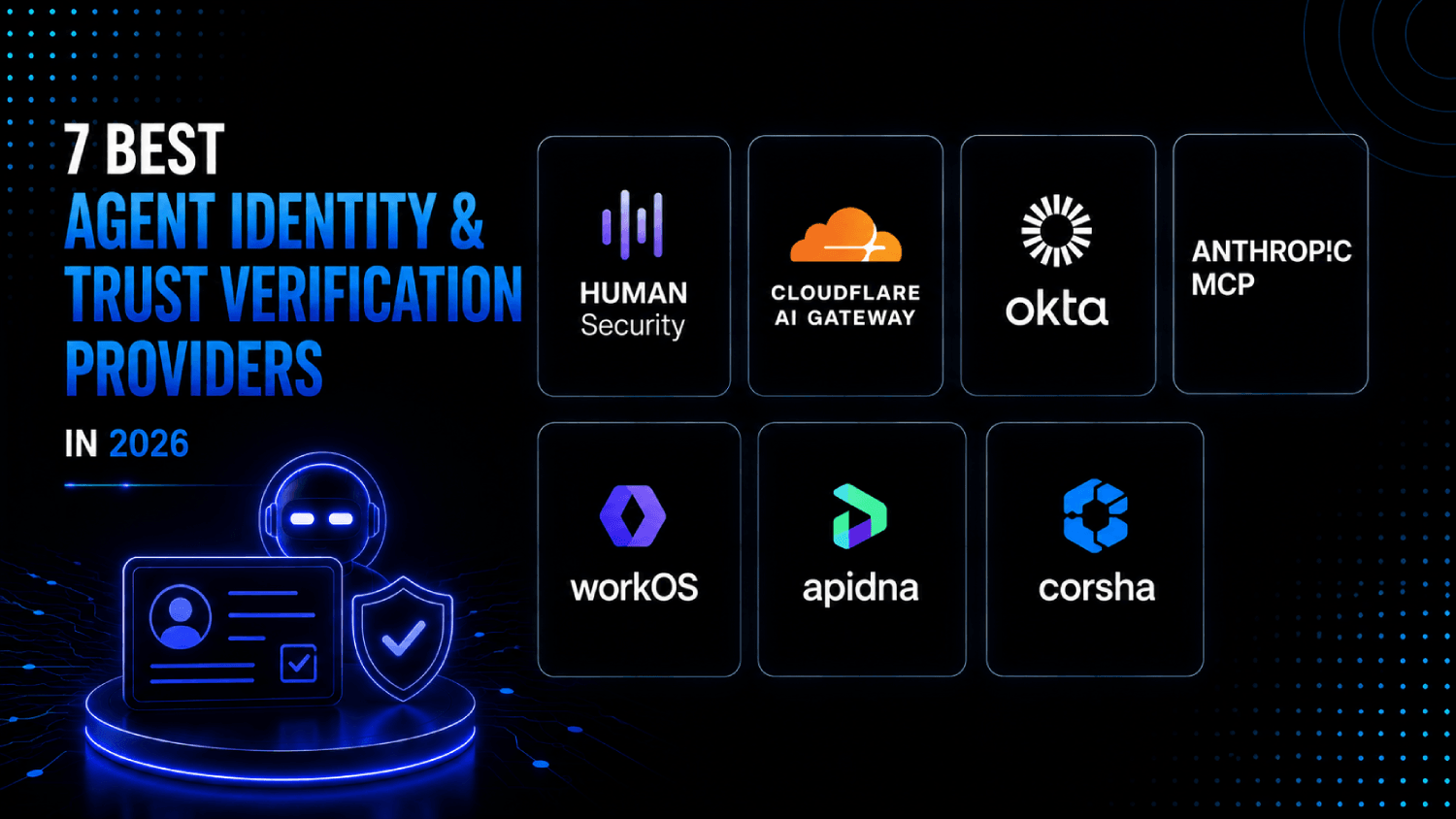
The seven providers best suited for AI agent identity verification in 2026 are HUMAN Security, Cloudflare, Okta, Anthropic’s Model Context Protocol infrastructure, WorkOS, Apidna, and Corsha. HUMAN and Cloudflare lead on bot-versus-agent signal quality. Okta and WorkOS bring machine identity and OAuth-based delegation into enterprise identity stacks. Apidna and Corsha address API-layer agent attestation. Anthropic’s MCP is the emerging standard for agent credential exchange.
Why Your Bot-Blocking Stack Will Start Blocking Revenue
Most fraud and bot-defense teams were built to answer a binary question: is this traffic human or machine? For years, that was the right question. Today it is the wrong one, and the cost of asking it is rising.
AI agents operated by real customers are now hitting checkout endpoints, querying account balances, initiating wire transfers, and renewing subscriptions. These agents look like bots to legacy detection systems because they are headless, they do not use a standard browser fingerprint, and they operate at inhuman speed. Block them, and you block the customer behind them. The trade-off between fraud prevention and user experience has a new, sharper edge.
The category that solves this is agent identity verification, sometimes called Know Your Agent (KYA). It is not a replacement for fraud detection. It is a new layer that sits upstream of your existing risk stack, sorting verified agents from unverified ones before your fraud engine even runs.
What Is Know Your Agent (KYA) and Why Does It Matter for Payments?
Know Your Agent (KYA) is a verification framework that establishes the identity, authorization, and scope of an AI agent before it is granted access to a platform or payment flow. Where KYC verifies the person behind an account, KYA verifies the agent acting on that person’s behalf and the chain of delegation that connects them.
A complete KYA check answers four questions: Who created this agent? What human or organization authorized it to act? What permissions were granted, and are they still valid? Has the agent’s behavior drifted outside those permissions? Vendors in this space answer some or all of these questions using a combination of cryptographic attestation, OAuth-scoped delegation tokens, behavioral signals, and trusted agent protocols.
The stakes are highest in payment and checkout contexts. An agent that can initiate a transaction on a user’s behalf is a high-value target for impersonation. A malicious actor who can spoof a trusted agent’s identity gets a payment-authorized session without ever touching the authentication layer. This is the attack surface that agent identity infrastructure is designed to close. For a broader view of how the fraud infrastructure stack is evolving, see FintechSpecs’ fraud detection and risk tools roundup.
The FintechSpecs Agent Trust Signal Stack: A Four-Layer Evaluation Framework
Before comparing vendors, it helps to have a consistent lens. Every provider in this space operates on at least one of four signal layers. Understanding which layers a vendor covers tells you where they fit in your architecture.
Layer 1: Network and behavioral signals. Traffic pattern analysis, TLS fingerprinting, user-agent anomaly detection, and request timing. This is where traditional bot defense lives. It distinguishes machine-generated traffic from human-generated traffic but cannot distinguish a legitimate agent from a malicious one at scale.
Layer 2: Agent attestation. Cryptographically signed credentials that identify an agent’s software origin, version, and publisher. Analogous to a TLS certificate for the agent itself. A receiving server can verify that the agent is what it claims to be.
Layer 3: Delegation proof. Evidence that a human or organization explicitly authorized this agent to act on their behalf, typically implemented via OAuth 2.0 scopes or similar token frameworks. The agent presents proof of delegation, not just proof of identity.
Layer 4: Human authorization chain. An auditable, real-time record of which human granted what permission to which agent at what time, with the ability to revoke access mid-session. This is the compliance layer. It is what a regulator asks for when an agent-initiated transaction goes wrong.
Most legacy bot-defense vendors cover Layer 1 only. The seven providers below span all four layers, with different combinations depending on their origin and product focus.
Which Providers Actually Verify AI Agent Identity?
1. HUMAN Security
HUMAN Security is the most credible general-purpose vendor for bot-versus-agent traffic classification at scale. Their MediaGuard and BotGuard products analyze behavioral and network signals across a large sensor network, and they have publicly committed to evolving their detection models to distinguish verified AI agents from malicious bot traffic. HUMAN covers Layer 1 signals more comprehensively than most dedicated bot-defense vendors, and their threat intelligence network gives them visibility into impersonation campaigns that smaller vendors cannot match.
What HUMAN does not yet offer in production is native delegation proof or human authorization chain logging. They are a strong Layer 1 anchor, not a full KYA stack on their own. For a fintech team that already runs HUMAN for bot defense and needs to add agent identity without ripping out their stack, the right move is to treat HUMAN as the behavioral signal layer and pair it with an attestation or delegation layer from another vendor on this list.
Pricing is not publicly disclosed. HUMAN sells enterprise contracts and does not publish list rates.
2. Cloudflare
Cloudflare AI Gateway has built the most accessible entry point for teams that need to start distinguishing AI agent traffic from generic bot traffic without a dedicated security vendor. Their AI Gateway product sits in front of API endpoints and applies bot management signals, rate limiting, and increasingly, agent-specific traffic classification based on declared agent headers and behavioral patterns.
Cloudflare’s network position is its core advantage. They see traffic patterns across an enormous share of web infrastructure, which means their anomaly detection models train on real-world agent behavior at a scale few vendors can match. For early-stage and Series A companies that are not yet ready to invest in dedicated agent identity infrastructure, Cloudflare’s AI Gateway provides a meaningful first layer of protection at a price point that fits a startup budget. Their public pricing for AI Gateway starts free for low-volume use and scales to paid tiers based on request volume, as listed on their public pricing page.
Cloudflare covers Layer 1 and partial Layer 2 (agent header validation). They do not provide delegation proof or authorization chain logging natively, though their Workers platform lets teams build custom attestation flows on top.
3. Okta
Okta enters this category from the identity side rather than the fraud side, which makes their coverage profile distinct. Their machine-to-machine authentication products, particularly around service accounts and non-human identities, address the delegation proof and human authorization chain problems that purely behavioral vendors miss.
Okta’s recently published guidance on non-human identities and AI agents frames the problem as a machine identity management challenge: every agent should have a registered identity, scoped credentials, and a clear revocation path. Their Workforce Identity Cloud supports OAuth 2.0 client credentials flows that work well for agent delegation scenarios. For enterprise fintech teams already running Okta for human identity, extending it to cover agent identities is architecturally coherent and avoids vendor sprawl.
The gap is Layer 1 behavioral detection. Okta does not do traffic anomaly analysis or bot scoring. Teams that need both behavioral classification and delegation proof will still need to pair Okta with a network-layer provider. Okta’s pricing for Workforce Identity Cloud varies by seat and feature tier; their public pricing page does not list a flat per-agent rate.
4. Anthropic MCP Infrastructure
Anthropic’s Model Context Protocol (MCP) is not a commercial security vendor. It is an open protocol standard that defines how AI agents exchange credentials, context, and permissions with the services they call. Including it here matters because MCP is rapidly becoming the de facto standard for agent credential exchange, and any serious KYA stack in 2026 should be MCP-compatible.
MCP supports structured agent attestation at the protocol level, meaning an agent built on MCP can declare its identity, its principal (the authorizing human or system), and the scope of permissions it holds in a machine-readable, verifiable format. A platform that accepts MCP-compatible agents can validate these declarations programmatically rather than relying entirely on behavioral signals.
For product and engineering leaders evaluating agent identity infrastructure, MCP compatibility should be a baseline requirement when evaluating commercial vendors. If a vendor’s agent verification tooling does not integrate with MCP, their attestation coverage will degrade as MCP adoption accelerates.
5. WorkOS
WorkOS has built its product around making enterprise-grade identity features accessible to SaaS companies at Series A and B scale. Their focus on SSO, SCIM, and fine-grained authorization translates directly to agent identity scenarios when combined with their newer machine identity features.
For fintech SaaS teams that need to grant AI agents access to their platform on behalf of enterprise customers, WorkOS provides the delegation infrastructure: scoped tokens, customer-controlled permission grants, and audit logs that satisfy the human authorization chain requirement at Layer 4. Their audit log capabilities are particularly relevant for compliance-conscious fintech operators who need to demonstrate to regulators which agent performed which action under which authorization.
WorkOS does not cover Layer 1 behavioral signals. It is a pure identity and delegation layer. The case for WorkOS is strongest when your threat model is impersonation of legitimate agents (a rogue agent claiming permissions it was not granted) rather than novel bot attacks. WorkOS publishes pricing on their website; enterprise contracts for their full feature set are negotiated separately.
6. Apidna
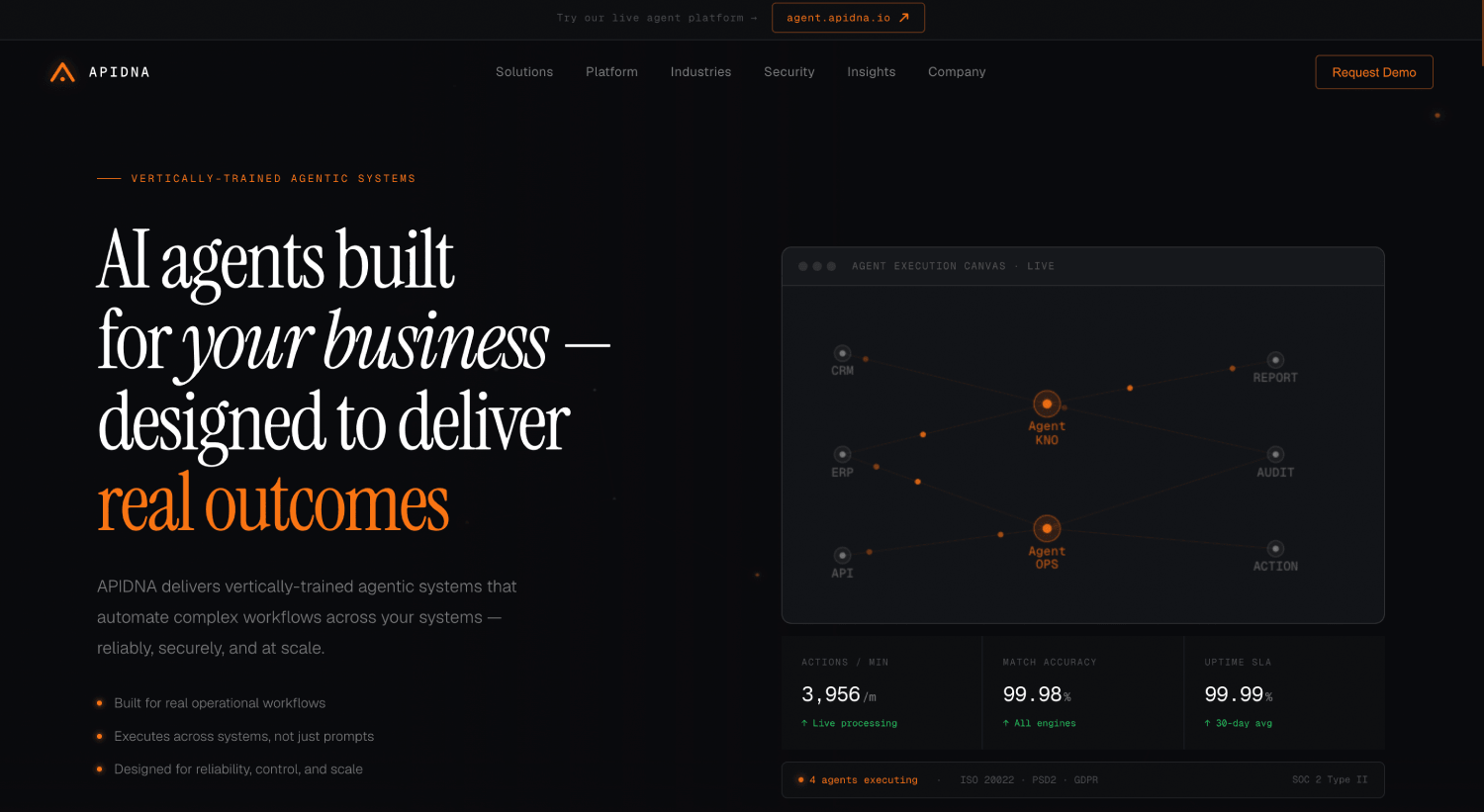
Apidna is a purpose-built API security vendor whose product is specifically designed to distinguish AI agent traffic from malicious automated traffic at the API layer. Their approach combines behavioral analysis with agent-specific fingerprinting, tracking how agents traverse API endpoints, the sequencing of their calls, and whether their behavior matches the declared scope of their credentials.
What makes Apidna relevant for the agent identity problem specifically is their focus on API call graph analysis. A legitimate shopping agent browsing product listings and adding to cart follows a predictable, human-authorized call sequence. A credential-stuffing bot or an impersonating agent will produce a different graph, even if individual requests look normal in isolation. Apidna detects these divergences and flags them for review or block.
Apidna is earlier-stage than HUMAN or Cloudflare, which means their threat intelligence network is smaller and their enterprise contract process is less mature. For companies processing significant API traffic from third-party agents, they are worth including in a proof-of-concept alongside a more established Layer 1 vendor. Apidna does not publish public pricing.
7. Corsha
Corsha addresses the machine identity problem from a security engineering angle, providing dynamic, rotating credentials for machine-to-machine API calls, including AI agents operating in automated pipelines. Their core technology issues time-bound, verifiable credentials to agents and rotates them continuously, so a stolen credential has a short window of usefulness before it expires.
For fintech teams worried about credential exfiltration in agentic payment flows, Corsha’s rotating credential approach adds a meaningful layer of protection that static OAuth tokens do not provide. An agent that authenticates successfully with Corsha’s infrastructure presents a credential that is valid for that session only, which limits the blast radius of a credential compromise event.
Corsha covers Layer 2 (attestation) and partial Layer 3 (delegation, via short-lived scoped credentials) but does not provide human authorization chain logging or behavioral analysis. They are an infrastructure component, not a complete KYA stack. Corsha sells primarily to defense and enterprise markets; pricing is not publicly disclosed.
How Do These Providers Compare Across the Four Signal Layers?
| Provider | Layer 1: Behavioral | Layer 2: Attestation | Layer 3: Delegation Proof | Layer 4: Auth Chain | Best For |
|---|---|---|---|---|---|
| HUMAN Security | Strong | Partial | No | No | High-volume bot defense + agent traffic separation |
| Cloudflare AI Gateway | Strong | Partial | No | No | Cost-effective entry layer for early-stage teams |
| Okta | No | Yes | Strong | Yes | Enterprise identity extension to non-human agents |
| Anthropic MCP | No | Yes (protocol) | Yes (protocol) | Partial | Protocol-level standard for MCP-native agent stacks |
| WorkOS | No | Yes | Strong | Yes | SaaS teams granting scoped access to enterprise agents |
| Apidna | Strong | Yes | Partial | No | API-layer agent fingerprinting + call graph analysis |
| Corsha | No | Strong | Yes | No | Rotating credentials for machine-to-machine agent flows |
How Should a Fintech Team Stack These Providers?
No single vendor covers all four layers today. The practical architecture for most fintech teams is a two-vendor stack: one Layer 1 provider for behavioral classification and one Layer 2-4 provider for attestation and delegation. The specific pairing depends on your stage and threat model.
For a Series A fintech with a checkout or subscription payment flow, the most defensible starting stack is Cloudflare AI Gateway at Layer 1 (low cost, fast setup) plus WorkOS at Layers 3 and 4 (delegation proof and audit logs). This covers the revenue-blocking risk on the behavioral side and the compliance risk on the authorization side without requiring an enterprise security budget.
For a Series B or C company processing significant agent-initiated payment volume, HUMAN Security at Layer 1 plus Okta for machine identity at Layers 2 through 4 is the more mature architecture. Both vendors have enterprise support, SOC 2 compliance, and the contract infrastructure to satisfy a procurement review. If your agent stack is MCP-native, verify MCP compatibility with your identity layer before signing. Reviewing how fintech compliance readiness requirements translate to agent authorization logging is worth doing before procurement, because the audit log requirements for agent-initiated transactions are likely to tighten.
Teams building products that third-party AI agents will call should add Apidna or Corsha as a third layer for API-level protection. An enterprise customer’s agent calling your API is a different threat surface than your own agent calling a downstream API, and the call graph analysis Apidna provides catches impersonation attacks that identity credentials alone do not.
What Is the Visa Trusted Agent Protocol and Who Supports It?
Visa has published early-stage guidance under what they refer to as a trusted agent framework for AI-initiated payment transactions. The core requirement is that a payment agent must be able to present verifiable proof of human authorization at the point of transaction, not just at the point of login. This is distinct from standard OAuth flows, where authorization is granted once at session start and assumed to persist.
Visa’s trusted agent concept aligns most directly with Layer 4 of the FintechSpecs Agent Trust Signal Stack: the human authorization chain must be auditable at the transaction level, not just the session level. Among the vendors on this list, WorkOS and Okta are the strongest current fits for this requirement because both support fine-grained, per-action authorization models with audit trails.
As of mid-2026, no vendor explicitly markets their product as “Visa Trusted Agent Protocol certified.” The protocol guidance is directional rather than a formal certification program. Teams building toward Visa’s framework should prioritize per-transaction authorization logging and revocable delegation tokens over session-level auth grants.
What Should You Ask Any Agent Identity Vendor Before Signing?
Beyond product feature coverage, three questions separate vendors who have thought carefully about agent identity from those who are repackaging generic security tools with new vocabulary.
First: how does your product handle agent impersonation, specifically the case where a malicious actor presents a valid-looking attestation credential for a real agent that they do not control? Vendors with strong Layer 2 coverage have an answer involving cryptographic binding between the credential and the agent’s runtime environment. Vendors without that answer are not actually solving attestation.
Second: what happens to delegated permissions when the authorizing human revokes access mid-session? A payment agent that keeps a live session after the user cancels access is a liability. Ask for a demo of the revocation flow, not just a feature checklist.
Third: does your threat intelligence update in real time as new agent impersonation patterns emerge, or is your detection model static between releases? The impersonation playbook for AI agents is changing faster than annual model updates can track. This question matters more for behavioral detection vendors than for attestation providers.
For teams building out a broader vendor evaluation process, the FintechSpecs fintech vendor evaluation framework covers procurement structure, contract terms, and due diligence steps that apply directly to security infrastructure buying decisions.
Frequently Asked Questions
What is Know Your Agent (KYA)?
Know Your Agent (KYA) is an identity verification framework for AI agents that establishes the agent’s origin, the human or organization that authorized it, the scope of permissions it holds, and an auditable record of actions taken under that authorization. It is the functional analog to KYC for human users, applied to the growing volume of AI-operated accounts and automated transaction flows. KYA is not a regulatory standard yet in the US, but payment networks and identity vendors are building infrastructure around its core requirements.
Are AI agents just bots? How is bot detection different from agent verification?
AI agents and bots both generate automated traffic, but the distinction matters commercially and legally. A bot is typically headless software making requests without an authorizing human principal behind it. An AI agent acts on behalf of a real person or organization, with explicit delegation of permission. Bot detection asks whether traffic is machine-generated. Agent verification asks whether the machine has a verified human authorization chain behind it. Blocking all machine traffic blocks legitimate agents. The new fraud perimeter runs between verified agents and unverified ones, not between machines and humans.
What is agent attestation in the context of AI agent identity?
Agent attestation is the process by which an AI agent presents cryptographically verifiable proof of its identity and origin to a receiving system. An attested agent carries a credential, analogous to a TLS certificate, that binds its declared identity to a verifiable root of trust. This lets a platform confirm that the agent is what it claims to be before granting access, rather than relying solely on behavioral signals. Attestation covers Layer 2 of the agent identity stack but does not by itself verify that a human authorized the agent to act.
What is delegation proof and why does it matter for payment flows?
Delegation proof is cryptographic or token-based evidence that a specific human or organization explicitly granted a specific agent the authority to perform a specific action. In a payment context, delegation proof means the platform can verify not only that the agent is legitimate, but that the customer behind it actually authorized this transaction. Without delegation proof, a valid agent identity does not prevent an impersonating agent from initiating unauthorized payments using a stolen session. Delegation proof is the Layer 3 requirement that payment-focused agent identity stacks must satisfy.
Does Cloudflare support AI agent identity verification?
Cloudflare AI Gateway provides Layer 1 behavioral analysis and partial Layer 2 agent header validation, making it a useful first layer for distinguishing AI agent traffic from generic bot traffic. It does not natively provide delegation proof or human authorization chain logging. For teams that need a low-cost entry point into agent traffic classification without dedicated security infrastructure, Cloudflare AI Gateway is a practical starting point. Teams with compliance requirements around agent-initiated transactions will need to pair it with an identity layer such as Okta or WorkOS.
How do I verify that an AI agent is legitimate before letting it initiate a checkout?
Verifying an AI agent at checkout requires checking all four layers of the agent trust stack: behavioral signals confirming the traffic pattern is consistent with a known agent type, attestation credentials confirming the agent’s declared identity, delegation proof confirming the authorizing human granted this action, and an authorization chain log capturing the full permission grant. In practice, most teams start with a behavioral layer (Cloudflare or HUMAN) and add a delegation layer (WorkOS or Okta) for payment-sensitive flows. Full four-layer coverage is an advanced architecture that most teams build toward over 12 to 18 months.
What is the trusted agent protocol for AI payments?
The trusted agent protocol is a conceptual framework, referenced by payment networks including Visa, that requires AI agents initiating payments to present verifiable proof of human authorization at the transaction level, not just at login. It extends standard OAuth-based session authorization to require per-transaction delegation evidence. No formal certification program for the trusted agent protocol exists as of mid-2026, but the requirement aligns with Layer 4 of the agent identity stack. WorkOS and Okta currently offer the closest functional equivalents to what the framework describes.
The Agent Perimeter Is Moving Faster Than Your Fraud Stack
The vendors building agent identity infrastructure today are solving a problem that most fraud teams have not formally named yet. That gap is closing faster than most organizations expect, driven by the pace of AI agent deployment across consumer and enterprise applications. By the time “agent-initiated fraud” appears in a quarterly risk report, the attack surface has usually been open for months.
The more useful reframe is commercial rather than adversarial. Verified agents represent a new transaction channel, one that customers are actively choosing to use. A checkout flow that blocks every headless agent is quietly refusing orders from customers who sent their agent to buy. This is the same logic that eventually pushed merchants to accept mobile wallets: the friction cost of rejecting a new channel compounds faster than it feels like it should. For an illustration of how payment channel decisions ripple through revenue, the payment infrastructure tools comparison on FintechSpecs shows how infrastructure choices constrain or expand channel optionality over time.
Start with two providers, not seven. Pick one behavioral layer and one delegation layer. Run them in logging mode before enforcement mode. The goal in the first 90 days is to understand what your agent traffic actually looks like before you make block-or-admit decisions. That data will tell you which of the remaining five vendors on this list you need and, more importantly, which ones you can skip.