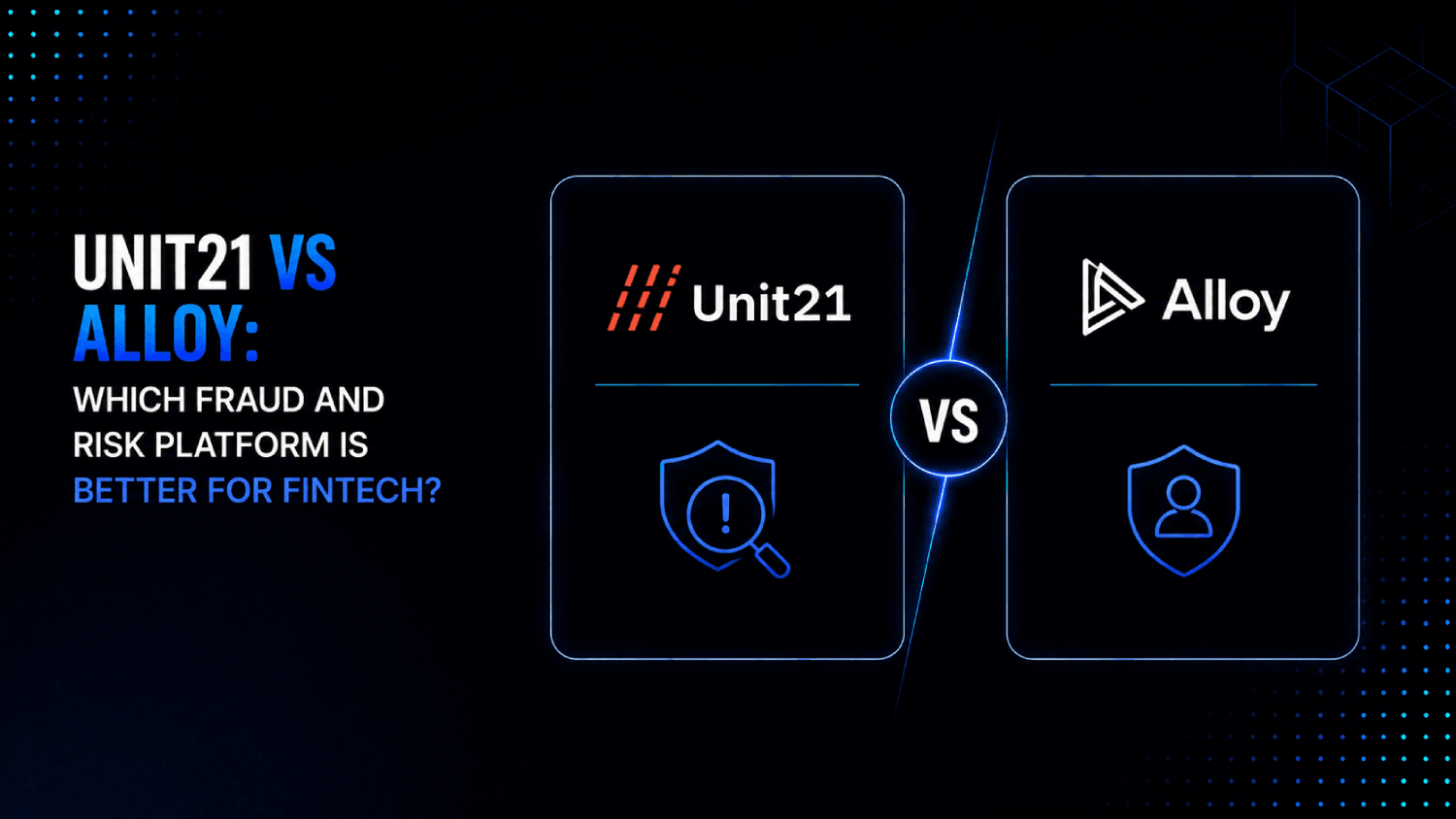

- Unit21 wins on transaction monitoring depth and fraud case management. Alloy wins on identity orchestration and onboarding decisioning. They are not the same product wearing different clothes.
- If your core problem is post-onboarding fraud operations, alert triage, and AML case filing, Unit21 is the sharper tool. If your core problem is who to let in and how to decision that in real time across many data vendors, Alloy is built for that.
- Alloy covers more of the identity and KYC/KYB decisioning surface. Unit21 covers more of the ongoing transaction risk and investigation surface. Buying one does not replace the other.
- Neither vendor publishes standard pricing. Both require a sales conversation, and both carry contract minimums that make early-stage evaluation expensive in time if not in dollars.
- The companies most burned by this decision are the ones who chose based on feature page language rather than which operational workflow they actually needed to fix first.
Unit21 and Alloy are the two most commonly shortlisted platforms when a fintech risk team outgrows its point solutions. Unit21 is built around transaction monitoring, fraud rule management, and case investigation. Alloy is built around identity decisioning and onboarding orchestration, with transaction monitoring added on top. The vendor that fits your company depends entirely on whether your biggest risk problem sits at account opening or inside ongoing activity.
Unit21 vs Alloy: Quick Verdict and Choose-If Table
Unit21 is the better fit for companies whose primary operational pain is managing fraud alerts, writing and tuning detection rules, and running SAR/AML case workflows at scale. Alloy is the better fit for companies whose primary pain is real-time identity decisioning at onboarding, integrating multiple data vendors through a single workflow engine, and building step-up verification logic.
| Choose Unit21 if… | Choose Alloy if… |
|---|---|
| Your fraud ops team spends hours triaging alerts manually | Your onboarding pass/fail logic is hardcoded in your engineering team’s codebase |
| You need SAR filing, case management, and AML audit trails in one place | You need to orchestrate KYC, KYB, and step-up verification across multiple data vendors without rebuilding every time |
| Transaction monitoring is your compliance team’s core daily workflow | Identity risk at account opening is your highest-volume decisioning problem |
| You want a no-code rule builder your compliance team can own without engineering | You want a visual workflow builder your risk team can use to change onboarding logic without a code deploy |
| You process enough transaction volume that false positive rates directly affect ops headcount | You’re onboarding consumers or businesses at scale and approval rate optimization matters as much as fraud prevention |
| You have or are building toward a dedicated fraud investigation team | Your risk team is smaller and needs a platform that handles more decisioning automatically |
What Does Unit21 Actually Do?
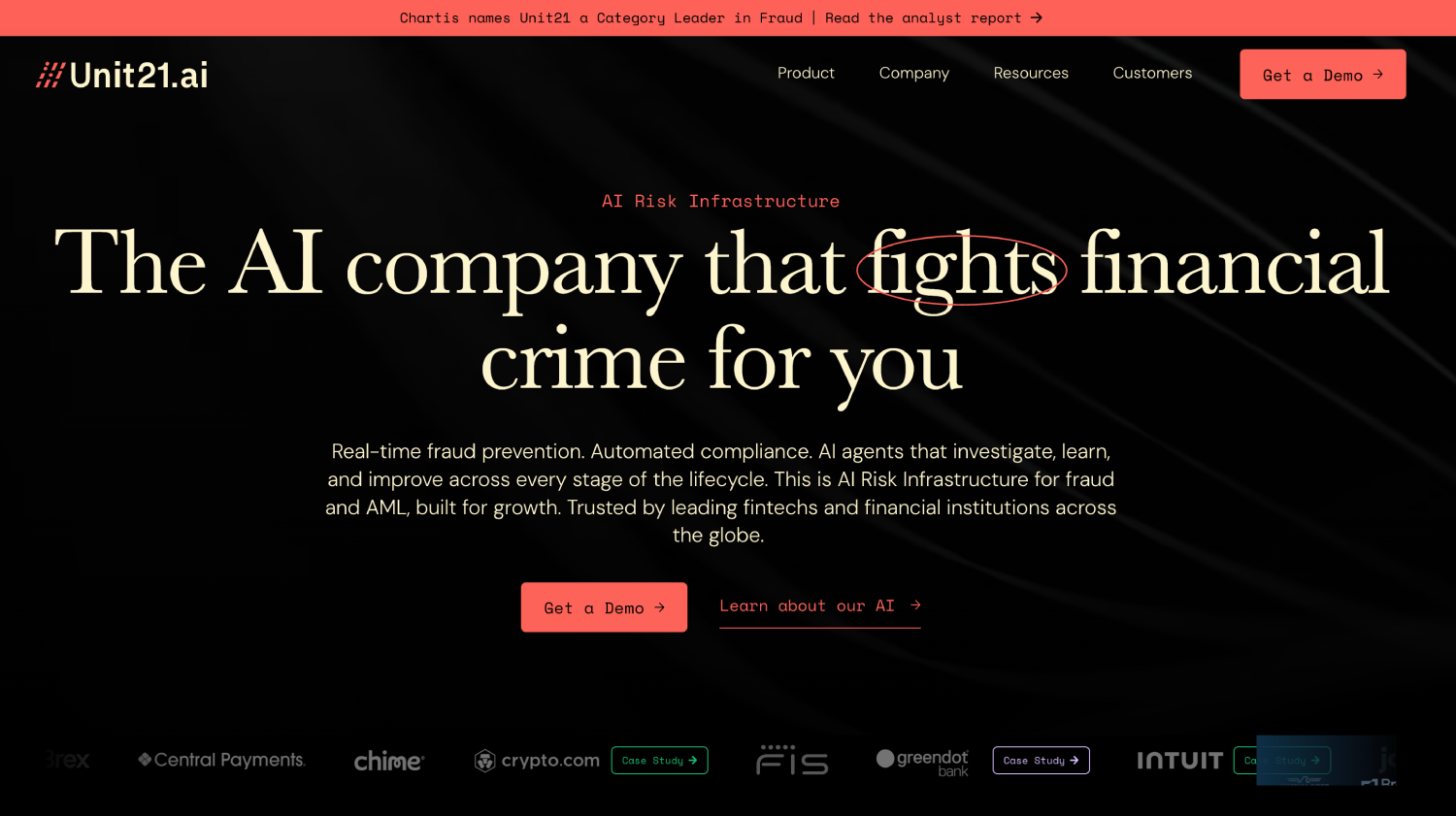
Unit21 is a fraud and AML operations platform. Its core product is transaction monitoring: ingesting transaction data, running it through configurable rules, surfacing alerts, and routing those alerts into a case management system where analysts investigate and file regulatory reports. The company describes its current direction as building agentic AI for financial crime operations, where AI agents handle investigation tasks that analysts previously did manually.
The platform covers rule-based and machine-learning detection, a no-code rule editor for compliance teams, a case management UI with SAR and CTR filing workflows, and integrations with payment processors, core banking systems, and data enrichment vendors. According to publicly available information, Unit21 counts companies like Gusto and DriveWealth among its customer base. The product is positioned specifically for fintech companies and banks that have dedicated fraud and compliance teams running daily alert review workflows.
Unit21 does not lead with identity verification or KYC at account opening. Its strength is what happens after someone is already a customer and transacting. If you’re thinking about fraud detection tools for fintech startups more broadly, the distinction between onboarding risk and post-onboarding risk is the most important filter to apply before any vendor evaluation.
What Does Alloy Actually Do?
Alloy is an identity decisioning and orchestration platform. Its primary function is connecting a fintech or bank to a network of identity data vendors, credit bureaus, document verification providers, and watchlist screening services, then letting risk teams build workflow logic that decisions each customer in real time without custom engineering for every data source.
Alloy does have a transaction monitoring product. According to its public product pages, Alloy’s transaction monitoring is positioned as part of its broader identity risk platform, designed to connect onboarding decisions to ongoing transaction behavior in one data layer. The difference from Unit21 is emphasis: Alloy’s transaction monitoring is an extension of an identity-first architecture, while Unit21’s is the center of the product.
Alloy’s workflow builder is its defining feature for most buyers. Risk teams can configure decision flows visually, run multiple data vendors in sequence or parallel, and update decisioning logic without a code deployment. For a team that has been asking engineering to update KYC thresholds via pull request, that alone justifies the evaluation. Our Alloy vs Persona comparison goes deeper on how Alloy’s identity orchestration stacks up against other platforms in the same category.
How Do Unit21 and Alloy Compare on Transaction Monitoring Depth?
Unit21 is purpose-built for transaction monitoring in a way Alloy is not. The rule builder in Unit21 is designed for compliance analysts: you can write rules based on transaction velocity, amounts, counterparties, and behavioral patterns without touching SQL or asking engineering. Alerts flow into a queue, get prioritized by risk score, and land in case management where analysts can add notes, attach documents, and file SARs directly from the case.
Alloy’s transaction monitoring does much of the same at a structural level, but its design heritage is onboarding decisioning, not investigation workflow. Teams that rely heavily on analyst-driven case review, SAR narrative writing, and AML audit trails tend to find Unit21’s case management UI more mature for that specific workflow. Alloy is stronger when transaction signals are being used to trigger step-up actions or feed back into an identity decision, rather than to populate an investigation queue.
For companies building toward a dedicated fraud ops function, the case management depth in Unit21 matters more than it looks on a feature comparison matrix. The difference is not just UI preference. It’s whether your compliance team can own their own workflow or whether they’ll always need a product or engineering handoff to make changes.
How Do Unit21 and Alloy Compare on Identity Orchestration?
Alloy wins this dimension clearly. The platform was designed from the ground up to connect multiple identity data vendors, run them in configurable sequences, and decision the output through logic your risk team controls. You can run a credit bureau hit, then a watchlist check, then document verification only if the first two steps return ambiguous results, all in a visual flow with no code changes required to update the logic.
Unit21 does not offer this kind of identity orchestration. It integrates with identity verification vendors as data inputs, but it does not provide a workflow engine for building and updating KYC or KYB decisioning flows. If your onboarding process requires coordinating Socure, Alloy, Persona, or similar providers under a single orchestration layer, Unit21 is not the tool for that job. Alloy is.
The practical implication: many fintech companies run both. Alloy handles onboarding decisioning and initial identity risk scoring. Unit21 handles the ongoing transaction monitoring and case management for customers already inside the product. The platforms are not natural competitors in the way their similar feature-page language suggests. They cover adjacent but distinct operational surfaces.
The FintechSpecs Fraud Stack Fit Test
Most vendor evaluations in this category fail because teams compare feature lists rather than matching the tool to the specific workflow bottleneck. The FintechSpecs Fraud Stack Fit Test is a four-question diagnostic for mapping your actual operational pain to the right product layer before committing to a proof of concept.
Question 1: Where does your fraud team spend most of its time? If the answer is reviewing alerts and writing SARs, your bottleneck is investigation workflow. That points to Unit21. If the answer is updating onboarding rules and chasing engineering for logic changes, your bottleneck is decisioning orchestration. That points to Alloy.
Question 2: Is your highest-volume risk event at account opening or post-account activity? Account opening at scale points to Alloy’s orchestration layer. Post-account transaction volume points to Unit21’s monitoring and case management layer.
Question 3: Do you need to coordinate multiple data vendors or work within a single vendor’s detection model? Multi-vendor orchestration is Alloy’s core competency. Single-layer detection with deep rule configuration is Unit21’s.
Question 4: Who owns the platform day-to-day? If it’s a compliance analyst with no engineering support, Unit21’s no-code rule builder and case management UI are built for that user. If it’s a risk product manager coordinating decisioning logic across onboarding and transactions, Alloy’s workflow builder fits better.
Run all four questions before any vendor demo. Where the answers cluster tells you which operational layer is actually broken. Teams that skip this step tend to buy the platform with the better sales motion rather than the one that solves the right problem. The broader framework for this kind of pre-purchase rigor is covered in the fintech vendor evaluation guide.
How Does Integration Work for Each Platform?
Unit21 ingests data through APIs and pre-built connectors. Implementation typically involves sending transaction event data to Unit21’s API, configuring the rules and alert routing, and training analysts on the case management interface. Engineering involvement is heavier upfront during data integration, but the ongoing operational model shifts to the compliance team once the pipes are in place. Unit21 has documented integrations with payment processors, ledger systems, and core banking providers, though the exact connector library is not fully disclosed publicly.
Alloy’s integration model is similar at the API level but differs in scope. Because Alloy connects to many third-party data vendors on your behalf, the integration effort involves configuring which vendors to use, in what order, and what to do with their outputs, rather than just piping your own data in. For companies that have been managing five separate vendor API integrations for identity, that consolidation is a real operational win. The tradeoff is that Alloy’s decisioning logic lives inside Alloy’s platform, which creates some vendor dependency on the onboarding workflow.
Both platforms are enterprise sales with implementation support, not self-serve products you spin up in a weekend. Teams evaluating either vendor should plan for a multi-week integration and configuration period before going live at production volume. For a broader picture of how fraud and risk tools fit into fintech infrastructure, the fintech infrastructure stack map provides useful context on where each layer sits.
What Are the Pricing Models and Contract Minimums?
Neither Unit21 nor Alloy publishes standard pricing on their websites. Both are enterprise products sold through a direct sales process, with pricing typically tied to transaction volume, number of users, and which product modules are included.
| Dimension | Unit21 | Alloy |
|---|---|---|
| Pricing model | Not publicly disclosed; typically volume-based | Not publicly disclosed; per-decision pricing referenced in third-party alternative comparisons, though we cannot independently verify the specific rate |
| Contract minimum | Not publicly disclosed | Not publicly disclosed |
| Self-serve option | No | No |
| Trial or sandbox | Available on request per sales process | Available on request per sales process |
| Pricing transparency | Requires sales conversation | Requires sales conversation |
One pattern worth noting: third-party Alloy alternative comparisons reference per-decision pricing as a concern for high-volume fintech teams, suggesting that unit economics can deteriorate at scale if onboarding volumes are high. FintechSpecs has not independently verified a specific per-decision rate from Alloy’s public materials; if this is a live variable in your evaluation, push the sales team for explicit volume tier illustrations. Unit21’s pricing model is described more consistently as volume-based on transactions monitored. If you are running more than a few million decisions per month, the pricing structure of each vendor deserves explicit negotiation rather than accepting the initial quote. The hidden costs in fintech SaaS margins article covers the category of vendor pricing structures that look reasonable in pilot but compress at scale.
How Do Unit21 and Alloy Handle Compliance Ownership?
Unit21’s design philosophy puts compliance teams in the driver’s seat. The no-code rule editor, the alert management system, and the SAR/CTR filing workflow are all built so a compliance analyst can operate the platform without opening a ticket to engineering. This is not a minor UX preference. For regulated companies where the compliance team needs to demonstrate ownership of their AML program to examiners, the ability to show that rule changes, alert reviews, and regulatory filings all happened inside a system the compliance team controls is operationally valuable.
Alloy’s compliance ownership model is similar in intent but different in practice. The workflow builder is designed for risk and compliance teams, not engineers. But because Alloy’s platform governs onboarding decisioning, changes to the platform can have immediate customer-facing consequences in a way that a transaction monitoring rule change typically does not. That creates a different governance dynamic, one where your risk team may need closer collaboration with product to make platform changes safely.
For companies navigating their first BSA/AML exam or building out a formal AML program, Unit21’s audit trail and case documentation structure is more directly mapped to what an examiner expects to see. The fintech product and compliance readiness checklist walks through the documentation and workflow requirements that most early-stage teams underestimate.
What Does Support Look Like for Each Vendor?
Both Unit21 and Alloy are enterprise vendors with dedicated customer success and implementation support baked into contract terms. Neither offers community-forum support as a primary tier, which reflects the compliance-sensitive nature of the product category. Public reviews for Unit21 specifically mention that the platform is well-suited for compliance teams, with support that understands regulatory workflows rather than just technical integrations.
Alloy has built a reputation for strong onboarding support, given that its implementation typically involves coordinating multiple third-party data vendors and configuring decision logic that goes live in production. The complexity of that implementation means a bad support experience during setup is particularly costly, and the company has structured its customer success function accordingly.
One practical difference: Unit21’s support tends to be evaluated by fraud operations teams who care about detection quality and case workflow. Alloy’s support is evaluated by risk product teams who care about decisioning logic and data vendor coordination. The support interaction is fundamentally different in character, reflecting the different buyer persona each platform serves.
How Do Unit21 and Alloy Compare on AI and Machine Learning Features?
Unit21 has publicly positioned itself around agentic AI for financial crime operations. According to the company’s own product positioning, the direction is toward AI agents that handle detection and investigation tasks, self-improving with each analyst decision. This is a meaningful architectural bet: the model learns from the feedback loop of human reviewers approving, dismissing, or escalating alerts. For companies with enough alert volume to generate meaningful training signal, that feedback loop compounds over time.
Alloy uses machine learning within its decisioning models for identity risk scoring, applying it across the data signals it aggregates from its vendor network. The ML layer in Alloy is less visible to the end user because it sits inside the risk score output rather than being surfaced as an explicit investigation tool. Neither company publishes model performance benchmarks publicly, so any claims about false positive rates or detection accuracy require direct testing against your own data during a proof of concept.
Teams evaluating AI features in either platform should ask one specific question during the demo: who owns the model training data, and what happens to it when you leave? Model portability and data ownership clauses in enterprise contracts for ML-enabled platforms are worth reviewing carefully before signing. This is one of the critical mistakes teams make when choosing fintech infrastructure: evaluating features without evaluating the contractual terms that govern them.
What Is the Switching Cost for Each Platform?
Switching cost for Unit21 is primarily operational, not technical. The alert history, case notes, SAR filing records, and rule configurations built inside Unit21 over time represent institutional knowledge about your fraud patterns. Exporting that history and reconstructing it in another platform is painful and time-consuming. The longer your compliance team has been working inside Unit21, the higher the effective switching cost, even if the API migration itself is straightforward.
Switching cost for Alloy is higher on the technical side. Because Alloy sits in your onboarding flow as a decisioning layer, replacing it means rebuilding the integration with each identity data vendor, re-implementing the decision logic, and testing the new flow against production-equivalent data before going live. That is a multi-month engineering project for most teams. The switching cost for Alloy is effectively the cost of the original implementation, repeated.
Consider this scenario: a Series B neobank that onboards 50,000 users per month using Alloy for KYC decisioning and Unit21 for post-onboarding transaction monitoring. If that team decides to replace Alloy, they are re-integrating multiple data vendors and rebuilding decisioning logic that has been tuned over months of production data. If they decide to replace Unit21, they are migrating case history and retraining analysts on a new investigation UI. Both are real costs, but the Alloy migration is the more engineering-intensive of the two.
Unit21 vs Alloy: Full Feature and Fit Comparison
| Category | Unit21 | Alloy |
|---|---|---|
| Core product focus | Transaction monitoring, fraud case management, AML operations | Identity decisioning, onboarding orchestration, KYC/KYB workflow |
| Transaction monitoring | Deep, purpose-built, rule + ML-based | Available, but secondary to identity focus |
| Case management and SAR filing | Full workflow, built for compliance teams | Limited relative to Unit21 |
| Identity orchestration | Not a core product | Primary product strength |
| No-code rule editor | Yes, for compliance team ownership | Yes, for decisioning logic (onboarding focus) |
| Multi-vendor data integration | Integrates with vendors as data sources | Orchestrates multiple vendors inside decisioning flows |
| AI/ML features | Agentic AI investigation, rule self-improvement | ML risk scoring within identity decisioning |
| AML audit trail and regulatory documentation | Strong, examiner-ready case documentation | Present, but not the product’s primary design priority |
| Primary buyer persona | Fraud ops, compliance officer, AML analyst | Risk product manager, head of fraud, onboarding team |
| Typical company stage | Series A and beyond with active fraud ops team | Series A and beyond with onboarding decisioning complexity |
| Pricing model | Volume-based, not publicly disclosed | Per-decision referenced in third-party sources, not independently verified; not publicly disclosed by Alloy |
| US market coverage | US-focused with bank and fintech customers | US-focused with broad data vendor network |
Frequently Asked Questions About Unit21 vs Alloy
What does Unit21 do?
Unit21 is a fraud and AML operations platform designed for fintech companies and banks. It provides transaction monitoring with configurable rule and ML-based detection, a no-code rule editor for compliance teams, alert management and prioritization, and a case management system with SAR and CTR filing workflows. The platform is built for companies with dedicated fraud and compliance teams who need to own their detection and investigation workflows without constant engineering support. Unit21 has publicly positioned itself toward agentic AI that automates investigation tasks inside the case management workflow.
Who are Alloy’s competitors?
Alloy’s direct competitors in identity decisioning and onboarding orchestration include Persona, Socure (as an orchestration layer), and Sardine. In the transaction monitoring layer, Alloy competes with Unit21 and Hawk AI. In the KYB-specific layer, Alloy competes with Middesk, as covered separately in our Alloy vs Middesk comparison. The market is segmented enough that most fintech companies run one identity orchestration platform and one transaction monitoring platform rather than choosing a single winner.
Is Alloy a fintech company?
Alloy is a fintech infrastructure company, not a consumer fintech. It sells software to banks, credit unions, and fintech companies to help them manage identity decisioning and fraud risk. Alloy does not hold any customer funds, originate loans, or issue cards. It operates as a B2B vendor in the fintech compliance and risk tooling category. The company is US-based and serves US financial institutions as its primary market, with its product built around the data vendor network relevant to US identity verification.
Who is the co-founder and CEO of Unit21?
Unit21 was co-founded by Trisha Kothari and Clarence Chio. Trisha Kothari serves as CEO. The company is headquartered in San Francisco and has raised venture funding from investors including Tiger Global. Clarence Chio has a background in machine learning and security research. The founding team’s background in financial crime detection and ML has shaped Unit21’s product direction toward analyst-augmenting AI and agentic investigation workflows.
Can you use Unit21 and Alloy together?
Yes, and many fintech companies do. Alloy handles identity decisioning at onboarding, deciding who to approve, reject, or send through step-up verification. Unit21 handles ongoing transaction monitoring, fraud detection, and case management for customers who pass onboarding. The platforms serve different operational layers and are not redundant in that configuration. The combined stack is more expensive and more complex than either vendor alone, but it is a recognized pattern at fintech companies that have separate compliance and risk product functions.
Which platform is better for AML compliance at an early-stage fintech?
Unit21 is better suited for AML compliance operations specifically. Its case management system, SAR filing workflow, and audit trail are built to satisfy the documentation requirements of a BSA/AML program. Alloy’s transaction monitoring can support AML compliance, but its depth in investigation workflow and regulatory filing is less developed. An early-stage fintech building its first AML program should evaluate Unit21 for the operational compliance layer, while separately evaluating Alloy or Persona if onboarding decisioning is also a bottleneck. The AML transaction monitoring software comparison covers additional options at different price points.
What is the difference between fraud orchestration and identity orchestration?
Fraud orchestration refers to coordinating multiple fraud signals, rules, and models to make a single risk decision about a transaction or account event, typically post-onboarding. Identity orchestration refers to coordinating multiple identity data vendors and verification steps to make a decision about who a person is during onboarding or a re-verification event. Alloy is primarily an identity orchestration platform. Unit21 is closer to fraud operations infrastructure. The distinction matters because the signals, data vendors, decisioning logic, and operational workflows are fundamentally different for each use case. The fraud orchestration platforms comparison covers the post-onboarding side of this in more depth.
Does Unit21 or Alloy offer better integration with banking-as-a-service platforms?
Both vendors integrate with major banking-as-a-service platforms, though the nature of the integration differs. Unit21 typically integrates at the transaction data layer, receiving events from BaaS providers like Unit, Synapse successors, or Stripe Treasury to run monitoring against. Alloy integrates at the identity layer, often sitting alongside or inside the BaaS onboarding flow to decision new account applications. For teams building on BaaS infrastructure, both integrations may be relevant. The banking-as-a-service platform comparison covers which BaaS providers have the strongest existing vendor integrations.
The Decision Most Teams Get Wrong
The default failure mode in this evaluation is treating Unit21 and Alloy as substitutes and picking one based on which sales team runs a more impressive demo. The more useful framing is sequential: identify which operational layer is creating the most friction today, solve that first, and plan the second layer as a follow-on decision. A team drowning in manual SAR filings needs Unit21. A team whose compliance team is still emailing an engineering backlog every time a KYC threshold needs updating needs Alloy.
If you are genuinely trying to solve both problems at once, the honest answer is that you probably need both platforms, or you need to accept meaningful capability gaps in one area while the other is prioritized. That is a legitimate business decision, not a vendor failure. Companies spending real money on risk infrastructure should go into contract negotiations knowing exactly which operational workflow they are buying, not a feature list that sounds like everything they need.
The word that does not appear enough in fintech vendor evaluations is “sequencing.” Pick the problem you have today. Sign the shorter contract you can negotiate. Prove the ROI in one layer before adding the second. Both Unit21 and Alloy are capable enough that the implementation and adoption work is the real constraint, not the feature set. For teams still mapping out where fraud and compliance tooling fits across the full stack, the tools fintech ops teams actually use is a useful cross-reference before committing to any single vendor conversation.