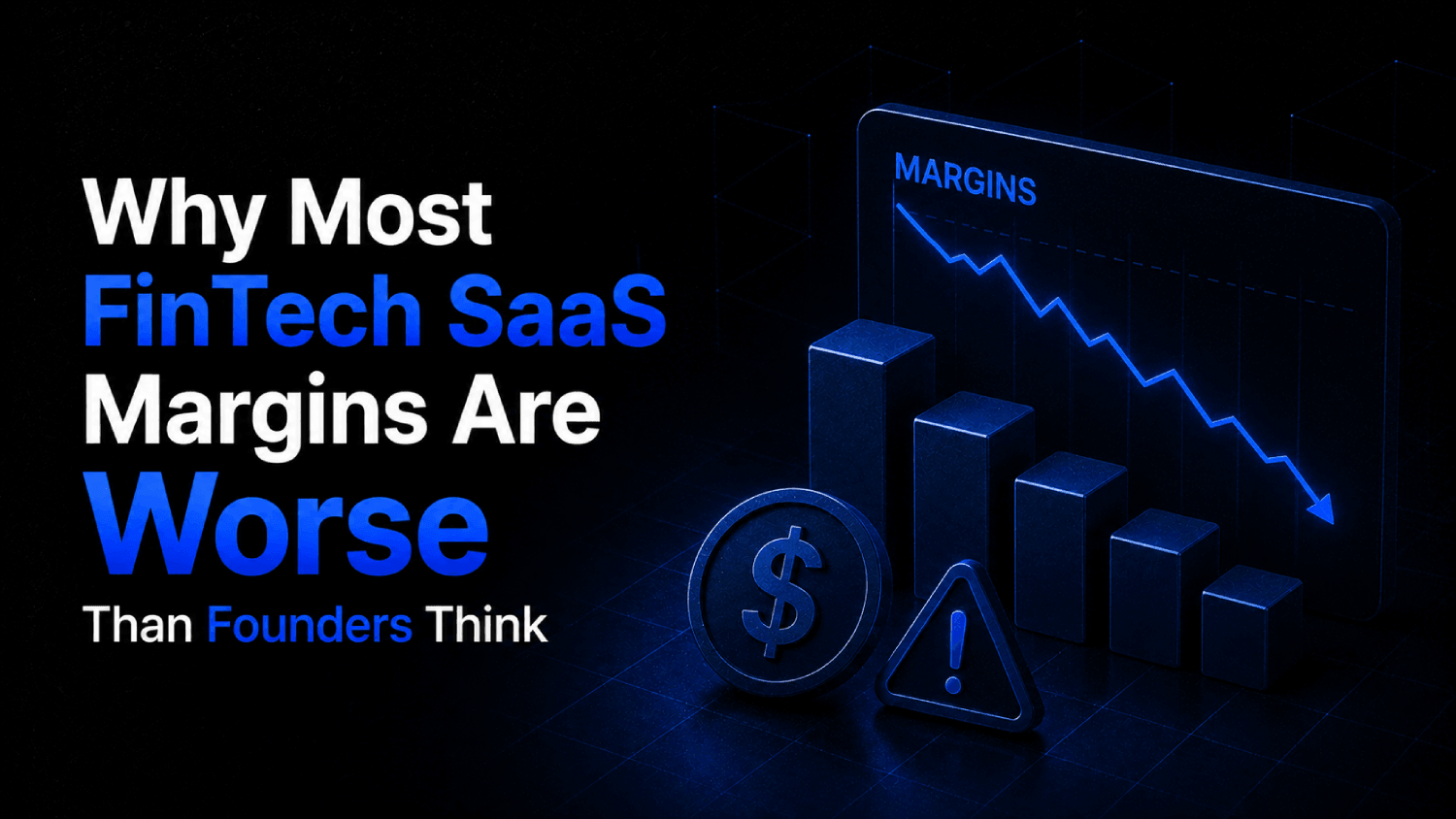

- Fintech SaaS gross margins typically run 10 to 30 percentage points below pure software benchmarks, and most founders do not see it until the P&L forces the conversation.
- The gap comes from six distinct cost buckets: payment processing, compliance, fraud, financial infrastructure, customer support, and partner revenue share. Each one is structural, not a startup tax you grow out of.
- Gross margin is only half the picture. Fintech unit economics live or die at the contribution margin level, where CAC payback and per-customer support costs can erase what gross margin left standing.
- Stage matters. A seed-stage fintech and a Series B fintech face the same cost categories but in very different proportions. Early companies are compliance-heavy; later ones get hit by support and fraud scale.
- The path to 70-plus percent gross margin in fintech exists, but it requires specific architecture decisions, not just growth.
Fintech SaaS gross margins are structurally lower than traditional SaaS margins because fintech companies carry cost-of-revenue burdens that pure software businesses do not: payment processing fees, banking infrastructure costs, compliance overhead, fraud losses, and partner revenue splits. A typical pure SaaS company targets 70 to 85 percent gross margin. A fintech SaaS company handling payments, lending, or embedded banking commonly lands between 40 and 65 percent at the gross margin line, depending on product mix and how much financial volume runs through the platform.
Why Do Founders Consistently Overestimate Their Fintech SaaS Margins?
The mental model most founders bring from traditional SaaS is not wrong for software. It is wrong for fintech. A pure SaaS company’s cost of revenue is almost entirely infrastructure hosting, third-party APIs, and a thin customer success layer. Those costs scale slowly relative to revenue. Fintech is different because revenue is often tied to financial volume, and financial volume carries costs that are linearly or near-linearly correlated to that volume.
If your revenue comes from a 1.5 percent take rate on payments processed, and you pay 0.9 percent in interchange and processing fees to move that money, your gross margin on that revenue line is not 80 percent. It is 40 percent before you touch a single engineering salary, support agent, or compliance tool. That math surprises founders who modeled their business at the ARR level without breaking down what each revenue dollar actually costs to produce.
There is also a categorization problem. Many fintech teams put compliance staff in G&A, fraud tooling in product costs, and support in S&M. When those get reclassified properly during a Series B diligence process or an audit, the gross margin number drops and nobody has a clean explanation. The costs were always there. They were just in the wrong bucket.
What Are the Six Core Cost Buckets Destroying Fintech Gross Margins?
1. Payment Processing and Interchange
Payment rails are not free. Stripe’s public pricing starts at 2.9 percent plus $0.30 per transaction for standard card processing. Adyen uses an interchange-plus model that can be cheaper at volume but still puts real basis points against every transaction. If your platform handles payments on behalf of customers and takes a margin on that volume, your processing costs go directly into cost of revenue.
The worst scenario is when a fintech embeds card issuing or ACH transfers and prices them as a subscription feature. The subscription revenue is high-margin. The underlying financial volume is not. When investors or CFOs look at blended gross margin, they see the combined picture, which can look closer to a payments company than a software company. Keeping payment revenue and software revenue as separate line items is not just good accounting. It is how you defend your multiple.
2. Banking-as-a-Service and Infrastructure Partners
Banking-as-a-Service platforms like Unit, Treasury Prime, Synapse (before its collapse), and Column charge in ways that are easy to underestimate during vendor selection. Some charge per active account per month. Some take basis points on deposit balances or interchange revenue. Some charge per transaction plus a platform fee. Those costs sit directly in your cost of revenue because without that infrastructure, you have no product to sell.
A company processing significant ACH volume, maintaining FDIC-insured accounts, or issuing virtual cards is paying its BaaS provider on every unit of activity. That cost does not compress meaningfully until you hit serious volume or negotiate custom contracts. Early-stage fintechs often face BaaS costs that represent 15 to 25 percent of their financial product revenue before anything else gets counted.
3. Compliance and Regulatory Overhead
Compliance is the cost bucket that surprises people most because it lives partly in headcount and partly in tooling, and neither scales the way software costs do. KYC and KYB verification vendors like Plaid, Persona, or Alloy charge per verification, per user, or per event. A fintech onboarding thousands of SMBs pays for every single KYB check, every re-verification, and every manual review triggered by a failed automated check.
Then there are the humans. Compliance officers, BSA/AML analysts, and legal counsel are not cheap, and they are not optional if you handle money. The fintech compliance readiness checklist covers what this function actually requires, but from a margin standpoint: based on typical fully loaded headcount costs, a compliance team of three to five people at a Series A fintech can easily represent five to eight percent of revenue. That belongs in cost of revenue if those people’s primary job is keeping the product operational and licensed.
4. Fraud and Risk Management
Fraud losses are a direct hit to gross margin that most founders treat as an operating exception until it becomes a pattern. For fintech companies handling real money, fraud is a cost of doing business. Tools like Stripe Radar, Sardine, or purpose-built fraud detection platforms reduce losses but do not eliminate them, and they carry their own per-transaction or monthly platform costs.
The calculation that matters is: what is your net fraud loss rate as a percentage of payment volume, plus the cost of your fraud tooling, plus the cost of the operations staff handling disputes and chargebacks? For consumer fintech especially, that combined number often lands between one and three percent of payment volume. On a thin take-rate product, that can wipe out half the margin on a given transaction.
5. Customer Support at Financial Stakes
Support costs in fintech are higher than in typical SaaS for two reasons. First, the stakes per ticket are higher. A user locked out of their account has actual money at risk. A failed payment has real business consequences. Those tickets take longer to resolve and require more skilled agents. Second, regulatory requirements in some jurisdictions mandate specific response time windows for financial products, which limits how much you can offshore or automate.
A B2C fintech with 100,000 active users might handle 10,000 support contacts per month at an average handle time of 8 to 12 minutes per contact. That volume requires real headcount. When you calculate the fully loaded cost of that team and divide it by monthly revenue, it often lands at three to seven percent of revenue as a cost-of-revenue line, not a G&A line.
6. Revenue Share and Partner Economics
If you distribute through a bank partner, payment network, or insurance carrier, you likely share revenue with them. A fintech issuing credit through a bank partner commonly shares 20 to 40 percent of net interest margin or fee revenue with that bank. A payments facilitator using a payfac-as-a-service model like Payrix or Stripe Connect gives up a cut of the economics to the underlying infrastructure provider.
These revenue shares are frequently excluded from COGS modeling in early-stage forecasts because founders think of the full take rate as revenue. The correct accounting treatment is to show the revenue share as a cost-of-revenue item, which immediately compresses gross margin by whatever percentage you are sharing.
What Do Fintech SaaS Gross Margins Actually Look Like by Stage?
| Company Stage | Typical Gross Margin Range | Dominant Cost Pressures | Notes |
|---|---|---|---|
| Pre-revenue / Seed | Not meaningful | Compliance setup, infrastructure minimums | Fixed costs before revenue make GM calculations misleading |
| Series A ($1M to $5M ARR) | 35% to 55% | BaaS fees, KYC/KYB per-verification costs, compliance headcount | Unit costs are highest; volume discounts not yet negotiated |
| Series B ($5M to $20M ARR) | 45% to 65% | Fraud at scale, support headcount, revenue share | Infrastructure costs begin compressing; fraud and support grow |
| Series C+ ($20M+ ARR) | 55% to 75% | Engineering allocated to compliance, partner renegotiation overhead | Product mix and architecture decisions from earlier stages determine the ceiling |
| Public Fintech SaaS | 50% to 75% | Varies heavily by product mix (payments vs. pure software) | Companies with higher software revenue mix report higher gross margins |
These ranges are illustrative, based on the structure of fintech cost categories, and are not derived from a specific dataset. Actual margins vary significantly by business model. A lending platform has different cost drivers than a corporate card issuer or a payroll API. The ranges above reflect companies where financial volume runs through the product, not pure data or workflow SaaS that happens to serve financial institutions.
What Is the Margin Stack That Actually Matters in Fintech SaaS?
Gross margin is a starting point, not the destination. In fintech, the contribution margin framework tells a sharper story because it forces you to account for customer-level costs that sit below gross profit but above company-wide G&A.
| Margin Layer | What Gets Subtracted | Target Range (Mature Fintech SaaS) |
|---|---|---|
| Revenue | Nothing yet | 100% |
| Gross Margin | Payment processing, BaaS fees, KYC/KYB, fraud tooling, direct compliance costs, revenue share | 50% to 70% |
| Contribution Margin | Customer-specific support costs, onboarding costs, per-customer fraud losses | 35% to 55% |
| Operating Margin | S&M, R&D, G&A | Typically negative pre-Series C; -10% to +15% at maturity |
| EBITDA Margin | D&A added back | Varies widely; public fintech companies often run single-digit to mid-teens |
The contribution margin layer is where fintech unit economics analysis does its real work. A customer generating $1,200 in annual subscription revenue with $600 in direct costs (gross margin of 50 percent) might also require $200 in annual support costs and $80 in annual onboarding amortization. That leaves $320 in contribution margin, or 27 percent. If CAC was $900, payback is well over three years at the contribution level, even though it looks like 18 months at the gross margin level. That distinction is what fintech metrics that actually matter require you to track.
How Does Product Architecture Determine Your Gross Margin Ceiling?
Founders often treat margin improvement as a future problem. In fintech, the architecture decisions made in the first 18 months largely determine whether you can ever reach 70 percent gross margin. Three decisions in particular set the ceiling early.
Build vs. Buy on Financial Infrastructure
Companies that build directly on bank APIs or obtain their own money transmission licenses eventually reach lower variable costs per unit of financial activity than those that stack BaaS providers on top of each other. The tradeoff is capital intensity and time to market. A BaaS-dependent company might launch in six months and pay 20 percent of payment revenue to its infrastructure stack. A company that builds closer to the rails might spend 18 months and $2 million getting there, then enjoy 8 percent infrastructure costs at scale. The breakeven on that investment depends entirely on volume.
Revenue Mix: Software vs. Financial Volume
The single most reliable way to report high fintech SaaS gross margins is to have most of your revenue come from software subscriptions rather than payment volume. A platform that charges $500 per month per seat plus takes 0.5 percent of payments processed has a blended gross margin that is almost entirely determined by the software-to-payments revenue ratio. If software is 70 percent of revenue, blended gross margins look good. If payments volume starts dominating revenue because it grew faster, the same business now has a structurally different margin profile. Fintech SaaS pricing models that mix subscription and usage-based revenue need explicit gross margin tracking by revenue line, not blended.
Automation Depth in Compliance and Support
The difference between a fintech that reaches 65 percent gross margin at Series B and one stuck at 50 percent is often how much of compliance and support they have automated. KYB orchestration platforms that route verifications intelligently, chatbot-first support flows that deflect high-volume low-complexity tickets, and automated transaction monitoring that escalates only genuine anomalies can materially compress the human cost per customer at scale. That investment has to happen early enough to be trained on real data before you hit the volume where it matters.
Why Are Fintech Margins Hard to Benchmark Accurately?
Public fintech company gross margins vary so widely that industry-level benchmarks are almost useless for planning purposes. A payments processing company, a lending platform, an insurtech, and an SMB banking platform all call themselves fintech SaaS, but their cost structures share almost nothing. According to Stripe’s published SaaS margin guidance, a gross margin above 75 percent is typically considered good for SaaS businesses broadly. But that figure was built on the economics of pure software, not platforms running financial volume.
The better benchmark is company-specific and model-specific. A payments facilitator should benchmark against other payfacs. A credit underwriting API should benchmark against other credit infrastructure companies. Using the broad 70 to 80 percent SaaS benchmark to evaluate a fintech that processes $50 million in annual payment volume is the kind of category error that leads founders to present inflated gross margins to investors and then face uncomfortable questions during diligence. The checklist for scaling fintech SaaS to $10M ARR addresses this framing problem directly: know what type of fintech company you actually are before you pick your margin targets.
Which Fintech Business Models Achieve the Highest Gross Margins?
Pure software tools serving financial institutions, like compliance workflow platforms, regulatory reporting tools, or risk analytics products, can reach 75 to 85 percent gross margins because they do not touch financial flows directly. The customer is paying for the software, not the financial activity, and the vendor does not carry interchange, BaaS fees, or fraud exposure.
API-first fintech infrastructure companies in the middle of the stack, like credit decisioning APIs or bank data aggregation platforms, typically run 60 to 75 percent gross margins at maturity. Their variable costs are mostly infrastructure hosting, third-party data costs, and some compliance overhead, but they do not carry the full cost of financial rails or live deposit accounts.
Consumer and SMB neobanks, payments platforms, and embedded finance products that hold or move money directly are the hardest category. Their gross margins often sit in the 40 to 60 percent range because they carry the full stack of costs: processing, BaaS, KYC/KYB, fraud, compliance headcount, and support. Companies in this category that reach 70 percent gross margins have usually either reached sufficient scale to negotiate dramatically better infrastructure pricing, reduced their payments revenue share relative to software subscriptions, or both. The ways fintech companies monetize payments without degrading unit economics reflect the same dynamic: revenue structure determines margin structure.
What Hidden Costs Do Fintech Founders Consistently Miss?
Beyond the six major buckets, several smaller cost lines consistently escape early-stage cost-of-revenue modeling. Chargeback dispute management has both hard costs (the disputed amounts, dispute fees from card networks) and soft costs (the operations time to respond to each dispute). Network and card scheme fees from Visa and Mastercard are separate from interchange and add basis points to every transaction. Data retention and audit trail infrastructure for regulatory purposes costs real money at scale. Third-party sanctions screening, PEP checks, and adverse media monitoring for AML compliance are recurring per-event or per-customer costs that add up fast on a growing customer base.
The hidden costs killing fintech SaaS margins covers the full catalog. The pattern across all of them is the same: each line item looks immaterial individually, and collectively they represent 10 to 15 percentage points of gross margin that founders did not budget for.
Frequently Asked Questions
1. What is a good gross margin for a fintech SaaS company?
It depends heavily on product mix. A pure software product serving financial institutions can reasonably target 75 to 85 percent gross margins. A platform that also handles payments, holds deposits, or issues credit will typically run 50 to 70 percent at maturity. According to Stripe’s public SaaS guidance, above 75 percent is generally considered strong for SaaS broadly, but that benchmark applies less cleanly to fintechs with significant financial volume running through the platform. The more relevant question is whether your margins are improving quarter over quarter as volume grows.
2. Why are fintech SaaS margins lower than traditional SaaS margins?
Fintech companies carry cost-of-revenue items that pure software companies do not. Payment processing fees, banking-as-a-service platform costs, KYC and KYB verification expenses, fraud losses, compliance headcount, and revenue shares with bank or network partners all sit in or near cost of revenue. Each of those costs scales with financial activity, not with software revenue. A traditional SaaS company adding one new customer pays marginal hosting costs. A fintech adding one new customer also pays per-verification, per-transaction, and per-account costs that a pure SaaS company never sees.
3. What is the EBITDA margin for a typical fintech company?
Public fintech companies show wide variation. Fintechs with higher software revenue mix and lower direct financial volume costs generally report stronger EBITDA margins than payment processors or neobanks that carry large balance sheet risk or thin processing margins. Pre-profitability is common through Series B and into Series C, as growth investment typically outpaces margin improvement in the early stages. Most mature fintech SaaS companies targeting profitability aim for positive EBITDA margins in the single digits to mid-teens range, though most fintech companies do not publicly disclose specific targets outside of investor filings.
4. How does adding payments to a SaaS product affect gross margins?
Adding payments to a SaaS product lowers blended gross margins when payments become a meaningful share of total revenue, because payment economics carry processing, fraud, and infrastructure costs that software subscriptions do not. A SaaS product with 80 percent gross margins that adds a payments feature generating 40 percent gross margins will see its blended gross margin fall in proportion to how much of total revenue comes from payments. The strategic question is whether the lifetime value increase from payments justifies the margin compression, which it often does, but the business plan needs to model it explicitly rather than assuming software margins hold.
5. Can fintech gross margins improve with scale?
Yes, but not automatically. Margin improvement at scale requires three specific things: negotiating better pricing with BaaS providers and payment processors based on volume, increasing the share of revenue that comes from software subscriptions relative to financial volume, and automating compliance and support so headcount costs do not grow linearly with customers. Companies that do all three can push fintech gross margins from 50 percent at Series A to 65 to 70 percent at Series C. Companies that do not actively manage those levers can see margins stay flat or compress as fraud and support costs grow faster than infrastructure savings.
6. How should fintech companies classify compliance costs in their P&L?
Compliance costs that are directly required to operate the financial product, such as KYC verification fees, KYB check costs, transaction monitoring tooling, and compliance officer headcount dedicated to product operations, belong in cost of revenue. Compliance costs that relate to the company’s overall licensing, legal counsel, and board reporting more commonly sit in G&A. The distinction matters because misclassifying compliance into G&A overstates gross margin. Investors doing serious diligence will reclassify those costs, so it is better to get the categorization right in your own reporting before that conversation happens.
7. What is the difference between gross margin and contribution margin in fintech?
Gross margin subtracts direct cost-of-revenue from total revenue. Contribution margin goes one level deeper and also subtracts customer-level variable costs that sit below gross profit: dedicated customer support costs per account, onboarding cost amortization, and per-customer fraud losses that may not be captured in COGS. In fintech, contribution margin is often 10 to 20 percentage points below gross margin because support and fraud costs per customer are significant. Contribution margin is the number that most directly drives CAC payback calculations, which makes it the more operationally relevant figure for growth-stage fintech companies.
8. What fintech business models have the best unit economics?
Vertical SaaS companies that sell compliance, risk, or reporting software to financial institutions tend to have the best unit economics because they carry no direct financial risk and have low variable costs per customer. API-first fintech infrastructure companies that sit in the data or decisioning layer also tend to show strong unit economics at scale. The harder unit economics belong to companies that move money directly, including neobanks, lending platforms, and payments facilitators. Those models can be highly valuable businesses, but they require either significant volume to compress variable costs or a premium pricing structure that covers the heavier cost base per customer.
The Mental Model That Changes How You Read a Fintech P&L
The most useful reframe for understanding fintech SaaS margins is this: fintech companies are operating two businesses simultaneously. There is the software business, which behaves like SaaS and earns high margins on logic and code. There is the financial services business, which behaves more like a financial intermediary and earns thin margins on volume, trust, and regulatory standing. The blended P&L is the weighted average of those two businesses, and the weight shifts every quarter based on which one is growing faster.
When a fintech is early, the financial services layer dominates because software revenue has not yet caught up with the fixed compliance and infrastructure investment required to run a licensed financial product. When a fintech matures, the margin quality of the blended business depends almost entirely on how much of its growth has come from the high-margin software layer versus the lower-margin financial volume layer. That is why two fintech companies at the same revenue scale can report gross margins that differ by 25 percentage points and both be telling the truth.
The investors who understand this do not ask “what is your gross margin?” They ask “what percentage of your revenue comes from software versus financial volume, what is the gross margin on each, and how is that mix trending?” Founders who can answer that question with clean data, and who have architecture decisions that improve both numbers over time, are the ones whose margin story holds up when it matters most.