
- According to 6sense research on B2B buyer anonymity, as many as 94% of B2B buyers use large language models during their purchasing process. That is not a traffic source. That is a shift in where decisions form.
- AI search changes the discovery phase most dramatically. Buyers arrive at vendor shortlists through conversations with ChatGPT or Perplexity, often before visiting a single vendor website.
- The fintech category is unusually exposed to this shift. Buyers ask complex, comparative, compliance-aware questions that map directly to what LLMs are good at answering.
- Vendors who optimize only for traditional SEO are building visibility in a channel that B2B buyers are increasingly leaving. The pipeline impact is structural, not cyclical.
- The buyer process has five stages where AI search intervenes: problem discovery, vendor shortlisting, comparison, validation, and internal buy-in. Each stage requires a different content response.
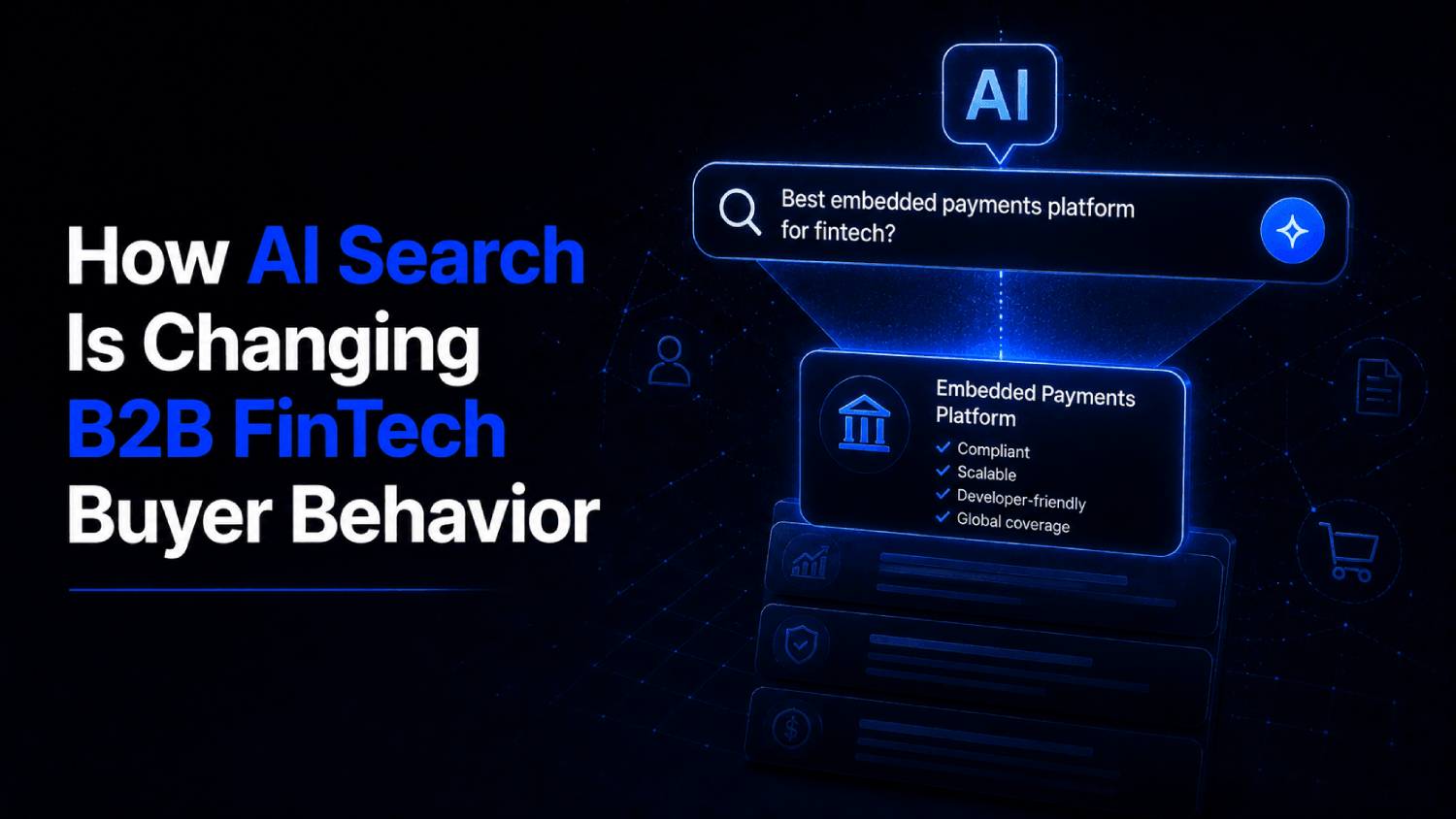
AI search changes B2B fintech buyer behavior because buyers now use tools like ChatGPT and Perplexity to ask comparative, context-specific questions long before they visit vendor websites. This compresses the traditional research funnel, moves shortlisting earlier in the process, and means vendors who are not cited by LLMs may never enter consideration at all. A strong website ranking in Google no longer guarantees discovery.
Why B2B Fintech Buyers Are Different from Other SaaS Buyers
Most B2B SaaS buying is complex. Fintech buying is a different tier of complex. The buyer at a Series B lending platform choosing a banking-as-a-service provider is not just evaluating features and pricing. They are evaluating regulatory exposure, data residency, uptime SLAs, AML obligations, and what happens if their infrastructure partner loses its bank sponsor.
These are not questions a product page answers. They are questions a buyer has to research across legal briefs, community forums, LinkedIn threads, and industry publications. Historically, that process took weeks. AI search compresses it to an afternoon.
The compression is not neutral. When a buyer types “which BaaS providers have the most stable bank sponsorship relationships for a Series B lender” into Perplexity, the answer shapes their shortlist before they have talked to a single sales rep. The vendors Perplexity names become the default consideration set. Vendors it omits start from zero, or do not start at all.
How Do Fintech Buyers Actually Use ChatGPT and Perplexity During Research?
The queries fintech buyers run through AI tools are not keyword-style searches. They are natural language questions that carry context, constraints, and comparative intent simultaneously. A CFO evaluating payment infrastructure does not search “payment processing tools.” They ask: “What payment processing provider is best for a B2B SaaS company with $3M in monthly volume that needs multi-currency support and a clean revenue recognition output for their audit?”
That is one query. It encodes company stage, transaction volume, geographic requirements, and a downstream accounting concern. No traditional search result handles it in a single answer. An LLM attempts to.
According to 6sense’s published B2B buyer research, 94% of B2B buyers now use AI tools during their research process. The shift is not generational. CFOs in their 50s use Perplexity to pull competitive comparisons. Engineering leads use ChatGPT to evaluate API documentation quality before scheduling a demo. The behavior is spreading across roles because the tool genuinely speeds up a painful process.
The Five-Stage AI Search Map for B2B Fintech Buyers
At FintechSpecs, we map fintech buyer behavior across five stages where AI search actively intervenes. We call this the PSCVI Framework: Problem, Shortlist, Compare, Validate, Internalize. Each stage is distinct. Each requires a different type of content to maintain visibility.
Stage 1: Problem Discovery
The buyer knows something is wrong before they know what to buy. A VP of Finance at a payments company sees margin compression and suspects payment processing fees are eating more than they should. They open ChatGPT and ask a diagnostic question: “Why are payment processing costs higher for B2B SaaS than typical SaaS margins?”
At this stage, the buyer is not ready for a vendor pitch. They want a framework to understand their problem. AI tools pull from educational content, industry explainers, and published analyses. Vendors whose content explains the problem clearly and accurately get named here. Vendors who only publish product marketing do not.
For fintech specifically, problem-stage queries tend to cluster around compliance costs, margin structure, infrastructure decisions, and growth blockers. Content that maps to those concerns, written at the depth an operator actually needs, earns early-stage AI citations.
Stage 2: Vendor Shortlisting
Once the buyer understands their problem, they ask for a solution overview. “What are the main payment infrastructure options for a B2B SaaS company processing $3M monthly?” is a Stage 2 query. The buyer wants a map of the category before they go deep on any one option.
This is where AI search diverges most sharply from traditional SEO. A Google search for this query returns a mix of landing pages, review sites, and blog posts. The buyer has to synthesize across sources. An LLM synthesizes for them. It produces a list of four to six vendors with a sentence or two of context on each. That list is the shortlist. Getting onto it is not guaranteed by ad spend or domain authority. It requires being the kind of source that AI tools trust enough to cite.
Stage 3: Comparison
The buyer has a shortlist. Now they want to understand the trade-offs in detail. “Stripe versus Adyen for a B2B SaaS company going upmarket, which has better enterprise contract flexibility?” is a Stage 3 query. It is comparative, specific, and often contains hidden concerns (in this case, the word “flexibility” is a proxy for “we’ve been burned by rigid pricing before”).
LLMs handle comparison queries by pulling from published comparisons, structured data, and named analyses. Vendor websites that only describe themselves in positive terms perform poorly here. Independent editorial sources that name both products and explain real trade-offs perform well. This is one reason fintech buyers increasingly cite independent publications when explaining how they built their shortlists.
Our own analysis of the Stripe versus Adyen trade-offs for B2B SaaS covers exactly the kind of comparison-stage content an LLM retrieves when a buyer asks that question to ChatGPT.
Stage 4: Validation
The buyer has a preferred vendor. Now they are looking for reasons not to choose them. This is the most underappreciated stage in the AI search process. Validation queries sound like: “What are the biggest complaints about Adyen from B2B SaaS companies?” or “Has anyone had compliance issues with [vendor]?” or “What does the contract with [vendor] actually lock you into?”
AI tools pull from review platforms like G2 and TrustRadius, community threads on Reddit and Hacker News, and editorial coverage that discusses known limitations. Vendors who have managed their narrative only on owned channels often look worse at the validation stage, not better, because the AI finds the unmanaged coverage instead.
Stage 5: Internal Buy-In
The buyer has made their decision. Now they have to sell it internally. A VP of Engineering who chose a new KYC provider still needs to convince their CFO. They often return to AI tools to build their internal case: “What are the strongest arguments for switching KYC providers when you are processing over 10,000 verifications a month?” or “How do I calculate ROI on a new fraud detection tool for a board presentation?”
Content that helps buyers win internal arguments, not just make personal decisions, earns strong retrieval at this stage. Case structures, ROI frameworks, and cost-of-inaction analyses give LLMs extractable reasoning to surface in response to these queries.
What Makes Fintech Especially Exposed to AI Search Shifts?
Three structural features of fintech buying make this category more affected by AI search than most SaaS verticals.
First, the questions are highly technical and contextual. A fintech buyer evaluating fraud detection tools cannot rely on generic comparison content. They need answers that account for their transaction volume, industry vertical, chargeback exposure, and regulatory jurisdiction. AI tools are better at synthesizing contextual answers than traditional search, so fintech buyers migrate to them faster.
Second, the stakes are high enough to justify thorough research. A fintech founder choosing the wrong payment processor versus merchant of record structure can create tax liability, revenue recognition complexity, and compliance exposure simultaneously. Buyers spend more time in research phases when the cost of being wrong is high. More time in research means more AI-assisted research.
Third, the fintech vendor space is fragmented and opaque. There is no single authoritative directory. Pricing is often not public. Contracts vary by customer size. AI tools that can synthesize this fragmented information into a coherent comparison earn heavy usage from fintech buyers specifically.
How AI Search Changes What “Visibility” Means for Fintech Vendors
Traditional SEO visibility means ranking on page one for target keywords. AI search visibility means being cited accurately and favorably when a buyer asks a relevant question to an LLM. These are related but not the same thing.
A vendor can rank first on Google for “best fraud detection software” and still be invisible in an AI-generated response to “what fraud detection tool is best for a marketplace with high dispute rates and EU data residency requirements.” The LLM is not pulling the page-one result. It is synthesizing from sources it considers authoritative for that specific, contextual question.
The content properties that earn AI citation are different from traditional SEO signals. Structured comparison content, clearly attributed data, named trade-offs, and editorial depth all improve AI retrieval. Thin landing pages with keyword density do not. This distinction is central to what separates generative engine optimization from traditional SEO for B2B SaaS.
What Type of Content Gets Retrieved by LLMs for Fintech Queries?
This is where the operational gap between knowing AI search B2B fintech buyer behavior has changed and knowing what to do about it becomes concrete. Based on the query patterns B2B fintech buyers actually run through tools like Perplexity and ChatGPT, the content types that earn citations share four properties.
Named comparisons with explicit trade-offs. Content that names two or more specific vendors and explains why one is better than the other in a defined scenario performs well in comparison-stage retrieval. Vague summaries that describe each vendor’s own marketing claims do not.
Content that cites named, dated sources earns more retrieval weight than unsourced claims. LLMs treat inline citations as authority signals. An article that references G2 data, a vendor’s public pricing page, or a regulatory agency document by name will outperform an article making the same claim without attribution.
Self-contained section answers improve retrieval because LLMs often pull one section of an article, not the whole piece. Each H2 in a well-structured fintech article should answer its own question completely. If it cannot stand alone, it will not be extracted.
Specificity about buyer context, particularly company stage, transaction volume, regulatory geography, and use case, signals to an LLM that the content is relevant to the kind of contextual query fintech buyers actually ask. Generic content about “enterprise fraud prevention” loses to specific content about “fraud prevention for seed-stage lending platforms processing under $1M monthly in the US.”
A Worked Scenario: How a Series B CFO Builds a Vendor Shortlist Without Talking to Sales
Consider a CFO at a Series B embedded finance company. They process roughly $8M per month, recently expanded to Canada, and are evaluating whether to switch their current payment infrastructure to something with cleaner multi-currency reconciliation. Their current provider works, but the accounting team spends three days per month manually reconciling CAD and USD transactions.
This CFO opens Perplexity. Their first query: “What are the main causes of multi-currency reconciliation problems for B2B SaaS companies using US-based payment processors?” The response synthesizes content from accounting publications, fintech editorial, and infrastructure vendor documentation. Three vendor names appear in the answer as examples of platforms with native multi-currency reconciliation. Two others are mentioned as common sources of the problem.
Their second query: “Stripe versus Adyen multi-currency reconciliation for a company processing $8M monthly with US and Canada operations.” The LLM compares fee structures, settlement timing, FX handling, and accounting integration depth. It pulls from comparison articles and cites two independent editorial sources by name.
By the third query, “what do finance teams actually complain about with Adyen reconciliation,” the CFO has a functional shortlist, a set of known risks to probe, and a list of questions for the first sales call. They have not visited a single vendor website. The entire first phase of their buying process happened inside an AI tool.
This is not a hypothetical future state. It is the current behavior pattern for technically sophisticated B2B buyers with complex requirements and limited time.
What This Means for Fintech Vendors and Marketers Right Now
The first-order implication is content strategy. Fintech vendors whose content library is mostly product-centric, top-line benefit focused, or keyword-stuffed for traditional search are building assets for a declining channel. The content that earns AI retrieval is educational, comparative, contextually specific, and honest about trade-offs.
The second-order implication is attribution. Pipeline from AI search does not look like organic traffic in a traditional analytics dashboard. A buyer who spent 40 minutes researching your product through Perplexity and then arrived via a direct URL or branded search will show up as direct traffic or branded search, not as organic. This is one reason fintech founders tracking growth metrics are increasingly running first-touch attribution surveys rather than relying solely on session data.
The third-order implication affects the entire go-to-market structure. If buyers are forming shortlists before engaging with sales, the role of sales development changes. The first sales call is no longer a discovery call. It is a validation call. The buyer already knows what problem they have, which vendors exist, and what questions to ask. Sales teams still running discovery scripts for buyers who arrived via AI-assisted research are operating with a stale playbook.
The FintechSpecs AI Visibility Audit: Five Checks for B2B Fintech Vendors
Before investing in GEO strategy, a fintech vendor should know where they currently stand. Here is a practical five-point audit you can run in under an hour.
- Citation check. Ask ChatGPT, Perplexity, and Google AI Overviews the top five comparison questions a buyer would ask in your category. Note whether your company is named, what context surrounds the mention, and what sources the LLM cites.
- Content depth check. Review your top five published assets. Assess whether each one answers a specific, contextual buyer question or whether it describes your product in general terms. Count how many contain named trade-offs or comparisons with competitor products.
- Source attribution check. Count how many of your published articles cite named external sources inline. Low citation density reduces LLM authority signals.
- Stage coverage check. Map each piece of content to one of the five PSCVI stages. Most fintech vendors find heavy coverage at the comparison stage and almost nothing at problem discovery or internal buy-in. Those gaps are where AI-invisible competitors become visible.
- Structured data check. Identify which pages include comparison tables, pricing breakdowns, or feature matrices in HTML format. LLMs extract structured data more reliably than prose comparisons. If your comparisons live in images or PDFs, they are not getting retrieved.
Frequently Asked Questions
How is AI search different from traditional search for B2B fintech buyers?
Traditional search returns a list of links. The buyer has to read multiple pages and synthesize the answer themselves. AI search returns a synthesized answer directly, often naming specific vendors with brief comparisons. For B2B fintech buyers, this means the shortlisting phase happens inside the AI tool rather than across multiple vendor websites. Vendors that are not cited in AI responses may never enter the buyer’s consideration set, regardless of their Google ranking.
How do fintech buyers use ChatGPT in vendor research?
Fintech buyers use ChatGPT and similar LLMs to run contextual, multi-constraint queries they cannot get answered by a single web page. Common patterns include problem diagnosis questions, vendor comparison requests with specific requirements baked in (transaction volume, geography, regulatory context), and validation queries designed to surface known weaknesses in a preferred vendor. The behavior spans job functions, from CFOs running cost analyses to engineering leads evaluating API quality.
What content types get cited by LLMs for fintech vendor queries?
LLMs prioritize content with named comparisons and explicit trade-offs, inline citations from named sources, structured data (HTML tables over prose lists), and contextual specificity about buyer type and use case. Editorial content from independent publications tends to outperform vendor-owned content because it carries implicit neutrality signals. Thin product marketing pages and keyword-dense landing pages with no analytical depth are rarely retrieved for complex buyer queries.
Does AI search affect pipeline attribution for fintech companies?
Yes, and significantly. Buyers who research through Perplexity or ChatGPT and then arrive via direct URL or branded search will not appear as organic traffic in standard analytics. This creates an attribution gap where AI-assisted pipeline looks like direct or branded demand. Fintech teams tracking growth metrics are increasingly adding first-touch attribution surveys and self-reported acquisition source fields at demo request to fill this gap.
What is the PSCVI Framework?
The PSCVI Framework is FintechSpecs’ five-stage model for mapping AI search intervention in the B2B fintech buyer process: Problem discovery, Shortlisting, Comparison, Validation, and Internal buy-in. Each stage represents a distinct AI query pattern and requires different content to maintain vendor visibility. Most fintech vendors have strong coverage at the comparison stage and weak coverage at problem discovery and internal buy-in, which are the stages where AI-assisted research increasingly starts and ends.
Why are fintech buyers more likely to use AI search than other B2B buyers?
Fintech purchases involve unusually high technical and regulatory complexity. A buyer evaluating payment infrastructure or fraud detection tools needs answers that account for transaction volume, geographic jurisdiction, compliance requirements, and downstream accounting implications simultaneously. AI tools handle multi-constraint, contextual queries better than traditional search, which makes them more useful for fintech buyers specifically. The higher cost of making a wrong infrastructure decision also motivates more thorough, AI-assisted research before any vendor contact.
How should fintech marketing teams respond to AI search behavior?
The primary response is a content strategy shift toward educational, comparison-oriented, deeply contextual material that covers all five stages of the buyer process. Beyond content, marketing teams need to rethink attribution models, since AI-assisted pipeline does not surface as organic traffic. Sales teams also need updated discovery playbooks, because buyers who arrive via AI-assisted research already know the category and are running validation questions, not orientation questions, on the first call.
Can a fintech vendor appear in AI search without a large content library?
Yes, but selectively. A single well-structured, contextually specific comparison article can earn strong LLM retrieval if it names real trade-offs, cites named sources, and uses structured HTML data. Volume of content matters less than depth and specificity. A vendor with ten high-quality, comparison-rich articles will outperform a vendor with a hundred thin product pages across AI search tools. The minimum viable content unit for AI retrieval is one section that completely answers a specific buyer question in under 200 words.
AI Search Changes When Opinions Form, Not Just Where Traffic Goes
Framing AI search as “another traffic source” misses what is actually changing. Traffic is a downstream metric. The upstream change is where buyer opinions form. When a fintech buyer asks ChatGPT to compare two payment infrastructure providers, they leave that conversation with a mental model, a preference, and often a draft shortlist. Vendors who shaped that answer earned influence before the buyer ever visited a website. Vendors who did not are catching up from behind when the first demo request arrives.
For fintech vendors specifically, the window for influencing early-stage opinion formation through AI search is still open. The category is complex enough that LLMs cannot yet synthesize it perfectly, which means well-structured, editorially credible content still earns disproportionate retrieval weight. That window closes as more vendors recognize the pattern and invest in the right content types. The GEO agencies specializing in fintech AI visibility are already seeing a surge in demand as early movers recognize this shift.
The fintech companies that treat AI search as a distribution question are solving the wrong problem. It is a positioning question. What matters is whether your company’s positioning, trade-offs, and category expertise are being accurately represented in the answers your buyers are getting before they ever reach you. If the answer is no, the pipeline problem is already happening. It just does not show up in your analytics yet.