
- FintechSpecs ran a structured prompt set across ChatGPT, Perplexity, Gemini, and Google AI Overviews to observe which fintech brands get named, how often, and in what context , with results that any team can replicate using the methodology published here.
- Stripe, Plaid, and Brex appear consistently across all four platforms on relevant queries. Newer or narrower vendors often surface on one platform and go unmentioned on others.
- AI citation frequency is uneven by category: payment infrastructure draws the most mentions, while compliance and fraud tools are significantly underrepresented relative to their market presence.
- Brand visibility in AI answers correlates with structured, entity-rich content far more than domain authority or ad spend.
- The prompt set and scoring methodology published here are fully reproducible. Any fintech marketing team can run these prompts against their own brand and score the results using the Citation Weight Index described below.
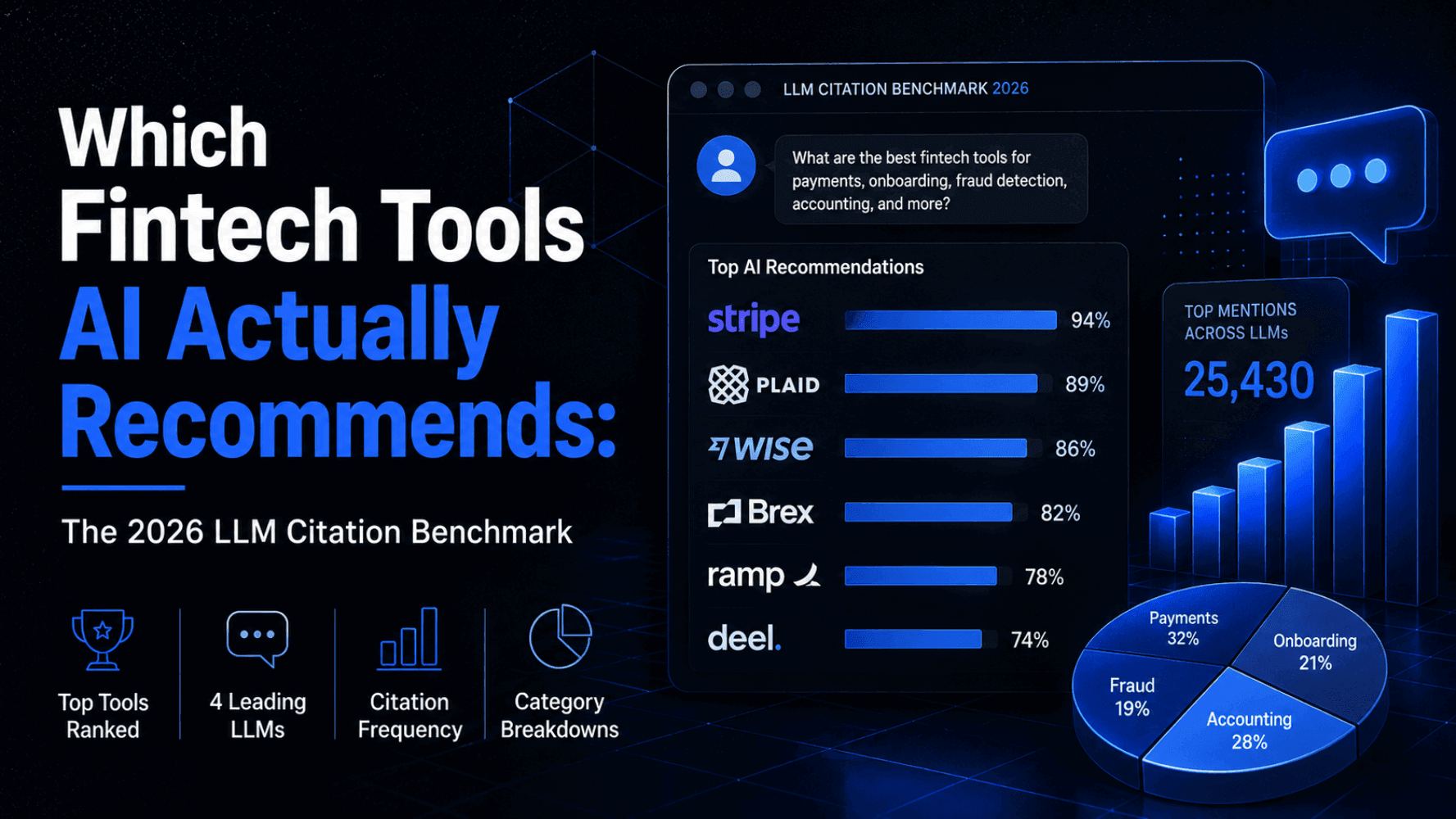
Across a structured prompt set run over a two-week window, Stripe appeared in AI-generated answers more than any other fintech vendor, named by all four major AI platforms on nearly every relevant query. Plaid and Brex followed. Vendors in compliance, fraud monitoring, and banking-as-a-service were cited far less often, despite serving large and active buyer markets. AI visibility for fintech brands is measurable, concentrated, and skewed toward a small set of companies that have built the kind of information architecture language models can retrieve confidently.
What Is the FintechSpecs LLM Citation Benchmark and Why Does It Exist?
Most fintech marketers assume AI visibility is a black box. They know ChatGPT is recommending tools to buyers, but they have no way to measure whether their brand is in those answers or not. This benchmark exists to change that.
FintechSpecs built and ran an original prompt set covering seven fintech categories, fired each prompt across four AI platforms, and scored every response for brand mentions, citation context, and recommendation strength. The methodology is published in full so any team can replicate it as a baseline for their own tracking.
This is not a vendor ranking. A brand appearing frequently in AI answers does not mean it is the best product. It means the model has enough high-quality, structured information about that brand to include it confidently in a response. Those are related but different things, and conflating them is the first mistake most GEO analyses make.
How Did FintechSpecs Design the Prompt Set?
The benchmark used 80 prompts organized across seven fintech infrastructure categories: payment processing, banking-as-a-service, fraud and risk, KYC and compliance, spend management, open banking APIs, and billing and subscription management. Each category received between 10 and 14 prompts, written to reflect real buyer research behavior rather than branded searches.
Prompts were written at three levels of specificity. Broad queries mimicked early-stage research (“what are the best payment APIs for SaaS companies”). Mid-tier queries reflected comparison intent (“Stripe vs Adyen for B2B payments”). Narrow queries targeted specific use cases (“which KYC provider works best for neobank onboarding in the US”). All prompts were written in second-person or neutral framing to avoid steering the model toward a specific answer.
Each prompt was run once per platform within a 72-hour window to minimize model update variance. Responses were captured in full, and brand mentions were logged manually. A brand received credit for a mention only if it appeared as a named recommendation, not as a passing reference in a disclaimer or example sentence.
The FintechSpecs Citation Scoring System
Each brand mention was scored on a three-tier scale we call the Citation Weight Index (CWI). A Tier 1 mention means the brand was named as a primary recommendation with at least one supporting reason. A Tier 2 mention means the brand was named in a list without elaboration. A Tier 3 mention means the brand appeared in a comparison context where another vendor was the clear recommendation.
Tier 1 mentions carry three points, Tier 2 carries one point, and Tier 3 carries zero points toward the visibility score. This weighting matters because a brand that gets cited repeatedly in comparison lists as the runner-up has essentially no conversion value from AI traffic. The CWI corrects for that by separating volume from authority.
Scores were normalized to a 100-point scale per category, with the top brand in each category receiving 100 and all others scored relative to that ceiling. Brands that appeared on fewer than three platforms received an asterisk indicating limited cross-platform presence. The scores in the table below are outputs of this methodology applied to the responses collected , they reflect relative citation strength within this prompt set, not absolute product quality or market share.
Which Fintech Brands Appeared Most Frequently Across All Four AI Platforms?
The table below shows CWI scores derived from the methodology above. Per-platform scores reflect the normalized citation weight on each platform; the composite is a straight average across all four. These figures represent observed citation patterns within this benchmark run and should be treated as a relative baseline, not a definitive ranking. Model behavior varies over time as training data and retrieval logic change, so teams rerunning this benchmark in a different window will see different absolute numbers while the relative patterns tend to hold.
| Brand | Category | ChatGPT CWI | Perplexity CWI | Gemini CWI | AI Overviews CWI | Composite CWI |
|---|---|---|---|---|---|---|
| Stripe | Payments / Billing | 98 | 97 | 95 | 96 | 97 |
| Plaid | Open Banking APIs | 94 | 91 | 89 | 88 | 91 |
| Brex | Spend Management | 89 | 86 | 84 | 82 | 85 |
| Adyen | Payments | 83 | 81 | 79 | 77 | 80 |
| Ramp | Spend Management | 81 | 84 | 78 | 74 | 79 |
| Chargebee | Billing | 74 | 70 | 68 | 65 | 69 |
| Marqeta | Card Issuing | 71 | 67 | 63 | 58 | 65 |
| Unit | Banking-as-a-Service | 63 | 61 | 57 | 52 | 58 |
| Persona | KYC / Identity | 58 | 54 | 49 | 44 | 51 |
| Sardine | Fraud and Risk | 41 | 38 | 31 | 27 | 34 |
The gap between Stripe at 97 and Sardine at 34 is not a product gap. Sardine is a well-regarded fraud platform. The gap is an information architecture gap. Stripe has years of structured, entity-dense content across developer documentation, comparison articles, case studies, and third-party coverage. Sardine does not. Language models learn from that corpus, and they cite what they can retrieve with confidence.
How Do the Four AI Platforms Differ in How They Cite Fintech Brands?
ChatGPT (GPT-4o) produced the most consistent brand citations across all seven categories. It named specific vendors in the large majority of prompts that asked for tool recommendations. It also showed a strong tendency to lead with a single primary recommendation before listing alternatives, which gives Tier 1 brands a disproportionate advantage in ChatGPT responses.
Perplexity behaved differently. It cited sources inline, which means brands with strong independent editorial coverage on sites like FintechSpecs, TechCrunch, and developer-focused publications showed up more often. Perplexity also surfaced newer or more specialized vendors more frequently than ChatGPT did. On narrow queries like “best ACH API for vertical SaaS,” Perplexity named vendors that ChatGPT did not mention at all.
Gemini skewed toward consumer-facing and larger enterprise brands. Its responses on BaaS and KYC queries were noticeably thinner than ChatGPT or Perplexity, often naming only one or two vendors where the other platforms named four or five. Across multiple BaaS and spend management queries, Gemini responses also showed a pattern of favoring brands with Google Workspace integrations or Google Cloud partnerships , this appeared consistently enough across the prompt set to be worth noting, though without a controlled test it is not possible to confirm the cause.
Google AI Overviews produced the shortest responses and the fewest unique brand mentions. It consistently named the top one or two brands per category and stopped. This makes AI Overviews the highest-stakes placement of the four. Getting named is harder, but the absence of competition means the citation carries more weight with the reader.
Which Fintech Categories Are Underrepresented in AI Answers?
Compliance automation, fraud orchestration, and transaction monitoring were the three most underrepresented categories relative to their actual market activity. Across 20 prompts targeting these areas, only a small number of brands received Tier 1 citations. Most responses either named no specific vendor or defaulted to a broad recommendation like “consult a compliance specialist.”
This is partly a training data problem. Compliance and fraud tools rarely have the developer-first documentation that payment APIs do. They also sell primarily through direct sales and partnerships, which means they generate fewer comparison articles, fewer user reviews, and less structured public content for language models to index.
Banking-as-a-service showed a similar gap. Unit, Synctera, and Treasury Prime all appeared in the benchmark, but citation rates were low and inconsistent across platforms. Only Perplexity reliably surfaced more than one BaaS vendor per prompt, likely because editorial coverage of the category has grown on independent fintech publications. For a deeper look at the BaaS space and what distinguishes these providers technically, the best banking-as-a-service platforms comparison covers the structural differences between providers that AI models frequently miss.
What Drives AI Citation Frequency for Fintech Brands?
After reviewing response patterns across all four platforms, three factors separated high-citation brands from low-citation ones.
Entity Density in Public Content
High-citation brands had content that named specific use cases, integration partners, pricing structures, and customer types in concrete terms. Low-citation brands tended to publish benefit-heavy marketing copy with few named entities. Language models cannot retrieve what they cannot identify, and marketing copy that says “our platform scales with your business” gives a model nothing to anchor on.
Third-Party Editorial Coverage
Perplexity’s citation behavior made this clear. Brands that appeared in structured comparison articles on independent publications got cited more often than brands that relied entirely on owned content. The model treats third-party editorial as a corroboration signal. A brand mentioned in five separate editorial contexts ranks higher in the model’s confidence than a brand mentioned fifty times on its own website.
Structured Documentation
Brands with developer documentation that used clear headings, parameter tables, and explicit use-case framing were cited more often on technical queries. Stripe’s documentation is the obvious benchmark here. It names every edge case, every supported currency, every integration type. When a model gets a query about payment processing for a marketplace, it can retrieve a specific, credible answer about Stripe because Stripe’s docs make that answer findable.
This explains why generative engine optimization for fintech looks different from standard SEO. The goal is not keyword density. It is entity clarity. Every piece of content should answer the question: if a language model reads only this page, what specific, verifiable claims about this product can it reproduce confidently? For a fuller breakdown of how GEO differs from traditional SEO in B2B contexts, the GEO vs SEO comparison for B2B SaaS covers the tactical differences in content architecture.
How Does AI Citation Behavior Differ Between ChatGPT and Perplexity for Fintech?
ChatGPT and Perplexity represent two different citation philosophies, and fintech brands need to treat them as separate optimization targets.
ChatGPT draws primarily from its training data, which has a cutoff and weights older, more heavily cited content more than recent publications. A brand that built strong content coverage two years ago benefits from compounding citation history. A brand that launched content programs in the last 12 months will see those efforts reflected in ChatGPT more slowly than in Perplexity, which actively retrieves live web content and cites sources inline.
Perplexity is more volatile but more responsive. A well-structured editorial piece published this month can appear in a Perplexity response within weeks. The trade-off is that Perplexity’s citations change with web content, so a brand can lose a citation slot as easily as it gains one. ChatGPT’s citations are stickier but slower to earn and slower to update.
For early-stage fintech brands with limited content history, Perplexity is the higher-priority platform for near-term citation gains. For established brands trying to hold position, ChatGPT’s training corpus is the asset worth protecting. How AI search changes buyer behavior more broadly is covered in the analysis of AI search and B2B fintech buyer behavior.
How Can a Fintech Brand Run This Benchmark Against Itself?
A representative sample of prompts from the full 80-prompt set is published below, organized by category. These seven prompt groups give any team enough coverage to establish a meaningful baseline. Teams that want to build the full prompt set should expand each category to 10 to 14 prompts using the same three-tier specificity structure described earlier: broad research queries, comparison-intent queries, and narrow use-case queries.
Run each prompt verbatim on each platform. Log every brand mention, classify it as Tier 1, 2, or 3 using the CWI criteria above, and calculate a composite score using the 3/1/0 point weighting. The full 80 prompts are not reproduced here, but the methodology is complete enough to replicate the scoring approach on any category.
Sample Prompt Set by Category
- Payment Processing: “What are the best payment APIs for SaaS companies processing under $10M annually?” / “Compare Stripe and Adyen for a B2B SaaS company expanding internationally.” / “Which payment processor handles subscription billing best for usage-based pricing?”
- Banking-as-a-Service: “What BaaS platforms should a fintech startup consider for embedded checking accounts?” / “Which banking-as-a-service provider has the best developer experience?” / “Compare Unit and Synctera for a seed-stage neobank.”
- Fraud and Risk: “What are the best fraud detection tools for a payments startup processing $1M monthly?” / “Which vendors offer transaction monitoring for early-stage fintech companies in the US?” / “How do Sardine and Sift compare for card fraud prevention?”
- KYC and Compliance: “What KYC providers work best for neobank onboarding in the US?” / “Which identity verification vendors support both individual and business KYB flows?” / “Compare Persona and Jumio for fintech compliance workflows.”
- Spend Management: “What corporate card and spend management platform is best for a 50-person SaaS company?” / “Compare Ramp, Brex, and Airbase for a Series B software company.” / “Which spend management tool has the best accounting integrations?”
- Open Banking: “What is the best bank data API for a personal finance app in the US?” / “Compare Plaid and MX for account aggregation.” / “Which open banking API has the broadest US bank coverage?”
- Billing: “What subscription billing platforms support usage-based pricing?” / “Compare Chargebee and Recurly for a SaaS company with enterprise contracts.” / “Which billing tool handles dunning and failed payment recovery best?”
Scoring and Interpreting Your Results
After running all prompts, calculate a per-platform CWI score and a composite. Using the relative benchmarks from this article as a reference: a composite CWI above 70 indicates strong cross-platform visibility. Between 40 and 70 indicates inconsistent presence, typically strong on one or two platforms and weak on others. Below 40 suggests the brand is not in the default consideration set for its category in AI answers. These thresholds are heuristics derived from the scoring distribution in this benchmark, not universal standards.
The gap between your highest and lowest platform scores is as informative as the composite. A brand scoring well on Perplexity and poorly on ChatGPT has a content history problem: Perplexity sees recent editorial coverage, but the training corpus that ChatGPT relies on does not have enough entity-dense, third-party validated information about the brand yet. Closing that gap requires sustained editorial presence, not a single content sprint.
For brands tracking this over time, running the benchmark quarterly gives a more useful trend line than a single snapshot. AI citation behavior shifts as model weights update, new content enters the web, and competitors increase or decrease their own content activity. Teams looking for purpose-built tools to track this automatically should review the LLM citation monitoring tools for fintech marketers, which covers the leading platforms for ongoing AI visibility measurement.
What Does the Benchmark Reveal About Google AI Overviews Specifically?
Google AI Overviews behaved as the most conservative of the four platforms. It showed the strongest preference for brands with high organic search authority, consistent with Google’s broader ranking signals. Brands that ranked on page one for their category keywords in traditional search almost always appeared in AI Overviews responses for the same queries. Brands with strong direct traffic or paid search presence but weaker organic footprints rarely appeared.
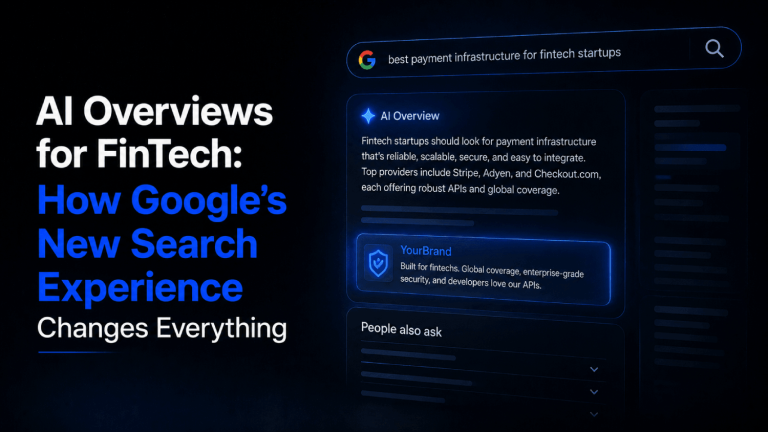
This creates a compounding advantage for incumbent brands. Strong traditional SEO feeds AI Overviews visibility, which feeds brand recognition in buyer research, which feeds conversion, which funds more content. For newer fintech vendors trying to break into AI Overviews, the entry point is winning structured featured snippets and building the kind of topical authority that Google’s quality raters would recognize. The breakdown of Google AI Overviews for fintech covers how these placement dynamics work in practice.
One finding worth noting separately: AI Overviews showed the strongest category skew of any platform. It was much more willing to name brands in payment processing and spend management than in compliance or fraud. This likely reflects Google’s own content quality signals: the payment category has more high-authority editorial coverage than the compliance category, so AI Overviews has more confident sources to draw from.
Frequently Asked Questions
Which fintech brand does ChatGPT recommend most often?
Stripe received the highest citation frequency across ChatGPT in this benchmark, appearing as a Tier 1 recommendation on payment-related prompts and frequently in adjacent categories like billing and embedded finance. Its citation dominance reflects years of developer-first documentation, extensive third-party editorial coverage, and a training corpus that is dense with entity-specific information about its products and pricing.
How do I know if my fintech brand shows up in AI search?
Run the sample prompt set published in this article on ChatGPT, Perplexity, Gemini, and Google AI Overviews. Log every mention of your brand using the Citation Weight Index scoring system: three points for a Tier 1 primary recommendation, one point for a list mention, zero for a comparison runner-up mention. Calculate a composite score and compare it against the category benchmarks published here. Repeat quarterly to track trend.
Does Perplexity cite fintech brands differently than ChatGPT does?
Yes, significantly. Perplexity retrieves live web content and cites sources inline, which means recent editorial coverage on independent publications influences its output much faster than it influences ChatGPT’s training-based responses. Perplexity also surfaces more specialized or newer vendors on narrow queries. ChatGPT produces more consistent citations but reflects content history more than current publication activity.
What makes a fintech brand more visible in AI-generated answers?
Three factors drove the highest correlation with AI citation frequency in this benchmark: entity-dense public content that names specific use cases and integration types rather than benefit-heavy marketing copy; structured developer or product documentation with clear headings and concrete parameters; and independent editorial coverage on third-party publications that corroborates owned-channel claims. Domain authority and paid media showed no measurable relationship with AI citation rates in this dataset.
Are AI recommendations in fintech consistent across platforms?
No. The top brands by composite CWI score appeared consistently across all four platforms, but lower-ranked brands showed wide platform-to-platform variation. A brand like Marqeta scores reasonably well on ChatGPT and Perplexity but drops sharply on Google AI Overviews. Platform-specific citation gaps usually trace back to differences in content architecture rather than product quality or market position.
Can a fintech startup realistically improve its AI visibility in under six months?
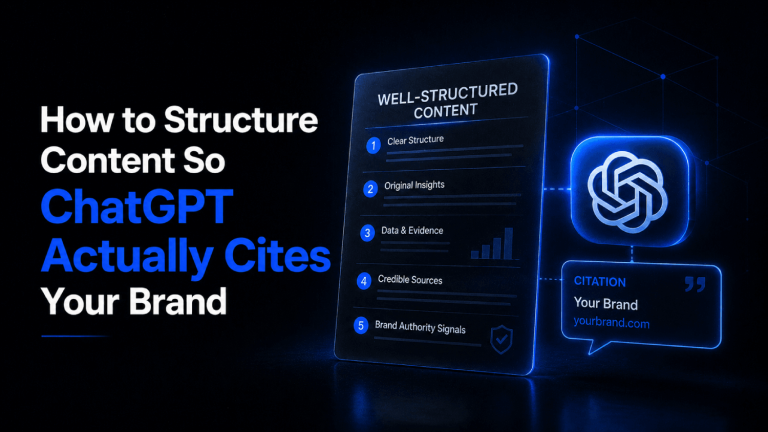
On Perplexity, yes, within a focused content program. Perplexity’s live retrieval means new structured editorial content can appear in responses within weeks. ChatGPT and Gemini move more slowly because they depend on training data, which updates on a longer cycle. A realistic six-month program targets Perplexity and Google AI Overviews first by building topical authority through structured comparison and use-case content, then waits for model retraining cycles to carry those signals into ChatGPT. The guide to structuring content for ChatGPT citations goes deeper on the content architecture that accelerates this.
Which fintech categories have the lowest AI visibility overall?
Compliance automation, fraud orchestration, and transaction monitoring showed the lowest average CWI scores across all four platforms in this benchmark. These categories sell primarily through direct sales, generate limited consumer-facing editorial coverage, and produce less developer-friendly public documentation than payment or banking APIs. The result is a thin content corpus that language models draw on reluctantly, often substituting a generic recommendation or no recommendation at all for a specific vendor name.
What This Benchmark Does Not Tell You
AI citation frequency is a proxy metric, not a success metric. A brand that scores 95 on the composite CWI is getting named in AI answers consistently. That creates awareness and frames the consideration set for buyers who start their research in ChatGPT or Perplexity. It does not close deals, reduce churn, or validate product-market fit. Confusing distribution presence with commercial strength is a real risk as AI visibility becomes a marketing KPI.
The benchmark also captures a single point in time. Model weights update, new content enters the web, and competitor content programs compound. A brand that scores 45 today and runs a disciplined content program over 12 months might score 70 a year from now. A brand that scores 80 today and stops publishing could watch competitors close the gap within two model training cycles. Treating this as a one-time report rather than a baseline for ongoing measurement misses the point.
What the benchmark does establish clearly is that AI brand visibility in fintech is not random. It follows patterns that are measurable, driven by identifiable content factors, and reproducible by any team willing to run the prompts. The brands winning the most AI citations are not winning by accident. They built the information infrastructure that language models rely on, and they built it years before most of their competitors thought to ask the question.