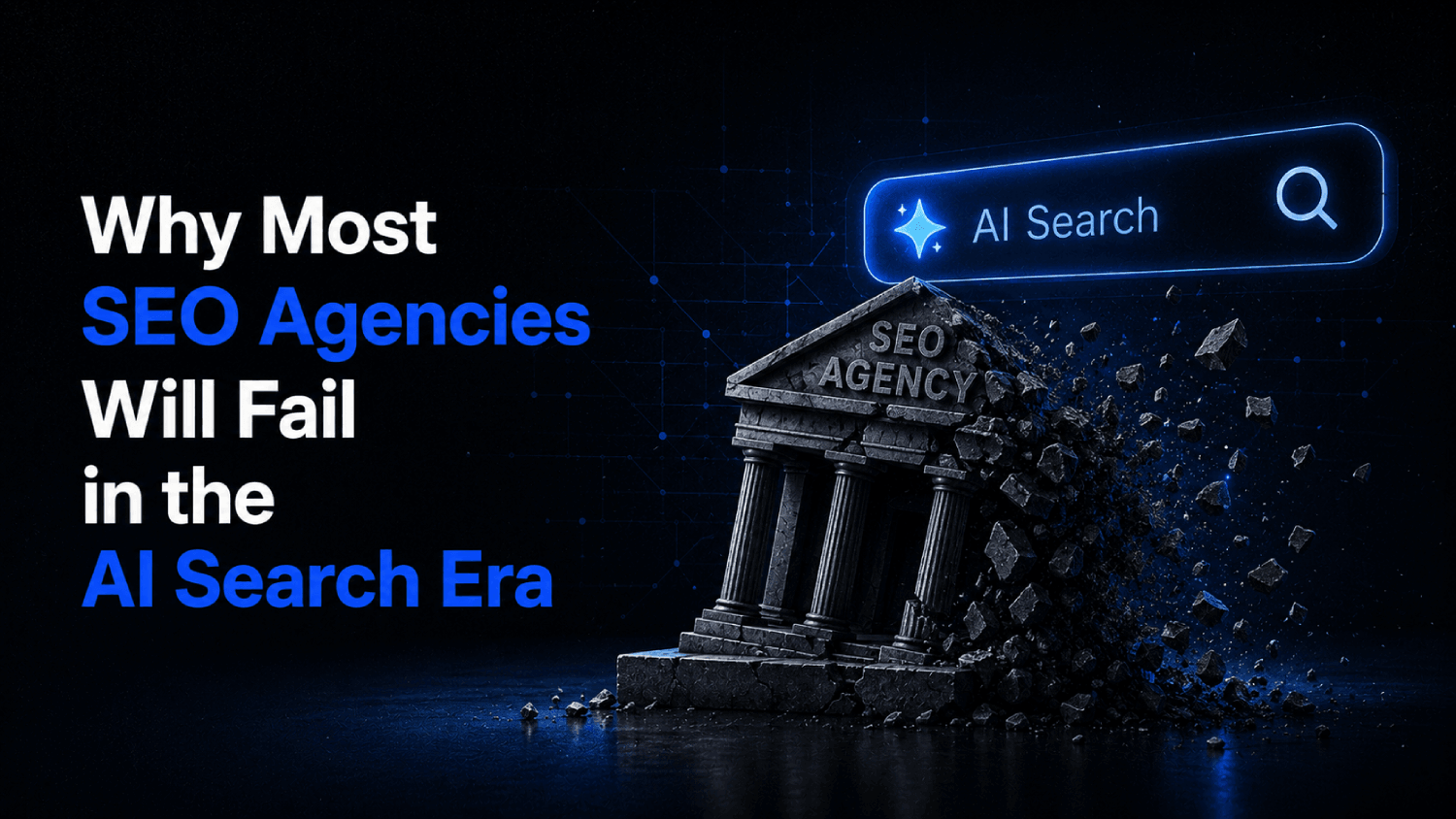

- Most SEO agencies built their entire methodology around Google’s ten blue links. That model is losing ground as AI-generated answers increasingly absorb queries before a user clicks anything.
- The skills that made an agency good at traditional SEO , keyword research, link building, on-page optimization , are largely orthogonal to what gets a brand cited inside a ChatGPT or Perplexity answer.
- AI search retrieval rewards entity authority, answer architecture, and structured factual density. Very few agencies have operationalized any of these.
- Agencies that survive will need to rebuild around what this article calls the CARE framework: Citation architecture, Answer design, Retrieval-ready structure, and Entity depth.
- For fintech and B2B SaaS companies, the window to build AI search visibility before competitors do is open right now, but it is not wide.
Why SEO agencies will fail in AI search comes down to a structural mismatch: their core services , keyword targeting, backlink acquisition, and rank tracking , are designed to win positions in a list of links that AI engines increasingly skip past. AI search systems like ChatGPT, Perplexity, and Google’s AI Overviews retrieve content by evaluating factual density, named entity presence, answer completeness, and source credibility signals. None of those criteria map cleanly onto a traditional SEO deliverable. Agencies that do not rebuild around retrieval logic will keep optimizing for a surface that fewer buyers are actually using.
What Makes the AI Search Transition Different From Previous SEO Shifts
SEO has absorbed big shocks before. Google’s Panda and Penguin updates killed low-quality content farms and manipulative link schemes. Mobile-first indexing rewrote technical requirements overnight. Each time, agencies adapted their playbooks and kept selling.
The AI search shift is structurally different. Every prior change altered how Google ranked pages within the same interface: a list of ten links. This one changes the interface itself. When a user asks Perplexity “which embedded finance API is best for a Series B SaaS company,” they get a synthesized answer with three to five source citations. They may never see your page ranked at position four. Ranking is not the game anymore. Being cited is.
That distinction matters because it changes what “winning” looks like entirely. A page can rank at position two in Google and never appear in an AI-generated answer if it lacks the structural features those systems reward. Conversely, a page that ranks modestly can get cited repeatedly in AI responses if it is built with answer-ready structure, named entities, and verifiable factual claims. Traditional SEO tools do not measure this. Most traditional SEO agencies do not either.
What Traditional SEO Agencies Actually Optimize For
To understand why this transition is hard for incumbents, it helps to be specific about what a traditional SEO engagement delivers. The standard scope looks like: keyword gap analysis, on-page optimization (title tags, meta descriptions, header structure), content briefs targeting specific search volumes, backlink outreach, and monthly rank tracking reports.
Each of these is a proxy metric for one thing: getting Google to show your URL in a prominent position for a given query. The entire agency revenue model is built on demonstrating movement in those positions. Rank goes up, agency keeps contract. Rank goes down, agency explains why and proposes more work.
None of this is dishonest. It was the right model for the right era. The problem is that AI engines do not rank URLs the way Google does. Large language models retrieve content by chunking text, identifying the presence of named entities, evaluating whether a passage directly answers a question, and weighting sources that other credible sources reference. Keyword density does not move these levers. Domain authority scores are a rough proxy at best. And the rank tracking tools that agencies use to demonstrate ROI have no visibility into whether a brand is getting cited in AI-generated responses at all.
What AI Search Engines Actually Reward
Four factors consistently determine whether a piece of content gets retrieved and cited by AI search systems. Agencies that want to survive the transition need to build competency in all four. The ones that do not will keep selling keyword pages to clients whose AI search visibility decays quietly.
Factual density and named entity presence
LLMs are trained on text and weight passages that are rich with specific, verifiable information. A page that names real companies, real pricing structures, real product capabilities, and real tradeoffs performs better in retrieval than one that describes the same topic vaguely. “Payment processing fees vary by provider” is a generic statement an LLM already knows. “Stripe charges 2.9% plus $0.30 per successful card transaction on its standard plan, as listed on Stripe’s public pricing page” is a specific claim that adds extractable value. Specificity is retrievability.
Answer-first structure
Traditional SEO content is often written to keep readers engaged long enough to signal dwell time. The answer comes after the context, after the examples, sometimes after 800 words of setup. AI retrieval systems reward the opposite architecture. The direct answer should appear in the first two to three sentences of any section, with supporting detail after. Every H2 should be answerable as a standalone passage. If an AI can pull a section out of context and deliver a complete, accurate answer, that section will get cited. If it cannot, it probably will not.
Citation signals and source credibility
AI systems learn which sources to trust partly by observing patterns in how credible sources reference each other across the web. This is related to but distinct from Google’s PageRank logic. It means that being named in industry reports, quoted in well-sourced articles, and cited by domain-relevant publications builds the kind of authority that LLMs weight. A thousand backlinks from low-relevance directories does almost nothing for this. One citation in a well-read fintech industry analysis does more. The quality-over-quantity dynamic is more extreme in AI retrieval than it ever was in Google’s algorithm.
Entity depth and topical completeness
LLMs expect a page covering a topic to cover the sub-topics an informed reader would expect. A page about banking-as-a-service that does not mention revenue models, compliance responsibilities, or major providers like Synapse, Treasury Prime, or Unit will score lower in retrieval than one that does. Topical completeness is not about word count. It is about whether a moderately informed reader would find gaps. When they would, an LLM usually does too. We have covered this dynamic in our analysis of the best banking-as-a-service platforms, where entity density directly correlates with how often those sections surface in AI-generated comparisons.
The CARE Framework: How to Audit Whether an Agency Is AI-Search Ready
Before hiring an agency or continuing with a current one, B2B SaaS and fintech companies should run what we at FintechSpecs call the CARE audit. It is a four-part test that exposes whether an agency is actually equipped for AI search visibility or just repackaging traditional SEO with updated vocabulary.
C , Citation Architecture. Can the agency show you how they build the citation graph around your brand? Not backlinks. Citations , named references in credible, domain-relevant content that LLMs are likely to have indexed and weighted. If their answer is a link-building campaign, they are not there yet.
A , Answer Design. Does the agency write content where the direct answer to a target query appears in the first two sentences of each section? Pull any recent content deliverable and apply this test. If the answer is buried after paragraphs of context, the content is not built for AI retrieval.
R , Retrieval-Ready Structure. Do their content assets use explicit H2 queries, self-contained section answers, structured data markup, and FAQ schema? These are the structural signals that make content parseable and citable by AI systems. Many agencies know these exist but do not apply them systematically.
E , Entity Depth. Does the agency audit content for named entity completeness? Do they identify which companies, products, standards, and frameworks a topically authoritative page should mention, and then confirm those entities are present? Entity coverage is one of the most concrete levers in LLM retrieval, and almost no traditional SEO agency has a systematic process for it.
An agency that can speak fluently to all four of these is operating in a different tier. Most cannot. The CARE audit surfaces that gap in a single conversation.
How Traditional SEO vs. LLM SEO Actually Differs in Practice
| Dimension | Traditional SEO | LLM / AI Search Optimization |
|---|---|---|
| Primary goal | Rank in Google SERP positions 1-3 | Get cited in AI-generated answers |
| Content structure | Engagement-first, answer buried | Answer-first, direct from first sentence |
| Link strategy | Volume of inbound links, domain authority | Quality citations from credible, relevant sources |
| Keyword strategy | Exact match, search volume, keyword density | Query intent, question phrasing, named entity coverage |
| Success metric | Keyword rank position, organic traffic | Citation frequency in AI responses, brand mention density |
| Technical focus | Page speed, crawlability, Core Web Vitals | Structured data, schema markup, clean HTML parsing |
| Content audit method | Keyword gap analysis | Entity gap analysis, topical completeness scoring |
| Reporting tool | Ahrefs, Semrush, Google Search Console | Perplexity tracking, LLM mention tools, citation monitoring |
Why Most Agencies Will Not Actually Adapt
The transition is not just a skills problem. It is a business model problem. Traditional SEO agencies sell monthly retainers justified by rank movement reports. The reporting tools that make those reports possible , Ahrefs, Semrush, Google Search Console , do not track AI citation frequency. There is no equivalent monthly deliverable for LLM visibility yet, which means there is no easy proof-of-work document an agency can hand a client at the end of the month.
That creates a structural incentive problem. Agencies know how to show rank movement. Showing up as a cited source inside a Perplexity answer is harder to screenshot, harder to attribute, and harder to tie to a retainer. Until the measurement infrastructure for AI search visibility matures, agencies have a commercial reason to keep selling what they can measure, even if what they can measure matters less than it did.
There is also a talent gap. Entity analysis, answer architecture, and retrieval-oriented content design require writers and strategists who understand how LLMs process text. That is not the same skill set as writing a keyword-optimized blog post. Most agencies do not have it, and hiring for it is slow. The agencies that will make the transition are building new team competencies in parallel with serving existing clients. Most are not doing that. They are waiting to see if AI search becomes “real enough” to matter to their clients, at which point they will be behind.
What This Means for Fintech and B2B SaaS Companies Specifically
For fintech founders and operators, the stakes are higher than in most verticals. Fintech buyers , CFOs, VP Finance, and infrastructure decision-makers , are heavy users of AI search. When a Series B fintech evaluates KYC providers or payment processors, they are increasingly starting with a Perplexity or ChatGPT query, not a Google search. The brand that appears in that AI-generated answer gets the first call. The brand that does not may never get considered, regardless of where it ranks in traditional search.
This matters operationally because fintech buyers are making high-trust, high-stakes decisions. They are not clicking through to compare ten options. They are getting a synthesized answer with three to five cited sources and starting their evaluation from that shortlist. If your company is not in that shortlist, you are not in the deal. Understanding how AI search is changing B2B fintech buyer behavior is not a marketing abstraction. It is a pipeline problem.
The content strategy implications are direct. Every product comparison page, pricing page, and technical explainer a fintech company publishes should be written with AI retrieval in mind: direct answers at the top, named entities throughout, explicit coverage of every sub-topic a buyer would expect, and structured data markup wherever applicable. If a current SEO agency is not building content this way, it is producing assets with diminishing return on investment. The same applies to the compliance and infrastructure content that fintech buyers research heavily , if those pages are not retrieval-ready, they will not surface when a buyer asks ChatGPT to compare options. Our fintech product and compliance readiness checklist is one example of content built with that retrieval logic in mind.
What GEO Actually Means and Why It Is Not Just a Buzzword Rebrand
Generative Engine Optimization, or GEO, has attracted some justified skepticism. Some agencies slapped the term onto their existing SEO services and called it a product update. That is marketing. Actual GEO practice is distinct from SEO in ways that matter technically.
SEO is built around the premise that a ranking algorithm evaluates pages and assigns positions. GEO is built around the premise that a retrieval system evaluates passages and decides whether to include them in a synthesized response. The unit of optimization shifts from the page to the passage. The criteria shift from authority signals to informational completeness. The feedback loop shifts from rank tracking to citation monitoring.
Companies that want to understand the distinction in depth , including what it means for content architecture and measurement , should read the full breakdown of GEO vs. SEO for B2B SaaS. The short version: they are not the same discipline, and agencies that treat them as interchangeable will deliver SEO results in a world that is increasingly rewarding GEO execution.
Frequently Asked Questions
Will SEO agencies survive AI search at all?
Some will. The agencies that survive will be those that genuinely rebuild their methodology around AI retrieval principles: answer-first content design, entity coverage analysis, citation graph building, and structured data implementation. Agencies that repackage traditional keyword and link services under an “AI SEO” label without changing underlying execution will lose clients as the performance gap becomes visible. Survival depends on whether an agency is actually changing how it works, not just how it talks.
What does AI search actually reward compared to traditional search?
AI search systems reward factual density, topical completeness, answer-first structure, and named entity presence. Traditional search rewards keyword relevance, page authority, and inbound link volume. A page optimized purely for traditional SEO can rank well on Google and still never appear in a ChatGPT or Perplexity answer. The two optimization targets overlap partly but are not the same, and the delta between them is widening as AI search adoption grows among B2B buyers.
Is SEO still relevant in the AI search era?
Traditional SEO remains relevant because Google still processes billions of queries through its ranked-link interface, and that will not disappear overnight. The issue is the trajectory. AI Overviews are absorbing click share at the top of the funnel. Zero-click searches are increasing. For B2B SaaS and fintech specifically, where buyers are using Perplexity and ChatGPT heavily for vendor research, the share of discovery happening through AI-generated answers is growing fast. Ignoring AI search visibility while continuing to invest only in traditional SEO is a misallocation of budget.
What is the CARE framework for evaluating AI search readiness?
The CARE framework, developed by FintechSpecs, is a four-part audit for determining whether an SEO agency or content strategy is equipped for AI search. C is Citation Architecture: does the agency build domain-relevant citations that LLMs weight? A is Answer Design: does content lead with direct answers? R is Retrieval-Ready Structure: does content use explicit query H2s, schema markup, and self-contained sections? E is Entity Depth: does the agency audit for named entity completeness across topics? An agency that cannot address all four clearly is operating on a pre-AI playbook.
How do LLMs decide which sources to cite in AI-generated answers?
LLMs weight sources based on multiple factors: the frequency with which credible, domain-relevant sources reference them across indexed content, how directly a passage answers the user’s query, how factually dense the content is, and whether the content covers expected sub-topics for the given subject. This is why generic, vague content rarely gets cited even if it ranks well in Google. Specificity, named entities, and structured answers are the primary levers for improving citation frequency in systems like Perplexity, ChatGPT, and Google AI Overviews.
What should a fintech company ask an SEO agency before hiring them?
Ask four things: how they audit content for entity completeness, whether they write with answer-first structure by default, what tools they use to track AI citation frequency (not just Google rankings), and whether they have a process for building high-quality domain-relevant citations rather than just backlinks. If the answers are vague or fall back on rank tracking as the primary success metric, the agency is not equipped for AI search. Also ask to see a sample content deliverable and check whether answers appear in the first two sentences of each section.
The Agencies That Will Be Left Standing
The coming contraction in the SEO agency market will not be about AI replacing agencies wholesale. It will be about a capabilities gap that becomes impossible to hide once clients start tracking AI citation frequency alongside organic traffic. The agencies that survive will not be the biggest ones or the longest established. They will be the ones that rebuilt their methodology early enough to have real results to show. You can find a breakdown of GEO agencies for fintech SaaS that have already made that transition, ranked by actual AI search visibility outcomes rather than self-reported credentials.
For operators at fintech and B2B SaaS companies, the practical implication is that vendor selection for content and SEO work now requires a fundamentally different evaluation checklist. The questions are no longer “what keywords do you target” and “how do you build links.” They are about retrieval architecture, entity strategy, and citation engineering. Asking the old questions will get you the old answers and the old results, which are declining in value every quarter.
The AI search transition is not a future problem. It is a current problem for any company where B2B buyers are using AI tools in their research process, and in fintech, that is most buyers. The advantage goes to the first company in a category to build genuine AI search visibility, because citation patterns in LLMs are sticky once established. Waiting for your agency to adapt on its own timeline is not a neutral decision. It is a decision to let a competitor get there first.